Ground Source Heat Pump Systems: Design and Installation
By Housey · Last reviewed 11th of May 2026
Ground Source Heat Pump Systems: Design and Installation
Ground source heat pumps (GSHPs) extract low-grade heat stored in the earth and upgrade it to useful space heating and hot water — an approach that suits a growing number of UK homes as energy costs rise and decarbonisation targets tighten. They arise most often when a homeowner is planning a significant renovation, building a new home, or switching away from oil or LPG. The decisions made at design stage — loop type, system size, and heat emitter compatibility — have long-term consequences for running costs and efficiency, so getting the specification right matters as much as the installation itself.
Key points
- The Boiler Upgrade Scheme (BUS) offers a £7,500 grant for ground source heat pumps installed by MCS-certified contractors on eligible properties in England and Wales.
- A heat loss calculation to BS EN 12831 must be completed before sizing a GSHP; an undersized system will underperform and may void MCS certification.
- Horizontal ground loops typically require 1.5–2 times the heated floor area in accessible, unshaded land; vertical boreholes are compact but usually require depths of 50–120 m per borehole.
- Ground source heat pumps typically achieve a Seasonal Coefficient of Performance (SCOP) of 3.5–4.5, compared with around 2.5–3.5 for most air source models in UK winter conditions.
- Vertical borehole installations in England may require a permit from the Environment Agency under the Environmental Permitting Regulations 2016, particularly near groundwater source protection zones.
How a ground source heat pump works
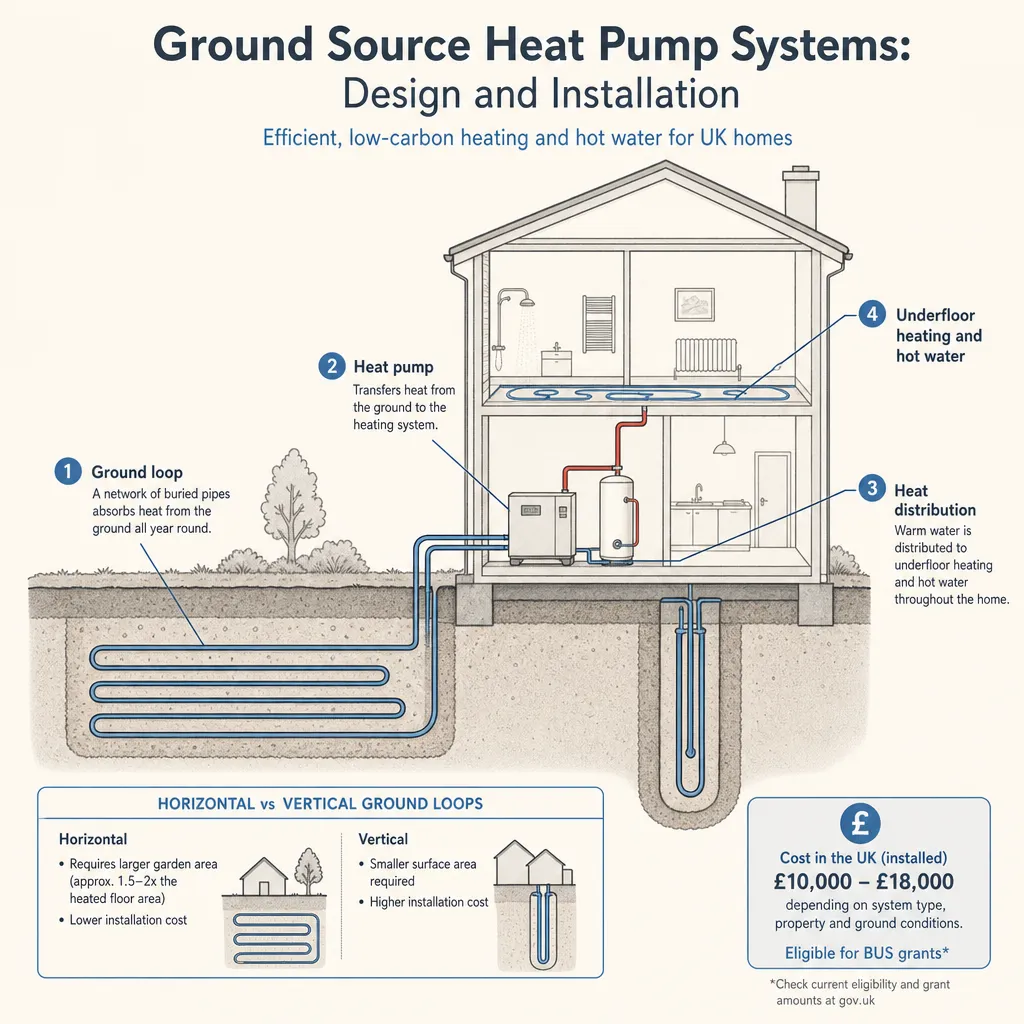
A GSHP system has three main components: a ground loop (buried pipework or borehole), a heat pump unit, and the heat distribution system inside the property.
The ground loop circulates a water–antifreeze mixture that absorbs heat from the ground. This heat is transferred to a refrigerant circuit inside the heat pump, where a compressor raises the temperature to a level suitable for space heating (typically 35–55 °C) or domestic hot water. Unlike air source heat pumps, ground temperatures in the UK remain relatively stable at 8–13 °C year-round below about 1.5 m depth, which gives GSHPs a consistent efficiency advantage in colder months.
Heat is distributed through the property via underfloor heating, low-temperature radiators, or a combination of both. Existing high-temperature radiators sized for a gas boiler are usually incompatible without replacement or upsizing to deliver adequate output at lower flow temperatures.
Horizontal versus vertical ground loop systems
Choosing between a horizontal loop and a vertical borehole is primarily a question of available land and ground conditions.
Feature | Horizontal ground loop | Vertical borehole system |
|---|---|---|
Land required | High — typically 1.5–2× heated floor area | Low — 1–3 boreholes, small surface footprint |
Installation disruption | Significant — trenches 1–2 m deep across a large area | Minimal surface area; drilling rig access needed |
Typical depth | 1–1.5 m (frost-free level) | 50–120 m per borehole |
Best for | Rural properties with open land; new builds | Smaller plots; retrofit; urban properties |
Indicative ground works cost | Lower upfront | Higher drilling cost (£8,000–£15,000+ depending on depth and geology) |
Environment Agency permit | Not usually required | May be required near groundwater source protection zones |
Ground suitability notes | Soil thermal conductivity matters; avoid rock or very dry sandy soils | Geology assessment usually needed; unsuitable in some karst or fractured rock areas |
Indicative UK costs, last reviewed 2026-05-11. Costs vary by region, ground conditions, and system size. Always obtain at least three quotes.
A geothermal slinky loop is a variant of the horizontal system that coils the pipework to fit more heat collector into a smaller area — useful where land is limited but not restricted enough to justify a borehole.
Which system should you choose?
- Choose a horizontal loop if you have a large garden or field, the ground is not heavily landscaped, and you want to minimise drilling costs.
- Choose a vertical borehole if your plot is small, you cannot disturb existing gardens or driveways at scale, or building on clay or wet soil makes horizontal trenching impractical.
- Commission a soil or geotechnical survey if you are uncertain about ground conditions — thermal conductivity varies significantly between clay, sandy soil, and rock, and affects system sizing directly.
- Ask an MCS-certified heat pump designer to confirm suitability; they are required to use a recognised design method (BS EN 15450 or equivalent) before specifying loop length.
- Check Environment Agency groundwater maps or consult a hydrogeologist if you are in or near a Source Protection Zone before proceeding with boreholes.
System sizing and heat emitter compatibility
A GSHP must be sized to meet the calculated heat loss of the building — not approximated from floor area or previous boiler rating. Under MCS standards, the installer must carry out (or commission) a full heat loss assessment to BS EN 12831 before specifying system capacity.
Key sizing considerations:
- Fabric-first improvements first: roof insulation, wall insulation, and draught-proofing reduce peak heat demand and allow a smaller, more efficient heat pump.
- Flow temperature: GSHPs achieve their best SCOP at 35–45 °C. Underfloor heating works well at these temperatures. Existing radiators sized for 70–80 °C flow may need to be upsized by roughly 50–100% to deliver the same heat output at lower temperatures.
- Hot water cylinder: most GSHP systems require a dedicated unvented or vented cylinder of at least 200–300 litres; combi-style operation is not standard for ground source systems.
- Electrical supply: the heat pump and circulation pump draw 2–6 kW depending on capacity; a single-phase supply is usually adequate for residential systems, but confirm with your electrician.
Planning permission and building regulations
Most ground source heat pump installations in England and Wales are treated as permitted development under Schedule 2, Part 14 of the Town and Country Planning (General Permitted Development) (England) Order 2015 — provided the system is not on a listed building or in a site of special scientific interest, and no borehole is sited within 5 m of a building or highway.
Building Regulations approval is required under Part L (Conservation of Fuel and Power) and potentially Part P (Electrical Safety). In most cases, an MCS-certified installer can self-certify compliance, removing the need for a separate building control application — confirm this arrangement with your local authority before work begins. In Scotland and Northern Ireland, different planning and building control frameworks apply.
Boiler Upgrade Scheme and other incentives
The Boiler Upgrade Scheme (BUS), administered by Ofgem on behalf of DESNZ, provides a £7,500 grant towards ground source heat pump installations (as at May 2026). The grant is claimed by the MCS-certified installer on the homeowner's behalf — you do not receive cash directly.
Eligibility conditions include:
- Property located in England or Wales
- Existing fossil fuel heating system (or an air source heat pump being replaced)
- Valid EPC with no outstanding loft or cavity wall insulation recommendations (or documented evidence such insulation is not technically feasible)
- Installation by an MCS-certified contractor using an MCS-listed product
The scheme is open until March 2028 under current government commitments, though this is subject to change. Check the Ofgem BUS guidance for current terms at the time of applying.
Important limitations
This article provides general information about ground source heat pump systems based on publicly available guidance as at May 2026. Ground conditions, local planning policy, environmental constraints, and building-specific heat loss figures vary significantly between properties. Nothing here constitutes engineering advice, planning advice, or a specification for any individual installation.
An MCS-certified heat pump designer or installer should assess your property before any commitment. Grant conditions and scheme availability can change; always verify current eligibility with Ofgem and your installer at the time of appointment.
What to ask a qualified professional
Before instructing an MCS-certified GSHP installer or heat pump surveyor, ask:
- Have you carried out a full heat loss calculation to BS EN 12831 for this property?
- What ground loop type do you recommend for this plot, and why?
- Will you carry out (or subcontract) a ground investigation or thermal conductivity test?
- Is an Environment Agency permit needed for this installation?
- Are the existing heat emitters compatible with a low-temperature flow, and if not, what is the cost of upgrading them?
- Is the property eligible for the Boiler Upgrade Scheme, and will you handle the application on my behalf?
- What SCOP do you expect to achieve based on the local ground temperature and system design?
- Who will notify building control, and how will Part L compliance be documented?
When to get professional help
Always use a qualified professional for GSHP design and installation — system sizing, ground loop specification, and heat emitter compatibility all require engineering assessment. Contact a professional immediately if:
- A quote does not include a heat loss assessment or makes no mention of design calculations
- The installer is not listed on the MCS database
- There are signs of groundwater nearby (springs, boggy ground, proximity to a watercourse) without a hydrogeological assessment
- The property has no loft insulation or uninsulated solid walls — these should usually be addressed before heat pump installation to avoid oversizing
How Housey can help
Housey connects UK homeowners with MCS-certified professionals for heat pump surveys and pre-installation assessments. If you need an evaluation of your ground conditions before specifying a loop type, our network includes specialists in geotechnical and soil investigations who can confirm suitability and support the engineering design.
Frequently asked questions
Do I need planning permission for a ground source heat pump in England?
Most residential GSHP installations qualify as permitted development in England under Part 14 of the GPDO, so full planning permission is not usually needed. Exceptions include listed buildings, scheduled monuments, and sites of special scientific interest. Boreholes within 5 m of a building or highway may also fall outside permitted development. Always confirm with your local planning authority before work begins.
How long does a ground source heat pump last?
The heat pump unit typically has a design life of 20–25 years; the buried ground loop can last 50 years or more if correctly installed. Annual servicing by a qualified engineer helps maintain efficiency and identify refrigerant or circulation pump issues early. The loop itself has few moving parts and requires little ongoing maintenance once installed.
Can a ground source heat pump work in an older property?
Yes, but a fabric-first approach is usually recommended first. Older properties — Victorian terraces, solid-wall semis — often have higher heat loss, which may require a larger, more expensive system. Insulating walls, lofts, and floors before installation typically allows a smaller, more efficient heat pump to meet the same heat demand at lower running cost.
Is a ground source heat pump better than an air source heat pump?
GSHPs generally achieve a higher SCOP in UK conditions because ground temperatures are more stable in winter than outdoor air. However, installation costs are higher due to ground works or borehole drilling. Air source heat pumps are more widely installed in the UK owing to lower upfront cost and simpler installation requirements, making them suitable for many properties where land is limited.
What is MCS certification and why does it matter for heat pumps?
MCS (Microgeneration Certification Scheme) is the UK quality and standards framework for small-scale renewable energy. For ground source heat pumps, both the product and the installer must be MCS-certified to access the Boiler Upgrade Scheme grant and to self-certify Building Regulations compliance. Check the MCS installer database before appointing a contractor.
Sources and further reading
- Boiler Upgrade Scheme guidance — Ofgem
- Ground source heat pumps guidance — Energy Saving Trust
- Microgeneration Certification Scheme — MCS
- Environmental Permitting Regulations 2016 — legislation.gov.uk
- Building Regulations Approved Document L — GOV.UK
Useful next reads
 Energy & Retrofit
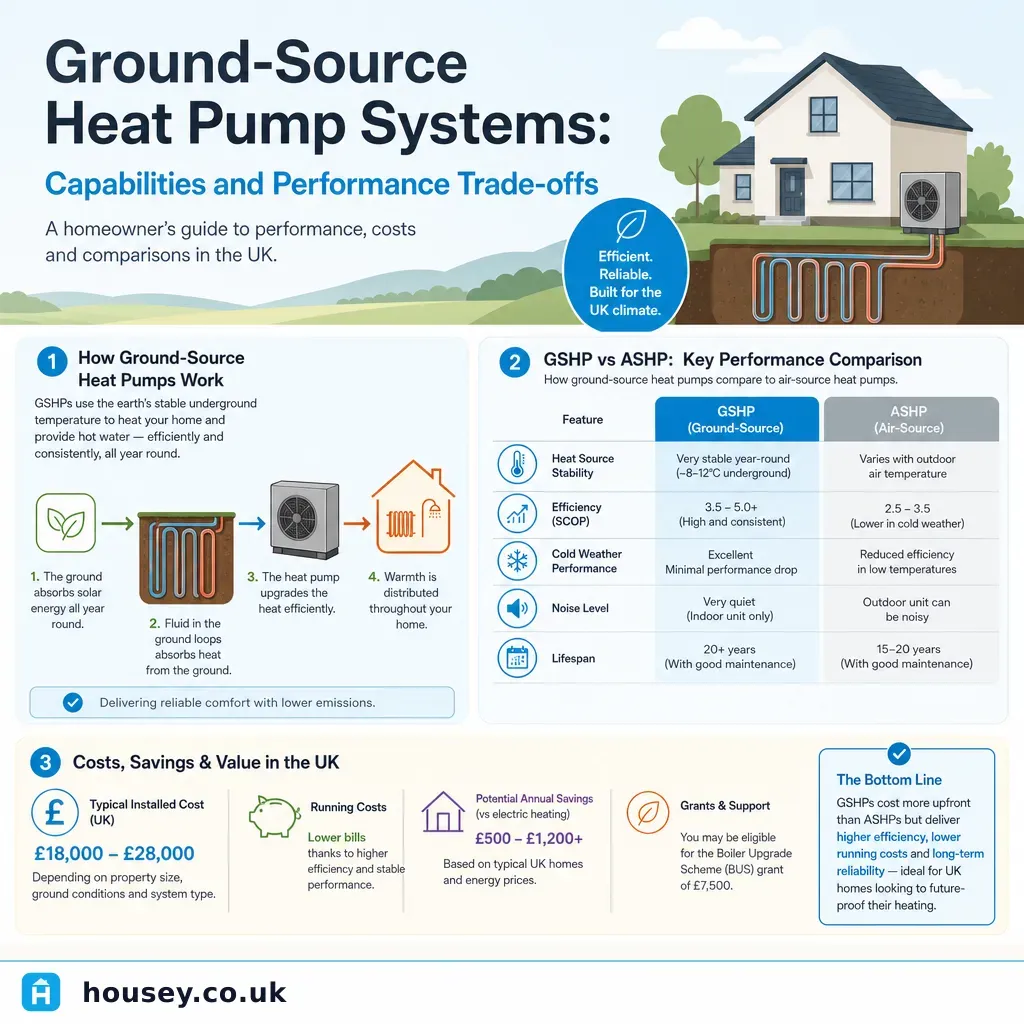
Ground-Source Heat Pump Systems: Capabilities and Performance Trade-offs
A ground-source heat pump extracts heat from the ground via buried loops, typically achieving a COP of 3.
 Energy & Retrofit
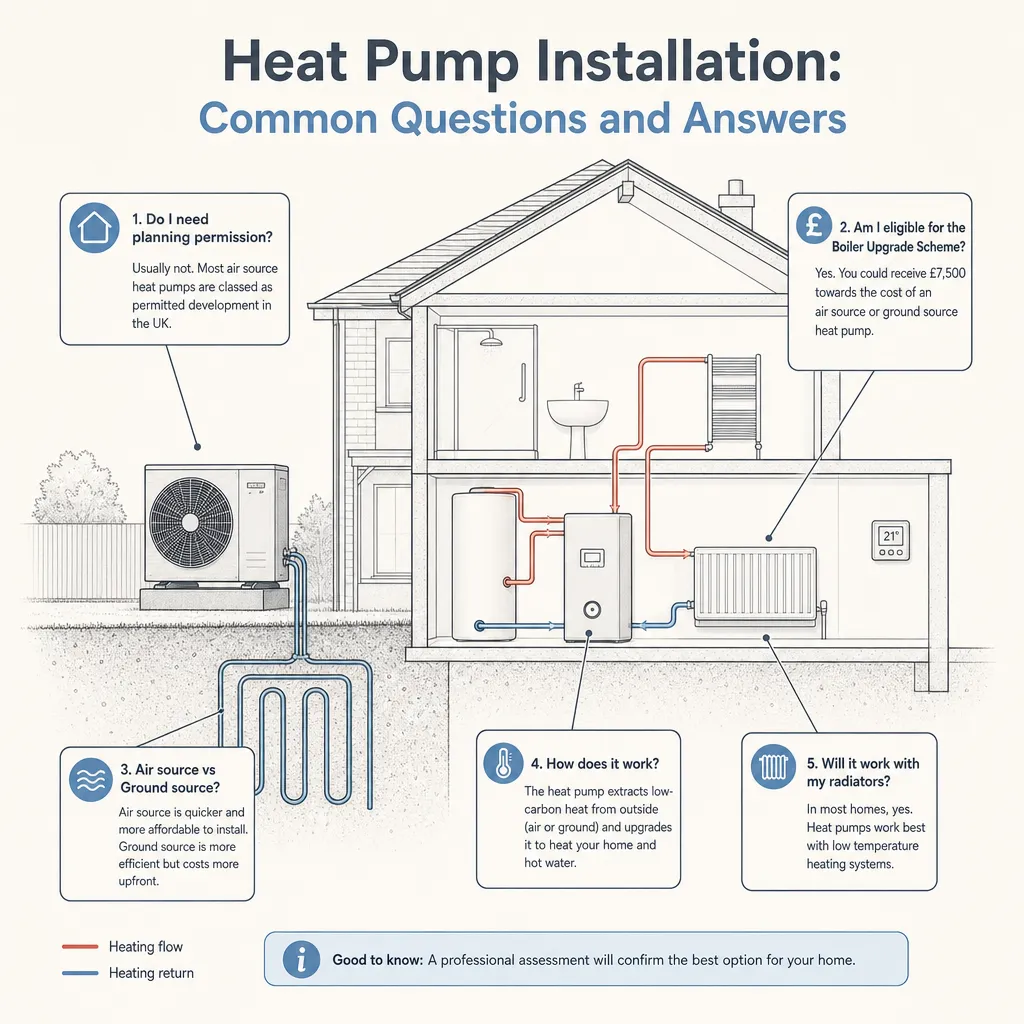
Heat Pump Installation: Common Questions and Answers
Heat pump installation in the UK typically requires an MCS-certified installer and a heat loss survey, and may qualify for the £7,500 Boiler Upgrade Scheme grant.
 Energy & Retrofit
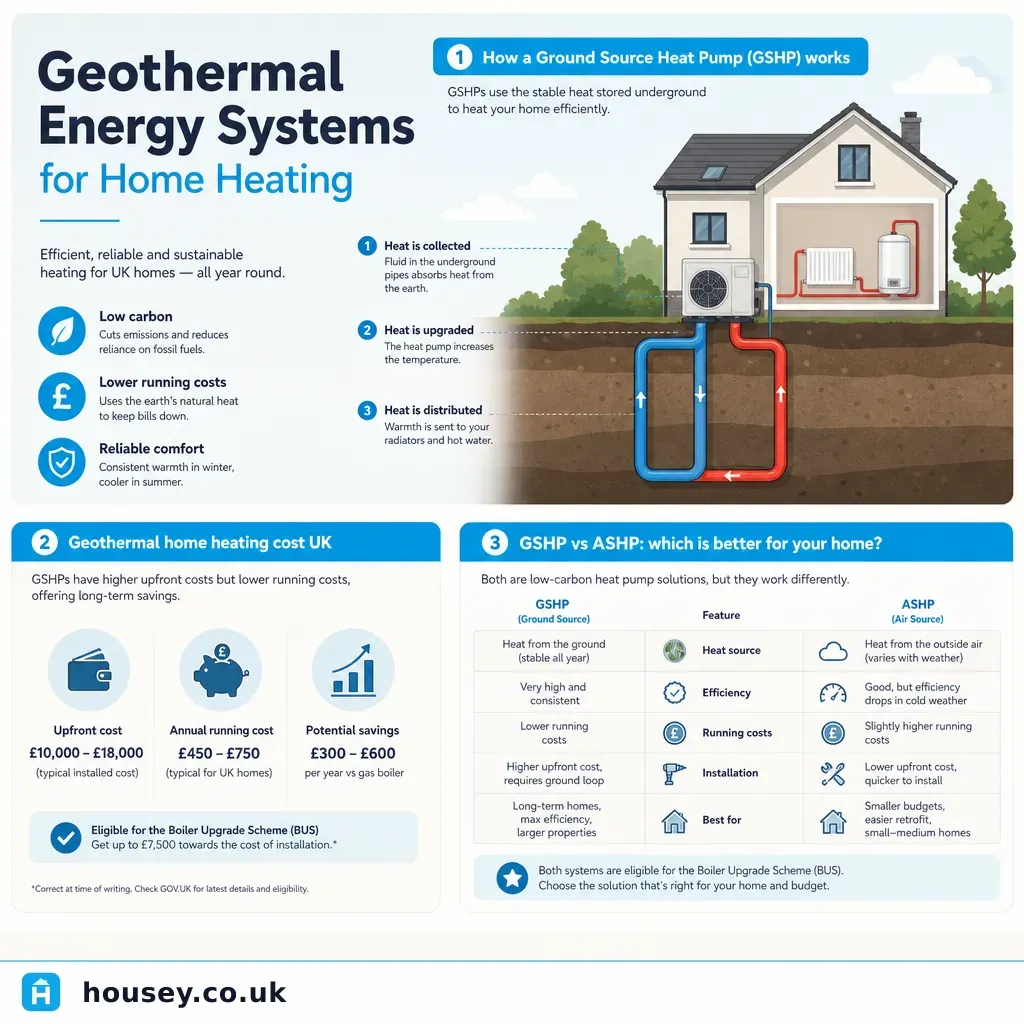
Geothermal Energy Systems for Home Heating
Ground source heat pumps (GSHPs) extract stable thermal energy from the earth via buried ground loops or boreholes, typically delivering 3–4 units of heat per unit of electricity consumed.
 Energy & Retrofit
Solar Panel Installation on Flat Roofs: Guide and Considerations
Solar panels can be installed on flat roofs using ballasted or mechanically fixed frames, with the tilt angle optimised for UK latitudes.
 Energy & Retrofit
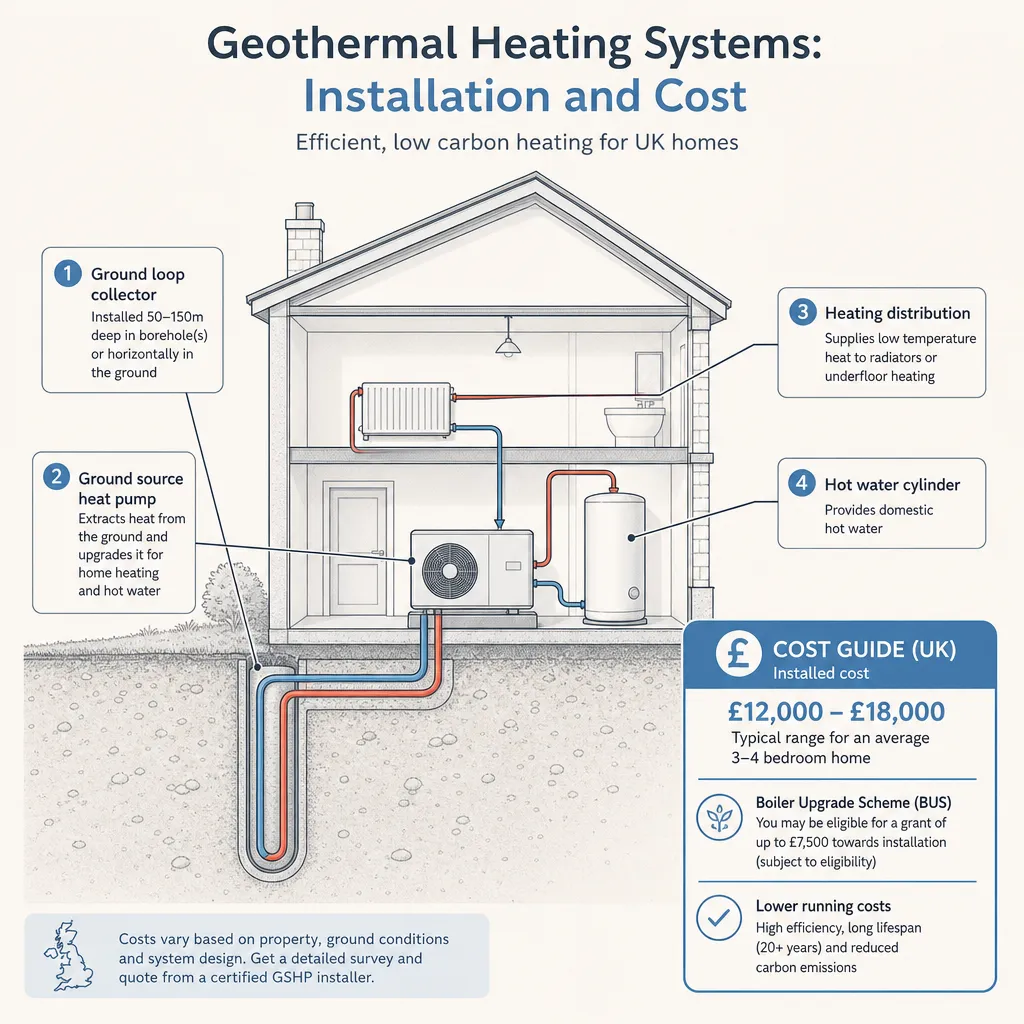
Geothermal Heating Systems: Installation and Cost
Ground source heat pumps extract stored solar energy from the earth via buried ground loops and convert it to usable heat for radiators and hot water.