Practical Energy Saving Tips for Homeowners
By Housey · Last reviewed 30th of May 2026
Practical Energy Saving Tips for Homeowners
Rising energy costs have made efficiency a financial priority for most UK households, yet the advice available is often generic or poorly prioritised. Whether you live in a Victorian terrace, a 1930s semi, or a modern flat, understanding which changes deliver the greatest return helps you focus time and money where they count most — and helps you identify when a professional assessment will unlock savings that habits alone cannot reach.
Key points
- Reducing your thermostat setting by 1°C typically cuts heating costs by around 10%, according to the Energy Saving Trust.
- LED bulbs use approximately 75% less electricity than incandescent equivalents and last significantly longer.
- Appliances left on standby can account for up to 16% of a typical household electricity bill (Energy Saving Trust).
- Draught-proofing doors, windows, and letterboxes is among the cheapest and most cost-effective energy-saving measures available to homeowners.
- Topping up loft insulation to 270 mm depth can save around £150 per year in a semi-detached home (Indicative UK costs, last reviewed 2026-05-30; Energy Saving Trust).
Where do most UK homes lose energy?
Heat loss in UK homes follows a broadly predictable pattern. Understanding this distribution helps you prioritise improvement spend rather than tackling everything at once.
Area of loss | Approximate share of heat loss | Typical fix | Indicative installed cost |
|---|---|---|---|
Roof / loft | ~25% | Loft insulation topped to 270 mm | £300–£600 |
Walls — solid, uninsulated | ~35% | Solid wall insulation (internal or external) | £8,000–£22,000 |
Walls — cavity, uninsulated | ~18% | Cavity wall insulation | £700–£1,500 |
Windows | ~10% | Double or triple glazing | £400–£700 per window |
Doors and draughts | ~15% | Draught-proofing strips, brush seals | £50–£300 |
Floor | ~10% | Underfloor insulation | £500–£2,500 |
Indicative UK costs, last reviewed 2026-05-30. Costs vary significantly by property size, type, location, and installer. Always obtain at least three quotes.
Heating and thermostat controls
Your heating system is usually the single largest item on a UK household energy bill. Small adjustments to how you control it can add up considerably across a heating season.
- Set your thermostat to 18–21°C depending on room use and household preference. Each degree lower saves roughly 10% on heating costs.
- Use a programmer or smart thermostat to heat rooms only when occupied. Many smart thermostats can learn occupancy patterns and adjust automatically.
- Bleed radiators if they have cold spots at the top — trapped air reduces efficiency and the time needed to warm a room.
- Arrange an annual boiler service by a Gas Safe-registered engineer to maintain efficiency and catch faults early.
- Check the boiler flow temperature — condensing boilers run most efficiently at lower flow temperatures (typically 55–60°C). A heating engineer can advise on the right setting for your system and radiator sizes.
- Turn off heating in unused rooms and close their doors, but avoid letting those rooms drop below 5°C if they share a wall with a heated space.
Lighting and appliances
Lighting and appliances account for a significant share of household electricity use, and habits around them are often straightforward to change.
Lighting
- Replace any remaining incandescent or halogen bulbs with LED equivalents. A typical LED A60 bulb uses 8–10 W versus 60 W for an incandescent.
- Make use of natural light during the day — pale, reflective paint colours near windows help spread it further.
- Fit motion sensors or timers in hallways, outbuildings, and external areas to avoid lights running unnecessarily.
Appliances
- Run dishwashers and washing machines on eco or lower-temperature cycles — 30°C is sufficient for most lightly soiled laundry.
- Fill the kettle only with the water you need; overboiling is one of the most common sources of avoidable electricity use in UK kitchens.
- Switch televisions, monitors, and games consoles fully off at the wall; standby power across multiple devices adds up over a year.
- When replacing appliances, check the UK Energy Label rating — A-rated models use meaningfully less electricity over their lifetime than older equivalents.
Draught-proofing and ventilation
Draught-proofing is often the quickest and cheapest win for UK homeowners, particularly those in older properties. Victorian terraces, 1930s semis, and pre-war houses with timber-framed windows and suspended timber floors tend to be draughty and respond well to relatively simple measures.
Foam or rubber strips around door frames, brush seals on letterboxes, and chimney balloons in unused fireplaces can all be fitted with modest time and expense. However, do not seal every gap indiscriminately — homes require background ventilation to prevent condensation and damp, especially in kitchens and bathrooms. Trickle vents in windows and extractor fans should remain clean and operational.
Seasonal energy-saving checklist
Use this checklist to prepare your home at the start of each season and to maintain efficiency year-round.
Before winter:
Year-round:
Before summer:
When to get professional help
Behavioural changes and basic draught-proofing are well within most homeowners' reach, but some energy-saving measures require professional assessment or installation to be safe and effective.
Seek professional advice if:
- You are considering solid wall insulation — poor installation can cause interstitial condensation and structural damp.
- You want to upgrade to a heat pump — sizing, system design, and Boiler Upgrade Scheme (BUS) eligibility all require an MCS-accredited installer.
- Your home has existing moisture or ventilation problems — adding insulation without addressing these first is likely to make them worse.
- You want to understand which measures offer the best return for your specific property type, construction, and budget.
How Housey can help
A qualified energy-efficiency consultant can audit your home, rank improvements by cost-effectiveness, and identify grant funding you may be eligible for — including ECO4 and the Boiler Upgrade Scheme. If inadequate insulation is your biggest concern, an insulation assessment will give you a clear picture of exactly where heat is escaping and what remediation will cost before you commit to any works.
Frequently asked questions
How much can I realistically save by following energy saving tips?
Savings depend on your current habits and property type, but the Energy Saving Trust estimates that switching to LED lighting, reducing thermostat settings by 1°C, and addressing draught-proofing could collectively save a typical household several hundred pounds per year. Structural improvements such as loft or cavity wall insulation typically offer the largest long-term savings.
Do I need a smart meter to save energy?
No, but a smart meter helps. Smart meters show real-time energy use in pounds and pence, making it easier to spot wasteful habits or appliances. Your energy supplier is obliged to offer one free of charge on request under Ofgem rules.
Is it worth improving my EPC rating if I am not planning to sell?
Yes. A higher EPC rating usually means lower running costs for the occupants. It also makes your property more attractive to buyers and, for landlords, supports compliance with current and forthcoming Minimum Energy Efficiency Standards (MEES) regulations in England and Wales.
What temperature should my hot water cylinder be set to?
The NHS and Health and Safety Executive (HSE) recommend a minimum of 60°C to prevent Legionella bacteria growth. There is no benefit to setting it higher. Check the thermostat on the cylinder itself — many older cylinders are set unnecessarily high, wasting energy without any safety benefit.
Sources and further reading
- Heating and hot water — Energy Saving Trust
- Insulation advice — Energy Saving Trust
- Typical domestic consumption values — Ofgem
- Boiler Upgrade Scheme — GOV.UK
- Legionella and Legionnaires' disease — Health and Safety Executive
Useful next reads
 Energy & Retrofit
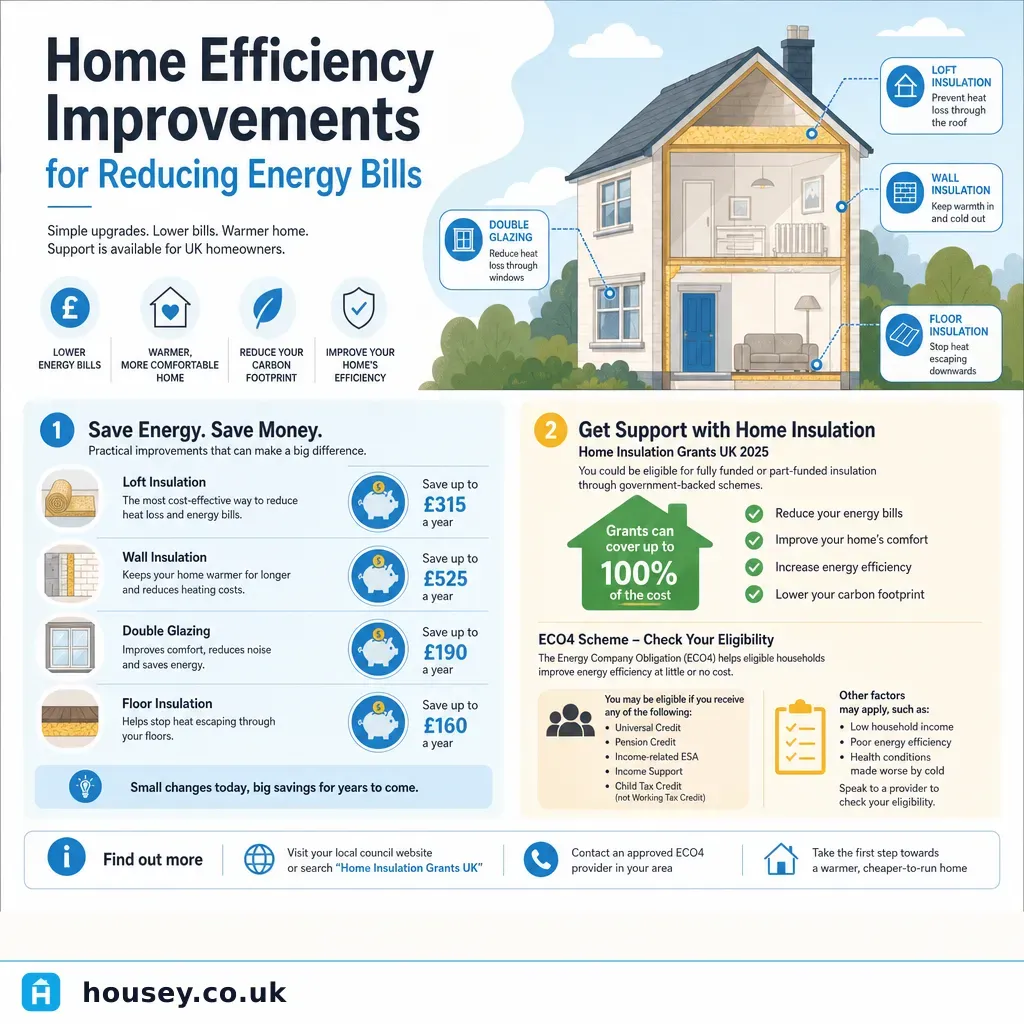
Home Efficiency Improvements for Reducing Energy Bills
The most cost-effective UK home efficiency improvements are usually loft insulation, cavity wall insulation, draught-proofing, and upgrading heating controls.
 Energy & Retrofit
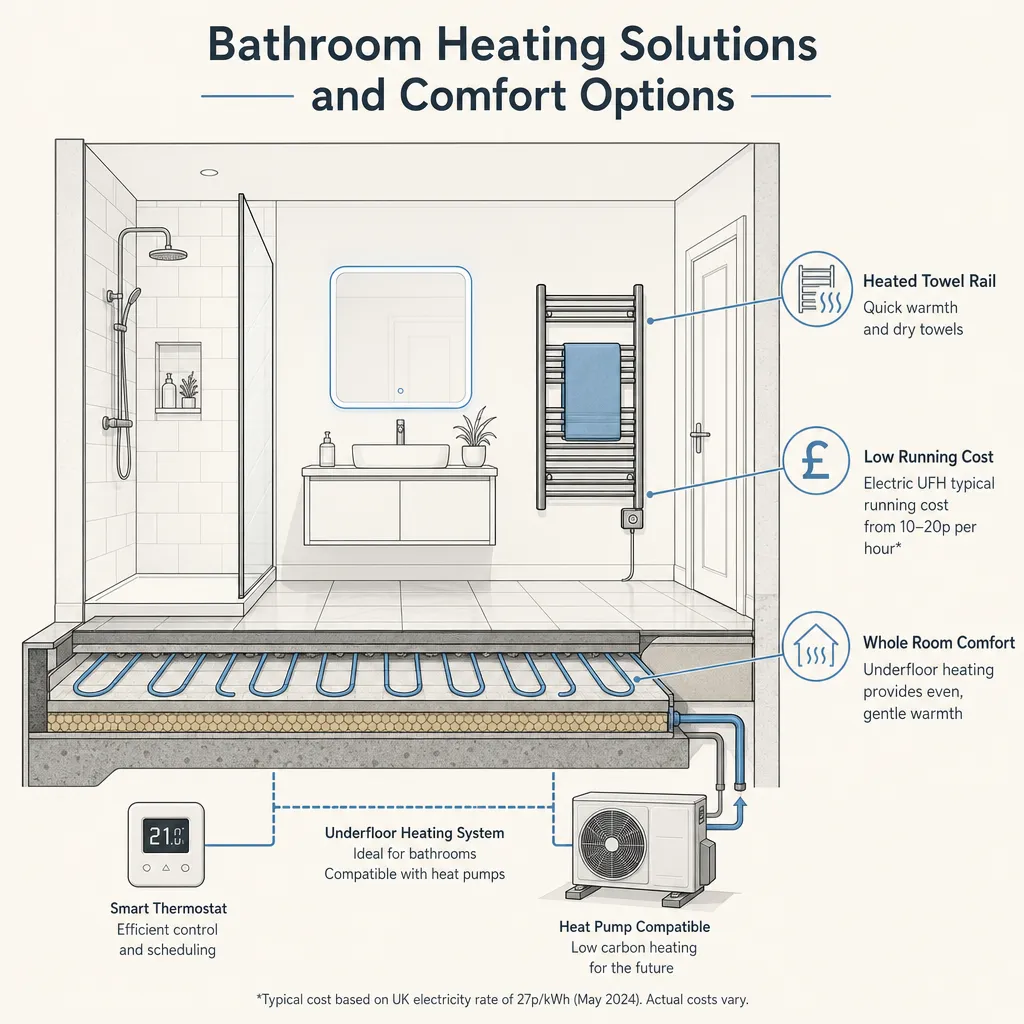
Bathroom Heating Solutions and Comfort Options
UK bathrooms can be heated using electric towel rails, wet radiators on the central heating circuit, electric or wet underfloor heating, or infrared panels.
 Energy & Retrofit
Optimising Heating Systems for Energy Efficiency
Optimising a UK heating system usually involves improving controls such as smart thermostats and thermostatic radiator valves, ensuring the boiler or heat pump is correctly sized, and upgrading radiators or pipework where needed.
 Energy & Retrofit
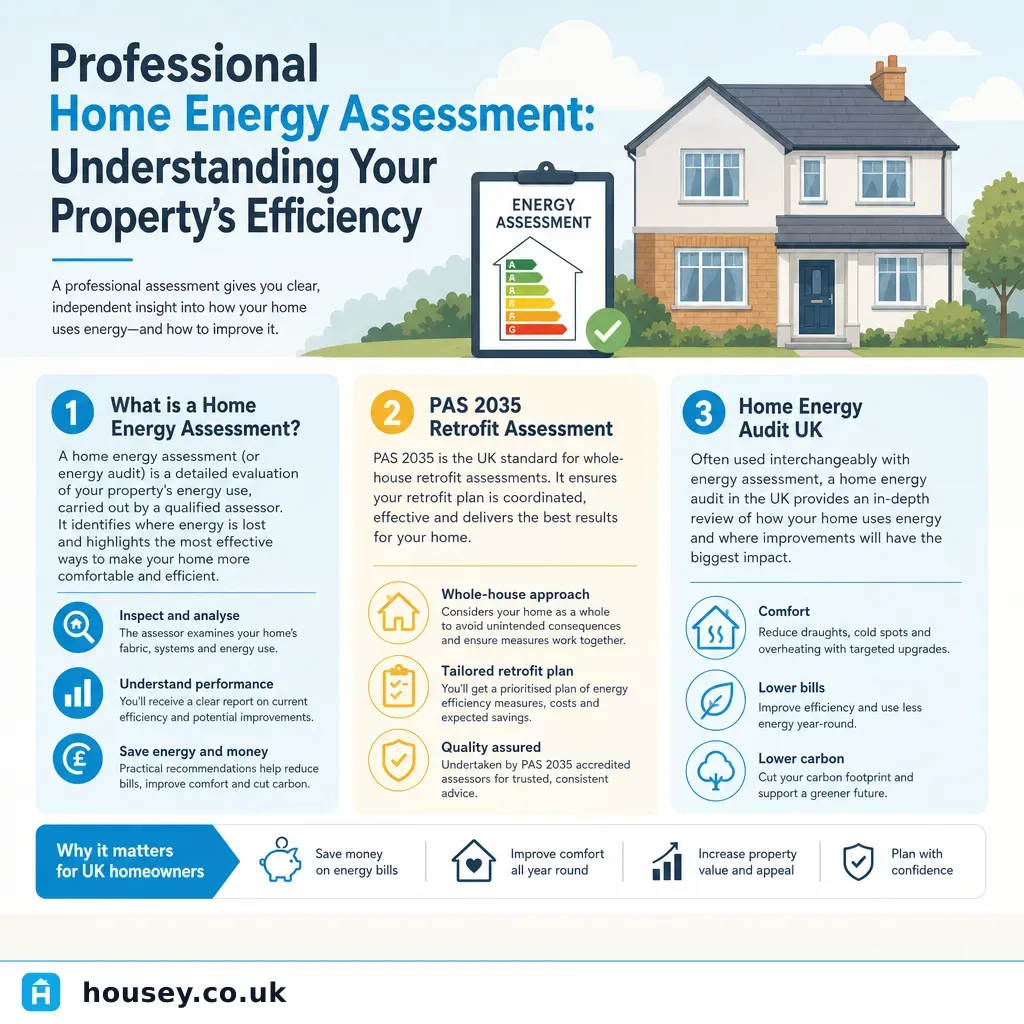
Professional Home Energy Assessment: Understanding Your Property's Efficiency
A professional home energy assessment goes beyond an EPC to evaluate how your property loses heat, where insulation is inadequate, and what improvements should be made in what order.
 Energy & Retrofit
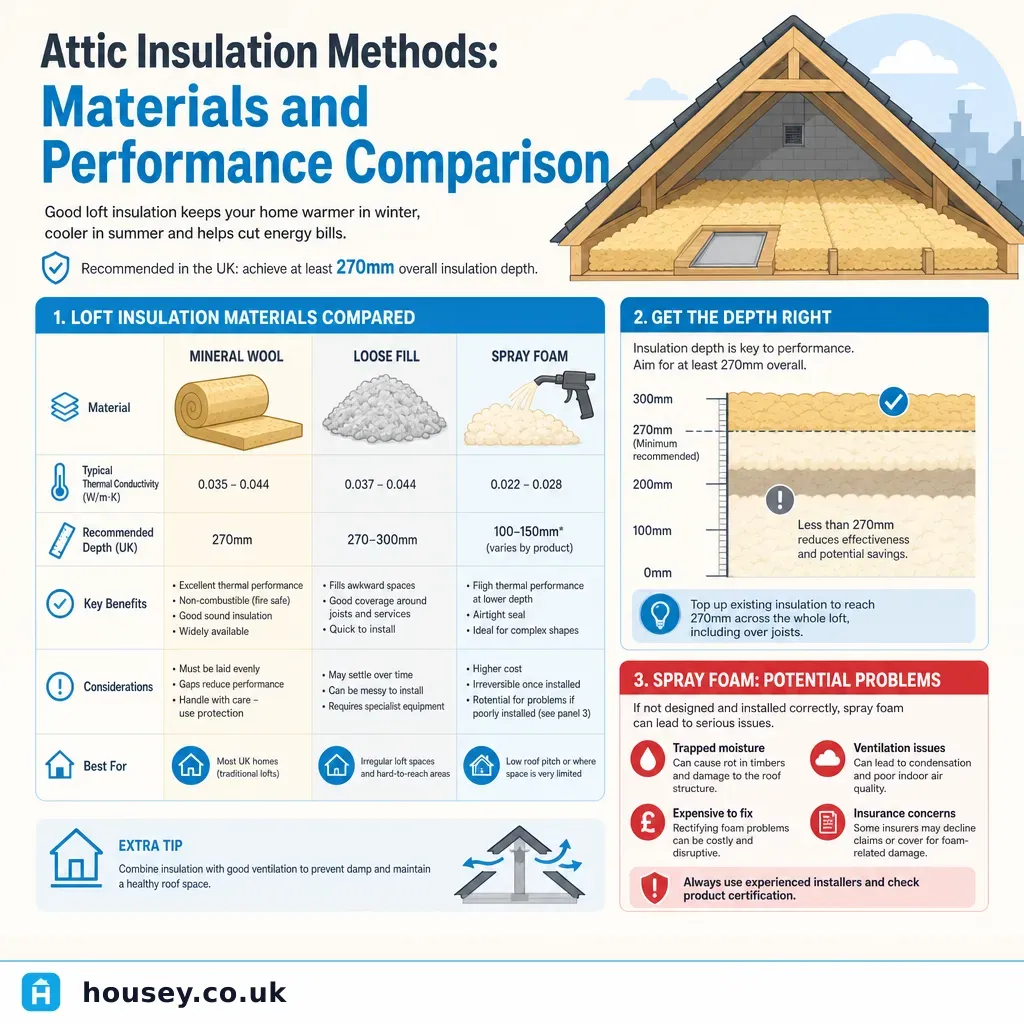
Attic Insulation Methods: Materials and Performance Comparison
UK loft insulation options include mineral wool rolls (most common and grant-funded), blown loose-fill for irregular lofts, and rigid PIR board for warm roof conversions.