Bathroom Planning Errors: Common Mistakes to Avoid in Your Renovation
By Housey · Last reviewed 19th of May 2026
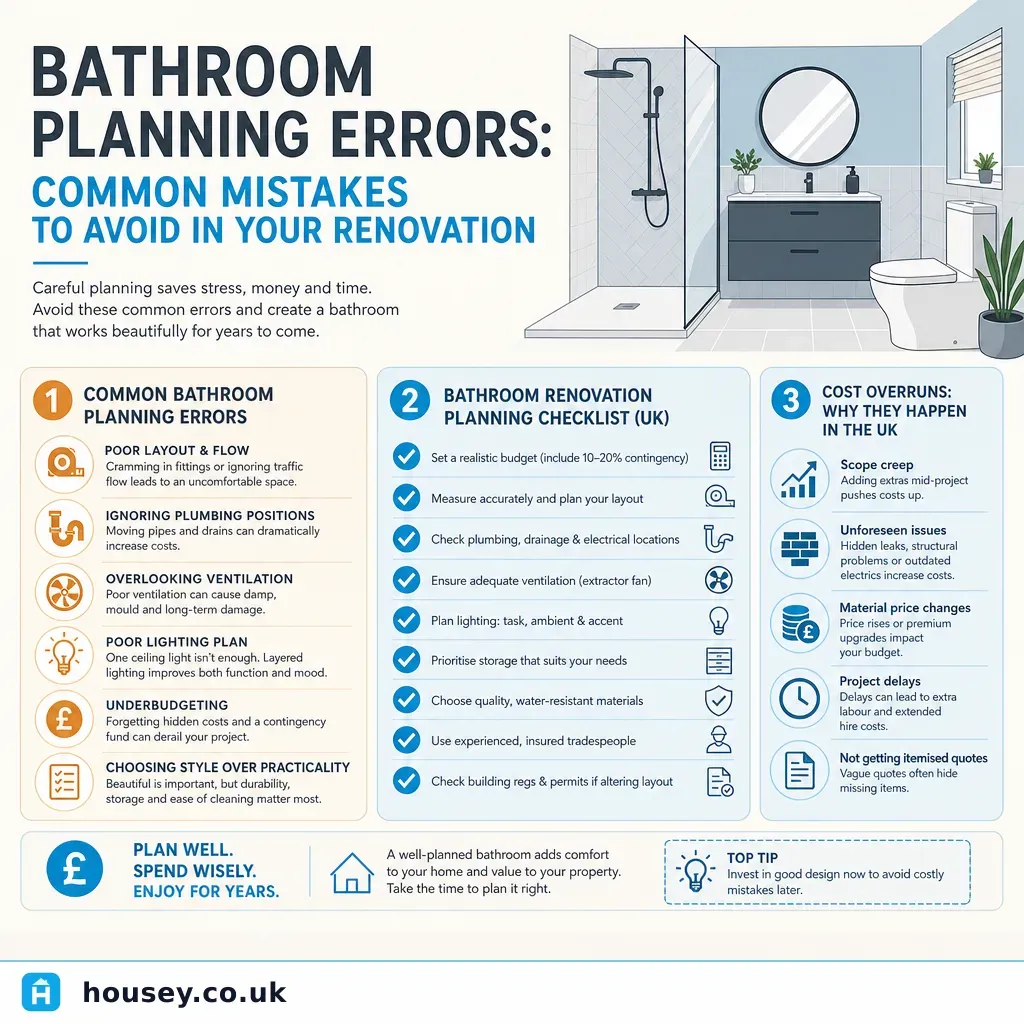
Bathroom Planning Errors: Common Mistakes to Avoid in Your Renovation
Bathroom renovations are one of the most common home improvement projects in the UK and among the most frequently delayed. Most overruns trace back to decisions made — or not made — before a single tile is lifted. Mistakes that seem minor in the planning stage tend to multiply once work begins: a soil pipe in the wrong position, an inaccurate measurement, a subfloor that needs more preparation than expected. Understanding where planning typically goes wrong helps homeowners set a realistic scope, brief tradespeople clearly, and avoid the cascade of rework costs that bathroom projects are known for.
Key points
- Moving a soil pipe in a UK property typically adds £500–£2,000 or more to a bathroom project and may require Building Regulations notification under Approved Document H where the drain configuration changes significantly.
- Building Regulations Part F requires mechanical ventilation at a minimum extract rate of 15 litres per second (intermittent) in bathrooms without openable external windows; the fan must include a 15-minute overrun timer.
- Electrical work in a bathroom is a notifiable location under Part P of the Building Regulations; it must be carried out or certified by a competent person registered with a Part P approved scheme such as NICEIC or NAPIT.
- The Water Supply (Water Fittings) Regulations 1999 require all plumbing work to meet backflow prevention and material suitability requirements; some work requires advance notification to the water undertaker.
- A contingency allowance of 10–20% is widely recommended by UK tradespeople — subfloor damage and concealed plumbing defects are among the most frequent sources of unbudgeted cost.
Mistake 1: Fixing the layout before locating the drains
The single most expensive planning error in bathroom renovations is committing to a layout — and ordering sanitaryware — before establishing exactly where the existing soil pipe, waste outlets, and water supplies are positioned.
Moving a WC means extending the soil pipe run. Soil pipes must fall at a gradient of approximately 1:40 to 1:80 under Approved Document H and have a minimum internal diameter of 100mm for WC connections. If your chosen WC position requires a long horizontal run without the right fall, the options are to raise the floor, drop the ceiling below, or accept a macerator pump — each carrying its own cost, noise, and maintenance implications.
Before finalising any layout:
- Lift an existing floor board (or access panel) to confirm the direction and level of the existing soil branch
- Establish whether the proposed WC position is uphill or downhill of the stack
- Check whether the stack is internal or on an external wall — external stacks affect extension and en-suite feasibility
- Confirm waste run lengths for the basin, bath, and shower against the trap seal depth required by Approved Document H
Mistake 2: Ordering before measuring accurately
Ordering tiles, sanitaryware, and furniture before taking careful measurements leads to two persistent problems: materials that do not fit and insufficient quantities.
Layout measurement checklist:
When ordering tiles, calculate the area, add your waste allowance (10% minimum on a standard grid; 15% for patterns), and order all from the same batch number to ensure colour consistency. Running out mid-project and reordering risks a visible batch mismatch.
Mistake 3: Underestimating subfloor and wall preparation
In a typical UK bathroom renovation, the default assumption is that the existing floor and walls will be ready to receive new finishes. In practice, tradespeople regularly uncover:
- Rotten timber floor joists or floorboards under old vinyl or carpet, particularly where a previous leak was not properly dried out
- Bounce and flex in suspended timber floors that will crack tile adhesive and grout if not addressed with overboarding before tiling
- Hollow or blown plaster on walls that needs hacking off and re-rendering before wall tiles can be fixed
- Out-of-square rooms in Victorian and Edwardian terraces where the difference in opposing wall length is enough to misalign a full-width bath or a run of floor tiles
- Redundant pipe runs and conduit within walls that create voids behind new finishes
Budget separately for subfloor and wall preparation — it is rarely zero, especially in properties built before 1980.
Mistake 4: Overlooking ventilation requirements
Building Regulations Part F mandates mechanical extract ventilation in bathrooms that lack adequate natural ventilation (i.e. those without an openable window providing at least 1/20th of the floor area). The minimum extraction rates are:
- 15 litres per second intermittent extract for a bathroom
- 8 litres per second continuous background ventilation as an alternative
- A 15-minute overrun timer after the occupancy trigger (typically the light switch)
Common ventilation errors include:
- Installing a replacement fan without an overrun — most older pull-cord fans lack a timer, allowing moisture to linger after use
- Routing the duct into the loft void rather than terminating at an external wall or roof grille — moisture then condenses in the roof space
- Using a fan undersized for the room volume, or omitting the fan entirely in a windowless WC or utility room conversion
Fan installation or replacement in a bathroom requires electrical work in a notifiable location under Part P; this must be carried out or certified by a registered competent person.
Mistake 5: Specifying large-format wall tiles without checking the substrate
Choosing large-format wall tiles without confirming the walls are flat and structurally sound enough to carry them is a common specification mismatch. Large wall tiles require:
- A flat substrate — deviation no greater than 3mm over 2m under BS 5385 Part 1
- Sound, clean plaster or cement board, primed with an appropriate bonding agent before tiling
- Flexible tile adhesive classified S1 or S2 (EN 12002) in areas subject to movement or thermal cycling from underfloor heating
- Movement joints at internal corners and at regular intervals on large tile runs — rigid adhesive without movement joints is a leading cause of bathroom tile delamination, particularly in a first-floor bathroom over a bay or extension
Mistake 6: Underbudgeting and omitting contingency
Running out of funds mid-project is one of the most disruptive outcomes in a bathroom renovation. A realistic budget structure:
Cost category | Notes |
|---|---|
Sanitaryware (bath, WC, basin, shower tray and enclosure) | Fixed once specified; delivery lead times can affect the project programme |
Tiles and flooring | Include waste allowance; confirm batch numbers before ordering |
Labour (plumber, tiler, electrician, plasterer) | Obtain at least three itemised quotes; check what preparation is included |
Subfloor and wall preparation | Rarely zero — agree a provisional sum and a variation process with the contractor |
Building control fee (if applicable) | Required for structural work, new drainage configurations, or Part P notifiable electrical work |
Sundries (adhesive, grout, sealant, fixings, backer board) | Frequently underestimated; can reach £150–£300 for a full bathroom refurbishment |
Contingency (10–20% of total) | Non-negotiable — unexpected subfloor and concealed defect costs are routine, not exceptional |
Indicative UK costs, last reviewed 2026-05-19.
What not to assume: common misconceptions
- "I don't need planning permission for a bathroom" — Usually correct for like-for-like replacement, but structural alterations, changes to drainage, and work in listed buildings may require consent. Check with your local planning authority if the scope is unusual.
- "Any tradesperson can do bathroom electrics" — Electrical work in a bathroom is a notifiable location under Part P and must be carried out or certified by a registered competent person. An uncertified installation may create problems when selling.
- "A bathroom installation quote covers everything" — Many fitters quote labour only, excluding the supply of sanitaryware, tiles, and materials. Confirm exactly what is and is not included before comparing quotes.
- "I can finish it myself if money runs out" — Leaving a bathroom partially complete — ungrouted, unsealed, or without working extract ventilation — creates conditions for moisture damage that can cost far more to remedy than the original saving.
- "Macerators are equivalent to gravity drainage" — Macerator pumps (such as Saniflo-type units) require maintenance, are audible during use, and can fail; they are not a like-for-like substitute for a gravity soil drain connection.
Red flags during a bathroom renovation
Pause and investigate before proceeding if you notice any of the following:
- Water staining, soft floorboards, or discoloured joists revealed when existing flooring is lifted — indicates a previous or ongoing leak that must be resolved before new finishes are installed
- The waste or soil pipe does not fall to the correct gradient when the run is extended — do not conceal a drain without confirming it flows fully clear under a flow test
- Damp or mould on the underside of a removed floor — structural moisture may require specialist investigation before the room is closed up and finished
- Electrical cable routing altered without certification — any new circuit or extension within the bathroom zones must be notified and certified under Part P
- Cracks or movement visible in the wall once tiles are removed — in an older property, investigate the cause before applying new finishes
- Artex or textured ceiling disturbed during a strip-out — if the property predates 2000, arrange an asbestos assessment before further work continues
When to get professional help
Instruct a professional at the outset if:
- The bathroom is in a listed building or a conservation area
- You are adding a new en-suite that requires breaking into the existing soil stack
- You want a level-access wet room, which requires structural floor alterations and a tanked waterproof membrane system
- You are unsure whether the existing floor structure can carry the proposed load, particularly for heavy stone tiles
- There are signs of structural movement, active damp, or previously undisclosed works
An architectural technologist can prepare a detailed bathroom layout drawing, specify materials to meet Building Regulations, and reduce the risk of disputes or rework once the contractor is on site.
How Housey can help
Housey connects homeowners with qualified architectural technologists who can turn a bathroom brief into a construction-ready specification — helping you avoid the planning errors that cause most project overruns before a single fixture is ordered.
Frequently asked questions
Do I need Building Regulations approval for a bathroom renovation?
Like-for-like replacement of sanitaryware and finishes does not usually require Building Regulations approval. Approval is typically required for structural alterations, new drainage connections, electrical work in notifiable locations under Part P, and any change to the drainage layout under Approved Document H. Check with your local building control body if the scope goes beyond straightforward replacement.
How long does a bathroom renovation take in the UK?
A straightforward full bathroom replacement by a two-person team — plumber and tiler — typically takes 5–10 working days depending on scope and complexity. Add time for material lead times on bespoke items, subfloor and wall preparation, and mandatory drying and curing periods. Projects where adhesive or screed curing time is not respected are a common source of early tile failure.
Should I use a bathroom designer or architectural technologist?
A bathroom designer or architectural technologist can produce a scaled layout drawing that catches conflicts — insufficient WC clearance, drain positions that prevent a layout, door swing clashes — before work begins. This is particularly valuable for small or awkward bathrooms, wet rooms, and en-suites carved from existing rooms. The cost of a design is typically recovered in avoided rework.
What is the biggest hidden cost in a bathroom renovation?
Subfloor and wall preparation are consistently cited by UK tradespeople as the most common source of unplanned cost, particularly in properties built before 1970. Rotten joists, hollow plaster, and out-of-square walls are frequently discovered only once existing finishes are stripped. Budget a provisional sum for preparation work and agree in writing how variation costs will be handled before work starts.
Sources and further reading
- Building Regulations Approved Document H: Drainage and waste disposal — GOV.UK
- Building Regulations Approved Document F: Ventilation — GOV.UK
- Building Regulations Approved Document P: Electrical safety in dwellings — GOV.UK
- Water Supply (Water Fittings) Regulations 1999 — legislation.gov.uk
- FENSA glazing certification scheme — FENSA
Useful next reads
 Improvement & Build
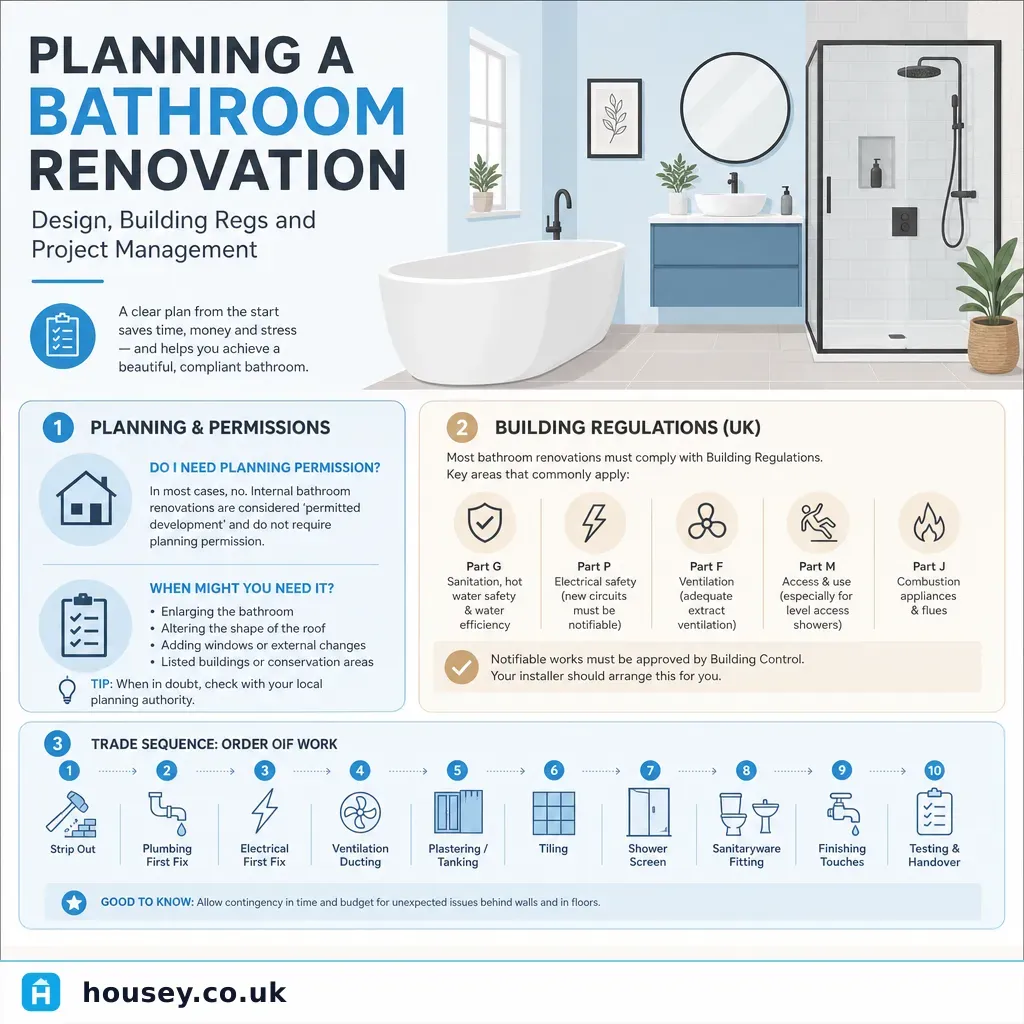
Planning a Bathroom Renovation: Design, Building Regs and Project Management
Most bathroom renovations replacing existing sanitaryware in the same location do not need building regs or planning permission.
 Improvement & Build
How to Find and Hire an Extension Builder
To hire a reliable extension builder, get at least three detailed written quotes from contractors with documented experience of similar projects.
 Improvement & Build
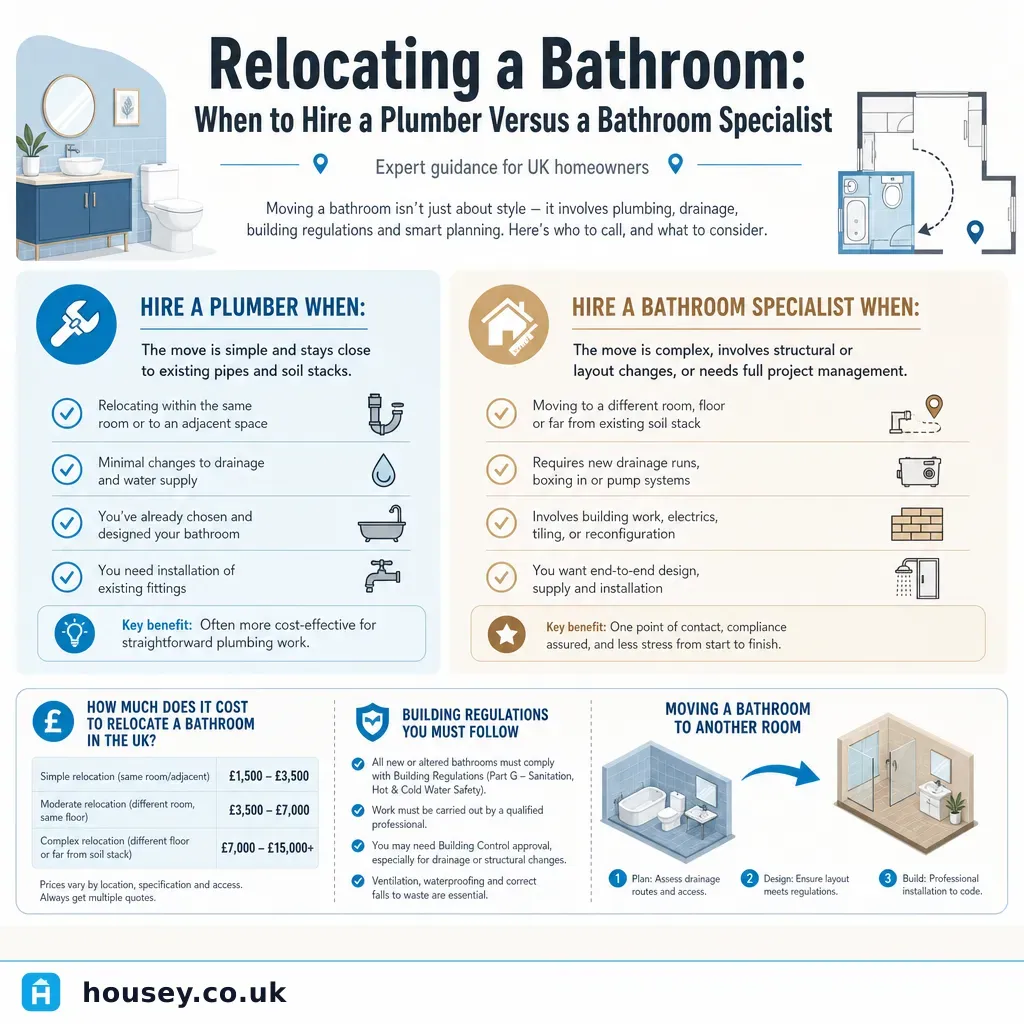
Relocating a Bathroom: When to Hire a Plumber Versus a Bathroom Specialist
Relocating a bathroom usually requires both a qualified plumber for pipework and drainage and other specialist trades for electrics, tiling, and finishes.
 Improvement & Build
Home Extensions and Additions: Planning Your Project
Most single-storey rear extensions can be built under permitted development without a full planning application, provided they stay within depth limits of 4 m for detached or 3 m for semi-detached and terraced properties.
 Improvement & Build
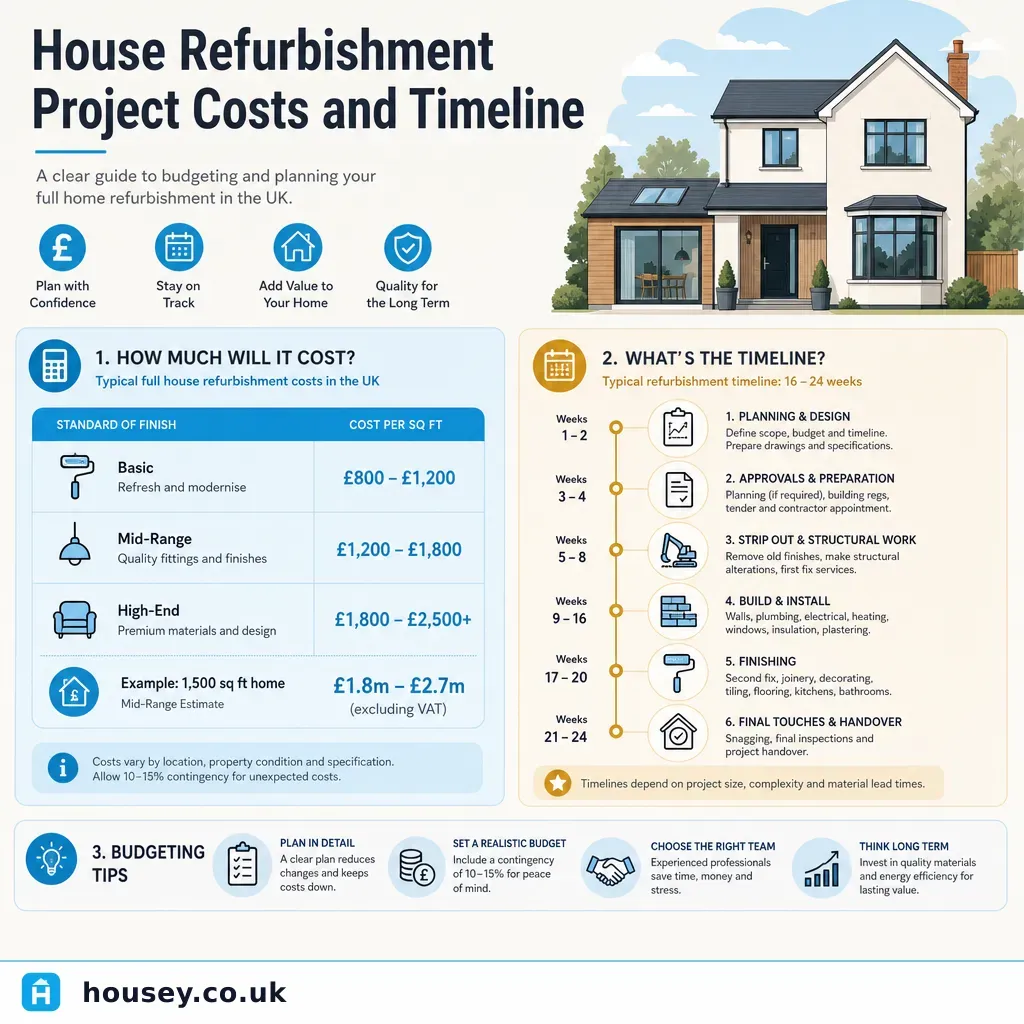
House Refurbishment Project Costs and Timeline
A full house refurbishment in the UK typically costs £30,000–£225,000+ depending on property size, scope, and location.