Home Extensions and Additions: Planning Your Project
By Housey · Last reviewed 26th of May 2026
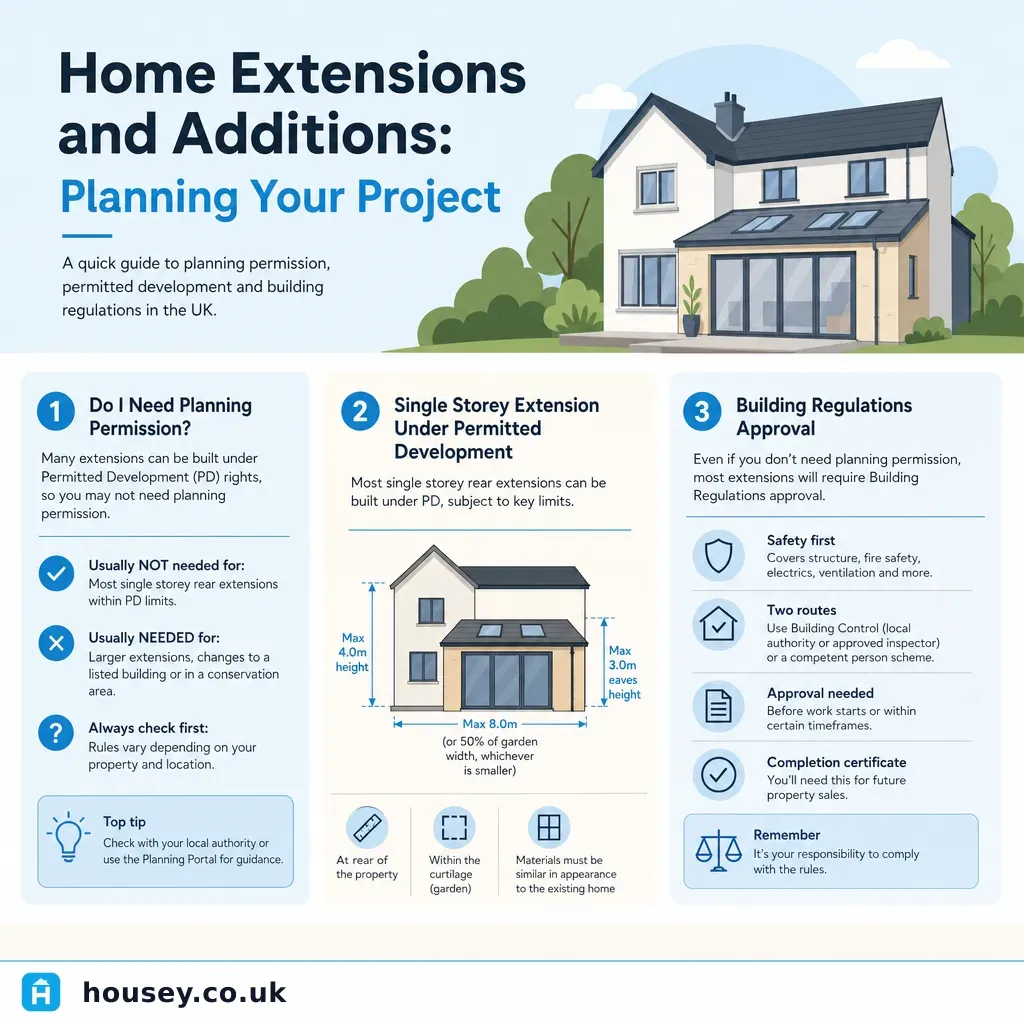
Home Extensions and Additions: Planning Your Project
A home extension is one of the most common ways UK homeowners add space and value to their property, yet it involves overlapping regulatory regimes — permitted development rights, planning permission, building regulations, and potentially party wall obligations — that can catch out even experienced renovators. Whether you are planning a rear single-storey kitchen extension on a 1930s semi or a two-storey side addition on a Victorian terrace, the planning stage determines how much the project costs, how long it takes, and whether the finished structure is legally compliant.
Key points
- Single-storey rear extensions up to 4 m deep (detached) or 3 m deep (semi-detached or terraced) generally fall within permitted development under the Town and Country Planning (General Permitted Development) (England) Order 2015, subject to conditions.
- The Prior Approval (Neighbour Consultation Scheme) route permits single-storey rear extensions up to 8 m deep (detached) or 6 m deep (semi/terrace), provided neighbours do not object and the local authority grants prior approval within 42 days.
- All extensions require Building Regulations approval — there is no opt-out — covering structural stability (Part A), fire safety (Part B), thermal performance (Part L), ventilation (Part F), and drainage (Part H).
- Extensions whose foundations are within 3 m of a shared boundary, or within 6 m of a neighbouring structure at a critical depth, are likely to trigger the Party Wall etc. Act 1996; a party wall award must be in place before foundation work begins.
- VAT on builder labour is charged at 20% for extensions to existing dwellings; accurate project categorisation matters because misclassification can affect total cost and VAT recovery position.
Important limitations
This article provides general guidance only. Permitted development rights vary depending on property location (conservation area, Area of Outstanding Natural Beauty, National Park, Article 4 Direction area), tenure (leasehold covenants may impose additional restrictions), and planning history (prior extensions reduce the remaining permitted development allowance). Always verify your specific position with your local planning authority before committing to a design or instructing a builder.
Extension types and what suits each situation
Extension type | Typical use | Permitted development likely? | Building regulations required? | Structural complexity |
|---|---|---|---|---|
Single-storey rear | Kitchen, dining room, family room | Often yes — within depth limits | Yes | Low to medium |
Single-storey side | Utility room, additional bedroom | Sometimes — half original house width rule applies | Yes | Low to medium |
Two-storey rear | Extra bedroom above ground-floor space | Usually no — planning permission needed | Yes | Medium to high |
Wrap-around (L-shape) | Rear and side combined | Partial — side element commonly needs permission | Yes | Medium to high |
Over-garage | Bedroom, home office, gym | Depends on original structure and PD history | Yes | Medium to high |
Basement | Additional habitable space | Usually no — planning often required | Yes | High (groundworks, waterproofing) |
Do you need planning permission?
Permitted development rules (England)
Under Schedule 2, Part 1, Class A of the GPDO 2015, a single-storey rear extension is permitted development if it does not exceed 4 m depth (detached) or 3 m depth (semi-detached or terraced), does not exceed 4 m in height at the highest point, does not result in more than 50% of the original curtilage being covered by buildings, does not extend beyond the principal elevation of the original house, and uses materials similar in appearance to the existing property.
These rights do not apply in conservation areas, Areas of Outstanding Natural Beauty, National Parks, World Heritage Sites, or where the local authority has made an Article 4 Direction withdrawing them. They also do not apply to flats or maisonettes.
Prior approval — larger home extensions
For extensions between the standard permitted development depth limits and 8 m (detached) or 6 m (semi/terrace), you must notify your local authority under the Prior Approval Neighbour Consultation Scheme. The council consults adjoining owners; if there are no objections, prior approval is granted or the authority must respond within 42 days. This is not a full planning application but the prior approval decision document should be retained.
When you need full planning permission
- Any two-storey extension.
- Extensions on listed buildings (also require listed building consent).
- Extensions in conservation areas that would be visible from the highway.
- Any extension exceeding the permitted development limits or failing any of the conditions.
- Extensions to flats or maisonettes.
Decision tree: permitted development or planning application?
- Single-storey rear, depth under 4 m (detached) or 3 m (semi/terrace): Likely permitted development — consider applying for a Lawful Development Certificate to confirm.
- Depth is 4–8 m (detached) or 3–6 m (semi/terrace): Use the Prior Approval Neighbour Consultation Scheme — notify the local authority before starting.
- Two-storey, side-return, wrap-around, or exceeding depth limits: Apply for full planning permission — allow 8 weeks for a decision (13 weeks for major applications).
- Property is listed, in a conservation area, or subject to an Article 4 Direction: Assume full planning permission and, where applicable, listed building consent are required.
- Property is a flat or maisonette: Permitted development rights do not apply — full planning permission is required.
Building regulations: what they cover
Every extension requires Building Regulations approval regardless of whether planning permission is needed. The two main routes are:
Full plans application — submit detailed drawings before work starts; building control checks drawings, inspects at specified stages, and issues a completion certificate. Best for larger or structurally complex projects.
Building notice — notify building control; they inspect at stages but do not pre-check drawings. Suitable for straightforward single-storey extensions.
Key Approved Documents you will encounter:
- Part A (Structure): foundations, walls, beams, and roof. Structural calculations from an engineer are typically required for loadbearing elements.
- Part B (Fire safety): escape routes and fire-resistant construction between the extension and the existing house.
- Part L (Conservation of fuel and power): U-values for new walls (0.28 W/m²K), roof (0.18 W/m²K), and floor (0.22 W/m²K), or compensatory trade-off measures.
- Part F (Ventilation): fresh air provision to habitable rooms and kitchens.
- Part H (Drainage): new drainage runs connecting correctly to existing foul and surface water systems.
Party wall obligations
The Party Wall etc. Act 1996 requires written notice to adjoining owners if you intend to build on or at the boundary (2 months notice), if excavations for foundations are within 3 m of a neighbouring structure and deeper than its foundations (1 month notice), or if new foundations are within 6 m of a neighbouring structure and cut a 45° line drawn from that structure's base (1 month notice).
Adjoining owners can consent — in which case work may proceed — or dissent, triggering appointment of a party wall surveyor and preparation of a party wall award. Work must not begin until the award is in place. Failing to serve notice exposes you to injunctions and compensation claims.
When this becomes urgent
Stop work immediately and seek professional advice if:
- Foundation excavations have begun without Building Regulations approval in place, or the building inspector was not notified at commencement.
- A party wall notice was required but was not served, and the neighbouring owner is now raising an objection or has instructed a surveyor.
- Cracks appear in adjacent walls, floors, or ceilings during groundworks or structural alterations — particularly stepped diagonal cracking through masonry or cracks spreading from window and door corners.
- Your mortgage lender or conveyancer identifies that a previous extension on the property has no building regulations completion certificate: this can prevent a sale or remortgage.
- Your contractor proposes removing a wall without written confirmation from a structural engineer that it is non-loadbearing.
What to ask a qualified professional
Before instructing an architect, builder, or engineer, ask:
- Have you checked whether this property retains its permitted development rights, including any Article 4 Direction?
- Will you obtain a Lawful Development Certificate even if a full planning application is not required?
- How do you propose to achieve Part L compliance — standard U-values, or a compensatory trade-off calculation?
- Who is responsible for coordinating the Building Regulations application and attending inspection stages?
- Does this design trigger the Party Wall etc. Act 1996, and if so, who will serve the notices?
- What structural calculations will be provided, and by whom?
- What drainage investigation is needed before the design is finalised?
- Is VAT included in your quote, and at what rate is it charged?
Homeowner checklist before starting your extension project
When to get professional help
Always engage a qualified professional when the extension involves removing or altering a loadbearing wall or chimney breast, when new foundations are adjacent to existing structures or trees in clay soils prone to subsidence, when the property is in a flood risk zone, when a basement is included, or when the party wall process is contested.
How Housey can help
Housey connects you with vetted extension builders who can quote against a clear specification, structural engineers for foundation design and loadbearing calculations, and building control consultants to guide your project through inspections to a completion certificate.
Frequently asked questions
How long does a home extension take to build?
A single-storey rear extension typically takes 8–16 weeks on site, depending on size, site access, and ground conditions. Allow a further 4–12 weeks for design and planning before work starts, and 2–4 weeks for building control final sign-off after completion. Two-storey extensions generally take 16–24 weeks on site. These are indicative timescales; your builder and local building control office can advise on your specific project.
Do I need an architect for a home extension?
Architects are not legally required, but their involvement in design, planning applications, and contract administration reduces the risk of cost overruns and quality disputes. For straightforward single-storey extensions, a CIAT-accredited architectural technologist can prepare drawings at lower cost. For two-storey, complex, or heritage properties a RIBA-registered architect is strongly advisable. Either way, ensure the designer carries professional indemnity insurance.
Does a home extension add value to my property?
Research by RICS and estate agents consistently shows that well-designed extensions add value, though the gain depends on the local market, the property type, and how the new space is used. A single-storey rear kitchen-diner extension on a three-bedroom semi typically offers stronger value uplift than an equivalent spend on a side utility addition. A local estate agent's view supported by recent comparable sales is the most reliable guide for your area.
Can I live in the house during the extension build?
In most cases yes, though disruption will be significant during foundation and structural work, particularly when external walls are opened to create the new connection. Discuss with your builder how the open phase will be managed, including temporary weatherproofing, dust barriers, and site security. Some homeowners choose to move out for two to four weeks during the most intrusive structural stage.
Sources and further reading
- Planning Portal: Extensions — Planning Portal
- Town and Country Planning (General Permitted Development) (England) Order 2015 — legislation.gov.uk
- Approved Document A: Structure — GOV.UK
- Approved Document L: Conservation of fuel and power — GOV.UK
- Party Wall etc. Act 1996: explanatory booklet — GOV.UK
Useful next reads
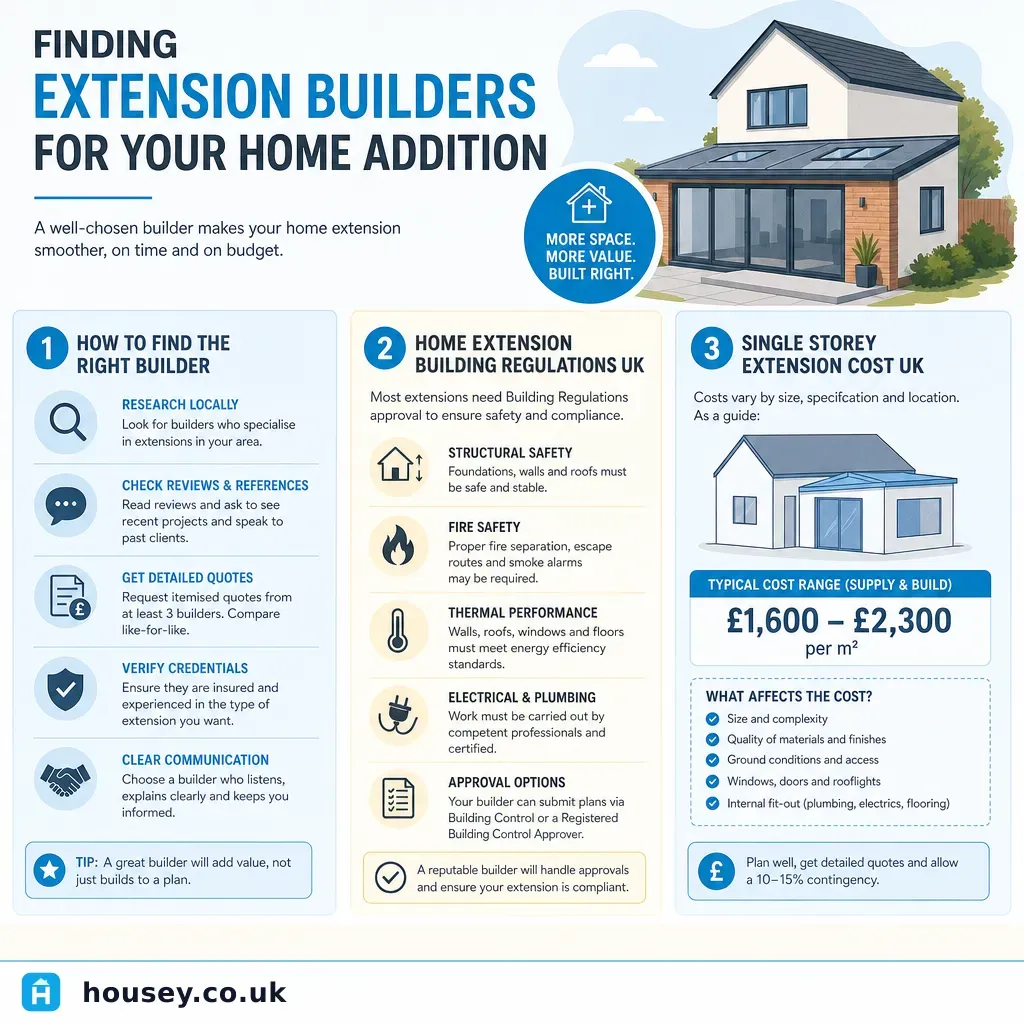 Improvement & Build
Finding Extension Builders For Your Home Addition
Finding the right extension builder means checking public liability insurance, FMB or TrustMark membership, recent references, and getting quotes on a full written specification.
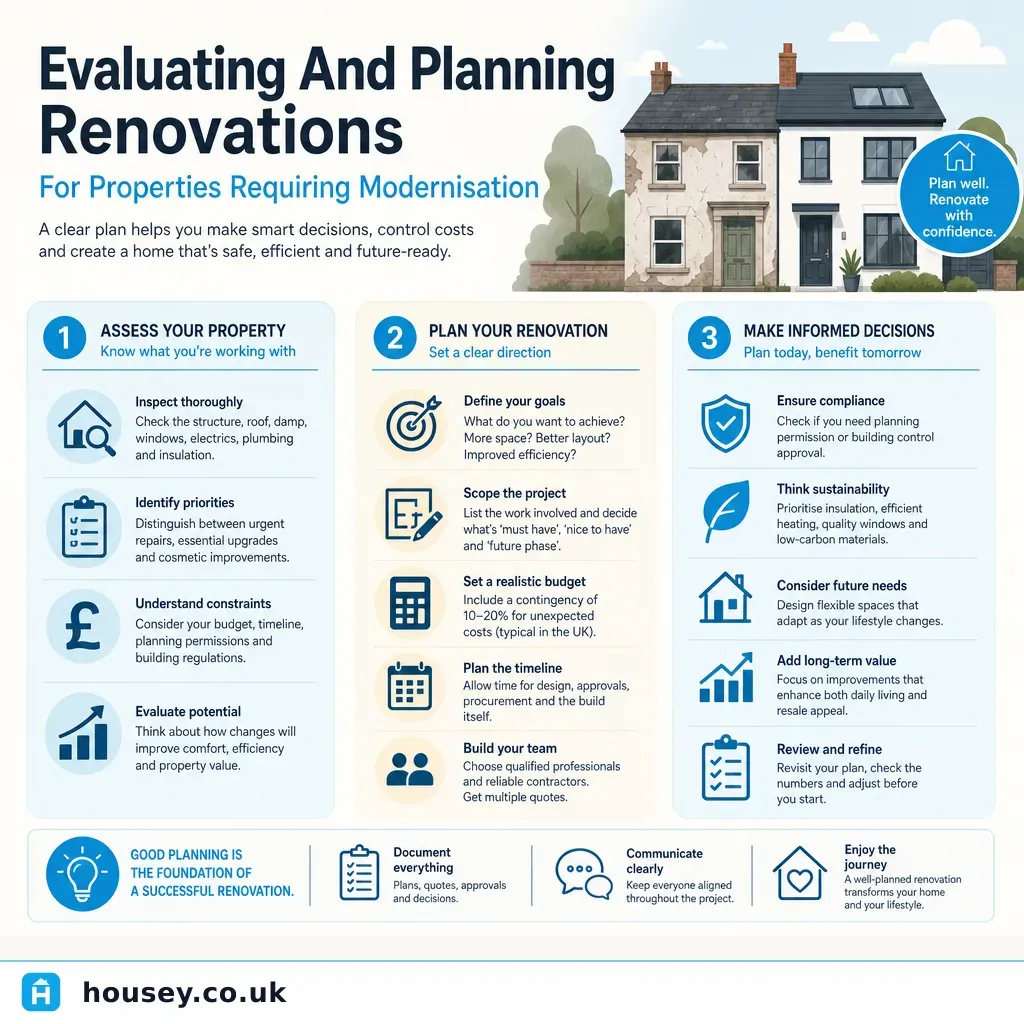 Improvement & Build
Evaluating And Planning Renovations For Properties Requiring Modernisation
Start by commissioning a condition survey — RICS Level 3 for pre-1919 properties — to identify structural defects, damp, and services issues before finalising a budget.
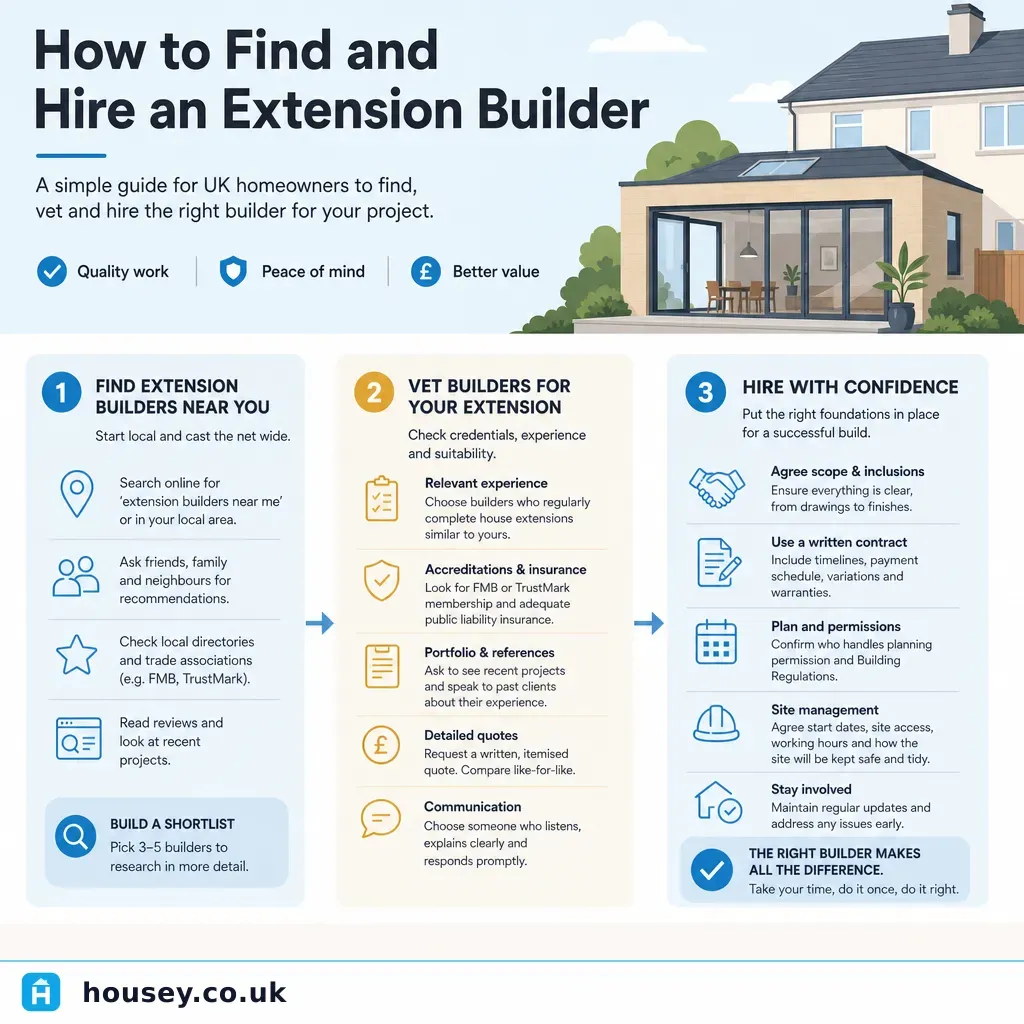 Improvement & Build
How to Find and Hire an Extension Builder
To hire a reliable extension builder, get at least three detailed written quotes from contractors with documented experience of similar projects.
 Improvement & Build
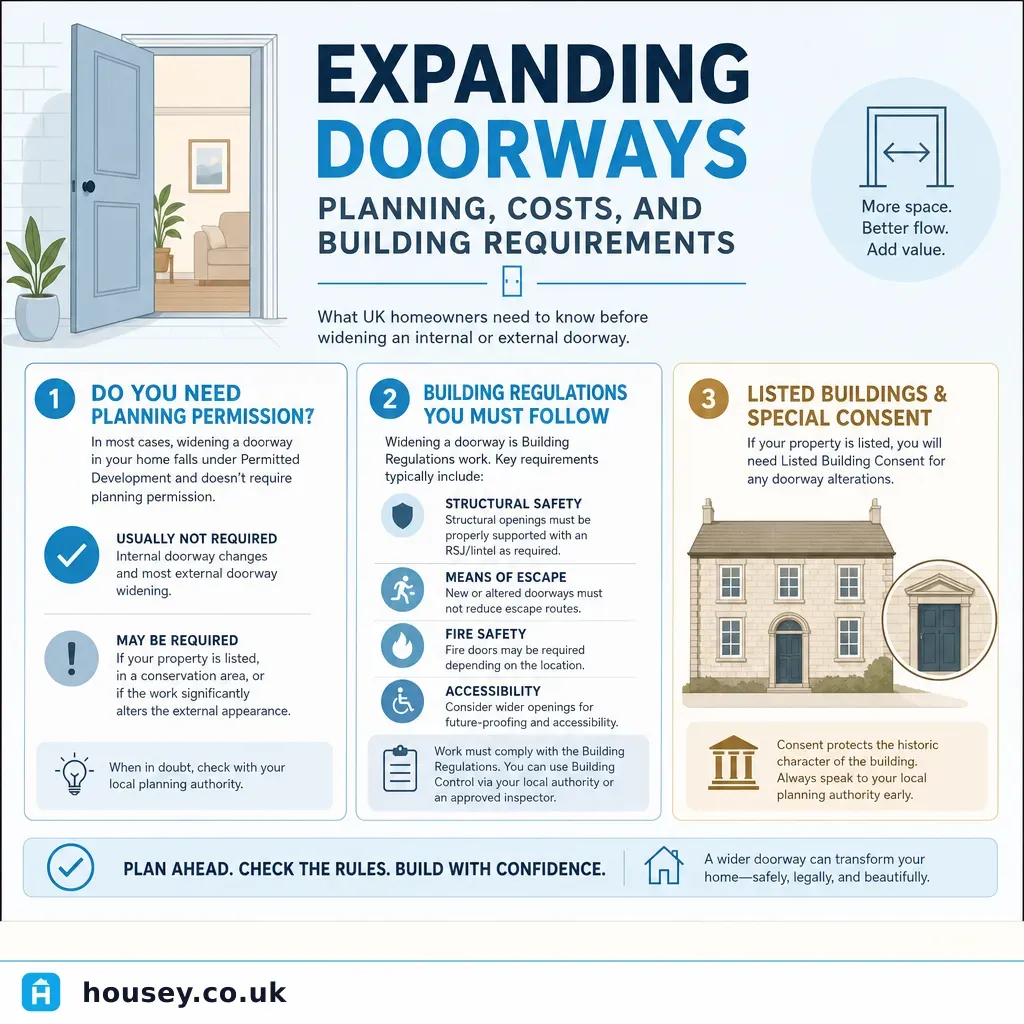
Expanding Doorways: Planning, Costs, and Building Requirements
Expanding a doorway in a load-bearing wall requires Building Regulations Part A approval and a structural engineer's lintel design.
 Improvement & Build
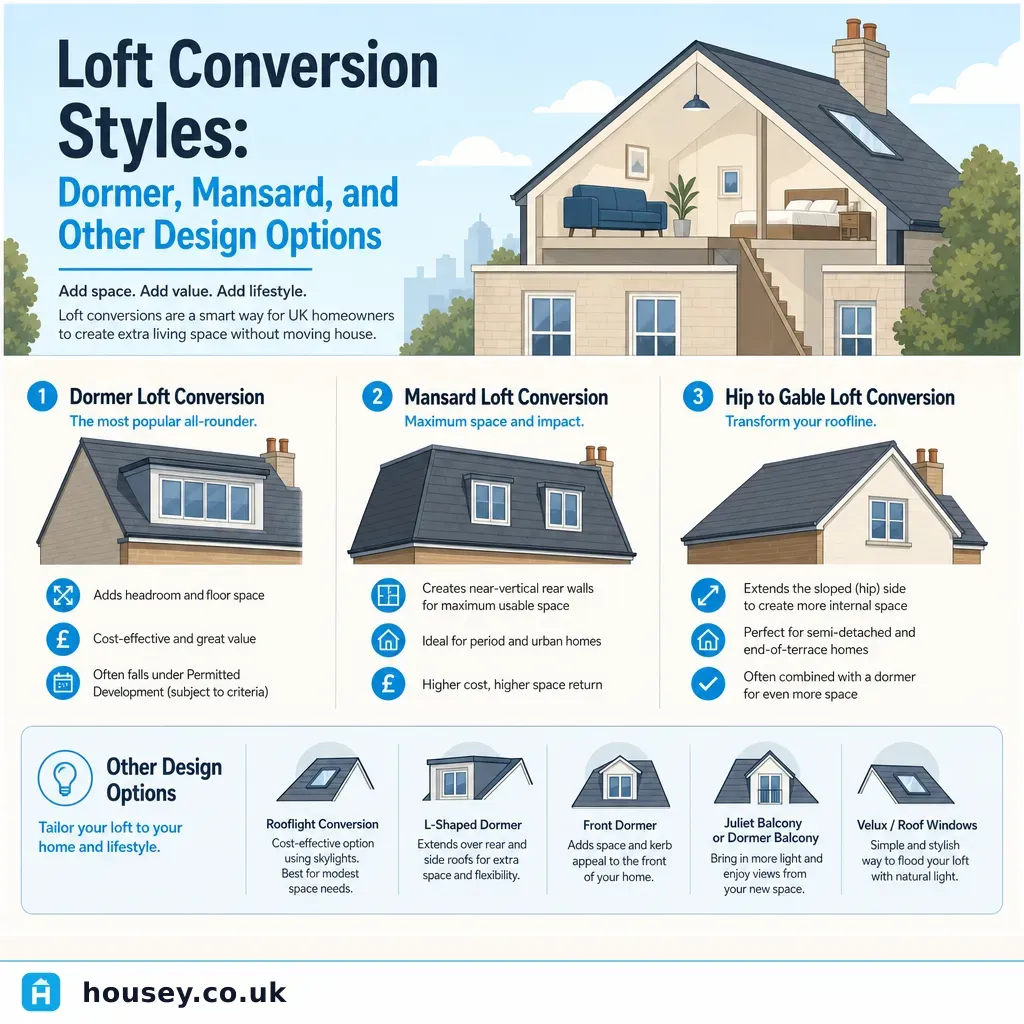
Loft Conversion Styles: Dormer, Mansard, and Other Design Options
The main loft conversion types in the UK are rooflight, dormer, hip-to-gable, and mansard.