Bathroom Reconfiguration and Its Effect on Home Value
By Housey · Last reviewed 11th of May 2026
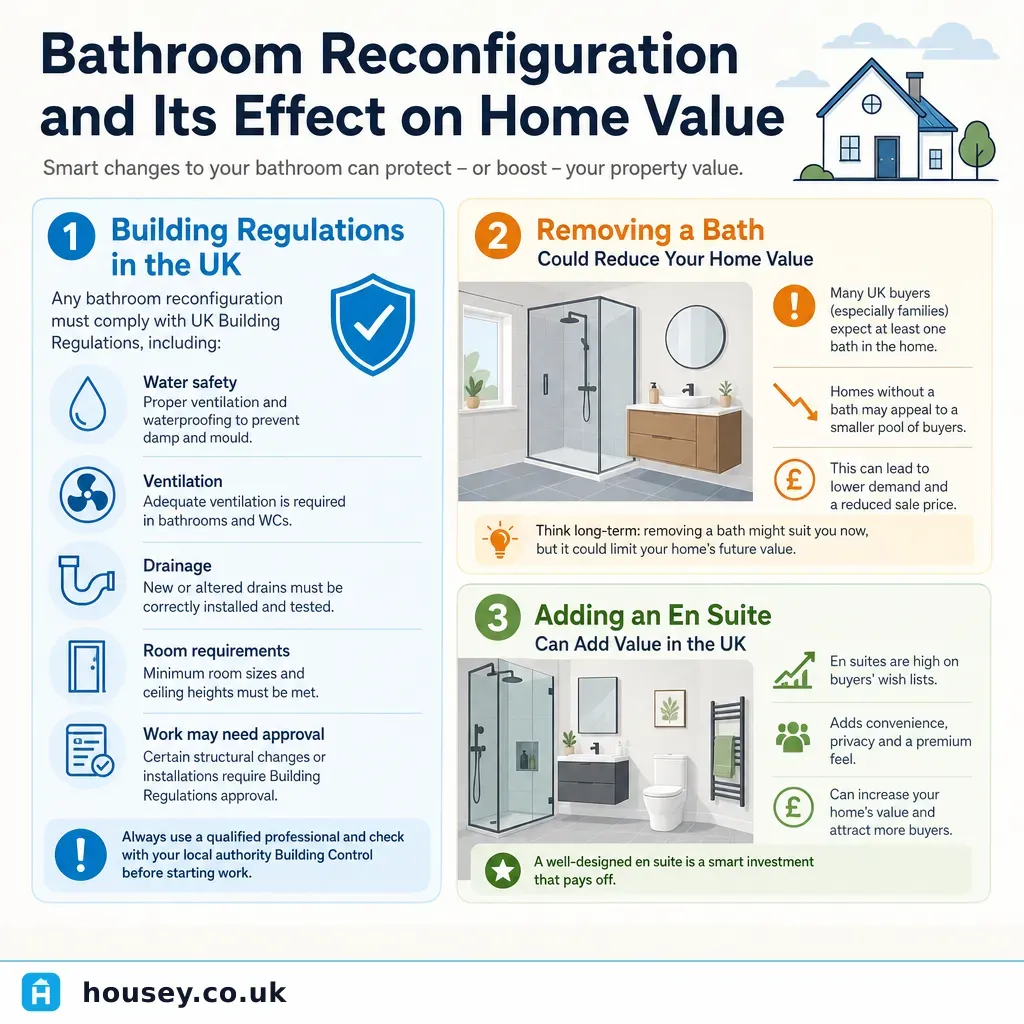
Bathroom Reconfiguration and Its Effect on Home Value
Deciding whether to reconfigure a bathroom — moving the toilet, replacing a bath with a shower, or completely redesigning the layout — is one of the more consequential home improvement decisions a UK homeowner can make before selling. The works involve plumbing, often tiling and waterproofing, and frequently structural considerations; and the results are highly visible to buyers and surveyors alike. Getting the configuration wrong can cost money twice: once during installation, and again when the market does not respond as hoped.
Key points
- Nationwide Building Society research has suggested a well-executed bathroom renovation can add up to 3% to a property's value, though this varies significantly by property type, location, and the baseline condition of the existing bathroom.
- Removing the only bath from a family home is consistently cited by estate agents and RICS valuers as a saleability risk — many buyers with young children and a significant portion of older buyers actively prefer a bath to be retained.
- Relocating a toilet, basin, or bath typically requires Building Regulations approval under Approved Document H (drainage and waste disposal) if it involves altering soil stack connections or the drainage layout.
- Adding a new en suite shower room to a master bedroom in a four-bedroom or larger property is one of the most reliably positive bathroom reconfigurations in the UK resale market.
- Bathrooms are a "special location" under Building Regulations Part P (electrical safety); any new circuits or significant electrical modifications must be carried out by a registered electrician or notified to building control.
Does bathroom layout affect property value?
The impact depends primarily on who the likely buyers are and what the reconfiguration actually achieves. UK buyers in the current market generally respond positively to:
- Good-quality sanitaryware in a practical, well-ventilated layout.
- A thermostatic shower — either over the bath or in a separate enclosure.
- Adequate storage — vanity units, recessed shelving, or a coordinated furniture suite.
- A new en suite to the master bedroom in a larger home where none previously existed.
They tend to respond negatively to:
- Bath removal from the main bathroom in a family home, particularly where no other bath exists in the property.
- Very small shower enclosures — a 760 mm square tray in a narrow bathroom is rarely perceived as a meaningful upgrade.
- Awkward layouts — a toilet positioned immediately beside the door, or a basin that requires squeezing past the WC to reach.
Comparison: bathroom reconfiguration scenarios and value impact
Reconfiguration | Buyer perception | Likely value effect | Key risk |
|---|---|---|---|
Replace dated suite with modern bath and thermostatic shower over | Positive | Neutral to modest positive | Cost may not be fully recouped in all markets |
Remove bath, install large walk-in shower (sole bathroom, family home) | Often negative | May reduce saleability | Bath removal is a common buyer objection |
Add en suite shower room to master bedroom in 4-bed home | Generally positive | Up to 5% in some markets | Building Regulations, waterproofing, noise transfer |
Upgrade cloakroom to full shower room | Positive where space is adequate | Modest positive | Drainage and ventilation compliance |
Reposition toilet requiring soil stack alteration | Neutral if executed correctly | Neutral | Building Regulations approval required |
Install wet room replacing main bathroom (family home) | Mixed | Neutral to slightly negative if no bath remains | Waterproofing quality, floor structure loading |
Which bathroom changes need Building Regulations approval?
Not all bathroom works require formal Building Regulations approval, but several commonly do:
- Moving or altering the soil stack or main drain — any drainage layout change requires approval under Approved Document H.
- A new bathroom or en suite where none previously existed — requires approval for drainage connections and ventilation under Approved Document F.
- Structural alterations — removing a wall, altering a floor joist, or creating a new opening — require Approved Document A (structure) approval.
- New or significantly altered electrical circuits — bathrooms are a "special location" under Part P; new circuits or major modifications within bathroom zones must be carried out by a registered electrician or notified to building control.
- Ventilation — an enclosed bathroom without an openable window must have mechanical extract ventilation meeting minimum air-change rates under Approved Document F.
Cosmetic like-for-like replacements — bath for bath, toilet for toilet in the same position — generally do not require Building Regulations approval. If in doubt, contact your local authority building control before starting.
Worked UK property scenario
A 1960s three-bedroom semi-detached in the East Midlands has a single dated family bathroom with a full bath, separate shower cubicle, basin, and toilet. The owner plans to upgrade before selling and considers two options: (A) refurbish in place with new sanitaryware, a thermostatic shower over the bath, and fresh tiling; or (B) remove the bath entirely and install a large walk-in shower with twin basins.
Option A costs approximately £5,000–£9,000 for mid-range fittings and labour. The bathroom remains practical for families and older buyers. The estate agent notes the improvement positively. Likely outcome: neutral to small positive effect on asking price, and reduced time on market.
Option B costs approximately £6,000–£12,000. The result looks contemporary and spacious. However, the estate agent advises that removing the only bath is likely to deter buyers with young children and some older buyers — precisely the demographic most likely to be purchasing a three-bedroom semi in this location. Likely outcome: the visual upgrade is noted positively, but the bath removal partially offsets this in buyer negotiations.
Indicative UK costs, last reviewed 2026-05-11. Costs vary significantly by region, specification, and contractor.
Homeowner checklist: planning a bathroom reconfiguration
Before committing to a layout change, work through the following:
When to get professional help
Most bathroom reconfigurations can be managed by a homeowner co-ordinating a plumber and bathroom fitter, but professional input adds value when:
- You are considering an en suite that requires opening up a floor or a structural wall — consult a structural engineer or experienced builder before specifying the design.
- You are unsure whether works trigger Building Regulations — a pre-application discussion with your local authority building control is free and can save significant cost.
- The property is a leasehold flat — check your lease before starting any works, as many leases require landlord consent for structural or drainage alterations, and some prohibit wet rooms above lower-floor flats due to flood risk.
How Housey can help
If you are planning a bathroom reconfiguration as part of a wider renovation or extension project, Housey can connect you with extension builders experienced in domestic structural works, drainage alterations, and Building Regulations compliance, who can advise on scope and provide realistic costs before you commit to a design.
Frequently asked questions
Does removing a bath reduce house value in the UK?
It can, particularly in a family home where the main bathroom is the only one in the property. Estate agents consistently report bath removal as a common buyer objection. In a one-bedroom flat or a property with multiple bathrooms, removing a bath from one room may be less significant. Always consider your likely buyer profile before making this change.
Do I need planning permission for a bathroom renovation?
Standard internal bathroom alterations do not require planning permission. However, Building Regulations approval is required for drainage alterations, new bathrooms with drainage connections, structural changes, and electrical work in bathroom zones. If your property is listed, speak to your local planning authority before altering any original features.
How much does a bathroom renovation add to house value?
A well-executed bathroom renovation may add up to 3% in some markets, according to Nationwide Building Society research, but this is not guaranteed and depends heavily on property type, location, the baseline condition before works, and buyer demographics. In many cases, improvements increase saleability and reduce time on market more reliably than they deliver a specific cash uplift.
Can I convert a downstairs toilet into a shower room?
In principle, yes — if there is sufficient space, drainage access, and ventilation. The works will likely require Building Regulations approval under Parts H and F. Consider whether removing the only downstairs WC will deter buyers who value a separate toilet; retaining a WC elsewhere in the property is generally advisable before making this change.
Sources and further reading
- Approved Document H: Drainage and waste disposal — GOV.UK
- Approved Document F: Ventilation — GOV.UK
- Approved Document P: Electrical safety in dwellings — GOV.UK
- House price research — Nationwide Building Society
Useful next reads
 Improvement & Build
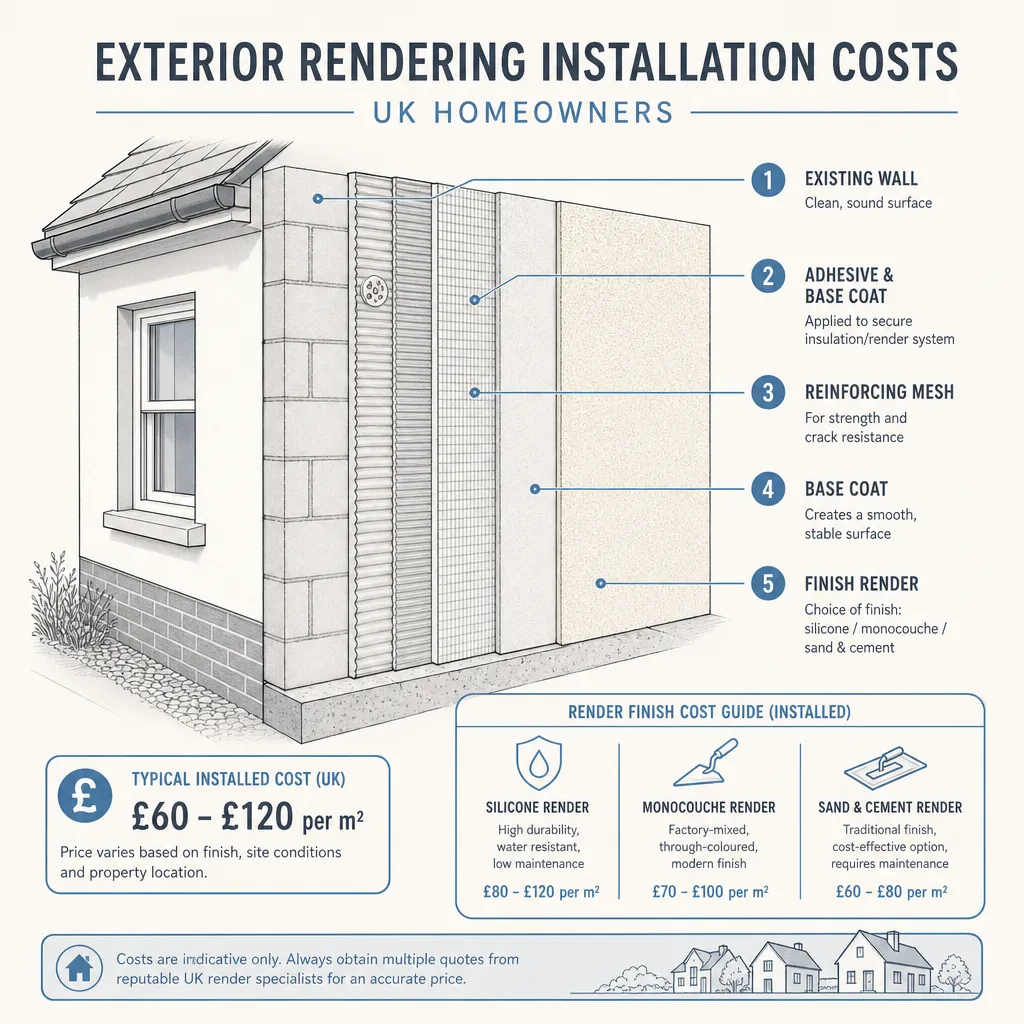
Exterior Rendering Installation Costs
Exterior rendering in the UK typically costs £20–£60 per square metre for standard render systems, or £80–£150 per square metre for External Wall Insulation with a render finish.
 Improvement & Build
Designing an outdoor kitchen for entertaining and garden living
An outdoor kitchen in a UK garden needs a stable, level base — typically a concrete slab or quality paving — with weather-rated materials such as stainless steel grade 316 or frost-rated porcelain.
 Improvement & Build
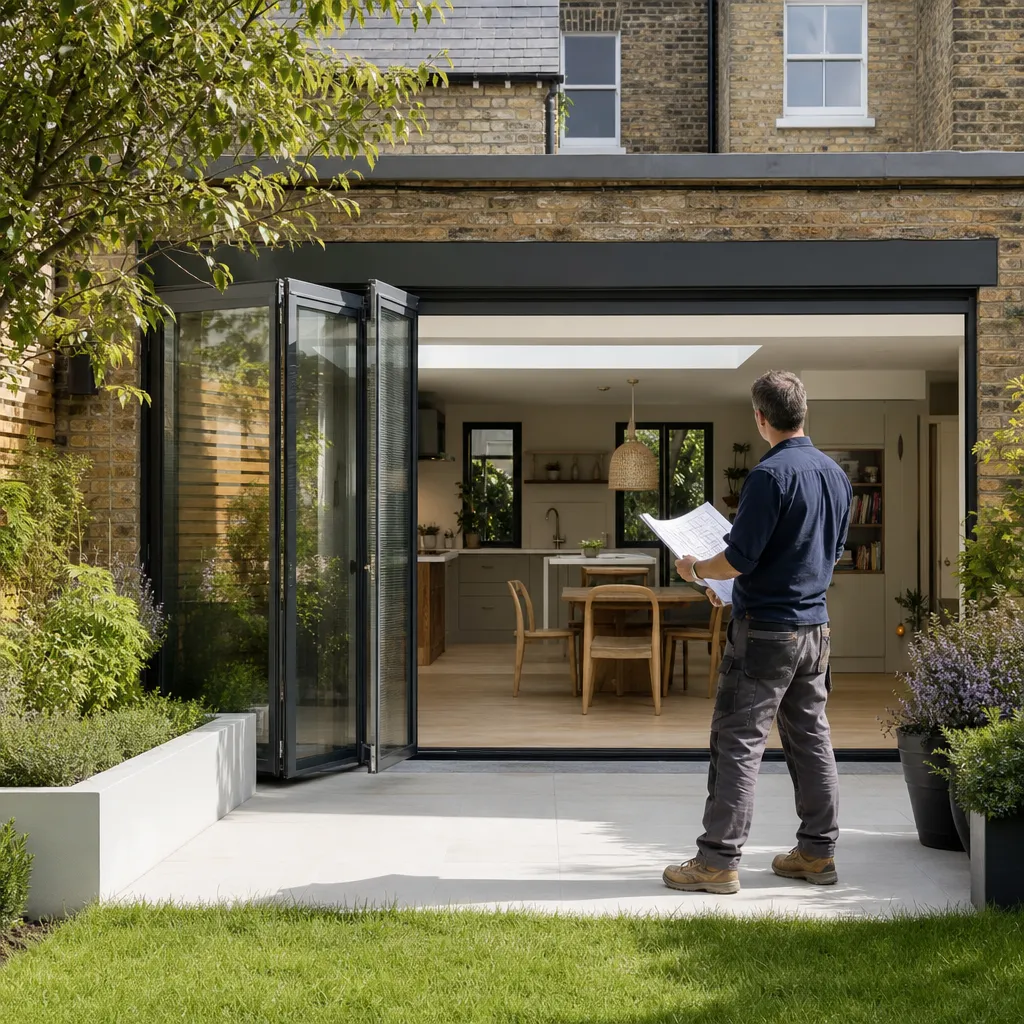
Home Improvement Projects That Add Value to Your Property
Loft conversions, rear extensions, and kitchen refurbishments typically offer the strongest return on investment for UK homeowners.
 Improvement & Build
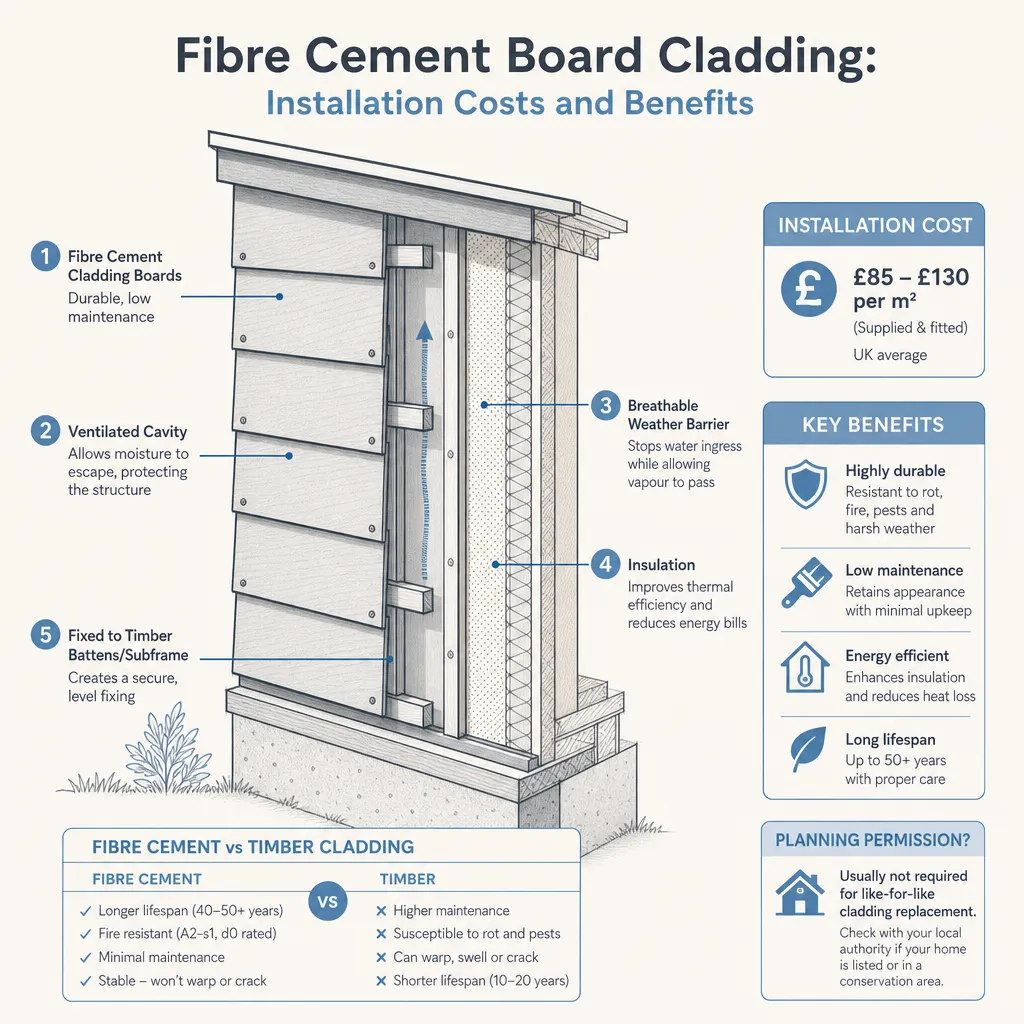
Fibre Cement Board Cladding: Installation Costs and Benefits
Fibre cement board cladding typically costs £80–£180 per m² installed in the UK, including boards, battens, breather membrane, and labour.
 Improvement & Build
Maximising Value Through Strategic Home Improvement Projects
In the UK, loft conversions and kitchen extensions tend to deliver the strongest return on investment, with loft conversions potentially adding around 20% to property value according to Nationwide data.