Fibre Cement Board Cladding: Installation Costs and Benefits
By Housey · Last reviewed 9th of May 2026
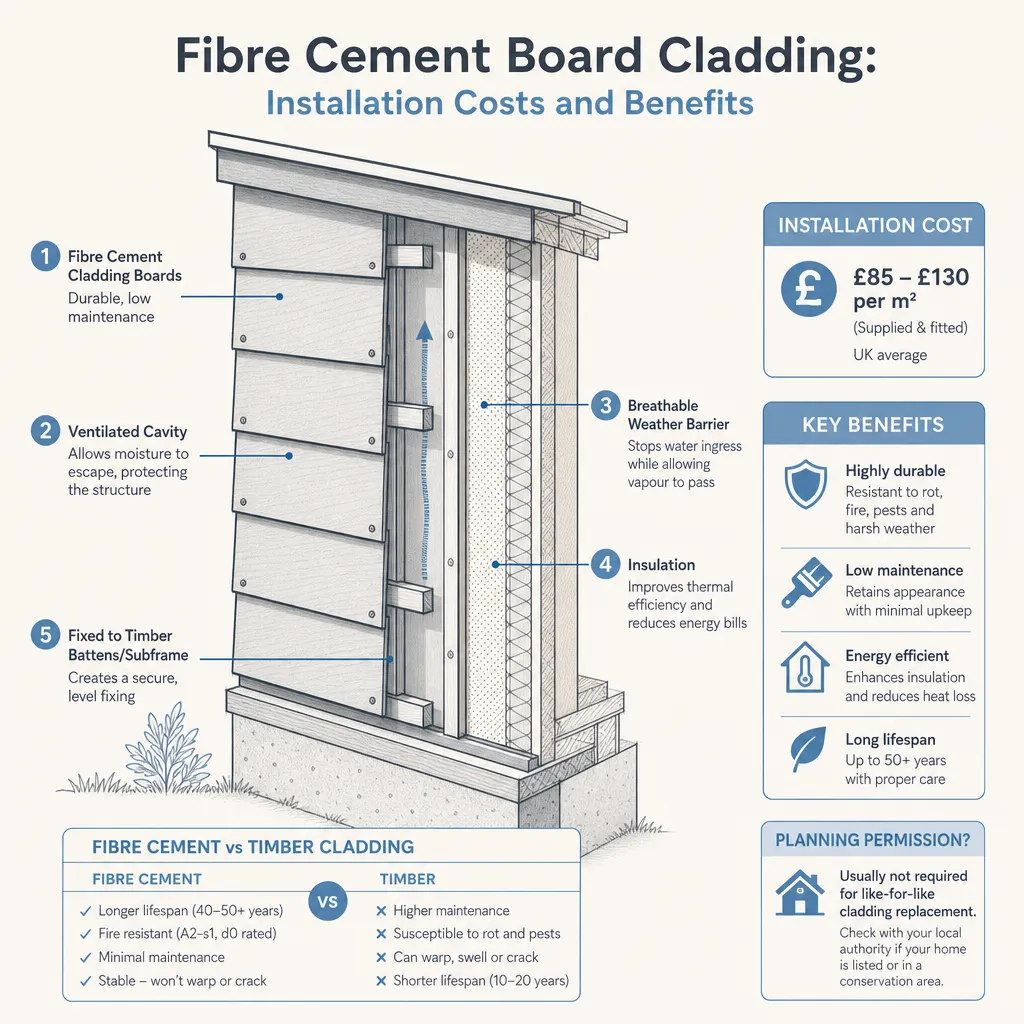
Fibre Cement Board Cladding: Installation Costs and Benefits
Fibre cement board cladding is increasingly chosen by UK homeowners upgrading the external finish of extensions, new builds, and older properties — particularly those seeking a low-maintenance, durable alternative to timber or render. Questions about cost and suitability typically arise during extension planning, full refurbishments, or when an existing cladding system reaches end of life. Getting the specification right from the outset avoids costly remediation and ensures compliance with Building Regulations.
Key points
- Fibre cement boards typically cost £30–£80 per m² for materials alone; total installed costs (including battens, fixings, breather membrane, and labour) commonly range from £80–£180 per m², depending on profile, finish, and access. (Indicative UK costs, last reviewed 2026-05-09.)
- Building Regulations Approved Document B (fire safety) and Approved Document C (site preparation and resistance to moisture) apply to external cladding systems, particularly on buildings over 11m in height.
- Fibre cement is non-combustible and typically classified A2-s1, d0 under EN 13501-1, making it suitable for buildings where combustible cladding is restricted under the Building Safety Act 2022.
- Most factory-finished fibre cement boards need re-coating every 10–15 years, compared with 3–5 years for untreated or painted timber cladding.
- Fibre cement is heavier than PVCu or timber cladding — typically 14–25 kg/m² depending on product thickness — so the structural adequacy of fixings and the supporting wall should be checked, particularly on older or lightweight-frame properties.
What is fibre cement board cladding?
Fibre cement boards are manufactured from Portland cement, sand, cellulose fibre, and water, compressed and cured under high pressure. The result is a rigid, dimensionally stable panel that resists moisture, rot, and insects — common vulnerabilities for timber cladding in the UK's wet climate. Products are available in flat, textured, lap (weatherboard), and large-format panel profiles, allowing them to mimic the appearance of timber boarding or offer a clean contemporary finish.
Well-known ranges in the UK include Cedral (by Eternit), HardiePlank and HardiePanel (James Hardie), and Marley Equitone. Each manufacturer publishes installation guidelines that contractors should follow to maintain warranty validity and Building Regulations compliance.
How much does fibre cement cladding cost to install in the UK?
The following ranges are indicative. Actual costs depend on profile choice, storey height, scaffold requirements, substrate condition, and regional labour rates.
Cost element | Typical range (per m²) | Notes |
|---|---|---|
Fibre cement boards (supply) | £15–£50 | Lap/plank profiles at lower end; large-format panels higher |
Battens, fixings, breather membrane | £8–£20 | Ventilated rainscreen systems require more components |
Labour (fixing) | £25–£60 | Higher for complex elevations, upper floors, or numerous cut-outs |
Scaffolding (amortised) | £5–£20 | Significant cost driver on two-storey or taller properties |
Total installed (typical) | £80–£180 | Indicative UK costs, last reviewed 2026-05-09 |
For a standard two-storey extension with approximately 60 m² of external wall to clad, total costs could range from roughly £4,800 to £10,800 depending on specification and location. Always request itemised quotes from at least three contractors. Prices in London and the South East typically sit at the upper end of these ranges.
What affects the cost of fibre cement cladding installation?
Several factors can push costs above or below the typical range:
- Profile and finish: Large-format panels require fewer joints but are heavier and harder to handle. Textured or pre-finished boards carry a premium over plain-primed fibre cement.
- Substrate condition: If the existing wall requires repair, re-rendering, or additional insulation boards before cladding, this adds to overall cost. Insulated systems improve thermal performance under Building Regulations Part L but increase material and labour costs.
- Ventilated vs direct-fix: Ventilated rainscreen systems — where boards are fixed on a battened frame with a clear drainage and ventilation cavity — are widely recommended in the UK and perform better in terms of moisture management than direct adhesive-fix methods.
- Access and height: Ground-floor cladding on a single-storey extension is far cheaper to install than two- or three-storey elevations requiring scaffold.
- Fire compliance: On residential buildings over 11m above ground level, the Building Safety Act 2022 and Approved Document B restrict combustible materials on external walls. Formal fire safety assessment of the whole system may be required and adds cost.
Fibre cement vs other cladding types
Cladding type | Best for | Not ideal for | Approx. installed cost per m² | Key risk |
|---|---|---|---|---|
Fibre cement board | Contemporary exteriors; fire-sensitive buildings; low-maintenance priority | Period properties where timber is planning-preferred; tight budgets | £80–£180 | Incorrect fixing voids manufacturer warranty |
Timber (treated softwood or hardwood) | Traditional aesthetics; listed buildings; smaller projects | High-moisture exposures without good detailing; fire-restricted zones | £60–£160 | Rot, swelling, regular maintenance required |
PVCu weatherboard | Budget refurbishments; rental properties | Design-led projects; buildings with fire restrictions | £40–£100 | UV colour fade; limited aesthetics |
Render (silicone through-colour) | Masonry properties; seamless appearance | Timber-frame with movement risk | £50–£120 | Cracking at junctions |
Metal panel (aluminium or steel) | High-spec extensions; commercial-look residential | Budget-constrained projects | £120–£300 | Thermal bridging if poorly detailed |
Indicative UK costs, last reviewed 2026-05-09. Obtain current quotes before budgeting.
Does fibre cement cladding need planning permission?
In most cases, replacing or adding cladding to an existing house falls within permitted development rights, meaning planning permission is not required — provided the materials are of a similar appearance to those used in the construction of the existing house. However, there are important exceptions:
- Conservation areas and Article 4 Directions: Permitted development rights for external changes are commonly removed in conservation areas, requiring planning consent before changing cladding material, colour, or profile.
- Listed buildings: Listed Building Consent is required for any material alteration to a listed building's external appearance.
- New cladding as part of an extension: If the extension itself requires planning permission, the cladding specification will be assessed as part of that application.
- Flats and purpose-built blocks: Permitted development rights do not apply to flats in the same way as houses. Check with your local planning authority (LPA) before proceeding.
Always check with your LPA if there is any uncertainty, particularly before purchasing materials or instructing a contractor.
Which professional do you need?
Stage | Professional | Why |
|---|---|---|
Design and specification | Architect or architectural technologist | Ensures compliance with Approved Documents B and C; details junctions and cavity correctly |
Installation on an extension | Extension builder with cladding experience | Coordinates waterproofing, structural connections, and window reveals |
Fire compliance (buildings over 11m) | Fire engineer or façade consultant | Mandatory assessment for buildings within scope of the Building Safety Act 2022 |
Planning advice | Planning consultant or LPA pre-application service | Needed in conservation areas or where permitted development rights are restricted |
What to ask before accepting a quote
- Which specific product, manufacturer, and system is being quoted — including board thickness and profile?
- Is a ventilated rainscreen cavity included, and what batten specification and breather membrane is proposed?
- What warranty does the manufacturer offer, and what installer accreditation is required to keep it valid?
- Is the price based on the existing substrate being in good condition, or does it allow for remedial work?
- Is scaffolding included, or will this be a separate cost?
- Is VAT included?
- What certification or sign-off documentation will be provided on completion?
When to get professional help
Fibre cement cladding installation is a specialist task, and errors in fixing, joint detailing, or fire specification can lead to moisture ingress, voided warranties, or Building Regulations non-compliance. Seek professional input if:
- The property is in a conservation area, is listed, or has an Article 4 Direction removing permitted development rights.
- The building is over two storeys or you are uncertain about fire compliance requirements under Approved Document B.
- The existing wall shows evidence of dampness, cracking, or structural movement — the underlying issue must be resolved before new cladding is applied.
- You are combining cladding with external wall insulation as part of a retrofit project, which requires careful moisture and thermal bridging detailing.
How Housey can help
If you are planning an extension or external refurbishment that includes fibre cement cladding, Housey can connect you with vetted extension builders who have experience with rainscreen cladding systems. For projects that also involve structural preparation or groundworks ahead of cladding installation, you can request quotes from groundworkers on the same platform.
Frequently asked questions
Does fibre cement cladding need painting?
Most boards are supplied pre-primed or factory-finished. Pre-finished boards need little maintenance, though a refresh coat every 10–15 years helps maintain appearance and weathering performance. Plain-primed boards must be overcoated with a suitable masonry or exterior paint before exposure to weather. Always follow the manufacturer's finishing specification to maintain warranty validity and ensure Building Regulations compliance.
Is fibre cement cladding fire-safe?
Fibre cement is a non-combustible material, typically classified A2-s1, d0 under EN 13501-1 when tested. This makes it suitable for buildings where combustible cladding is restricted under the Building Safety Act 2022. However, the entire cladding system — including insulation, fixings, and cavity barriers — must comply with Approved Document B. On residential buildings over 11m, a formal system-level fire safety assessment is required.
How long does fibre cement cladding last?
Manufacturers typically offer product warranties of 15–25 years. Many installations last 30–50 years or more when correctly specified, installed, and maintained. Longevity depends on correct junction detailing, ventilated cavity provision, appropriate finishing, and periodic inspection to identify any cracked or displaced boards before moisture can penetrate behind the system.
Can fibre cement cladding be installed over existing render?
This depends on the condition and adhesion of the existing render. A ventilated rainscreen system fixed through battens into the structural substrate is usually the safest approach, as it avoids relying on potentially deteriorating existing surfaces. A contractor or architect should assess the substrate before specifying the fixing method — do not assume existing render provides a sound base without checking.
Sources and further reading
- Building Regulations Approved Document B (Fire Safety) — GOV.UK
- Building Regulations Approved Document C (Moisture Resistance) — GOV.UK
- Building Safety Act 2022 — legislation.gov.uk
- Permitted development rights for householders: technical guidance — GOV.UK
- BS EN 13501-1 Fire classification of construction products — BSI Group
Useful next reads
 Improvement & Build
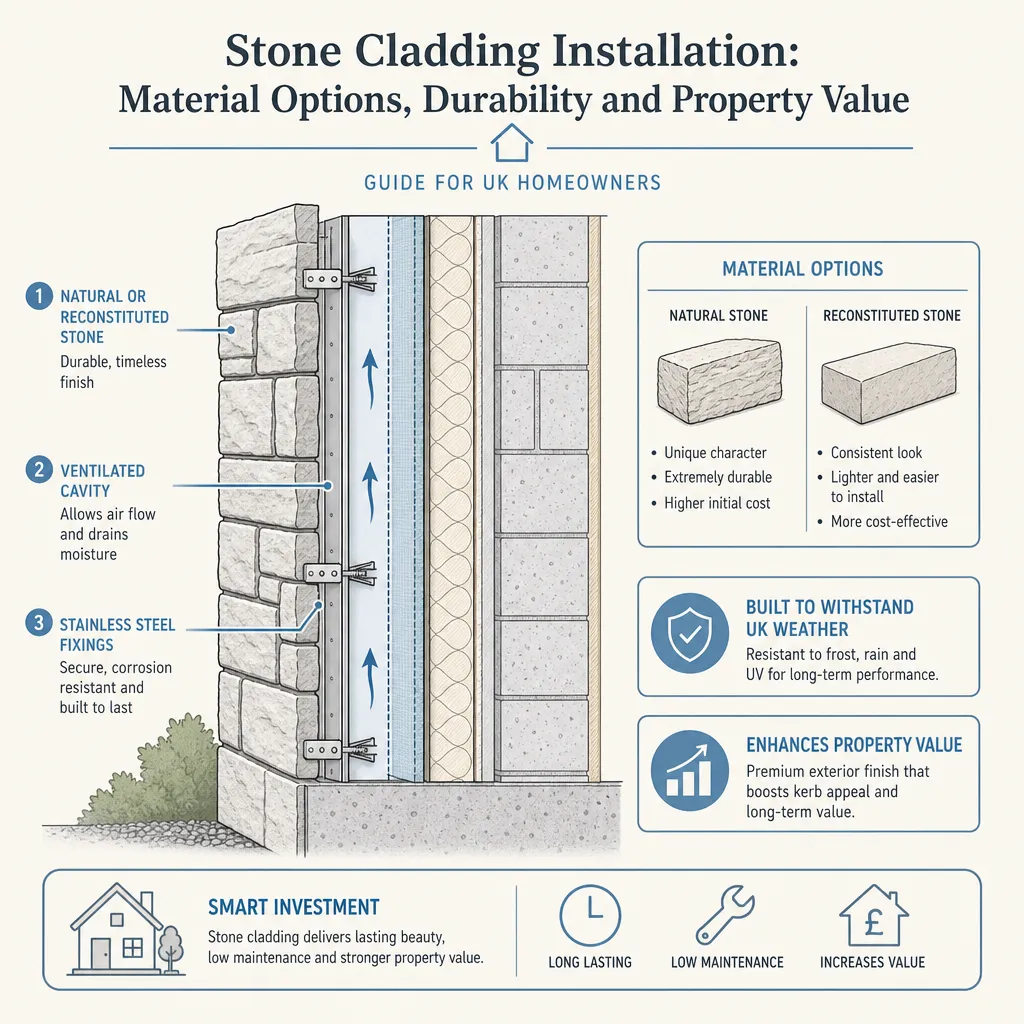
Stone Cladding Installation: Material Options, Durability and Property Value
Stone cladding adds texture and character to a UK property's exterior and can improve weather protection, but installation quality is critical — poorly fixed cladding can trap moisture and cause structural damage.
 Improvement & Build
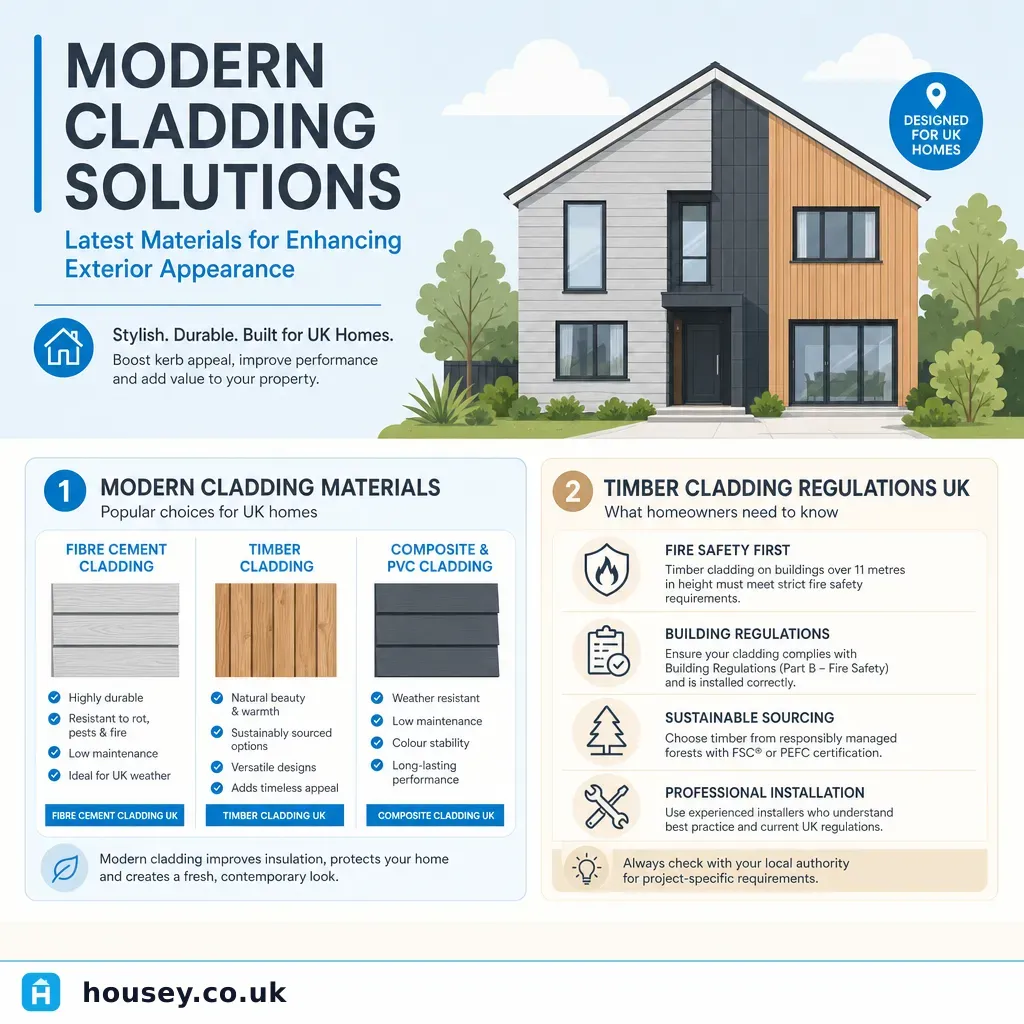
Modern Cladding Solutions: Latest Materials for Enhancing Exterior Appearance
Modern cladding options for UK homes include fibre cement, timber, brick slips, render, and metal.
 Improvement & Build
Soundproofing Materials and Acoustic Treatments for UK Homes
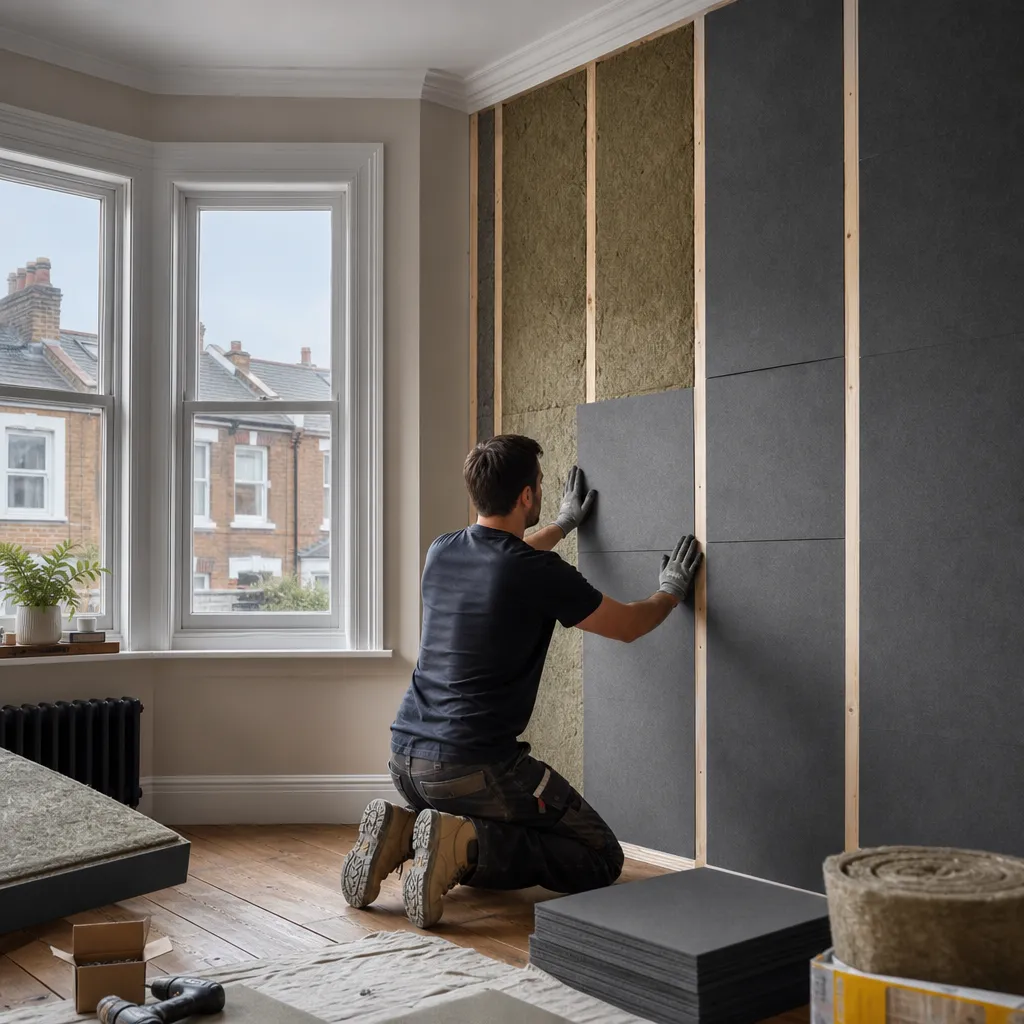
Effective soundproofing in UK homes combines three principles: mass (adding weight with acoustic plasterboard or mass-loaded vinyl), decoupling (breaking the vibration path with resilient bars or an independent frame), and absorption (filling cavities with dense mineral wool).
 Improvement & Build
Exterior Rendering Installation Costs
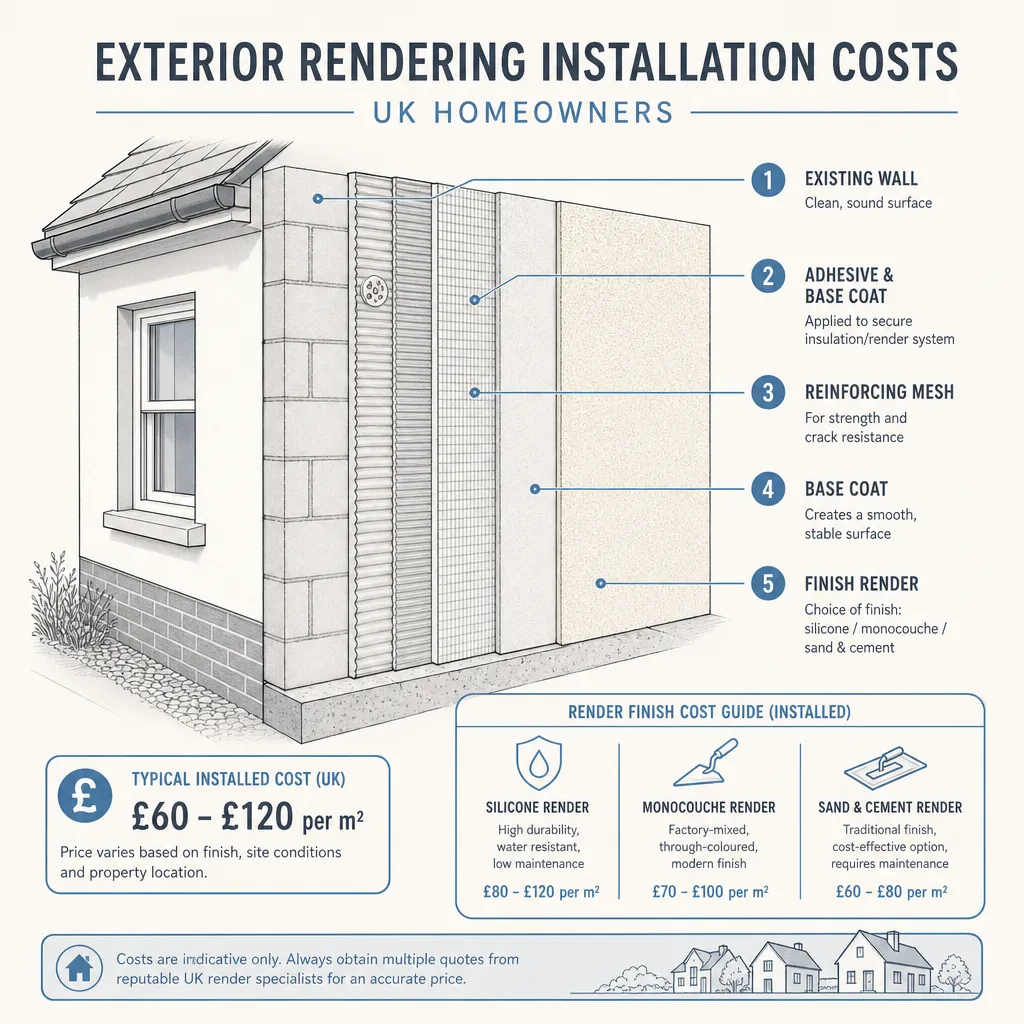
Exterior rendering in the UK typically costs £20–£60 per square metre for standard render systems, or £80–£150 per square metre for External Wall Insulation with a render finish.
 Improvement & Build
Designing an outdoor kitchen for entertaining and garden living
An outdoor kitchen in a UK garden needs a stable, level base — typically a concrete slab or quality paving — with weather-rated materials such as stainless steel grade 316 or frost-rated porcelain.