Exterior Rendering Installation Costs
By Housey · Last reviewed 7th of May 2026
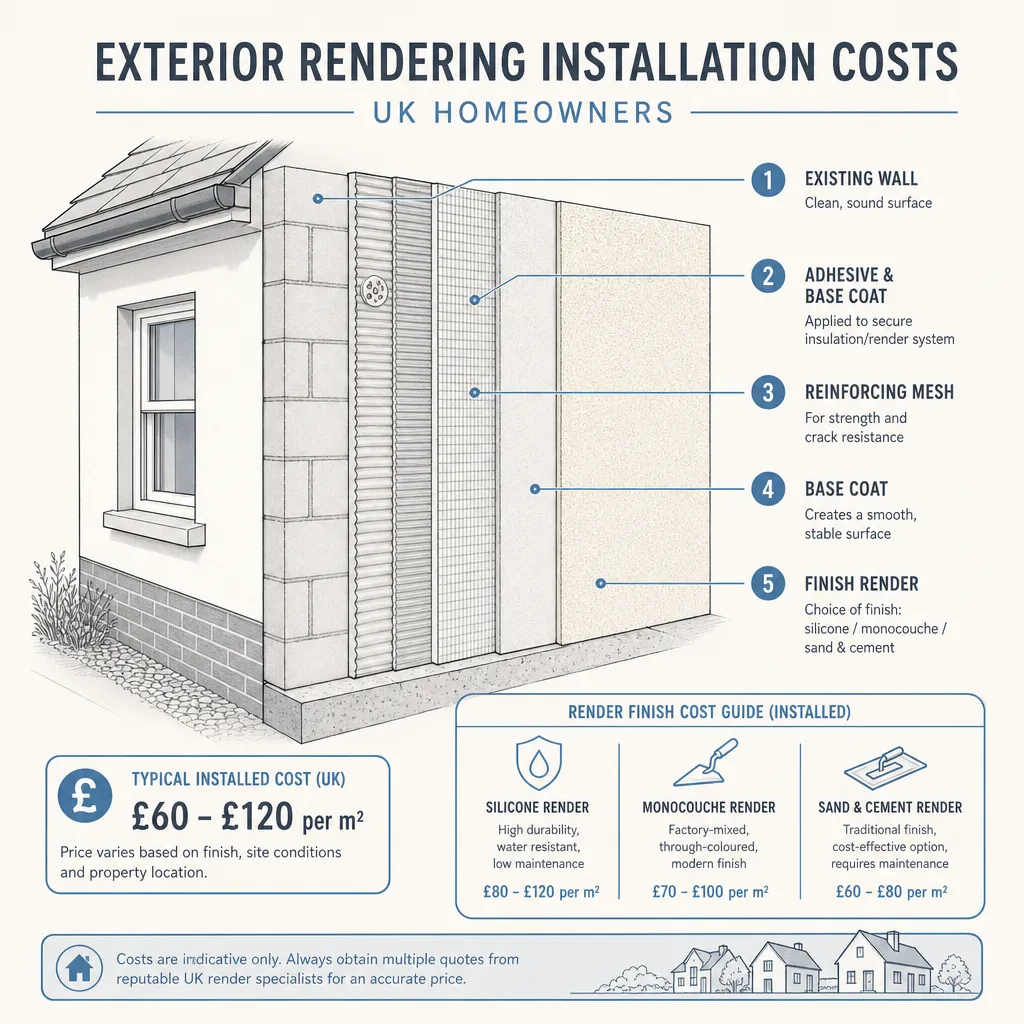
Exterior Rendering Installation Costs
When a property's external walls are visibly deteriorating — crumbling patches, failed paintwork, or old pebbledash that has blown away from the substrate — rendering can restore weatherproofing and transform kerb appeal in a single project. Homeowners typically face this decision during a general exterior refurbishment, following an extension build that leaves unrendered wall sections, or when repeated patch repairs have proved ineffective and a fresh start makes more financial sense.
Key points
- Rendering a semi-detached house typically costs £3,000–£8,000 depending on render type, property size, and the extent of surface preparation required. (Indicative UK costs, last reviewed 2026-05-07.)
- Silicone render is the most widely specified modern choice, valued for its flexibility, integral colour stability, and resistance to cracking and algae growth.
- Sand and cement render is the traditional and cheapest option per square metre to apply, but it is more prone to cracking and requires painting every five to eight years.
- Render on a standard residential property in England generally falls under permitted development and does not require a planning application, but listed buildings and conservation area properties are likely exceptions.
- External Wall Insulation (EWI) combines insulation board with a render finish; PAS 2035-compliant EWI may qualify for funding under ECO4 or the Great British Insulation Scheme for eligible households.
Types of exterior render and how they compare
Choosing the right render system depends on your wall substrate, budget, desired maintenance level, and whether thermal insulation is a priority.
Render type | Best for | Typical cost per m² (supply and fit) | Maintenance | Expected lifespan |
|---|---|---|---|---|
Sand and cement | Traditional properties; budget-conscious owners | £20–£35 | Painting every 5–8 years | 20–30 years if maintained |
Monocouche (through-coloured) | Modern or recently built homes; consistent integral colour | £35–£55 | Low; colour is part of the mix | 25–35 years |
Silicone (thin-coat) | Most property types; flexible and self-cleaning | £40–£60 | Very low | 25+ years |
Acrylic | Quicker application; wide range of coloured finishes | £30–£50 | Low; occasional cleaning | 15–25 years |
EWI with render finish | Solid-wall homes needing insulation upgrade | £80–£150+ | Low | 30+ years (system dependent) |
Indicative UK costs, last reviewed 2026-05-07. Prices vary by region, scaffold requirement, surface condition, and supplier.
What drives the cost of exterior rendering?
Surface preparation
The largest variable cost. If existing render is cracking, hollow, or has delaminated from the substrate, it must be removed before new render can be applied. Hacking off old render can add £10–£20 per m² to the overall cost and significantly extends the programme.
Scaffolding
Most rendering projects on a two-storey or higher property require full scaffolding. Scaffold hire typically costs £600–£1,500 for a standard semi-detached property, depending on size and duration. This is often bundled into a combined quote but should be confirmed explicitly before accepting.
Property size and shape
Costs scale with wall surface area. A mid-terrace house may have 60–90 m² of external elevation; a detached family home may have 200–350 m². Complex shapes, projecting bay windows, and recessed porches add labour time and material.
Render system and insulation
Standard thin-coat renders cost considerably less per m² than EWI systems, which include insulation boards, mechanical fixings, mesh reinforcement, and a specialist render finish. EWI can reduce heating bills noticeably in solid-wall homes and may attract grant funding that offsets the higher upfront cost.
Region
Labour costs are higher in London and the South East. Expect a 15–25% premium over national average costs for work in central London compared to northern England or the Midlands.
A worked UK scenario
Scenario: A homeowner in Sheffield owns a 1930s semi-detached house with original pebbledash that is crumbling in patches and has been repaired multiple times over the years.
- Total wall surface area of front and side elevations: approximately 110 m².
- Around 80 m² of pebbledash is failing and must be removed; the remainder is sound and can remain.
- Three quotes were obtained: £5,800, £7,200, and £6,450.
- The lowest quote specified sand and cement render only with no written warranty; the two higher quotes specified silicone thin-coat with a 10-year materials and workmanship guarantee.
- The homeowner chose the £6,450 quote from a manufacturer-accredited installer, which included scaffold erection and removal, full surface preparation, and written guarantee documentation.
The choice of render system — not just the headline price — determined the long-term value outcome in this scenario.
Planning permission and permitted development
Rendering a house generally falls under permitted development for standard residential properties in England, meaning no planning application is required.
Exceptions where consent may be needed:
- Listed buildings: Any change to external appearance, including render type or colour, typically requires Listed Building Consent. Carrying out work without consent is a criminal offence.
- Conservation areas: Applying render for the first time or changing the render type may require prior approval or Conservation Area Consent — check with your local planning authority before starting work.
- Article 4 directions: Some councils restrict changes to external materials in specific streets or areas via Article 4 directions. Your local planning authority can confirm whether one applies to your property.
Always check with your local planning authority before starting work on a listed building or in a conservation area. Enforcement action can require you to reinstate the original finish at your own cost.
Render and energy efficiency
A standard render finish alone provides very limited insulation benefit. If improving thermal performance is a priority, consider the following options.
External Wall Insulation (EWI): Insulation boards are fixed to the wall surface and finished with a render system. EWI can meaningfully improve the energy rating of a solid-wall property, which typically has a U-value of around 2.0 W/m²K uninsulated. A well-installed EWI system can reduce this to approximately 0.3 W/m²K.
ECO4 and the Great British Insulation Scheme: Owner-occupiers in eligible solid-wall homes may qualify for grant funding toward EWI installation. Eligibility depends on household income, existing EPC rating, and property type. Check current criteria via GOV.UK or the Energy Saving Trust, as schemes are subject to change.
PAS 2035 compliance: EWI projects using government-backed funding must comply with PAS 2035, which requires a retrofit assessment by a qualified Retrofit Coordinator and installation by a TrustMark or MCS-registered contractor. Work that does not comply with PAS 2035 may be ineligible for funding.
Red flags when reviewing rendering quotes
Watch for these warning signs when comparing estimates:
- No written specification: A quote that does not name the render system, manufacturer, or number of coats leaves you unprotected if standards slip during the job.
- No mention of scaffolding: If a quote seems unusually low, confirm whether scaffold is excluded from the price.
- No warranty: Reputable installers of silicone and monocouche render typically offer at least a 5–10 year workmanship guarantee alongside manufacturer product guarantees.
- No surface assessment: A renderer who quotes without checking whether the existing render is sound is a significant risk — failure to identify hollow areas is a common cause of early re-render failure.
- Cash-only payment with no written contract: Paying entirely in cash with no written agreement offers limited recourse if the work is substandard or incomplete.
What to ask before accepting a rendering quote
- What render system (manufacturer and product name) is being specified?
- How many coats, and what are the base coat and topcoat specifications?
- Is scaffold included in the price, and who is responsible for its erection and removal?
- Will existing render be removed, and how have you confirmed the remaining surface is sound?
- What warranty on materials and workmanship is offered, and will it be provided in writing?
- Are you a manufacturer-accredited or trade-body-registered installer?
- Is VAT included in the quoted price?
- How will waste material be disposed of, and how will the site be managed during the works?
When to get professional help
Rendering is skilled plastering work; surface preparation and application technique directly affect how long the finished coat lasts. Seek professional advice before proceeding when:
- Your property is listed or in a conservation area — consult your local planning authority and a conservation specialist before instructing any contractor.
- Existing render is failing extensively across the whole building, which may indicate a deeper moisture ingress or substrate issue that needs diagnosing before new render is applied.
- You are considering EWI — a PAS 2035 retrofit assessment is required for grant-funded work, and installation must be by a TrustMark or MCS-registered contractor.
- Render failure keeps recurring in the same area, which may indicate water ingress from gutters, roof, or window flashings that should be resolved before re-rendering.
How Housey can help
Housey helps homeowners request quotes from qualified tradespeople for exterior rendering and associated improvement work. If your rendering project forms part of a wider build or extension, you may also need extension builders for the structural work. For associated roofing or weatherproofing that should be completed before new render is applied, roofers can also be found through Housey.
Frequently asked questions
Does rendering a house add value?
Fresh, well-maintained render can improve kerb appeal and may support property value, particularly where neighbouring properties appear tired or the existing finish is visibly failing. Value uplift is not guaranteed and depends on local market conditions. An independent valuer can advise on likely impact for your specific property.
How long does it take to render a house?
A standard semi-detached property typically takes 3–7 working days, depending on the render system, extent of surface preparation, and weather conditions. Silicone thin-coat systems require a primer and at least one topcoat with drying time between coats. Cold or wet weather can extend the programme.
Can I render over existing render?
Only if the existing render is fully sound — no hollow spots, cracks, or delamination. A competent renderer will check by tapping the surface. If more than roughly 20–30% is hollow or failing, it is generally better to remove the whole surface and start fresh rather than risk delamination of the new coat.
Do I need building regulations approval for rendering?
Straightforward re-rendering with like-for-like materials on a standard property does not usually require building regulations approval. If you are installing External Wall Insulation, Building Regulations Part L (conservation of fuel and power) and Part C (moisture resistance) are likely to apply, and you should engage a building control body before starting work.
Is render better than cladding for a UK home?
They serve different purposes. Render is wet-applied and bonds to the wall; cladding is a panel system fixed in front of it. Render is generally cheaper, integrates better with traditional masonry, and is easier to repair locally. Cladding offers more design variety and, in some systems, better insulation performance. The right choice depends on property type, budget, and maintenance preference.
Sources and further reading
- Permitted development rights for householders: technical guidance — GOV.UK
- External wall insulation — Energy Saving Trust
- Apply for the Great British Insulation Scheme — GOV.UK
- Plaster, renders and external wall coatings — Historic England
- Planning Portal: Exterior works guidance — permitted development guidance for householders
Useful next reads
 Improvement & Build
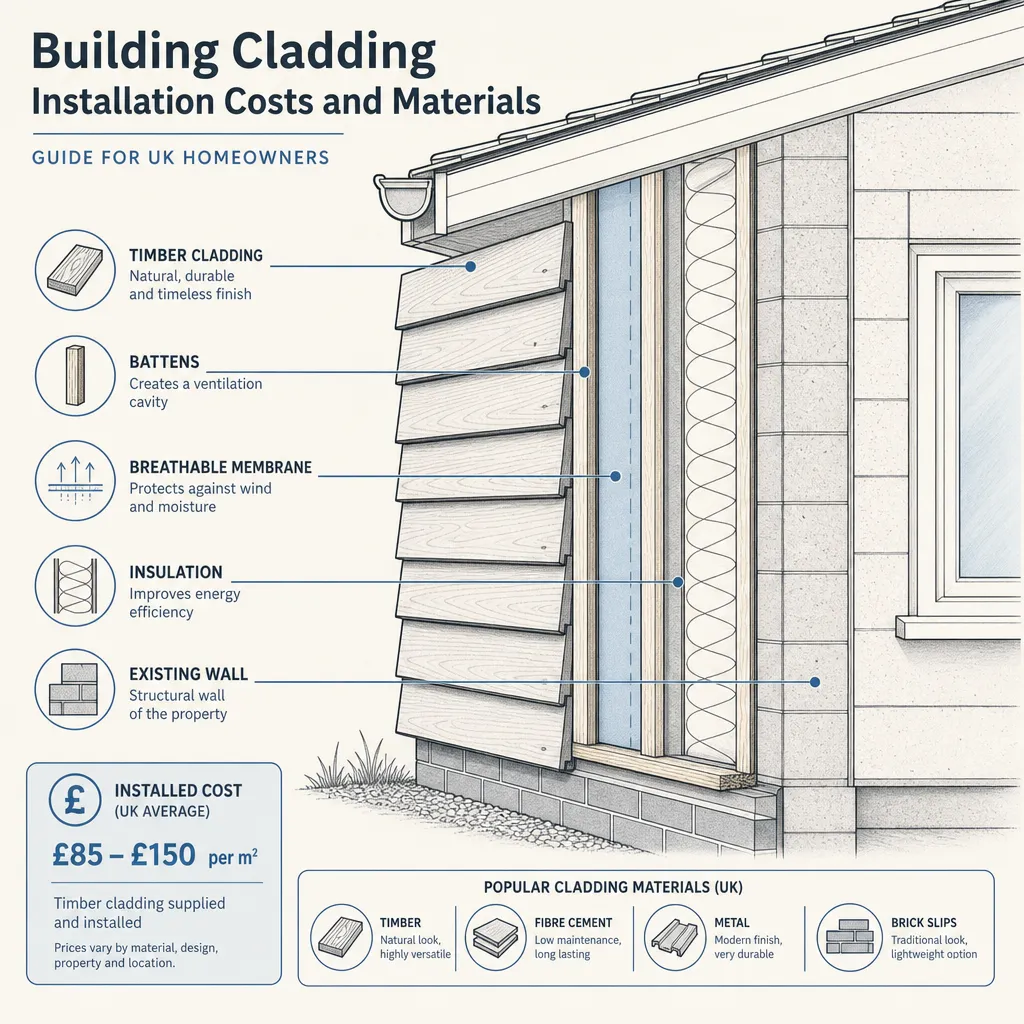
Building Cladding Installation Costs and Materials
External cladding in the UK typically costs £40–£200 per m² installed, depending on material choice, wall preparation, and scaffold requirements.
 Improvement & Build
Designing an outdoor kitchen for entertaining and garden living
An outdoor kitchen in a UK garden needs a stable, level base — typically a concrete slab or quality paving — with weather-rated materials such as stainless steel grade 316 or frost-rated porcelain.
 Improvement & Build
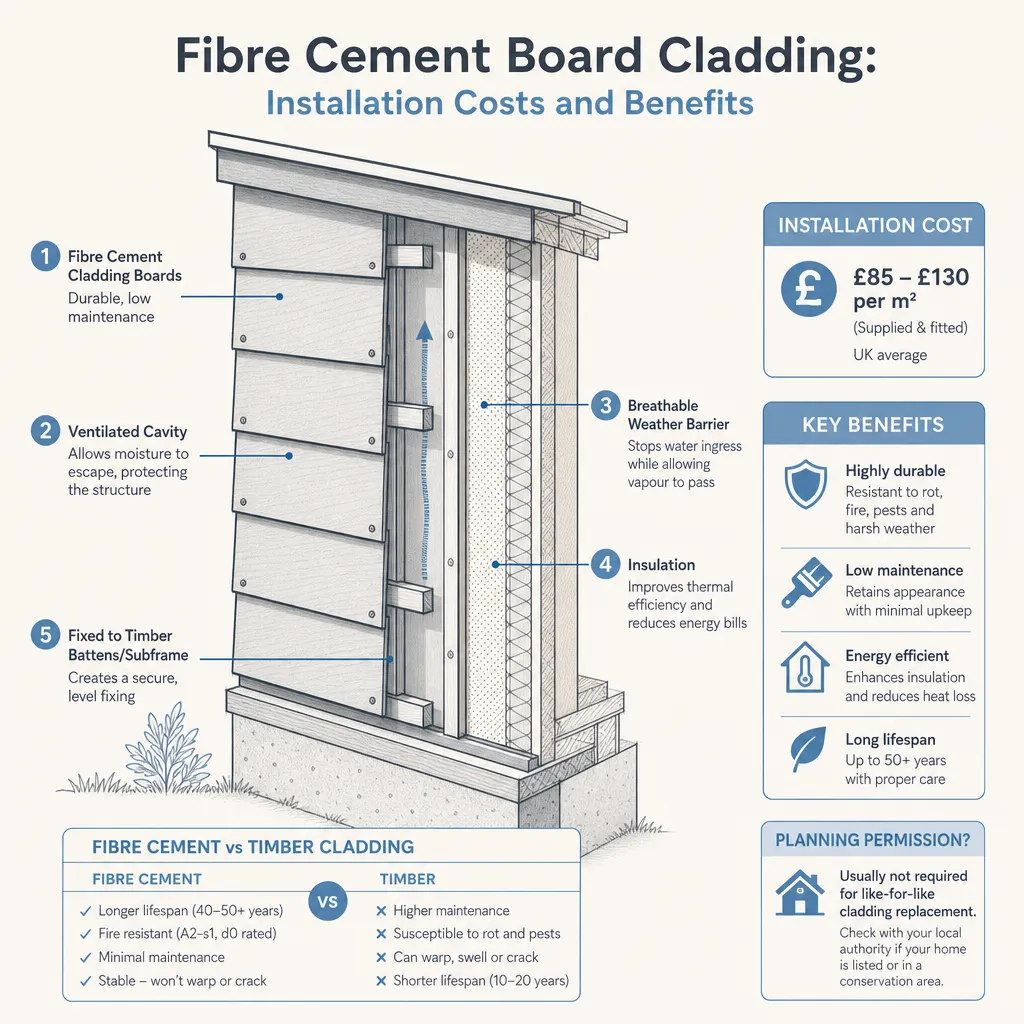
Fibre Cement Board Cladding: Installation Costs and Benefits
Fibre cement board cladding typically costs £80–£180 per m² installed in the UK, including boards, battens, breather membrane, and labour.
 Improvement & Build
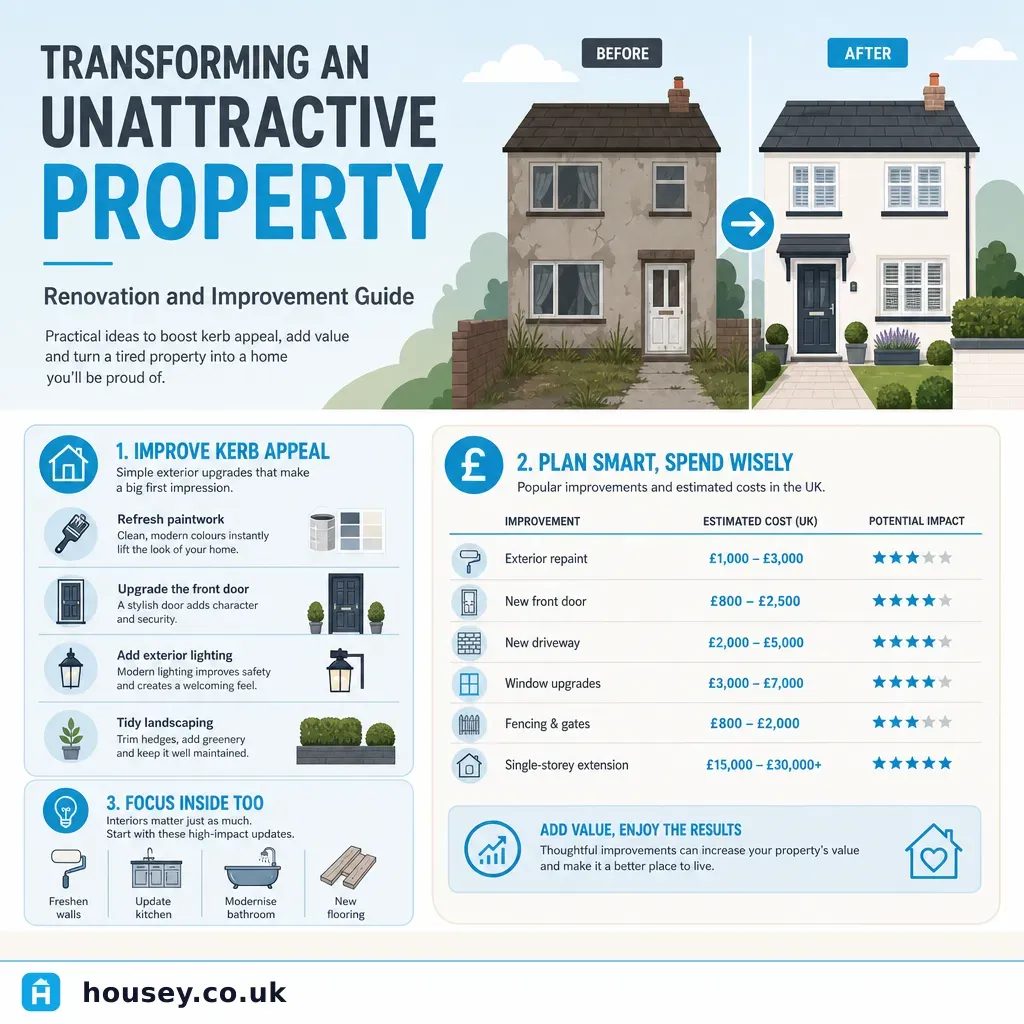
Transforming an Unattractive Property: Renovation and Improvement Guide
Transforming an unattractive UK property usually starts with surface-level improvements — render, windows, doors, and front landscaping — before tackling structural changes like extensions.
 Improvement & Build
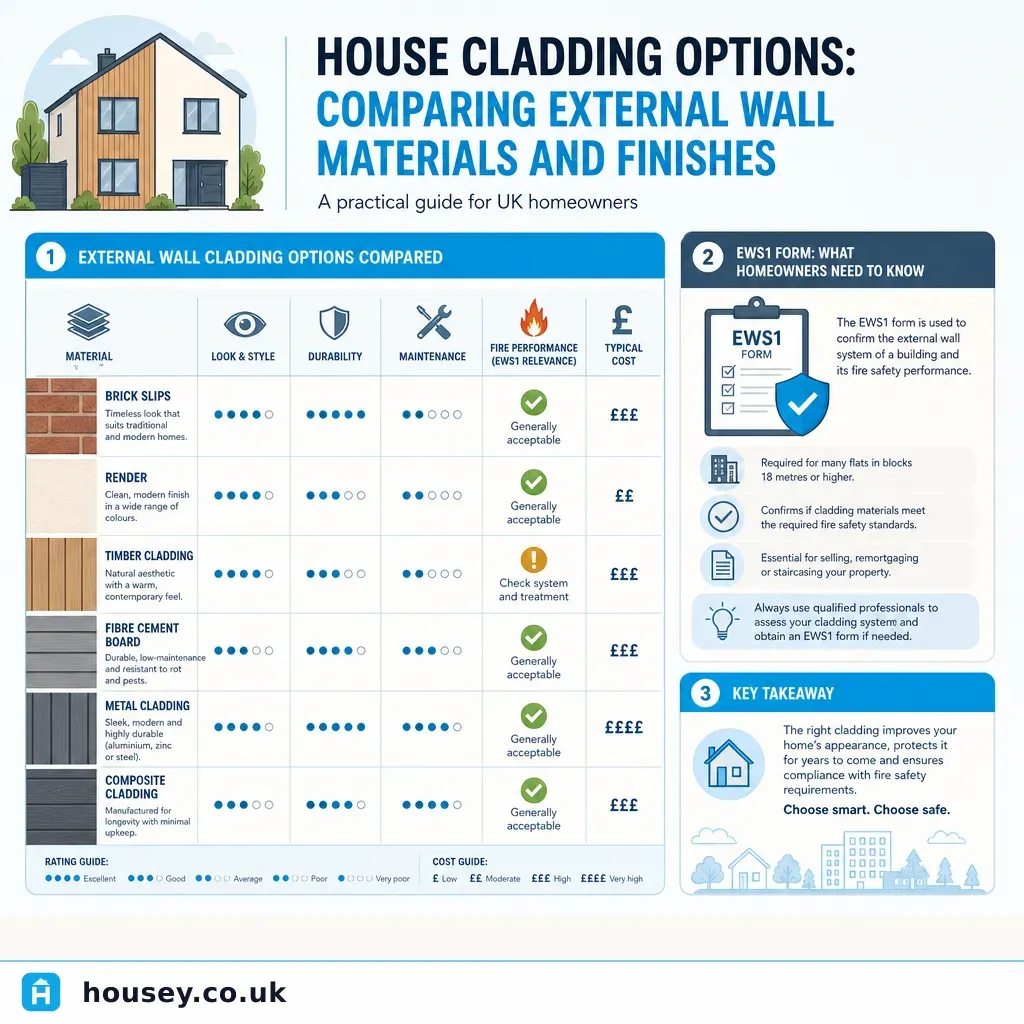
House Cladding Options: Comparing External Wall Materials and Finishes
External cladding materials for UK homes include render over insulation, brick slips, timber boards, metal panels, and fibre cement.