Bay Windows: Characteristics, Installation, and Architectural Benefits
By Housey · Last reviewed 19th of May 2026
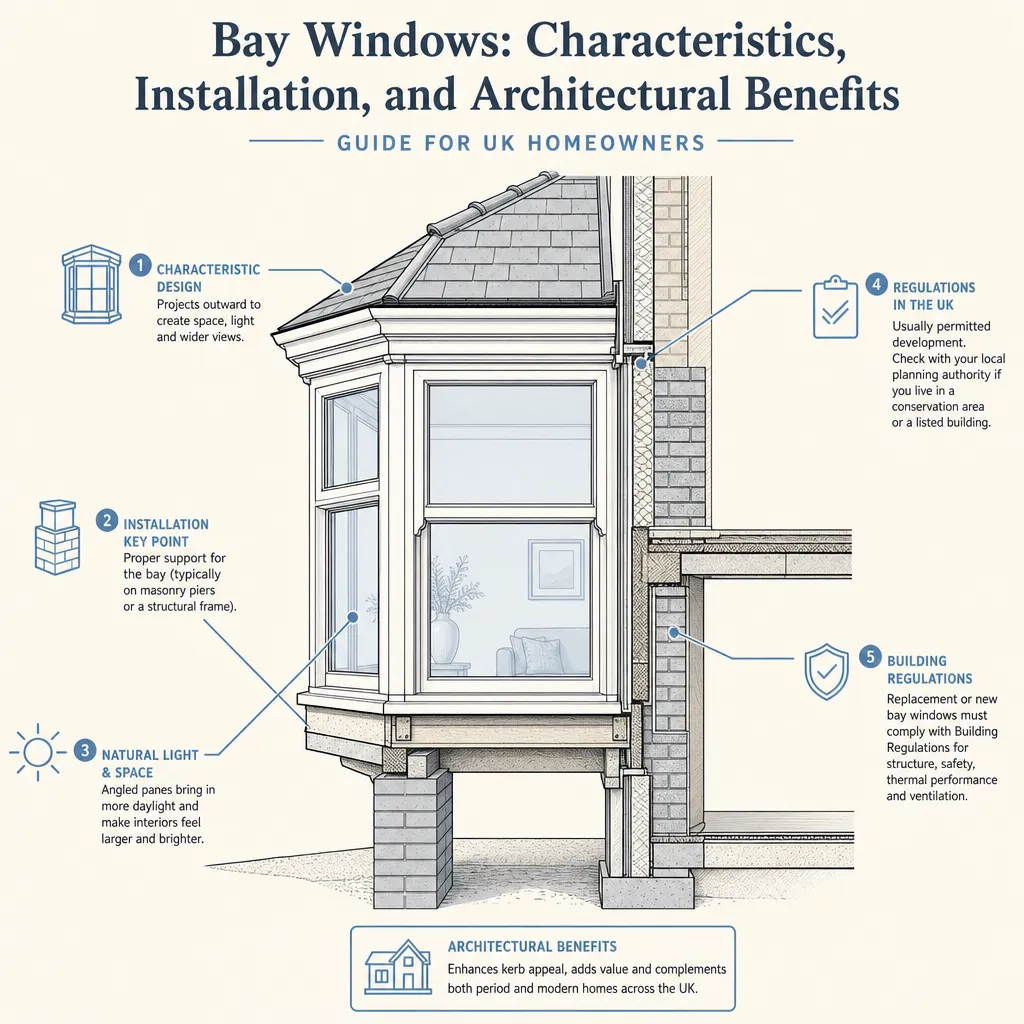
Bay Windows: Characteristics, Installation, and Architectural Benefits
Bay windows are one of the most recognisable features of British domestic architecture, appearing on Victorian terraces, Edwardian semis, 1930s estate houses, and contemporary ground-floor extensions alike. Whether you are replacing an ageing bay, considering adding one as part of an alteration, or trying to understand what you already have, the decisions involved touch on planning rules, building control compliance, glazing standards, and structural adequacy.
Key points
- Replacement windows in England must achieve a minimum whole-window U-value of 1.4 W/m²K under Building Regulations Approved Document L (2021 edition); frame-only replacements retaining existing glazed units must meet 1.6 W/m²K.
- All replacement window installations must be self-certified by a FENSA or CERTASS registered installer, or formally notified to local authority building control before work begins — an uncertified installation will need to be regularised before a property can be sold.
- Most like-for-like bay window replacements in England are permitted development and require no planning application, but listed buildings, conservation areas, and properties subject to Article 4 Directions are common exceptions.
- A canted bay projects at 45° on each side; a box bay uses 90° square returns; a bow window is formed from three or more sections to create a curved profile — each type suits different property styles and frontage widths.
- New bay openings and structural alterations to existing bays require a structural assessment, as the lintel above the projection and the floor structure below must be sized to carry the transferred load.
What is a bay window?
A bay window is a window assembly that projects outward beyond the main external wall, creating a shallow alcove inside the room. The projection adds usable floor area, improves daylighting from multiple angles, and gives the building external visual depth.
Bay windows appear widely on Victorian and Edwardian terraced and semi-detached housing throughout UK towns and cities. They are also common on 1930s and 1950s suburban semis and are frequently specified in contemporary ground-floor extensions to bring side light into rear living rooms.
Comparing bay window types
Type | Projection geometry | Best for | Not ideal for |
|---|---|---|---|
Box bay | 90° flat front with square returns | 1930s–1960s semis; modern extensions; maximises internal width | Narrow frontages where a 90° return may look disproportionately bulky |
Canted bay | Angled sides, typically 45° | Victorian and Edwardian terraces; the most common UK residential style | Wide plots where a full box bay would give more usable internal space |
Bow window | Curved profile, three or more sections | Period cottages; Georgian and Regency properties; feature elevations | Tighter budgets; custom curved glazing units add cost and lead time |
Does a bay window need planning permission?
In most cases, replacing an existing bay window like-for-like is permitted development in England and does not require a planning application. However, there are important exceptions.
You will likely need planning permission or consent if:
- The property is a listed building (any grade) — all window alterations typically require Listed Building Consent.
- The property is in a conservation area and the work materially alters the appearance of the principal elevation.
- An Article 4 Direction has removed permitted development rights in your area.
- The work involves creating a new opening in a party wall, which may also trigger obligations under the Party Wall etc. Act 1996.
In Wales, Scotland, and Northern Ireland, permitted development rules differ from those in England — always check with the relevant planning authority before commencing work.
Decision tree: permitted development or planning application?
- Choose permitted development (no application needed) if: like-for-like replacement on an undesignated residential property outside a conservation area with no Article 4 Direction.
- Check with your local planning authority (LPA) if: the property is in a conservation area, World Heritage Site, or Area of Outstanding Natural Beauty.
- Apply for Listed Building Consent if: the property is listed at any grade before instructing any installer.
- Check the Planning Portal or your LPA for Article 4 Directions if you are uncertain of your property's permitted development status.
- Seek party wall advice if: any new opening or structural alteration involves a shared or party wall.
Building Regulations for bay window replacements
Regardless of whether planning permission is required, replacement windows must comply with Building Regulations Approved Document L in England. The key thermal performance requirement is:
- Whole-window U-value: ≤ 1.4 W/m²K (Approved Document L, 2021, England)
- Frame-only replacement retaining existing glazed units: ≤ 1.6 W/m²K
All replacement installations must be either carried out by a FENSA or CERTASS registered competent person who self-certifies compliance and registers the work, or formally notified to your local authority building control before work starts, with a completion certificate issued on satisfactory inspection.
An uncertified installation is a building regulations breach. It will need to be regularised — usually through a retrospective building control application or an indemnity insurance policy — before the property can be sold. Always ask your installer for the FENSA or CERTASS certificate before they leave site.
Structural considerations for bay windows
Bay windows transfer load differently from a flat wall. The masonry above the window opening is carried by a lintel — for bay windows, typically a steel boot lintel or reinforced concrete lintel sized for the projection geometry. The floor structure or foundation below a bay window with a pitched or flat roof also carries its own weight and must be adequate.
When replacing an existing bay, a competent window installer will assess whether the existing lintels appear sound. When creating a new bay opening as part of an extension or significant alteration, a structural engineer should calculate lintel sizes and specify any propping required during construction.
Signs that the bay window structure may need professional assessment before work proceeds:
- Cracking or stepped cracking in the brickwork directly above or beside the bay
- Visible differential settlement between the bay and the main house wall
- Rotted timber cills that have allowed water to track into the masonry below
- Gaps between the bay roof flashing and the main wall, or signs of water ingress at the junction
For new bay additions forming part of a building project, Building Regulations Part A (Structure) will apply and building control will inspect the structural elements.
Materials and glazing choices
Bay windows in the UK are commonly supplied in:
- uPVC: most cost-effective; low maintenance; wide range of colours and woodgrain foils; readily achieves Part L U-value requirements.
- Aluminium: slim sightlines; long-lived; suits contemporary extensions and period properties where slim profiles are preferred; typically higher cost than uPVC.
- Timber: traditional aesthetic; often required by conservation officers or listed building officers; higher maintenance; achieves Part L compliance with modern double or triple glazing.
- Composite (timber core, aluminium external): reduced maintenance compared with solid timber; often acceptable to conservation officers where slim profiles are specified.
Double glazing is standard across all materials. Triple glazing is increasingly available and may be worthwhile for north-facing elevations or high-heat-loss solid-wall properties.
What to ask before accepting a quote
- Are you FENSA or CERTASS registered, and will you provide the certificate on completion?
- What U-value will the new windows achieve, and can you confirm Part L compliance in writing?
- What lintel and sub-frame assessment will you carry out before installation?
- Is structural propping or scaffolding access included in the quote, and for how long?
- What guarantee covers the frames, glazed units, and hardware — and is it insurance-backed?
- Is VAT included, and what are the payment terms?
- What is your process if you find hidden rot, asbestos-containing materials, or other unexpected defects?
- Will you clear and dispose of the old frames and glazing?
When to get professional help
Replacing an existing bay window like-for-like with a registered installer is usually straightforward. Seek additional professional input if:
- There is visible cracking, settlement, or movement in the brickwork around the bay.
- You are enlarging the opening, changing the bay geometry, or adding a new bay where none currently exists.
- The property is listed or in a conservation area — architect or conservation officer advice may be needed before instructing a window company.
- The bay has a flat or pitched roof and there is evidence of water ingress into the structure below the window.
- Tiles, textured coatings, or insulation boards around an existing pre-2000 frame may contain asbestos-containing materials — arrange an asbestos survey before disturbing them.
How Housey can help
Housey connects UK homeowners with vetted, FENSA-registered window and door installers who can survey your bay, confirm Building Regulations compliance, and provide itemised quotes. Request quotes through Housey to compare installers in your area.
Frequently asked questions
Does a bay window add value to a UK house?
A well-specified bay window can improve kerb appeal and usable internal space, both of which influence buyer perception. Value impact depends on location, property type, and installation quality. An estate agent valuation or a RICS-accredited surveyor assessment will give a more reliable indication than general estimates.
How long does bay window installation take?
Most like-for-like bay window replacements take one to two days per window, assuming no structural complications. Larger bays, ground-floor alterations involving structural work, or bespoke timber frames may take longer. Confirm the programme and access requirements with your installer before work begins.
Do I need to tell my mortgage lender about a bay window replacement?
A like-for-like replacement on a standard property is unlikely to require lender notification, but if the work materially changes the footprint — for example, a new bay as part of an extension — check your mortgage conditions. Always inform your buildings insurer before starting structural work.
What is the difference between a bay window and an oriel window?
An oriel window projects from an upper storey only, supported by corbels, brackets, or a cantilevered structure, rather than extending to ground level. Bay windows typically sit on foundations or a structural base and are most common at ground-floor level. Both add light and visual interest but differ significantly in structural requirements.
Sources and further reading
- Building Regulations Approved Document L (2021) — GOV.UK
- FENSA: Fenestration Self-Assessment Scheme — FENSA
- Planning Portal: Windows — Planning Portal
- Party Wall etc. Act 1996 guidance — GOV.UK
Useful next reads
 Improvement & Build
Custom Glass Solutions: Windows, Doors, and Glazing Services
Replacement windows and doors in England and Wales must comply with Building Regulations Approved Document L (2022), requiring a whole-window U-value of 1.
 Improvement & Build
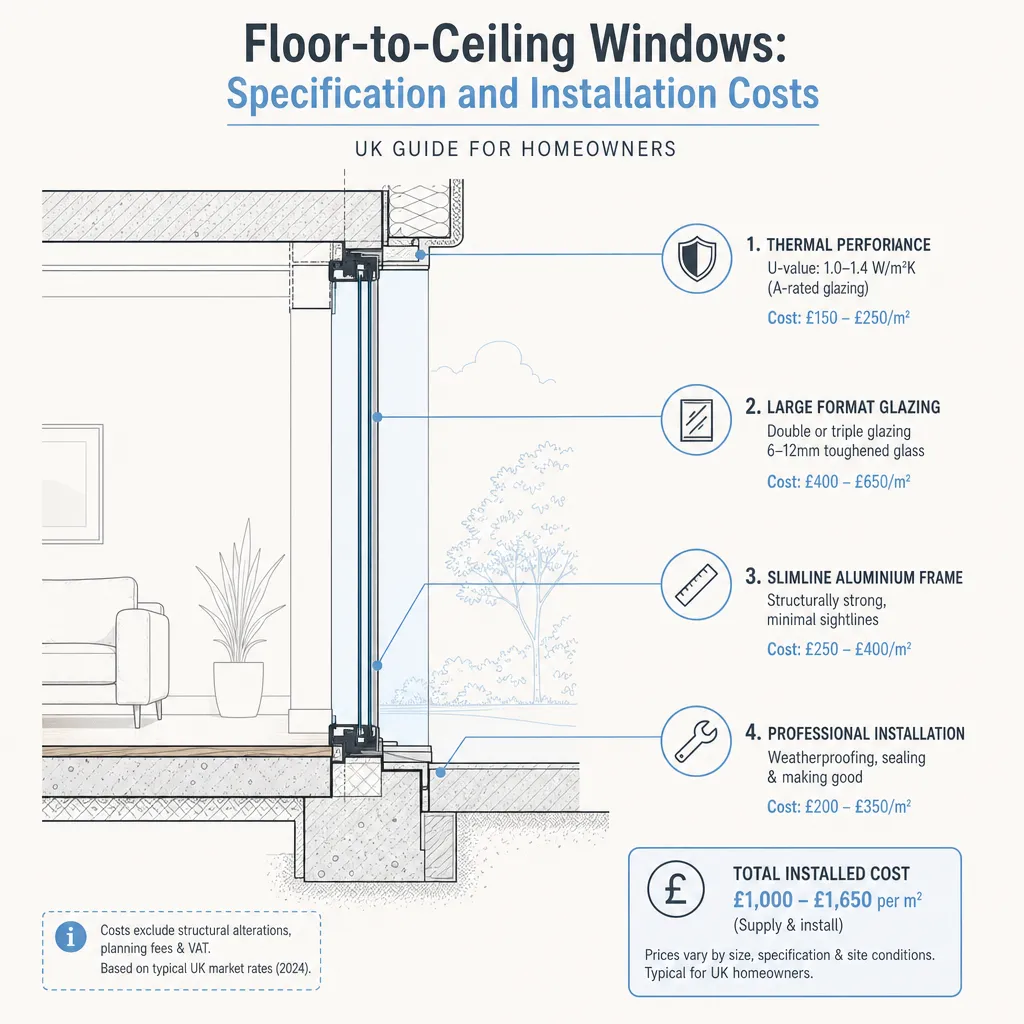
Floor-to-Ceiling Windows: Specification and Installation Costs
Floor-to-ceiling windows in the UK typically cost £1,800–£6,500 per unit installed, depending on glazing type, frame material, and whether structural alterations are needed.
 Improvement & Build
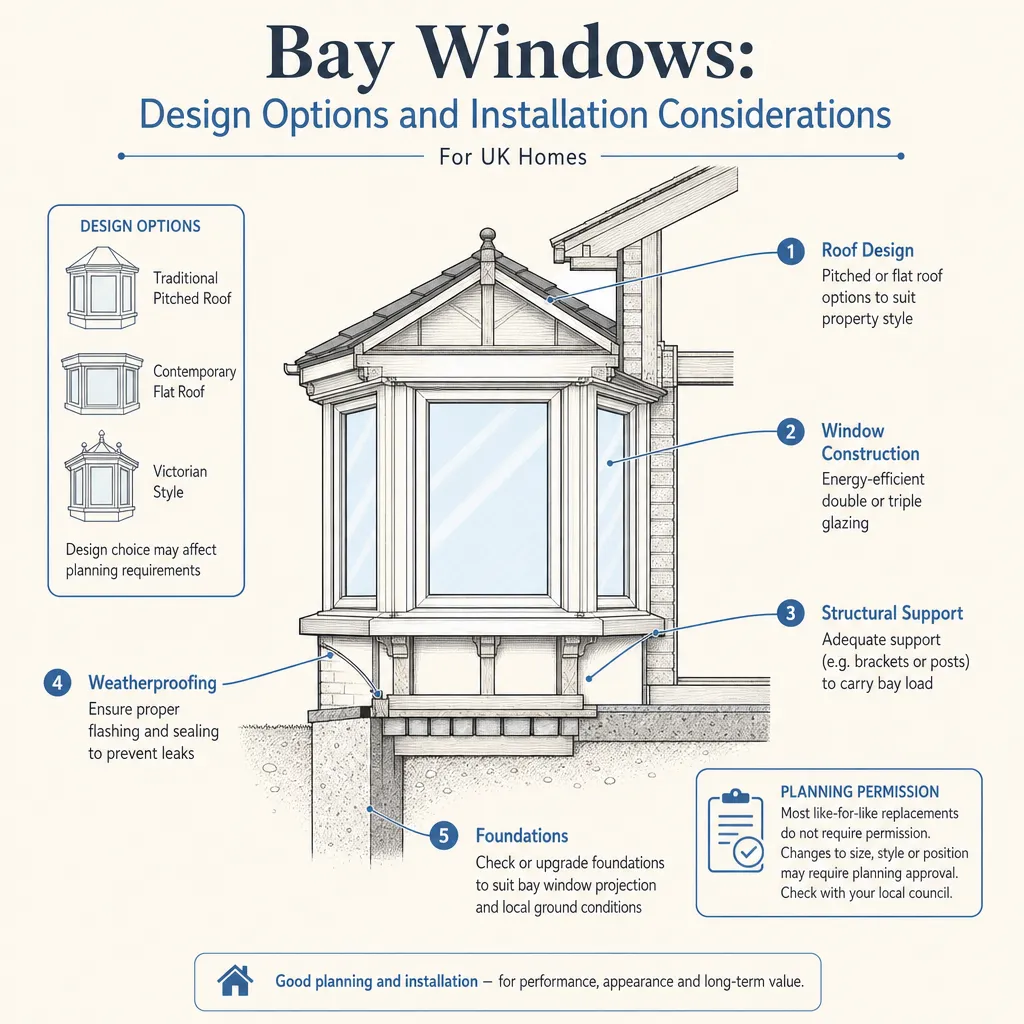
Bay Windows: Design Options and Installation Considerations
Bay windows project beyond the main wall of a house, increasing floor area and natural light.
 Improvement & Build
Garden Windows: Design, Installation, and Benefits
A garden window is a small projecting window unit with a sloped glass roof panel and side vents, designed to maximise natural light and create a shallow display shelf.
 Improvement & Build
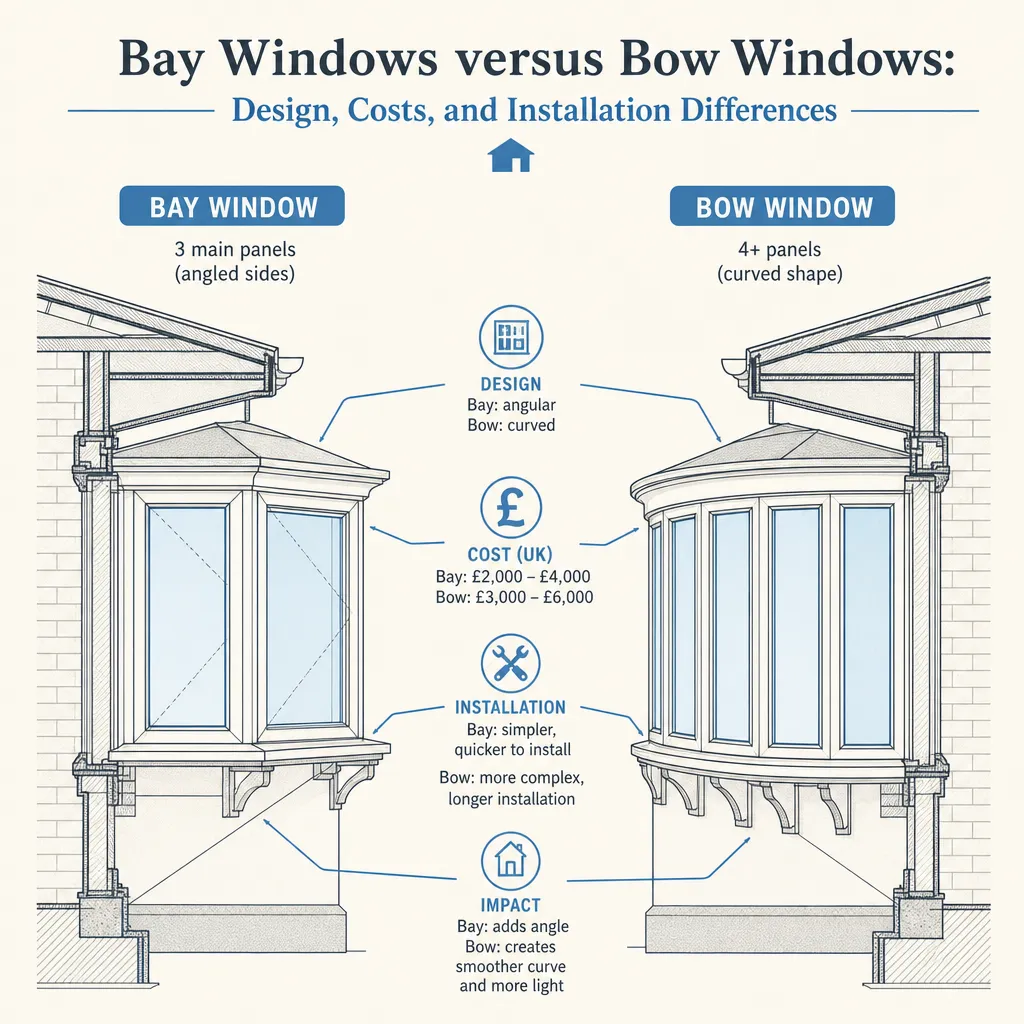
Bay Windows versus Bow Windows: Design, Costs, and Installation Differences
Bay windows project outward at angles — usually three panels at 90° or 135° — creating more floor space inside.