Bay Windows: Design Options and Installation Considerations
By Housey · Last reviewed 26th of May 2026
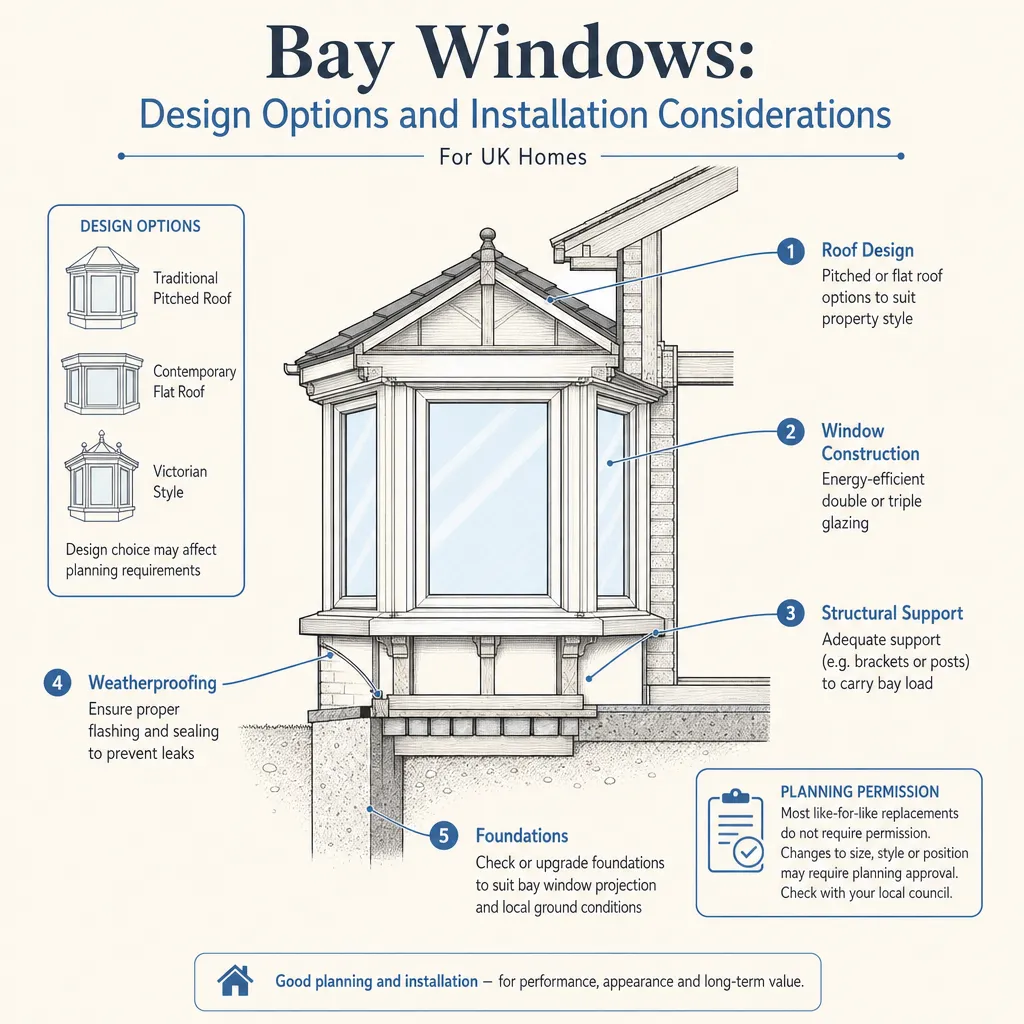
Bay Windows: Design Options and Installation Considerations
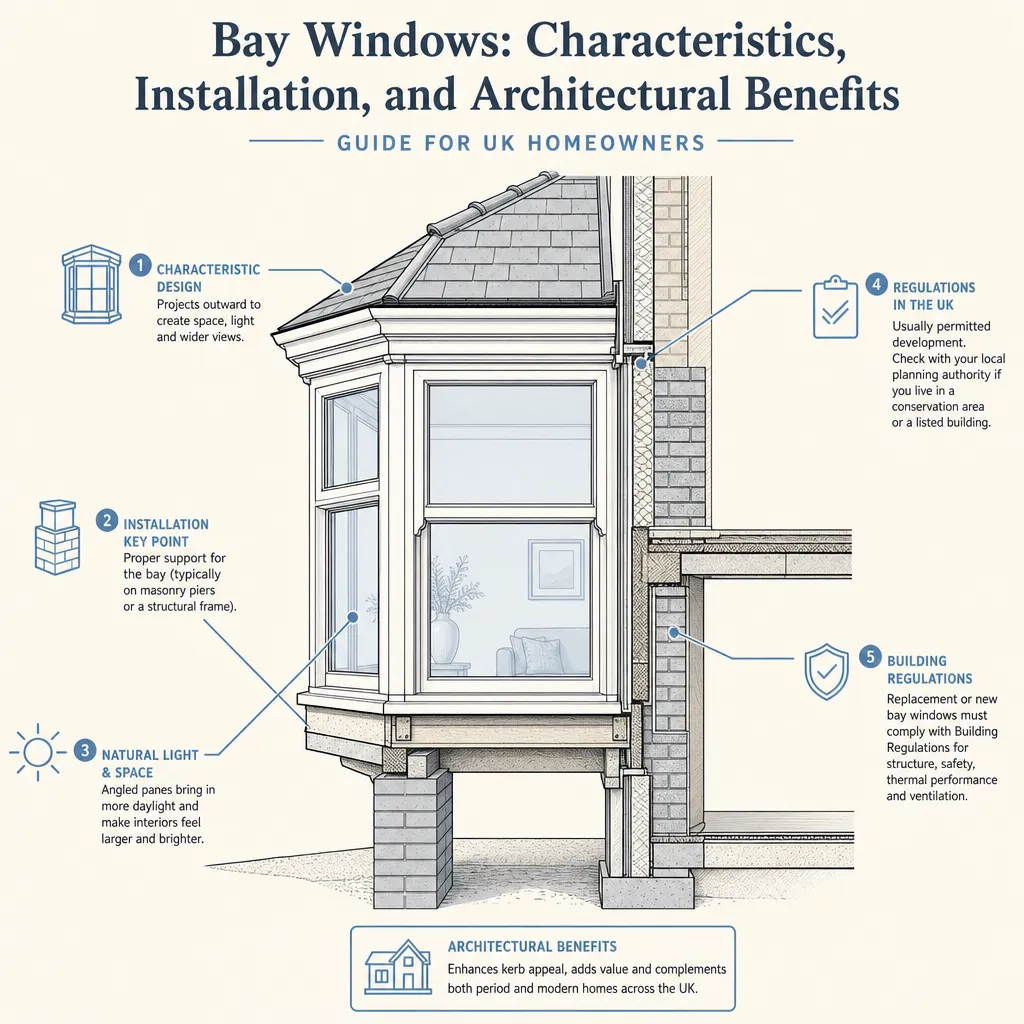
Bay windows appear prominently in Victorian and Edwardian terraces and semis across the UK, but they are also a frequent feature of new extensions and replacement window schemes. Whether a homeowner is restoring a period original, replacing a deteriorating bay, or adding one as part of a ground-floor extension, the decisions around configuration, structure, glazing, and planning are considerably more involved than for a standard flat-wall window installation.
Key points
- Bay windows are categorised as square (90° side returns), canted (typically 45° angled returns), or bow (curved, with multiple frames), each requiring different structural and weathering details.
- Ground-floor bay windows typically require their own concrete pad foundation, separate from the main wall, to carry the combined weight of the bay frame and roof above.
- Replacing an existing bay window usually falls within permitted development, but adding a new bay projecting beyond the existing principal elevation requires a planning application in most cases.
- Building Regulations Part L requires replacement bay window units to achieve a whole-window U-value of no more than 1.4 W/m²K.
- The junction between the bay roof and the main wall cavity is the most vulnerable point for water ingress; lead flashing or soakers-and-step-flashing detail is standard practice.
The three main bay configurations
The configuration of a bay determines its structural demands, glazing options, and visual character. Each type suits different property styles and project scenarios.
Configuration | Geometry | Typical use | Structural note |
|---|---|---|---|
Square (box) bay | 90° side returns, flat or pitched roof | Victorian and Edwardian terraces; modern extensions | Side cheeks carry significant point loads; RSJ or steel lintel typically required across main wall opening |
Canted (angled) bay | 45° or 135° angled returns | Edwardian and interwar semis; period restorations | Angled head and sill sections require precision joinery or fabricated steel components |
Bow bay | Curved profile of 3–5 frames | Georgian and larger Victorian properties; curved extensions | Frame-by-frame curved construction; curved roof covering more complex to weatherproof correctly |
Canted bays at 45° are by far the most common type found in UK Victorian and Edwardian street housing. Bow bays with five or more frames are more typical of larger period properties and Georgian terraces.
Structural requirements: above and below
A bay window is not simply a glazing feature — it is a structural projection. The roof and frame bear down on the bay's sub-structure, and the bay's weight bears down on its foundation.
Above the bay: Most bays carry a roof — either a flat lead-covered structure, a mono-pitch tiled section, or in modern extensions a GRP or glazed roof. This roof load transfers into the bay's structural frame and then into the main wall. In masonry construction, a rolled steel joist (RSJ) or reinforced lintel is commonly required across the bay opening in the main wall behind.
Below the bay: Ground-floor bays typically sit on their own concrete pad foundation, separate from the main wall. This is particularly important on clay soils — prevalent across London, the Midlands, and parts of the South East — where differential settlement between the bay and the main structure is a known cause of cracking and racking. A structural engineer or experienced builder should confirm the foundation arrangement on properties built before 1919, where original foundations may be shallow lime-mortar construction.
First-floor bays typically cantilever from the floor structure or are supported on piers below. Both arrangements require structural assessment if the original construction is being altered.
Glazing options within a bay
The individual frames of a bay can accommodate most standard glazing configurations:
- Sash windows (double-hung vertical sliders) are the period-appropriate choice for Victorian and Edwardian bays. Replacement in timber or aluminium-clad timber maintains period character; uPVC sash profiles are also available.
- Casement windows suit a wider range of styles and are easier to achieve in aluminium or uPVC for thermally efficient, low-maintenance bays.
- Fixed lights are sometimes used for the angled cheek panels in canted bays, where an opening mechanism would be awkward to operate.
- Flush sash windows are a contemporary option increasingly specified in conservation-area bays as a thermally improved, single-rebated alternative to traditional sashes.
Glazing specification must meet Building Regulations Part L: a whole-unit U-value of no more than 1.4 W/m²K for replacement work, or the Target Fabric Energy Efficiency (TFEE) standard where the bay forms part of a new extension.
Bay window roofs: materials and lifespan
The bay roof is a common source of water ingress in UK homes. The most widely used materials are:
- Lead (Code 4 or 5): Traditional and long-lasting — over 50 years if correctly installed by a sheet-lead specialist. Standard in conservation area restorations and most appropriate for pre-1919 properties.
- GRP (glass-reinforced plastic): Widely used in the replacement window trade; 20–30 year lifespan; lower cost; performs well in UK conditions.
- Zinc: Used in contemporary extensions and some conservation area replacements; lifespan 30–50 years, but requires correct detailing to avoid white-rust corrosion in exposed locations.
- EPDM rubber: Used in flat or very shallow-pitch bays; lifespan 20–30 years; good UV resistance.
The junction between the bay roof and the main wall is the most vulnerable point. A lead flashing or soakers-and-step-flashing detail is required here and is a common failure point in unspecified or DIY replacement work.
Planning and permitted development
Replacing an existing bay window: Like-for-like replacement in the same position is usually permitted development and does not require planning permission. If the property is listed or in a conservation area, even a replacement using similar materials may require conservation area consent or listed building consent.
Adding a new bay to an existing flat wall: Under Class A of the Town and Country Planning (General Permitted Development) (England) Order 2015, a bay addition may qualify as permitted development if it does not project beyond the existing principal elevation (the front wall of the house). Always verify with your local planning authority, particularly on pre-1919 properties in conservation areas, which are common in English market towns and historic suburbs.
Which bay window should you choose?
- Choose a square (box) bay if you are designing a modern extension and want maximum interior floor area with a clean, contemporary appearance.
- Choose a canted (45°) bay if you are restoring or replacing a period original on a Victorian or Edwardian property where the angled profile is historically characteristic.
- Choose a bow bay if your property has an existing curved profile, or you want a softer exterior on a Georgian-style property.
- Ask a structural engineer before removing, altering, or building a bay on a pre-1919 property, or where cracking or racking is visible in the existing bay structure.
- Check with your local planning authority if the property is listed, in a conservation area, or if the proposed bay would project beyond the current front wall.
When to get professional help
Bay window installation involves structural, weathering, and often planning considerations that go beyond standard window fitting. Professional input is especially important when:
- The bay is at first-floor level or forms part of a cantilevered or piled structural arrangement.
- Cracks, racking, or differential settlement are visible in the existing bay structure.
- The property is listed or in a conservation area and original materials need to be matched.
- The bay roof is showing signs of damp penetration at the ceiling below.
- A new bay is being added as part of an extension requiring building control sign-off.
How Housey can help
Housey connects UK homeowners with vetted window and door installers experienced in bay window projects, and with extension builders who can manage new-build bay additions as part of a wider ground-floor extension. Describe your project for free and receive quotes from qualified local professionals.
Frequently asked questions
Do I need planning permission to replace a bay window?
Replacing a bay window like-for-like is usually permitted development and does not require planning permission. If the property is listed or in a conservation area, or if the replacement materially alters the appearance of the building, you should check with your local planning authority before starting work.
How long does a bay window installation take?
A straightforward replacement bay window can typically be installed in one to two days by an experienced team. A new-build bay forming part of an extension will take longer, depending on the foundation, structural, and roofing elements involved. Always confirm the programme with your installer before work starts.
Can a bay window be added to a house that did not originally have one?
Yes, but it is more involved than replacing an existing bay. The main wall opening needs a lintel or RSJ, the floor and bay roof must be designed and detailed, and the planning position must be confirmed with the local planning authority — particularly if the bay faces a public highway or is on a designated property.
What is the best frame material for a period bay window?
Timber or aluminium-clad timber is generally considered most appropriate for Victorian and Edwardian bays, particularly in conservation areas. uPVC is acceptable in many non-designated areas and is lower maintenance, but some conservation areas restrict its use. Always check your local planning authority's supplementary guidance before specifying.
Sources and further reading
- Planning Portal: Windows and Doors — Permitted Development — Planning Portal
- Town and Country Planning (General Permitted Development) (England) Order 2015 — legislation.gov.uk
- Building Regulations Approved Document L: Conservation of fuel and power — GOV.UK
- Historic England: Windows in historic buildings — Historic England
- FENSA: Competent Person Scheme for window installation — FENSA
Useful next reads
 Improvement & Build
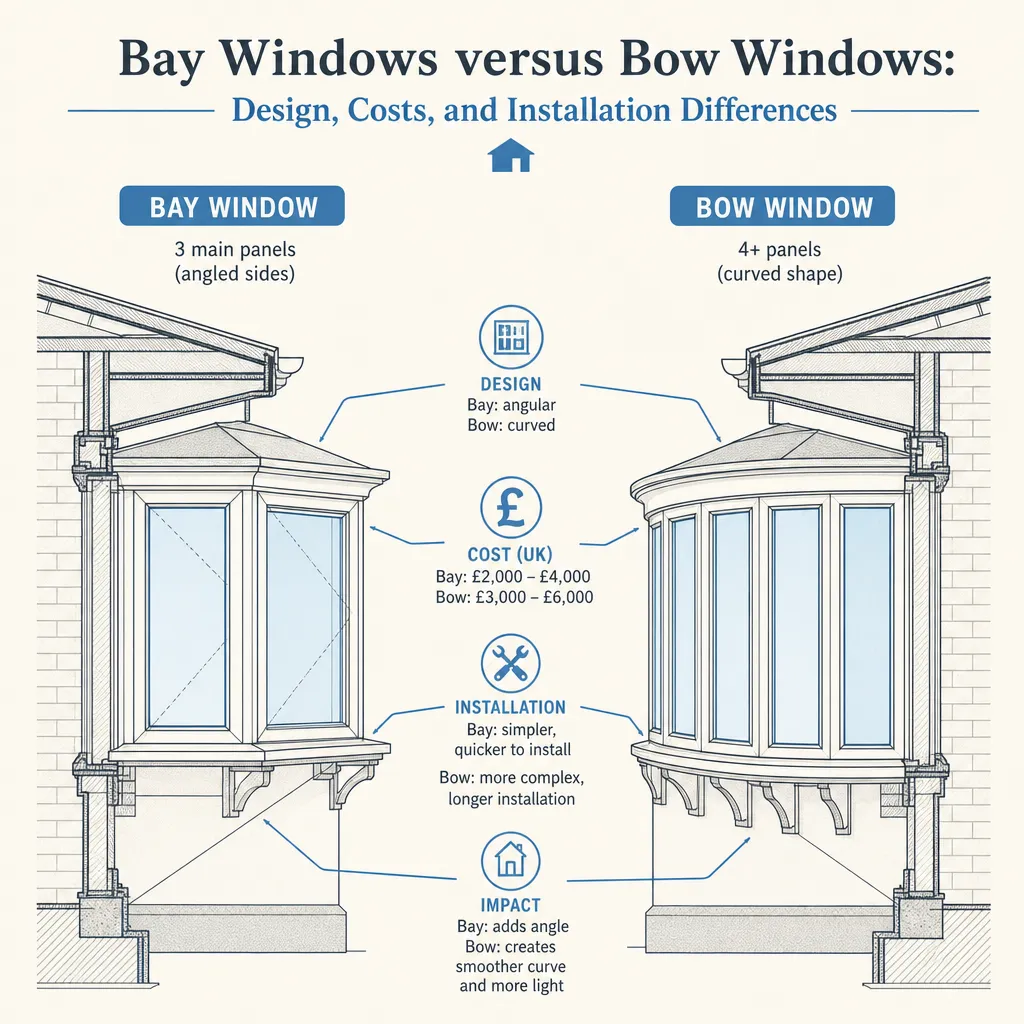
Bay Windows versus Bow Windows: Design, Costs, and Installation Differences
Bay windows project outward at angles — usually three panels at 90° or 135° — creating more floor space inside.
 Improvement & Build
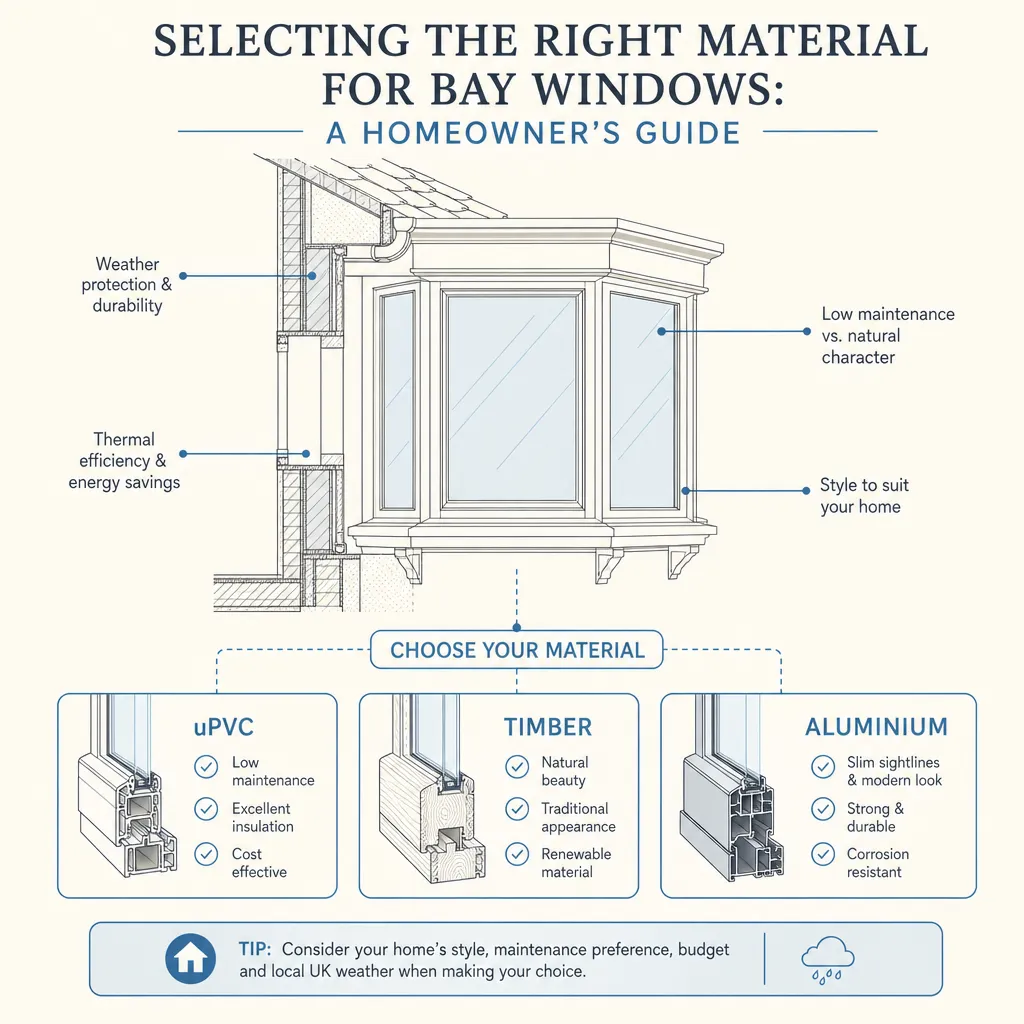
Selecting the right material for bay windows: a homeowner's guide
The main bay window materials in the UK are uPVC, timber, and aluminium.
 Improvement & Build
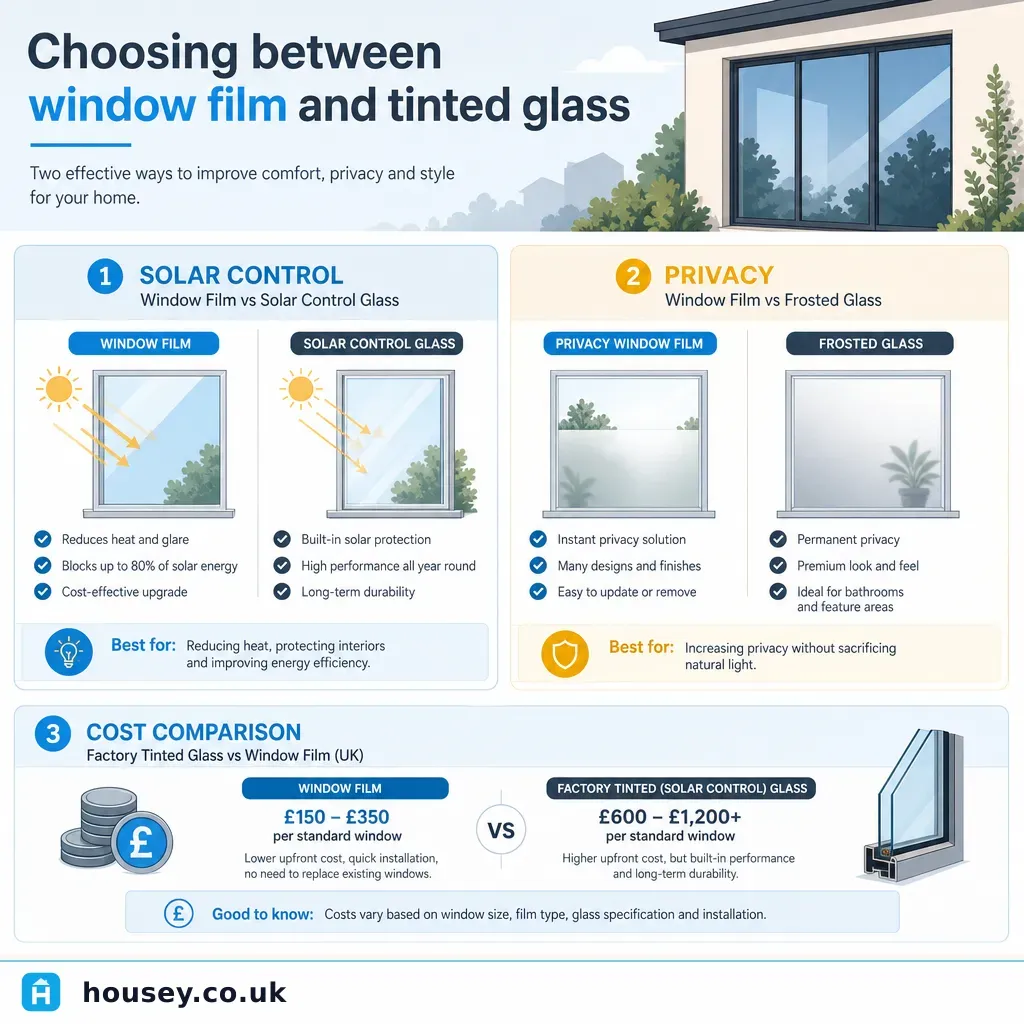
Choosing between window film and tinted glass
Window film is a retrofittable adhesive layer applied to existing glass — cheaper and reversible; factory-tinted or solar-control glass is manufactured with the tint integral to the pane, offering better durability and consistent performance.
 Improvement & Build
Composite French Doors: A Complete Buyer's Guide
Composite French doors combine a GRP or timber-effect outer skin with a solid insulated core, offering durability and low maintenance suited to UK weather.
 Improvement & Build
Bay Windows: Characteristics, Installation, and Architectural Benefits
Bay windows project outward from the main wall, adding floor space, natural light, and architectural character.