Composite French Doors: A Complete Buyer's Guide
By Housey · Last reviewed 11th of May 2026
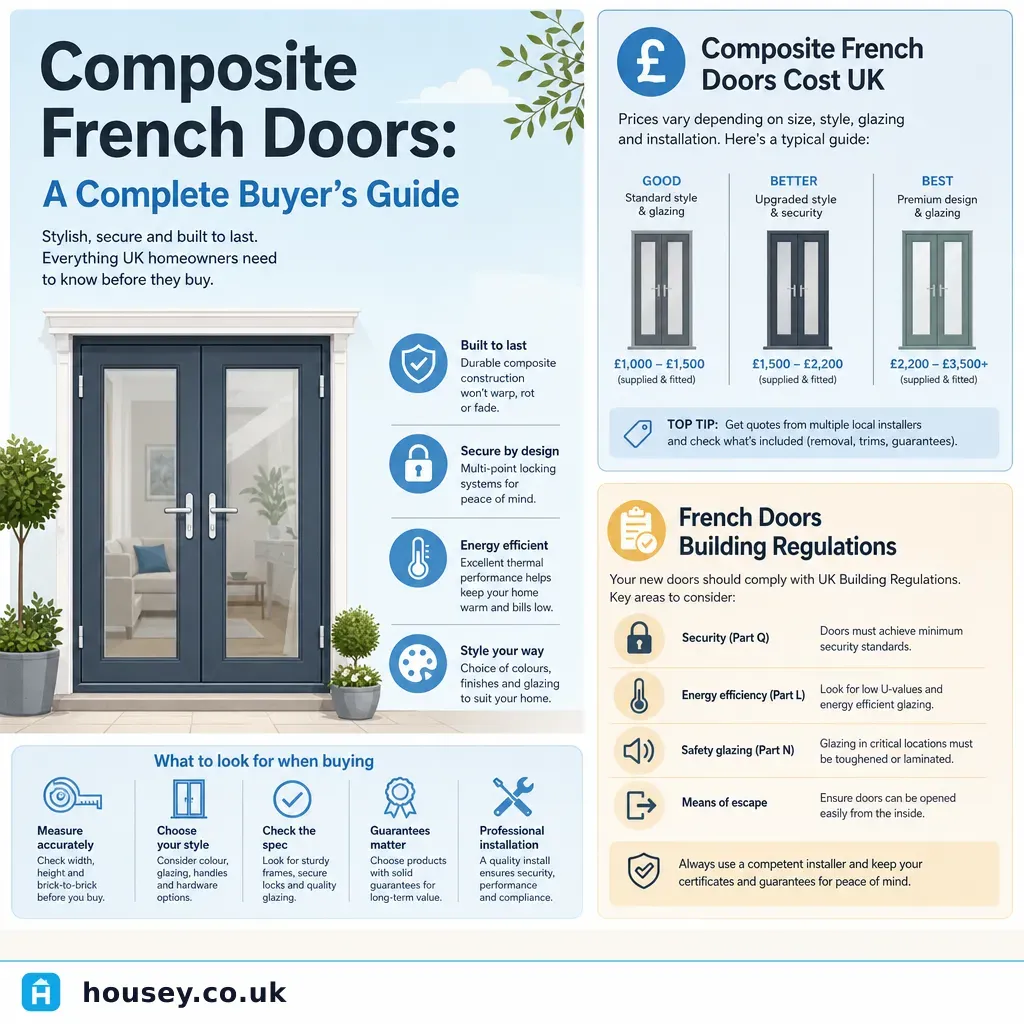
Composite French Doors: A Complete Buyer's Guide
French doors are one of the most popular rear-of-house upgrades in UK homes — creating a wide, light-filled opening to a garden, terrace, or decking area. Composite versions have largely replaced timber in new installations, delivering the period style many homeowners want alongside the thermal performance and low maintenance that current building standards demand. Getting the specification right before you order matters, because French doors are made-to-measure products with lead times of three to eight weeks that are difficult or costly to alter once manufacturing has started.
Key points
- Approved Document L sets a maximum U-value of 1.6 W/m²K for replacement door units (including frame) in existing English dwellings; most quality composite French door sets comfortably meet this.
- Safety glazing in French doors must comply with BS EN 12600 — toughened or laminated glass is required in critical locations as defined by Approved Document N of the Building Regulations.
- A FENSA- or CERTASS-registered installer handles building control notification automatically; if your installer is unregistered, you must apply to your local authority building control department separately.
- PAS 24:2016 or later certification on the complete door set indicates independent security testing against manual attack, which is a requirement under Approved Document Q for new dwellings.
- Standard composite French door sets typically have a combined width of 1,200–1,800 mm; bespoke wider sets affect lead time and cost and may require structural assessment of the opening.
What makes composite French doors different from uPVC or aluminium?
Composite French doors use the same core construction as composite single doors: a GRP or timber-effect outer skin bonded to a solid insulated core — usually dense polyurethane foam — mounted inside a uPVC or aluminium perimeter frame. The result combines the aesthetic of a painted timber door with the dimensional stability of an engineered product.
uPVC French doors are typically the most affordable option but carry a visibly plastic appearance that can look out of place on brick-built Victorian or Edwardian homes. Aluminium French doors offer the slimmest sight lines and suit contemporary new-build properties, but usually cost significantly more. Composite sits between the two: closer to timber in appearance, closer to uPVC in price, and with a performance envelope suited to the British climate.
Size, configuration, and opening direction
French doors always come as a double-leaf pair. Key decisions to make before ordering include:
- Opening direction: outward-opening is more common in UK homes as it preserves interior floor space, but requires a clear external path for the swing arc and a slightly different weatherseal arrangement. Inward-opening suits patios with steps or raised thresholds.
- Active and passive leaf: one leaf carries the main multipoint lock (active) and is used daily; the other is secured by flush bolts top and bottom (passive) and opened less frequently.
- Sidelights: fixed glazed panels either side of the door pair increase light and apparent width without requiring a wider structural opening.
- Clear opening width: the two stiles and the central mullion reduce the actual clear opening width; confirm the net opening suits any furniture access or building regulation requirements for accessible thresholds.
Glazing options compared
Glazing accounts for the majority of the visible door area and has a significant effect on thermal performance, privacy, and appearance.
Glazing type | Best for | Approximate unit U-value | Notes |
|---|---|---|---|
Double-glazed clear | Maximum light, standard performance | 1.2–1.6 W/m²K | Most common; meets Part L in most configurations |
Triple-glazed clear | Maximum thermal performance | 0.6–1.0 W/m²K | Heavier; may need reinforced hinges |
Obscure or patterned | Privacy in overlooked gardens | Similar to clear equivalent | Various patterns; natural light still passes |
Georgian bar or leaded effect | Traditional or heritage aesthetic | Similar to clear equivalent | Decorative bars may be internal or external |
Solar control glass | South-facing or conservatory openings | Similar to clear equivalent | Reduces summer overheating and UV degradation |
All glazing in French doors must use safety glass — toughened or laminated — in the critical locations defined by Approved Document N, which in practice covers all glazed panels below 1,500 mm from floor level in an external door.
Security and hardware
Security is worth specifying carefully on French doors, as the two-leaf configuration introduces additional vulnerabilities at the central meeting point. Look for:
- PAS 24:2022 certificate on the complete door set — this is independent test evidence, not just a manufacturer claim.
- Multipoint locking on the active leaf — typically hook bolts, roller bolts, and a deadbolt — plus top-and-bottom flush bolts on the passive leaf.
- TS 007 3-star cylinder or a cylinder with anti-snap, anti-pick, and anti-drill protection.
- Hinge security: external hinges should incorporate security hinges or hinge bolts to resist lever attacks.
- Secured by Design accreditation is a useful quality indicator; it requires PAS 24 as a minimum and is backed by the Police Crime Prevention Initiatives programme.
Building Regulations and FENSA
Replacing existing French doors, or installing new French doors into an existing opening, triggers compliance with Approved Document L (thermal performance), Approved Document N (glazing safety), and Approved Document Q (security — for new dwellings). A FENSA- or CERTASS-registered installer self-certifies compliance and issues a certificate within 30 days of completion.
If you are creating a new opening rather than replacing an existing one, structural work to the lintel or wall is likely to trigger a building control application separately from FENSA. Clarify this with your installer or building control department early — especially if the new opening is in a loadbearing wall or close to a corner.
What to ask before accepting a quote
Use this checklist when comparing quotes from installers:
- What is the complete door set's tested U-value as a unit, including frame and threshold?
- Does the door set carry PAS 24 or Secured by Design certification, and can you provide the certificate number?
- Is the installer FENSA- or CERTASS-registered, and will the compliance certificate be issued within 30 days?
- Is the price for supply and installation, and does it include removal and disposal of the existing door?
- What glass specification is included, and what is the cost to upgrade to triple glazing or solar control?
- What frame colour options are available, and are non-standard RAL colours subject to additional cost or longer lead times?
- What is the lead time from order confirmation to installation?
- What is the manufacturer's warranty on panel, frame, and hardware separately?
- Is VAT included in the quoted price?
Red flags when buying composite French doors
Watch out for these warning signs before you commit:
- No security certificate number: a PAS 24 claim without a verifiable certificate number is unconfirmable — ask for the document.
- Unusually short lead time: under two weeks for a made-to-measure product may indicate stock-size doors rather than a custom-manufactured set.
- No written U-value or glass specification before signing — if the installer cannot state the U-value of the unit, thermal compliance is unverifiable.
- Unregistered installer with no explanation of how building control notification will be handled — this leaves you responsible for regularising the installation.
- Pressure to sign before comparing quotes — a reputable installer will provide a written, itemised quote that remains valid for at least 14 days.
When to get professional help
For a standard rear-door replacement in a conventional property, a FENSA-registered installer handles the full process. Seek additional advice if:
- You are widening an existing opening — a structural engineer or builder should assess the lintel and load path before any masonry is removed.
- Your property is listed or in a conservation area — consult your local planning authority before ordering a product, as the specification may need to match the historic character of the building.
- The existing threshold has a significant step that needs addressing for accessibility — a builder or access consultant can advise on Approved Document M-compliant solutions.
How Housey can help
For competitive quotes from vetted, FENSA-registered professionals, connect with window and door installers on Housey, who can provide itemised proposals for composite French door supply and installation across the UK.
Frequently asked questions
Do composite French doors need planning permission?
Usually not for a like-for-like replacement in England. However, if your property is listed, in a conservation area, or if you are creating a new opening in an external wall, planning permission or Listed Building Consent may be required. Always check with your local planning authority before ordering a made-to-measure product.
How much do composite French doors cost to supply and install?
Indicative UK costs range from approximately £1,500 to £3,500 for supply and installation of a standard composite French door set, depending on size, glazing specification, hardware, and region. Bespoke sizes, triple glazing, and premium ironmongery increase costs considerably. Obtain at least two or three itemised quotes. Indicative UK costs, last reviewed 2026-05-11.
How long do composite French doors last?
Most manufacturers offer warranties of 10–20 years on composite door panels and frames. With normal maintenance — occasional cleaning and annual lubrication of hardware — a composite French door set should provide a service life of 25–35 years under typical UK conditions.
Can composite French doors be used on a conservatory or orangery?
Yes — composite French doors are commonly fitted to conservatory and orangery openings. Check that the door set's U-value meets Part L requirements and that the threshold transition between the conservatory and the main house is appropriate for the thermal boundary of your property.
What is the difference between French doors and bifold doors?
French doors are a hinged double-leaf pair opening from the centre inward or outward. Bifold doors fold back in sections on a track, typically offering a wider clear opening but requiring more hardware maintenance and usually a higher upfront cost. French doors suit standard openings of 1,200–1,800 mm; bifolding suits wider spans.
Sources and further reading
- Approved Document L: Conservation of fuel and power — GOV.UK
- Approved Document Q: Security — dwellings — GOV.UK
- Approved Document N: Glazing safety — GOV.UK
- FENSA: Information for homeowners — FENSA
- Secured by Design: Door sets guidance — Secured by Design
- Planning Portal: Doors — do I need permission? — Planning Portal
Useful next reads
 Improvement & Build
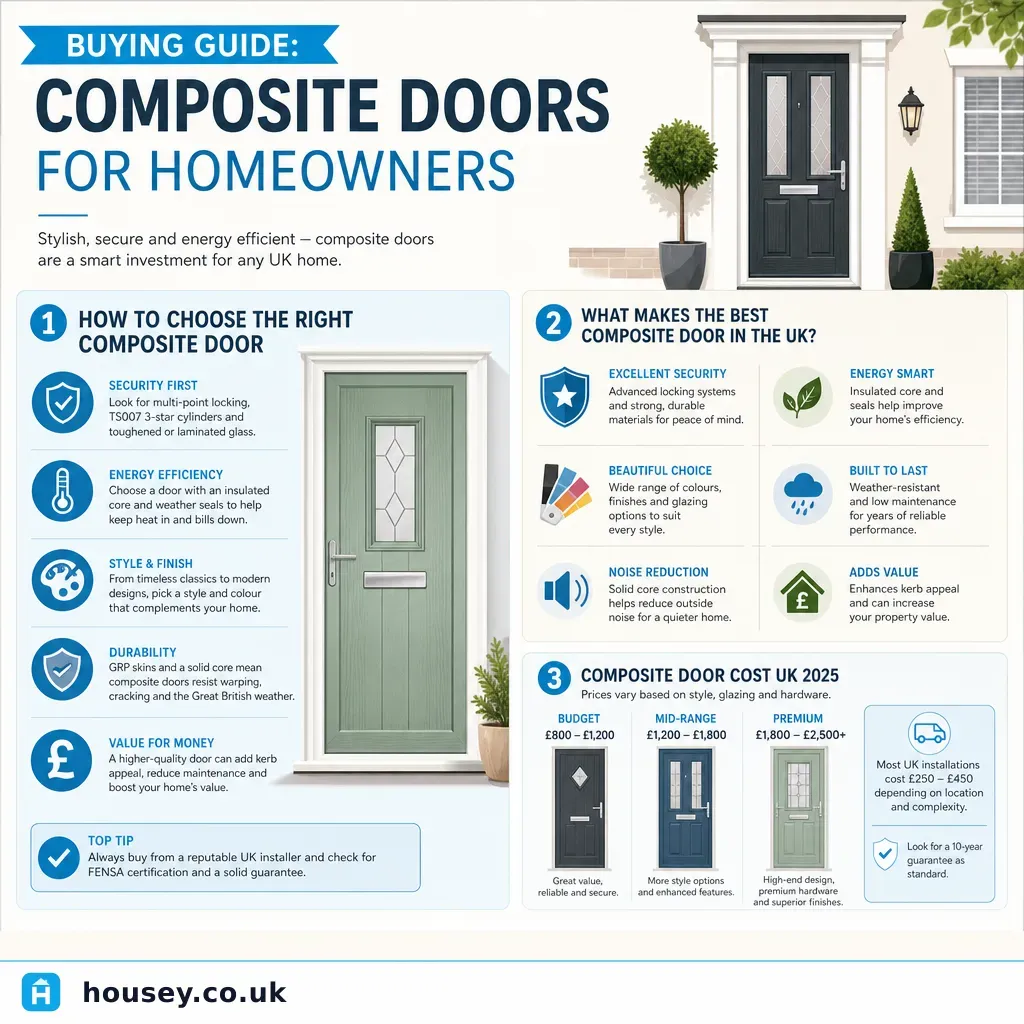
Buying guide: composite doors for homeowners
A composite door is a multi-layer product with a glass reinforced plastic outer skin, solid foam core, and multipoint locking as standard.
 Improvement & Build
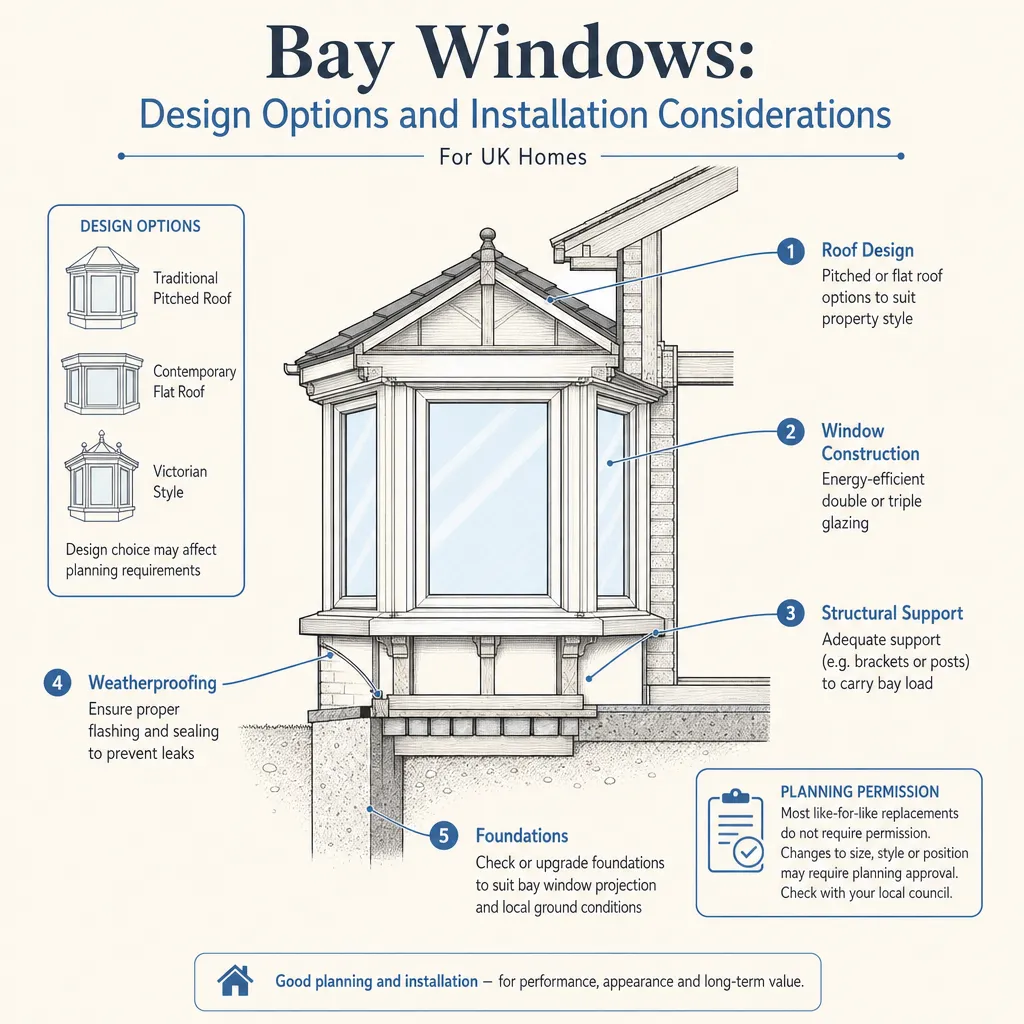
Bay Windows: Design Options and Installation Considerations
Bay windows project beyond the main wall of a house, increasing floor area and natural light.
 Improvement & Build
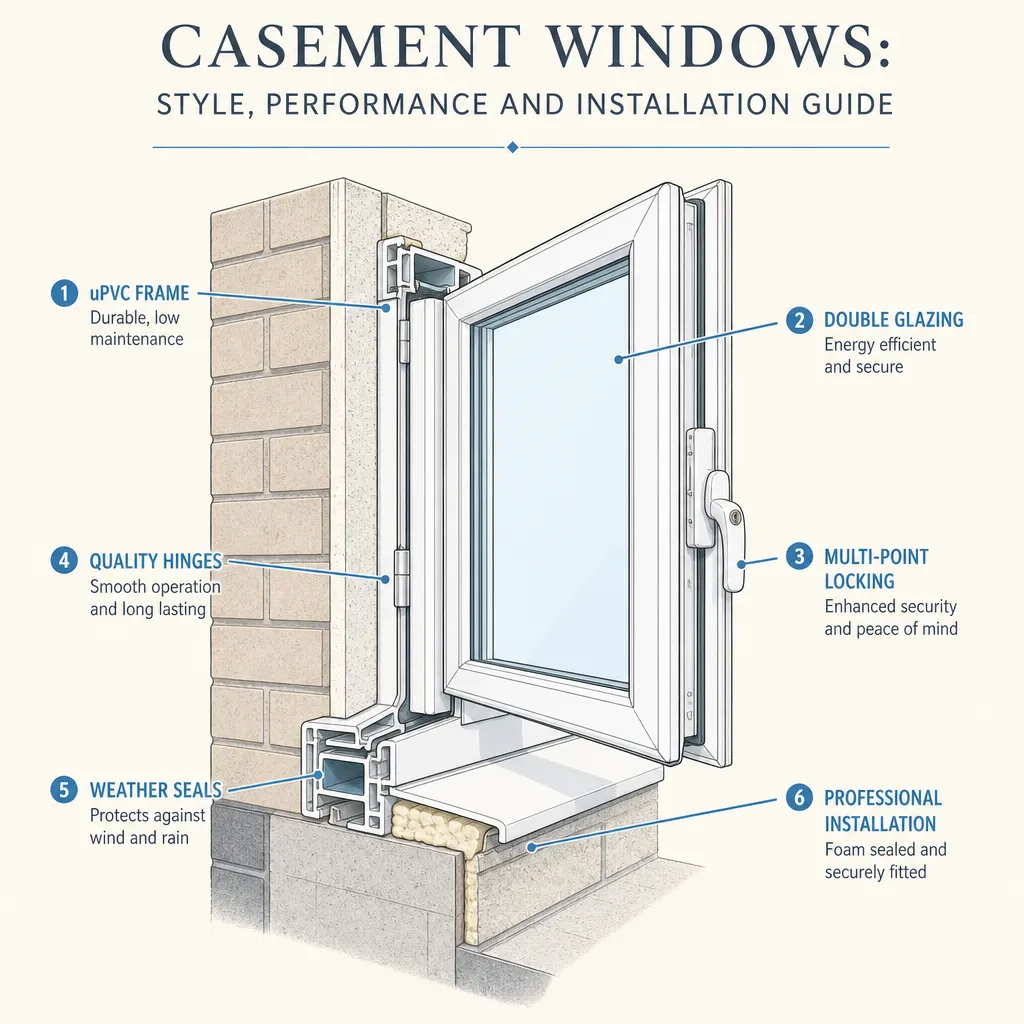
Casement Windows: Style, Performance and Installation Guide
Casement windows are hinged on one side and open outward, making them the most widely fitted window type in UK homes.
 Improvement & Build
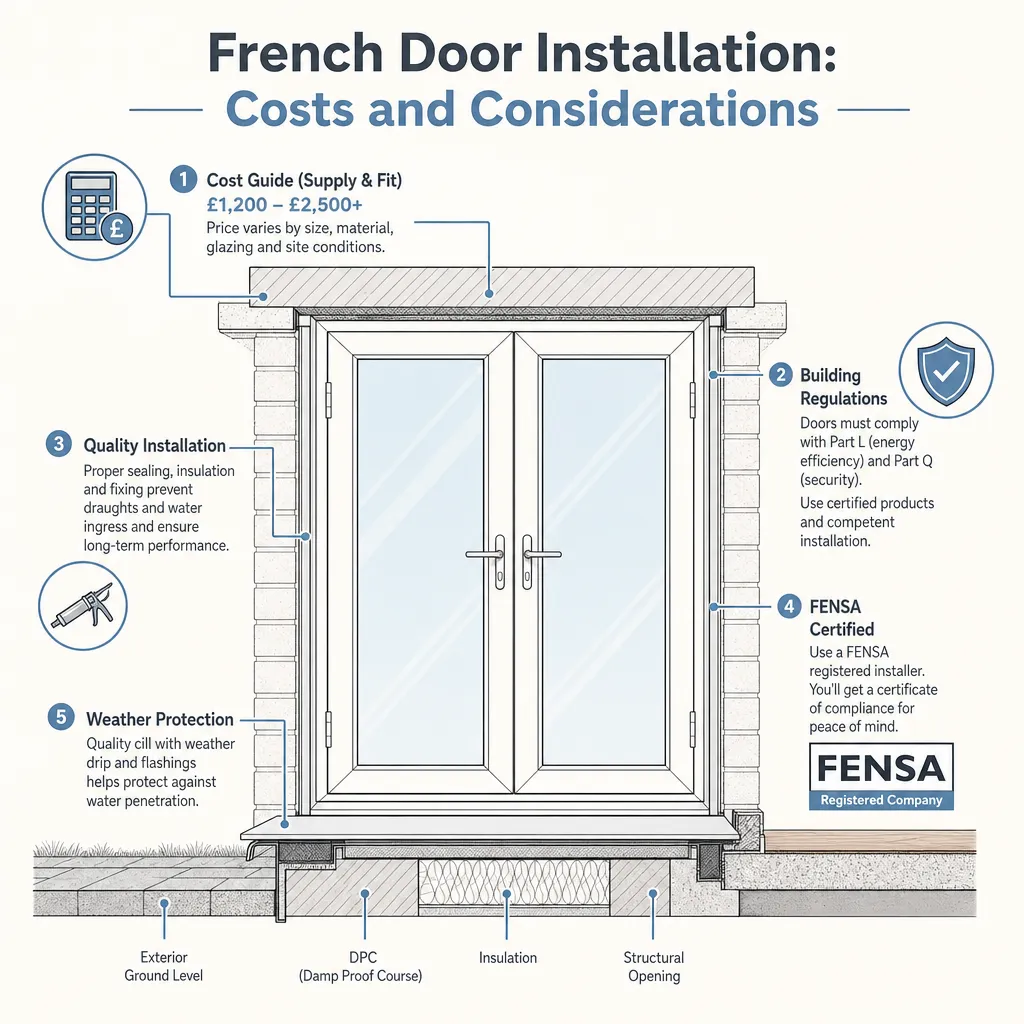
French Door Installation: Costs and Considerations
External French door installation typically costs £1,500–£4,000 in the UK, including supply and fitting, depending on material, glazing specification, and whether structural alterations are needed.
 Improvement & Build
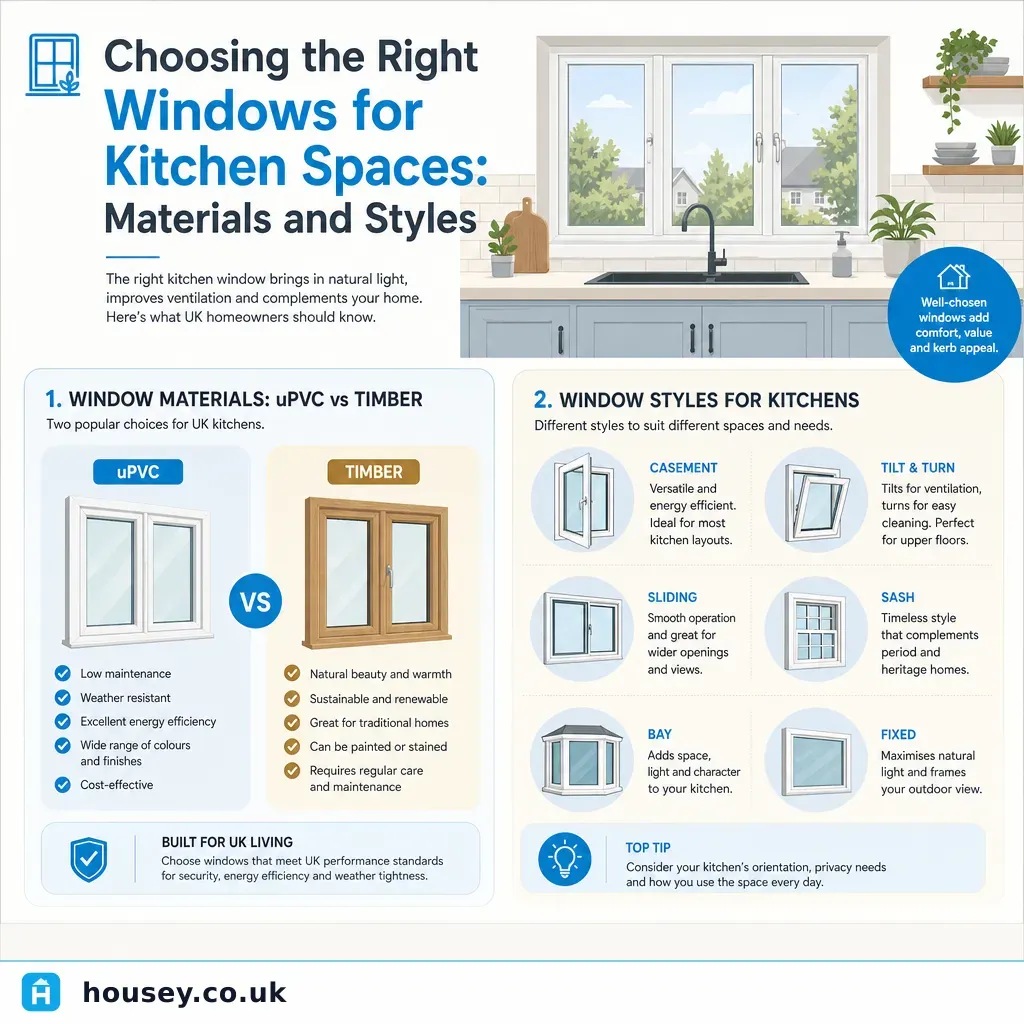
Choosing the Right Windows for Kitchen Spaces: Materials and Styles
Kitchen windows must meet Building Regulations Part L, achieving at least Window Energy Rating Band C.