Benefits of Hiring Established Landscaping Services in Coastal Areas
By Housey · Last reviewed 7th of May 2026
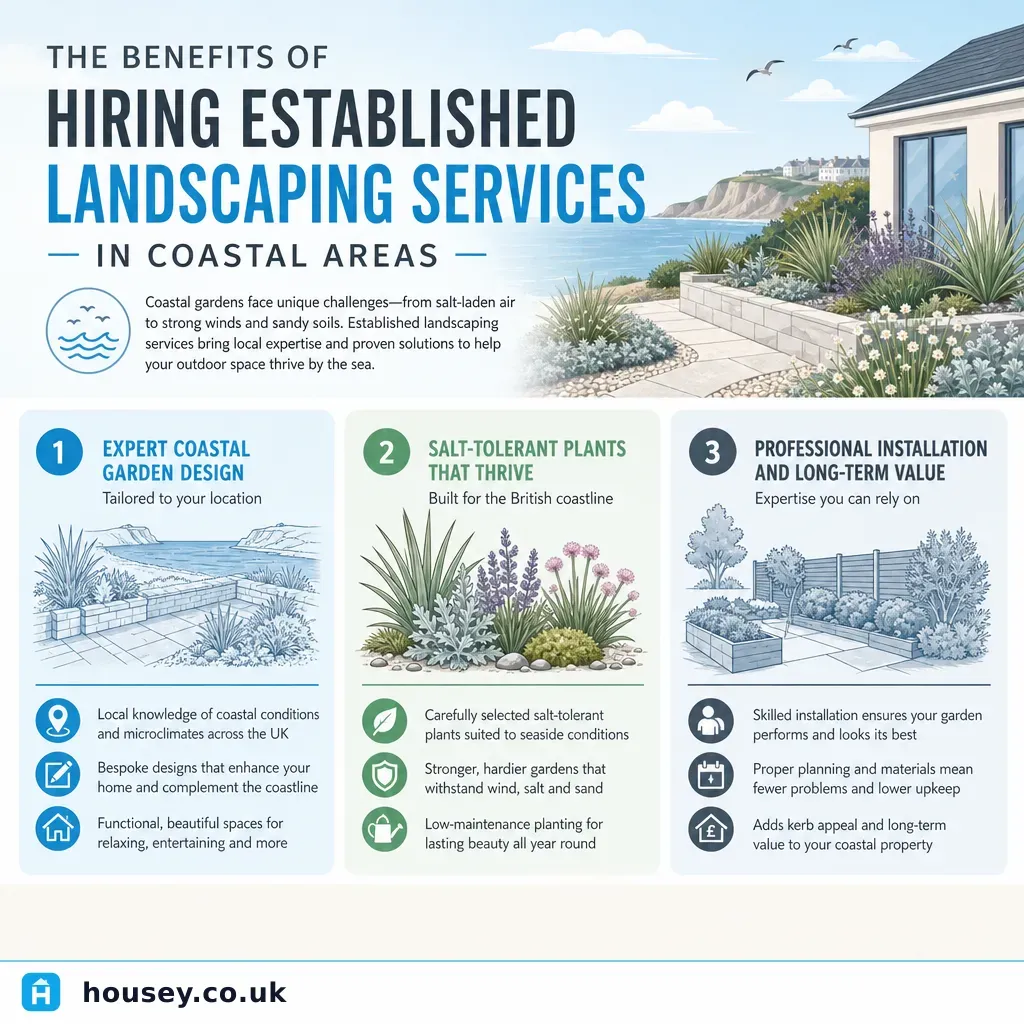
Benefits of Hiring Established Landscaping Services in Coastal Areas
Owning a property near the sea brings obvious pleasures, but the marine environment is genuinely hostile to plants, structures, and materials that perform perfectly well inland. Many homeowners only discover this after a standard landscaper has installed a scheme that looks beautiful in autumn and is half-dead or heavily corroded by the following spring. Coastal landscaping is a distinct specialism, and the difference between a contractor with proven local experience and a general gardening firm can mean the difference between a scheme that matures gracefully and one that needs expensive remediation within two or three seasons.
Key points
- Salt spray damage is measurable up to 100 metres from the shoreline on exposed coasts, and wind-driven spray can travel further on elevated or south-west-facing sites.
- Coastal Change Management Areas (CCMAs), designated under the National Planning Policy Framework, may restrict certain hard landscaping and groundwork near eroding or dynamic coastlines.
- Sites of Special Scientific Interest (SSSIs) adjacent to coastal gardens impose statutory constraints on groundworks, drainage, and the use of certain chemicals under the Wildlife and Countryside Act 1981.
- Metalwork, fencing, and irrigation components in coastal gardens should meet a minimum C4 or C5 corrosion resistance category under ISO 12944 to withstand persistent salt-laden air.
- The RHS Award of Garden Merit designation includes plants specifically assessed for coastal and exposed maritime conditions — an experienced coastal landscaper will draw on this and comparable trials data.
Why coastal conditions demand specialist knowledge
The marine environment creates three main challenges that general landscapers may underestimate: salt exposure, wind loading, and soil conditions.
Salt spray deposits sodium chloride on leaf surfaces, drawing moisture out of plant tissue through osmosis. It also corrodes metals, degrades untreated timber, and affects mortar in certain brickwork and stonework. The intensity of damage depends on distance from the water, aspect, elevation, and the presence or absence of existing windbreaks. An experienced contractor will have observed how these variables play out across different properties in the same coastal postcode area — knowledge that cannot be replicated by consulting a planting catalogue.
Wind loading on coastal sites is often significantly higher than the UK average. Exposed coasts regularly experience sustained winds above 50mph during winter months, and gusts in excess of 70mph are not unusual on elevated south-west-facing sites. This affects structural decisions around fencing, pergolas, garden buildings, and boundary walls — specifications that are adequate inland may fail within a single season under persistent coastal exposure.
Soil conditions near the coast are frequently free-draining, sandy, and low in organic matter, or — in estuarine and tidal settings — clay-heavy and prone to waterlogging during wet periods. Both extremes call for different soil improvement strategies and planting selections, and a contractor unfamiliar with local conditions may apply a standard soil preparation approach that fails to address the underlying constraint.
Experienced coastal landscaper versus general contractor
Aspect | Established coastal landscaper | General landscaper without coastal experience |
|---|---|---|
Plant selection | Draws on local performance data; avoids known coastal failures | May rely on generic planting palettes unsuited to salt exposure |
Hard landscaping materials | Specifies C4/C5 corrosion-rated fixings, marine-grade or composite materials | May use standard inland-specification products that corrode or degrade quickly |
Planning awareness | Familiar with CCMA conditions, SSSI adjacency, and conservation area rules | May be unaware of coastal-specific planning and regulatory constraints |
Soil preparation | Understands local soil profiles, drainage behaviour, and organic matter deficit | May apply standard soil improvement without accounting for coastal drainage |
Windbreak sequencing | Stages planting to establish shelter before exposing tender ornamentals | May plant simultaneously, exposing vulnerable specimens before any windbreak establishes |
Aftercare advice | Provides site-specific seasonal maintenance guidance, including salt wash timings | Unlikely to tailor aftercare advice to local coastal salt spray patterns |
Planning and legal considerations near the coast
Before significant landscaping work begins near a coastal boundary, the following are worth confirming with your local planning authority (LPA):
Coastal Change Management Areas (CCMAs): Your LPA can confirm whether your property falls within a CCMA. In these zones, planning policy may restrict works considered to increase coastal erosion risk or constitute development in a flood-risk area. CCMAs are identified in Local Plans and are searchable on most council planning portals.
SSSI adjacency: If your garden adjoins or lies within a SSSI, Natural England must be notified before certain operations — including groundworks affecting hydrology and the use of herbicides or pesticides near the boundary. The notification process under the Wildlife and Countryside Act 1981 can take up to 28 days and should be factored into project timelines from the outset.
Conservation areas: Many coastal towns have designated conservation areas where boundary treatments, outbuildings, and hard landscaping to front gardens may need prior approval from the LPA, even where the works would otherwise be permitted development.
An established local contractor will know which of these designations apply in your area and may have submitted similar applications on behalf of previous clients in the same street or postcode.
A worked example: coastal cottage in Cornwall
A detached cottage sits 60 metres from a south-west-facing cliff edge in Cornwall. The garden slopes gently toward the sea and has no existing windbreak planting. A general landscaper quotes to lay a stone patio, install composite fencing, and plant a mixed herbaceous border — all in a single phase beginning in spring.
An experienced coastal landscaper would approach this differently:
- Survey the site for prevailing wind direction, identify any sheltered microclimates, and assess drainage behaviour during heavy rainfall by observing the slope and subsoil.
- Recommend a phased approach: establish a windbreak of proven coastal species — Escallonia, Griselinia littoralis, Hippophae rhamnoides — in season one before installing the patio or planting ornamental specimens in exposed positions.
- Specify marine-environment materials: marine-grade stainless steel fixings throughout, resin-bonded gravel surfacing rather than conventionally mortared paving, and composite decking supported on a marine-grade aluminium subframe.
- Check planning: confirm whether CCMA conditions apply to the site boundary, and advise whether the proposed fencing height triggers any permitted development limitations given the proximity to a coastal edge.
- Design for drainage: specify a drainage channel between the patio edge and the sloping lawn to prevent surface water tracking back toward the house during storms — a common oversight on sloping coastal plots.
The phased approach costs more in year one but results in a scheme that survives the first winter rather than requiring plant replacement and material remediation the following spring.
What to ask a coastal landscaping contractor before you appoint
Before accepting a quote, ask:
- Can you provide examples of completed projects within 10 miles of my property, ideally on a site with a similar coastal exposure and aspect?
- Are you familiar with any site-specific designations that apply here — SSSI, Area of Outstanding Natural Beauty, conservation area, or Coastal Change Management Area?
- What plant species would you recommend for a first-year windbreak on this site, and why those species specifically given the aspect and exposure?
- What corrosion resistance specification will you apply to all metalwork, fixings, fencing posts, and irrigation components?
- How will you prepare and improve the soil, and how will drainage be managed across the site?
- Do you offer a seasonal aftercare visit in the first year to assess salt spray damage and carry out any early remedial work?
- What guarantees or warranties apply to the planting and to the hard landscaping elements?
When to get professional help
If your coastal garden project involves any of the following, specialist input beyond a standard landscaping contractor is warranted:
- Works within or adjacent to a SSSI — consult a qualified ecologist before disturbing ground or altering surface drainage
- Tree removal or surgery near the coast or within a conservation area — an arboricultural survey may be required before consent is granted by the LPA
- Significant earthworks or changes to drainage near a coastal boundary — consult your LPA and potentially a drainage engineer before committing to a design
- Any works that may affect coastal Common Land, a public right of way, or a designated flood-risk zone identified in your Local Plan
How Housey can help
Housey helps you find vetted local professionals for coastal and seaside garden projects. Request quotes from experienced landscapers and garden designers who know the conditions in your area, so you can compare credentials, approaches, and local knowledge before committing to a scheme.
Frequently asked questions
Do I need planning permission for landscaping near the coast?
Most garden landscaping is permitted development, but coastal locations bring additional considerations. Works within Coastal Change Management Areas, SSSI buffer zones, conservation areas, or flood-risk zones identified in your Local Plan may require planning consent or prior notification. Check with your local planning authority before starting significant hard landscaping, earthworks, or boundary treatments near a coastal edge.
Which plants are most reliable in exposed coastal gardens?
Species with strong track records in exposed maritime conditions include Escallonia, Griselinia littoralis, Pittosporum tenuifolium, Hippophae rhamnoides, Tamarix, and Elaeagnus. The RHS Award of Garden Merit list includes a coastal and exposed category. An experienced local landscaper will also draw on what they have observed performing well in your specific microclimate, which national trials data cannot always predict.
How much more does coastal landscaping cost than standard garden work?
Corrosion-resistant materials, specialist soil preparation, and phased planting can add 15–30% to a comparable inland scheme, though costs vary significantly by site and scope. The additional investment is usually justified given the replacement cost of standard materials that fail in salt-laden air within a few seasons. Always request itemised quotes. Indicative UK costs, last reviewed 2026-05-07; quotes vary.
What is a Coastal Change Management Area?
A Coastal Change Management Area is a planning designation under the National Planning Policy Framework identifying stretches of coast subject to dynamic processes such as erosion or flooding. Within a CCMA, local planning policy may restrict certain works — including hard landscaping and groundworks — that would otherwise be permitted development. CCMAs appear in Local Plans and are searchable on most council planning portals.
Sources and further reading
- National Planning Policy Framework — GOV.UK / DLUHC
- Sites of Special Scientific Interest guidance — Natural England / GOV.UK
- RHS Award of Garden Merit — Royal Horticultural Society
- Wildlife and Countryside Act 1981 — legislation.gov.uk
Useful next reads
 Improvement & Build
Garden Design Professionals: Landscaper, Garden Designer or Landscape Architect?
A landscaper carries out physical groundworks and planting; a garden designer creates detailed plans and often manages the build; a landscape architect holds a chartered title and suits complex or planning-sensitive projects.
 Improvement & Build
Garden and Landscape Services for Your Property
Garden designers and landscapers both improve outdoor spaces but offer different services.
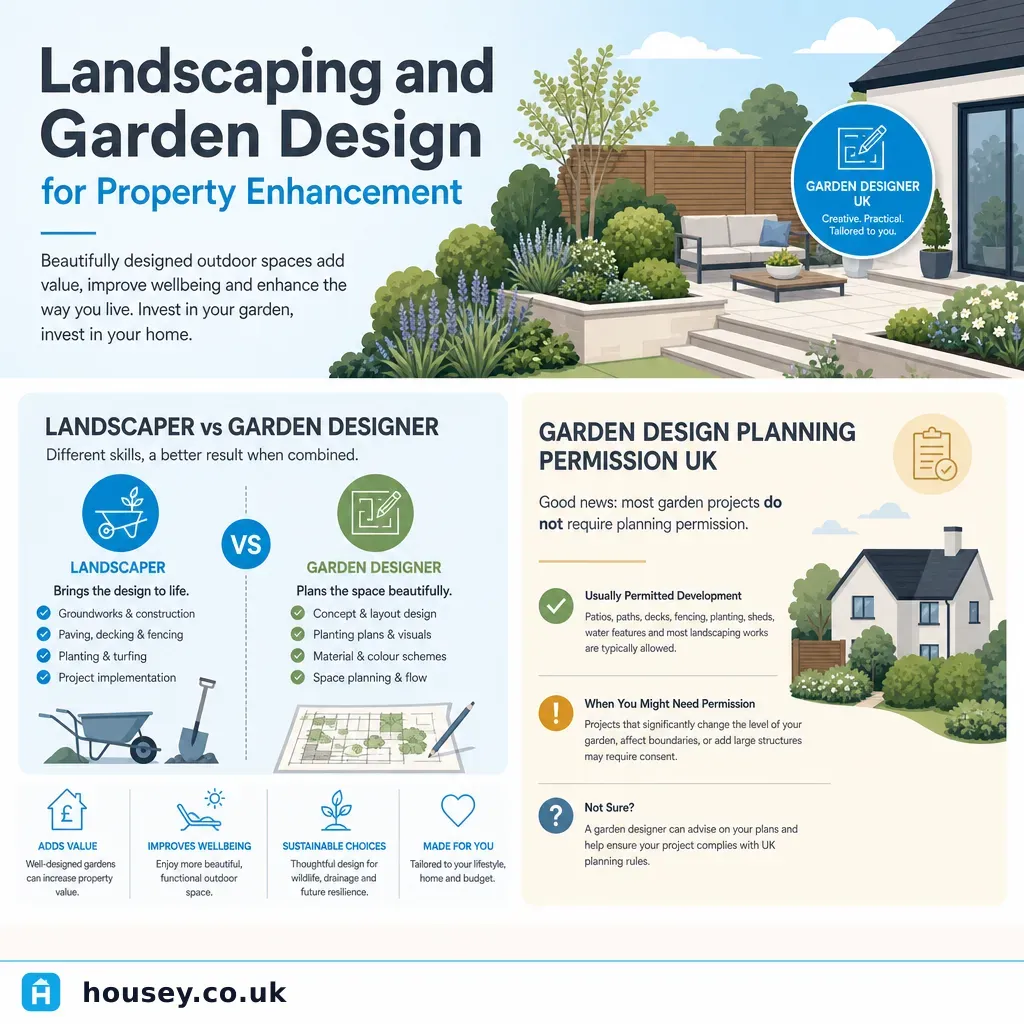 Improvement & Build
Landscaping and Garden Design for Property Enhancement
Landscaping and garden design involve planning and building outdoor spaces — from patios and raised beds to planting schemes and drainage.
 Improvement & Build
Hiring A Garden Designer For Your Outdoor Space
A garden designer creates a detailed plan — including layout, planting schemes, and hard landscaping specifications — tailored to your outdoor space and budget.
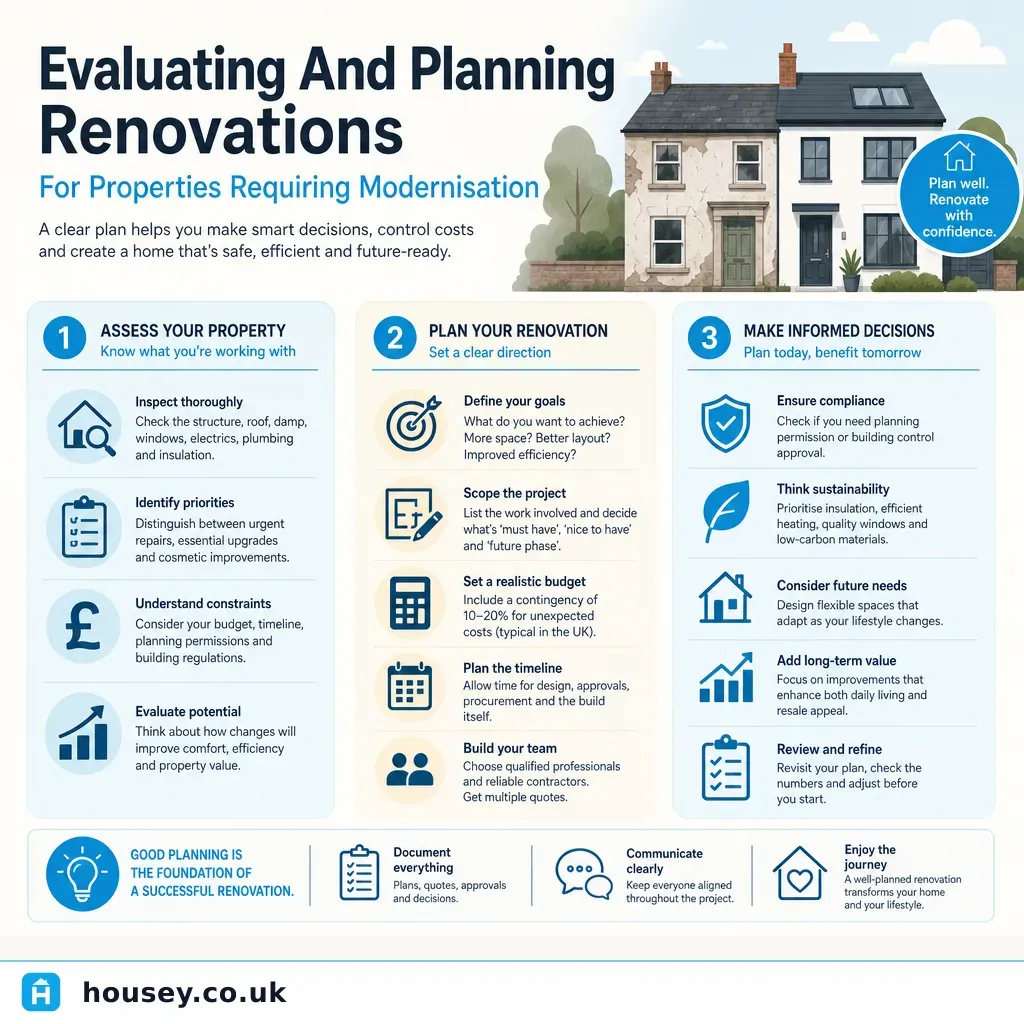 Improvement & Build
Evaluating And Planning Renovations For Properties Requiring Modernisation
Start by commissioning a condition survey — RICS Level 3 for pre-1919 properties — to identify structural defects, damp, and services issues before finalising a budget.