Landscaping and Garden Design for Property Enhancement
By Housey · Last reviewed 24th of May 2026
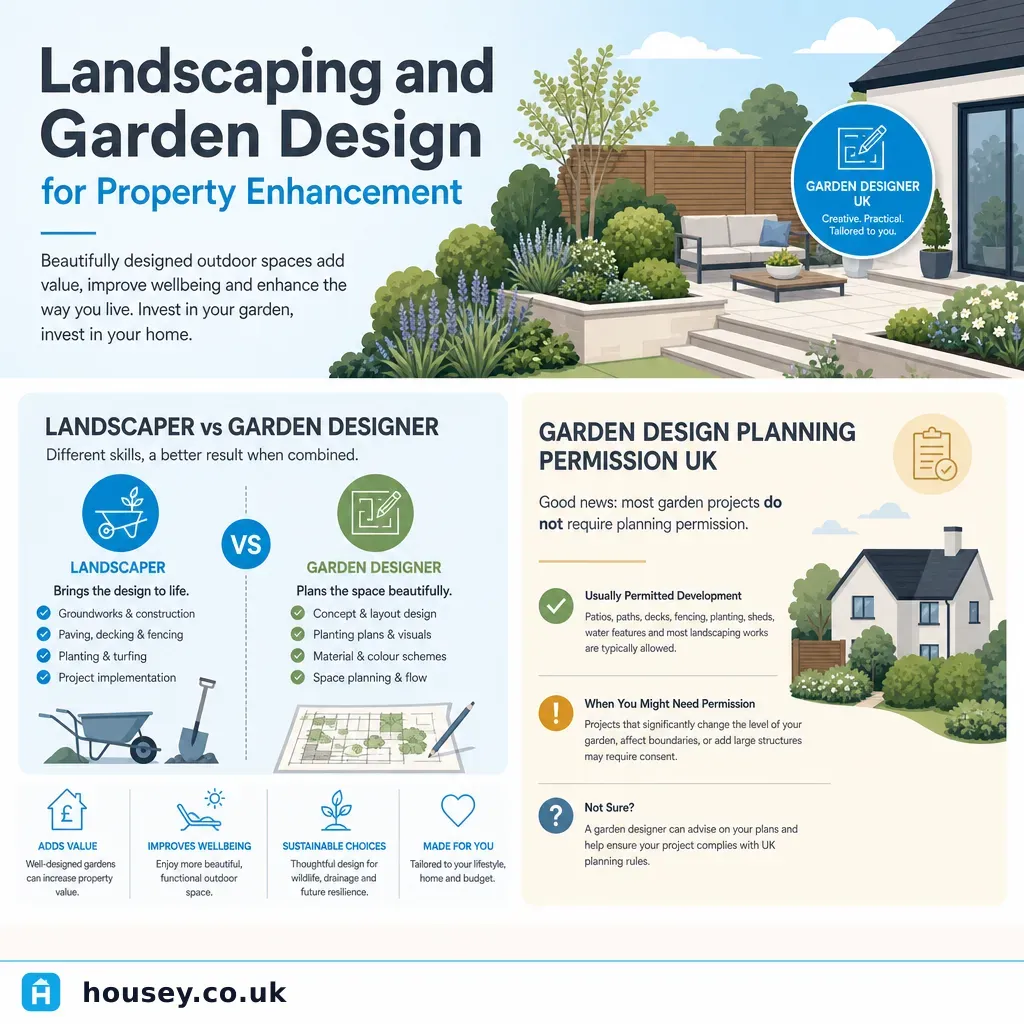
Landscaping and Garden Design for Property Enhancement
Gardens occupy a significant portion of most UK residential plots, yet outdoor spaces are frequently the last priority during renovation planning. Whether you are preparing a property for sale, settling into a new home with an overgrown plot, or finally tackling a garden that has never worked for your household, professional garden design and landscaping can transform how a space functions and feels. The decisions of who to hire, when, and in what sequence depend on the scope of your project and the kind of output you need.
Key points
- Paving over 5 m² in a front garden with non-permeable materials has required planning permission since October 2008; the Planning Portal sets out the conditions and permeable alternatives that avoid this requirement.
- Members of the Society of Garden Designers (SGD) hold recognised UK professional credentials; the British Association of Landscape Industries (BALI) is the main accreditation body for landscape contracting firms.
- A garden designer produces design drawings, planting plans, and material specifications; a landscape contractor builds to those plans — many projects benefit from engaging both in sequence.
- Drainage connections to a public sewer may require approval from your water and sewerage company under the Water Industry Act 1991.
- Trees subject to a Tree Preservation Order (TPO) or within a conservation area cannot be pruned or felled without local planning authority consent; penalties can be unlimited.
Garden designer or landscaper: what is the difference?
The two roles are distinct but often complementary. A garden designer focuses on the concept, layout, and detailed specification of an outdoor space — producing scale drawings, planting schemes, material schedules, and a brief for contractors to price against. Many hold qualifications from the RHS or are members of the Society of Garden Designers (SGD), which requires assessed professional competency.
A landscaper (or landscape contractor) carries out the physical work: groundworks, hard landscaping (paths, patios, raised beds, boundary walls), soft landscaping (turf laying, planting installation), drainage, and outdoor lighting. BALI-accredited contractors have agreed to a code of practice and carry relevant public liability and employers' liability insurance.
For smaller or well-defined projects — a patio replacement or a lawn re-turfing — a landscaper alone may be sufficient. For larger or more complex gardens, engaging a garden designer first produces a proper brief that reduces scope creep and cost surprises when the work goes to tender.
Comparison: garden designer vs landscaper
Role | What they produce | Best for | Not ideal for |
|---|---|---|---|
Garden designer | Concept plans, planting schedules, material specs, contractor brief | New gardens, complex layouts, design-led transformations | Physical construction work |
Landscaper / contractor | Groundworks, hard and soft landscaping, drainage, lighting installation | Executing an existing design, straightforward construction | Producing design drawings or detailed planting plans |
Design-and-build firm | Integrated design and construction package | Single point of contact, medium-complexity projects | Highly bespoke planting design or detailed specifications |
Does garden landscaping need planning permission?
Most garden work falls within permitted development — homeowners generally do not need planning permission for patios, decking, raised beds, fences (up to 1 m adjoining a highway, 2 m elsewhere), or garden buildings within specified limits.
Exceptions to check:
- Front garden paving: Installing non-permeable paving larger than 5 m² at the principal elevation requires planning permission, as set out on the Planning Portal. Permeable paving or directing drainage to a lawn or border avoids this requirement.
- Listed buildings and conservation areas: Permitted development rights may be restricted or removed entirely. Check with your local planning authority (LPA) before starting any external works.
- Article 4 directions: Some LPAs have issued Article 4 directions removing certain permitted development rights in specific areas. Your LPA can confirm whether any apply to your address.
- Decking and outbuildings: Structures within 2 m of a boundary and over 2.5 m in height, or covering more than 50% of the original garden area, may require planning permission.
The Planning Portal's interactive house tool is a reliable starting check for most situations.
Planning your landscaping project
A structured approach reduces delays and rework. Before approaching a designer or contractor, it helps to have the following ready:
Pre-project checklist
Which professional do you need?
- Choose a garden designer if you want a detailed designed scheme and do not have a clear layout or planting plan in mind.
- Choose a BALI-accredited landscaper if you have an existing design or a straightforward brief and need a contractor to build it.
- Choose a design-and-build firm if you want a single point of contact for a project of moderate complexity.
- Consult your local planning authority if the property is listed, in a conservation area, or if you intend to pave the front garden.
- Consult an arboricultural consultant if the garden contains trees that may be subject to a Tree Preservation Order.
Hardscaping: materials and drainage
Patios, paths, and driveways form the structural framework of a garden. Material choice affects maintenance, drainage, and visual character. Common UK options include:
- Natural stone (sandstone, granite, limestone): durable and attractive; higher cost; requires skilled laying on a full mortar bed
- Porcelain paving: frost-resistant and low-maintenance; must be laid on a full mortar bed to prevent hollow spots
- Block paving: modular and easy to repair; permeable variants available and increasingly common for driveways
- Resin-bound gravel: fully permeable; meets sustainable drainage principles; popular for driveways and paths
All paved surfaces should have adequate falls (minimum 1:80) to direct surface water away from the building. Where new drainage connects to a public sewer, approval from your water and sewerage company may be needed under the Water Industry Act 1991.
When to get professional help
Most garden landscaping is low-risk, but certain situations warrant specialist input:
- Tree Preservation Orders: Never prune, lop, or remove a TPO tree without written consent from your LPA. Penalties can be unlimited.
- Boundary disputes: Confirm ownership of walls and fences before altering them; the Land Registry title plan and property deeds are the starting point.
- Japanese knotweed or invasive species: A specialist contractor should assess and manage the plant; incorrect disposal is an offence under the Wildlife and Countryside Act 1981.
- Listed buildings or conservation areas: Apply for listed building consent or planning permission before any external works begin.
- Public sewer connections: Consult a drainage contractor and your water company before connecting new drainage runs to the public network.
How Housey can help
Housey connects you with vetted garden designers and landscapers across the UK. Submit your project brief and receive comparable quotes from local professionals — no obligation, no cold calls.
Frequently asked questions
Do I need planning permission for a new patio or deck?
In most cases, no. Patios at ground level and decking under 30 cm high are usually permitted development for dwellings. However, if the property is listed, in a conservation area, or the decking is substantial in size or height, planning permission or listed building consent may be required. Always check with your local planning authority if you are in any doubt.
What is the difference between a garden designer and a landscaper?
A garden designer produces the concept, layout drawings, planting plan, and material specifications for an outdoor space. A landscaper carries out the physical construction and planting work. Many projects use a designer to produce a brief and then a BALI-accredited contractor to build it. Some firms offer a combined design-and-build service for a single point of contact.
How long does a typical garden landscaping project take?
Timescales vary by project scale. A patio replacement or lawn re-turf may take one to three days. A full garden redesign with new planting, hard landscaping, lighting, and drainage could take several weeks. Allow extra time for design work, any planning enquiries, material ordering, and contractor availability — spring and early summer are typically the busiest periods.
Does landscaping add value to my property?
A functional, well-maintained outdoor space is generally viewed positively by buyers and can improve saleability and kerb appeal. RICS research suggests gardens contribute to perceived property value, though specific uplift depends heavily on location and buyer profile. Investment in landscaping is rarely poor value for livability, even where direct financial return is uncertain.
Sources and further reading
- Planning Portal: Driveways and hardstandings — Planning Portal
- Society of Garden Designers — SGD
- British Association of Landscape Industries (BALI) — BALI
- Water Industry Act 1991 — legislation.gov.uk
Useful next reads
 Improvement & Build
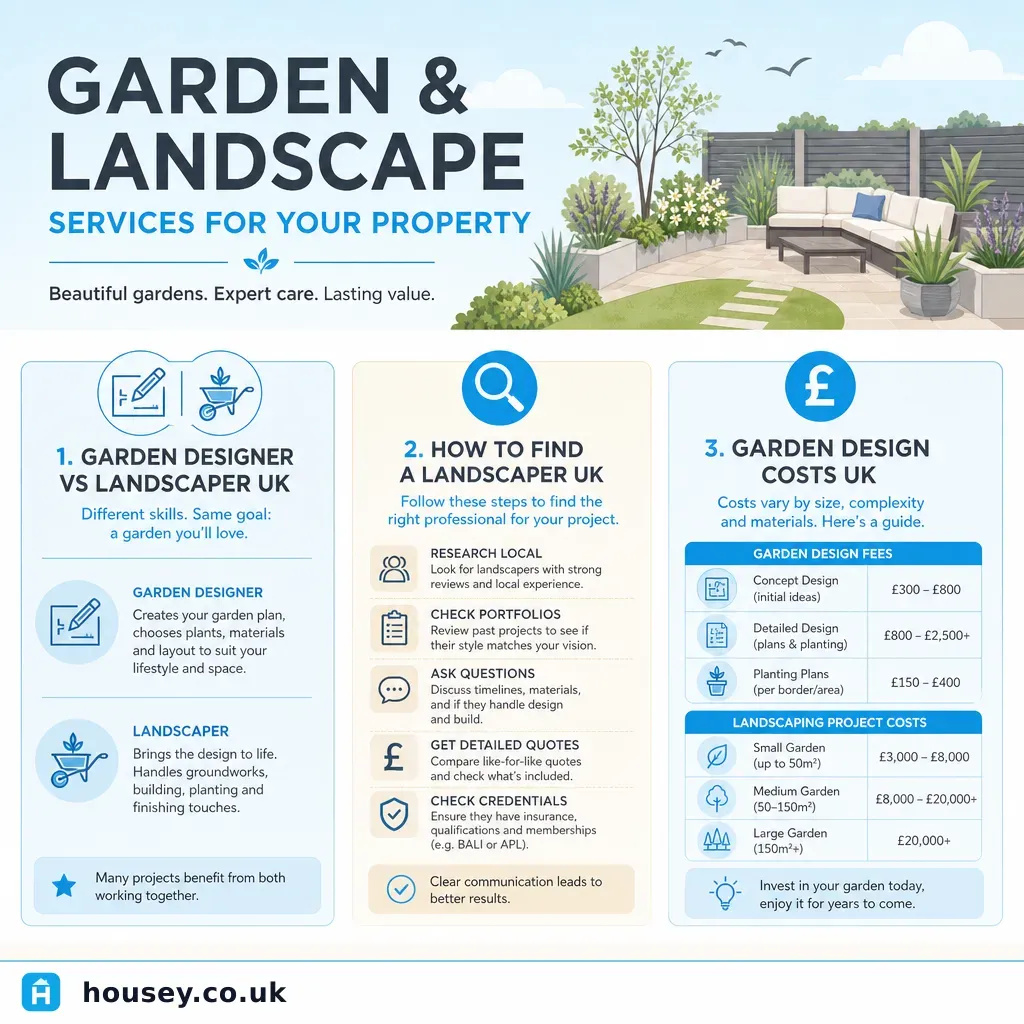
Garden and Landscape Services for Your Property
Garden designers and landscapers both improve outdoor spaces but offer different services.
 Improvement & Build
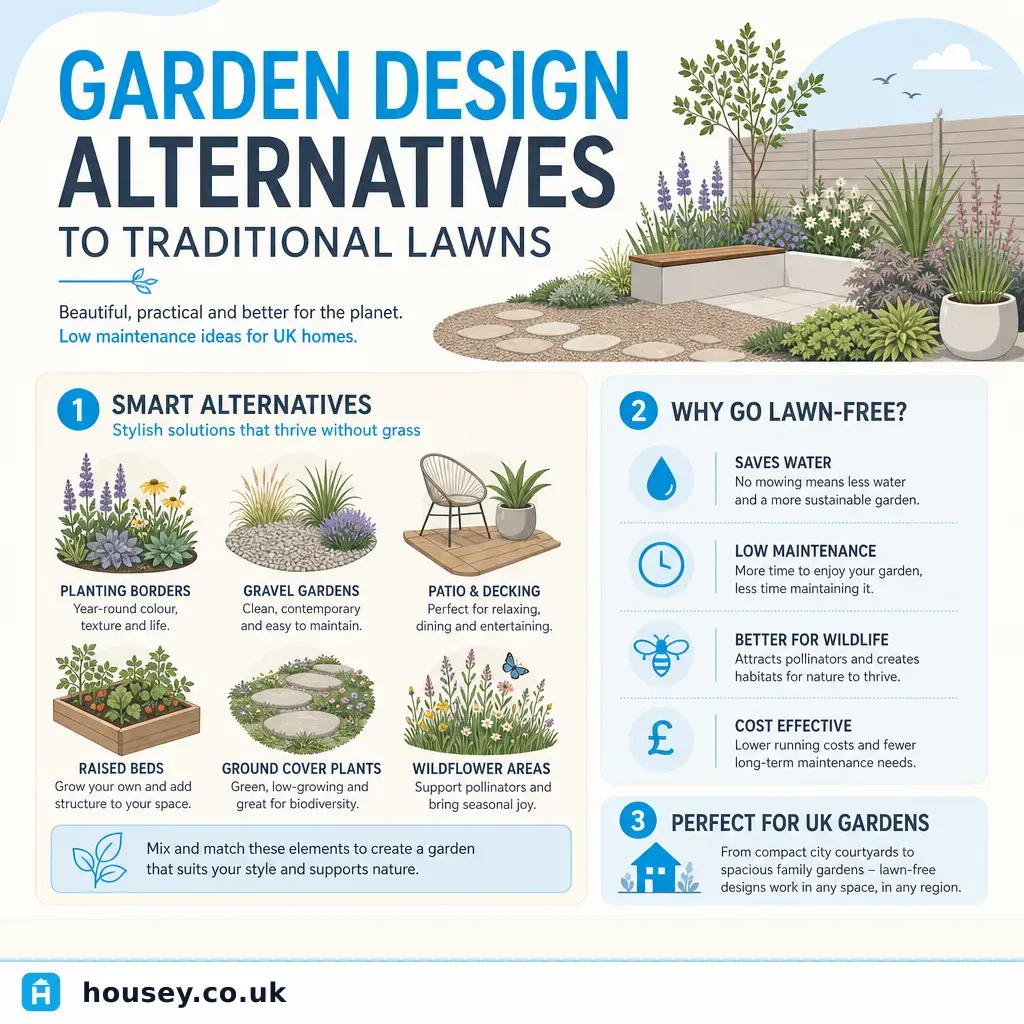
Garden Design Alternatives to Traditional Lawns
Popular alternatives to a traditional grass lawn in UK gardens include gravel, wildflower meadow planting, permeable paving, and ground-cover plants.
 Improvement & Build
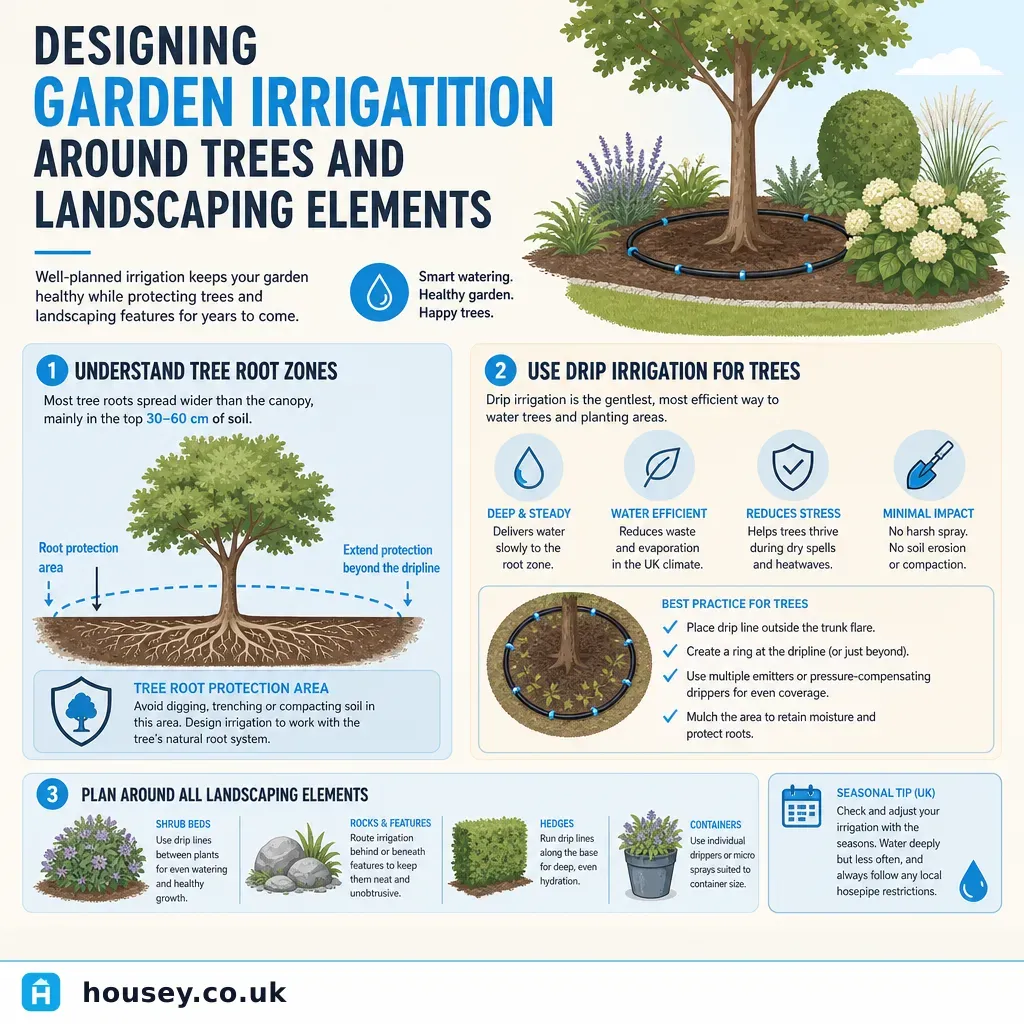
Designing Garden Irrigation Around Trees and Landscaping Elements
Design irrigation around trees by respecting the root protection area defined under BS 5837:2012, using drip or leaky pipe delivery rather than spray heads, and putting the tree zone on its own circuit.
 Improvement & Build
Garden Design Trends and Contemporary Landscaping Ideas
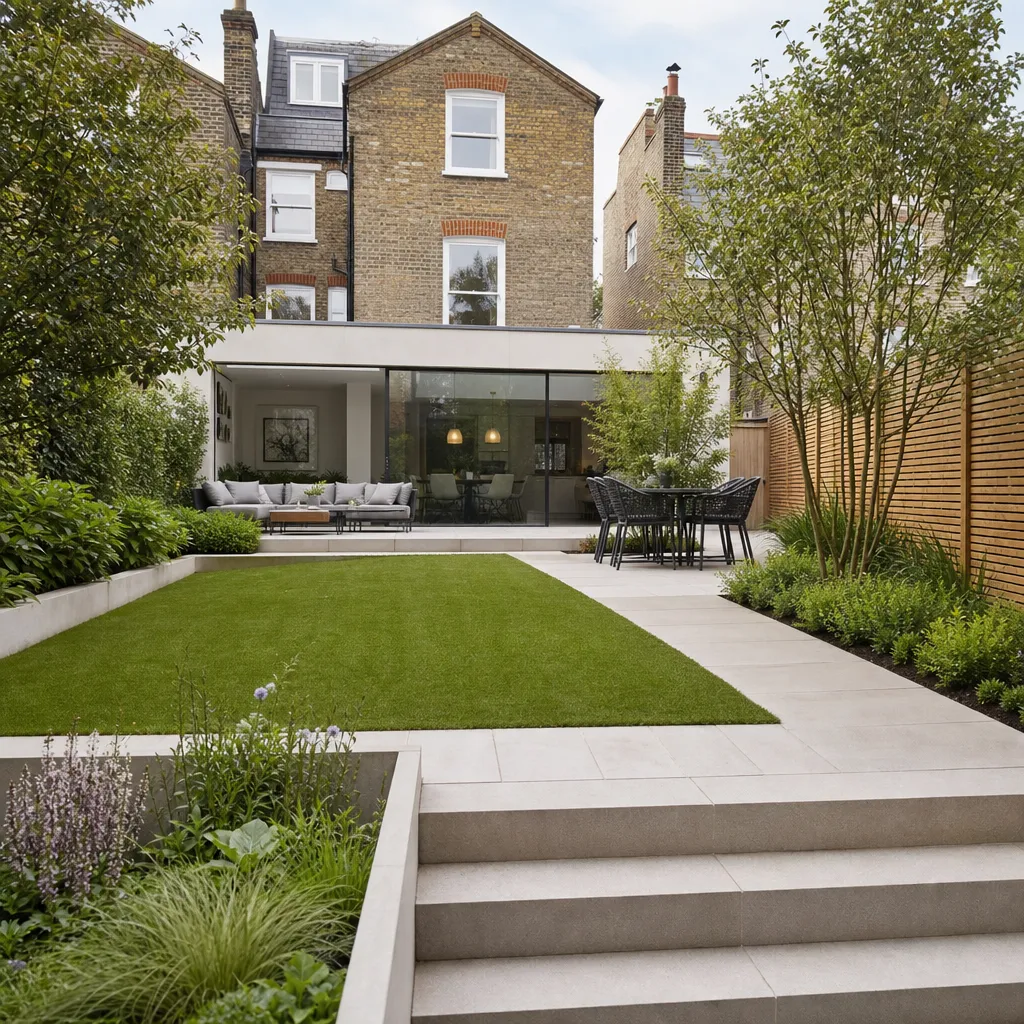
Contemporary UK garden design centres on low-maintenance naturalistic planting, multi-functional outdoor spaces, sustainable hard landscaping materials, and wildlife-friendly rewilded areas.
 Improvement & Build
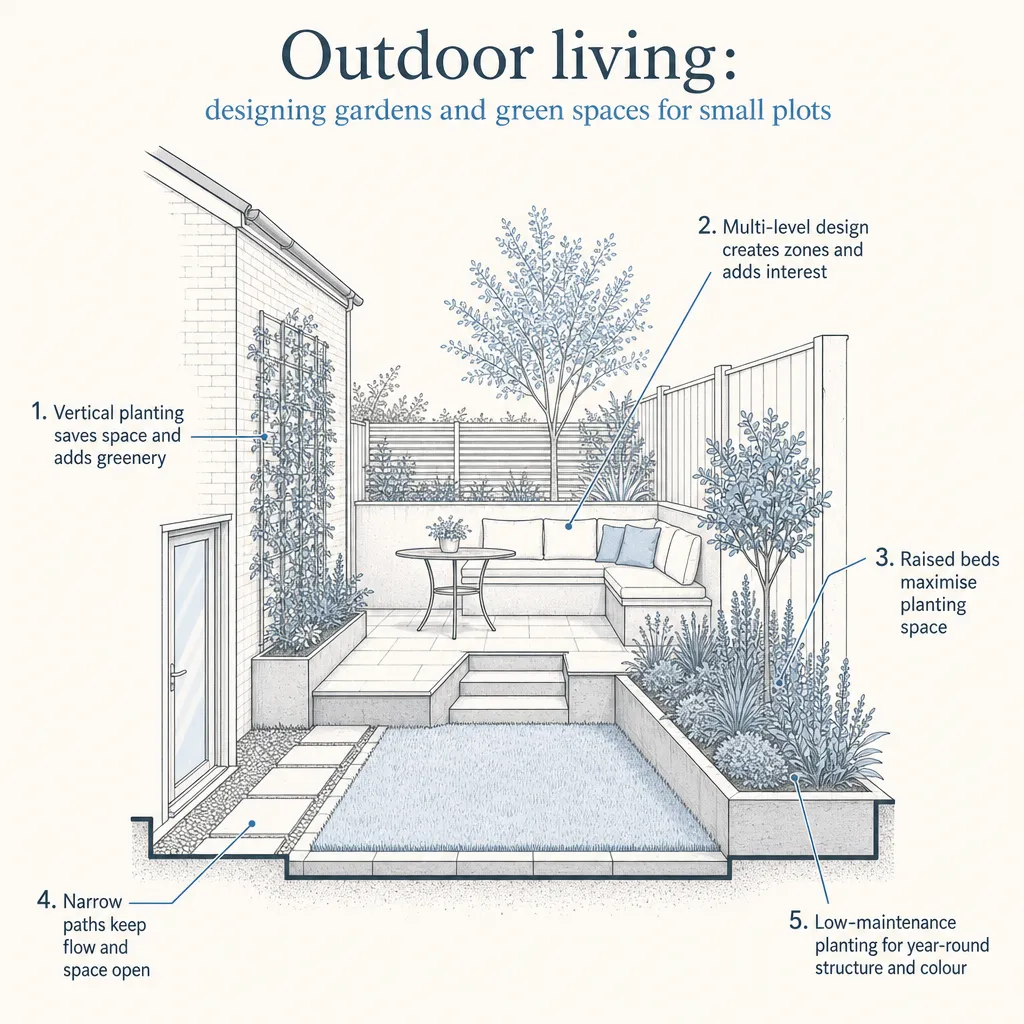
Outdoor living: designing gardens and green spaces for small plots
Small plots work best when divided into defined zones — seating, planting, and utility — before materials are chosen.