How Much Does Bespoke Built-In Storage Cost in the UK?
By Housey · Last reviewed 6th of May 2026
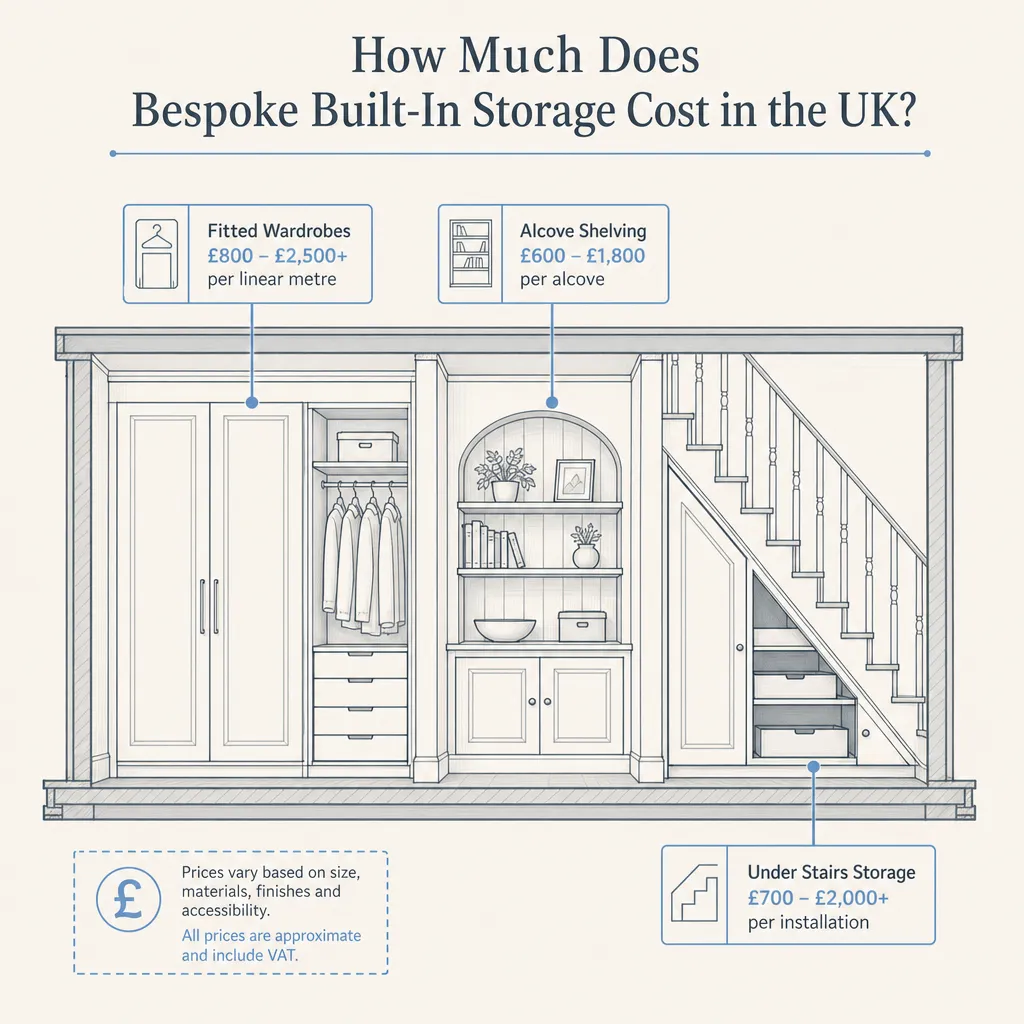
How Much Does Bespoke Built-In Storage Cost in the UK?
Built-in storage consistently ranks among the home improvements that buyers and estate agents view positively — it increases perceived space, reduces clutter, and can turn an awkward Victorian alcove or sloped loft ceiling into a practical asset. Yet costs vary considerably depending on whether you choose MDF-painted joinery from a local carpenter, a mid-range specialist fitted-furniture company, or fully bespoke cabinetry from a furniture maker. Understanding the cost structure before you invite quotes makes it far easier to set a realistic brief and compare proposals like for like.
Key points
- Alcove shelving fitted by a local joiner typically costs £400–£1,500 per alcove, depending on the number of shelves, drawer sections, and cupboard units included.
- Full bedroom fitted wardrobes range from approximately £2,000 for a basic MDF-painted run to £8,000–£15,000+ for bespoke solid-wood or veneered cabinetry.
- Under-stairs storage conversion typically costs £1,000–£3,500, depending on the existing structure and level of fit-out.
- Materials account for roughly 30–50% of the total project cost; the remainder is skilled labour and finishing.
- VAT at 20% applies to joinery and installation work unless your contractor operates below the VAT registration threshold — always clarify before comparing quotes.
The three tiers of built-in storage
"Built-in" and "bespoke" are used loosely across the market. In practice, most projects fall into one of three tiers, each with distinct cost and quality characteristics.
Tier | What you get | Indicative cost range | Best suited to |
|---|---|---|---|
Fitted flatpack (e.g. IKEA PAX, Hammant) | Standard frames with professionally fitted doors and integrated surrounds | £800–£3,000 installed | Straight runs, standard ceiling heights, flexible brief |
Semi-bespoke (specialist company) | Made-to-measure fronts on standard internal frames; wider finish and colour options | £2,000–£7,000 | Most alcoves and bedrooms; customised appearance at lower cost than full joinery |
Fully bespoke joinery | Purpose-built from scratch by a joiner or furniture maker | £3,000–£15,000+ | Listed buildings, unusual spaces, high-specification finishes, long-term investment |
Indicative UK costs, last reviewed 2026-05-06. Costs vary by region, specification, complexity, and individual contractor rates. Obtain at least three itemised quotes.
Cost breakdown by storage type
Alcove shelving and cabinetry
Alcove units — typically fitted either side of a chimney breast in a 1930s semi or Victorian terrace — are among the most commonly requested built-in storage projects. Costs depend on how many shelves are open versus enclosed in a cupboard section, and the quality of finish required.
- Open shelving only (3–5 shelves, MDF painted): £400–£900 per alcove.
- Shelves above, cupboard below (MDF painted): £700–£1,500 per alcove.
- Solid wood or veneered finish: Add 30–60% to the above figures.
Fitted bedroom wardrobes
Bedroom wardrobes vary the most in cost because configuration options multiply quickly — hanging rail arrangements, internal drawers, LED lighting, mirror panels, and soft-close mechanisms all add to the total.
- Basic MDF-painted run, no frills (2.4m wide): £1,800–£3,000 fully fitted.
- Mid-range with soft-close drawers and mirror panels: £3,500–£6,000.
- High-specification bespoke cabinetry: £6,000–£15,000+.
For sloped loft or attic ceilings, expect a cost premium of 20–40% due to the additional cutting and fitting time involved.
Under-stairs storage
Under-stairs cupboards can be fitted with pull-out drawers, shelving, a home desk, or utility storage. Structural work is rarely required unless the staircase itself is being altered.
- Basic shelving and new door: £800–£1,500.
- Pull-out drawers and fitted shelving: £1,500–£3,000.
- Utility-style fit-out with plumbing or additional electrical outlets: £2,500–£5,000+ (electrical work must be carried out or certified by a Part P registered contractor).
Home office built-in desks and shelving
Home office joinery — a run of desk, shelving, and cabinetry across a wall or alcove — is increasingly common since the shift to hybrid working patterns.
- Simple MDF desk and shelving: £1,000–£2,500.
- Full wall of cabinetry with integrated desk and storage: £3,000–£8,000.
What drives the cost up or down?
Cost drivers (upward):
- Material upgrade: Moving from MDF painted to solid oak or walnut typically increases material cost by 50–100%.
- Integrated lighting: LED strip or spotlight integration adds approximately £200–£600 per unit.
- Premium hardware: Blum or Hettich soft-close fittings add £150–£400 per unit compared with budget alternatives, but offer significantly longer service life.
- Complex spaces: Sloped ceilings, curved walls, and limited access all add fitting time and increase material waste.
- Location: London and south-east labour rates typically run 20–40% above the UK average.
Cost drivers (downward):
- Standard ceiling heights (2.4m) and straight runs minimise cutting and fitting time.
- MDF is considerably cheaper than solid timber and accepts paint well.
- Semi-bespoke (custom fronts on standard frames) substantially reduces cost versus fully bespoke joinery.
- Flexible scheduling — some joiners offer reduced rates for work fitted around other projects.
What to ask when comparing quotes
- Is VAT included or excluded in this figure?
- What material forms the carcass — MDF, plywood, or solid wood?
- What is the visible face material and finish specification — painted MDF, timber veneer, solid wood?
- How many coats of paint or finish are included?
- Who manufactures the components — your firm directly, or a third-party supplier?
- What is the lead time from site survey to installation?
- How are uneven or out-of-square walls handled — is scribing or packing included in the price?
- Is a full site survey included in the quoted price?
- What is the guarantee period, and is it provided in writing?
Red flags when hiring a joiner or fitted-furniture company
- Quoting without a site visit — accurate pricing for built-in joinery genuinely requires a physical survey of the space.
- No written specification document — a price without a description of materials, dimensions, finishes, and inclusions cannot be fairly compared or enforced.
- No clear VAT status on the quote.
- Unusually low quotes that do not itemise hardware, finishing materials, or site preparation.
- No mention of lead time or programme — bespoke joinery typically takes four to twelve weeks from survey to installation, and unusually short timescales may indicate off-the-shelf substitutions.
- Reluctance to provide references, photographs of previous work, or a signed contract before taking a deposit.
When to get professional help
Most fitted storage work does not require planning permission or a building control application. However, there are situations where professional input or formal notification is needed:
- Electrical changes: If built-in storage includes new mains-connected lighting, additional sockets, or consumer unit connections, the work must be carried out or certified by a contractor registered under a competent-person scheme such as NICEIC or NAPIT, or separately notified to building control under Part P of the Building Regulations (Approved Document P, GOV.UK).
- Listed buildings: Any permanent fixture in a listed building — including built-in joinery — may require listed building consent from your local planning authority before installation begins. Check before commissioning work.
- Structural changes: If creating a storage niche involves removing or altering a loadbearing wall or structural element, consult a structural engineer before work starts.
How Housey can help
Housey helps homeowners describe their storage project and receive quotes from vetted local joiners and fitted-furniture specialists. Share the room, approximate dimensions, material preferences, and budget, and compare proposals from multiple professionals before committing to any contractor.
Frequently asked questions
Is bespoke built-in storage worth the cost versus flatpack fitted furniture?
For awkward spaces — sloped ceilings, unusually narrow alcoves, or non-standard heights — bespoke joinery is usually the only practical option and delivers a result that flatpack cannot match. For standard straight runs in regular rooms, semi-bespoke (custom fronts on standard frames) often delivers a high-quality finish at considerably lower cost than fully bespoke joinery.
How long does bespoke built-in storage take to complete?
Lead times vary by joiner and time of year. A straightforward alcove unit may be made and fitted within two to three weeks. Full bedroom wardrobes or complex home office joinery typically take four to eight weeks from survey to installation. Specialist furniture makers can run ten to sixteen weeks for complex commissions, particularly when solid hardwood or specialist materials are involved.
Does built-in storage add value to a property?
Well-executed built-in storage is generally viewed positively by estate agents and buyers, as it increases perceived space and reduces visual clutter. No published UK data assigns a specific percentage price uplift, but it is widely regarded as a neutral-to-positive improvement for resale. Poor-quality joinery with visible defects, misaligned doors, or rough scribing can, however, be a negative at the point of sale.
Do I need planning permission or building control notification for fitted storage?
In most cases, no planning permission is required for internal fitted storage. Listed buildings require listed building consent for any permanent internal alteration. If mains electrical work is involved and carried out by an unregistered contractor, a separate building control notification is required under Part P of the Building Regulations. Using a NICEIC or NAPIT-registered electrician ensures self-certification and avoids that requirement.
Sources and further reading
- Approved Document P: Electrical safety in dwellings — GOV.UK
- NICEIC — Find a registered electrician — NICEIC
- Planning Portal — Listed buildings and consent — Planning Portal
- Citizens Advice — Getting work done on your home — Citizens Advice
Useful next reads
 General property advice
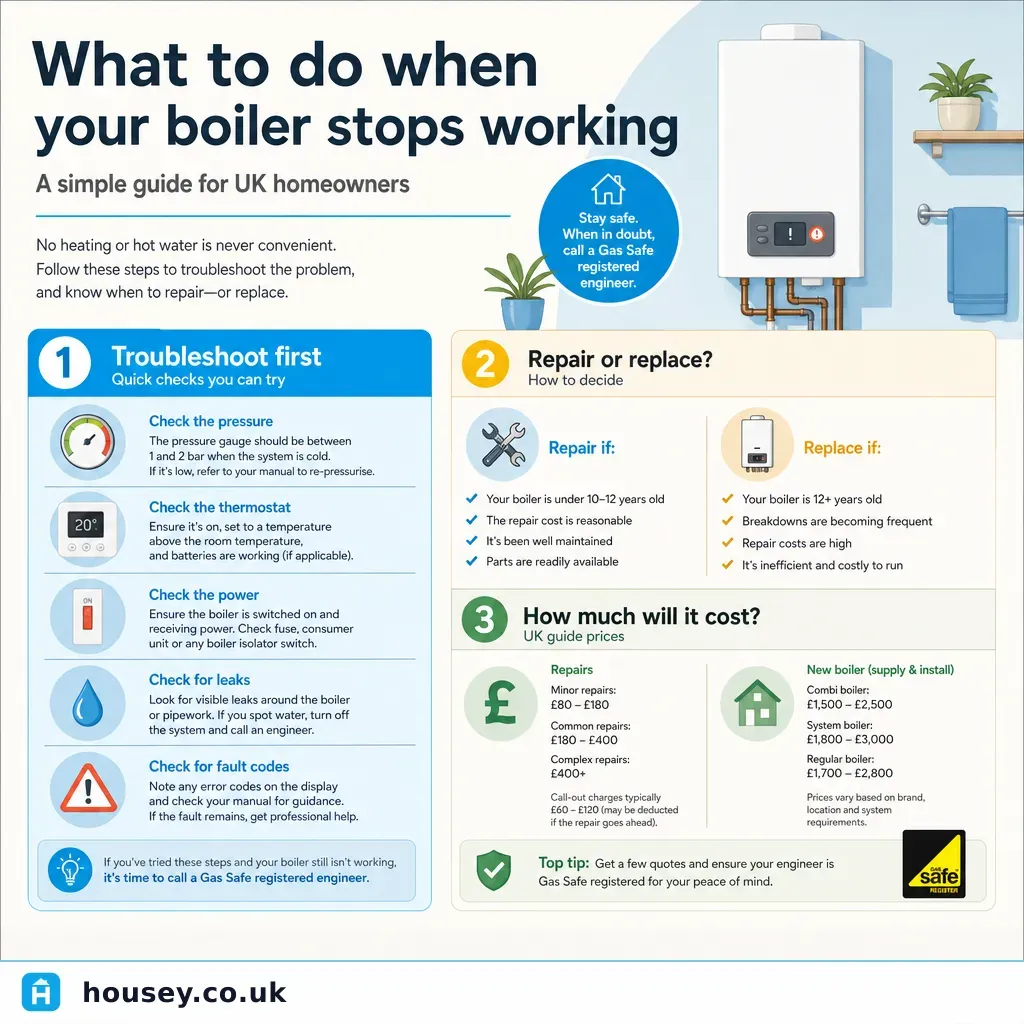
What to do when your boiler stops working
When your boiler stops working, check the pressure gauge (should read 1–1.
 General property advice
Property Market Trends: Activity Growth and Price Movements
UK property market activity is measured through completed sale registrations (HM Land Registry), lender mortgage data, and transaction volumes from HMRC.
 General property advice
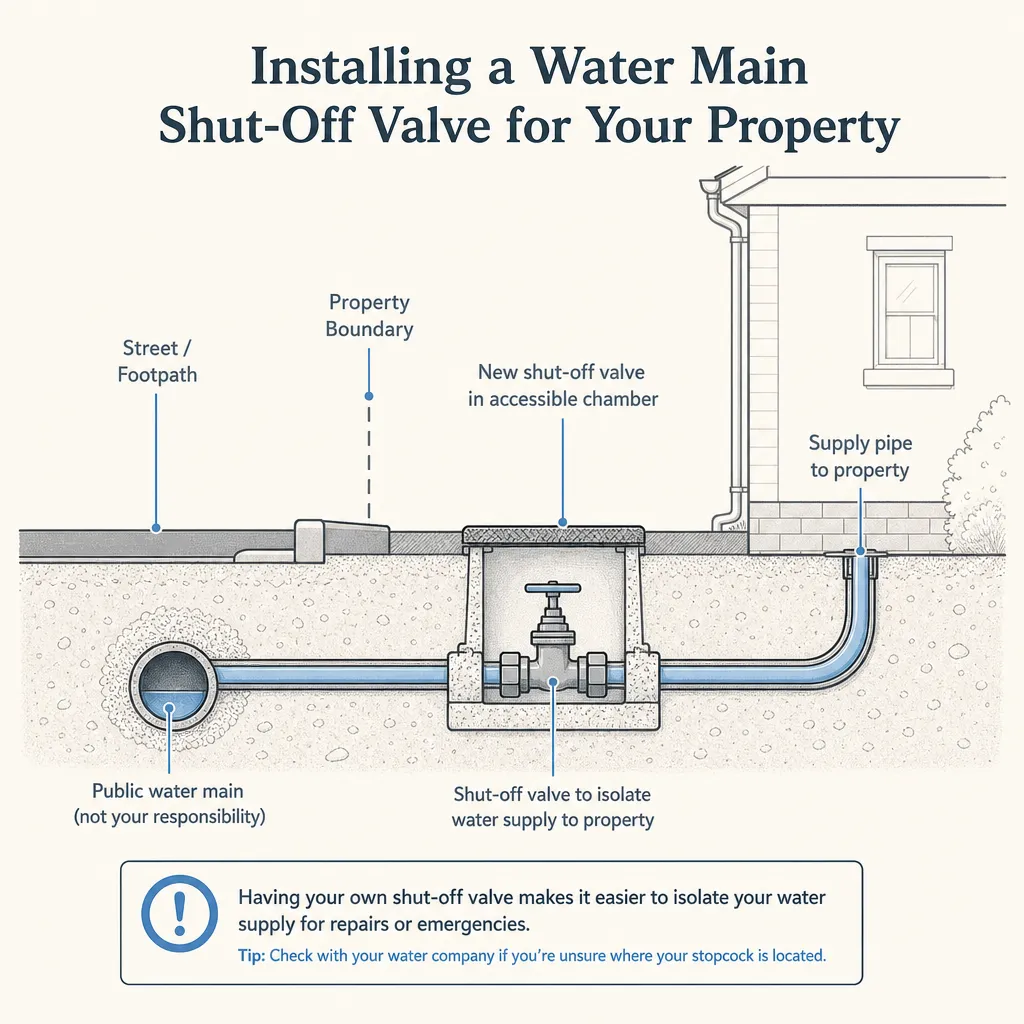
Installing a water main shut-off valve for your property
A water main shut-off valve — commonly called a stopcock — controls all water entering your home from the mains.
 General property advice
Monthly House Price Index: August Market Report and Analysis
The UK House Price Index is published monthly using completed Land Registry transaction data, meaning August figures typically reflect sales agreed months earlier.
 General property advice
Scottish Property Market: Activity and Regional Trends
Scotland's property market operates under distinct legal rules: sellers must provide a Home Report before marketing, transactions become legally binding at conclusion of missives rather than exchange of contracts, and Land and Buildings Transaction Tax replaces Stamp Duty.