Installing a water main shut-off valve for your property
By Housey · Last reviewed 6th of May 2026
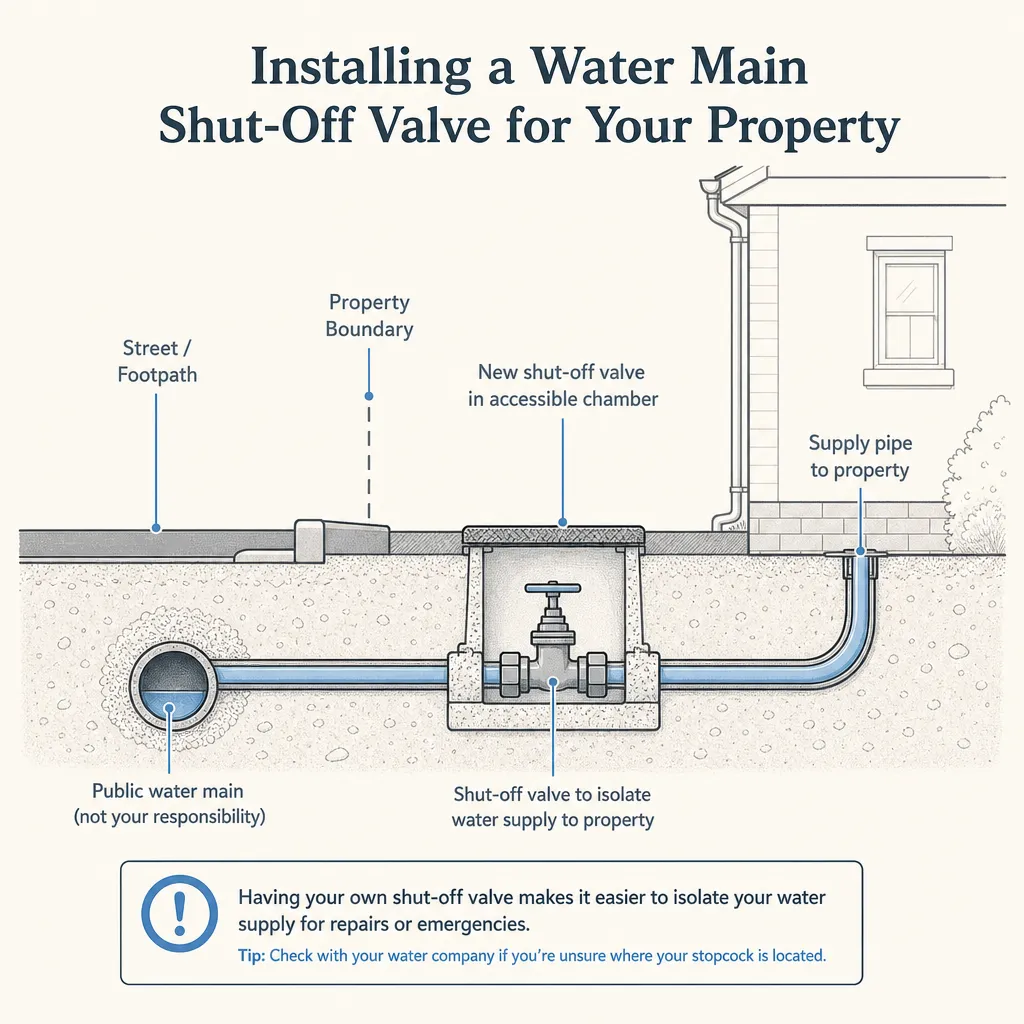
Installing a water main shut-off valve for your property
When a pipe bursts or a plumbing job needs doing, the ability to cut off the water supply quickly is essential. Many homeowners only discover they cannot find or operate their stopcock when water is already spreading across the floor — the worst possible moment. Understanding what a water main shut-off valve is, where to find yours, and when to have one professionally installed or replaced can prevent serious damage and expense.
Key points
- The internal stopcock is most commonly located under the kitchen sink or where the supply pipe enters the building from the boundary.
- External stop taps at the property boundary are owned by your water company — you cannot legally alter, replace, or relocate them.
- All water fittings in England and Wales must comply with the Water Supply (Water Fittings) Regulations 1999; in Scotland the Water Byelaws 2004 apply.
- A WaterSafe-approved plumber is the recognised standard for supply pipe work in England and Wales.
- Ball valves are strongly preferred over old gate valves for new installations — they are far less likely to seize and take a simple quarter-turn to operate.
What is a water main shut-off valve?
A water main shut-off valve — commonly called a stopcock — controls the entire water supply entering your home from the mains. Turning it clockwise closes the valve and stops water flowing to every tap, appliance, and fitting in the property.
Most UK homes have two relevant valves:
External stop tap: In a small underground box near the property boundary, usually in the footpath or driveway. Owned by your water company (Thames Water, Yorkshire Water, Severn Trent, and so on). You may use it in an emergency but cannot alter or relocate it.
Internal stopcock: The valve inside your home that you control. Usually under the kitchen sink, in a ground-floor cupboard, under the stairs, or in a utility room — wherever the supply pipe first enters from the boundary.
Gate valve vs ball valve: which should you choose?
Feature | Gate valve | Ball valve |
|---|---|---|
Visual open/closed indicator | No | Yes — handle parallel to pipe means open |
Risk of seizing with age | High | Low |
Emergency operation | Difficult if seized | Simple quarter-turn |
Typical valve cost (supply only) | £5–£20 | £8–£30 |
Recommended for new installs | No | Yes |
A seized gate valve that will not close can turn a small drip into a costly flood. Always replace with a ball valve.
DIY or call a plumber? A decision tree
- Consider DIY if you are replacing a like-for-like stopcock on a visible, accessible copper or plastic pipe, can operate the external stop tap without difficulty, and are confident with push-fit or compression fittings.
- Call a WaterSafe-approved plumber if the pipe material is lead or unknown; the valve or surrounding pipework is corroded; you need to move the stopcock location; you are working close to the supply pipe entry point; or the external stop tap will not close.
- Contact your water company if you suspect a fault with the external stop tap, the boundary box is damaged, or there appears to be a leak on the supply pipe before it enters the property.
What does installation cost?
Indicative UK costs, last reviewed 2026-05-06. Figures vary by region, access difficulty, pipe material, and whether additional work is needed. Request itemised quotes from at least two WaterSafe-approved plumbers.
Job | Indicative cost range |
|---|---|
Like-for-like internal stopcock replacement (accessible) | £100–£250 |
New stopcock installation where none exists | £150–£400+ |
Upgrade gate valve to ball valve on accessible pipework | £80–£200 |
Partial internal supply pipe replacement | £300–£800+ |
Always confirm whether VAT is included and ask what happens if unexpected issues — corroded fittings, unknown pipe material — are found during the work.
Preparation checklist before a plumber visits
Compliance with Water Regulations
All water fittings in England and Wales must comply with the Water Supply (Water Fittings) Regulations 1999. In Scotland, the Water Byelaws 2004 apply. Fittings must be rated for the correct operating pressure and temperature, backflow prevention must be maintained downstream where required, and all fittings must remain accessible for inspection. Certain plumbing works require notification to the water supplier — a WaterSafe-approved plumber will advise whether this applies to your job.
When to get professional help
Contact a WaterSafe-approved plumber if:
- The existing valve has seized and cannot be turned
- There is active leaking around the valve body or gland
- You cannot locate an internal stopcock at all
- The pipework is old, corroded, or made from lead
- Water pressure is unusually low throughout the property, suggesting a supply pipe issue
Contact your water company if you suspect a fault with the external stop tap, a leak between the boundary and the property, or any issue on the public highway.
How Housey can help
Housey connects homeowners with experienced local plumbers for jobs including stopcock installation and replacement. Use our quote request tool to describe the work and receive competitive quotes from vetted tradespeople in your area.
Frequently asked questions
Where is the water main shut-off valve in a UK home?
Most commonly under the kitchen sink, in a ground-floor cupboard near the front of the property, or in a utility room — wherever the supply pipe enters the building from the boundary. If you cannot find it, trace the route between your external stop tap box and the kitchen. Some older properties were never fitted with an internal stopcock at all.
Can I turn off the mains water without a plumber?
Yes, in most cases. The external stop tap in the boundary box — operated with a flat-bladed screwdriver or a stop tap key — cuts off water to the whole property in an emergency. If it is seized or faulty, contact your water company directly. Do not attempt to force it, as damage can make things worse.
How long does it take to replace an internal stopcock?
A straightforward like-for-like replacement on accessible pipework typically takes one to two hours for a qualified plumber, including draining down. Jobs involving difficult access, corroded fittings, unfamiliar pipe materials, or re-routing will take longer. Ask your plumber for a time estimate and a fixed or capped quote before they begin.
Do I need to notify my water company when installing a stopcock?
For most simple internal replacements, notification is not routinely required, but the Water Supply (Water Fittings) Regulations 1999 do require notification for certain categories of plumbing work. A WaterSafe-approved plumber will advise on whether notification applies to your specific job. In Scotland, the relevant legislation is the Water Byelaws 2004.
What is the difference between a stopcock and an isolation valve?
A stopcock controls the entire incoming water supply to the property. An isolation valve — sometimes called a service valve — controls supply to a single appliance such as a washing machine, dishwasher, or toilet cistern. Both are useful, but only the stopcock can cut all water to the home simultaneously in an emergency.
Sources and further reading
- Water Supply (Water Fittings) Regulations 1999 — legislation.gov.uk
- WaterSafe: Find an approved plumber — WaterSafe
- Water Byelaws 2004 (Scotland) — legislation.gov.uk
- Problems with your water supply — Citizens Advice
Useful next reads
 General property advice
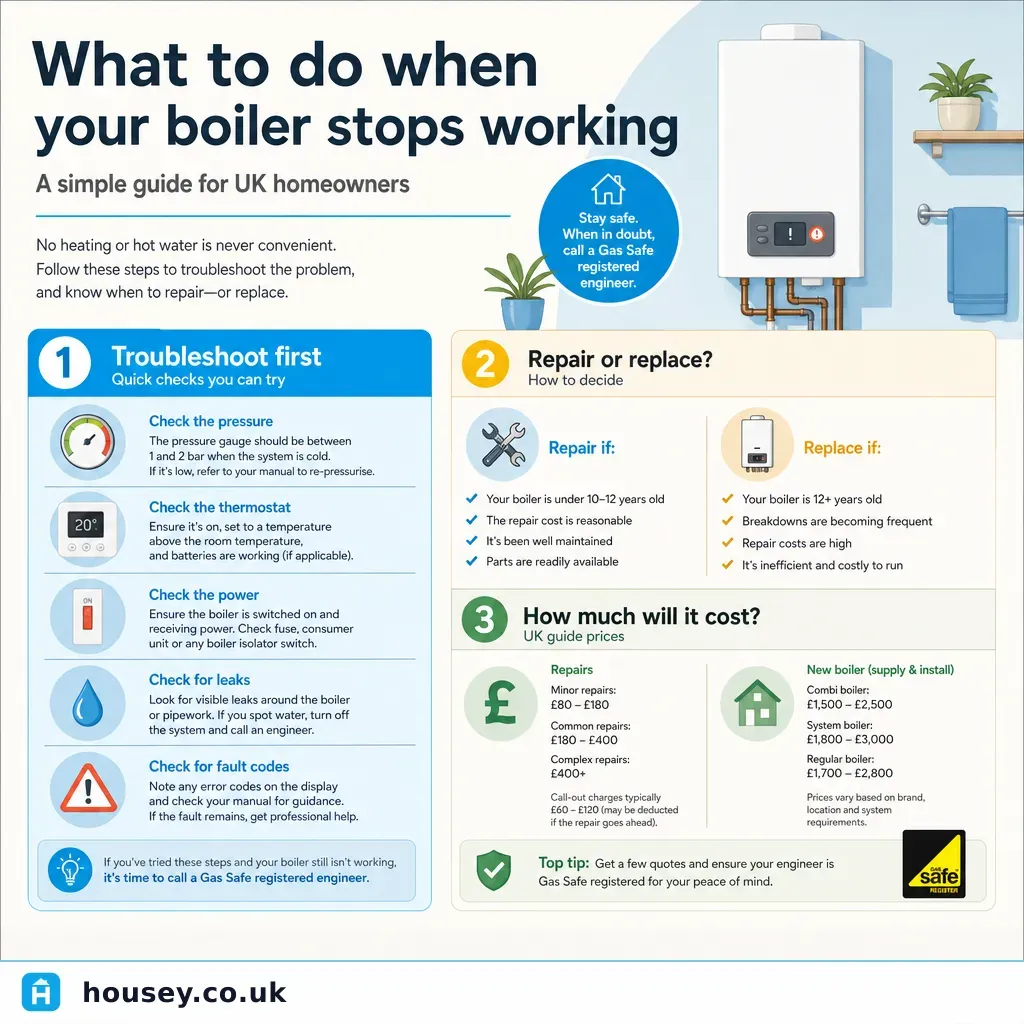
What to do when your boiler stops working
When your boiler stops working, check the pressure gauge (should read 1–1.
 General property advice
Property Market Trends: Activity Growth and Price Movements
UK property market activity is measured through completed sale registrations (HM Land Registry), lender mortgage data, and transaction volumes from HMRC.
 General property advice
Monthly House Price Index: August Market Report and Analysis
The UK House Price Index is published monthly using completed Land Registry transaction data, meaning August figures typically reflect sales agreed months earlier.
 General property advice
Scottish Property Market: Activity and Regional Trends
Scotland's property market operates under distinct legal rules: sellers must provide a Home Report before marketing, transactions become legally binding at conclusion of missives rather than exchange of contracts, and Land and Buildings Transaction Tax replaces Stamp Duty.
 General property advice
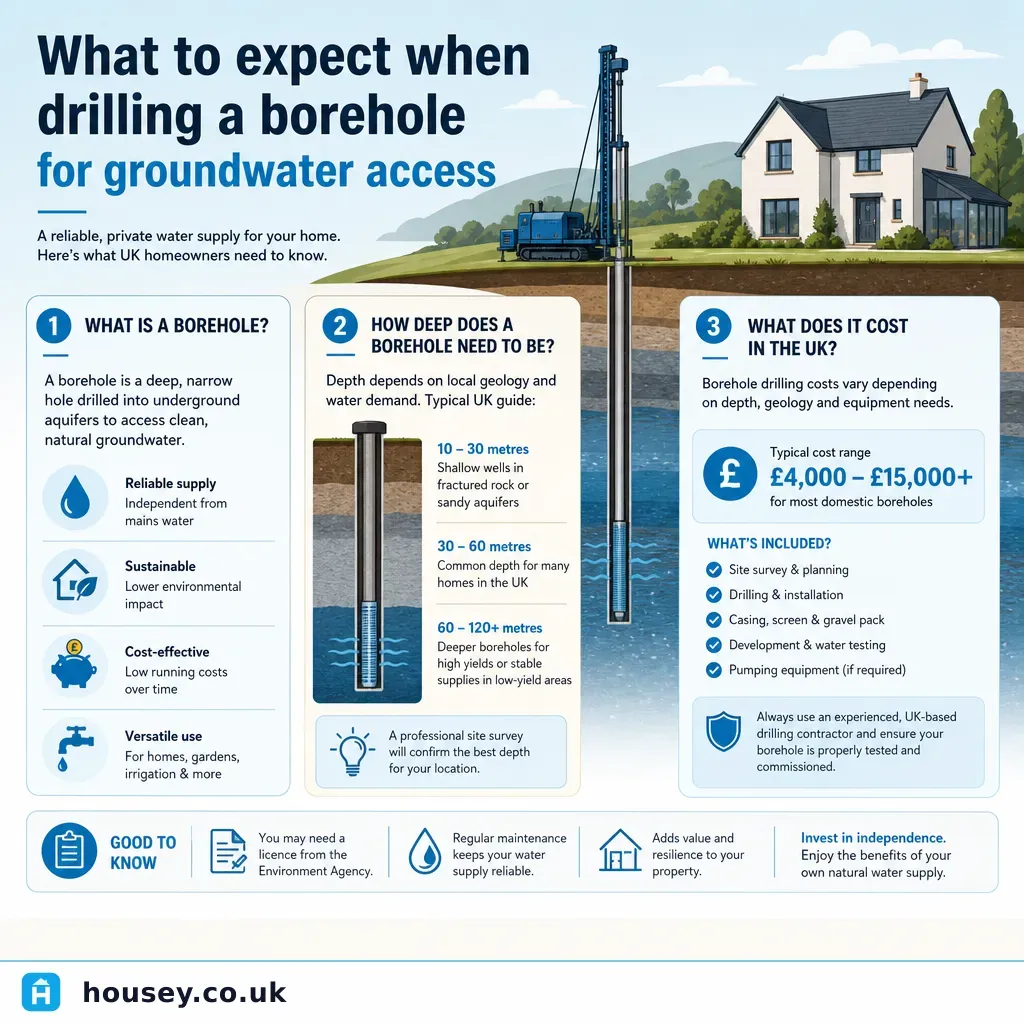
What to expect when drilling a borehole for groundwater access
Drilling a borehole for groundwater access typically involves a hydrogeological assessment, a driller installing steel casing to the required depth (often 30–150 m), water quality testing under the Private Water Supplies Regulations 2016, and in many cases an Environment Agency abstraction licence if you draw more than 20 m³ per day.