What to do when your boiler stops working
By Housey · Last reviewed 11th of May 2026
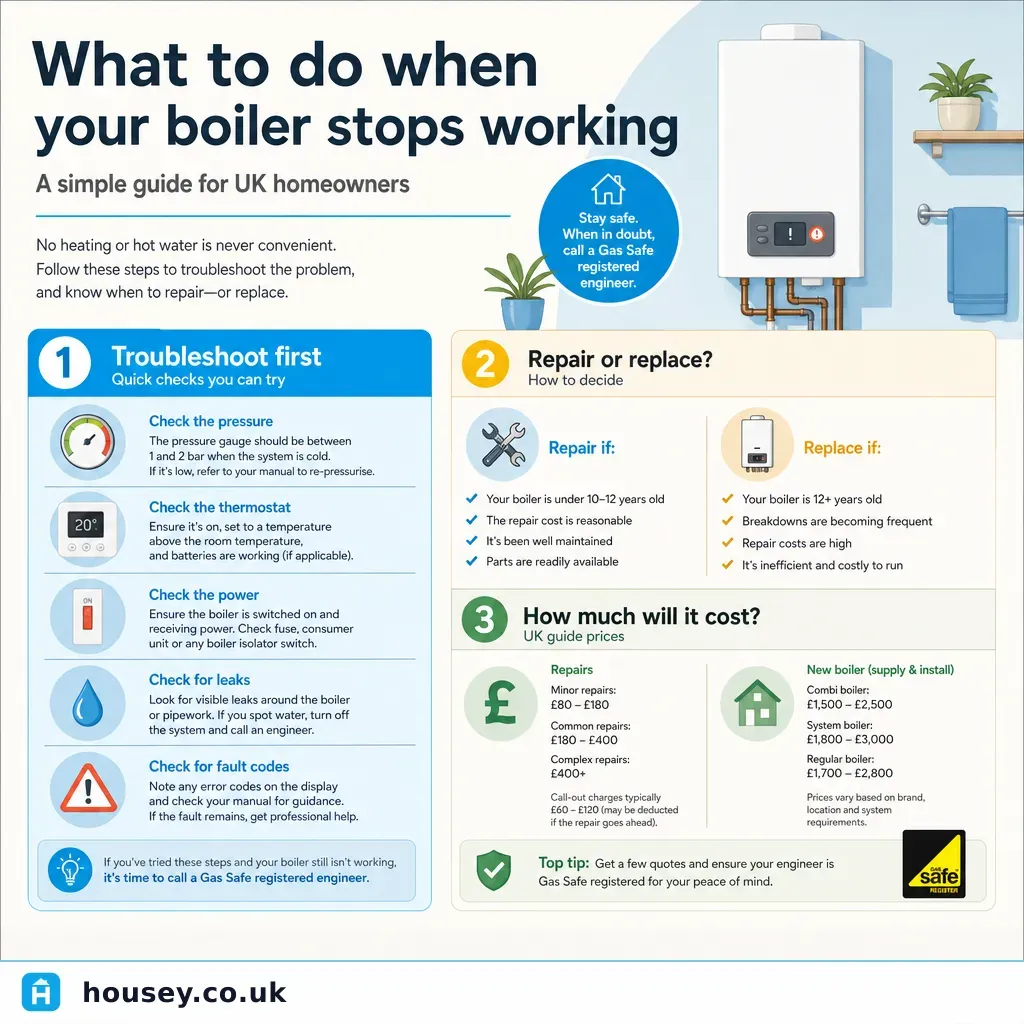
What to do when your boiler stops working
Discovering your boiler has stopped working can feel alarming, but many common faults have straightforward causes — and some can be identified, or even resolved, before a Gas Safe engineer visits. Knowing the right diagnostic steps saves time, avoids unnecessary callout charges, and helps you make a well-informed decision between repair and replacement when an engineer does arrive.
Key points
- All gas boiler repair work is legally restricted to Gas Safe registered engineers under the Gas Safety (Installation and Use) Regulations 1998 — attempting to repair gas valves, heat exchangers, or burner components yourself is both illegal and dangerous.
- The three most common causes of a boiler lockout are low water pressure (below 1 bar), an electronic fault triggering a reset condition, and a frozen or blocked condensate pipe — all diagnosable without any gas knowledge.
- Modern condensing boilers display manufacturer-specific fault codes (such as F1, E1, or EA) that significantly speed up diagnosis — always note the code before calling an engineer.
- Boilers over 15 years old with a repair quote exceeding £500 are often more cost-effective to replace; a new A-rated condensing boiler can reduce gas bills by 15–30%, according to the Energy Saving Trust.
- New boiler installations in England and Wales must comply with Building Regulations Part L (conservation of fuel and power) and Part J (combustion appliances) — the installing engineer should register via a government-approved Competent Person Scheme automatically.
Step-by-step: what to check before calling an engineer
The following checks involve no gas components and are safe for any householder.
1. Boiler pressure gauge
Check the pressure gauge on the boiler front panel. Most combi and system boilers should read between 1 and 1.5 bar when the system is cold. A reading below 1 bar is one of the most frequent causes of automatic lockout.
To re-pressurise: locate the filling loop (usually a flexible hose beneath the boiler) and slowly open one or both valves until the gauge reads approximately 1.2 bar, then close both valves fully. If pressure drops again within a few days, suspect a leak in the system — a Gas Safe engineer should trace and repair it.
2. Reset the boiler
Consult your boiler manufacturer's manual for the specific reset procedure. Press and hold the reset button for a few seconds, then allow the boiler to attempt ignition. If it restarts and locks out again within minutes, there is an underlying fault requiring professional diagnosis.
Note any fault code displayed on the panel. Codes such as F1, E1, and EA are manufacturer-specific — search your boiler model's manual or the manufacturer's website to understand the code before calling an engineer.
3. Thermostat and programmer
Check that the room thermostat is set above the current room temperature, the programmer or timer is set correctly (especially after a power cut), all thermostatic radiator valves (TRVs) are open rather than turned fully off, and any zone valves are not stuck in the closed position.
4. Condensate pipe
Modern condensing boilers have a plastic condensate pipe that carries wastewater to an outside drain. In cold weather this pipe can freeze — triggering a lockout fault, often accompanied by a gurgling noise. You can safely thaw a frozen condensate pipe by pouring warm (not boiling) water over the exposed external section, then resetting the boiler.
5. Gas supply
Check whether other gas appliances (hob, oven) are working. If not, a supply issue may be the cause — check that a prepayment meter has not run out of credit, and contact your gas supplier.
Repair vs replace: making the right decision
When an engineer has diagnosed the fault, you will need to decide whether to repair or replace. The table below outlines the key factors.
Scenario | Likely recommendation | Reason |
|---|---|---|
Boiler under 8 years old, single isolated fault | Repair | Cost-effective; parts available; boiler has useful life remaining. |
Boiler 8–12 years old, repair cost £200–£400 | Repair or replace — get both quotes | Depends on overall condition and current energy rating. |
Boiler over 15 years old, or repair cost over £500 | Replace | Older boilers are inefficient; further faults are likely. |
Repeated breakdowns within 12 months | Replace | Indicates end-of-life; ongoing repair costs add up. |
Heat exchanger failure | Replace | A major component; repair cost often approaches replacement cost. |
Boiler within manufacturer's warranty | Repair via warranty | Unauthorised repairs may void coverage — check documentation first. |
Indicative UK costs, last reviewed 2026-05-11: a new combi boiler supplied and fitted typically ranges from £1,500 to £3,000, depending on boiler brand, output, and installation complexity. Obtain at least three quotes from Gas Safe registered engineers and confirm that each installation will be registered via a Competent Person Scheme.
What not to assume
Several common misconceptions lead homeowners to waste time, spend money unnecessarily, or create safety risks:
- 'I can re-light the pilot on any boiler.' Modern condensing boilers have electronic ignition — there is no standing pilot light. On older standing-pilot models, re-lighting follows the manufacturer's procedure, but never touch the gas supply itself.
- 'A boiler service will fix a breakdown.' A service is preventive maintenance, not a repair. A failed boiler requires a fault diagnosis and repair — a separate, usually more expensive, job.
- 'Turning the thermostat higher will make the heating faster.' A thermostat is a target temperature, not a power dial. Increasing it will not speed up heating output.
- 'Any plumber can work on my boiler.' Gas work is legally restricted to Gas Safe registered engineers. An unregistered person cannot lawfully carry out boiler work, and any such work may invalidate your home insurance.
- 'My boiler is 10 years old — it is too new to replace.' Average boiler lifespan is 10–15 years, but this varies widely by brand and service history. If repair costs are high relative to the boiler's value, replacement can be the right choice regardless of age.
Important limitations
This article provides general guidance only and does not constitute gas safety, engineering, or legal advice. Boiler faults vary significantly by model, age, and installation type. Always consult your boiler manufacturer's instructions first. Do not attempt any work on gas valves, heat exchangers, flues, or gas pipework. Only a Gas Safe registered engineer should diagnose and repair a gas boiler.
If you smell gas or suspect carbon monoxide at any point, leave the property immediately and call 0800 111 999.
What to ask a qualified professional
Before instructing a Gas Safe engineer for a repair or replacement:
- Can I see your Gas Safe ID card before work begins?
- What is your callout or diagnostic fee, and is it deducted from any repair cost?
- Can you provide a written, itemised quote before starting work?
- What is the realistic remaining lifespan of this repair, given the boiler's age and condition?
- If replacement is recommended, which brands and outputs suit my home size and usage?
- Will the new installation be registered via a Competent Person Scheme for Building Regulations notification?
- Is there any remaining manufacturer's warranty on the current boiler?
When to get professional help
Always call a Gas Safe registered engineer if:
- Basic checks do not restore heating.
- The boiler locks out repeatedly after resetting.
- You notice gas odour, sooting, staining, or discolouration around the boiler casing or flue.
- Pressure keeps dropping after re-pressurising, suggesting a system leak.
- The boiler produces persistent banging, clanging, or unusual sounds.
If you smell gas at any point, leave the property and call 0800 111 999 immediately.
How Housey can help
Housey helps homeowners across the UK find and compare vetted Gas Safe registered heating engineers. Describe your boiler fault on the Housey platform and receive quotes from qualified professionals in your area — whether you need a diagnosis, a repair, or a full boiler replacement.
Frequently asked questions
How much does an emergency boiler callout cost in the UK?
Emergency callout fees typically range from £80 to £150 for the initial visit, with parts and labour charged separately on top. Rates vary by region, time of day, and whether you hold a boiler cover policy. Indicative UK costs, last reviewed 2026-05-11 — always confirm the charge with the engineer before they travel.
Why does my boiler pressure keep dropping?
Repeated pressure loss indicates a leak in the heating system — this could be a radiator valve, a pipe joint, a pressure relief valve discharging, or a faulty heat exchanger. A Gas Safe engineer can pressure-test the system to locate the source. Do not keep re-pressurising without investigating, as this may mask a growing problem.
Can I use my boiler for hot water if the central heating has failed?
On combi boilers, the heating and hot water circuits share the same appliance — if the boiler is locked out, both functions are typically unavailable. On system boilers with a separate hot water cylinder, hot water may remain available if the fault affects only the heating circuit. Your engineer can clarify this during the diagnostic visit.
Do I need building regulations approval for a new boiler?
Yes, in England and Wales. New boiler installations must comply with Building Regulations Part L (conservation of fuel and power) and Part J (combustion appliances). Most Gas Safe registered installers register the work automatically via a Competent Person Scheme — confirm this is included in your quote, as failure to register can cause problems when selling the property.
Sources and further reading
- Gas Safe Register: find a registered engineer — Gas Safe Register
- Energy Saving Trust: boiler and heating advice — Energy Saving Trust
- Building Regulations Approved Document L: conservation of fuel and power — GOV.UK
- Gas safety in the home — Health and Safety Executive
- Problems with your gas supply — Citizens Advice
Useful next reads
 General property advice
Common problems with Baxi boilers and how to fix them
Most Baxi boiler faults show a numeric error code on the front panel.
 General property advice
Boiler not working after a power cut: troubleshooting steps
After a power cut, most gas boilers enter a protective lockout because their electronic controls detect an abnormal shutdown — the gas supply is unaffected.
 General property advice
Common Boiler Faults: Identification and Remedies
The most common boiler faults in UK homes are pressure loss, no heating or hot water, unusual noises such as kettling or banging, a frozen condensate pipe, and repeated lockouts.
 General property advice
What to do when your boiler is making unusual noises
Boiler noises most often indicate limescale build-up (kettling), trapped air, or system sludge — all addressable by a Gas Safe engineer.
 General property advice
What to do if your boiler breaks down in winter
When your boiler breaks down in winter, start with safe non-gas checks: boiler pressure (should read 1–1.