Bespoke Kitchen Design and Installation Costs
By Housey · Last reviewed 6th of May 2026
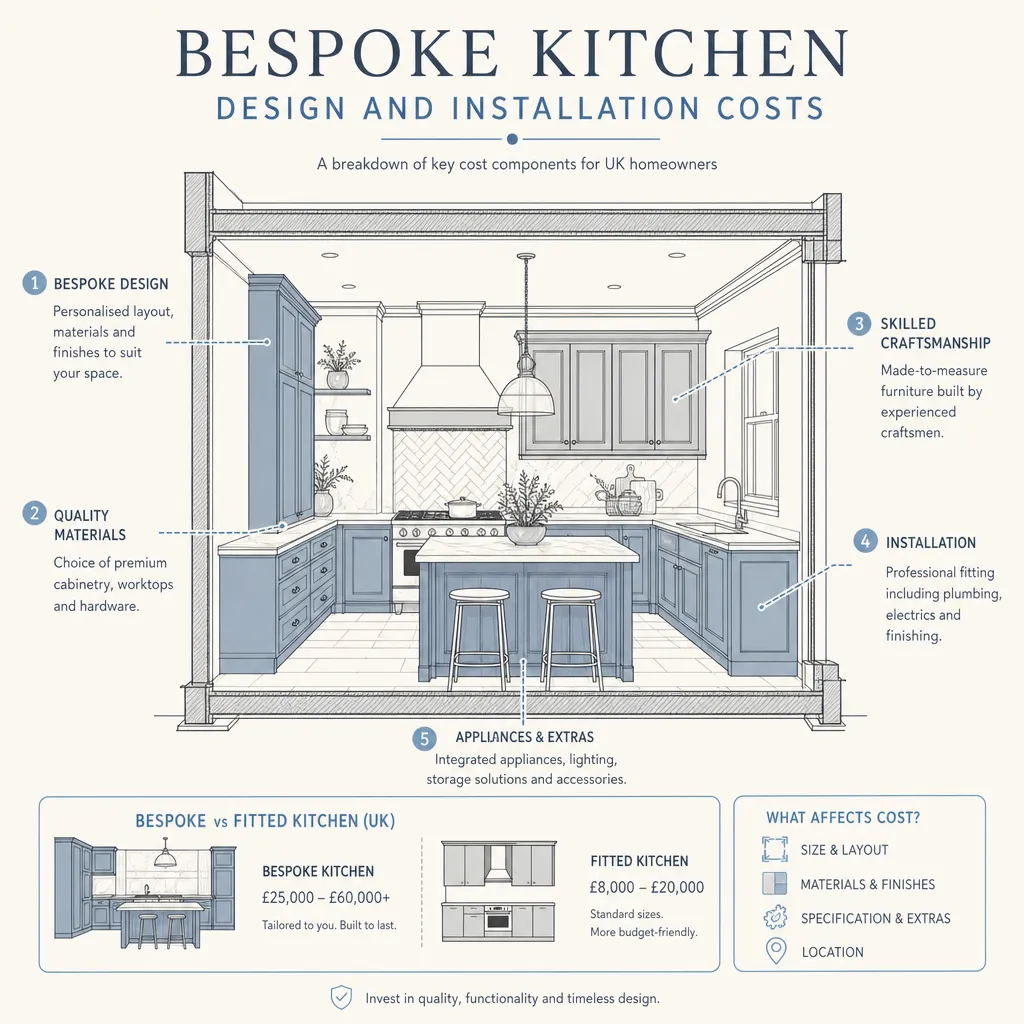
Bespoke Kitchen Design and Installation Costs
A kitchen replacement is one of the largest home improvements most UK homeowners undertake. Choosing a bespoke route — made-to-measure cabinetry and a tailored layout — changes both the budget and the process significantly compared with modular ranges. The question typically arises during a whole-house renovation, when dealing with a non-standard room, or when catalogue kitchens simply cannot accommodate the space.
Key points
- Bespoke kitchens in the UK typically cost £15,000–£60,000+ for design, cabinetry, worktops, and installation combined; high-end commissions can exceed £100,000. (Indicative UK costs, last reviewed 2026-05-06.)
- Lead times from design sign-off to installation are commonly 8–20 weeks, depending on the manufacturer and project complexity.
- VAT at 20% applies to kitchen goods and labour; eligible conversion projects may qualify for a reduced rate — confirm specifics with your installer and HMRC.
- Structural changes — wall removal, new drainage, or consumer unit alterations — each require Building Regulations approval under Part A, Part H, and Part P respectively.
- True bespoke kitchens are manufactured to your room's exact dimensions; unlike semi-custom ranges, there are no standard unit sizes to work around.
What 'bespoke' actually means in UK kitchen terms
Tier | What you get | Typical supply cost | Lead time |
|---|---|---|---|
Mass-market modular | Fixed unit sizes (e.g. 300 mm, 600 mm), flat-pack or rigid carcasses, limited finishes | £1,000–£5,000 | 1–4 weeks |
Semi-custom / designer ranges | Wider finish and door choices, some size flexibility, national showroom brands | £5,000–£20,000 | 4–10 weeks |
True bespoke / handmade | Made-to-exact-measurement, any finish, full design service, often British-manufactured | £15,000–£60,000+ | 8–20 weeks |
Indicative UK costs, last reviewed 2026-05-06. Prices for supply only; installation, worktops, appliances, and design fees may be additional or bundled.
The key practical difference is that bespoke cabinetry is drawn from your room's actual measurements — awkward alcoves, chimney breasts, and sloping ceilings are incorporated rather than worked around with filler panels.
What drives the cost of a bespoke kitchen?
Cabinet material and construction: Solid hardwood frames with dovetail-jointed drawers cost significantly more than MDF carcasses with veneered fronts. Both can look similar once installed; the difference lies in longevity and repairability.
Worktop material: Quartz composite (such as Silestone or Caesarstone) typically costs £300–£700 per linear metre installed. Natural stone (granite, marble) ranges from £400–£1,200+. Porcelain slabs are increasingly popular and similarly priced. (Indicative UK costs, last reviewed 2026-05-06.)
Designer fees: Included in some package prices; charged separately at £500–£2,000 in others, covering measured survey, 3D renders, and revised drawings.
Installation complexity: Partition removal, new plumbing, or electrical circuit changes each require additional qualified tradespeople — a structural engineer, plumber, and NICEIC or NAPIT registered electrician respectively.
Worked UK property scenario
A homeowner in a 1930s semi-detached in the West Midlands has formed a kitchen-diner by removing the original rear partition wall. The 5 m × 4 m space has a steel beam overhead and a chimney breast on one wall.
A modular flat-pack kitchen would leave noticeable filler panels around the chimney breast. A bespoke designer can draw cabinets that wrap it cleanly and incorporate the beam as a design feature.
Approximate project budget:
- Bespoke cabinetry (design, manufacture, installation): £22,000–£35,000
- Quartz worktops: £4,000–£6,000
- Integrated appliances (oven, hob, fridge-freezer, dishwasher): £3,000–£8,000
- Plumbing and electrical alterations: £1,500–£3,000
- Total indicative range: £30,000–£52,000 + VAT
Indicative UK costs, last reviewed 2026-05-06. Quotes vary by region, specification, and manufacturer.
Decision tree: choosing the right kitchen tier
- Choose mass-market modular if room dimensions are standard and budget is under £8,000.
- Choose semi-custom if you want more finish choice but can work within standard unit increments.
- Choose bespoke if the space is non-standard (chimney breasts, beams, sloping ceilings), specific materials matter, or longevity is the priority.
- Consult a structural engineer first if wall removal is part of the plan — measurements cannot be finalised until structural works are complete and signed off.
- Instruct a registered electrician for any circuit or consumer unit changes — notifiable work under Building Regulations Part P.
What to ask before accepting a quote
- Is design included in the price, or is there a separate fee?
- What CAD or 3D visuals will I receive before manufacture begins?
- Where are cabinets manufactured and what materials make up the carcasses?
- What warranty applies to cabinetry, doors, and hardware?
- Who carries out installation — the manufacturer's own team or a subcontractor?
- Is worktop templating and fitting included?
- Is VAT included in the quoted price?
- What snagging process applies after installation is complete?
When to get professional help
Bespoke kitchen projects almost always require qualified tradespeople beyond the kitchen manufacturer and fitter:
- A Gas Safe registered engineer for any gas supply changes — a legal requirement.
- An NICEIC or NAPIT registered electrician for circuit or consumer unit work notifiable under Building Regulations Approved Document P.
- A structural engineer if any load-bearing wall is being altered or removed.
Pause the project and seek professional advice if you discover suspected asbestos-containing materials (likely in pre-1985 floor or ceiling tiles — do not disturb), active damp behind existing cabinets, or a widening crack in an external wall adjacent to the planned kitchen area.
How Housey can help
Housey connects UK homeowners with vetted local professionals across renovation and home improvement trades. If your bespoke kitchen project involves structural alterations, specialist electrical work, or drainage repositioning, Housey can help you compare quotes from relevant specialists before committing to a manufacturer's programme.
Frequently asked questions
How long does a bespoke kitchen project take from start to finish?
Allow 12–24 weeks from initial consultation to completed installation. Design and measured survey take 2–4 weeks, manufacturing 8–16 weeks, and installation 1–3 weeks. If building works such as wall removal or replumbing precede the kitchen, add those programmes separately — the manufacturing clock starts only once the room is ready to measure.
Does a new kitchen add value to a UK property?
A well-specified kitchen supports saleability, though it rarely delivers pound-for-pound return. Estate agents note that an outdated kitchen can reduce buyer appetite, while a high-quality one can strengthen offers where the price bracket supports it. Formal valuation impact depends on local comparable sales and property type rather than spend alone.
Do I need planning permission for a new kitchen?
Replacing a kitchen like-for-like does not require planning permission. If the work involves extending the footprint, a permitted development or planning check may be needed. Building Regulations approval is required separately for structural changes, new drainage connections, and notifiable electrical work under Part P of the Building Regulations.
What is the difference between a kitchen designer and a kitchen fitter?
A kitchen designer creates the layout, specifies materials, produces drawings, and may project-manage manufacture and trades. A kitchen fitter assembles and installs units on site. Bespoke companies often employ both; confirm who is responsible for design sign-off and who handles snagging if installation quality falls short.
Sources and further reading
- Building Regulations Approved Document P (Electrical Safety in Dwellings) — GOV.UK
- Building Regulations Approved Document F (Ventilation) — GOV.UK
- VAT on buildings and construction (Notice 708) — HMRC / GOV.UK
- Gas Safe Register: illegal gas work — Gas Safe Register
- NICEIC: find a registered electrician — NICEIC
Useful next reads
 Improvement & Build
Designing and Installing a Television-Inspired Kitchen
A television-inspired kitchen draws on the design principles of TV cooking shows and renovation programmes: clear functional layouts, professional-grade appliances, statement cabinetry, and quality worktops.
 Improvement & Build
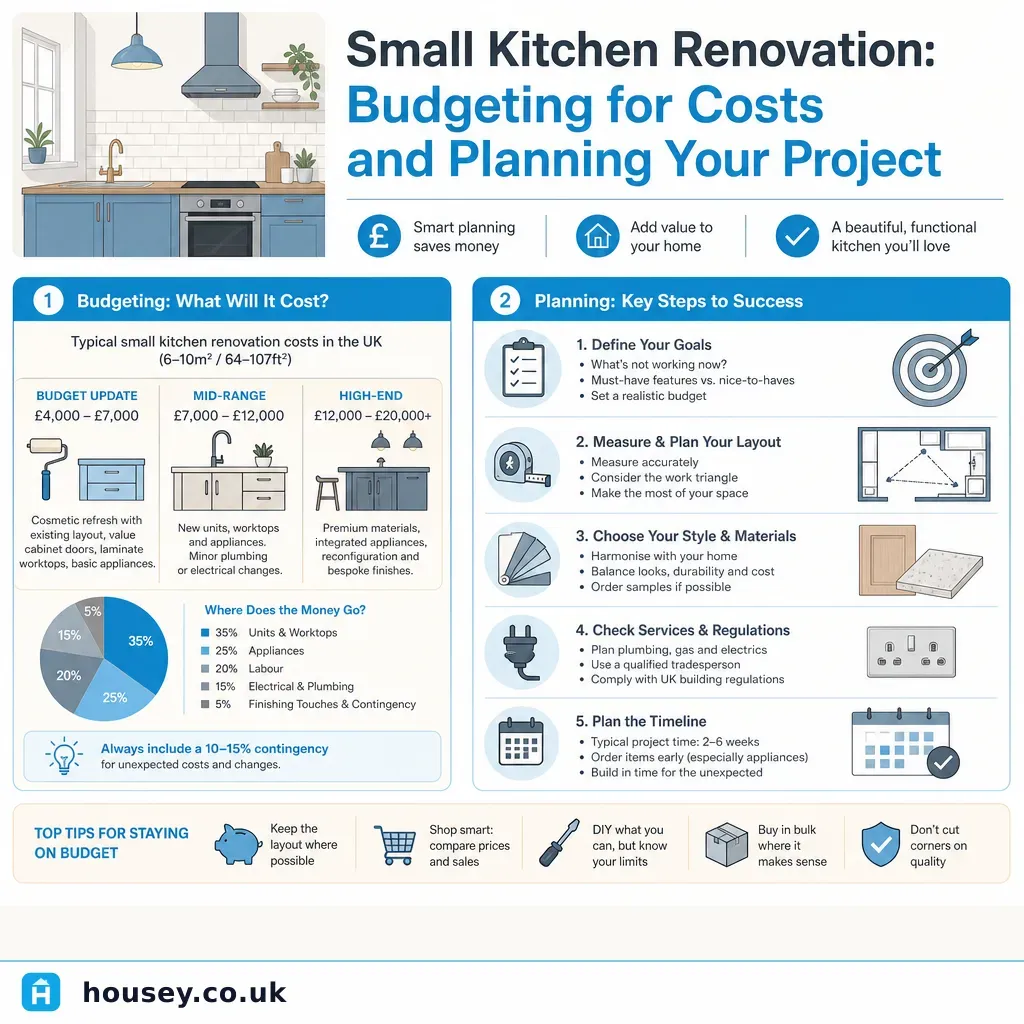
Small kitchen renovation: budgeting for costs and planning your project
A small kitchen renovation in the UK typically costs £5,000–£15,000 for a full refresh including new units, worktops, tiling, and appliances, though costs vary widely by specification, region, and whether structural changes or rewiring are involved.
 Improvement & Build
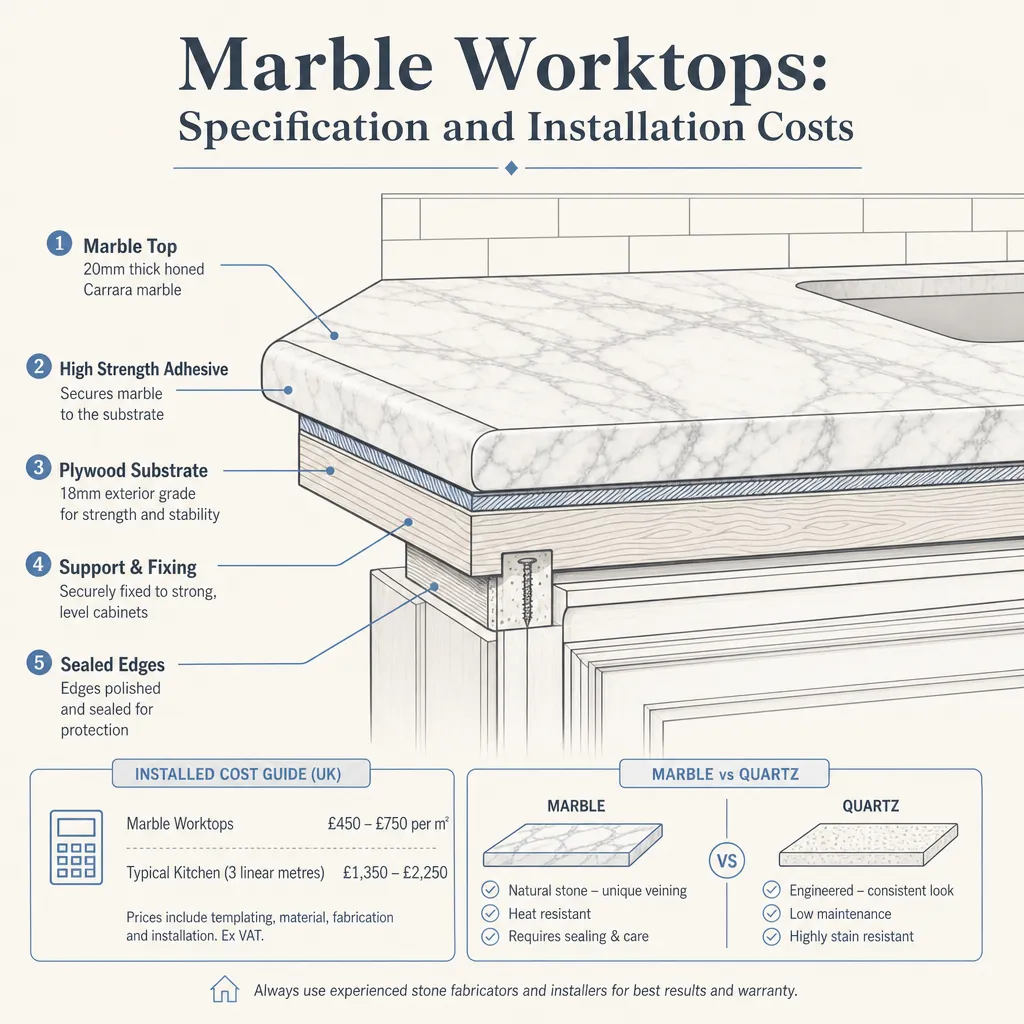
Marble Worktops: Specification and Installation Costs
Marble worktops in the UK typically cost £300–£800 per linear metre installed, depending on marble grade, slab thickness, finish, and edge profile.
 Improvement & Build
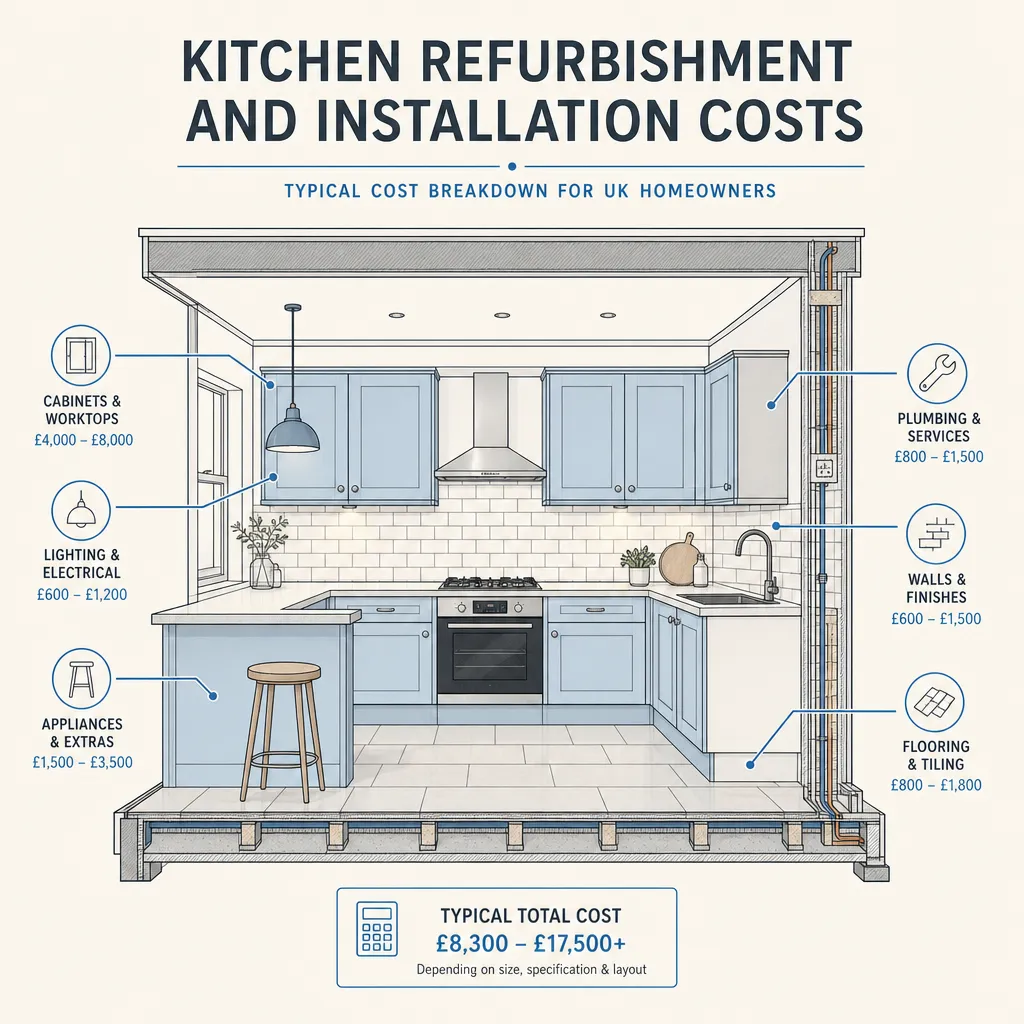
Kitchen Refurbishment and Installation Costs
A kitchen refurbishment in the UK typically costs between £3,000 and £40,000 or more, depending on whether you are replacing units only or carrying out a full design-and-build project.
 Improvement & Build
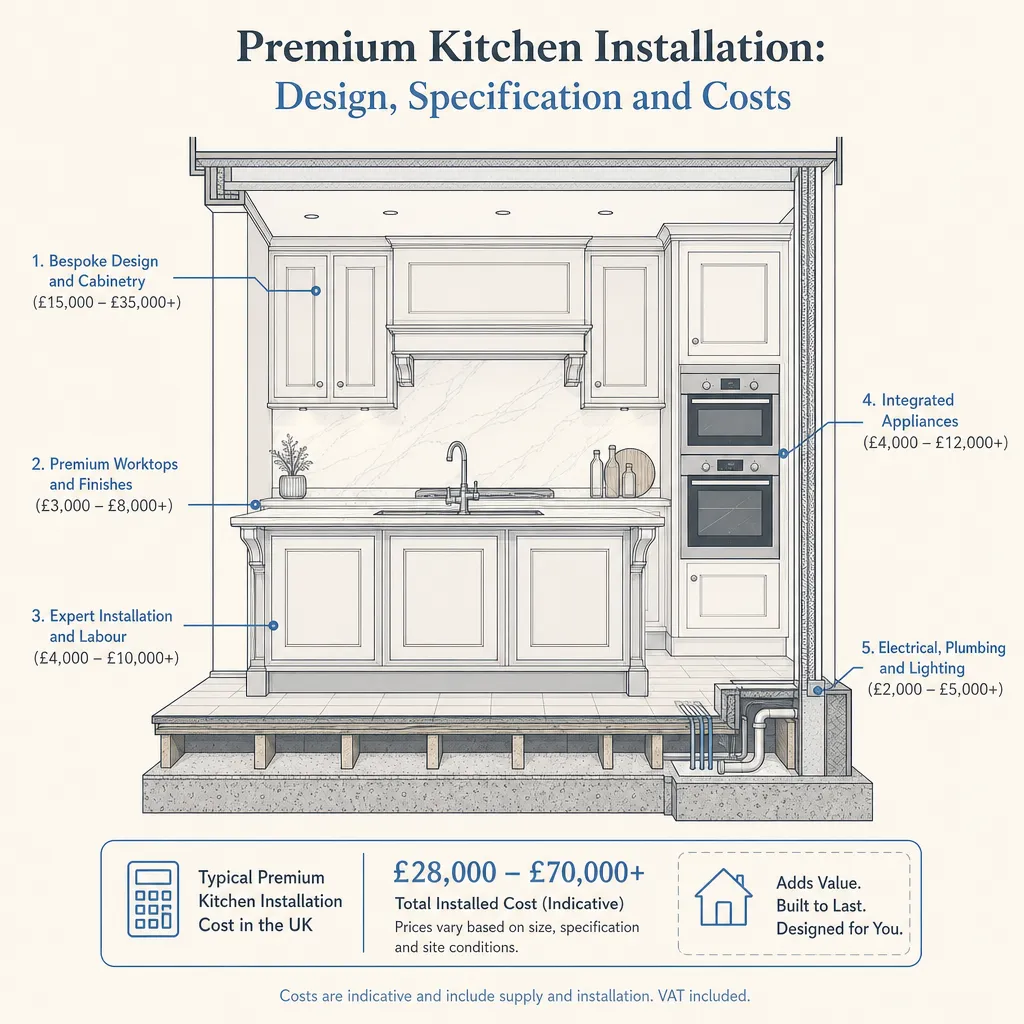
Premium Kitchen Installation: Design, Specification and Costs
A premium kitchen in the UK typically costs £20,000–£80,000 or more installed, depending on cabinetry specification, worktop material, appliance brands, and whether structural changes are needed.