Marble Worktops: Specification and Installation Costs
By Housey · Last reviewed 9th of May 2026
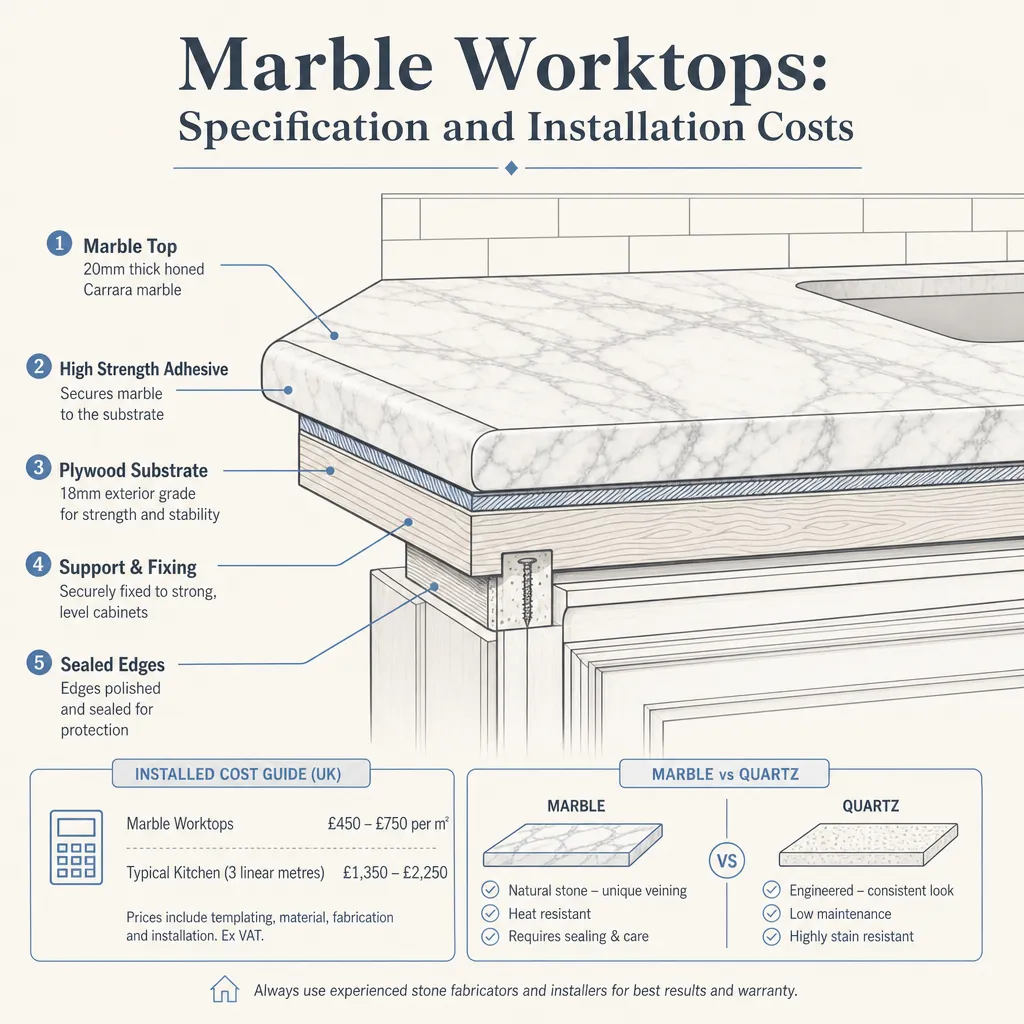
Marble Worktops: Specification and Installation Costs
Deciding on a worktop material is one of the last major choices in a kitchen project, but it shapes daily life in that space for years. Marble sits at the premium end of the natural stone market, and the gap between a well-specified installation and a poorly planned one — in cost, durability, and long-term satisfaction — can be substantial. Understanding what drives price and performance before you commit to a supplier will help you avoid expensive surprises once the stone has been cut and the deposit has been paid.
Key points
- Carrara marble, the most widely available grade in UK fabrication yards, typically costs £300–£500 per linear metre supplied and installed; rarer marbles such as Statuario and Calacatta can reach £600–£800 or more per linear metre. Indicative UK costs, last reviewed 2026-05-09.
- Standard residential worktop slab thickness is 20 mm or 30 mm; 20 mm requires a fully supported substrate across the full span, while 30 mm is more self-supporting and better suited to overhangs at breakfast bars.
- Marble is porous and must be sealed on installation using a penetrating impregnator sealer; re-sealing annually is essential, and unsealed marble will stain from acidic foods — lemon juice, vinegar, red wine — within minutes.
- A honed (matt) finish disguises surface etching and fine scratches considerably better than a polished finish, making it the more practical choice for a busy family kitchen.
- Fabrication complexity — cutouts for undermount sinks, curved edges, mitred upstands, matched veining across joins — adds meaningfully to labour cost and should always be itemised separately in any quote.
Marble grades and what they cost in the UK
Not all marble is Carrara. The grade and geographic origin of the stone, combined with pattern consistency and background colour, determine both the aesthetic character and the price at UK fabrication yards.
Marble grade | Origin | Typical installed cost per linear metre | Best for |
|---|---|---|---|
Carrara | Italy | £300–£500 | Classic white/grey look; most available grade in UK; suits a wide range of kitchen styles |
Statuario | Italy | £450–£700 | High-contrast grey veining on a bright white background; fewer consistent slabs available |
Calacatta | Italy | £500–£800+ | Bold, dramatic veining; premium projects where the stone is a centrepiece |
Emperador | Spain/Morocco | £350–£550 | Warm brown tones; suits traditional, rustic, or Mediterranean-style kitchens |
Nero Marquina | Spain | £400–£600 | Black background with white veining; high-impact choice for an island or breakfast bar |
Indicative UK costs, last reviewed 2026-05-09. Prices vary significantly by slab quality, fabricator location, and current stone supply. Always obtain at least three quotes before committing.
What drives marble worktop installation costs
Several factors push the final invoice above or below the mid-range figure.
Slab selection and wastage Marble is priced by the slab, and fabricators cut your worktops from those slabs. Complex kitchen layouts with many individual pieces increase wastage. A peninsula or island may require a full-width slab for visual continuity across a join, even if only part of the slab is ultimately used.
Thickness 20 mm slabs are standard for most residential kitchens. 30 mm slabs look more substantial, require less substrate preparation, and are better suited to unsupported overhangs at breakfast bars, but cost more in material, handling, and transport. The additional weight of 30 mm stone also needs consideration in floor-loading calculations on upper storeys.
Edge profile A straight, pencil-rounded, or chamfered edge is typically included in most UK fabricators' base price. Ogee, bullnose, dupont, or mitred upstand profiles add approximately £30–£80 per linear metre at most UK fabrication yards.
Cutouts and holes Each cutout for an undermount sink, hob, or tap hole requires precision templating and machining. Expect £80–£200 per cutout depending on complexity and stone thickness. Fragile marbles such as Calacatta require slower machining and may cost more.
Templating and installation Reputable fabricators template on-site in person before any cutting takes place. Templating fees may be charged separately (typically £100–£200) or bundled into the installation price. Always confirm this before booking so you can compare quotes on a like-for-like basis.
Access and location Heavy stone slabs — 20 mm Carrara weighs approximately 56 kg per square metre — require two or more trained installers and sometimes specialist lifting equipment. Remote locations or restricted access, such as narrow corridors or upper-floor kitchens accessible only by a tight staircase, may incur a delivery or access surcharge.
Marble versus alternative worktop materials
Marble is not the only premium worktop option, and it is not always the most appropriate choice. This table compares it against common alternatives at a similar price point.
Material | Heat resistance | Scratch resistance | Stain resistance | Maintenance | Typical installed cost per linear metre |
|---|---|---|---|---|---|
Marble (natural stone) | Good — thermal shock can crack; avoid direct high-heat pan contact | Poor to moderate | Poor unsealed; moderate when sealed annually | Annual sealing; immediate clean-up of acids essential | £300–£800 |
Quartz composite (e.g., Silestone, Caesarstone) | Moderate — avoid prolonged direct heat | Good | Excellent | Minimal; no sealing required | £300–£700 |
Granite (natural stone) | Excellent | Good | Good when sealed annually | Annual sealing; very hard-wearing in daily use | £250–£600 |
Porcelain slab | Excellent | Excellent | Excellent; non-porous | Very low | £350–£700 |
Engineered marble (cultured marble) | Moderate | Moderate | Moderate | Easier to maintain than natural marble | £150–£350 |
Indicative UK costs, last reviewed 2026-05-09.
Decision tree: is marble right for your kitchen?
- Choose marble if aesthetics are the primary driver, the kitchen sees moderate rather than heavy daily use, and you are comfortable with annual sealing and the immediate clean-up discipline that acid exposure demands.
- Choose quartz composite if you need low maintenance, maximum stain resistance, or a consistent pattern repeated across multiple slabs without colour variation between batches.
- Choose granite if you want a natural material with better stain and scratch resistance than marble at a broadly comparable installed cost.
- Choose porcelain slab if you need near-zero maintenance, maximum heat resistance, and a highly consistent appearance across large surface areas.
- Ask a kitchen designer or design-and-build firm if you are combining materials across a complex layout — for example, marble on the island and a more durable alternative on the main worktop run.
- Consult extension builders if the kitchen project involves structural changes that affect floor loading, joist spans, or access logistics for heavy stone delivery.
Specification checklist before ordering
Before confirming your marble order, work through this checklist to avoid costly oversights.
When to get professional help
Marble fabrication and installation is specialist work. Unlike laminate or solid timber worktops, natural stone cannot be modified meaningfully on-site without the risk of cracking. Get professional input in the following situations:
- You are planning an island or peninsula span exceeding 1,500 mm without intermediate support — spans beyond this risk cracking under load, particularly in 20 mm slabs.
- The kitchen is on an upper floor with restricted stair access, or the floor construction is a suspended timber floor; a structural assessment may be needed before installing 30 mm slabs across a wide span.
- You are unsure whether marble from different slabs or batches will match closely enough — a stone specialist should select and mark slabs together at the yard before ordering.
- A crack or fracture appears in an existing marble worktop — do not attempt DIY resin repair without understanding the cause and the correct product for the stone type.
How Housey can help
If you are planning a kitchen with marble worktops as part of a wider project — a full kitchen replacement, house extension, or conversion with a new kitchen specification — design-and-build firms on Housey can coordinate stone selection alongside the wider build programme. For projects involving structural changes to create a larger kitchen footprint, extension builders can advise on load-bearing requirements, substrate preparation, and access logistics before stone is ordered.
Frequently asked questions
Can marble worktops be used in a bathroom as well as a kitchen?
Yes. Marble is widely used for bathroom vanity tops, shower ledges, and bath surrounds. Bathroom environments are less likely to encounter acidic foodstuffs, but ongoing moisture exposure makes sealing equally important. Specify a penetrating impregnator sealer rated for wet areas and re-apply annually or when water no longer beads on the surface.
How long does marble worktop installation take from ordering to fitting?
Templating usually takes 30–60 minutes on-site. Fabrication then takes 5–10 working days for standard projects. Installation typically takes one day for an average kitchen layout. Allow two to three weeks in total from confirming your slab selection to installation day, and longer during busy periods at fabrication yards.
Do marble worktops add value to a property?
Natural stone worktops are generally viewed favourably by buyers, but the uplift depends heavily on the overall kitchen quality and the property's price bracket. A marble worktop in a high-specification kitchen supports the broader value proposition; the same worktop installed in a budget kitchen setting is unlikely to return its cost at the point of sale.
Will marble worktops etch even if they are sealed?
Yes. Sealing protects against liquid penetration — staining — but does not prevent etching, which is the chemical reaction between acids and the calcium carbonate in marble that dulls the polished surface. A honed finish makes etching considerably less visible. If etching accumulates over years, a stone restoration specialist can re-polish or re-hone the surface.
Is marble suitable for a kitchen island with a seating overhang?
Marble can accommodate an overhang of up to approximately 200–250 mm without additional support, depending on slab thickness and length. Overhangs beyond this typically require corbels or steel support brackets built into the island carcass. Always confirm the maximum unsupported span with your fabricator before finalising the island design, as limits vary by slab grade and thickness.
Sources and further reading
- Stone Federation Great Britain — Natural Stone Guidance — Stone Federation Great Britain
- Which? — Kitchen Worktops Review — Which?
- NBS — Specifying Natural Stone — NBS (National Building Specification)
Useful next reads
 Improvement & Build
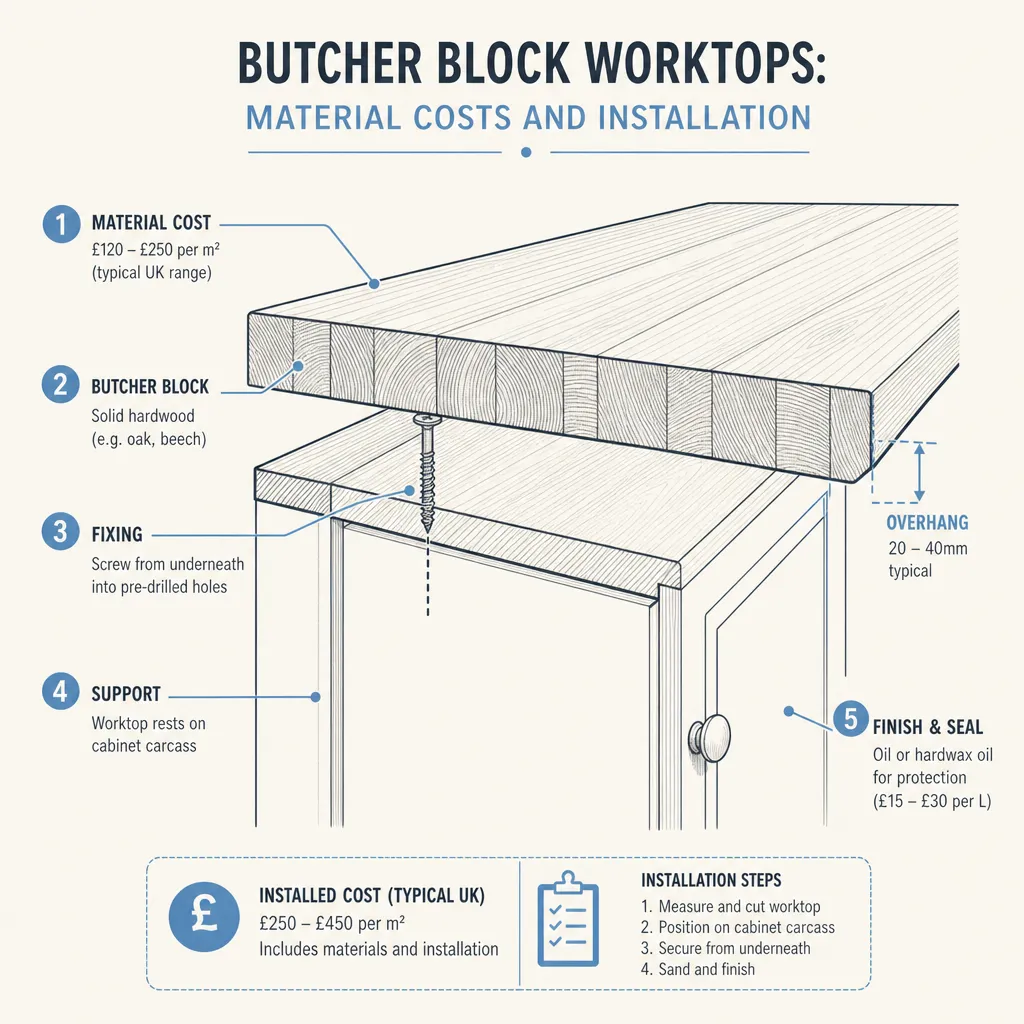
Butcher Block Worktops: Material Costs and Installation
Butcher block worktops typically cost £80–£450 per linear metre for materials in the UK, depending on timber species and construction type.
 Improvement & Build
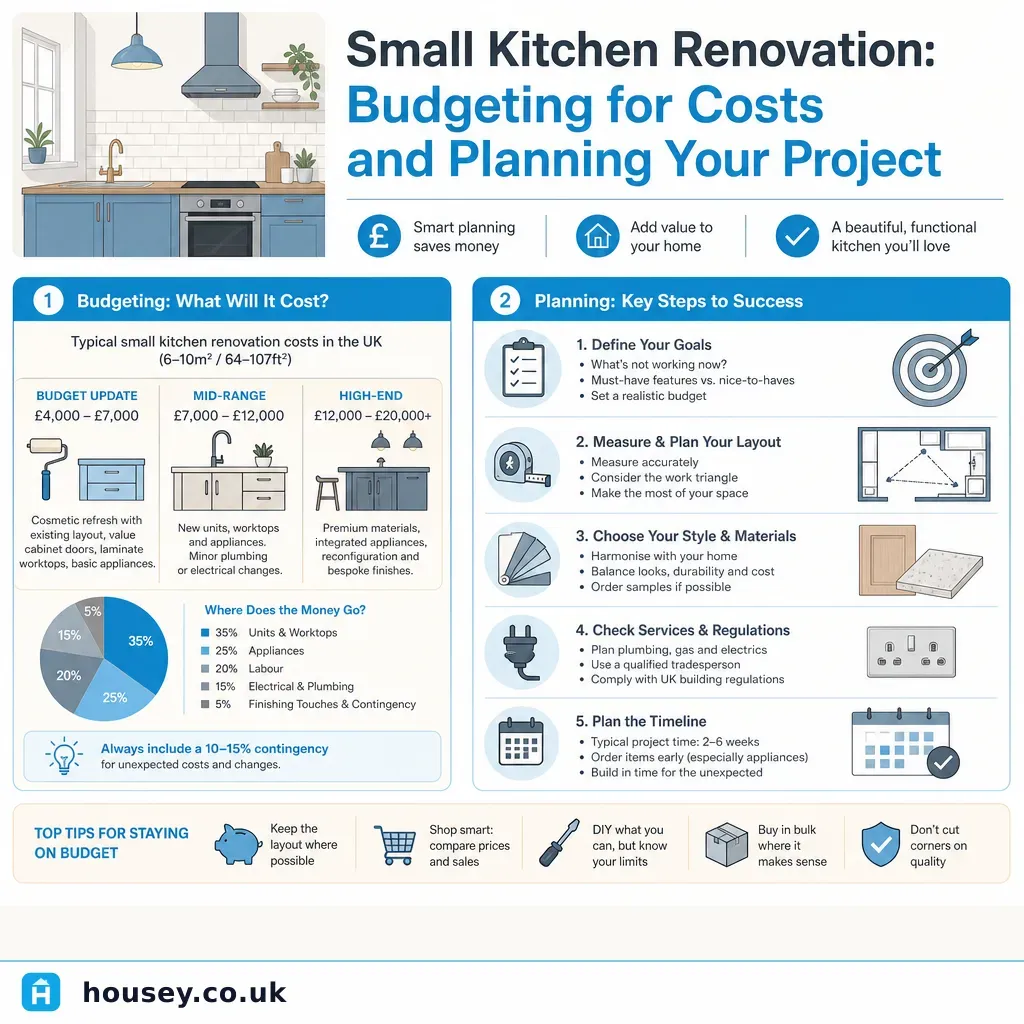
Small kitchen renovation: budgeting for costs and planning your project
A small kitchen renovation in the UK typically costs £5,000–£15,000 for a full refresh including new units, worktops, tiling, and appliances, though costs vary widely by specification, region, and whether structural changes or rewiring are involved.
 Improvement & Build
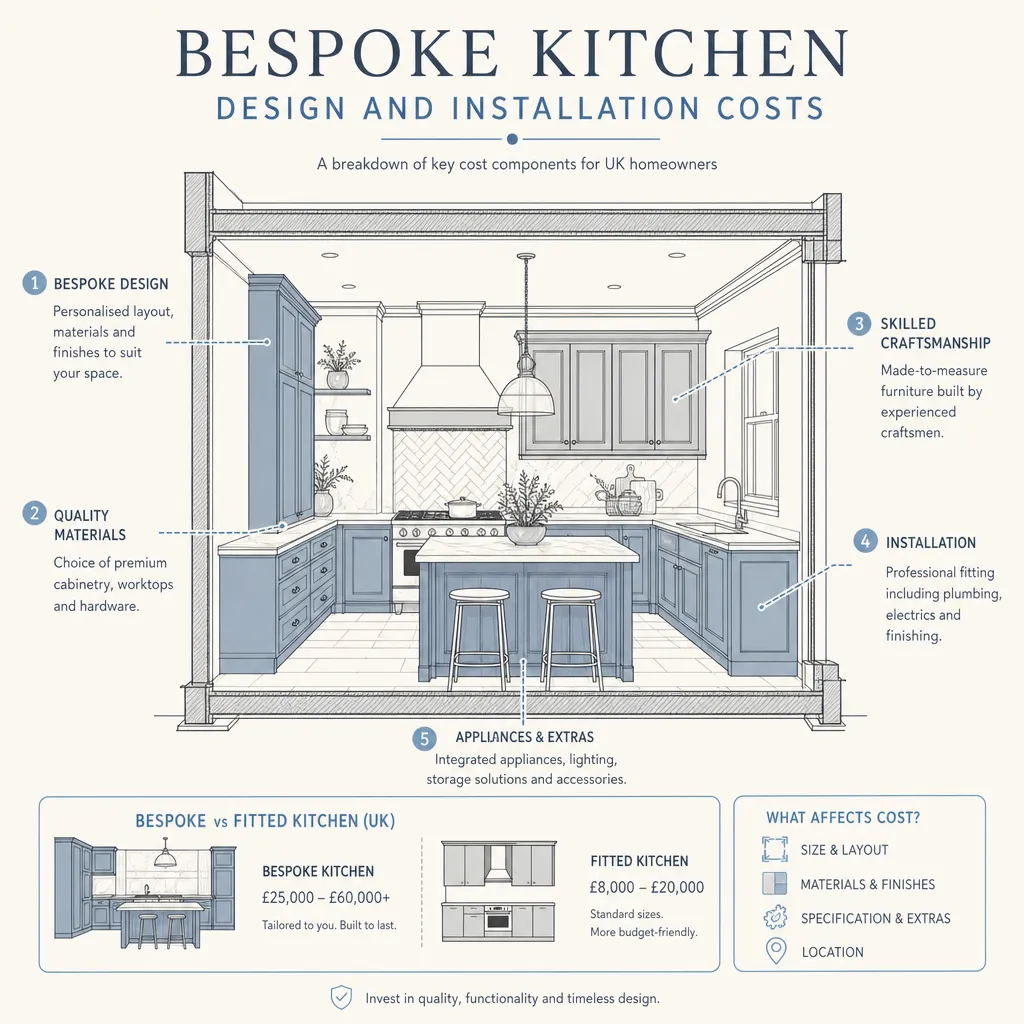
Bespoke Kitchen Design and Installation Costs
Bespoke kitchens in the UK typically cost £15,000–£60,000+ for design, cabinetry, worktops, and installation combined, with high-end commissions reaching £100,000 or more.
 Improvement & Build
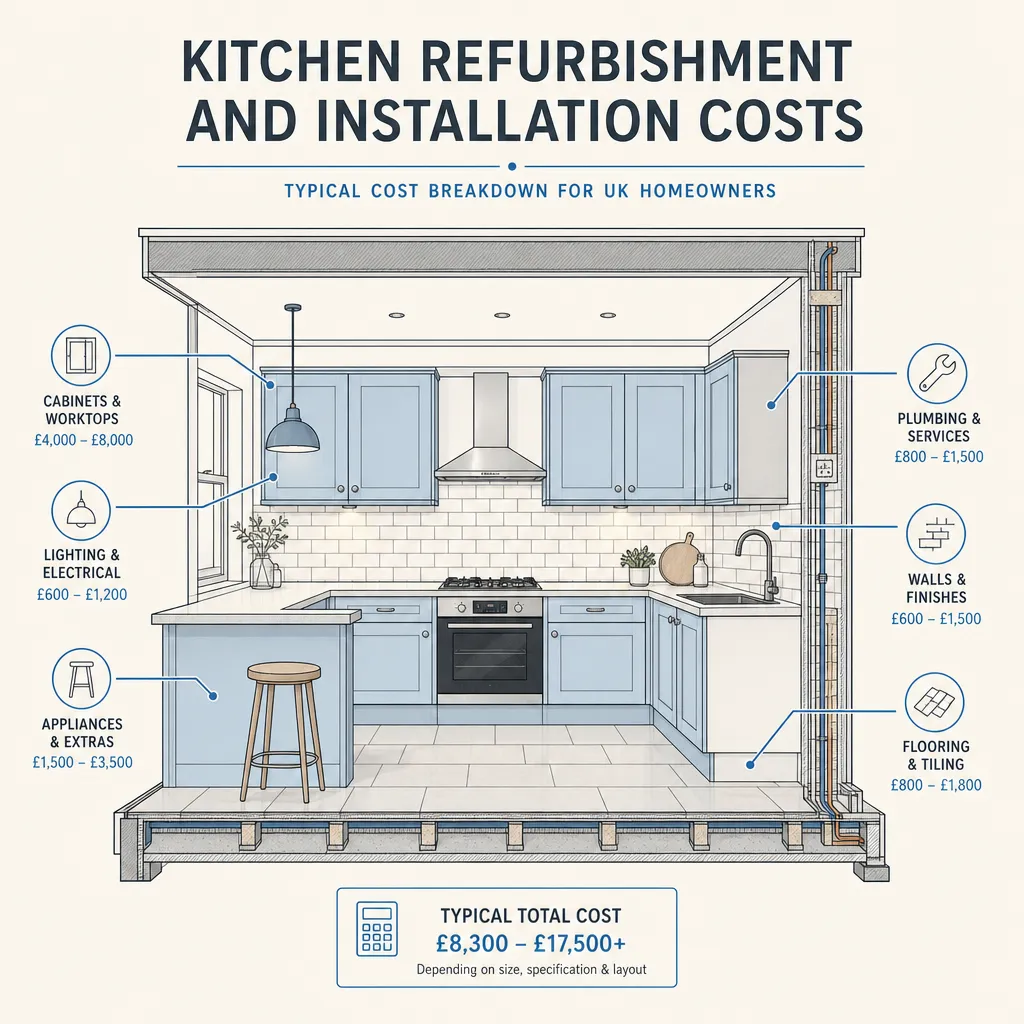
Kitchen Refurbishment and Installation Costs
A kitchen refurbishment in the UK typically costs between £3,000 and £40,000 or more, depending on whether you are replacing units only or carrying out a full design-and-build project.
 Improvement & Build
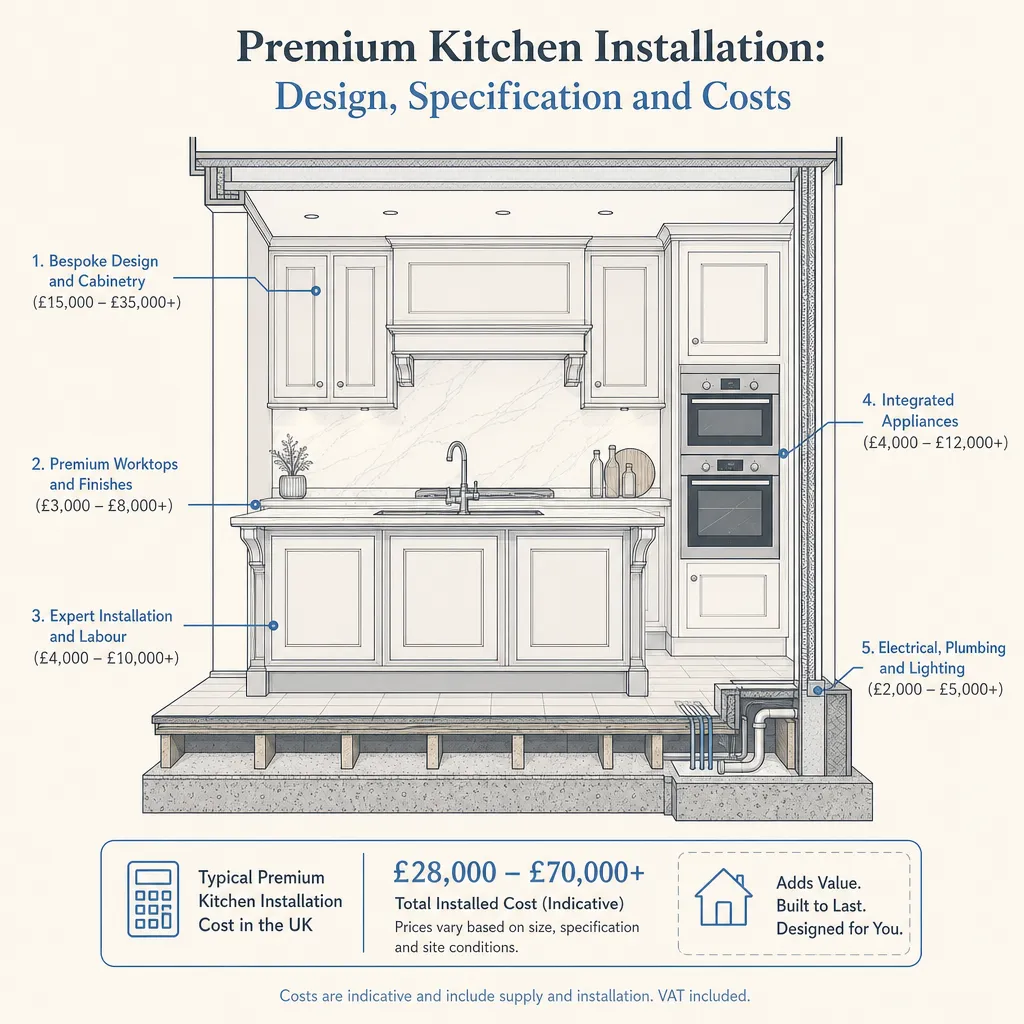
Premium Kitchen Installation: Design, Specification and Costs
A premium kitchen in the UK typically costs £20,000–£80,000 or more installed, depending on cabinetry specification, worktop material, appliance brands, and whether structural changes are needed.