Premium Kitchen Installation: Design, Specification and Costs
By Housey · Last reviewed 7th of May 2026
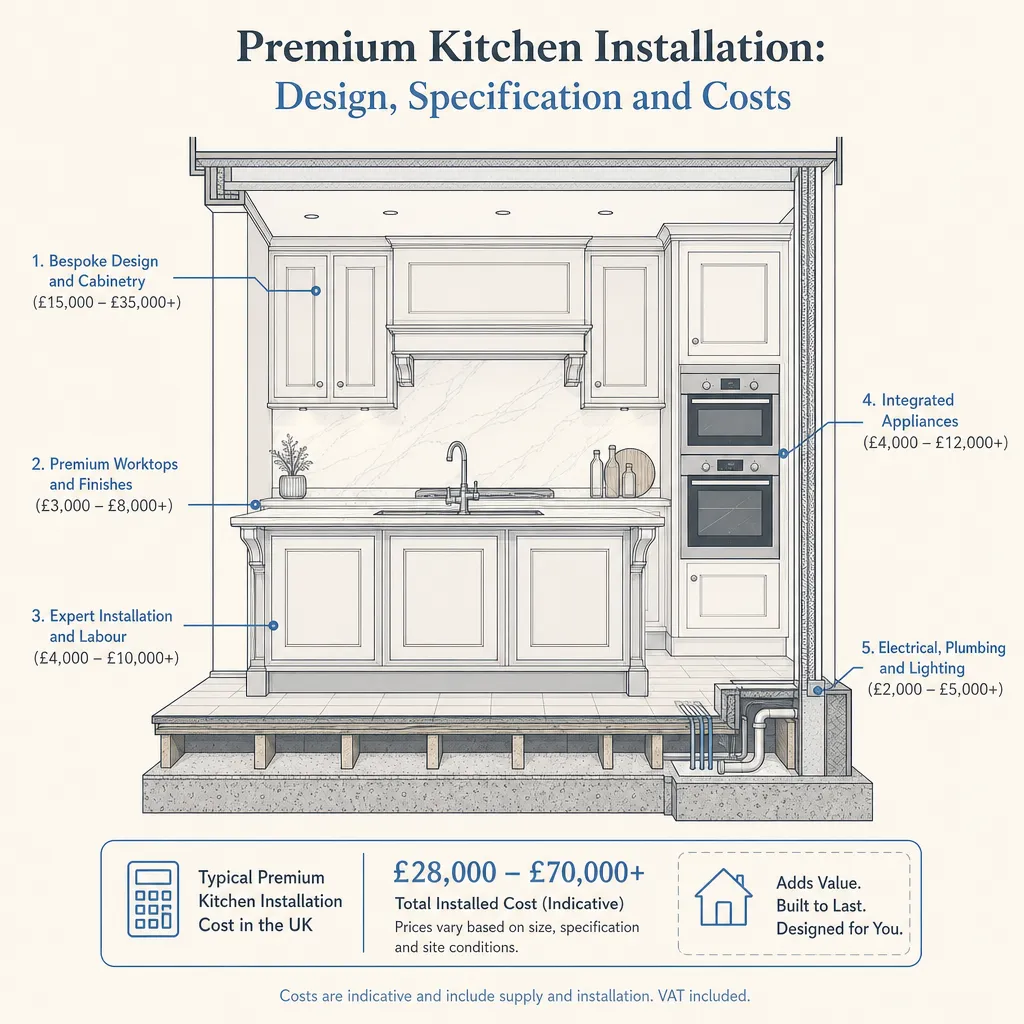
Premium Kitchen Installation: Design, Specification and Costs
The kitchen is often the most complex single room to renovate in a UK home, combining cabinetry, worktops, appliances, lighting, flooring, plumbing, and electrics into one coordinated project. For a premium specification, decisions made early in the design process — about layout, construction quality, appliance brands, and materials — have a direct bearing on both the finished result and the total cost, which can range from around £20,000 to well over £80,000 for a fully fitted premium kitchen.
Key points
- Premium kitchen cabinetry in the UK typically uses in-frame or framed construction with solid or semi-solid doors, dovetail-jointed drawers, and full-extension soft-close runners — distinct from the frameless carcase construction common in mass-market flat-pack ranges.
- Moving a kitchen's location, knocking through a wall to create a kitchen-diner, or relocating a gas supply or soil pipe will require Building Regulations approval; a structural engineer is also needed if load-bearing walls are involved.
- VAT at the standard rate of 20% applies to both kitchen supply and installation on standard residential projects; always confirm whether VAT is included in contractor quotes.
- Indicative total installed costs in 2026 range from approximately £20,000–£35,000 for a quality mid-premium kitchen, rising to £50,000–£100,000 or more for bespoke cabinetry with high-end stone worktops and integrated appliances. (Indicative UK costs, last reviewed 2026-05-07.)
- Lead times for bespoke or semi-bespoke kitchen cabinetry typically run 8–16 weeks from order confirmation; plan your project timeline accordingly, especially where building works are also involved.
How premium kitchens differ from standard fitted kitchens
The most significant differences between a premium and a standard fitted kitchen relate to construction method, materials, and the level of customisation available.
Feature | Standard/budget | Mid-range | Premium/bespoke |
|---|---|---|---|
Carcase construction | Melamine-faced chipboard | Moisture-resistant MDF or chipboard | Solid hardwood, plywood, or in-frame |
Door construction | Slab or foil-wrapped MDF | Painted MDF or shaker-style | Solid hardwood, hand-painted, or lacquered |
Drawer mechanism | Basic metal runners | Soft-close, full-extension | Dovetail-jointed wooden box, Blum or Hettich runners |
Worktops | Laminate | Quartz or entry-level granite | Engineered stone, marble slab, or granite slab |
Supply source | DIY retailer | Kitchen retailer (Wren, Magnet) | Specialist retailer, independent designer, or bespoke maker |
Customisation | Standard sizes only | Limited variations | Fully custom widths, heights, and configurations |
Lead time | 1–4 weeks | 4–10 weeks | 8–20 weeks |
Brands frequently specified in UK premium kitchen projects include deVOL, Tom Howley, Smallbone of Devizes, Harvey Jones, Naked Kitchens, and Neptune. German manufacturers such as Bulthaup, Poggenpohl, and SieMatic also serve the top of the UK market.
Specification decisions that drive cost
Cabinetry and construction method
In-frame construction — where the door sits within a solid frame rather than overlaying the carcase front — is associated with premium UK kitchen brands and adds rigidity and a furniture-quality finish. It is generally more expensive to produce than frameless construction and typically adds 20–40% to cabinetry costs compared with an equivalent frameless specification.
Paint finish (sprayed in a booth rather than foil-wrapped or laminated) allows for custom RAL or NCS colours and a surface that can be touched up or re-sprayed in future, unlike foil-wrapped alternatives.
Worktop materials
Worktop material is one of the highest single cost variables in a premium kitchen.
Worktop material | Indicative supply cost per linear metre | Notes |
|---|---|---|
Good-quality laminate | £30–£80 | Not typical in premium kitchens; included for reference |
Engineered quartz (Silestone, Caesarstone) | £200–£500 | Consistent patterning; non-porous; very durable |
Granite slab | £250–£600 | Natural variation; requires periodic sealing |
Marble slab | £350–£900+ | Premium appearance; porous and prone to staining without care |
Dekton or sintered stone | £400–£800 | Ultra-durable, heat-resistant; specialist cutting required |
Solid oak or walnut | £150–£400 | Warm aesthetic; requires oiling; not ideal directly around sinks |
(Indicative UK costs per linear metre, supply only, last reviewed 2026-05-07. Fabrication and installation are additional.)
Appliances
A full suite of integrated appliances — oven, hob, extractor, fridge-freezer, dishwasher, and wine cooler — from a premium manufacturer such as Miele, Gaggenau, Sub-Zero/Wolf, or Siemens can add £8,000–£25,000 to the project cost. Appliance selection should be confirmed before cabinetry is ordered, as housing dimensions and ventilation requirements directly influence the cabinet specification.
Plumbing and electrical works
Premium kitchen projects commonly include elements that require qualified tradespeople:
- Boiling water tap (Quooker, Grohe): requires a dedicated cold-water feed and 230V supply; typically £800–£1,500 supply only.
- Island with hob: requires extraction above or an integrated downdraft system, plus a dedicated electrical circuit; a gas hob on an island requires a gas supply routed by a Gas Safe registered engineer.
- Underfloor heating: most practical to install during a full kitchen refit rather than retrospectively, particularly under stone or porcelain tile.
- Lighting circuits: pelmet lighting, plinth lighting, and feature pendants above an island generally require a new or extended circuit installed by a Part P-registered electrician (NICEIC or NAPIT registered).
What does a premium kitchen installation cost in the UK?
(Indicative UK costs, last reviewed 2026-05-07. Costs vary significantly by region, specification, and whether structural changes are required.)
Project scope | Indicative cost range |
|---|---|
Kitchen units and fitting only (no appliances, no structural work) | £8,000–£20,000 |
Full premium kitchen fit-out (units, worktops, appliances, fitting) | £20,000–£45,000 |
Bespoke kitchen with high-end appliances and stone worktops | £45,000–£80,000 |
Full kitchen extension or structural reconfiguration | £60,000–£150,000+ |
London and the South East typically command 15–30% higher labour costs than the UK average.
Design and layout: key planning considerations
The kitchen triangle — the spatial relationship between the sink, fridge, and cooking zone — remains a practical planning benchmark. Each leg is generally recommended to fall between 1.2m and 2.7m, with a total perimeter under 8m (National Kitchen and Bath Association guidance). In open-plan kitchen-diners, separating preparation, cooking, and socialising zones with distinct lighting and surface treatments is an equally important consideration.
Worked UK example: 1960s semi-detached in Manchester
A 1960s semi-detached has a rear kitchen measuring approximately 3.5m × 3m. The homeowners want to knock through to the adjoining dining room to create an L-shaped kitchen-diner of roughly 4.5m × 5.5m, with in-frame painted units, a quartz worktop, and a range cooker.
The project scope includes:
- Structural engineer's beam design and Building Regulations application (full plans route) to the local building control body
- Builder to remove the wall and install the steel beam
- Premium kitchen supply and installation by a specialist fitter
- Gas Safe registered engineer to relocate the gas supply for the new range cooker position
- Part P-registered electrician for new circuits (lighting, appliances, extractor)
- Decorator for replastered walls and new floor throughout
Estimated total: £45,000–£70,000, depending on the cabinetry specification, appliance brands, and local contractor rates.
Document and planning preparation checklist
Before committing to a premium kitchen project, prepare the following:
What to ask before accepting a quote
- Is VAT included in the quoted price?
- Who will carry out the installation — the retailer's own team or a subcontracted fitter?
- What qualifications do the plumber and electrician hold (Gas Safe registration, NICEIC or NAPIT accreditation)?
- What is the payment schedule and what happens if the cabinetry lead time changes after ordering?
- Does the quote include removal and disposal of the existing kitchen?
- What warranty is provided on the units, worktops, and fitting work?
- How are site protection and dust management handled during installation?
- What snagging period is included and what is the process for rectifying defects?
When to get professional help
A premium kitchen project almost always involves multiple regulated trades. Always use qualified professionals for:
- Structural changes (removing walls, creating openings for extensions): require a structural engineer's design and Building Regulations approval via a building control body.
- Gas work (relocating supply, connecting a gas hob or range cooker): must be carried out by a Gas Safe registered engineer.
- Electrical work (new circuits, consumer unit alterations): must comply with Part P of the Building Regulations and should be carried out by an NICEIC or NAPIT-registered electrician.
- Listed buildings: significant internal alterations require listed building consent from your local planning authority, regardless of whether the changes are structural.
If your project involves extending the kitchen into a rear addition, a design-and-build approach can simplify coordination of structural, building control, and kitchen design work.
How Housey can help
If your premium kitchen project involves structural changes or a rear extension, coordinating multiple trades is often the most challenging part. Find extension builders on Housey to compare quotes for the structural and building work, or explore design-and-build firms who can manage the full project — from initial design through to finished installation.
Frequently asked questions
Do I need planning permission for a new kitchen?
A kitchen refit within the existing footprint of a house does not normally require planning permission. If the works involve a rear extension to enlarge the kitchen, you will need either permitted development approval or a full planning application. Listed buildings require listed building consent for significant internal alterations regardless of size. Always check with your local planning authority if you are uncertain.
How long does a premium kitchen installation take?
A standard premium kitchen installation with no structural changes typically takes one to three weeks on site, depending on kitchen size and complexity. Projects involving structural works, extensions, or significant replumbing may take 8–20 weeks in total, including design, planning, and build phases. Factor in 8–16 weeks of cabinetry lead time when scheduling the wider project.
Can I claim VAT relief on a kitchen renovation?
Standard residential kitchen renovations are subject to VAT at 20%. Reduced-rate VAT at 5% may apply for certain renovation and conversion works where a property has been empty for two or more years; always confirm eligibility with your contractor and HMRC. New-build construction may qualify for zero-rate VAT, but this does not extend to fitting out an existing home.
What is the difference between a kitchen designer and a design-and-build firm?
An independent kitchen designer focuses on planning and specification, typically working alongside a separate fitter or builder for installation. A design-and-build firm takes responsibility for both design and physical construction, which can simplify project management. Scrutinise the contract carefully to confirm who is responsible for each element, particularly structural works, plumbing, and electrical installation.
How do I protect myself if a kitchen fitter goes out of business mid-project?
Limit the initial deposit to 10–25% of the total project value and agree a staged payment schedule tied to defined project milestones. Ensure the contract specifies what happens if the firm cannot complete the work. Using a company registered with the Kitchen Bathroom Bedroom Specialists Association (KBSA) or another recognised trade body may provide access to a formal dispute resolution process.
Sources and further reading
- Building Regulations Approved Document A: Structure — GOV.UK / MHCLG
- Gas Safe Register: find a registered engineer — Gas Safe Register
- Building Regulations Approved Document P: Electrical Safety in Dwellings — GOV.UK / MHCLG
- VAT Notice 708: Buildings and construction — HMRC
- Listed buildings: applying for listed building consent — Historic England
Useful next reads
 Improvement & Build
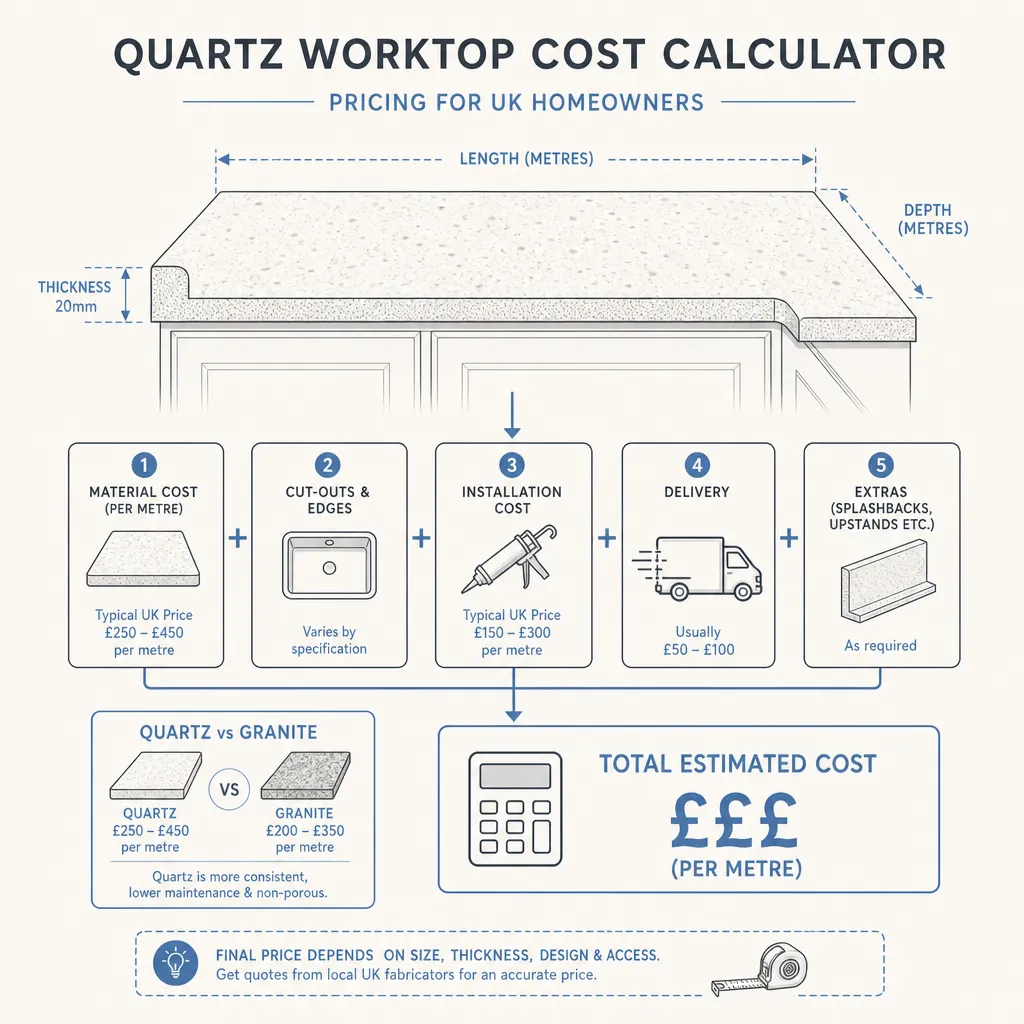
Quartz Worktop Cost Calculator and Pricing
Quartz worktops in the UK typically cost £250–£600 per linear metre for supply and professional installation, putting a standard 4–5 metre kitchen at £1,000–£3,000.
 Improvement & Build
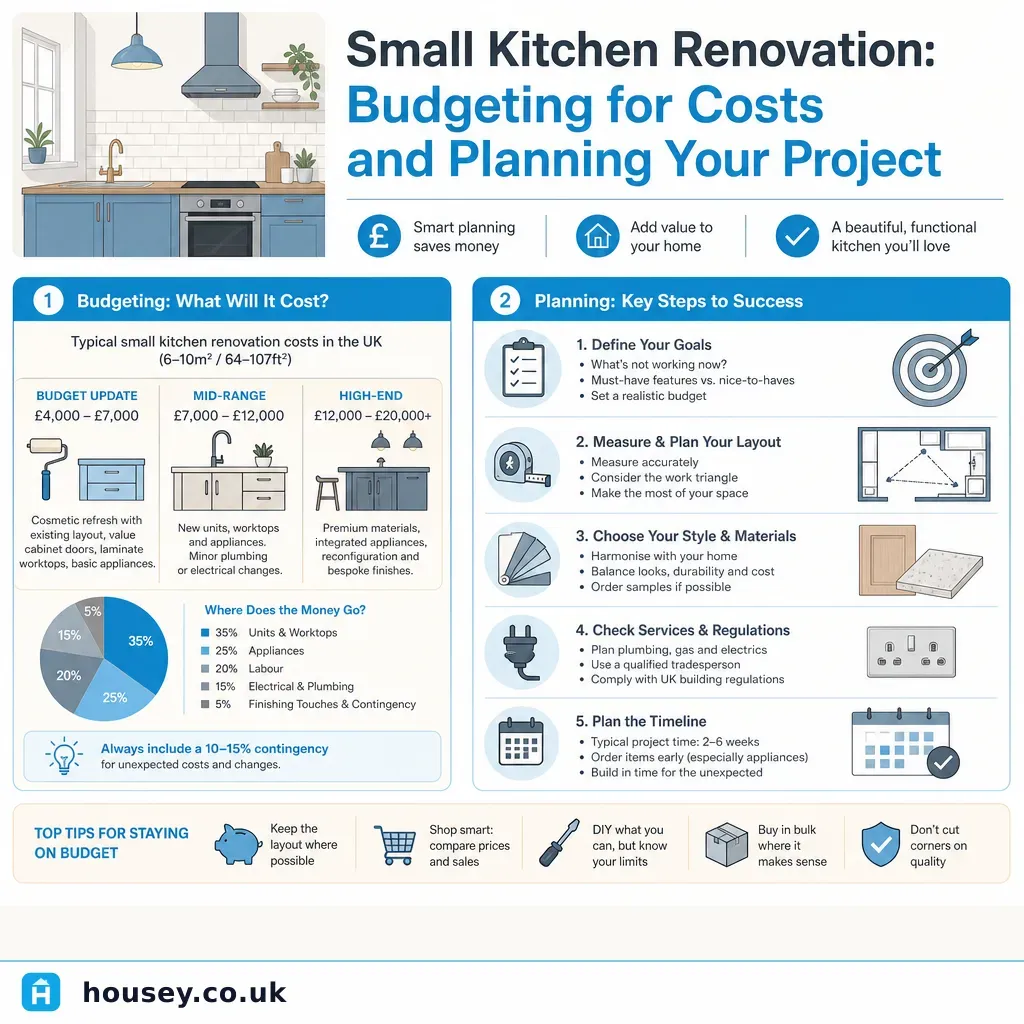
Small kitchen renovation: budgeting for costs and planning your project
A small kitchen renovation in the UK typically costs £5,000–£15,000 for a full refresh including new units, worktops, tiling, and appliances, though costs vary widely by specification, region, and whether structural changes or rewiring are involved.
 Improvement & Build
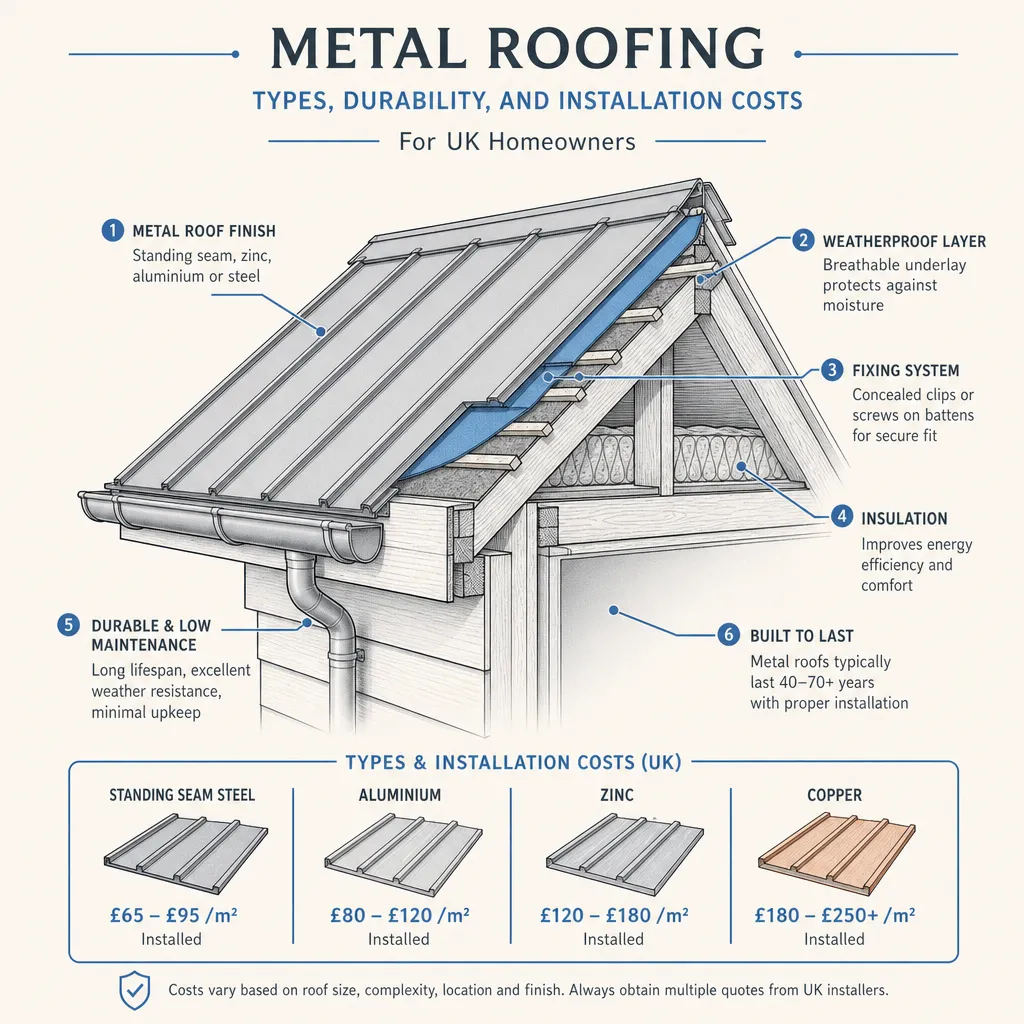
Metal Roofing: Types, Durability, and Installation Costs
Metal roofing in the UK includes standing seam, corrugated sheet, and metal tile systems in steel, aluminium, zinc, or copper.
 Improvement & Build
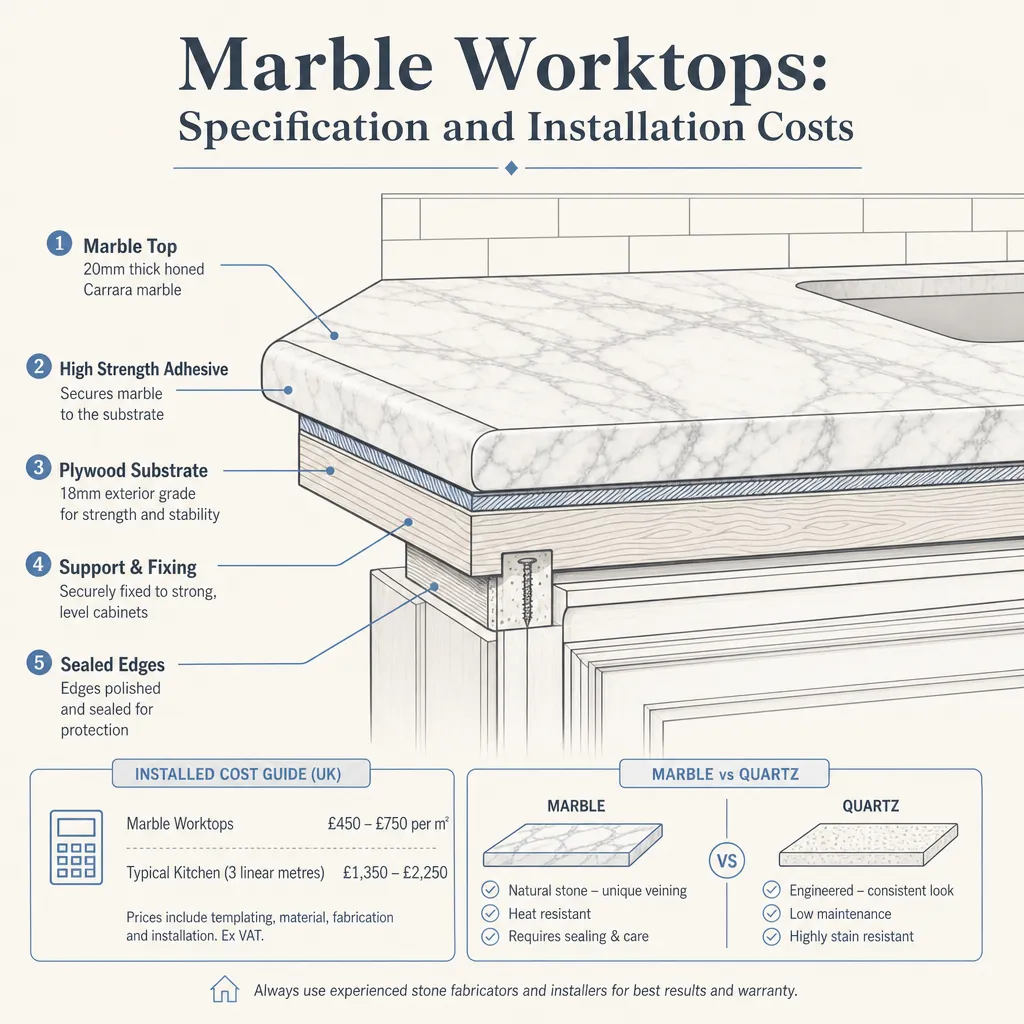
Marble Worktops: Specification and Installation Costs
Marble worktops in the UK typically cost £300–£800 per linear metre installed, depending on marble grade, slab thickness, finish, and edge profile.
 Improvement & Build
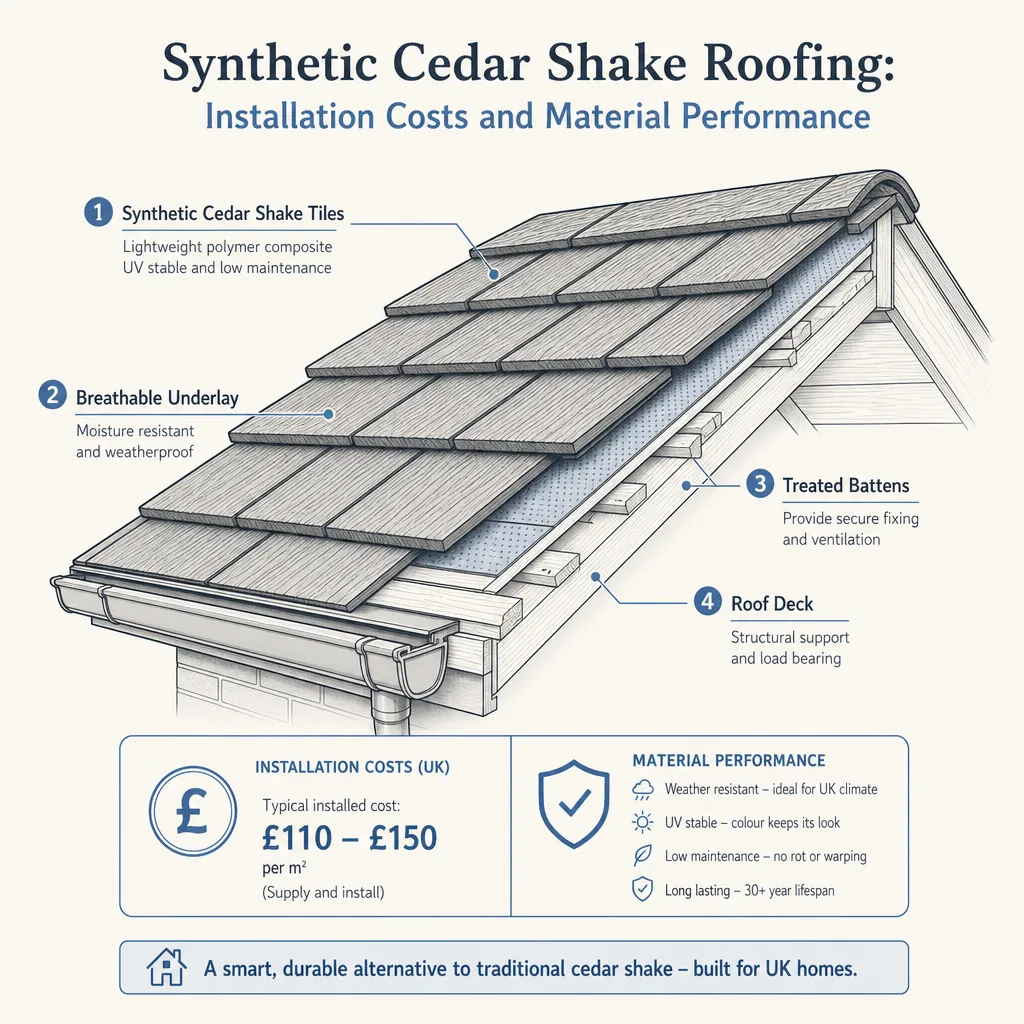
Synthetic Cedar Shake Roofing: Installation Costs and Material Performance
Synthetic cedar shake roofing uses polymer composite, rubber, or fibre-cement tiles to replicate the look of natural cedar wood shingles.