Best Practice Standards for Residential Concrete Construction
By Housey · Last reviewed 25th of May 2026
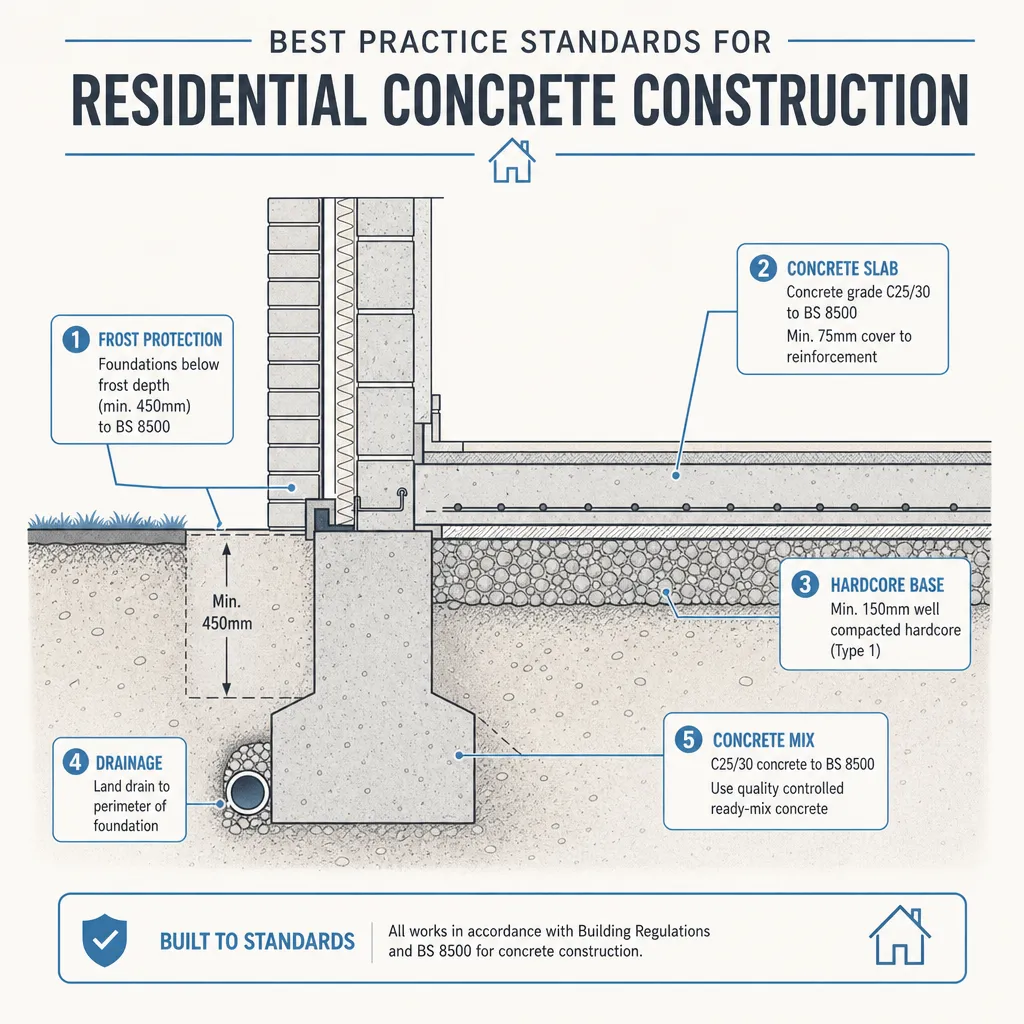
Best Practice Standards for Residential Concrete Construction
Concrete underpins most UK residential structures — from strip foundations and trench-fill to ground-bearing slabs, retaining walls, and basement construction. Whether you are commissioning a self-build, overseeing an extension, or trying to understand what your contractor is proposing, knowing what good concrete practice looks like helps you ask the right questions and spot problems before they become structural liabilities. The penalties for poor concrete — from progressive sulfate attack in aggressive soils to honeycombing in load-bearing walls — can be significant and expensive to remedy after the fact.
Key points
- Concrete for residential foundations must comply with BS EN 206 and BS 8500, which define exposure classes, minimum cement content, and maximum water-cement ratios for each application and ground condition.
- Building Regulations Approved Document A requires foundations to be designed for the specific ground conditions and loads — typically a minimum depth of 450 mm in most of England and Wales for conventional masonry strip foundations.
- The most common grade for strip and trench-fill foundations on non-aggressive ground is C25/30 (designated GEN 3 or RC30 in the older BS 8500 labelling system); sulfate-bearing soils require specialist mixes including sulfate-resisting Portland cement.
- All structural concrete elements in new residential builds require building control sign-off from a local authority or a Registered Building Control Approver (formerly Approved Inspector).
- Concrete should not be placed when air temperature is below 2 °C or above 30 °C without specific cold- or hot-weather precautions, as temperature extremes compromise the curing process and long-term compressive strength.
What the building regulations say about concrete in homes
Approved Document A sets minimum standards for structural design, including foundations. It does not prescribe a single concrete specification but requires that foundations are adequate for the loads imposed and the ground conditions present. The concrete specification is therefore determined by:
- The results of a geotechnical or soil investigation
- The structural loads imposed by walls, floors, and roofs
- The exposure class of the element (below-ground, internal, or external)
- The presence of aggressive ground chemicals such as sulfates or chlorides
For straightforward domestic extensions on non-aggressive ground, building control bodies commonly accept a standard C25/30 designated mix. For anything more complex — reactive or shrinkable clays, high sulfate levels, proximity to trees, made ground, or sloping sites — a site-specific geotechnical report is usually required before a concrete specification can be confirmed. Building control may request this as a condition of approval.
Concrete mix standards: BS EN 206 and BS 8500
BS 8500 (Concrete — Complementary British Standard to BS EN 206) is the primary reference for specifying concrete in the UK. It classifies concrete into three main categories:
- Designed mixes — specified by a structural engineer to meet defined strength and durability requirements for a particular application.
- Designated mixes — pre-defined mixes (GEN 3, RC30, PAV 1, FND 2) suited to common residential uses without bespoke engineering design.
- Standardised prescribed mixes — where the concrete recipe (quantities of each constituent) is specified directly rather than the performance outcome.
Mix designation | Typical residential use | Key standard reference |
|---|---|---|
GEN 0–3 (C8/10–C25/30) | Mass fill, blinding, footpaths, non-structural slabs | BS 8500-1 Table A.3 |
RC30–RC40 (C25/30–C32/40) | Strip foundations, ground beams, retaining walls | BS 8500-1 Table A.5 |
PAV 1–PAV 2 | Driveways and external paving exposed to de-icing salts | BS 8500-1 Table A.7 |
FND 2–FND 4 | Foundations in sulfate-bearing ground | BS 8500-1 Table A.6 |
Using the wrong mix designation — for example, specifying GEN 3 in sulfate-rich ground — can cause progressive deterioration that may not become visible for years. A structural engineer or building control body should confirm the correct designation before concrete is ordered.
Placement, compaction, and curing: where practice matters most
Even correctly specified concrete can fail if it is poorly placed on site. Key best-practice requirements include:
Placement
Concrete should be deposited as close to its final position as possible. Excessive raking or moving concrete across a large area causes segregation — the aggregate separates from the cement paste, creating zones of weakness. Free-fall height should generally be limited to 1.5 m in columns or deep foundations to avoid this problem.
Compaction
Poker (internal) vibrators are the standard method for compacting concrete in formed elements such as columns, beams, and walls. Insufficient compaction leaves voids known as honeycombing, which reduce strength and allow water and aggressive chemicals to penetrate the concrete over time.
Curing
Freshly placed concrete must be protected from drying out too rapidly. In warm, sunny, or windy conditions, exposed surfaces should be covered with polythene sheeting, damp hessian, or a proprietary curing compound. The minimum recommended curing period under Eurocode 2 principles is typically 3–7 days depending on cement type and ambient conditions; 28-day compressive strength remains the standard acceptance benchmark.
Quality assurance and testing
Building control bodies may require evidence that concrete placed on site meets the agreed specification. Common quality assurance measures include:
- Slump tests (BS EN 12350-2): check workability and indicate whether the water-cement ratio is within specification at point of delivery.
- Cube or cylinder tests (BS EN 12390-3): concrete samples taken on site, cured in controlled conditions, and crushed at 7 and 28 days to verify characteristic compressive strength.
- Delivery tickets: ready-mixed concrete must arrive with a delivery note confirming the mix designation, water-cement ratio, and cement type in accordance with BS EN 206.
- Site records: date, time, weather conditions, element location, and volume placed should be logged for each concrete pour.
Homeowner inspection checklist
Use this checklist when overseeing concrete construction on your property:
Red flags that suggest non-compliant concrete work
Be alert to these warning signs on site:
- Water added to the mix on site without a corresponding delivery-ticket record — this raises the water-cement ratio and reduces long-term strength and durability.
- Concrete placed in freezing conditions without cold-weather precautions such as a heated mix, insulated formwork, or frost-protection blankets.
- No slump test performed on delivery, particularly on large or structural pours.
- Honeycombing visible after striking the formwork — pockets of visible aggregate without surrounding cement paste, indicating inadequate compaction.
- Surface cracking within 24–72 hours of placing — plastic shrinkage cracking caused by rapid moisture loss, indicating inadequate curing or excessive wind exposure during the pour.
- No delivery tickets retained by the contractor or site manager after the pour.
Important limitations
This article provides general guidance on UK best practice and recognised standards. Concrete specification is site-specific: the correct mix, cement type, reinforcement arrangement, and curing regime depend on your soil conditions, structural loads, exposure class, and the requirements of your building control body or Registered Building Control Approver. Do not use this guide as a substitute for professional structural or building control advice on your specific project.
What to ask a qualified professional
Before concrete is placed on your project, ask your structural engineer or building control surveyor:
- What mix designation (BS 8500 reference) is specified for each structural element, and what is the rationale?
- Do ground conditions require a sulfate-resisting or low-alkali cement type?
- What slump and strength tests are required, and who is responsible for arranging them?
- What is the minimum curing time and method for the anticipated site conditions?
- What happens if a 28-day cube test result falls below the specified characteristic compressive strength?
When to get professional help
Seek professional advice before work begins if:
- Your site has been previously developed, backfilled, or is near trees with aggressive root systems.
- A soil investigation has identified sulfates, made ground, or poor load-bearing capacity.
- You are constructing retaining walls, basements, or reinforced floor slabs thicker than 150 mm.
- Your building control body has requested a structural engineer's design for the foundations.
- You notice any of the red flags listed above during or after a concrete pour.
A structural engineer should be your first point of contact for any concern about structural concrete specification or visible defects. For formal approval of the works, a building control consultant can guide you through the sign-off process. Where your site has uncertain or variable ground conditions, a geotechnical investigation is the essential first step before any concrete specification is finalised.
How Housey can help
Housey connects homeowners and self-builders with building control consultants and structural engineers who can specify and approve concrete construction for your project. If your site requires ground investigation before a concrete specification can be responsibly confirmed, our geotechnical investigation specialists can arrange the assessments that underpin a sound and code-compliant design.
Frequently asked questions
What concrete grade do I need for house foundations in the UK?
For most residential strip or trench-fill foundations on non-aggressive ground, a C25/30 designated mix (GEN 3 in the older BS 8500 labelling system) is widely accepted by building control bodies. The correct grade depends on soil conditions, structural loads, and exposure class. Your structural engineer or building control body should confirm the specification for your specific site before ordering concrete.
Does all residential concrete work need building control approval?
Any structural concrete element — foundations, ground beams, basement walls, or retaining structures — requires building control approval as part of the full plans or building notice process. Non-structural concrete such as garden paths or small outbuilding bases may fall outside building regulations, but confirm with your local authority or a Registered Building Control Approver before assuming no approval is needed.
Can the concrete lorry driver add water on site?
Only within the limits set by the mix design and documented on the delivery ticket. BS EN 206 permits a small controlled water adjustment at delivery if it falls within the designed water-cement ratio. Uncontrolled addition of water to improve workability is non-compliant and can significantly reduce the concrete's final compressive strength and long-term durability.
How long does concrete take to reach full strength?
The conventional benchmark is 28-day characteristic compressive strength, verified by crushing concrete cubes or cylinders. Concrete continues to gain strength beyond 28 days, but this figure governs compliance testing. Seven-day results are sometimes used to assess early progress but do not replace the 28-day test for formal building control acceptance.
Sources and further reading
- Approved Document A: Structure — GOV.UK
- BS 8500-1:2023 Concrete — Complementary British Standard to BS EN 206 — BSI Group
- BS EN 206:2013+A2:2021 Concrete — Specification, Performance, Production and Conformity — BSI Group
- BRE Special Digest 1: Concrete in Aggressive Ground — Building Research Establishment
- Construction (Design and Management) Regulations 2015 — HSE
Useful next reads
 Planning & Pre-Build
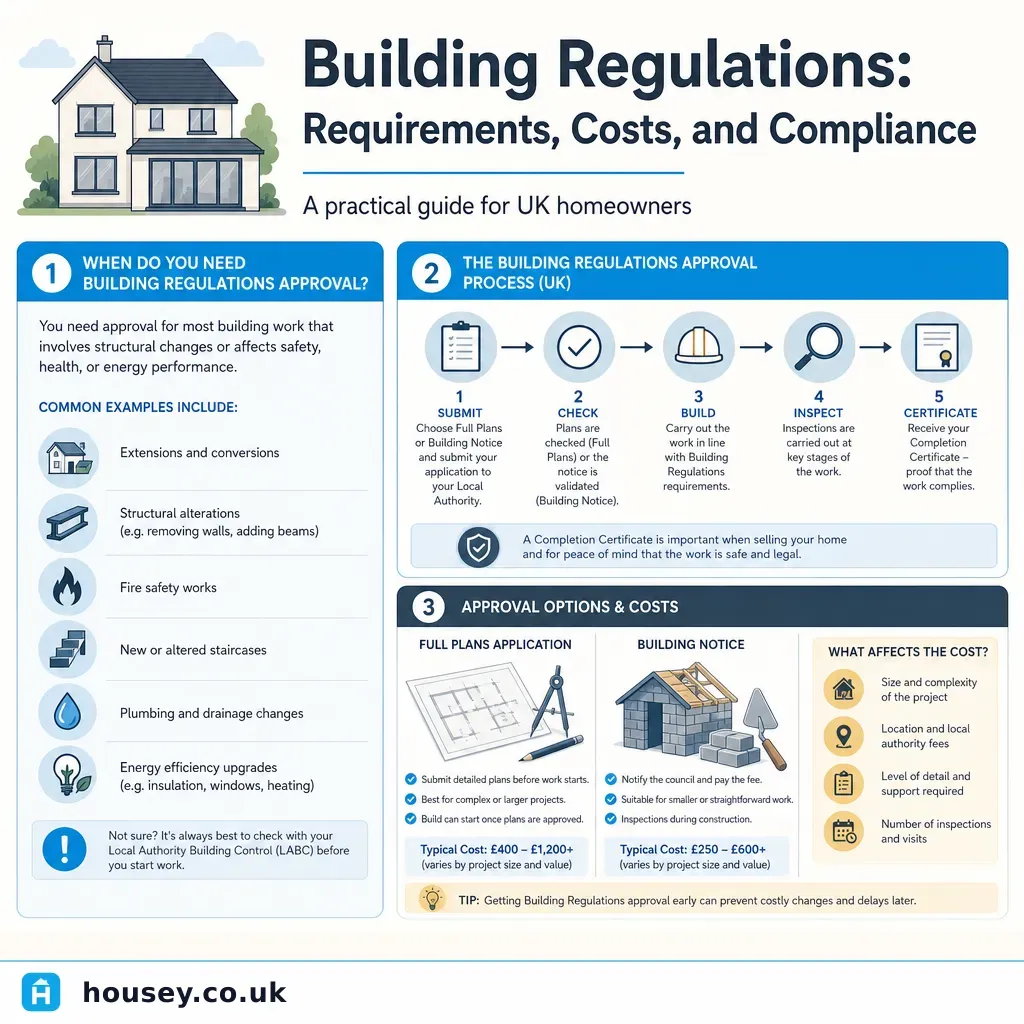
Building Regulations: Requirements, Costs, and Compliance
Building regulations set minimum standards for how construction work is carried out in the UK, covering structural stability, fire safety, energy efficiency, and ventilation.
 Planning & Pre-Build
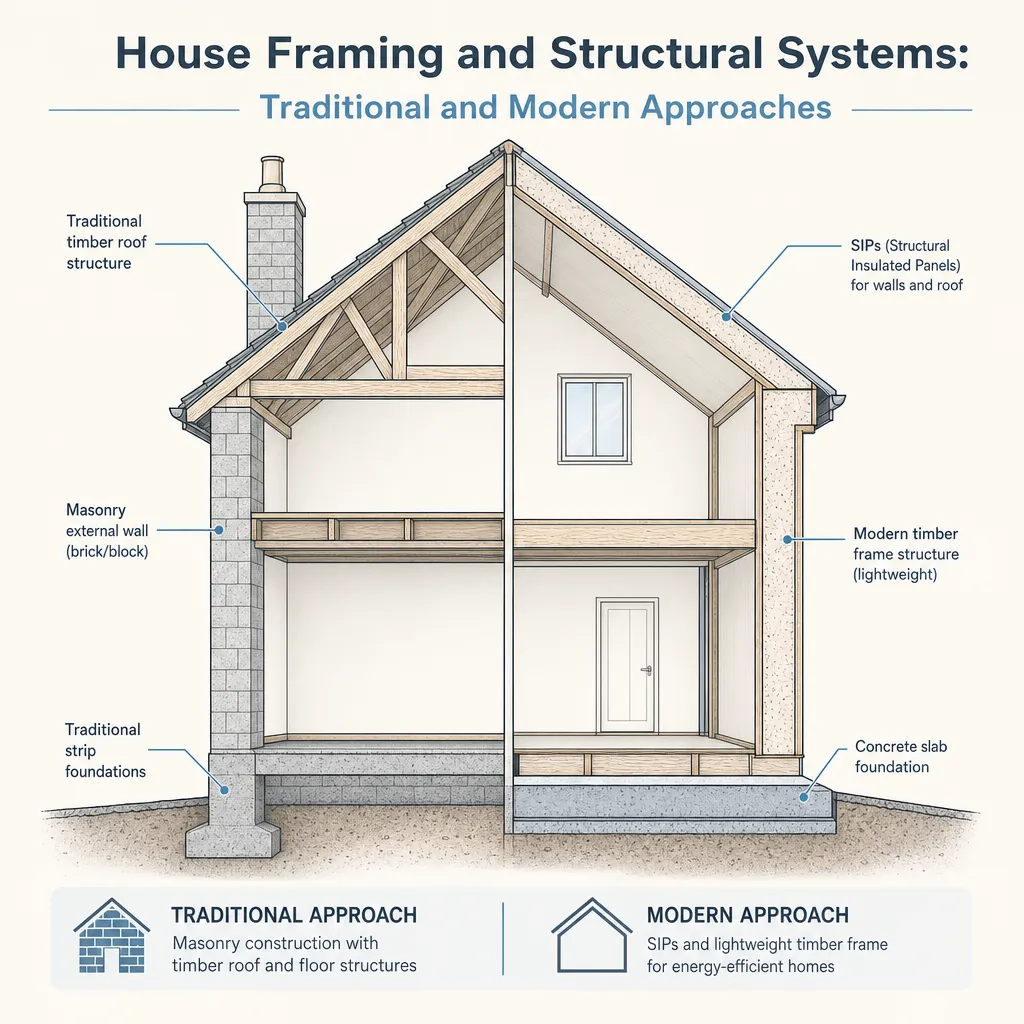
House Framing and Structural Systems: Traditional and Modern Approaches
UK homes are built using four main structural systems: traditional masonry (brick and block), timber frame, structural insulated panels (SIPs), and insulated concrete formwork (ICF).
 Planning & Pre-Build
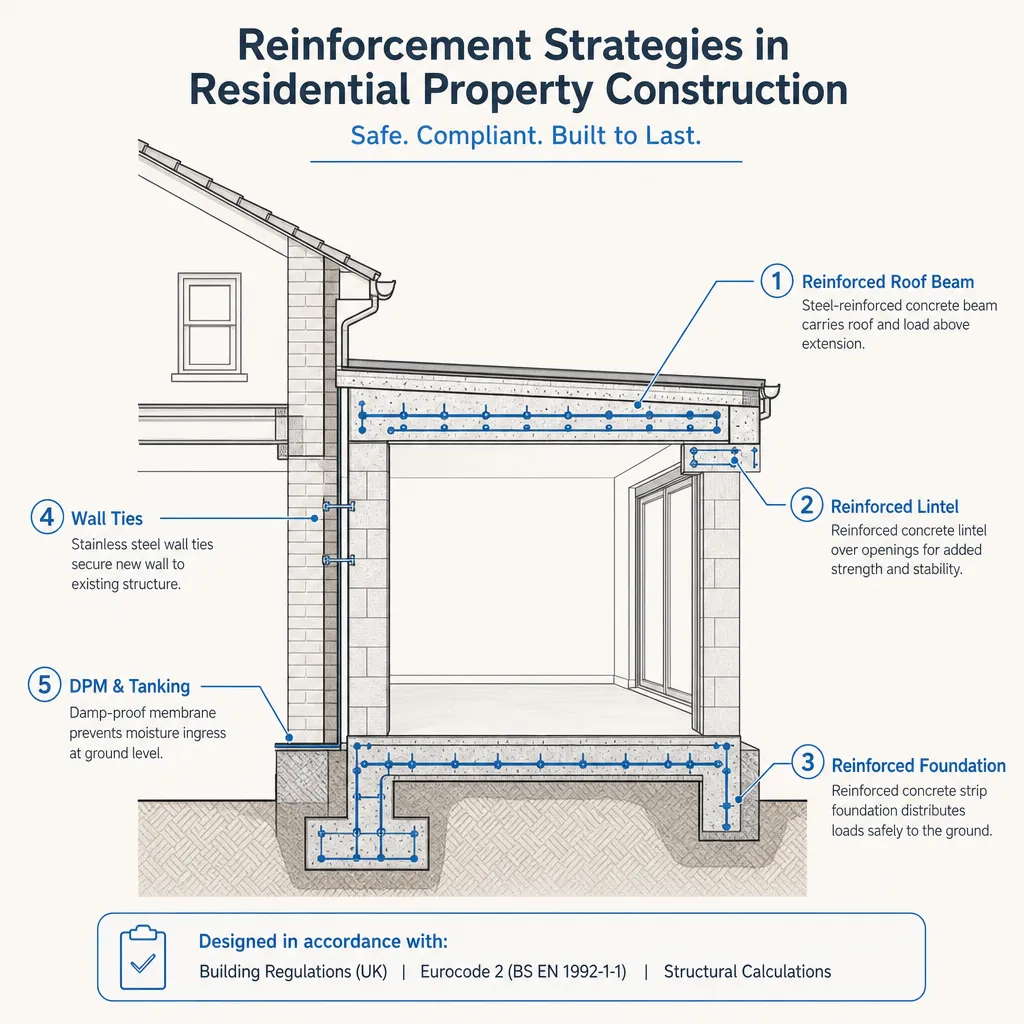
Reinforcement Strategies in Residential Property Construction
In UK residential construction, reinforcement is specified by a chartered structural engineer and must comply with Eurocode 2 and Building Regulations Approved Document A.
 Planning & Pre-Build
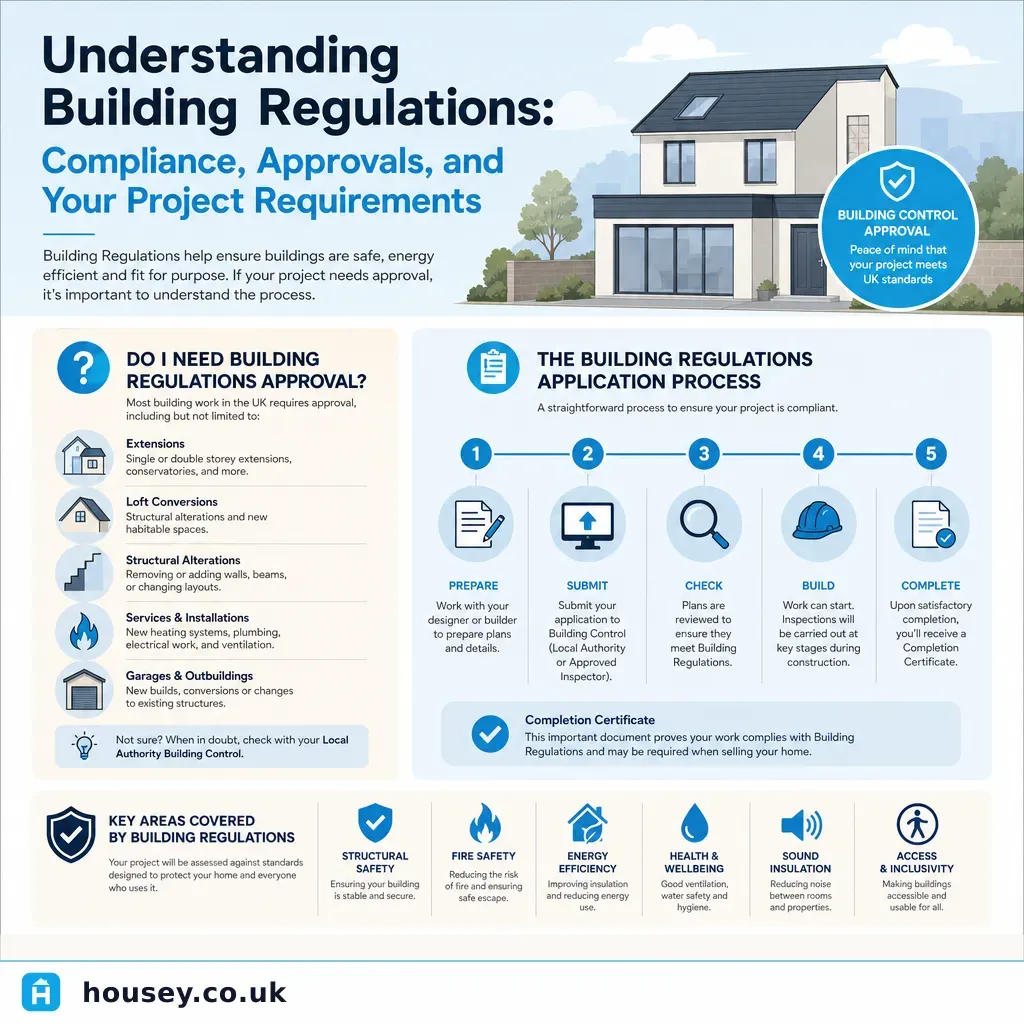
Understanding Building Regulations: Compliance, Approvals, and Your Project Requirements
Building regulations set minimum standards for design, construction, and alterations to buildings in England and Wales.
 Planning & Pre-Build
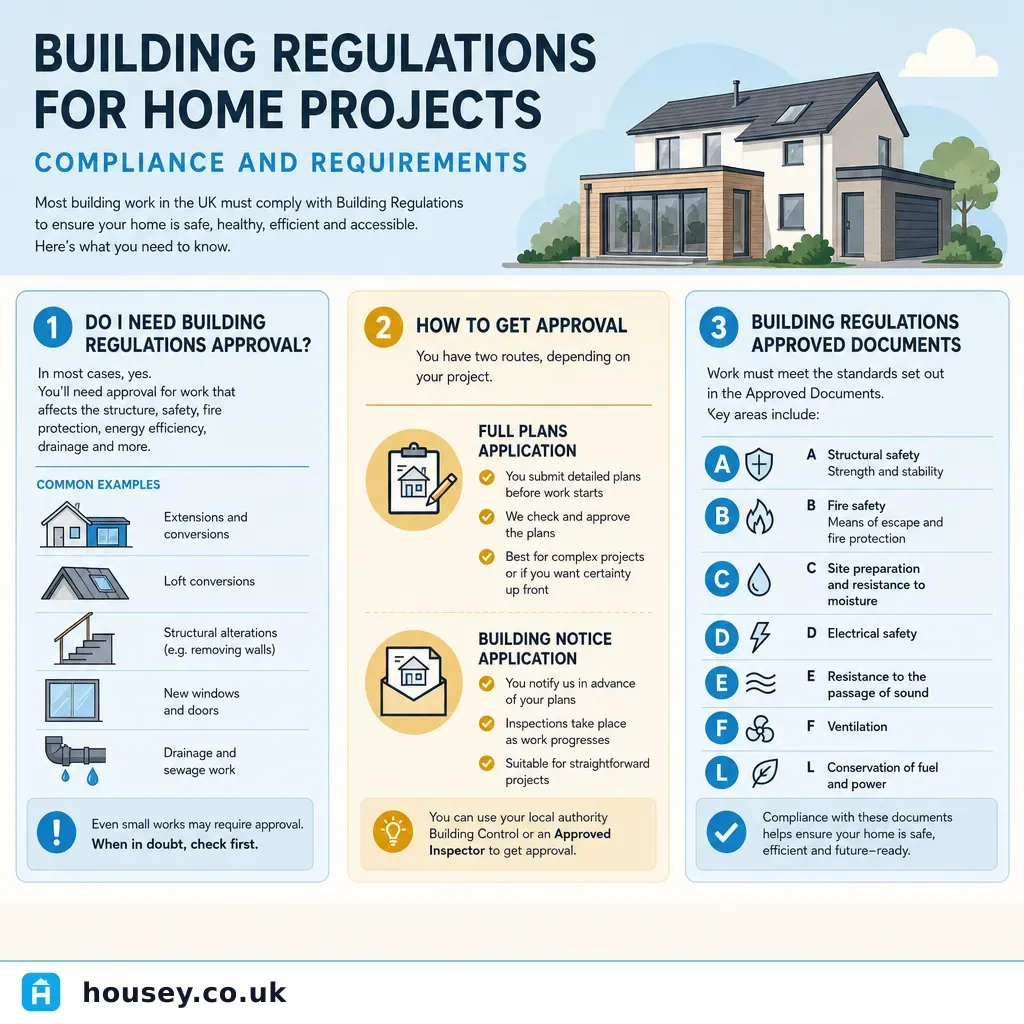
Building Regulations for Home Projects: Compliance and Requirements
Building regulations approval is needed for most structural, safety-related, and energy-related home projects in England and Wales, including extensions, loft conversions, and new heating systems.