House Framing and Structural Systems: Traditional and Modern Approaches
By Housey · Last reviewed 26th of May 2026
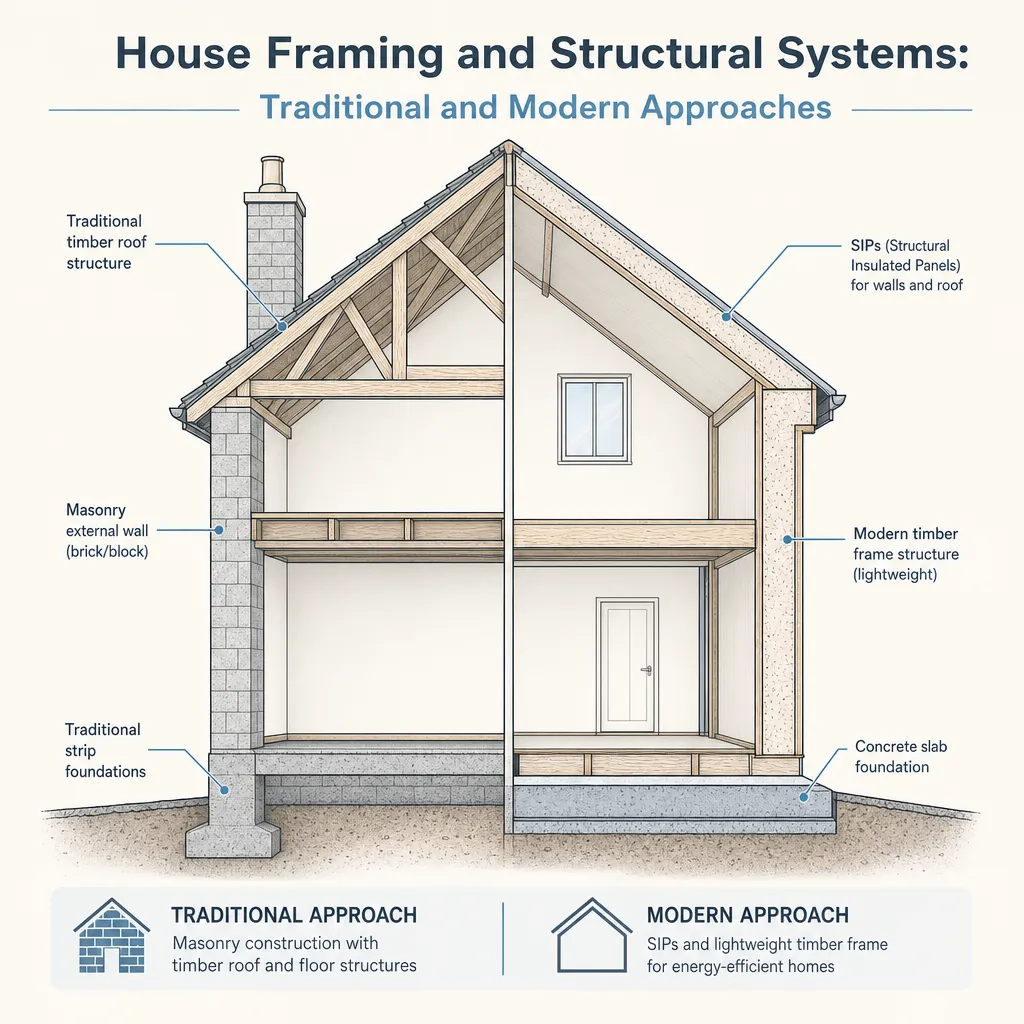
House Framing and Structural Systems: Traditional and Modern Approaches
The structural system chosen for a new build, substantial extension, or major conversion determines how a building carries its own weight, manages imposed loads, and performs over decades. In the UK, most of the existing housing stock was built using traditional masonry, but architects, developers, and self-build clients increasingly draw on a wider range of systems — from engineered timber panels to insulated concrete formwork — each carrying different implications for design, construction programme, thermal performance, and regulatory compliance. Understanding the options matters before briefing an architect or submitting a planning application.
Key points
- Traditional masonry — brick outer leaf, cavity, and inner dense concrete block leaf — remains the dominant structural approach in UK housing and is well understood by building control bodies, trades, and warranty providers.
- Timber frame accounts for an estimated 25–30% of new housing starts in England and Wales, and approximately 70% in Scotland, making it the most common alternative structural system for domestic new build (NHBC Foundation data).
- Building Regulations Part A (Structure) and Approved Document A govern structural design for all construction types; calculations must reference the relevant Eurocodes (BS EN 1990–1997 series).
- Structural Insulated Panels (SIPs) and Insulated Concrete Formwork (ICF) are classified as Modern Methods of Construction (MMC) and can support the high airtightness levels required under Building Regulations Part L (2021 edition).
- Any structural frame element in a new build, extension, or conversion must be designed or reviewed by a competent structural engineer before building control approval can be issued.
Traditional masonry: brick and block cavity walls
The most familiar structural approach in UK domestic construction consists of a facing brick outer leaf, a cavity (typically 100–150 mm, increasingly filled with partial or full-fill insulation to meet Part L thermal targets), an inner leaf of dense concrete block, and cavity ties connecting both leaves. Most UK homes built between the 1930s and the 1990s use this system.
Masonry is thoroughly understood by UK trades, surveyors, building control officers, and major warranty providers. It requires no specialist erection teams and has a long, well-documented performance history. Its main limitations are a relatively slow build programme compared with framed or off-site systems, dependence on wet trades (brickwork, mortar, plasterboard), and the need for additional insulation strategies — cavity fill, internal wall insulation, or external wall insulation — to achieve current Part L U-value targets.
Timber frame
Structural timber panels or open-frame studs form the load-bearing walls and floor structures. The two main categories used in UK domestic construction are:
- Platform (stick) frame: individual studs, sole plates, and head binders assembled on site within a conventional build programme sequence.
- Closed panel (engineered) systems: factory-manufactured wall panels, pre-insulated and sometimes pre-fitted with service battens, craned into position on site for rapid erection.
Timber frame is more susceptible to moisture damage during construction than masonry. Structural timber must be treated to at least Use Class 2 under BS 8417, and the frame must be made weathertight promptly after erection. NHBC Standards Chapter 6.4 sets specific requirements for timber frame construction under its warranty scheme. In Scotland, timber frame is the dominant method for new houses and has been for several decades.
Structural Insulated Panels (SIPs)
SIPs consist of a rigid foam core — typically expanded polystyrene (EPS) or polyisocyanurate (PIR) — bonded between two structural skins, usually oriented strand board (OSB). Panels are factory-manufactured to specification and assembled rapidly on site. Key characteristics for UK residential use include:
- High levels of airtightness, supporting compliance with Part L and Passivhaus performance targets.
- Fast shell erection — a typical house shell can be made weathertight within days of panel delivery.
- Reduced thermal bridging compared with conventional timber stud construction.
SIPs require precise structural design to accommodate openings, service penetrations, and junction details. Not all building control bodies have direct experience with SIPs; early engagement with your building control body or an approved inspector is advisable when SIPs are specified.
Insulated Concrete Formwork (ICF)
ICF uses hollow polystyrene or composite block units stacked to form the wall geometry, then filled with structural concrete. Once the concrete sets, the formwork remains as permanent thermal insulation. ICF is used on self-build projects and some developer schemes where high thermal mass, robustness, and airtightness are design priorities.
ICF requires specific structural engineering design for the concrete specification, reinforcement, and connection details. Mortgage lenders and insurers should be consulted before committing to ICF, as some products have a more limited acceptance record with standard UK warranty providers than masonry or timber frame.
Structural systems compared
System | Best for | Main advantage | Key limitation | Structural engineer required? |
|---|---|---|---|---|
Traditional masonry | Extensions, new builds, alterations | Proven, trades familiar, warranty-friendly | Slower build, thermal bridge management needed | For non-standard spans or loads |
Timber frame (platform) | New builds seeking programme speed | Faster than masonry, familiar to UK market | Moisture risk during construction | Yes, for calculations |
Timber frame (closed panel) | Speed and factory precision | Rapid erection, quality-controlled | Higher upfront material cost | Yes |
SIPs | Airtight and low-energy buildings | High airtightness, fast shell erection | Precise detailing required, specialist contractors | Yes |
ICF | High thermal mass, robust structures | Combined structural and insulating function | Concrete logistics, limited warranty familiarity | Yes |
Which professional do I need?
Stage | Professional | Why |
|---|---|---|
Structural design | Structural engineer (IStructE or ICE member) | Part A calculations and structural drawings |
Planning application | Architect or CIAT architectural technologist | Design drawings and planning documentation |
Building control | Local authority building control or approved inspector | Part A, Part L, Part B compliance sign-off |
Specialist frame review | Structural engineer | Review of SIPs or ICF supplier shop drawings |
On-site construction | Experienced extension builders | Construction management and trade coordination |
Important limitations
Structural system selection is a technical decision that depends on site-specific ground conditions, local planning policy, lender requirements, and the warranty scheme you intend to use. This article provides comparative general information only and does not constitute structural, engineering, or planning advice. Requirements under Building Regulations Part A and the involvement of qualified structural engineers and building control bodies must be determined project by project. Do not proceed with structural design, groundwork, or frame erection on the basis of this guide alone.
What to ask a qualified professional
Before appointing a structural engineer or specialist contractor:
- What structural system do you recommend for this site, programme, and budget — and why?
- Which warranty schemes (NHBC, Premier Guarantee, LABC Warranty, ICW) have you worked with for this system, and are there restrictions I should know about before committing?
- What structural calculations, drawings, and building regulations documentation will you provide, and at which stages?
- How and when will structural elements be inspected during construction, and by whom?
- Are there ground investigation or geotechnical survey requirements before the structural design can be finalised?
- If the building is altered in future, what structural implications should subsequent owners be aware of?
When to get professional help
Instruct a structural engineer before any structural construction work begins. This is not optional — it is a building control compliance requirement. Do not rely solely on a contractor's assessment for:
- Removal or alteration of any load-bearing wall, beam, or column in an existing building.
- Loft conversions involving changes to rafters, ridge, purlins, or floor joists.
- Extensions requiring new foundations, padstones, or structural steelwork.
- Any visible structural distress — cracking, deflection, or differential settlement — in a property being extended or altered.
How Housey can help
Housey connects UK homeowners and self-build clients with experienced structural engineering firms and building control consultants who can advise on the right structural system and manage compliance from design through to sign-off. If you are planning a new build or extension, extension builders on the Housey platform are experienced in working alongside structural engineers from the outset.
Frequently asked questions
Does my choice of structural system affect my mortgage or buildings insurance?
Yes, it can. Some lenders and insurers have restrictions on non-standard construction types including certain engineered timber systems, SIPs, and ICF. Check with your mortgage lender and buildings insurer before committing to a Modern Methods of Construction system. This is particularly important for self-build mortgage products where draw-down stages may be tied to specific construction milestones.
Can I use timber frame for an extension to a masonry house?
Timber frame extensions to masonry houses are technically achievable and increasingly common, but the structural junction between the two systems requires careful engineering design to manage differential movement, moisture ingress, and thermal bridging. Connection details should be designed by a structural engineer with experience of mixed-construction junctions.
What does Part A of the Building Regulations require?
Approved Document A requires that buildings are designed to sustain and transmit loads to the ground without causing structural failure or excessive deformation. All structural work — new builds, extensions, conversions, and alterations to load-bearing elements — must satisfy Part A before building control sign-off can be issued in England and Wales.
Do SIPs panels comply with major UK building warranty schemes?
Several major warranty providers including NHBC accept SIPs construction subject to specific technical requirements. Confirm acceptance with your chosen warranty provider before selecting SIPs as your structural system, as requirements vary and some SIPs products may require third-party accreditation or a current BBA certificate to qualify.
Sources and further reading
- Approved Document A: Structure — GOV.UK
- NHBC Standards Chapter 6.4: Timber and concrete framed buildings — NHBC
- Structural Timber Association: Technical guidance — Structural Timber Association
- Institution of Structural Engineers: Guidance documents — IStructE
- NHBC Foundation: Modern Methods of Construction — NHBC Foundation
Useful next reads
 Planning & Pre-Build
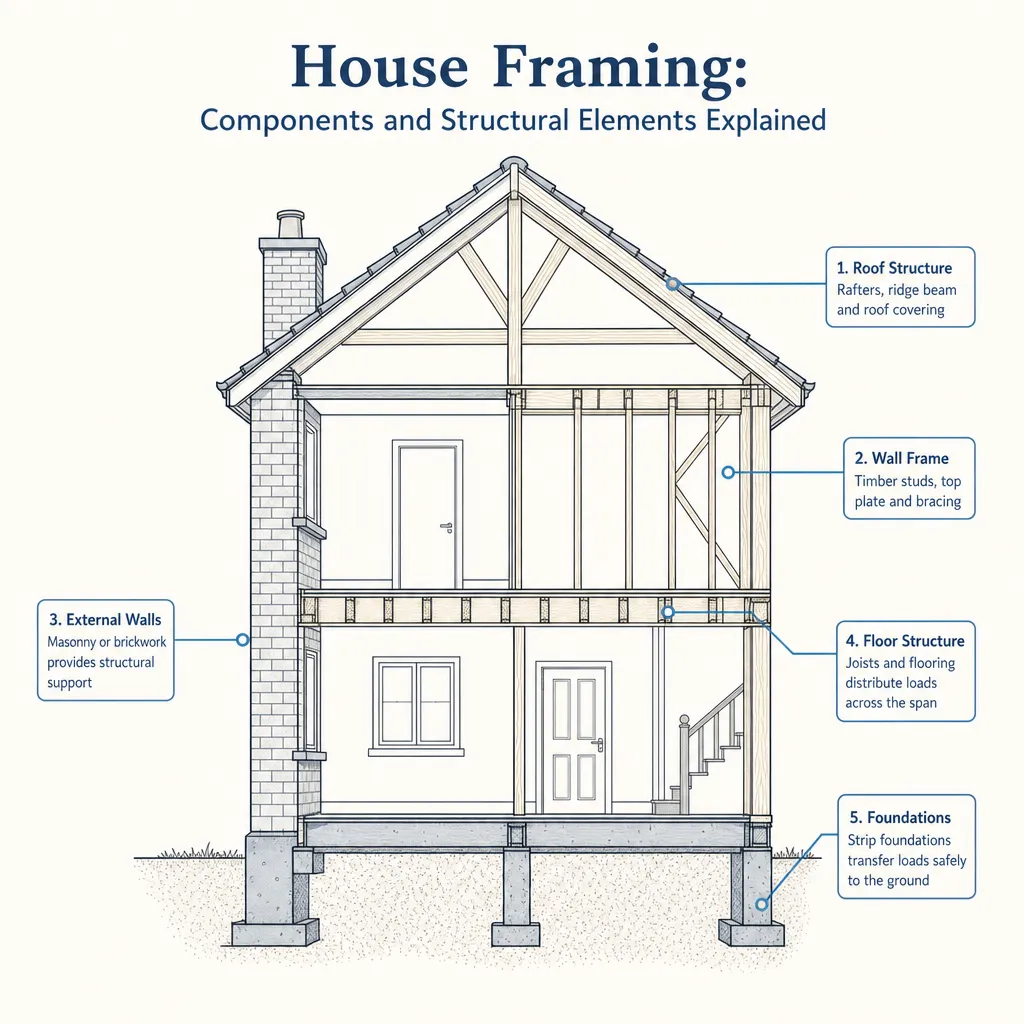
House Framing: Components and Structural Elements Explained
Most UK homes are built from load-bearing masonry — brick and block cavity walls — or, increasingly, from factory-engineered timber frames where the masonry outer leaf is non-structural cladding.
 Planning & Pre-Build
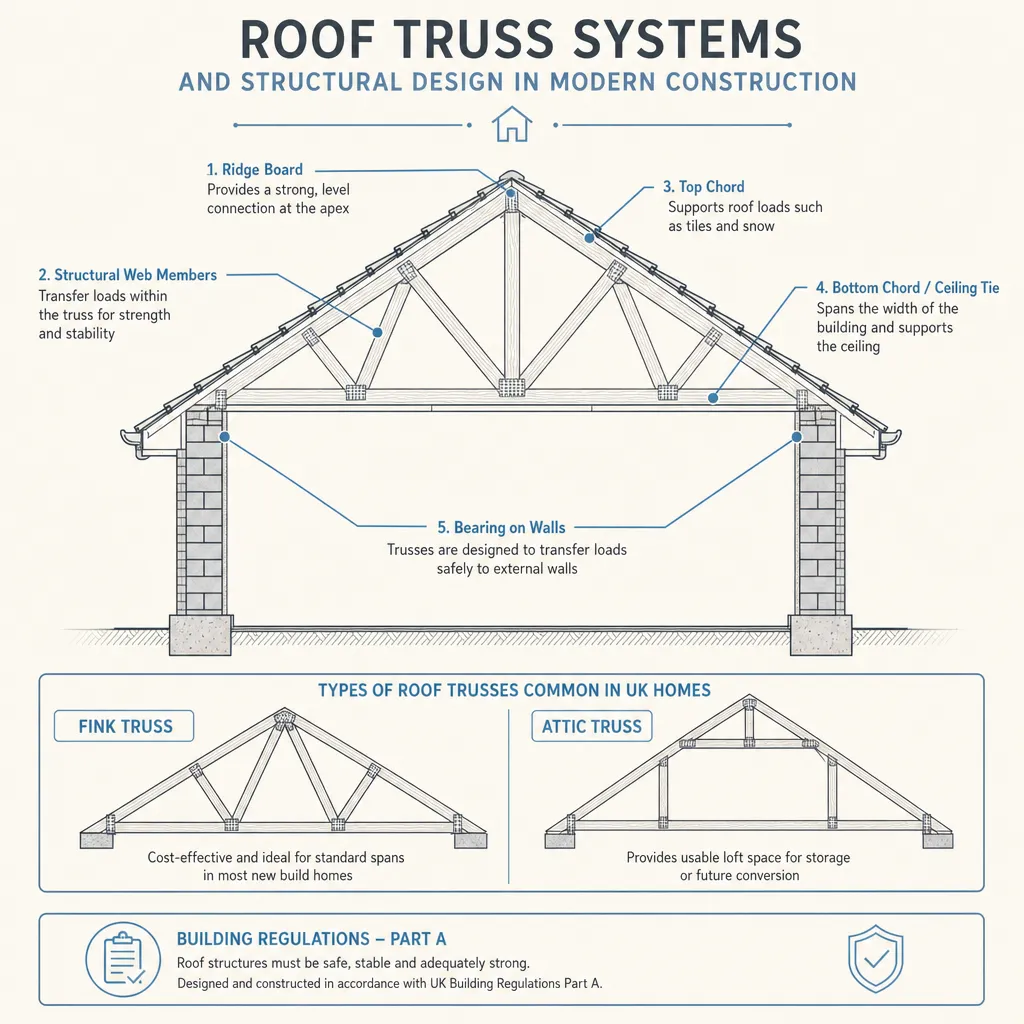
Roof Truss Systems and Structural Design in Modern Construction
Roof trusses are factory-engineered frames that carry roof loads to load-bearing walls.
 Planning & Pre-Build
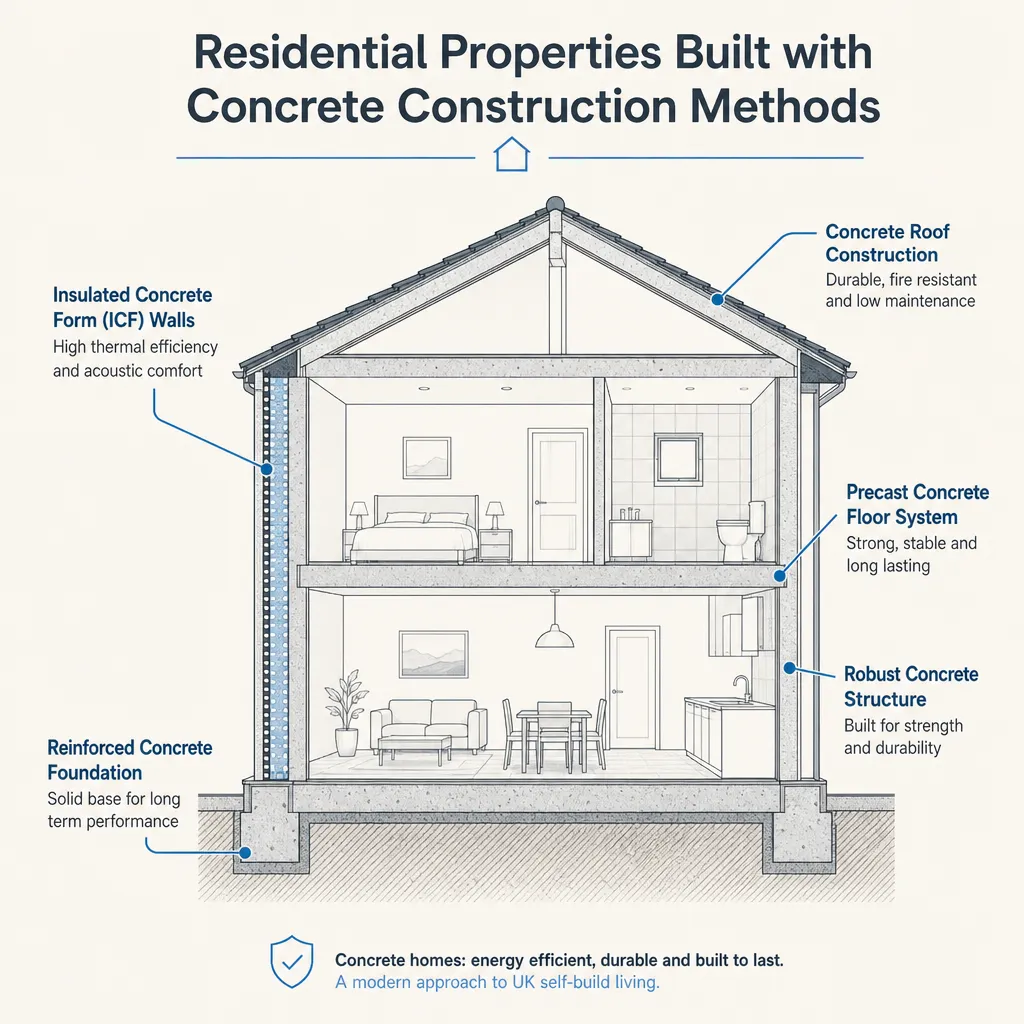
Residential Properties Built with Concrete Construction Methods
UK homes are built using several concrete methods: in-situ cast concrete, precast panel systems, insulating concrete formwork (ICF), and older non-traditional types such as Wimpey No-Fines and Laing Easiform.
 Planning & Pre-Build
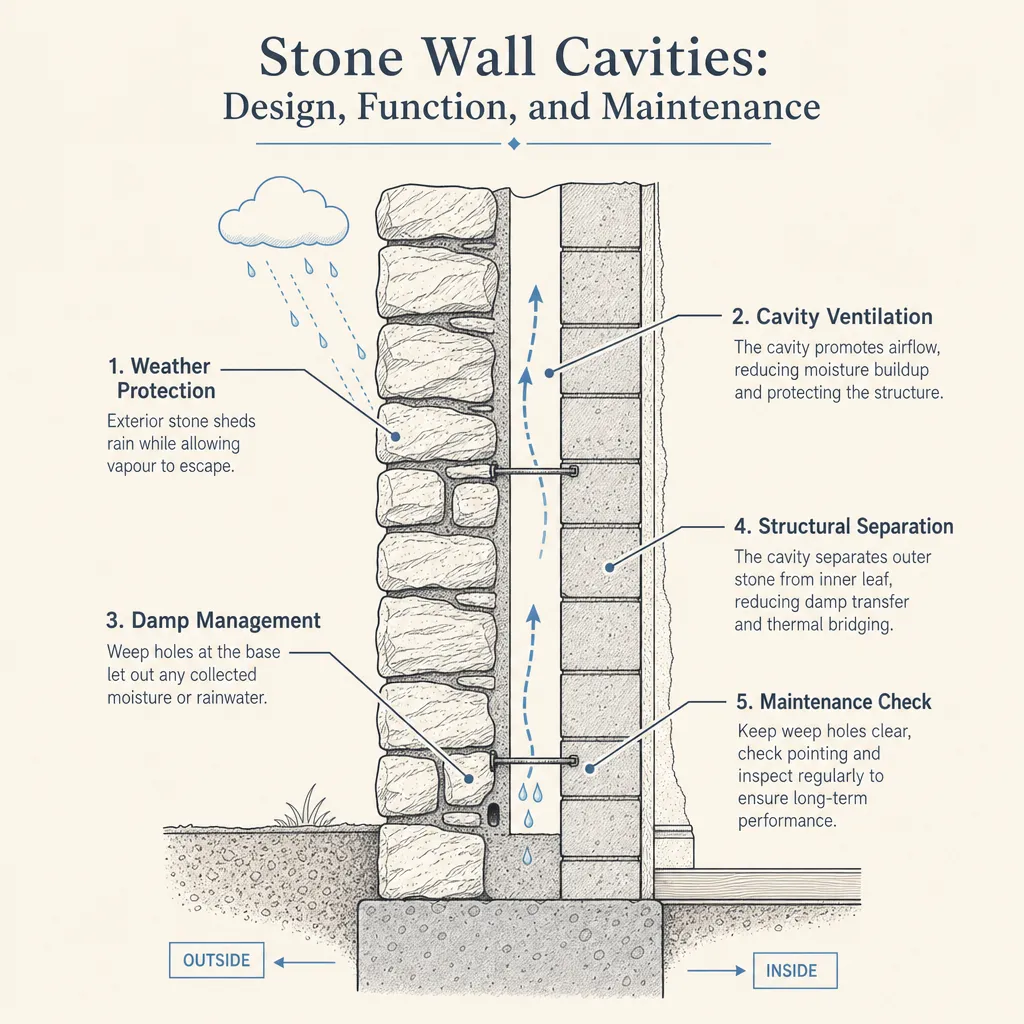
Stone Wall Cavities: Design, Function, and Maintenance
Stone wall cavities in UK construction appear in two distinct contexts: purpose-built stone-faced cavity walls common in modern construction, and traditional thick solid stone walls that achieve moisture control through mass rather than an air gap.
 Planning & Pre-Build
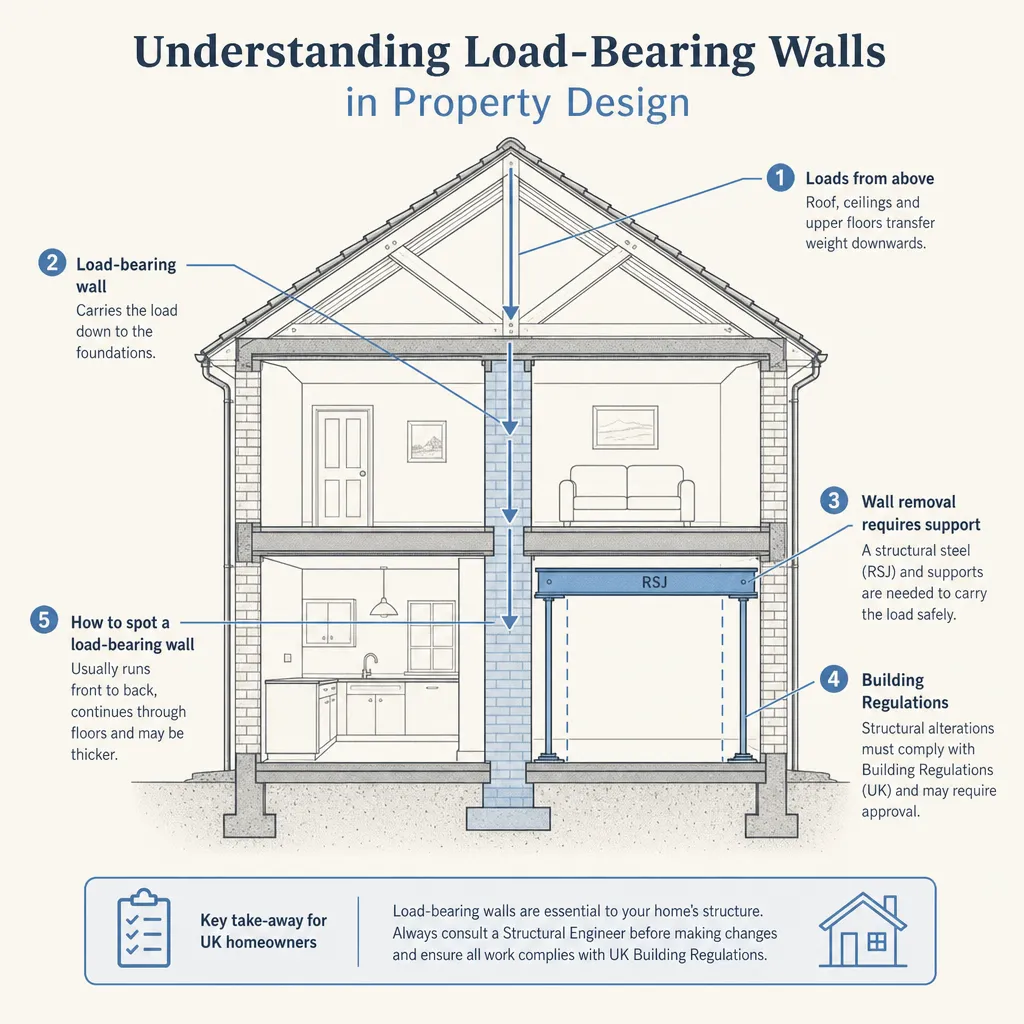
Understanding Load-Bearing Walls in Property Design
A load-bearing wall carries the weight of floors, roofs, or other walls above it down to the foundations.