Understanding Building Regulations: Compliance, Approvals, and Your Project Requirements
By Housey · Last reviewed 24th of May 2026
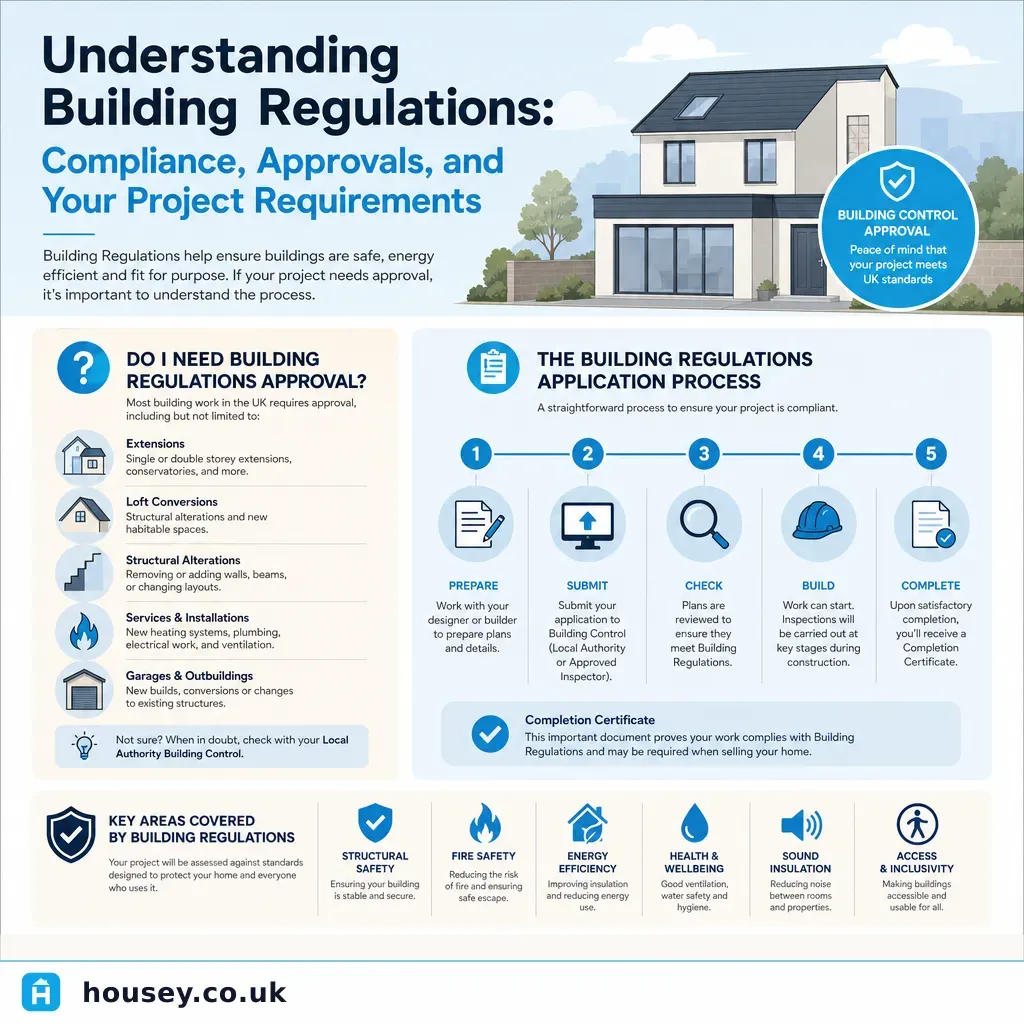
Understanding Building Regulations: Compliance, Approvals, and Your Project Requirements
Building regulations exist to protect the health, safety, and welfare of people in and around buildings in the UK. For most homeowners, the question of whether work requires approval arises when planning an extension, loft conversion, new bathroom, or significant structural alteration. Getting this wrong — by starting notifiable work without approval or failing to obtain a completion certificate — can affect your ability to sell the property and may require costly remediation.
Key points
- Building regulations in England are made under the Building Act 1984 and implemented through 18 Approved Documents covering structure (Part A), fire safety (Part B), energy efficiency (Part L), and electrical safety (Part P), among others.
- Most structural work, new electrical circuits, plumbing alterations, extensions, loft conversions, and changes of use require building regulations approval before work begins — even if planning permission is not needed.
- You can apply via your local authority building control (LABC) department or use a private approved inspector; both routes conclude with a completion certificate on satisfactory inspection.
- A building notice allows work to start 48 hours after submission without pre-approved drawings; a full plans application provides formal design approval before work begins, reducing on-site risk and protecting you if disputes arise.
- Failure to obtain approval for notifiable work can make a property difficult to sell; conveyancers and mortgage lenders routinely request completion certificates as part of the conveyancing process.
What building regulations actually cover
Building regulations are entirely distinct from planning permission. Planning controls land use, appearance, and neighbourhood impact. Building regulations control the technical standard of how a building is constructed or altered. A project may require both, neither, or only one of the two regimes.
The 18 Approved Documents cover key areas including:
- Structure (Part A): loads, ground movement, and disproportionate collapse
- Fire safety (Part B): means of escape, compartmentation, and fire resistance of structural elements
- Moisture resistance (Part C): damp-proofing, drainage, and subfloor ventilation
- Energy efficiency (Part L): insulation U-values, heating system performance, and air permeability
- Electrical safety (Part P): notifiable electrical work in dwellings
- Ventilation (Part F): airflow in habitable rooms, kitchens, and bathrooms
- Sanitation and drainage (Part H): foul and surface water drainage
Each Approved Document sets out one compliant approach; alternative approaches are permitted provided compliance can be demonstrated to the building control body.
Which projects need building regulations approval?
The table below is a general guide. Always confirm the specific position for your project with your local authority building control department before work begins, as requirements depend on the property's construction, age, and location.
Project | Building regulations required? | Notes |
|---|---|---|
Single-storey rear extension | Usually yes | Structural, drainage, insulation, Part B |
Loft conversion | Yes | Structural, fire escape, Part L insulation |
Garage conversion to habitable room | Yes | Insulation, ventilation, fire, drainage |
New bathroom in existing space | Usually yes | Drainage, Part F ventilation |
Like-for-like boiler replacement | Yes (Competent Person Scheme) | Gas Safe engineer self-certifies |
Window replacement | Usually yes (FENSA or LABC) | Energy performance, safety glazing |
New kitchen, no structural changes | Often no | Confirm if drainage is altered |
Garden room or outbuilding | Sometimes | Depends on size and intended use |
Internal non-load-bearing partition | Usually no | Confirm no structural implication first |
Choosing your approval route
Decision tree: which application route is right for your project?
- Choose a full plans application if your project is structurally complex, involves basement work, or you want formal approval of the design before work begins. This protects you if disputes arise and reduces the risk of costly on-site changes to non-compliant work.
- Choose a building notice if the project is straightforward — a small extension or bathroom alteration — and your builder is experienced with the relevant inspection stages. Work can start 48 hours after submission, but no drawings are pre-approved.
- Apply for a regularisation certificate if notifiable work has already been done without approval. This retrospective route involves inspection of accessible elements and may require opening up completed work to allow assessment.
- Consider a private approved inspector if faster turnaround or specialist expertise matters — the legal outcome is the same as LABC, but response times can be shorter.
The inspection process
Once a building notice has been submitted or a full plans application approved, your building control surveyor will carry out site inspections at agreed stages. Typical stages for an extension include:
- Commencement notice before work begins
- Foundations before concrete is poured
- Damp-proof course and oversite
- Drainage before backfilling
- Structural frame, roof, and insulation before closing up
- Final inspection
Keep records of all inspection dates and correspondence. A completion certificate is issued after the final inspection is passed. Retain this document permanently — it will be requested during any future sale or remortgage.
Homeowner checklist: before you start any project
Important limitations
This article provides general information about building regulations in England. Rules in Scotland (Building (Scotland) Act 2003), Wales, and Northern Ireland differ in important respects. The specific requirements for any project depend on your property's construction, age, condition, location, and the nature of the proposed works. This guide is not a substitute for professional assessment by a qualified building control consultant, architect, or architectural technologist.
When this becomes urgent
Seek professional guidance promptly if:
- Previous works on the property have no building regulations approval and you are preparing to sell or remortgage.
- Your local authority has issued a building regulations enforcement notice.
- You are proposing structural alterations and are uncertain whether the existing structure can bear additional loads.
- The project involves fire-safety-relevant works — escape routes, fire doors, or compartmentation — and compliance with Part B is unclear.
What to ask a qualified professional
Before instructing a building control consultant or architectural technologist:
- Which Approved Documents apply to my project, and what are the key compliance points for each?
- Do I need full plans approval or will a building notice suffice for this type of work?
- What drawings and specifications will be required at submission?
- How many inspection stages should I expect, and what triggers each one?
- What happens if the inspector identifies work that does not comply?
- Will you liaise with the LABC or private approved inspector on my behalf throughout the project?
How Housey can help
Housey connects homeowners with experienced building control consultants who can review your project, identify which Approved Documents apply, and advise on the most appropriate approval route. Specialists in building regulations drawings can prepare the technical documentation needed for a full plans application. Use the Housey quote tool to receive up to four competitive quotes from qualified professionals.
Frequently asked questions
Do I need building regulations if I already have planning permission?
Yes. Planning permission and building regulations are entirely separate consents. Planning controls whether a development is acceptable in land-use terms; building regulations control how it is built to minimum technical standards. Many projects require both; some require only one. Always check both regimes before starting work — your local authority planning and building control departments operate independently of each other.
What is a completion certificate and why does it matter?
A completion certificate is formal sign-off from your building control body confirming that inspected work satisfies the relevant Approved Documents. Mortgage lenders, conveyancers, and buyers routinely request completion certificates for notifiable work. Without one, you may need to apply retrospectively for a regularisation certificate, which can involve opening up completed elements to allow inspection.
What happens if I carry out notifiable work without building regulations approval?
The local authority can issue an enforcement notice requiring you to alter or remove non-compliant work, and there is a time-limited risk of prosecution. More practically, absence of approval typically delays or prevents a property sale. A regularisation certificate may resolve historic cases but is not always available — particularly where work has been concealed or remains unsafe.
How long does a full plans application take?
Local authorities have a statutory target of five weeks to approve or reject a full plans application, extendable to two months by agreement with the applicant. Private approved inspectors often respond faster. Submitting complete, accurate drawings and specifications at the outset reduces the risk of queries, additional information requests, and delays to the programme.
Sources and further reading
- Building regulations: overview — GOV.UK — GOV.UK
- The Building Act 1984 — legislation.gov.uk — legislation.gov.uk
- Approved Documents collection — GOV.UK — Ministry of Housing, Communities and Local Government
- Local Authority Building Control (LABC) — LABC
Useful next reads
 Planning & Pre-Build
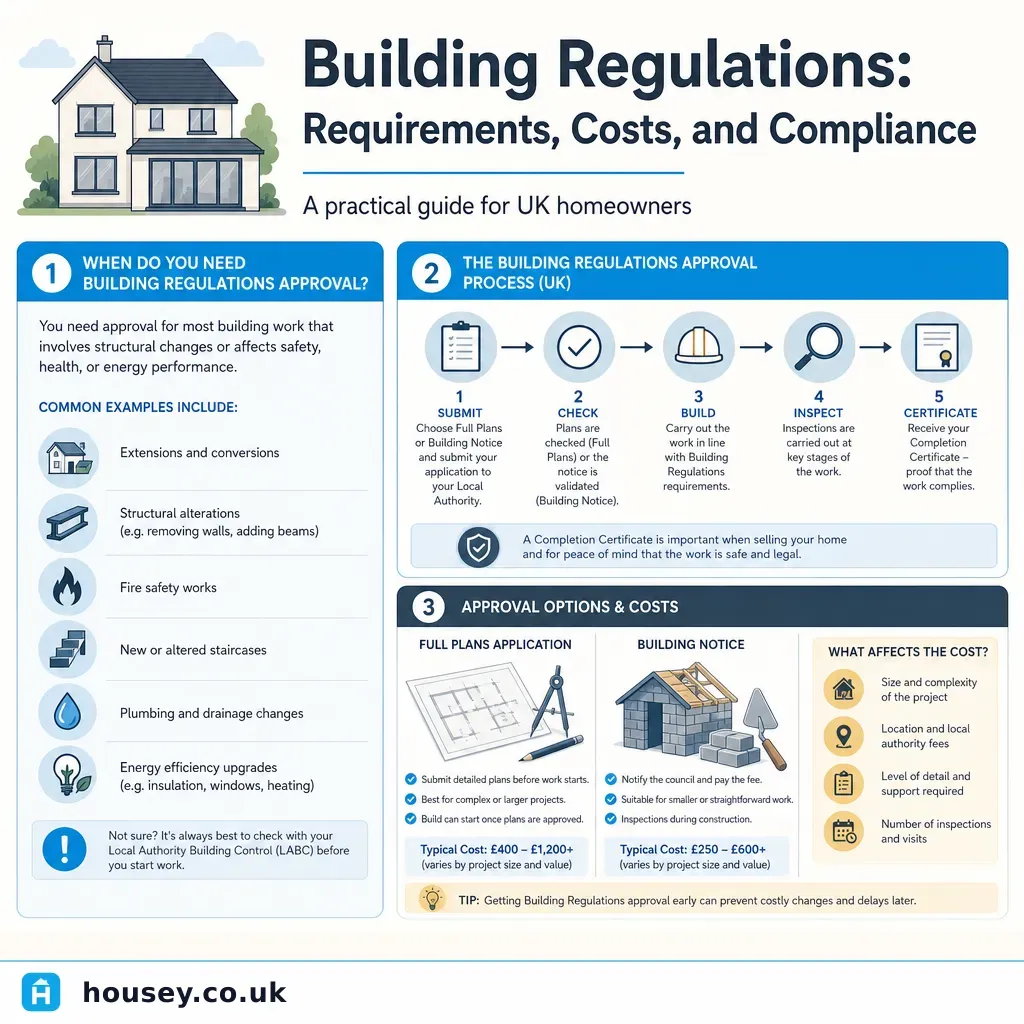
Building Regulations: Requirements, Costs, and Compliance
Building regulations set minimum standards for how construction work is carried out in the UK, covering structural stability, fire safety, energy efficiency, and ventilation.
 Planning & Pre-Build
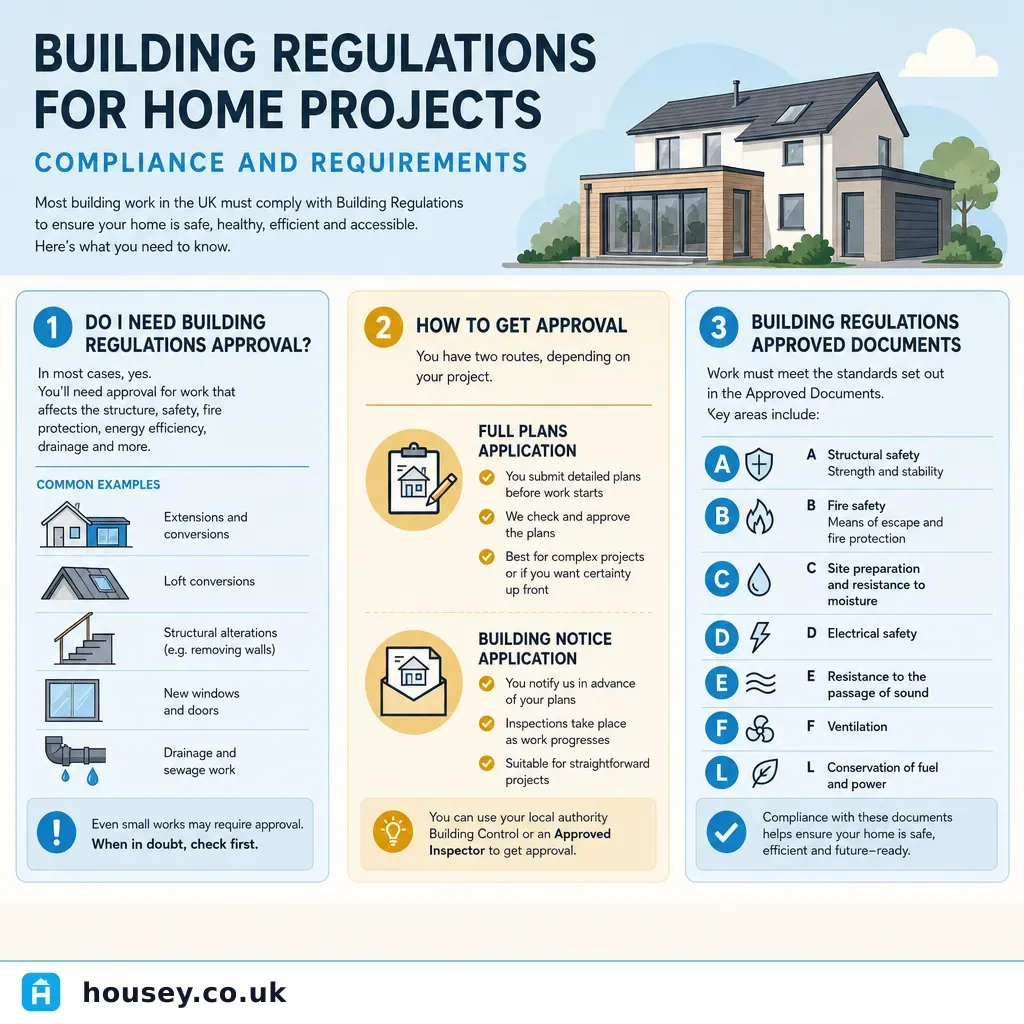
Building Regulations for Home Projects: Compliance and Requirements
Building regulations approval is needed for most structural, safety-related, and energy-related home projects in England and Wales, including extensions, loft conversions, and new heating systems.
 Planning & Pre-Build
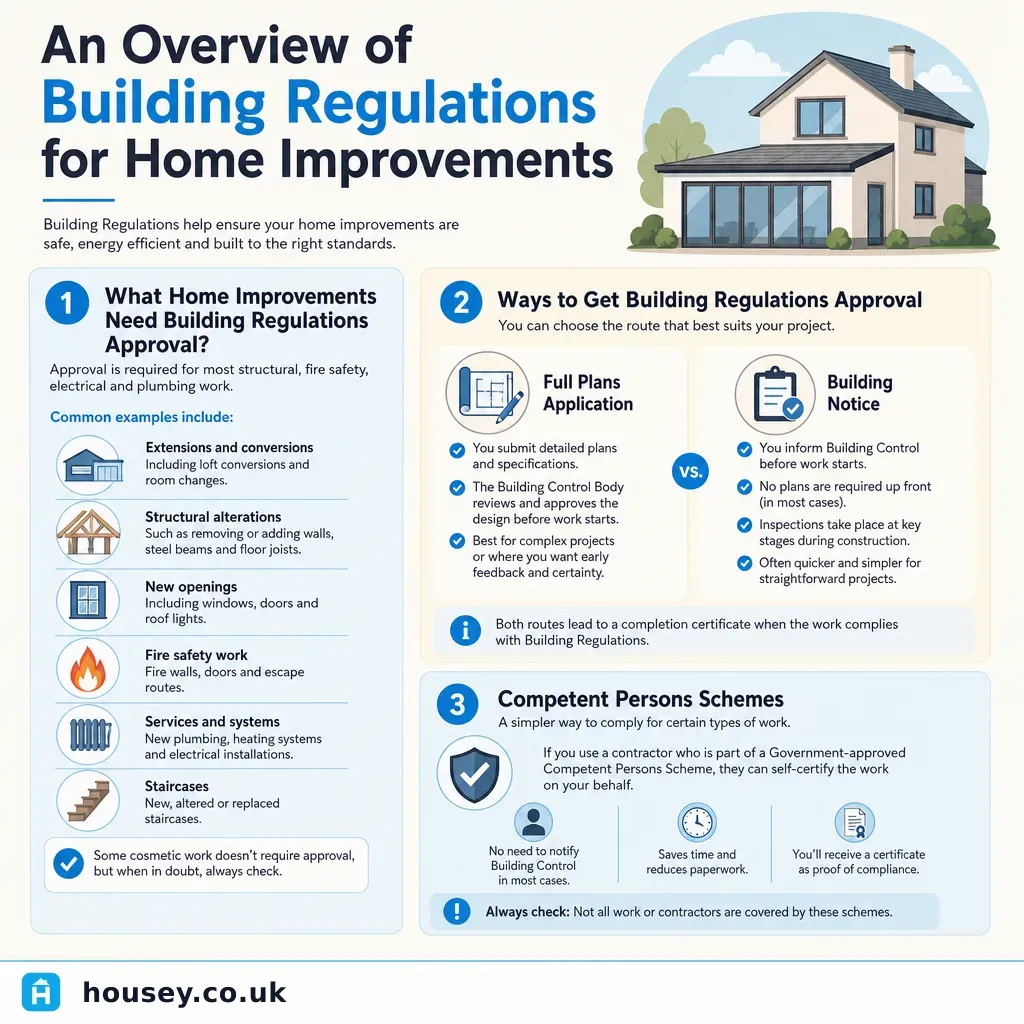
An Overview of Building Regulations for Home Improvements
Building regulations apply to most structural, energy, fire safety, and electrical work in UK homes — but not to like-for-like repairs or maintenance.
 Planning & Pre-Build
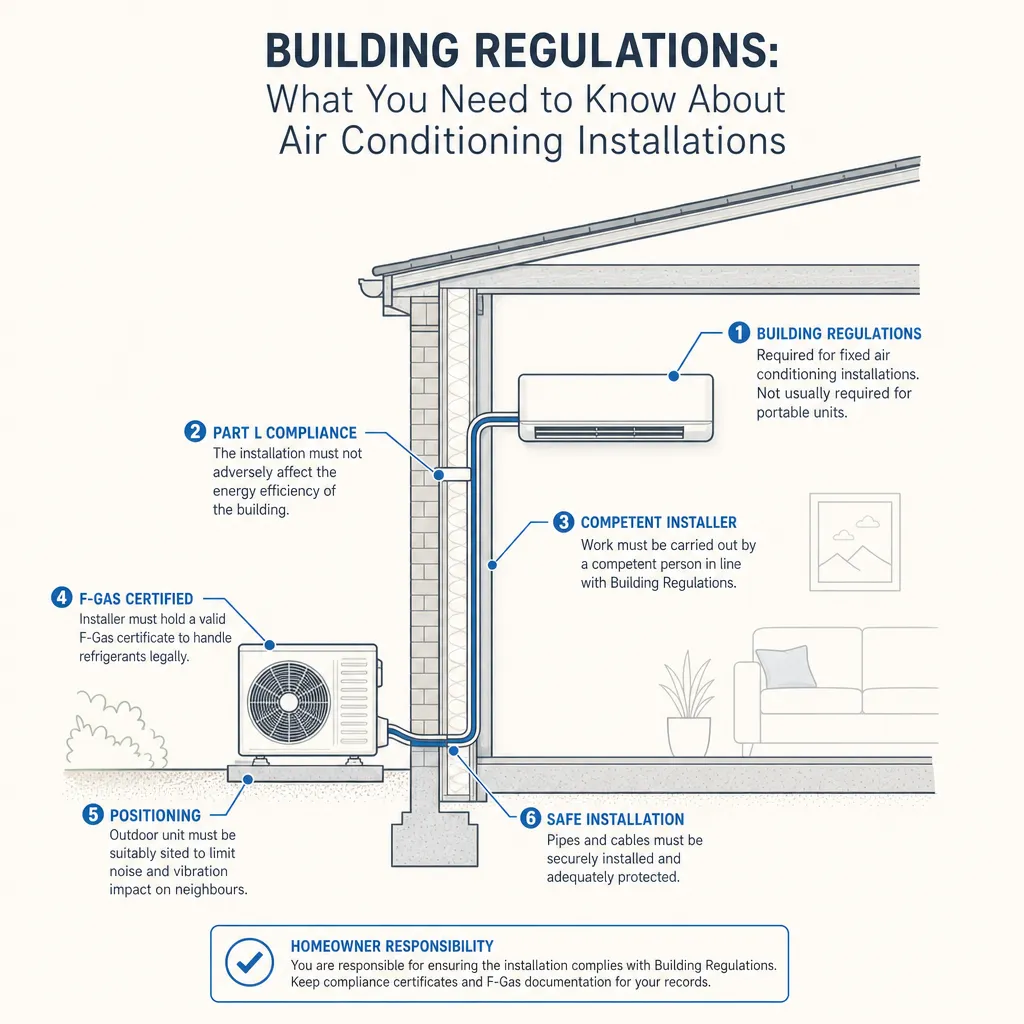
Building Regulations: What You Need to Know About Air Conditioning Installations
Most domestic air conditioning installations in England must comply with Building Regulations Part L (energy efficiency) and Part F (ventilation).
 Planning & Pre-Build
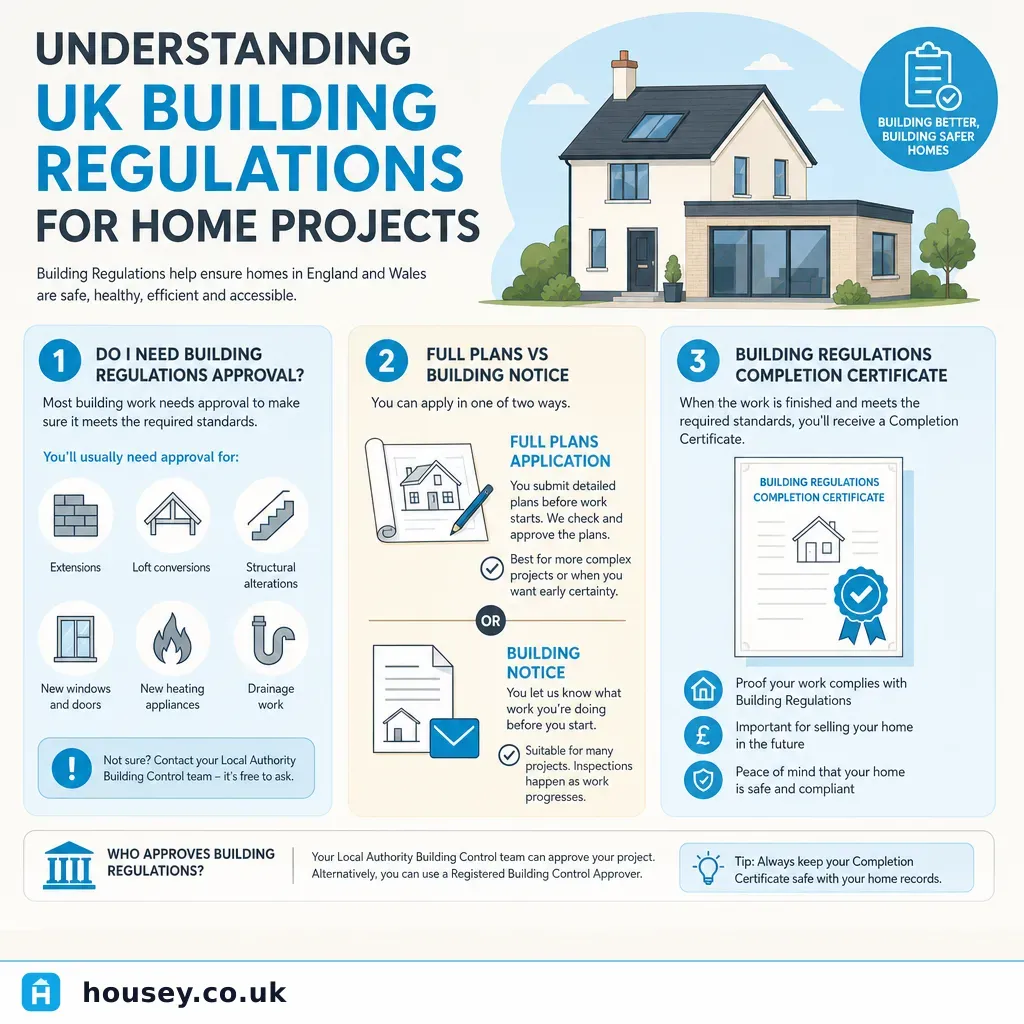
Understanding UK Building Regulations for Home Projects
UK building regulations set minimum construction standards covering structure, fire safety, ventilation, and energy efficiency.