Building Regulations: Requirements, Costs, and Compliance
By Housey · Last reviewed 6th of May 2026
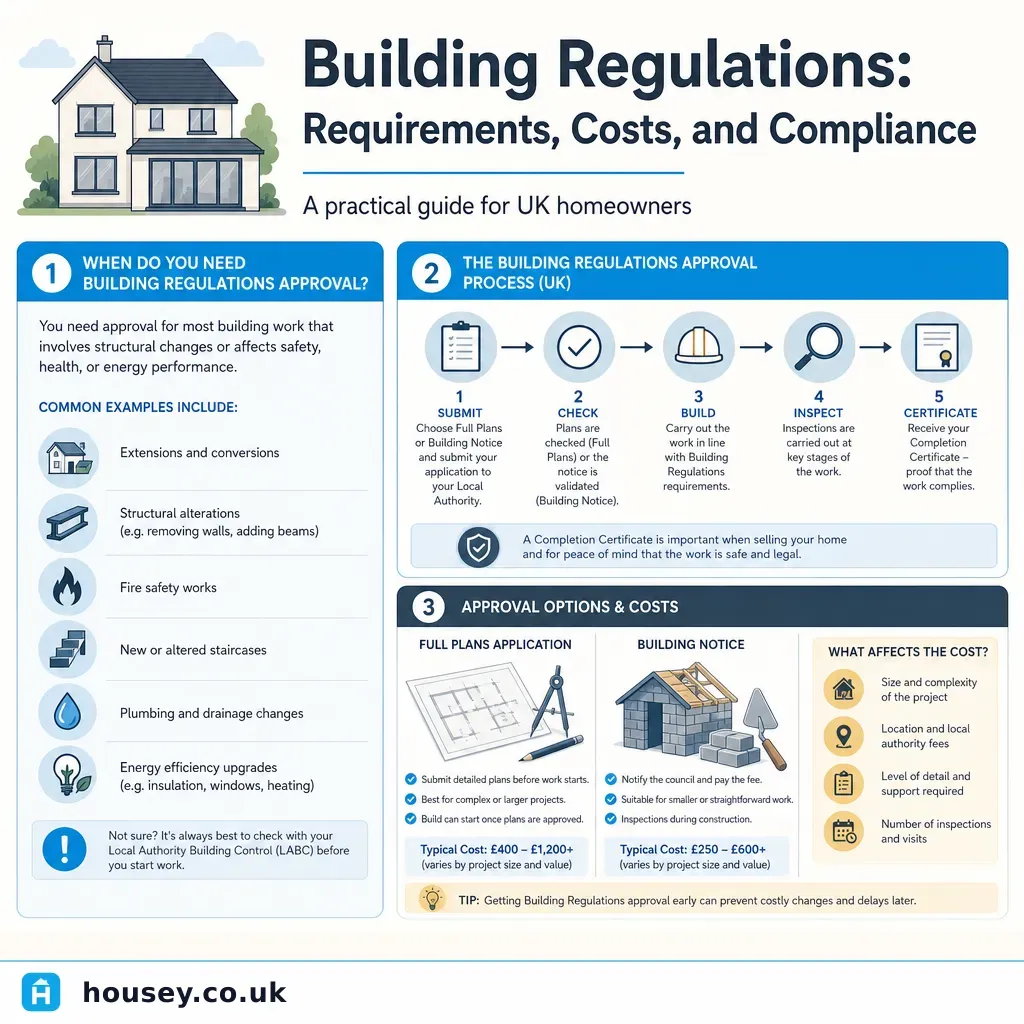
Building Regulations: Requirements, Costs, and Compliance
Building regulations apply to an enormous range of construction and alteration work in the UK, yet many homeowners only encounter them mid-project when a contractor mentions needing approval or a building control officer arrives on site. Understanding when they apply, which route to use, and what inspections to expect helps you plan your project correctly — and avoids the complications that arise when past works have no completion certificate at the point of sale or remortgage.
Key points
- Building regulations are mandatory minimum standards set by the Building Act 1980 and the Building Regulations 2010, covering structural stability, fire safety, energy efficiency, ventilation, drainage, and accessibility.
- There are 18 Approved Documents (Parts A through T, with some letters unused) setting out technical guidance; Part A covers structure, Part B covers fire safety, and Part L covers energy efficiency.
- As of 6 April 2024, all building control work in England must be carried out by a Local Authority Building Control (LABC) body or a Registered Building Control Approver (RBCA) — formerly known as Approved Inspectors — registered with the Building Safety Regulator.
- The Building Safety Act 2022 introduced stricter Gateway approval stages for higher-risk buildings (residential buildings over 18m or 7 storeys with two or more dwellings).
- Carrying out notifiable building work without approval is a criminal offence under the Building Act 1980 and can complicate property sales and remortgaging.
What do building regulations cover?
Building regulations set minimum standards for how construction work is built, separate from planning permission. Planning controls what you build and where; building regulations govern how it must be constructed.
The principal Approved Documents and their topic areas are:
Approved Document | Topic area |
|---|---|
Part A | Structural safety |
Part B | Fire safety |
Part C | Site preparation and resistance to moisture |
Part E | Resistance to sound |
Part F | Ventilation |
Part J | Combustion appliances and fuel storage |
Part K | Protection from falling, collision, and impact |
Part L | Conservation of fuel and power (energy efficiency) |
Part M | Access to and use of buildings |
Part O | Overheating in residential buildings |
Part P | Electrical safety in dwellings |
Part Q | Security in dwellings |
Part S | Infrastructure for electric vehicle charging |
Work requiring building regulations approval includes: extensions of any size, loft conversions, garage conversions to habitable use, new dwellings, structural alterations, new boilers and heating appliances, replacement windows (unless by a FENSA or Certass-registered installer), and most electrical work in kitchens and bathrooms.
When do building regulations apply?
Not all work triggers a building regulations application. Minor repairs, like-for-like replacements, and purely decorative work generally do not.
Decision tree: does your project need building regulations approval?
- No approval needed for: decorative work (painting, tiling, replacing kitchen units in the same position), like-for-like repairs or maintenance, and work explicitly listed as exempt under Schedule 2 of the Building Regulations 2010.
- Approval is needed for: extensions of any size, loft conversions, structural alterations, new load-bearing walls or beams, new or replacement boilers, and electrical work in kitchens and bathrooms.
- Use a competent person scheme if: your installer — Gas Safe boiler engineer, NICEIC electrician, FENSA window fitter — is registered under a government-authorised scheme and can self-certify their specific work without a separate building control application.
- Check with a building control body if: you are unsure whether your project is notifiable; both LABC bodies and RBCAs can advise before work starts.
Full plans, building notice, and regularisation: which route?
There are three main routes for obtaining building regulations approval in England and Wales.
Route | How it works | Best for | Risk |
|---|---|---|---|
Full plans | Detailed drawings submitted before work starts; plans checked and approved; stage inspections during build | Extensions, loft conversions, complex structural work | Lower risk — problems found before building begins |
Building notice | Short notice submitted before work starts; no upfront plan check; site inspections only | Small projects where the builder is confident of compliance | Higher risk — non-compliance found only during or after construction |
Regularisation | Applied for retrospectively after unauthorised work is complete | Legalising past work that proceeded without approval | Most complex — may require opening up finished work; not available for all project types |
For most significant domestic projects — extensions, loft conversions, or structural alterations — the full plans route provides the greatest certainty and reduces the risk of needing to rectify non-compliant work later.
How the building control process works
A typical building regulations process for a domestic extension follows these stages:
- Appoint building control — choose a Local Authority Building Control body or a Registered Building Control Approver.
- Submit the application — for full plans, include drawings, structural calculations, and an application form and fee; for a building notice, a shorter form is submitted.
- Plans checked (full plans route only) — the building control body reviews the submission and issues a notice of approval or requests amendments, usually within five weeks.
- Work starts — the builder notifies building control at key stages before covering up structural work.
- Stage inspections — the building control surveyor visits at commencement, foundations, damp-proof course level, structural frame, drains, insulation, and completion.
- Completion certificate — issued once all inspections pass; solicitors routinely request this document when a property is sold or remortgaged.
Costs of building regulations approval
Fees depend on the type of work, project value, route chosen, and whether you use a local authority or a private RBCA. Fees vary by local authority and are reviewed periodically.
Project type | Typical fee range |
|---|---|
Small domestic extension (under 40m²) | £400–£900 |
Loft conversion | £500–£1,000 |
Garage conversion to habitable use | £250–£600 |
New single dwelling | £900–£2,500+ |
Structural alterations and larger extensions | £700–£1,500 |
Indicative UK costs, last reviewed 2026-05-06. Fees are set individually by each LABC or RBCA and vary across England. Always confirm the current fee schedule before applying. Fees exclude the cost of drawings and structural calculations.
Document and information checklist
Before submitting a full plans building regulations application, you will typically need:
- Site location plan (scale 1:1250 or 1:2500)
- Block plan showing the property and proposed works (scale 1:500 or 1:200)
- Floor plans of existing and proposed layouts
- Elevations and sections where structural changes or new openings are proposed
- Structural calculations for new foundations, beams, roof structures, or load-bearing wall alterations
- A specification describing materials, insulation, and construction methods
- SAP energy calculation for extensions adding habitable floor area (demonstrates Part L compliance)
- Drainage details if new or altered connections are proposed
Important limitations
Building regulations requirements vary by project type, building use, and property history. The Building Safety Act 2022 introduced additional requirements for higher-risk buildings not fully covered here. Rules in Scotland, Wales, and Northern Ireland differ significantly from those in England. This article provides general guidance only and is not a substitute for advice from a qualified building control officer, structural engineer, or architect with knowledge of your specific project.
What to ask a qualified professional
Before appointing a building control body or a professional to prepare drawings:
- What documents and drawings are required for my application, and which specialist calculations are needed?
- Will you provide a schedule of inspections so I can co-ordinate access with my contractor?
- How long does plan checking take, and what happens if the contractor wants to start sooner?
- If using an RBCA, how is responsibility transferred if they become unavailable mid-project?
- What would prevent the completion certificate from being issued, and how are defects resolved?
When to get professional help
Seek professional advice before starting work if:
- You are unsure whether your project is notifiable under the Building Regulations 2010.
- The project involves structural alterations, removal of load-bearing elements, or new structural openings.
- The property is listed, in a conservation area, or falls under the higher-risk building regime (over 18m or 7 storeys with two or more dwellings).
- You are purchasing a property with past building works that have no completion certificate.
- The project involves drainage alterations, new foundations, or underpinning.
How Housey can help
A qualified building control consultant can manage your application, liaise with the building control body, and co-ordinate inspection stages throughout the project. Accurate building regulations drawings prepared by a qualified designer give the building control body everything needed to check the application efficiently and reduce the risk of costly delays. Housey can connect you with qualified professionals in your area.
Frequently asked questions
What is the difference between building regulations and planning permission?
Planning permission controls whether a development is acceptable in planning terms — its location, size, appearance, and use. Building regulations control how the work is built, covering structural safety, fire safety, energy efficiency, and other technical standards. Many projects need both; some need one but not the other. They are administered separately, often by different departments within the same local authority.
What happens if building work is done without building regulations approval?
Carrying out notifiable work without approval is a criminal offence under the Building Act 1980. The local authority may require the work to be opened up for inspection or removed. Practically, missing building regulations certificates frequently cause problems when selling a property, as solicitors request evidence of compliance for all notifiable works carried out since the property was built.
How long is a completion certificate valid?
A completion certificate does not expire, but it covers only the work described in the original application. If further notifiable work is subsequently carried out, a new application and certificate is required for that work. Solicitors may request certificates for all notifiable works since the property was built, so keeping records is important.
Can I use a private building control company instead of the council?
Yes. Registered Building Control Approvers (RBCAs) — formerly known as Approved Inspectors — are private bodies registered with the Building Safety Regulator that can carry out plan checking and inspections. Since 6 April 2024, all RBCAs must be registered. Completion certificates from RBCAs carry the same legal weight as those issued by local authority building control.
Do bathroom renovations need building regulations approval?
Most cosmetic bathroom renovations — replacing a bath, tiles, or sanitary ware in the same position — do not require approval. Electrical work in a bathroom is notifiable under Part P and must be carried out by a registered competent person. Moving drainage, adding an en suite, or making structural alterations does require a building regulations application.
Sources and further reading
- Building regulations approval: overview — GOV.UK
- Approved Documents: Building Regulations technical guidance — GOV.UK
- Building Act 1980 — legislation.gov.uk
- Building Safety Act 2022 — legislation.gov.uk
- Local Authority Building Control (LABC) — LABC
- Find a registered building inspector — GOV.UK / Building Safety Regulator
Useful next reads
 Planning & Pre-Build
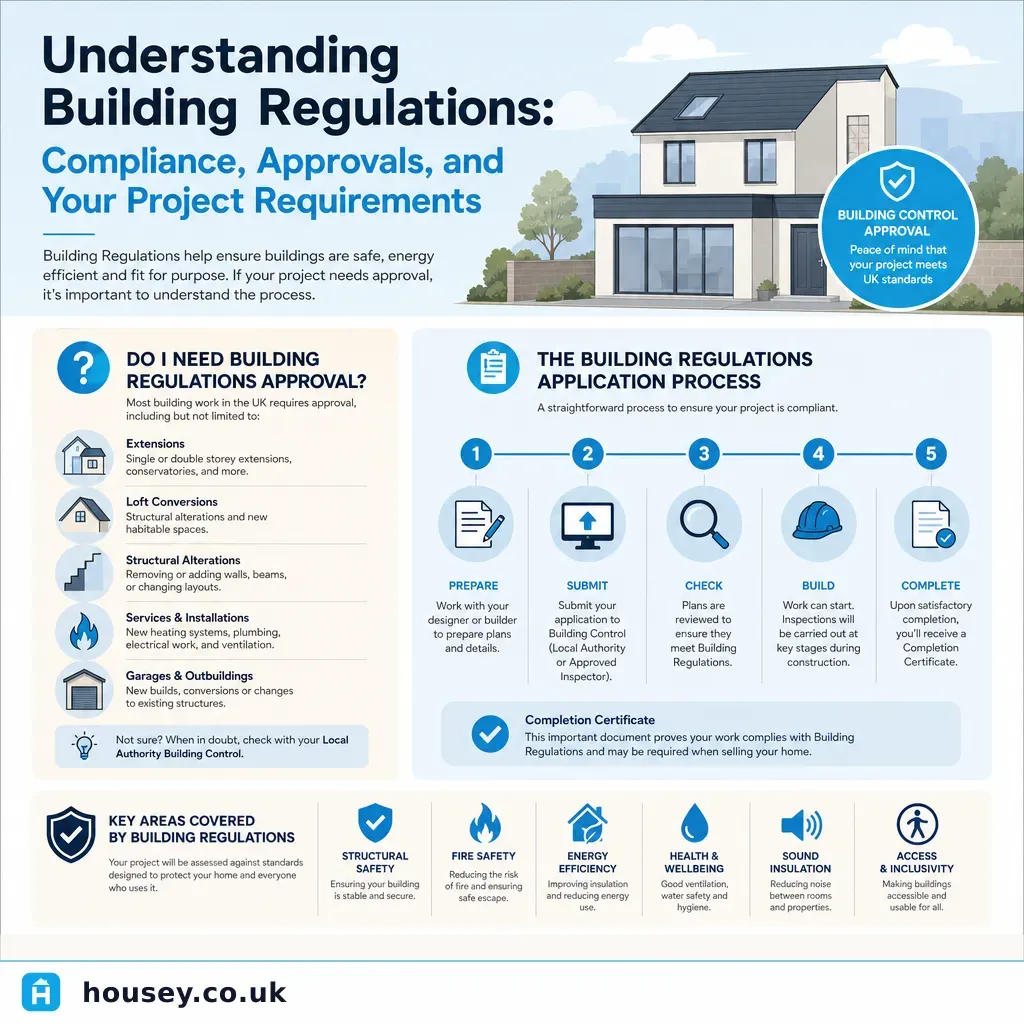
Understanding Building Regulations: Compliance, Approvals, and Your Project Requirements
Building regulations set minimum standards for design, construction, and alterations to buildings in England and Wales.
 Planning & Pre-Build
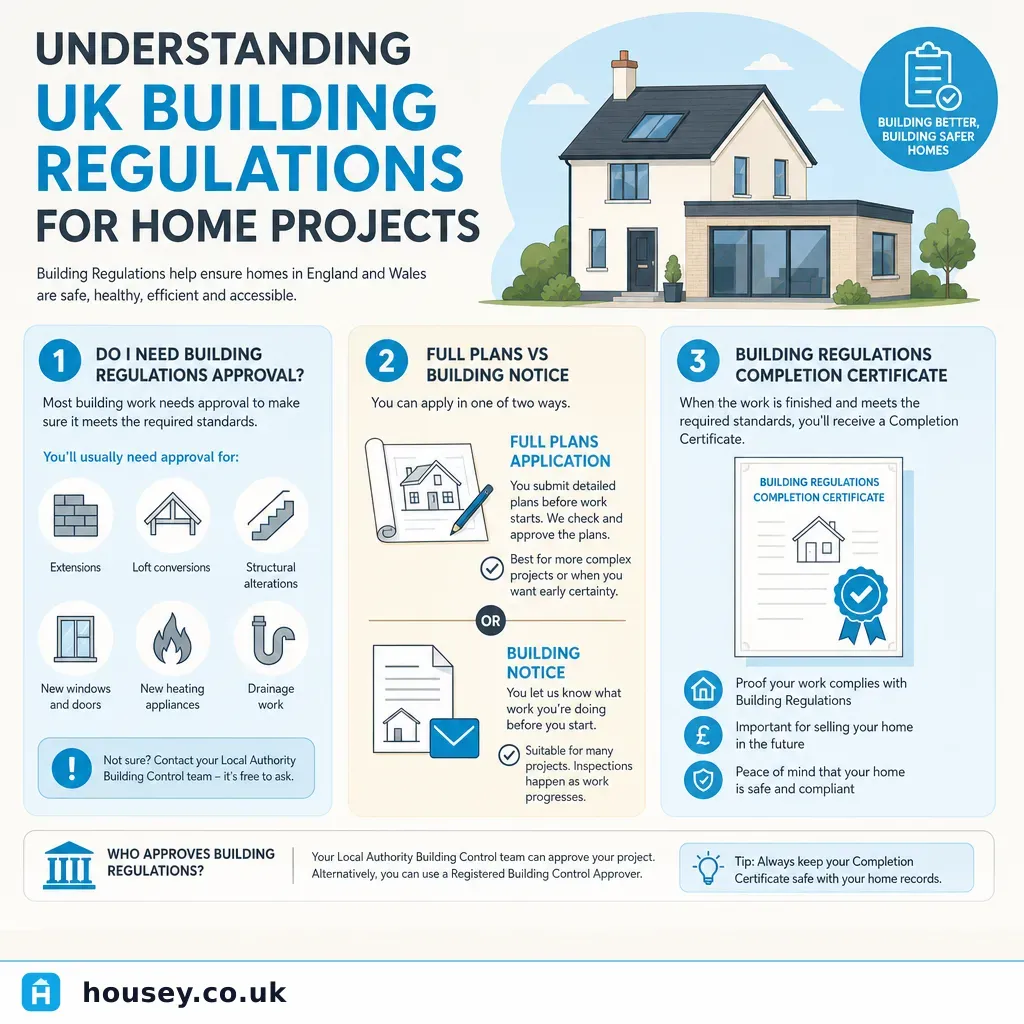
Understanding UK Building Regulations for Home Projects
UK building regulations set minimum construction standards covering structure, fire safety, ventilation, and energy efficiency.
 Planning & Pre-Build
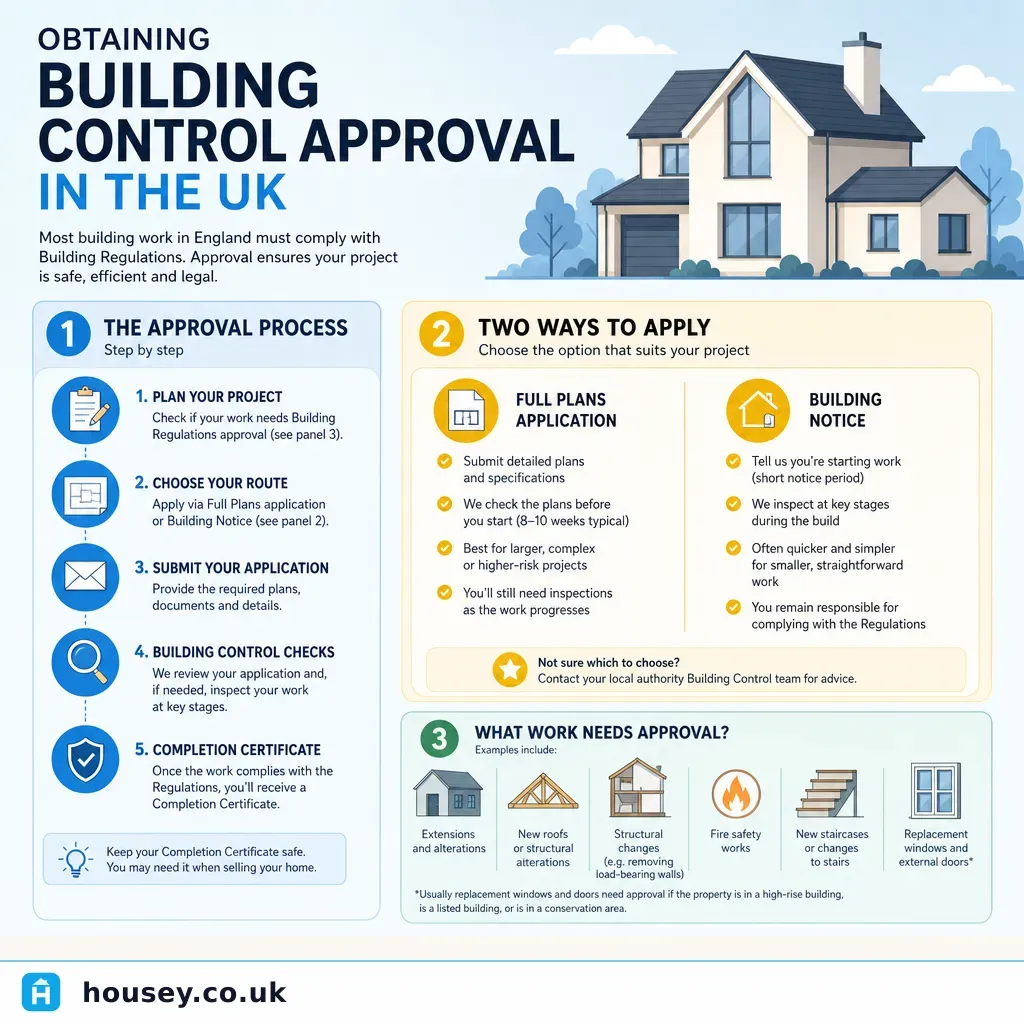
Obtaining Building Control Approval in the UK
Building control approval in the UK is required for most structural changes, extensions, loft conversions, and new builds.
 Planning & Pre-Build
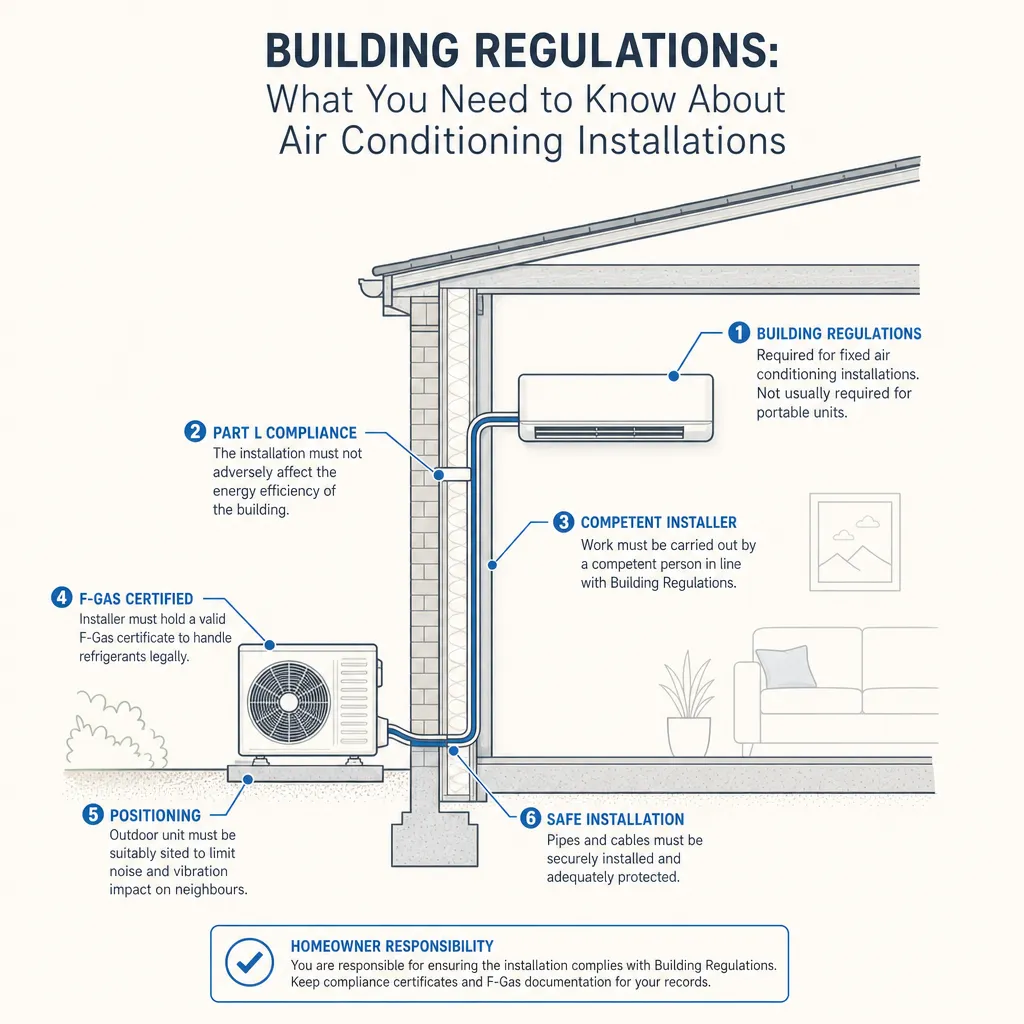
Building Regulations: What You Need to Know About Air Conditioning Installations
Most domestic air conditioning installations in England must comply with Building Regulations Part L (energy efficiency) and Part F (ventilation).
 Planning & Pre-Build
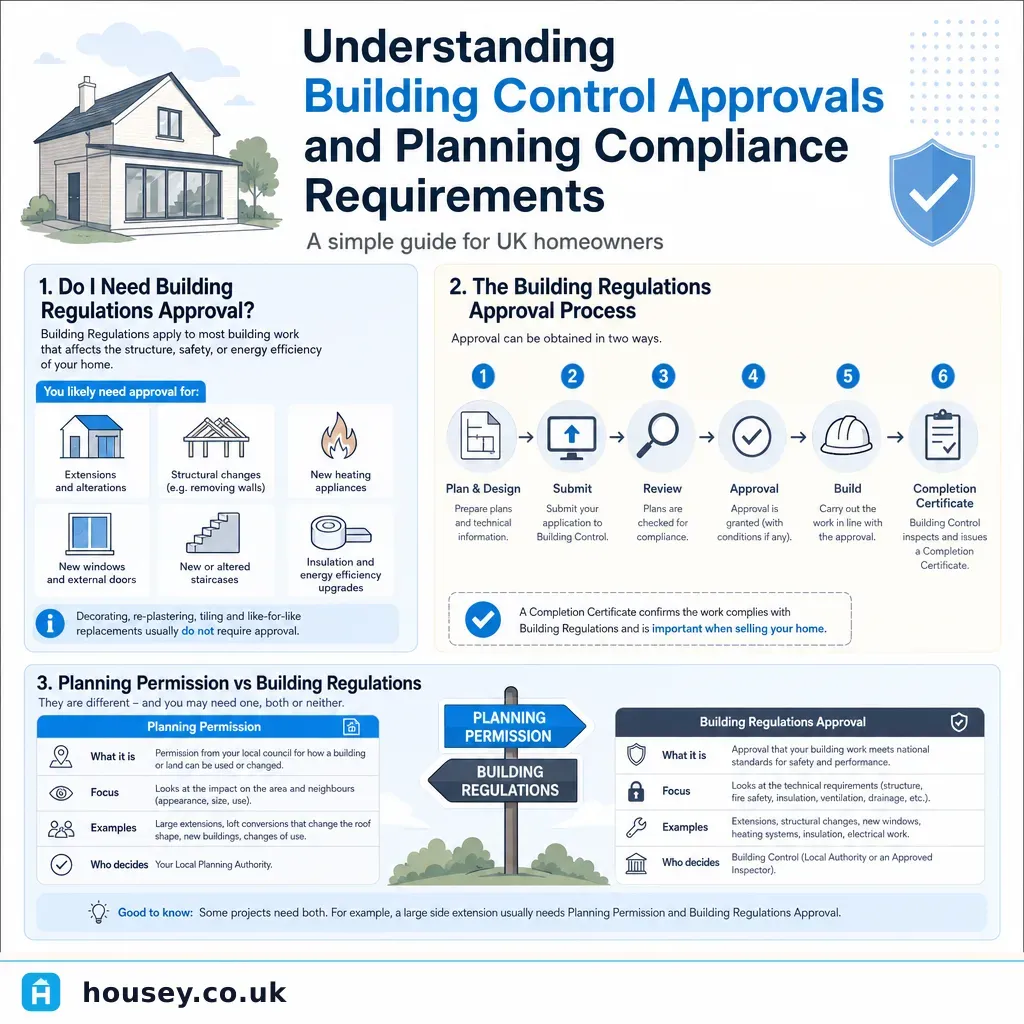
Understanding Building Control Approvals and Planning Compliance Requirements
Planning permission and building regulations are separate consents.