Reinforcement Strategies in Residential Property Construction
By Housey · Last reviewed 25th of May 2026
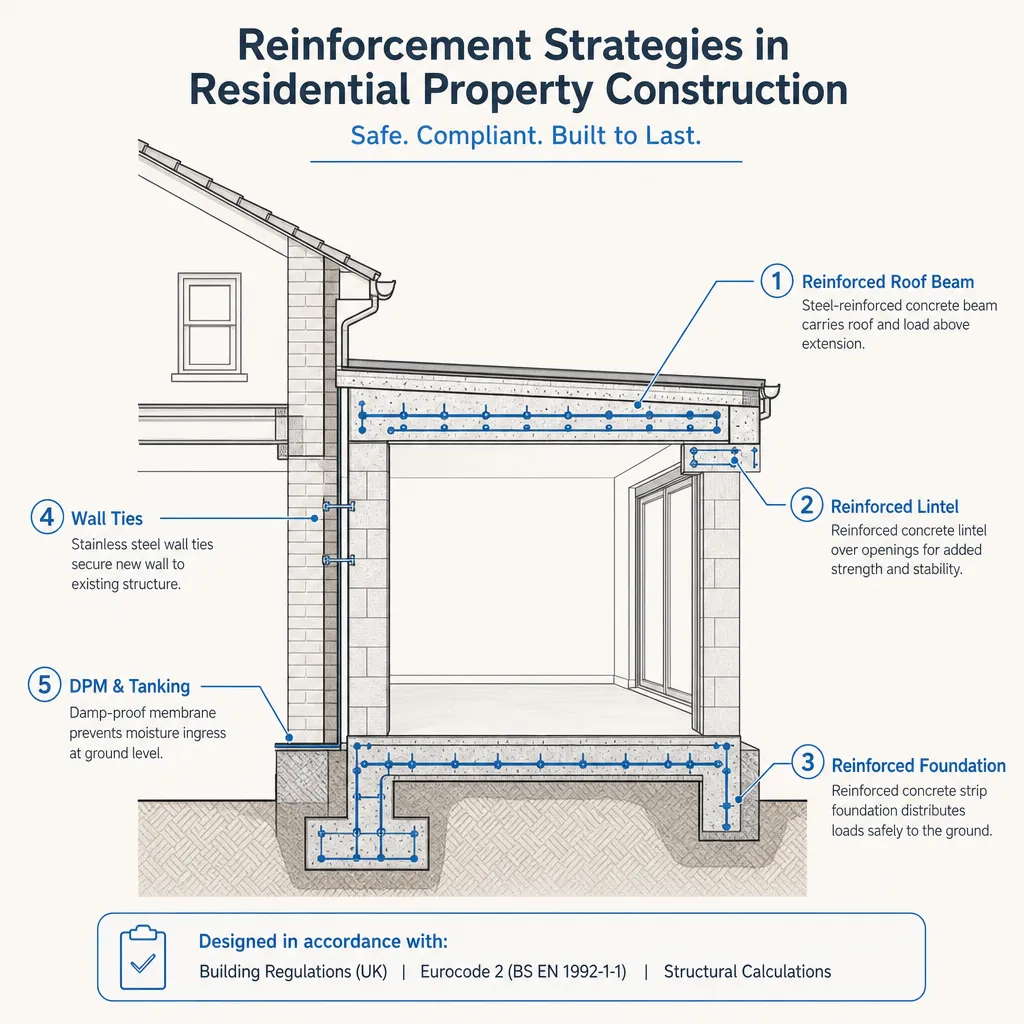
Reinforcement Strategies in Residential Property Construction
Planning a new home, basement conversion, or substantial extension in the UK means engaging with structural decisions that carry long-term safety and legal implications. Reinforcement — the steel embedded in concrete to give it tensile strength — is specified by chartered engineers, inspected by building control, and governed by published standards from the earliest design stage. Getting it wrong is not a cosmetic problem; it can compromise the structural integrity of the entire building.
Key points
- Reinforced concrete design for UK buildings must comply with BS EN 1992-1-1 (Eurocode 2) and its UK National Annex, as referenced in Building Regulations Approved Document A (Structure).
- The most commonly specified reinforcement steel in UK residential work is grade B500B or B500C to BS 4449.
- Minimum concrete cover to reinforcing steel is typically 25 mm to 50 mm depending on the exposure class defined in Eurocode 2 — insufficient cover leads to corrosion and spalling.
- Building Control approval for reinforced structural elements requires structural calculations prepared or checked by a chartered engineer (MIStructE or CEng MICE).
- Reinforcement drawings and specifications form part of the building regulations submission and must be retained as part of the property's legal records.
Why reinforcement matters in residential buildings
Concrete is strong in compression but weak in tension. Without steel reinforcement, foundations, retaining walls, ground-floor slabs, and flat roofs would crack or fail under everyday loads. Reinforcing steel — typically deformed bar (rebar) or welded mesh — works with concrete to resist tensile and shear forces that plain concrete cannot safely carry.
In residential construction, reinforced concrete is used in:
- Strip and trench-fill foundations for load-bearing walls
- Raft foundations on poor or variable ground
- Basement walls and ground-bearing slabs
- Retaining walls for terraced gardens or underpinned extensions
- Flat-roof structures and transfer beams
- Ground-floor slabs where ground conditions require a structural solution rather than a simple ground-bearing slab
The reinforcement strategy for each element depends on the loads it carries, the soil conditions, and the durability requirements established by the structural engineer.
Types of reinforcement used in UK residential projects
Steel rebar (reinforcing bar): The most common form is deformed high-yield steel bar to BS 4449, typically grade B500B (standard ductility) or B500C (high ductility). Bar diameters range from 8 mm to 32 mm in typical residential work, with 10 mm, 12 mm, and 16 mm most common for foundations and slabs.
Welded steel mesh (fabric reinforcement): Prefabricated sheets of welded wire are widely used in ground-bearing slabs. Common designations include A142, A193, A252, and A393 — the number reflects the cross-sectional area of steel per metre width in mm². Engineers specify mesh type based on slab thickness and imposed loading.
Fibre reinforcement: Polypropylene, steel, or glass fibres mixed into the concrete can supplement conventional mesh in some slab applications. This must be specified by a structural engineer — it is not a straightforward like-for-like substitution for standard mesh reinforcement.
Reinforcement specifications and Building Regulations
Building Regulations Approved Document A (Structure) requires all structural elements to resist dead loads, imposed loads, wind loads, and ground movement. For reinforced concrete, this means complying with Eurocode 2 and its UK National Annex.
Practical implications for residential projects:
- A structural engineer must prepare calculations for any reinforced concrete element not covered by the simple prescriptive tables in Approved Document A. Most bespoke residential work falls outside those tables.
- The engineer specifies bar sizes, spacings, laps, bends, and cover — all of which appear on reinforcement drawings submitted to Building Control.
- On site, reinforcement must be placed and tied as specified before concrete is poured. Building Control inspectors check reinforcement in place before casting — missing this inspection may require breaking out the concrete to verify compliance.
Exposure classes and concrete cover
Exposure class | Typical residential context | Minimum cover (indicative) |
|---|---|---|
XC1 — dry or permanently wet | Internal slabs, dry indoor conditions | 25 mm |
XC2 — wet, rarely dry | Foundations in contact with soil | 40 mm |
XC3/XC4 — moderate or cyclic wet-dry | External exposed elements, sheltered structures | 35–45 mm |
XS/XD — chloride exposure | Coastal locations, car park slabs | 45–55 mm |
Cover values are indicative. Engineers specify nominal cover with a construction tolerance allowance, typically +10 mm. Always refer to the engineer's specification for the specific element and site conditions.
Which reinforcement strategy suits your project?
- Choose a raft foundation if ground conditions are weak, variable, or prone to differential settlement — made ground, shrinkable clay, or filled sites benefit from a reinforced raft that distributes loads across a larger area.
- Choose trench-fill with mesh or bar for conventional strip foundations on stable ground — the most common approach for extensions and new-build houses on straightforward sites.
- Specify B500C rather than B500B only where your engineer recommends it for ductility reasons — do not substitute reinforcement grades independently.
- Use fabric mesh (A142 or A193) for domestic ground-bearing slabs in most standard residential situations, and confirm with your engineer before using any alternative reinforcement type.
- Appoint a structural engineer at the earliest design stage if the site has steep slopes, adjacent structures, made ground, a high water table, or any evidence of historic subsidence.
Common misunderstandings about residential reinforcement
"My builder can design the reinforcement." Reinforcement design is a structural engineering task requiring professional calculations and Building Control sign-off. A contractor installs reinforcement to a specification — producing that specification requires a chartered engineer.
"Adding extra steel is always safer." Over-reinforcing can reduce concrete cover, introduce construction errors, and create brittleness at connections. Engineers design for specific loads and conditions — more steel is not automatically better or safer.
"If it has passed building control it must be right." Inspections check visible elements at specific stages. Reinforcement errors concealed before the inspector visits may not be caught. Ensuring that reinforcement matches the approved drawings is the contractor's and engineer's shared responsibility throughout the construction process.
Important limitations
This article provides general information about reinforcement principles and UK standards. Structural design is site-specific, load-specific, and ground-specific. Nothing here constitutes a structural specification or replaces the professional judgement of a chartered structural engineer. Always appoint a qualified engineer for any work requiring reinforced concrete elements, and ensure all structural work is submitted to Building Control.
When to get professional help
Commission a structural engineer at the earliest design stage — ideally before planning permission is granted, so structural constraints can inform the overall design. Seek professional advice immediately if:
- Ground investigation reveals filled ground, soft spots, or a high water table
- The site is on or near a slope, or within the influence zone of adjacent structures
- You are proposing a basement, underpinning, or other below-ground element
- Any existing cracking, settlement, or ground movement is visible on or near the site
- Building Control raises queries about structural details during the application process
What to ask a qualified professional
Before appointing a structural engineer for a reinforced concrete project:
- Are you a chartered member of the Institution of Structural Engineers (MIStructE) or a CEng member of the Institution of Civil Engineers (ICE)?
- Will you provide structural calculations and reinforcement drawings suitable for Building Control submission?
- What ground investigation data do you need before finalising the design?
- Will you carry out a site inspection to check reinforcement placement before concrete is poured?
- What concrete specification will you include, and will you liaise directly with the concrete supplier?
- Who is responsible for checking that as-built reinforcement matches the approved drawings?
How Housey can help
Housey connects you with vetted structural engineering practices who can prepare calculations, reinforcement drawings, and site inspection services for residential projects. If your project also requires drawings for a full building regulations submission, Housey can match you with professionals covering both.
Frequently asked questions
Do I need a structural engineer for a house extension?
Most extensions involving reinforced concrete foundations, retaining walls, or beams require structural calculations from a chartered engineer for Building Control approval. Straightforward extensions on stable ground may use prescriptive Approved Document A tables, but unusual ground conditions or non-standard structural elements will generally require a chartered engineer's input.
How do I know if the correct reinforcement was installed?
Your structural engineer should carry out at least one site inspection before concrete is poured. Building Control will also inspect at key stages. Ask your contractor for dated photographic records of the reinforcement in place before casting, and check these against the approved reinforcement drawings.
What happens if reinforcement cover is too small?
Insufficient cover allows moisture and chlorides to reach the steel, causing corrosion. Corroding steel expands, cracking and spalling the surrounding concrete — a defect that is expensive to remediate and can compromise structural integrity. Correct cover is maintained using plastic spacers fixed to the reinforcement cage during construction.
What is the difference between B500B and B500C reinforcement steel?
Both are high-yield steel grades to BS 4449. B500C has higher ductility — its characteristic strain at maximum force is at least 7.5%, versus at least 5% for B500B — making it more resistant to sudden fracture under extreme loading. Most UK residential work uses B500B, but an engineer may specify B500C for specific elements or locations.
Sources and further reading
- Approved Document A — Structure — HM Government
- BS EN 1992-1-1 (Eurocode 2) — Design of Concrete Structures — BSI (British Standards Institution)
- Institution of Structural Engineers — IStructE
- Building regulations approval — GOV.UK
Useful next reads
 Planning & Pre-Build
Building Climate-Resilient Homes: Design and Energy Strategies
A climate-resilient UK home handles hotter summers, wetter winters, and rising energy costs through high-performance insulation, overheating mitigation, flood-resilient construction, low-carbon heating, and good water management.
 Planning & Pre-Build
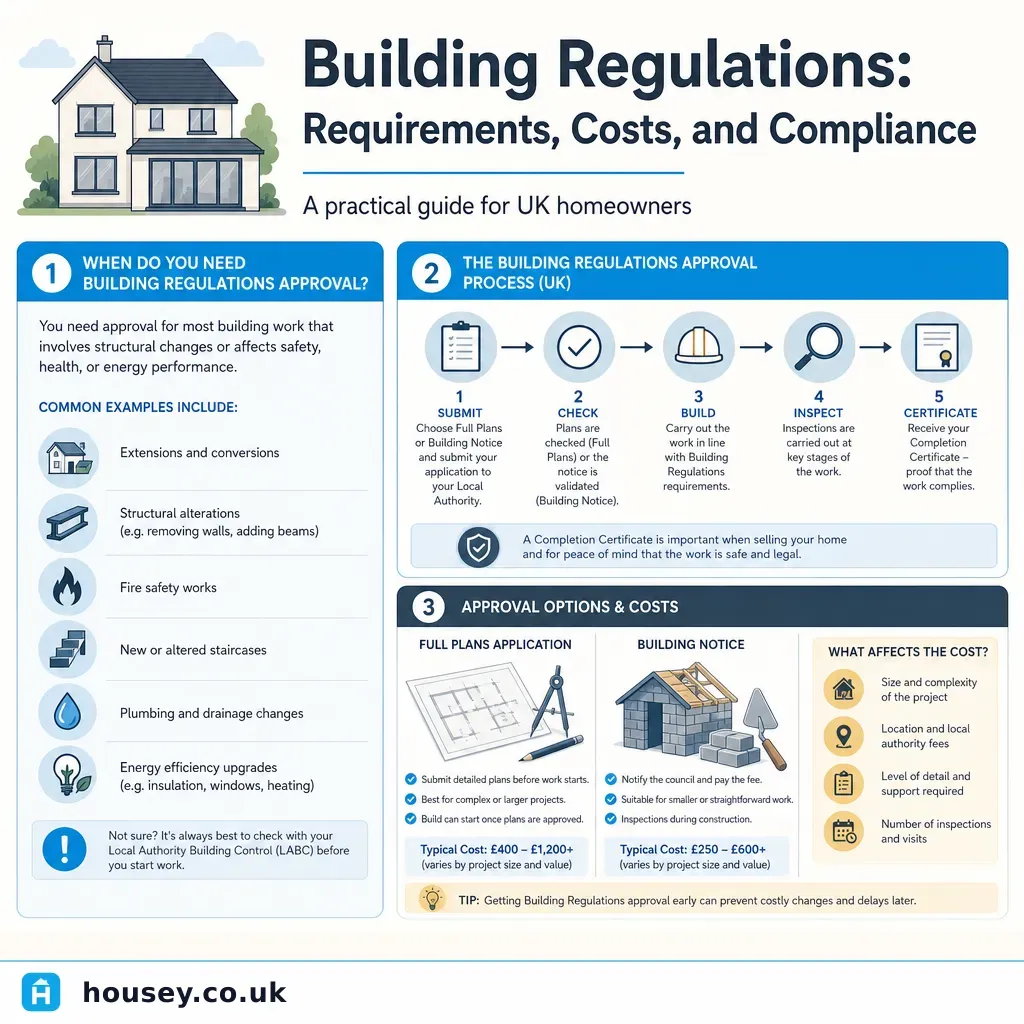
Building Regulations: Requirements, Costs, and Compliance
Building regulations set minimum standards for how construction work is carried out in the UK, covering structural stability, fire safety, energy efficiency, and ventilation.
 Planning & Pre-Build
Architectural Design Services for Home Extensions and Renovations
Architectural design services for UK extensions and renovations span initial feasibility, planning drawings, building regulations packages, and site monitoring.
 Planning & Pre-Build
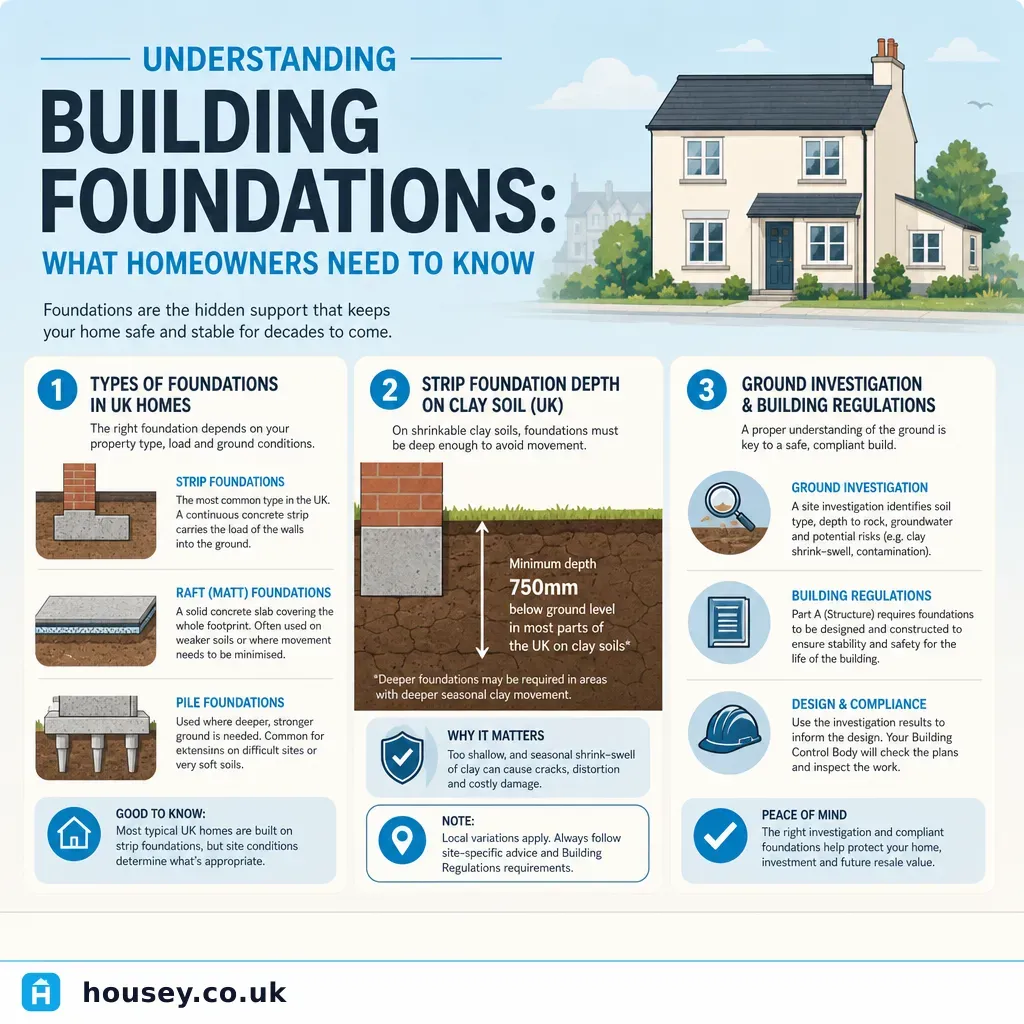
Understanding building foundations: what homeowners need to know
Building foundations transfer a structure's load safely to the ground beneath it.
 Planning & Pre-Build
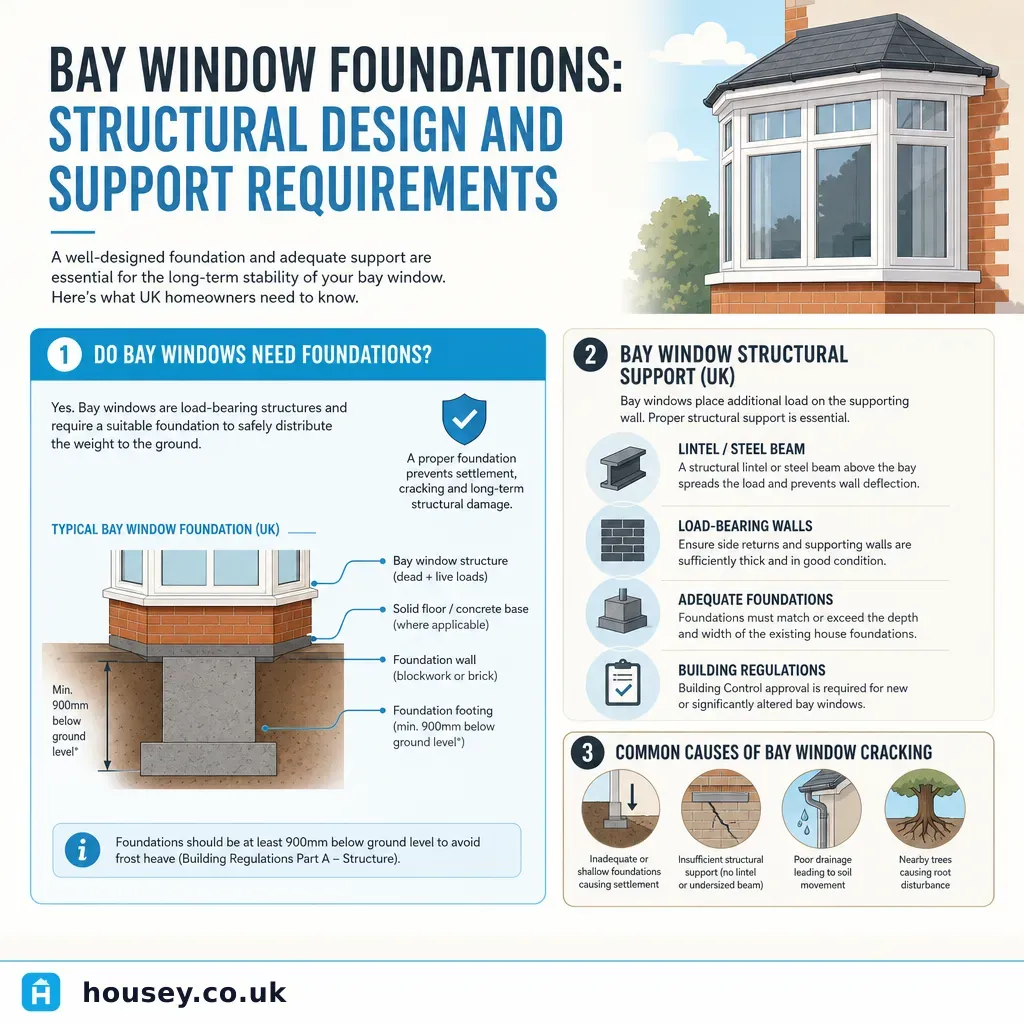
Bay Window Foundations: Structural Design and Support Requirements
Bay window foundations must transfer the bay's structural load to the ground independently of the main wall.