Building Regulations for Home Projects: Compliance and Requirements
By Housey · Last reviewed 25th of May 2026
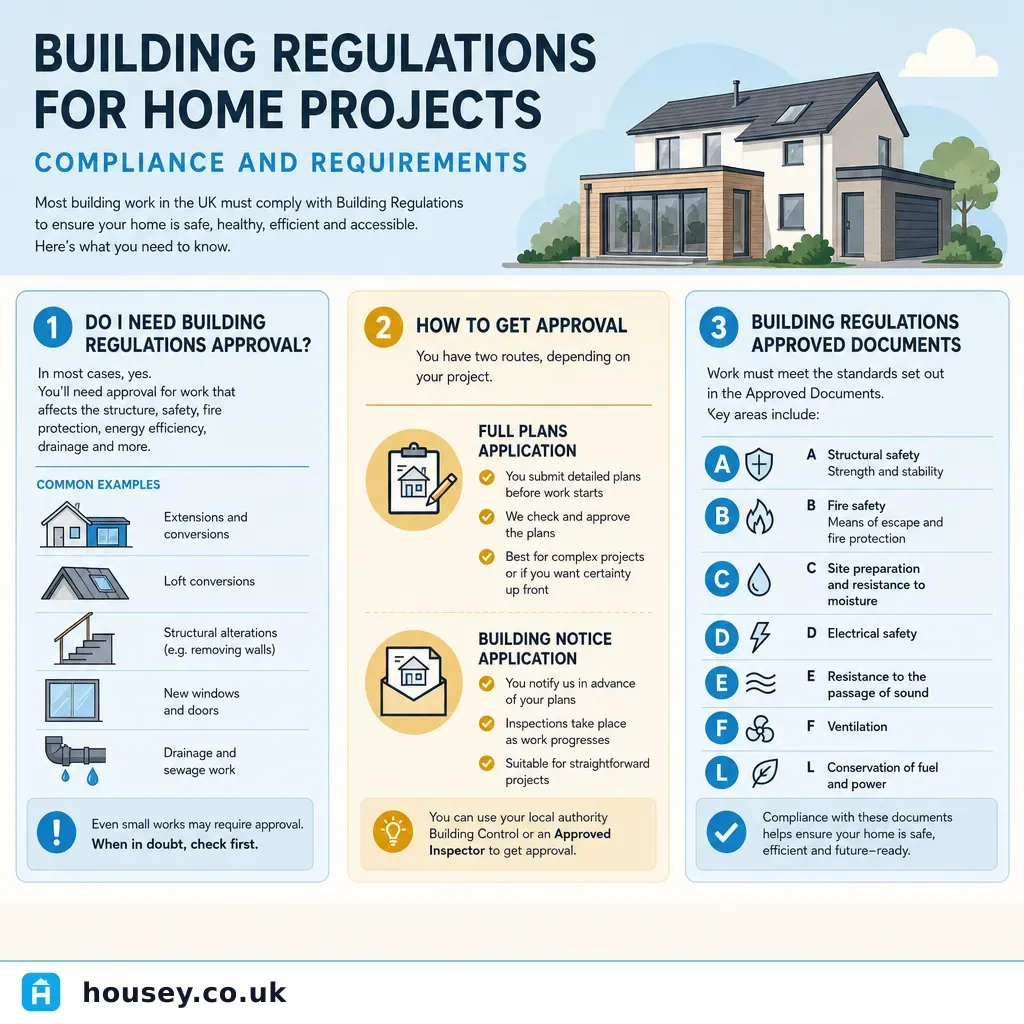
Building Regulations for Home Projects: Compliance and Requirements
Building regulations touch almost every significant home improvement project in England and Wales, from rear extensions and loft conversions to replacement boilers and new electrical circuits. Understanding when approval is required — and what the process involves — helps homeowners avoid enforcement action, sale delays, and costly remediation work that can arise when projects are completed without the necessary sign-off.
Key points
- Building Regulations in England and Wales are made under the Building Act 1984 and the Building Regulations 2010 (as amended), covering structural integrity, fire safety, energy efficiency, drainage, ventilation, and more.
- Two main approval routes exist: Full Plans (detailed drawings submitted before work starts, preferred for complex projects) and Building Notice (informal notification before work begins, no drawings required upfront).
- The 2021 amendments to Part L (Conservation of Fuel and Power) tightened energy-efficiency requirements for extensions in England, setting maximum U-values of 0.18 W/m²K for new walls and 0.15 W/m²K for new roofs.
- Competent Person Schemes — including FENSA (replacement glazing), Gas Safe (gas appliances), and NICEIC or NAPIT (electrical work) — allow registered contractors to self-certify compliance without a separate local authority notification.
- Building regulations approval is entirely separate from planning permission: a project may need one, both, or neither — and having one does not imply the other.
Which home projects need building regulations approval?
Most structural, safety-critical, or energy-related work requires approval under the Building Regulations 2010. Common projects that typically need building regulations sign-off include:
- Loft conversions and dormer additions
- Single-storey and two-storey rear or side extensions
- Garage conversions to habitable space
- Internal structural alterations, including removing or altering load-bearing walls
- New or replacement heating systems (gas boilers, heat pumps)
- New electrical circuits or consumer unit replacements
- Underpinning or significant foundation work
- New bathrooms or en-suites involving drainage alterations
Some projects are exempt from building regulations. Small porches under 30 m², conservatories with a permanent thermal separation from the main house, and certain agricultural buildings may not require approval. GOV.UK maintains an exemptions list, but if you are uncertain, contact your local authority building control (LABC) before starting work. Assumptions about exemption that turn out to be incorrect can create complications at resale.
The two main approval routes
Route | How it works | Best for | Key consideration |
|---|---|---|---|
Full Plans | Detailed drawings and specification submitted before work begins; approval usually within 5 weeks (up to 8 weeks by agreement) | Extensions, loft conversions, structural alterations | Provides documented approval; lenders and solicitors generally prefer this route |
Building Notice | Written notice given to LABC before work starts; no drawings submitted in advance; inspector visits during the work | Simpler projects; Competent Person Scheme works | No approved drawings; potential for disputes if work needs altering mid-build |
Regularisation | Retrospective application for work already carried out without approval (England and Wales only) | Purchasing a property with historic unpermitted works | Inspector may require opening up fabric; approval is not guaranteed |
Building control is delivered by either your local authority building control (LABC) or a registered approved inspector — a private sector body regulated by the Building Safety Regulator since the Building Safety Act 2022. Both routes are legally valid, though some mortgage lenders and solicitors prefer LABC completion certificates.
Approved Documents: what they cover
Building Regulations are supported by a series of Approved Documents (Parts A to S), each addressing a specific area:
- Part A — Structure
- Part B — Fire safety in dwellings
- Part F — Ventilation
- Part J — Combustion appliances and fuel-storage systems
- Part L — Conservation of fuel and power
- Part M — Access and facilities for disabled people
- Part P — Electrical safety in dwellings
- Part S — Infrastructure for the charging of electric vehicles
Compliance with Approved Documents provides a safe harbour — it is not the only way to meet the regulations, but it is the most straightforward to evidence to a building control body.
Competent Person Schemes: self-certification without a separate application
Where a registered contractor carries out certain types of work, they can self-certify compliance and notify the local authority on your behalf:
- FENSA or CERTASS — replacement windows, doors, and rooflights
- Gas Safe Register — gas appliances, boilers, and pipework
- NICEIC or NAPIT — electrical installation work in dwellings
- HETAS — solid fuel heating appliances
- MCS (Microgeneration Certification Scheme) — solar panels and heat pumps
After completion, the contractor issues a certificate that should be kept with your property documents. These certificates are routinely requested during conveyancing and by mortgage lenders.
Decision tree: do you need building regulations approval?
- Is the work structural? (extensions, loft conversions, removing load-bearing walls) — Building regulations approval is almost certainly required.
- Does the work involve gas, electrical, or heating systems? — Either a Competent Person Scheme registration or building regulations approval is required.
- Is it a small, non-structural addition? (e.g., a small porch under 30 m², a conservatory with a permanent thermal separation) — Check the GOV.UK exemptions list before proceeding; do not assume exemption applies.
- Is the property listed? — Contact your LABC and local planning authority: listed building consent may be needed in addition to building regulations approval.
- Are you unsure? — Ask your LABC or an approved inspector before starting work. Pre-application advice is usually free or low-cost and avoids costly errors later.
Important limitations
This article provides general information about building regulations in England and Wales under the Building Regulations 2010. Scotland applies different legislation — the Building (Scotland) Act 2003 and associated Scottish Building Standards — as does Northern Ireland under the Building Regulations (Northern Ireland) 2012. Specific technical requirements depend on the property type, construction method, location, and the scope of the works proposed. Always confirm requirements with your LABC or a qualified professional before committing to a design or instructing contractors.
When to get professional help
Seek advice from an architect, structural engineer, or building control professional if:
- The project involves removing or altering any load-bearing element
- Work has already been carried out without building regulations approval and you need to sell, remortgage, or investigate regularisation
- You are unsure whether a claimed exemption genuinely applies
- The project touches multiple Approved Document areas simultaneously (e.g., a loft conversion involving structure, fire safety, insulation, and ventilation)
- A contractor proposes to self-certify but cannot confirm their registration with the relevant Competent Person Scheme
What to ask a qualified professional
Before instructing a building control body or a contractor:
- Is this project exempt from building regulations, or does it require approval?
- Which approval route — Full Plans or Building Notice — is more appropriate for the scope of work?
- Which Approved Documents apply, and are there any specific local or site constraints?
- If previous work was done without approval, can regularisation be achieved and what does the process involve?
- Will you provide a completion certificate or final certificate on sign-off?
- Are you a local authority building control body or an approved inspector registered with the Building Safety Regulator?
How Housey can help
If you are planning a home project and need guidance on compliance, Housey connects you with building control consultants who can advise on approval routes, check your proposals against the relevant Approved Documents, and manage the sign-off process from start to finish. For projects where planning permission may also be required, our planning consultancy service can help you navigate both regimes together.
Frequently asked questions
Do I need building regulations approval for a loft conversion?
Yes, in almost all cases. A loft conversion creates new habitable space and typically involves structural alterations, new floor joists, fire escape routes, and insulation — all areas covered by the Building Regulations 2010. A building control body will need to inspect the work at key stages and issue a completion certificate when satisfied.
What happens if I sell a property where building work was done without approval?
A buyer's solicitor will usually request evidence of building regulations sign-off. If none exists, you may need retrospective approval through regularisation, or indemnity insurance. Indemnity insurance covers the buyer against enforcement action but does not certify the work is safe — it is a legal workaround, not a substitute for proper sign-off.
How long does building regulations approval take?
For a Full Plans application, local authorities aim to respond within five weeks, or eight weeks if both parties agree. The inspection process continues throughout the build, and a completion certificate is issued after a final inspection — which may take several weeks after practical completion.
What is a completion certificate and why does it matter?
A completion certificate confirms that the work was inspected and complied with building regulations at the time of construction. Solicitors request it during conveyancing; some mortgage lenders also require it. Keeping it with your property documents avoids complications when you later sell or remortgage.
Sources and further reading
- Building Regulations approval guidance — GOV.UK
- The Building Regulations 2010 — legislation.gov.uk
- Approved Documents (Parts A to S) — Ministry of Housing, Communities & Local Government
- Competent Person Schemes — GOV.UK
- Local Authority Building Control — LABC
Useful next reads
 Planning & Pre-Build
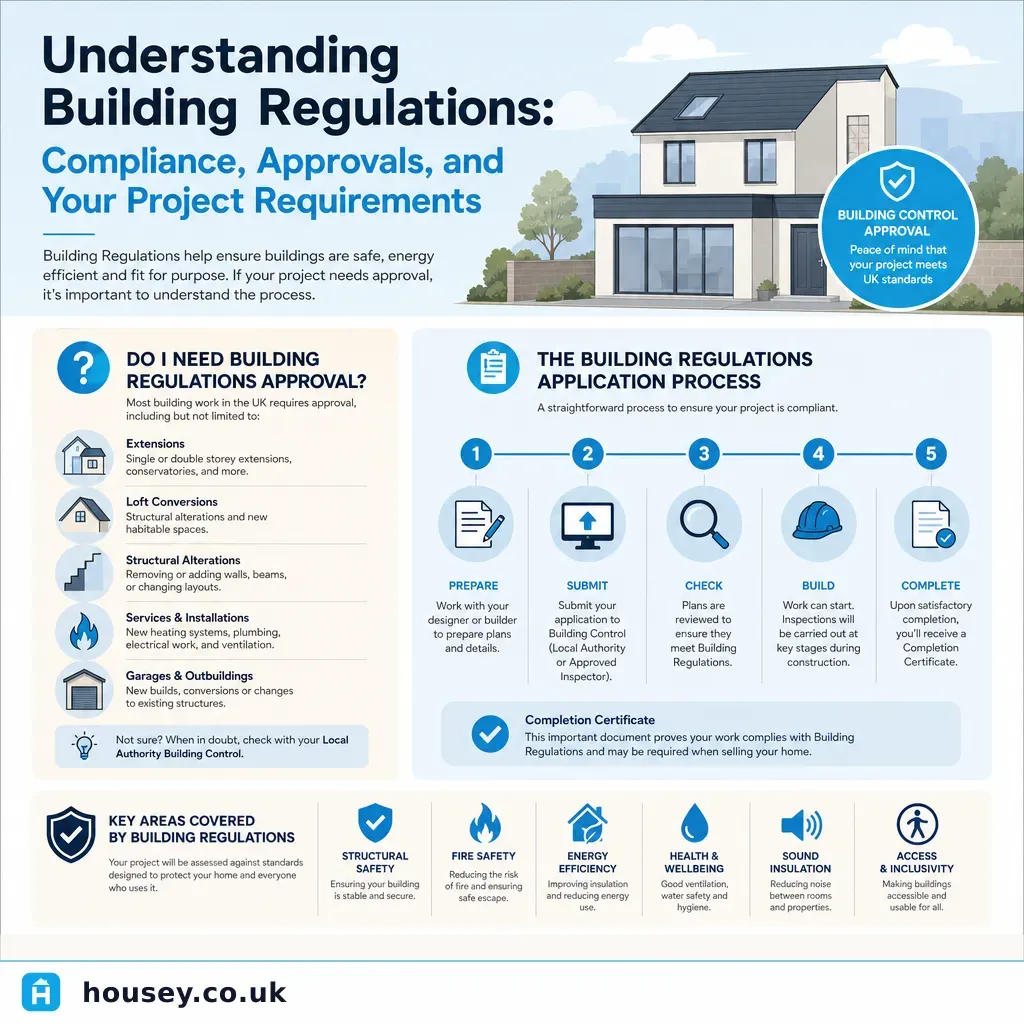
Understanding Building Regulations: Compliance, Approvals, and Your Project Requirements
Building regulations set minimum standards for design, construction, and alterations to buildings in England and Wales.
 Planning & Pre-Build
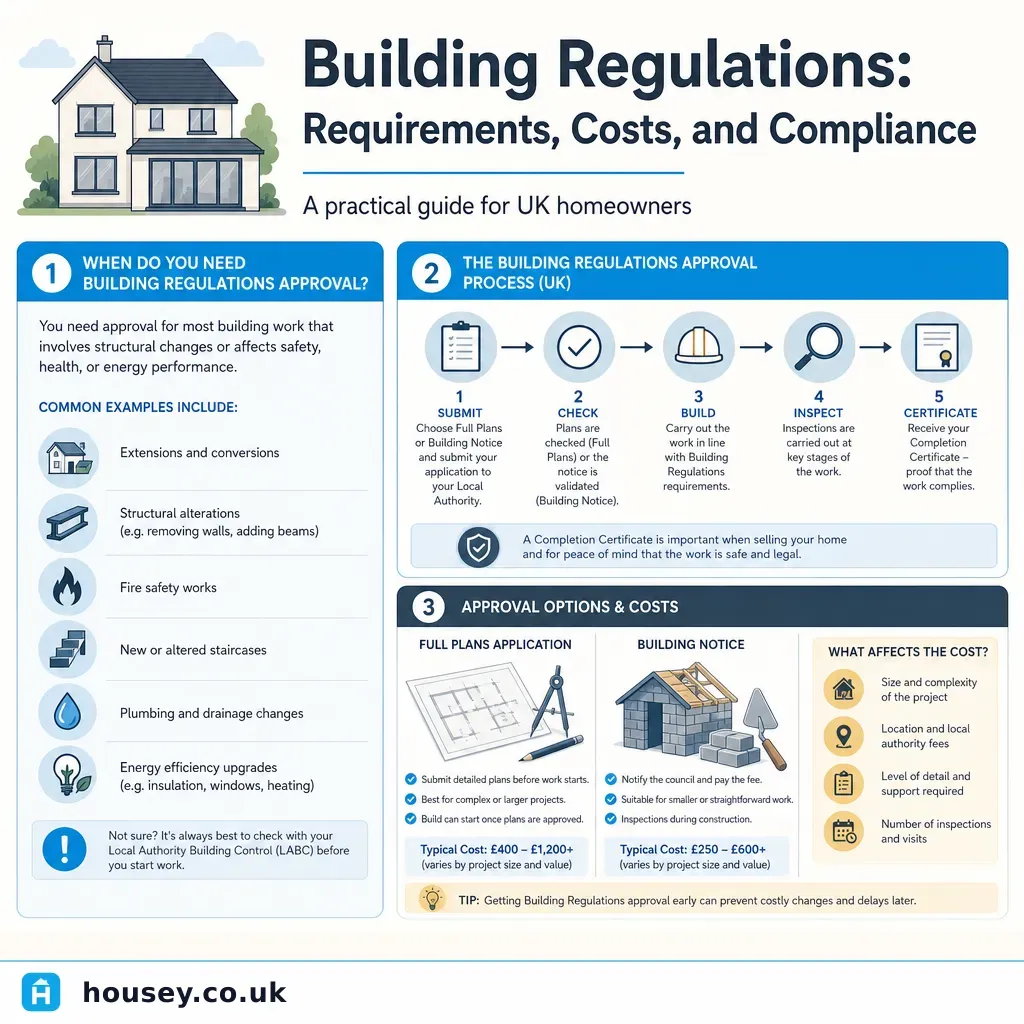
Building Regulations: Requirements, Costs, and Compliance
Building regulations set minimum standards for how construction work is carried out in the UK, covering structural stability, fire safety, energy efficiency, and ventilation.
 Planning & Pre-Build
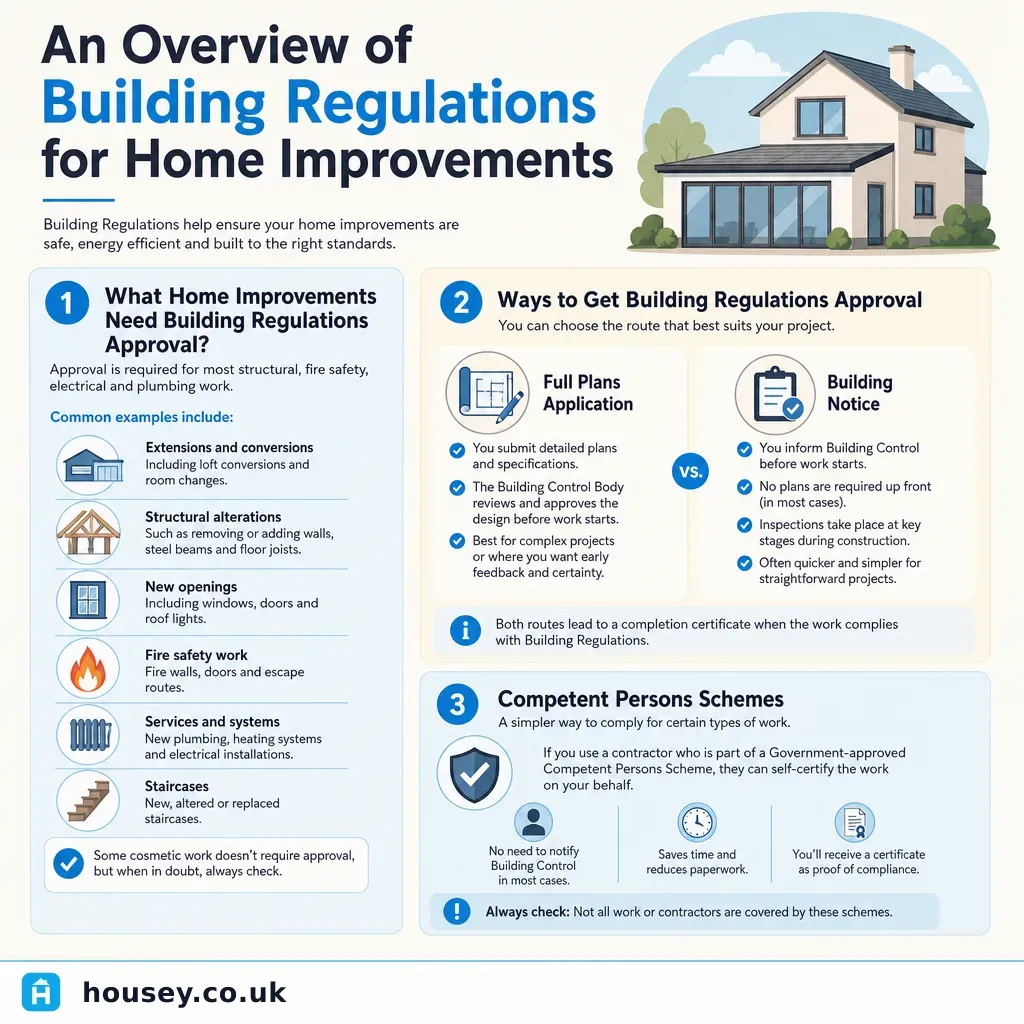
An Overview of Building Regulations for Home Improvements
Building regulations apply to most structural, energy, fire safety, and electrical work in UK homes — but not to like-for-like repairs or maintenance.
 Planning & Pre-Build
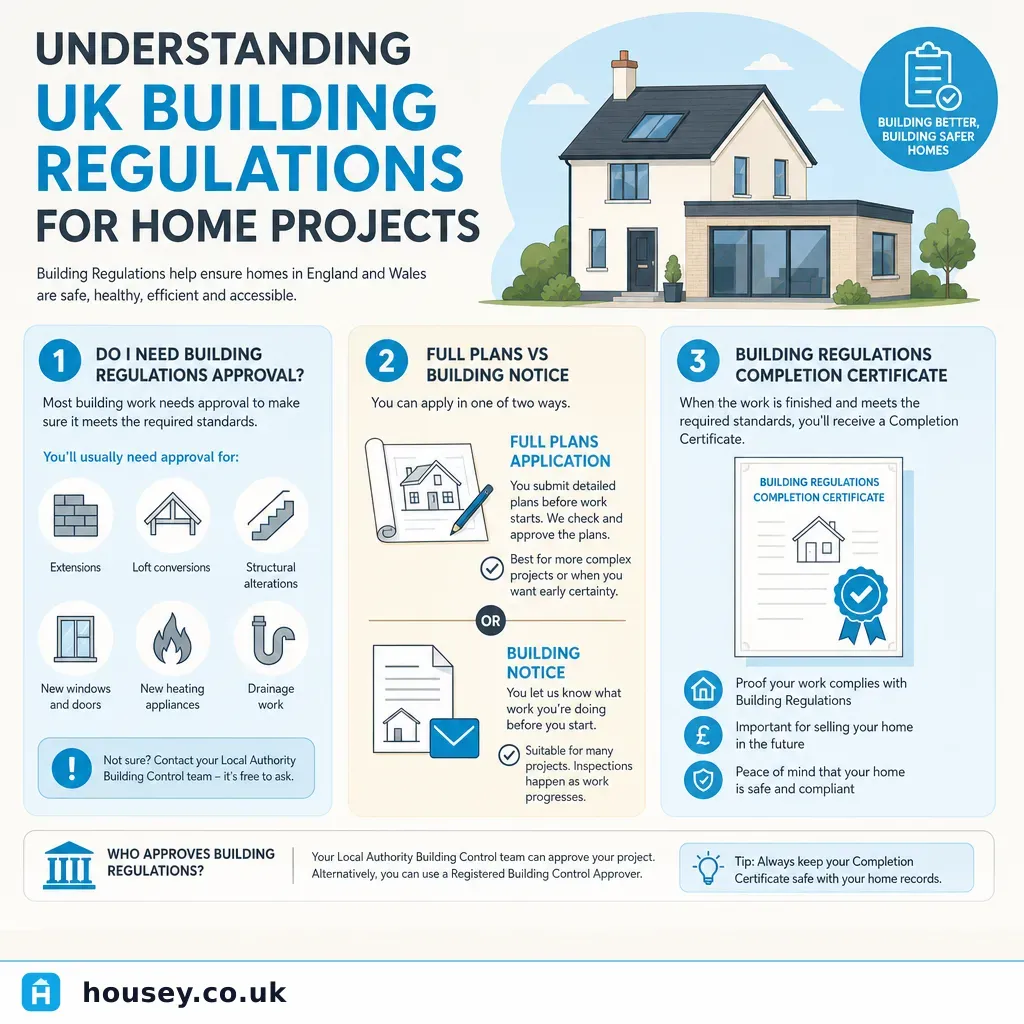
Understanding UK Building Regulations for Home Projects
UK building regulations set minimum construction standards covering structure, fire safety, ventilation, and energy efficiency.
 Planning & Pre-Build
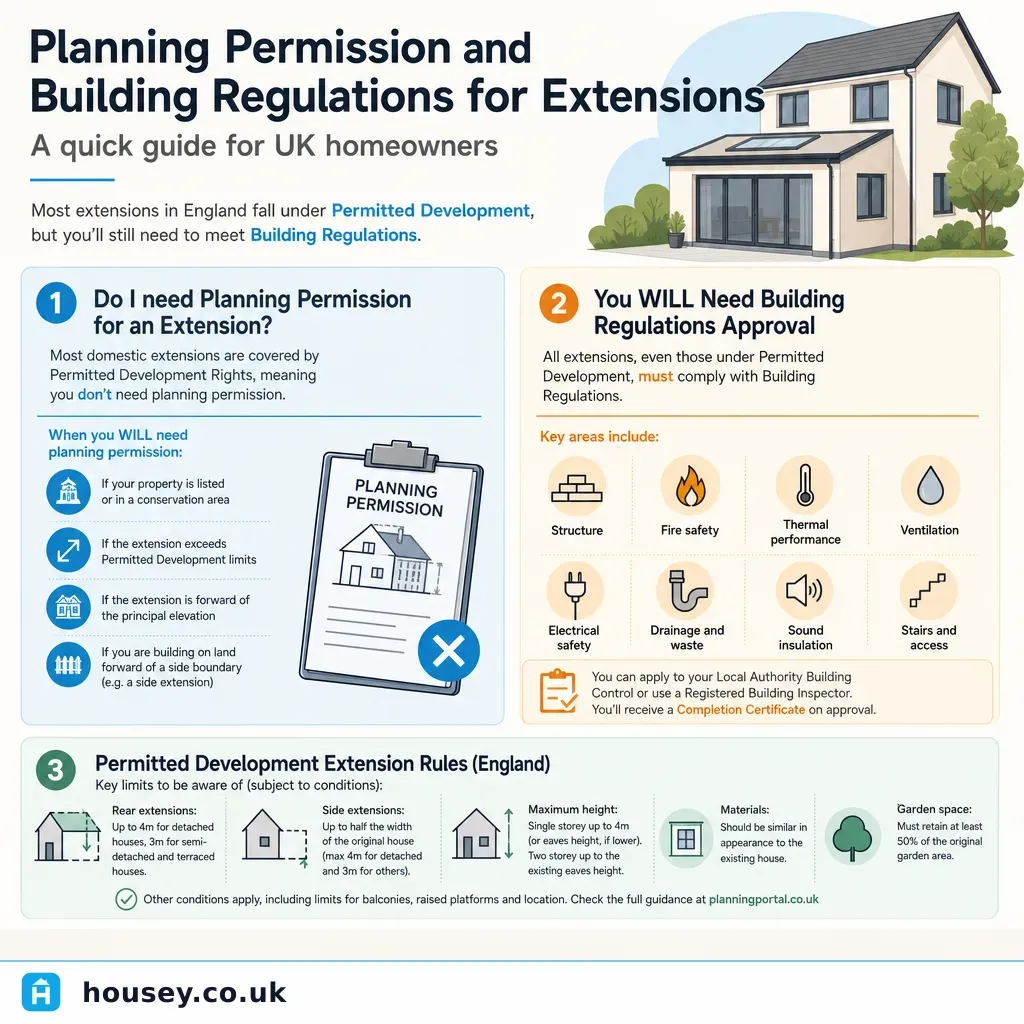
Planning Permission and Building Regulations for Extensions
UK home extensions usually require both planning permission and Building Regulations approval, though most smaller rear extensions qualify as Permitted Development under the GPDO 2015 and need no planning application.