Bifold Closet Doors: Design, Installation and Maintenance
By Housey · Last reviewed 1st of June 2026
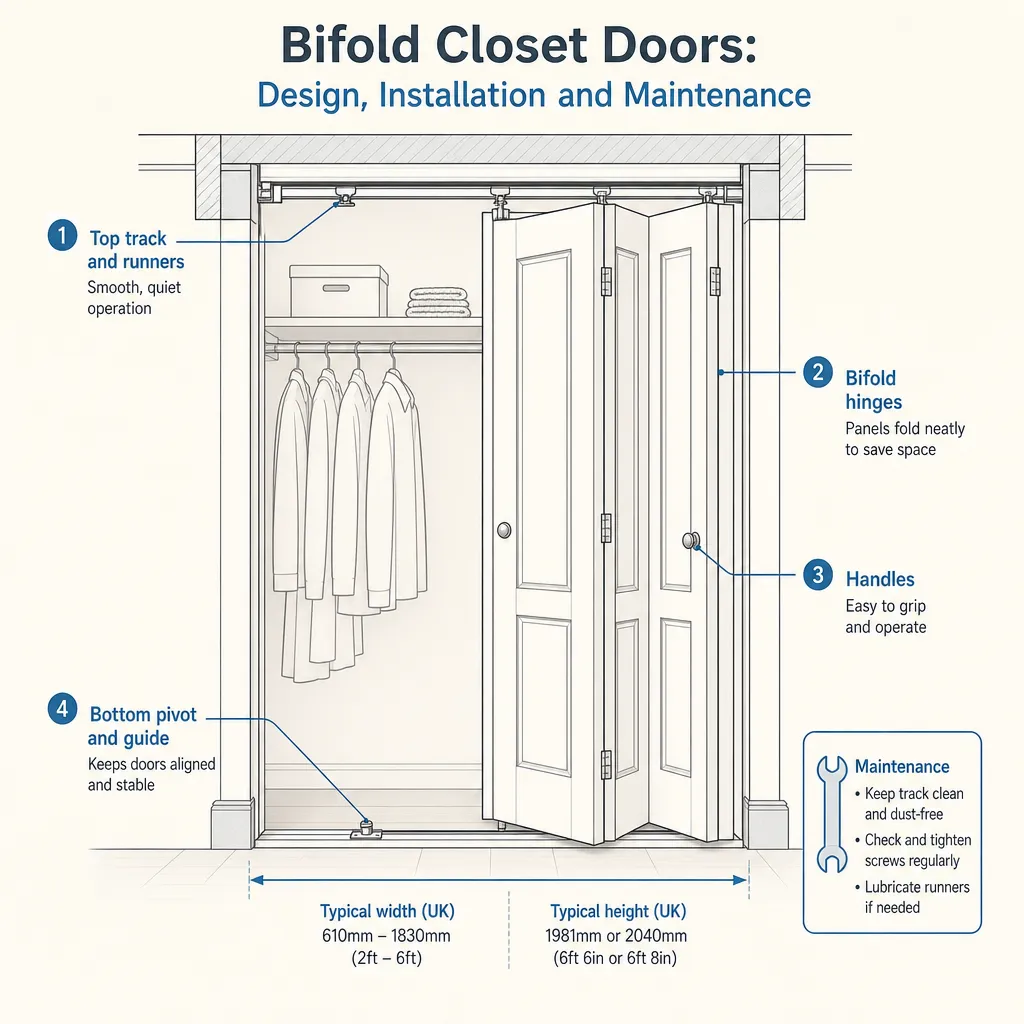
Bifold Closet Doors: Design, Installation and Maintenance
Fitting or replacing bifold closet doors is one of the more straightforward interior improvement projects in a UK home, yet the finished result depends heavily on decisions made before a screw is turned. Whether you are fitting out a new alcove wardrobe in a Victorian terrace, refreshing a tired 1970s airing-cupboard arrangement, or updating a built-in closet in a 1990s estate house, choosing the right door type, track system, and hardware from the outset avoids the most common problems.
Key points
- Standard UK bifold door leaf widths range from 450 mm to 900 mm per leaf; most fitted wardrobe openings require two to six leaves to span the full width.
- The top track bears the full door weight — it must be fixed into a structural lintel, solid timber noggin, or continuous batten secured to studwork, never into plasterboard alone.
- MDF-faced bifold doors are the most common budget option; solid timber costs more but performs better acoustically and takes paint and stain more cleanly.
- Like-for-like internal door replacements in England do not generally require Building Regulations approval, but structural alterations to the opening, or any work in a listed building or conservation area, warrant separate consideration.
- Soft-close bottom pivots and anti-jump guides are now standard on mid-range bifold hardware sets and prevent the majority of common rattling and derailment problems.
Bifold, sliding, or hinged: which suits your space?
The three main options for fitted closet doors each suit different openings and households. The table below sets out the practical differences.
Door type | Best for | Not ideal for | Approximate leaf cost (mid-range) | Main risk if wrong |
|---|---|---|---|---|
Bifold | Openings up to about 3 m wide; rooms where clearance in front of the wardrobe is limited | Very wide openings with more than six leaves; uneven floors | £30–£120 per leaf | Track misalignment if not fixed to solid substrate |
Sliding (bypass) | Wide openings; minimalist look; heavy daily use | Accessing the full wardrobe width at once | £50–£200 per leaf | Centre overlap means half the wardrobe is always obscured |
Hinged | Single-bay alcoves; traditional properties; maximum access | Rooms with restricted floor clearance in front | £40–£150 per door | Requires 90° clear swing space in front |
Indicative UK costs, last reviewed 2026-06-01. Prices vary by supplier, finish, and door size.
Choosing the right bifold door
Material options
- MDF-faced: Most widely available; takes paint well; susceptible to moisture swelling in high-humidity spaces such as en-suites or utility rooms.
- Solid timber: More dimensionally stable; takes stain and paint cleanly; higher cost, typically £80–£250 or more per leaf for hardwood options.
- Hollow-core timber: Lightweight and low-cost; less robust for heavy daily use; poor acoustic performance.
- Glass-panelled: Creates a lighter, more open feel; useful in darker rooms; requires safety glazing compliant with Approved Document N of the Building Regulations if located within 1,500 mm of the floor.
Size and fit
Most UK suppliers offer bifold doors in standard metric sizes. Common heights are 1,981 mm (6 ft 6 in) and 2,040 mm. Measure your opening at the top, middle, and bottom — use the smallest width figure. Note any floor variation: bifold tracks require a reasonably level floor, and deviations above around 5 mm may need packing or shimming before installation.
How bifold door hardware works
A bifold door hangs from rollers that travel along a top-fixed track. The outer leaf pivots at floor level via a bottom pivot plate; the inner leaf connects to the outer by a hinge. When the door is pulled open, the leaves fold together and stack to one side.
Critical hardware components:
- Top track: Must be screwed at no more than 300 mm intervals into solid substrate — a structural lintel, timber batten fixed into studwork, or equivalent solid backing. Fixing into plasterboard alone is the most common cause of track failure.
- Top rollers: Carry the door weight. Quality steel or nylon rollers with height adjustment allow fine-tuning after installation.
- Bottom pivot: Positions the door at floor level. Soft-close variants absorb the final few degrees of travel, preventing slam and reducing hardware wear.
- Anti-jump floor guide: A small floor-mounted guide that prevents the bottom of the door kicking outward. Omitting this is a leading cause of bifold doors coming off track.
- Alignment adjusters: Most mid-range and premium track systems include top and bottom adjusters to correct lean, binding, or gaps after fitting.
Pre-installation checklist
Before ordering doors or starting installation, work through these checks:
Installation: key steps and common errors
Most competent DIYers can install a two- or four-leaf bifold door set. Wider installations, or those requiring structural work to the opening, are generally better suited to a professional.
Key installation steps:
- Fix the top track into solid substrate at the correct height, allowing for the door height plus hardware clearance.
- Hang the inner top roller in the track before securing the outer track end cap.
- Fit the bottom pivot plate, aligning it vertically beneath the track end.
- Hang the doors: inner leaf roller into track, bottom leaf into pivot.
- Fit the floor guide at the midpoint of the track.
- Adjust top and bottom hardware for plumb and level operation.
- Check the door folds and unfolds smoothly through its full range before replacing any skirting or trim.
Common installation errors and their consequences:
Error | Consequence |
|---|---|
Fixing top track into plasterboard without a batten | Track pulls away from the wall under door weight |
Bottom pivot misaligned laterally | Door binds or rubs against the frame |
Omitting the anti-jump floor guide | Bottom of door swings out; door comes off track |
Not accounting for carpet or flooring thickness | Door drags or fails to open fully |
Mismatching leaf widths to opening | Uneven gaps; door cannot be properly aligned |
Maintenance and troubleshooting
Bifold doors require minimal ongoing maintenance. A few checks each year keep them operating reliably.
Routine maintenance:
- Wipe the top track clean every six months to remove dust and debris that impede roller movement.
- Apply a dry silicone lubricant (not an oil-based product, which attracts grime) to the track and pivot points once a year.
- Check that all fixing screws remain tight, particularly the top track screws.
- Inspect the bottom pivot for signs of wear or cracking, especially on doors used many times daily.
Common faults and remedies:
Fault | Likely cause | Remedy |
|---|---|---|
Door rattles when closed | Anti-jump guide loose or absent | Refit or add a floor guide |
Door binds or drags | Bottom pivot misaligned; debris in track | Clean track; re-adjust pivot |
Door leans to one side | Top roller height uneven | Use the height adjustment screw |
Track pulls away from wall | Fixed into plasterboard without backing | Remove, add timber batten, refix |
Bottom of door swings outward | No anti-jump guide fitted | Fit a floor guide |
What to ask a door installer before accepting a quote
- What substrate will the top track be fixed to, and what fixings will be used?
- Is the anti-jump floor guide included in the scope of work?
- What adjustment range does the hardware offer once the doors are hung?
- What is the door leaf material and finish, and is it appropriate for a high-humidity location if relevant?
- Will the installer remove and dispose of the existing doors?
- Is VAT included in the quoted price?
- What warranty is provided for both the hardware and the installation workmanship?
When to get professional help
Most single- or double-bay bifold door installations are within the scope of a competent DIYer. Consider engaging a professional if:
- The opening is wider than approximately 2.4 m, requiring six or more leaves.
- The lintel or structural head above the opening is unknown or in suspect condition.
- The floor has significant level variation that may require subfloor work.
- The installation is in a listed building or conservation area, where materials and methods may be subject to consent conditions.
- Glass panels are being used and the glazing specification must comply with Approved Document N.
- Previous installation attempts have resulted in a track that will not stay fixed or a door that cannot be adjusted to hang plumb.
How Housey can help
If you prefer a professional to measure, supply, and fit your bifold closet doors, Housey connects you with vetted window and door installers in your area. Submit a brief about your project and compare quotes from local specialists before committing to any work.
Frequently asked questions
Do bifold closet doors need planning permission?
In almost all cases, no. Replacing or fitting internal bifold closet doors does not require planning permission, which is generally relevant to external alterations or structural changes. However, if your property is listed, any material alteration — including internal works — may require listed building consent. Check with your local planning authority if you are unsure about your specific circumstances.
Can I fit bifold doors on an uneven floor?
Minor floor variation of up to around 5 mm can usually be accommodated by adjusting the bottom pivot height. Greater variation may require packing beneath the track or locally levelling the floor. Check levelness before ordering doors, particularly in older properties where floors can slope noticeably across the width of a wardrobe opening.
How many leaves do I need for my wardrobe opening?
Divide the opening width by the intended leaf width — typically 450 mm to 600 mm for standard fitted wardrobes. An 1,800 mm opening might suit four 450 mm leaves or three 600 mm leaves. Most suppliers provide sizing guides, and some offer made-to-measure leaves for non-standard openings.
What is the best material for bifold wardrobe doors in a UK bedroom?
MDF-faced doors are lighter, lower cost, and paint well. Solid timber is more durable, takes stain cleanly, and tends to be more dimensionally stable in centrally heated rooms. Avoid standard MDF in high-humidity locations such as bathrooms or wet rooms; use moisture-resistant MDF grades in those spaces instead.
Sources and further reading
Useful next reads
 Improvement & Build
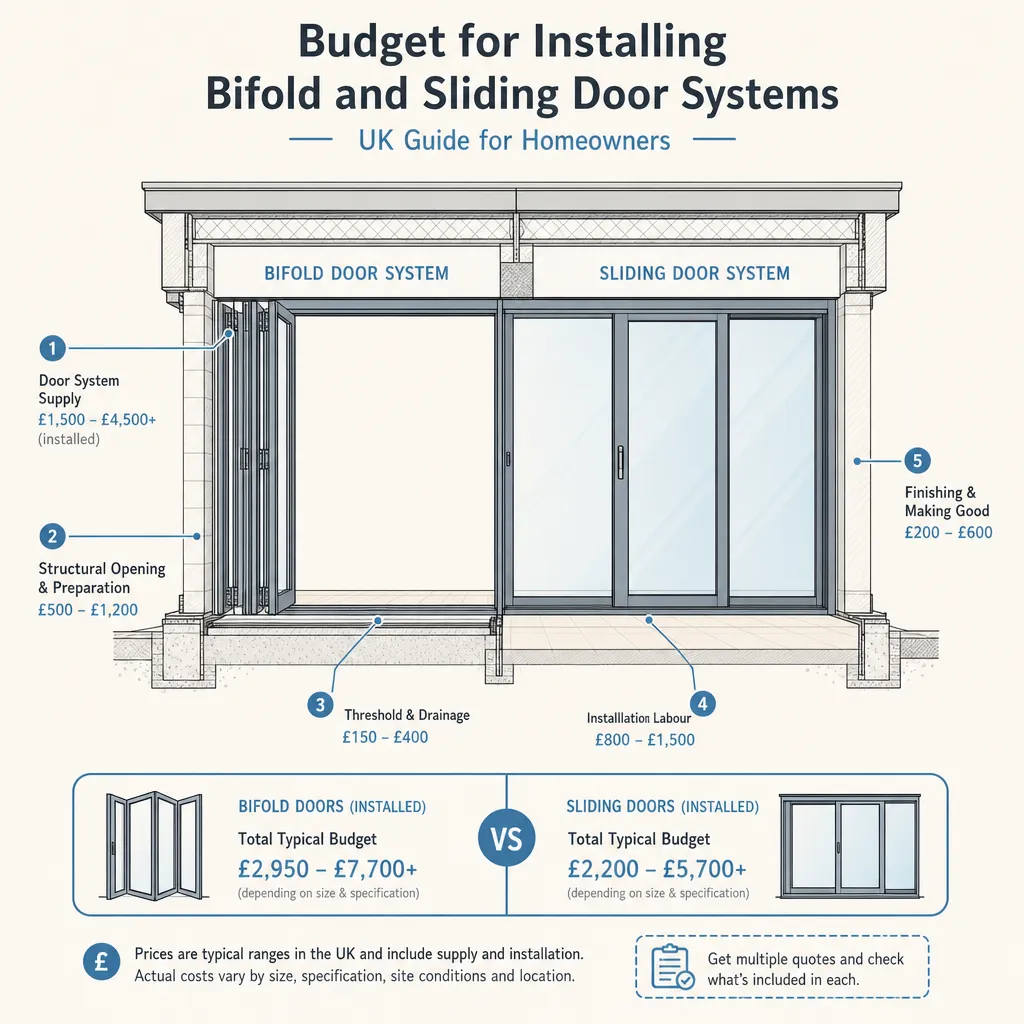
Budget for Installing Bifold and Sliding Door Systems
Aluminium bifold doors typically cost £4,000–£12,000 supplied and installed; uPVC bifolds run £2,500–£6,000.
 Improvement & Build
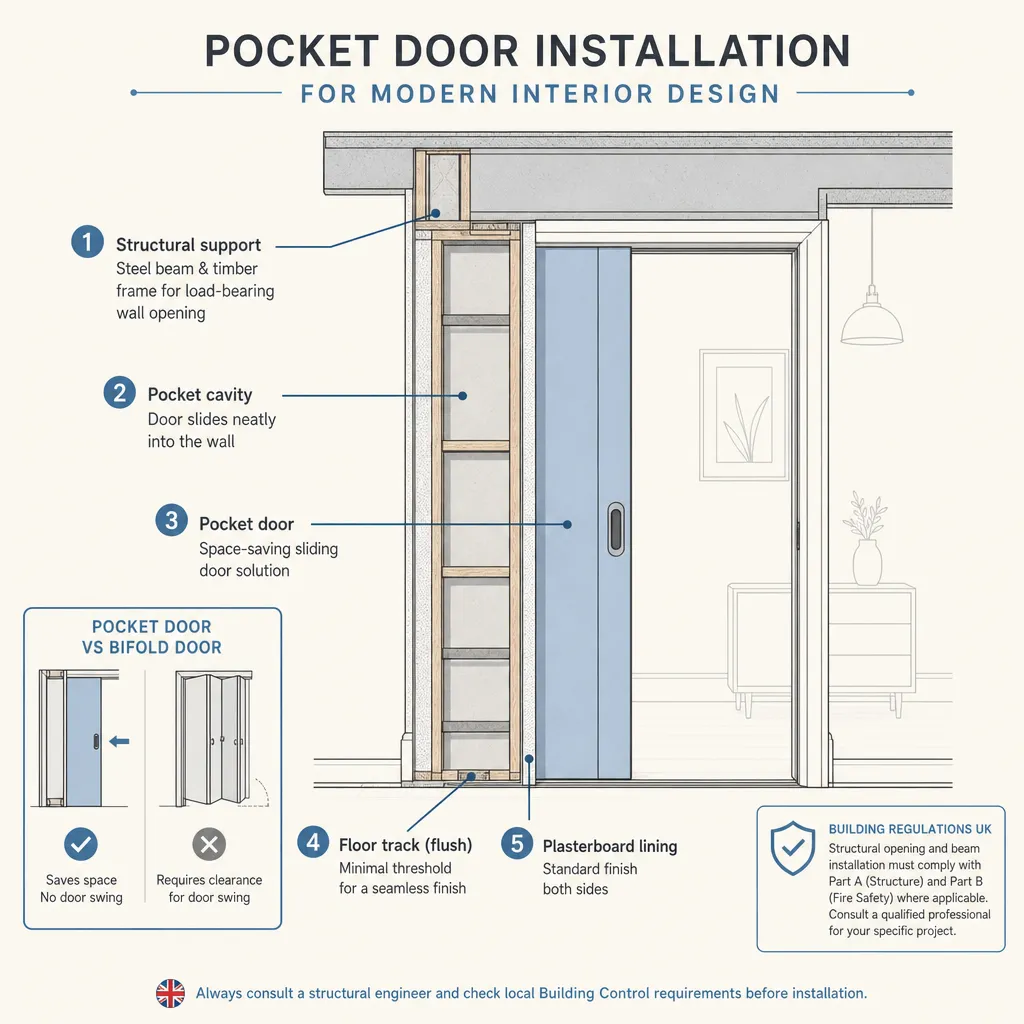
Pocket Door Installation for Modern Interior Design
A pocket door slides into a wall cavity on a top-hung track, saving the swing space of a standard hinged door.
 Improvement & Build
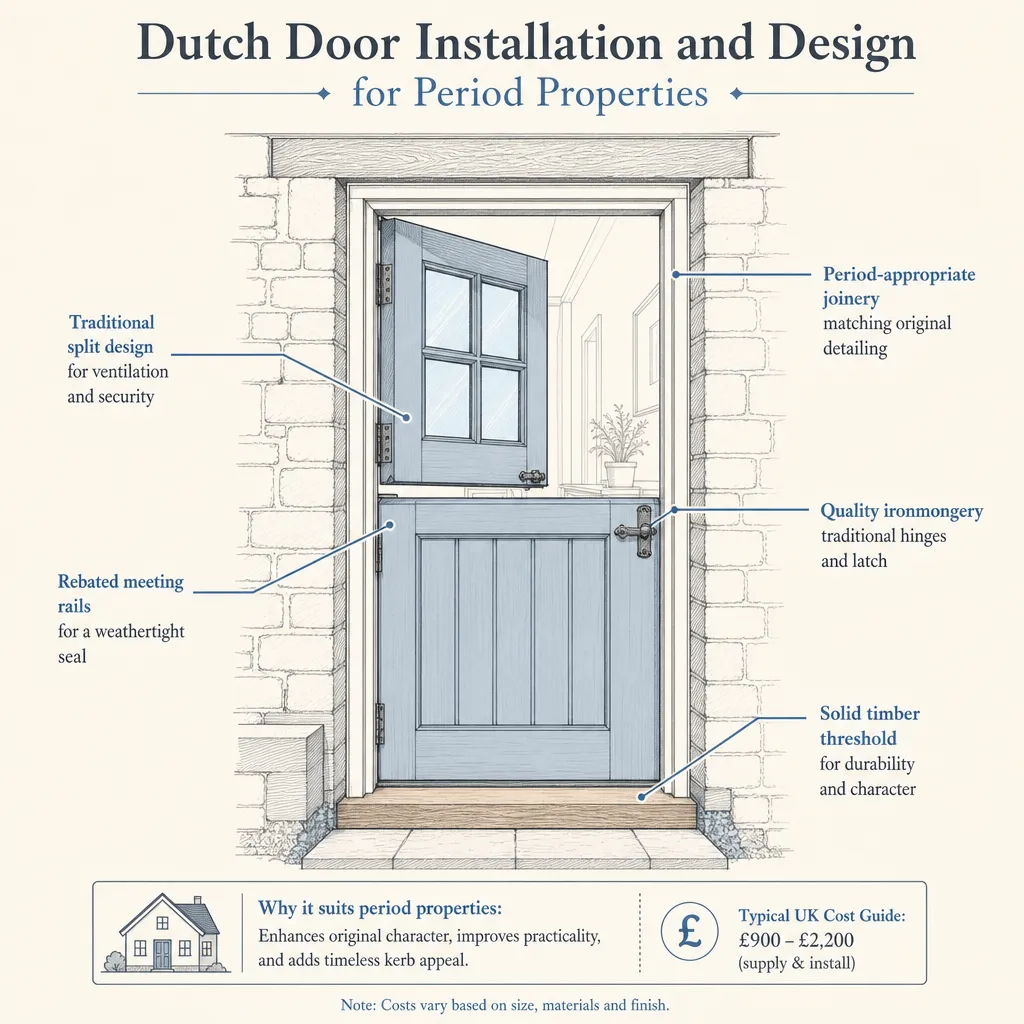
Dutch Door Installation and Design for Period Properties
A dutch door — also called a stable door — divides horizontally so the top and bottom halves open independently.
 Improvement & Build
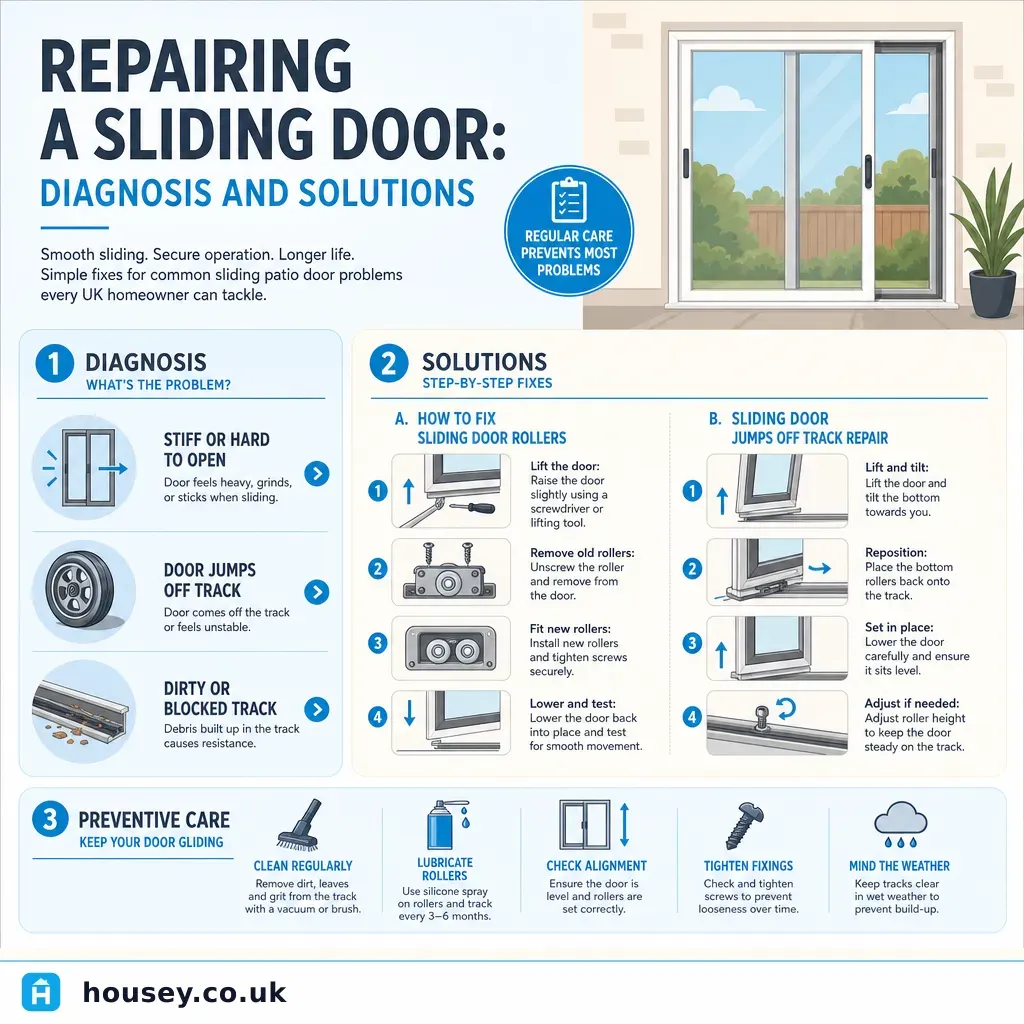
Repairing a Sliding Door: Diagnosis and Solutions
Most sliding door problems — stiffness, jumping off track, or draughts — are caused by dirty tracks, worn rollers, or misaligned guides.
 Improvement & Build
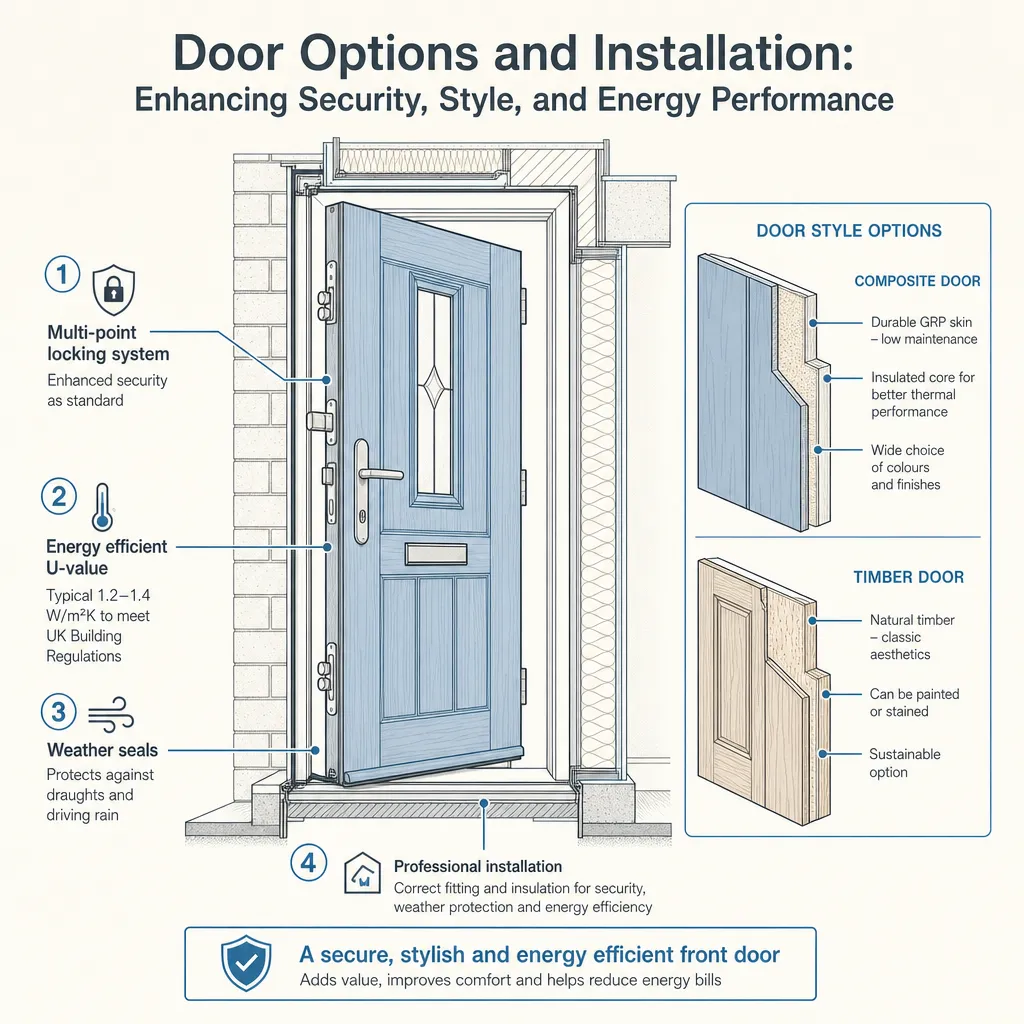
Door Options and Installation: Enhancing Security, Style, and Energy Performance
Choosing a new external door involves balancing security ratings, thermal performance, and style.