Black Mould in Window Sealant: Removal and Prevention Strategies
By Housey · Last reviewed 4th of May 2026
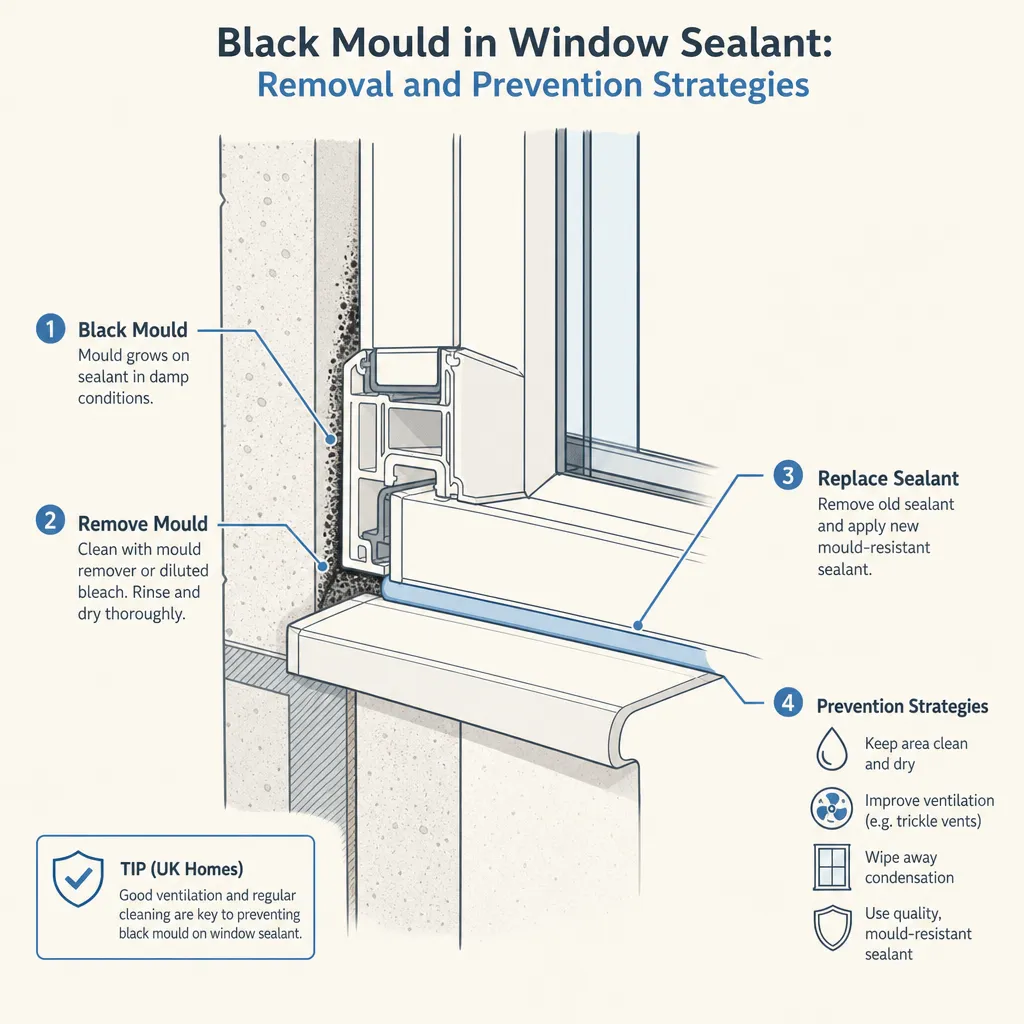
Black Mould in Window Sealant: Removal and Prevention Strategies
Black mould on window sealant is one of the most common indoor maintenance problems in UK homes, particularly in kitchens, bathrooms, and bedrooms where winter condensation is at its heaviest. It can appear even in relatively well-kept homes, and its presence is nearly always a reliable sign that moisture levels or ventilation are not quite right for the way the room is being used.
Key points
- Black mould on silicone sealant is most commonly Cladosporium or Aspergillus/Penicillium species — opportunistic moulds that colonise humid, poorly ventilated surfaces around window frames.
- Sealant showing deep black discolouration — spots or streaks that do not lift with surface cleaning — needs to be removed and replaced; mould hyphae penetrate the silicone matrix and cannot be fully eliminated by surface treatment alone.
- Approved Document F (Ventilation, Building Regulations England) sets minimum air change rates for habitable rooms; many older UK homes fall below these thresholds, which directly contributes to condensation on cold glazing surfaces.
- Trickle vents in window frames should remain open year-round — closing them to reduce draughts is one of the most common mistakes UK homeowners make, and it significantly raises indoor relative humidity.
- Replacement windows must be installed by a FENSA-registered installer or notified to local building control under the Building Regulations to comply with Part L (energy performance) and Part F (ventilation).
Why black mould grows on window sealant
Window reveals and glazing frames are natural cold bridges — surfaces that sit significantly below room air temperature on a cold winter day. When warm, moisture-laden indoor air contacts a cold surface, it drops below its dew point and water vapour condenses into liquid. Silicone sealant at the junction between the glazing frame and the wall is particularly vulnerable because:
- It sits at a thermal weak point where frame meets wall, often with minimal insulation directly behind the reveal.
- Silicone has a slightly textured surface that allows mould spores to establish a foothold once moisture is repeatedly present.
- The location commonly has poor air movement, especially in corners or where curtains and blinds are drawn close to the glass.
This is not usually a structural problem in itself, but it is a consistent indicator that indoor relative humidity is too high, ventilation is insufficient for the occupancy level, or the glazing is underperforming thermally.
How to remove mould from window sealant
Step 1: Assess the extent of contamination
Examine the sealant in good light before reaching for cleaning products. If the mould is:
- Surface-level — a greyish or light black bloom that wipes away with light pressure: cleaning is likely to be effective.
- Deep-seated — solid black spots or streaks embedded in the sealant body that do not lift: remove and replace the sealant rather than attempting repeated cleaning.
Repeated cleaning of deeply contaminated sealant is ineffective — mould hyphae have penetrated the silicone and will return within days of any surface treatment.
Step 2: Protect yourself and ventilate the room
Open windows before starting. Wear rubber gloves. If anyone in the household has asthma or a respiratory condition, an FFP2 disposable mask is a sensible precaution when disturbing visible mould growth.
Step 3: Apply a suitable cleaning agent
Cleaning agent | How to apply | Effective against surface mould? | Notes |
|---|---|---|---|
White vinegar (undiluted) | Apply with cloth or spray bottle; leave 30 minutes; wipe clean | Yes | Low toxicity; good first choice for light contamination |
Dilute bleach (1 part bleach to 10 parts water) | Apply with cloth; leave 10 minutes; rinse thoroughly with water | Yes | Effective but may discolour coloured sealants; never mix with other cleaning products |
Specialist mould remover (e.g., HG Mould Spray) | Follow label instructions | Yes | Formulated for bathroom and kitchen sealant; widely available in UK DIY retailers |
Bicarbonate of soda paste | Apply, scrub gently with soft brush, rinse | Partly | Useful for very light surface deposits; mild abrasive |
Avoid abrasive pads or wire wool on silicone sealant — they scratch and roughen the surface, making future mould adhesion easier.
Step 4: Dry thoroughly
After cleaning, dry the sealant and all surrounding surfaces with a dry microfibre cloth, then leave the window open to air-dry fully. Residual moisture accelerates regrowth.
Step 5: Replace contaminated sealant if cleaning fails
If cleaning does not clear the mould, or if it returns within a few weeks:
- Score along both edges of the old sealant with a sharp craft knife.
- Pull away the old sealant in strips.
- Remove any remaining residue with a silicone remover product (available from UK DIY retailers).
- Clean and dry the joint thoroughly before applying anything new.
- Apply a low-modulus silicone sealant with an integral fungicide — products labelled "mould-resistant bathroom silicone" or "kitchen and bathroom silicone" contain a biocide that inhibits regrowth.
Replacing sealant around window frames is within the capabilities of most confident DIYers. If the mould extends into the surrounding plasterwork, timber reveals, or window frame material itself, seek professional advice before proceeding.
Preventing mould from returning
Improve ventilation
Inadequate ventilation is the most common underlying cause of persistent window mould in UK homes:
- Trickle vents: Keep trickle vents in window frames open year-round. Many homeowners close them in winter to reduce draughts, but this traps moisture-laden air and raises indoor humidity significantly.
- Extractor fans: Kitchen and bathroom fans must vent directly to the outside — not into a loft void or roof space. A fan fitted with a 15-minute overrun timer removes moisture effectively after cooking or bathing.
- Whole-house ventilation: In persistently damp homes, mechanical ventilation with heat recovery (MVHR) or positive input ventilation (PIV) can substantially reduce indoor humidity levels year-round, though both systems require professional design and installation.
Reduce moisture production
Moisture source | Practical measure |
|---|---|
Cooking | Use lids on pans; run the extractor fan; briefly open a window to vent steam |
Bathing and showering | Run the extractor fan during and for 15 minutes after; keep the bathroom door closed |
Clothes drying | Dry outdoors where possible; use a vented tumble dryer or a dehumidifier indoors |
High overnight occupancy | Keep trickle vents open in bedrooms; consider a bedroom dehumidifier in winter |
Improve glazing performance
Older single-glazed or pre-2002 double-glazed units produce substantially more condensation than modern low-emissivity (low-E) glazing, because their inner pane surfaces are significantly cooler. If upgrading, new windows must be installed by a FENSA-registered window and door installer or notified to your local building control authority under the Building Regulations to comply with Part L energy performance standards.
Homeowner checklist: reducing window mould
Red flags: when to seek professional advice
- Mould is appearing on walls, ceilings, or plasterwork around window reveals — not just on the sealant bead itself.
- Mould returns within days of cleaning, suggesting very high ambient humidity or a moisture source beyond normal occupancy.
- There are damp patches or tide marks on the inner face of the wall around the window frame.
- Window frames are soft, discoloured, or show visible signs of timber rot or delamination.
- Household members are experiencing respiratory symptoms that may be connected to indoor air quality.
- The property is a solid-wall Victorian or Edwardian home where surface condensation on windows may be a symptom of a wider thermal bridging and moisture management challenge.
When to get professional help
If mould returns rapidly after cleaning, or has spread from the sealant to adjacent walls and ceilings, the sealant itself is unlikely to be the primary problem. A ventilation and condensation assessment can measure whether your home's air change rates meet the requirements of Approved Document F and identify exactly where moisture is accumulating. A damp and timber survey can rule out penetrating or rising damp as a contributing factor before you invest in replacement glazing or mechanical ventilation upgrades.
How Housey can help
If window mould is persistent or spreading to the surrounding structure, Housey can connect you with qualified professionals to investigate and resolve the root cause. Request a ventilation and condensation assessment to check whether your home's ventilation meets current standards, arrange a damp and timber survey to rule out structural moisture issues, or find a FENSA-registered window and door installer if your glazing is overdue for replacement.
Frequently asked questions
Is black mould on window sealant dangerous to health?
For most healthy adults, surface mould on window sealant poses a low health risk with ordinary exposure. However, elevated indoor mould levels can aggravate asthma and respiratory allergies, and prolonged exposure to some mould species can be problematic for vulnerable people. If any household member has a respiratory condition, addressing the source of excess moisture and improving ventilation should be treated as a priority rather than a cosmetic concern.
How long does anti-mould silicone sealant last?
Silicone sealant with an integral fungicide typically remains effective for 5–10 years under normal conditions. Over time the biocide is depleted, and the sealant can crack, shrink, or lose adhesion to the surrounding surfaces. Inspect window sealant annually and plan to replace it when you see cracking, shrinkage, loss of adhesion, or the first signs of mould contamination returning despite good ventilation.
Can I just paint over mouldy window sealant?
No. Paint does not seal in mould or stop it spreading — it will peel, and the mould will re-emerge through the surface within weeks. Mouldy sealant must be properly cleaned if the contamination is surface-level, or fully removed and replaced with a fresh mould-resistant silicone product if the discolouration is deep-seated. Painting over the problem only delays the necessary remediation.
My extractor fan is running but I still get mould on my windows — why?
Extractor fans often underperform due to blocked or kinked ductwork, fans that vent into a loft void rather than directly outside, or an impeller too small for the room volume. Age also reduces fan performance significantly. A ventilation and condensation assessment can measure actual airflow rates against the minimum requirements set by Approved Document F and identify exactly where the shortfall lies.
Does a dehumidifier fix window mould?
A dehumidifier lowers indoor relative humidity and reduces condensation on cold surfaces, which can significantly reduce mould growth on window sealant. However, it treats the symptom rather than the cause. Improving ventilation, keeping trickle vents open, upgrading underperforming glazing, and reducing moisture-generating habits are more lasting solutions — a dehumidifier works best as a supplement to these measures, not a replacement for them.
Sources and further reading
- Approved Document F: Ventilation — GOV.UK
- Understanding and addressing the health risks of damp and mould in the home — GOV.UK / DLUHC
- FENSA: Window replacement and building regulations — FENSA
- Draught-proofing and ventilation advice — Energy Saving Trust
- Damp and mould in the home — NHS
Useful next reads
 Surveys & Inspections
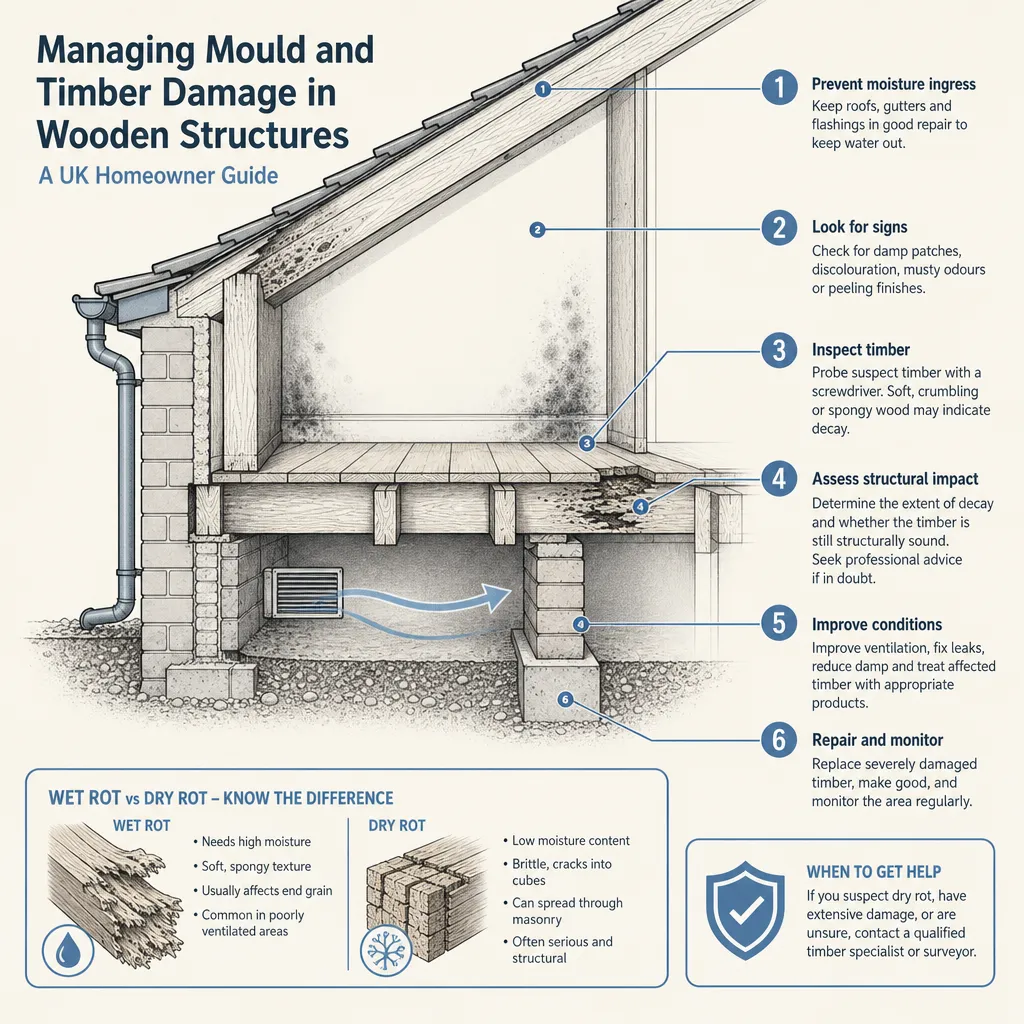
Managing Mould and Timber Damage in Wooden Structures
Mould and timber decay in wooden structures are usually symptoms of excess moisture rather than standalone problems.
 Surveys & Inspections
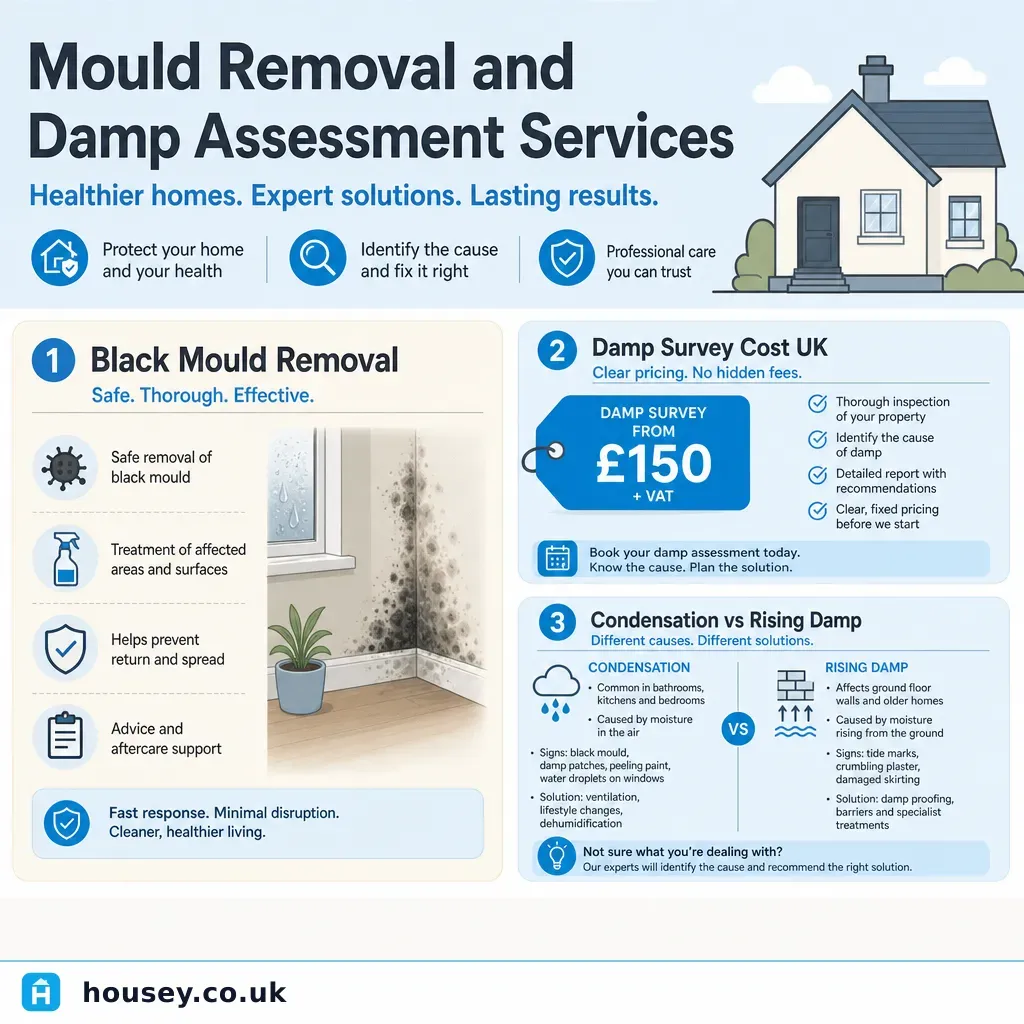
Mould Removal and Damp Assessment Services
Professional mould removal and damp assessment starts with identifying the moisture source—condensation, rising damp, or penetrating damp—before any treatment begins.
 Surveys & Inspections
Ideal Humidity Levels in Homes: Achieving Comfort and Health
The recommended indoor relative humidity in a UK home is 40–60%.
 Surveys & Inspections
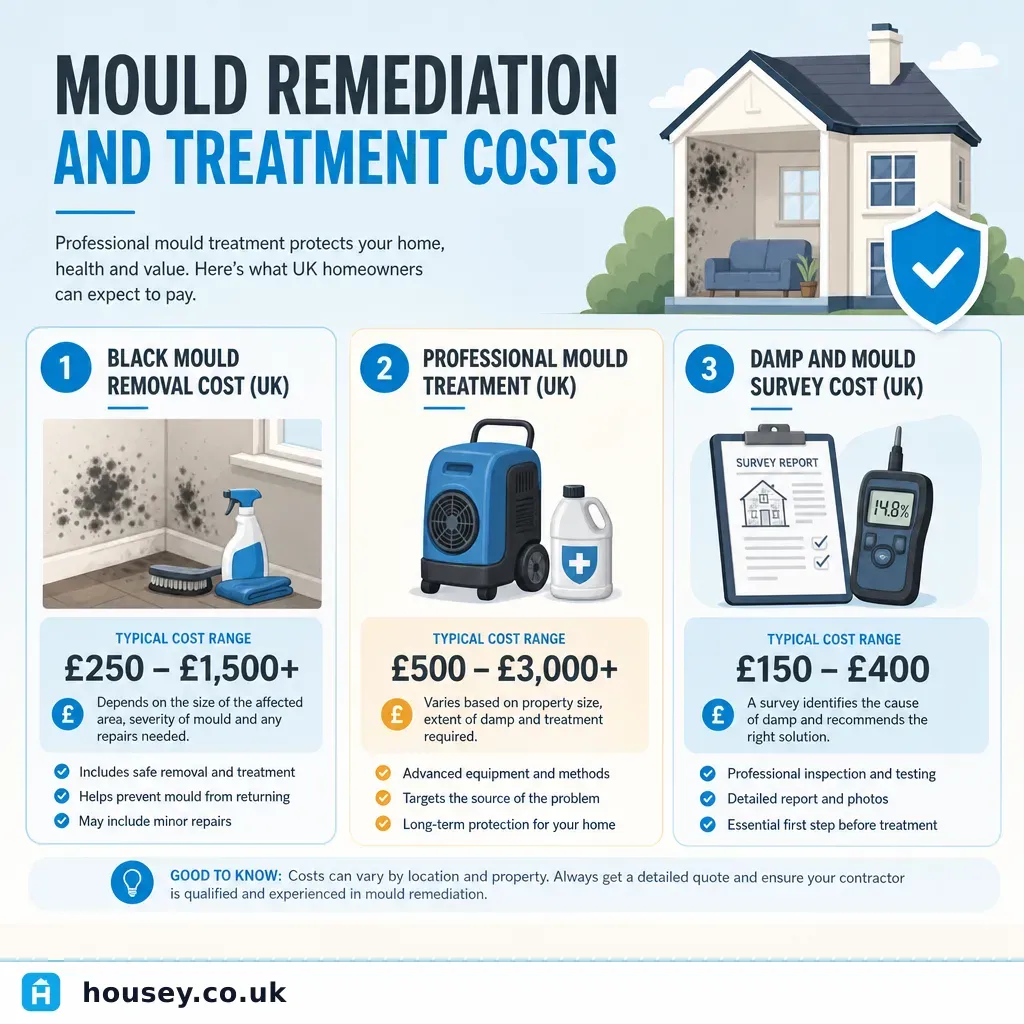
Mould Remediation and Treatment Costs
Professional mould remediation in the UK typically costs £150–£1,500+ depending on the extent of growth, underlying cause, and materials affected.
 Surveys & Inspections
Why Property Boundaries Matter: Surveying and Dispute Prevention
Property boundaries in England and Wales are recorded as general boundaries by HM Land Registry — not precise measurements.