Brick Driveway Installation: Materials and Costs
By Housey · Last reviewed 5th of May 2026
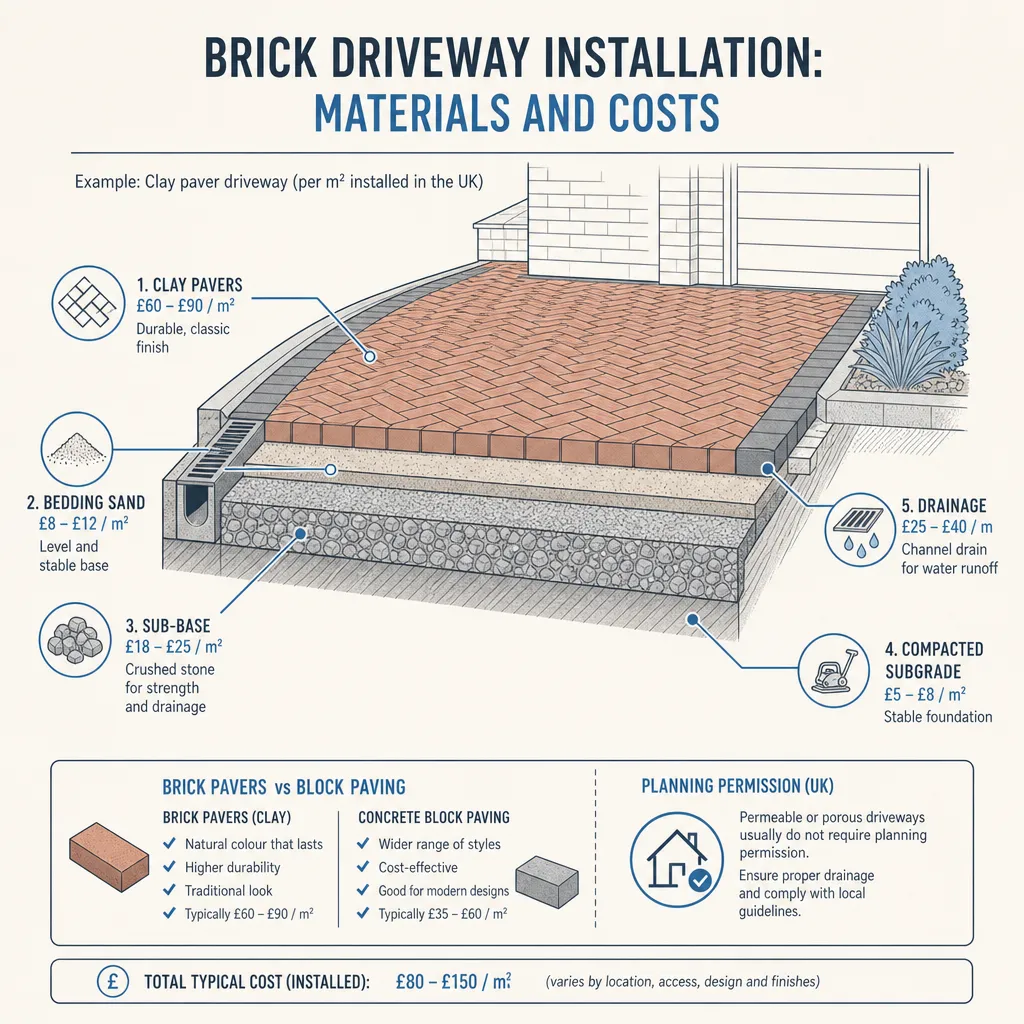
Brick Driveway Installation: Materials and Costs
A brick or clay paver driveway is one of the more substantial front-of-house investments a UK homeowner can make — typically running from £6,000 to £20,000 or more depending on size, materials, and groundwork requirements. The decision usually arises when an existing surface has deteriorated beyond repair, when adding off-street parking for the first time, or when renovating a period property where a clay paver finish is more sympathetic than concrete block paving.
Key points
- Driveways over 5 m² that drain to a public highway must use permeable surfacing or include drainage to a soakaway or lawn under the Town and Country Planning (General Permitted Development) (England) Order 2015, Schedule 2, Part 1, Class F.
- Clay pavers are fired at high temperature and are more colour-stable over time than concrete block paving; they are a common choice for Victorian and Edwardian street frontages.
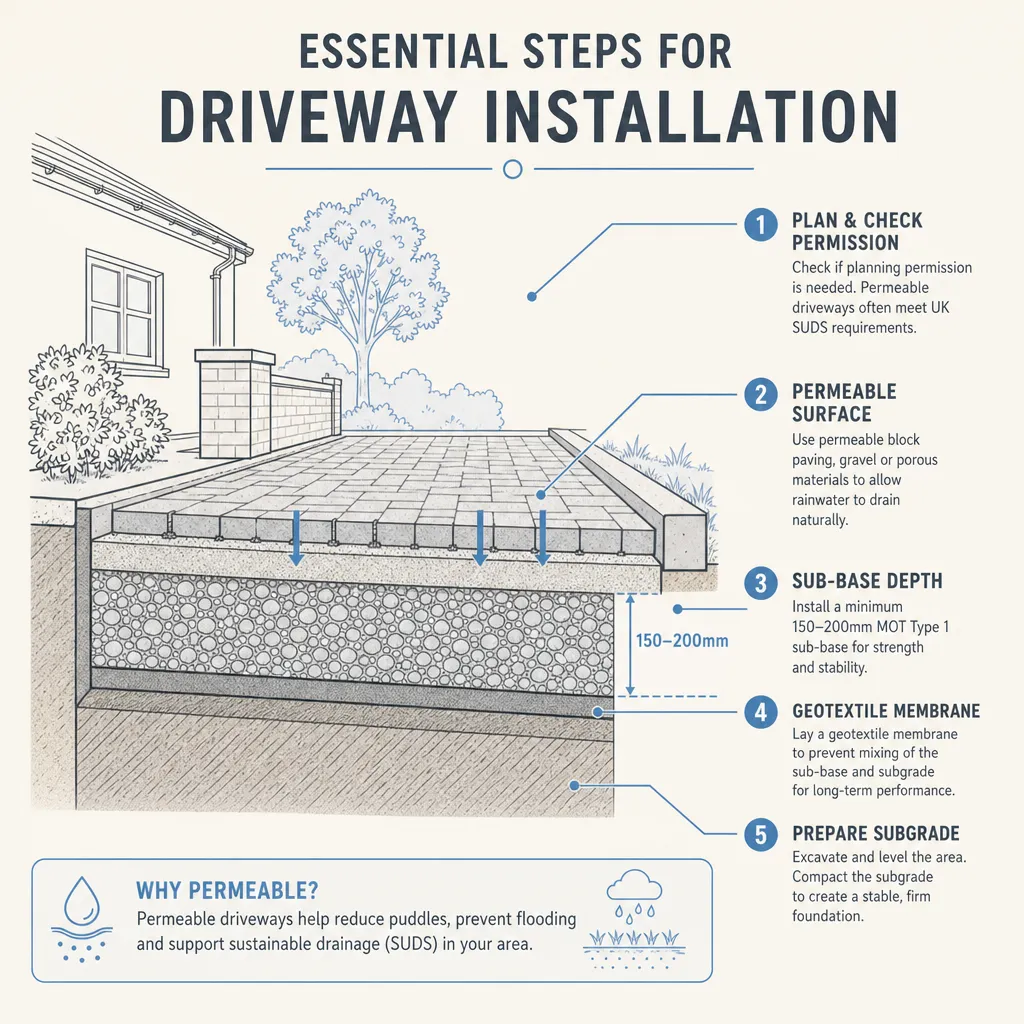
- A properly constructed sub-base — typically 150–200 mm of compacted MOT Type 1 hardcore — is critical to driveway longevity; inadequate sub-base is the most common cause of premature driveway failure.
- Installing a new vehicle crossing from a public highway requires a dropped kerb and a licence from the local highway authority, regardless of the driveway surface type.
- A well-constructed clay paver driveway can last 40–60 years, substantially longer than asphalt or concrete block paving.
Brick versus block paving: understanding the materials
The terms 'brick driveway' and 'block paving' are often used interchangeably, but they describe different products with distinct performance characteristics.
Material | Composition | Colour stability | Cost relative | Typical lifespan |
|---|---|---|---|---|
Clay pavers (wire-cut or handmade) | Fired clay | Excellent — colour runs through | Higher | 40–60 years |
Concrete block paving | Precast concrete | Surface colour fades over 10–15 years | Lower | 20–30 years |
Reclaimed clay or engineering bricks | Fired clay, salvaged | Excellent — aged patina | Variable (can be high) | 50+ years if sound |
Granite sett paving | Natural stone | Excellent | Highest | 50–100 years |
Clay pavers and reclaimed bricks are frequently chosen for period properties where a concrete block finish would look out of character. Granite setts are common in conservation area schemes where the local planning authority encourages traditional materials.
Planning permission and permitted development rules
Most domestic driveway installations in England do not need a formal planning application, but there are important conditions to satisfy.
Under permitted development rights (Town and Country Planning (General Permitted Development) (England) Order 2015, Schedule 2, Part 1, Class F), a hard surface may be installed without planning permission provided:
- The surface is permeable — for example, permeable block paving, gravel, or clay pavers with open joints on a permeable base — or
- Rainwater run-off is directed to a lawn or border within the property, or
- The surface area is 5 m² or less.
If none of these conditions is met — for example, an impermeable surface draining to the highway — planning permission is required.
Dropped kerb: A new vehicle crossing over a public pavement or verge requires a highway authority licence, separate from planning permission. Costs typically range from £1,000 to £3,000 depending on the authority and site conditions.
Listed buildings and conservation areas: additional controls may apply — check with your local planning authority before proceeding.
Which route applies to your project?
- Replacing an existing driveway on the same footprint with a permeable surface — usually no permission needed.
- Replacing with an impermeable surface and adding drainage to lawn or soakaway within the property — usually no permission needed.
- Creating a new driveway where none previously existed — check permitted development conditions; a dropped kerb licence is always required for a new highway crossing.
- Property is listed or in a conservation area — contact the local planning authority before starting any work.
The installation process
A well-built brick or clay paver driveway follows a consistent sequence regardless of size.
- Site survey and design: the contractor measures the area, confirms drainage falls, identifies buried services (gas, water, electricity) requiring protection, and agrees the paver pattern and edging detail.
- Excavation: existing surface and subsoil removed to typically 300–350 mm depth for domestic car loading.
- Sub-base installation: compacted granular sub-base (usually MOT Type 1) laid and compacted in layers to the specified depth.
- Edge restraints: concrete haunching or proprietary edging laid to define the boundary and prevent lateral spread of the paving.
- Bedding layer: sharp sand or grit sand screeded to a consistent 25–40 mm depth.
- Paver laying: bricks or pavers laid to the agreed bond pattern and cut to fit at edges.
- Compaction and jointing: pavers vibrated into the bedding layer using a plate compactor (with a rubber mat for clay pavers); kiln-dried sand brushed into joints.
- Final inspection and clean: excess sand removed; surface checked for level and alignment.
Indicative costs
Indicative UK costs, last reviewed 2026-05-05. Costs depend on driveway size, access, groundwork depth, material grade, and regional labour rates. Always obtain at least three written quotes before proceeding.
Item | Indicative range |
|---|---|
Concrete block paving (supply and install) | £60–£100 per m² |
Clay paver driveway (supply and install) | £90–£150 per m² |
Granite sett driveway (supply and install) | £120–£220 per m² |
Permeable block paving (supply and install) | £80–£130 per m² |
Sub-base preparation only | £20–£40 per m² |
Dropped kerb (council or approved contractor) | £1,000–£3,000 (fixed cost) |
Source: indicative ranges compiled from UK contractor pricing guides and trade body estimates; individual quotes will vary significantly by location and site conditions.
Typical total project cost for a standard double driveway (approximately 40–50 m²):
- Concrete block paving: approximately £3,000–£5,500.
- Clay pavers: approximately £4,500–£8,000.
A worked UK scenario
A homeowner in a 1930s semi-detached in the East Midlands wants to replace a crumbling tarmac driveway (approximately 45 m²) with clay pavers to match the character of neighbouring properties. An existing dropped kerb is already in place.
- The existing tarmac drains to the highway, so the new surface must be permeable or drainage directed to a soakaway within the property.
- The contractor proposes a permeable clay paver system with open sand-filled joints on a permeable sub-base, satisfying permitted development conditions without a planning application.
- Indicative cost: approximately £5,500–£7,500, including excavation, permeable sub-base, clay pavers, and edging.
- Timeline: approximately 3–5 working days on site.
- No planning permission required; the existing dropped kerb crossing is retained.
What to include in your quote request
When requesting quotes from driveway contractors, ask each one to confirm:
- The proposed sub-base specification (depth and material) and why it is appropriate for this site.
- Whether the finished surface will satisfy permitted development drainage requirements.
- What edge restraint or haunching system is included.
- Whether excavation and disposal of the existing surface is covered.
- The specific paver product — manufacturer, range, and thickness — and whether it carries a product warranty.
- How drainage falls are designed into the finished surface level.
- Whether VAT is included in the total.
- What access is required and how many working days the project should take.
When to get professional help
If your driveway project involves significant changes to ground levels, existing drainage runs, or nearby trees with protected root zones, consult a professional before instructing a contractor. Tree root zones can extend 1.5 times the canopy spread from the trunk, and some trees are protected by Tree Preservation Orders (TPOs) or conservation area provisions. An arboricultural report may be required before the highway authority approves a new dropped kerb.
If you are uncertain about planning or permitted development requirements, check with your local planning authority's duty planner or engage a planning consultant before any work begins.
How Housey can help
Housey connects UK homeowners with vetted driveway installers who can advise on clay pavers, concrete block paving, and permeable driveway systems. Use Housey to request quotes from local contractors, compare their sub-base specifications and drainage proposals, and check their approach to permitted development compliance before committing to any work.
Frequently asked questions
Do I need planning permission for a brick driveway in England?
In most cases, no — provided the surface is permeable or drainage is directed to a soakaway or lawn within the property. If the new surface would drain to a public highway and covers more than 5 m², a planning application is usually required. A new dropped kerb crossing always requires a separate highway licence from the local authority, regardless of planning permission status.
How long does a clay paver driveway last?
A well-constructed clay paver driveway with a proper sub-base typically lasts 40–60 years. Clay pavers are fired at high temperature, so colour and finish are integral to the material rather than a surface coating. Individual damaged pavers can usually be lifted and replaced without disturbing the surrounding surface, extending the overall lifespan considerably.
Can I lay a brick driveway myself?
The laying itself is achievable for an experienced DIYer, but achieving correct sub-base compaction, drainage falls, and edge restraints requires specialist equipment and experience. Incorrect sub-base depth is the most common cause of early driveway failure. Most homeowners find it more cost-effective to use a professional contractor who can also advise on planning and drainage compliance.
What is the difference between clay pavers and ordinary house bricks?
Clay pavers are manufactured specifically for external paving — they are denser, more abrasion-resistant, and have lower water absorption than facing or common house bricks. Using standard house bricks as driveway paving is not recommended: they are likely to spall and deteriorate under vehicle loads and repeated freeze-thaw cycles.
Does a brick driveway add value to a property?
A well-finished driveway improves kerb appeal and provides off-street parking, which is a valued feature for buyers in many UK locations. Its effect on formal valuation is property- and location-specific. Clay pavers are often considered a premium finish and may appeal more to buyers of period properties than concrete block paving, but no specific valuation uplift can be guaranteed.
Sources and further reading
- Paving your front garden — GOV.UK
- Town and Country Planning (General Permitted Development) (England) Order 2015 — legislation.gov.uk
- Sustainable Urban Drainage Systems (SuDS) guidance — CIRIA
- Work at Height Regulations 2005 — Health and Safety Executive
Useful next reads
 Improvement & Build
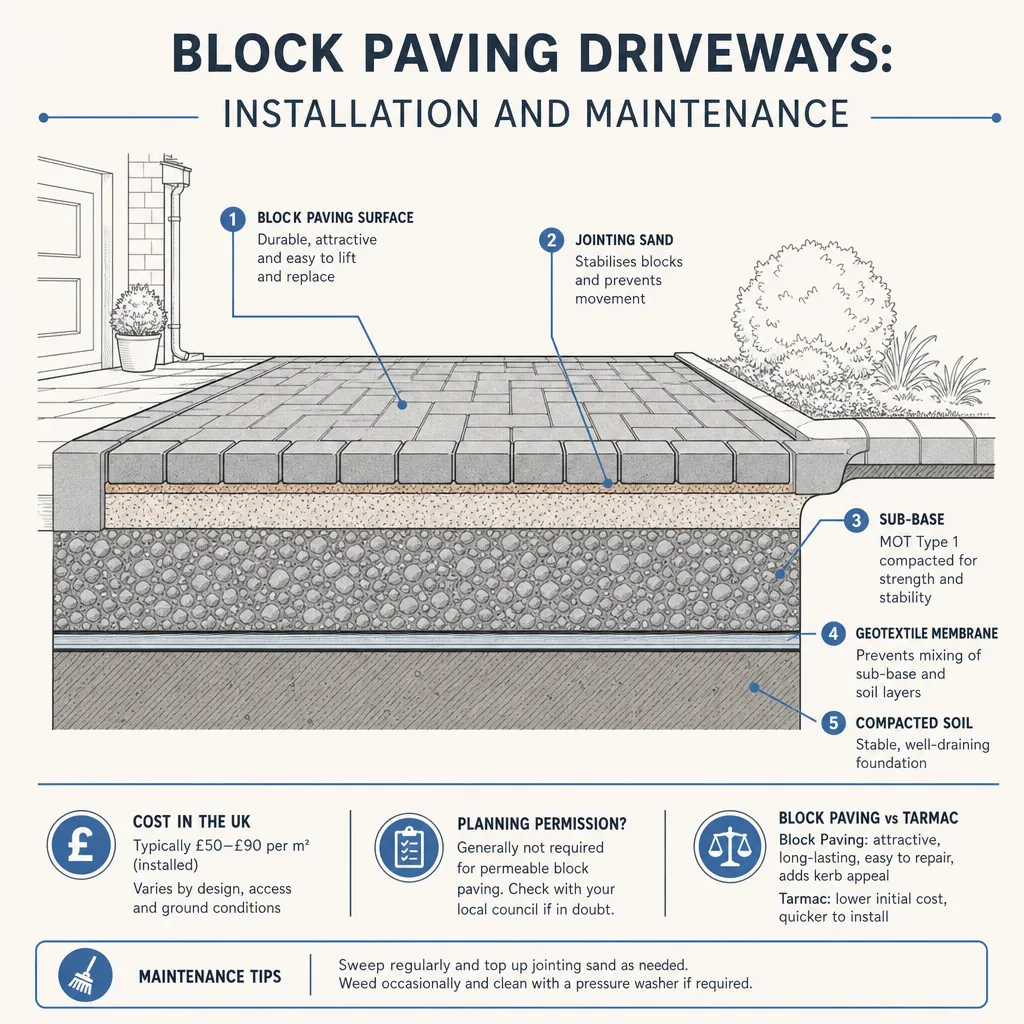
Block Paving Driveways: Installation and Maintenance
Block paving driveways typically cost £50–£120 per m² installed and last 20–30 years with good maintenance.
 Improvement & Build
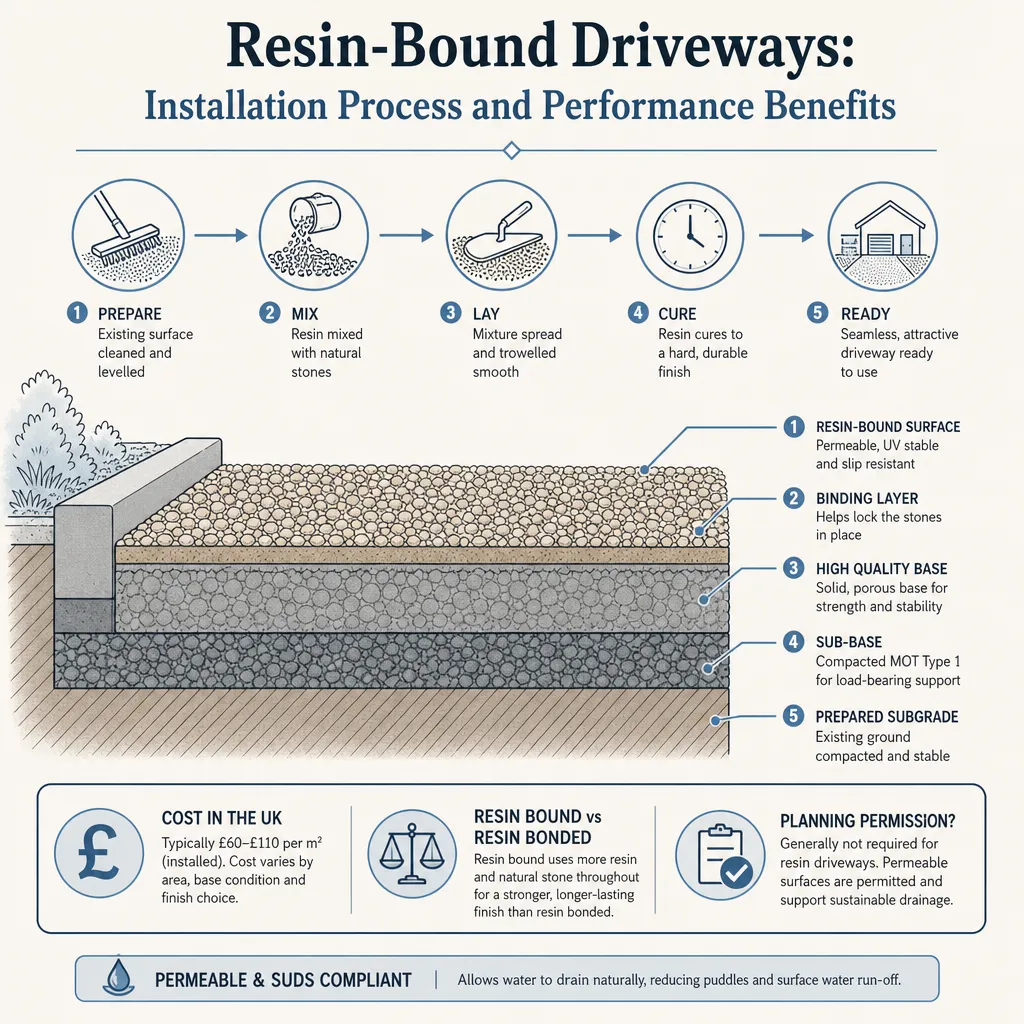
Resin-Bound Driveways: Installation Process and Performance Benefits
Resin-bound surfacing mixes natural aggregate with UV-stable polyurethane resin to create a smooth, porous driveway that drains water through its surface layer.
 Improvement & Build
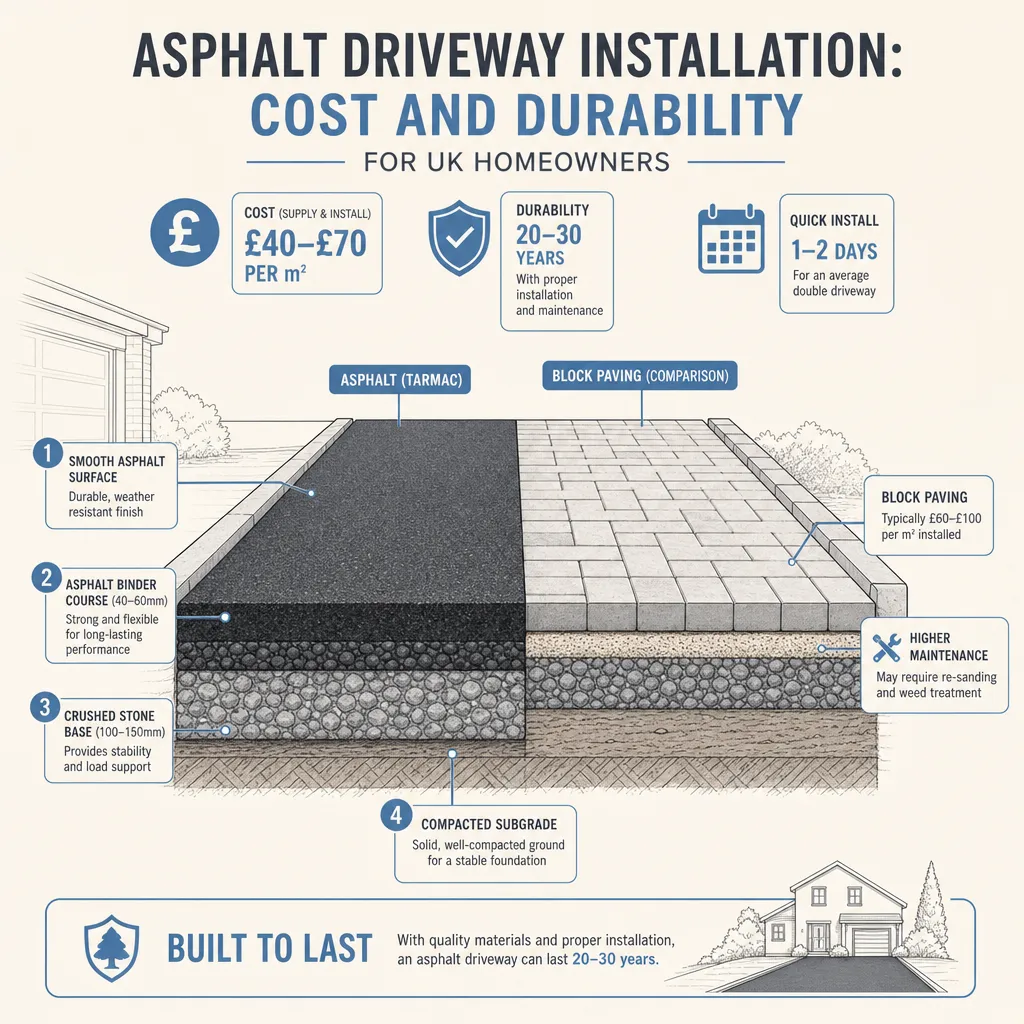
Asphalt Driveway Installation: Cost and Durability
Asphalt driveway installation in the UK typically costs £40–£80 per square metre.
 Improvement & Build
Essential Steps for Driveway Installation
Installing a driveway in England requires planning permission only when using an impermeable surface (standard tarmac, concrete, or block paving) on a front garden area over 5 m².
 Improvement & Build
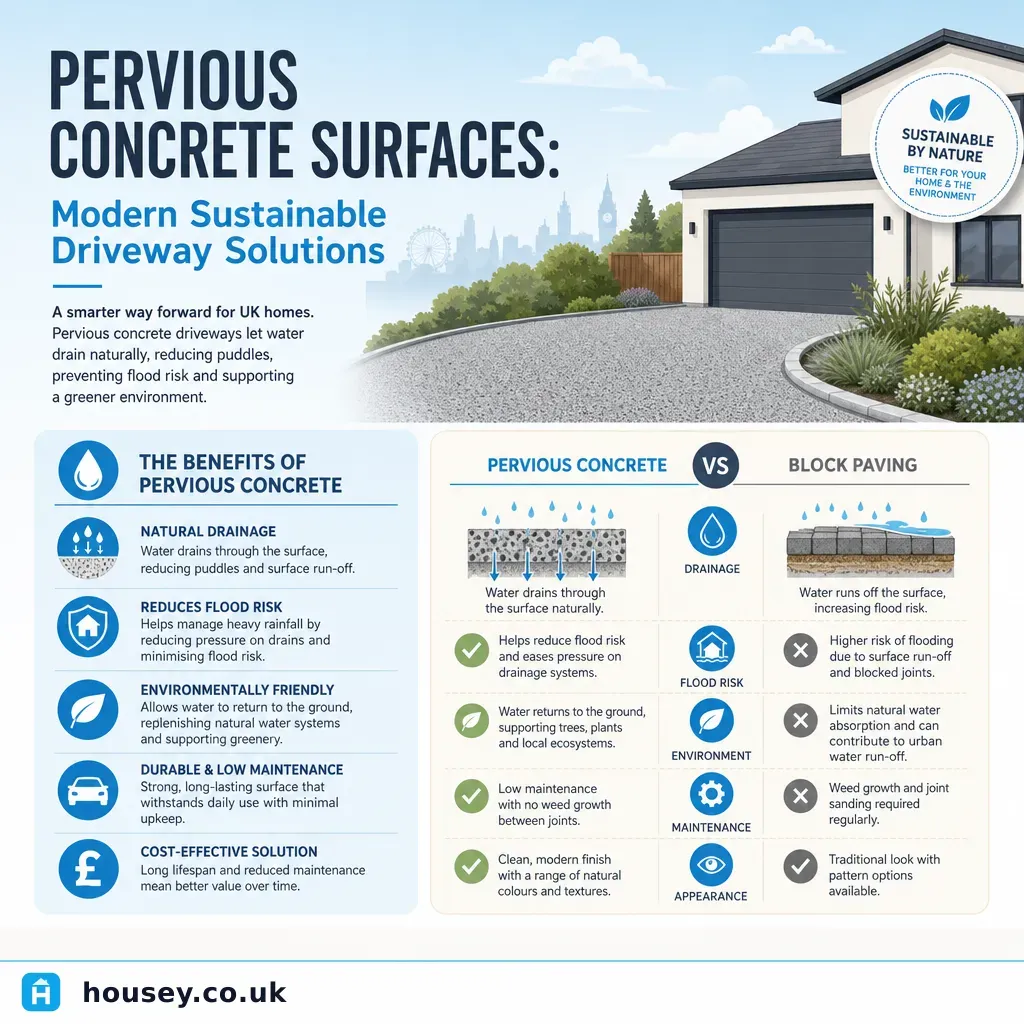
Pervious Concrete Surfaces: Modern Sustainable Driveway Solutions
Pervious concrete (also called porous or no-fines concrete) is a specialist concrete mix with large voids that allow rainwater to pass through the surface and into the sub-base below.