Blown-In Insulation: Installation Cost and Energy Efficiency Benefits
By Housey · Last reviewed 1st of June 2026
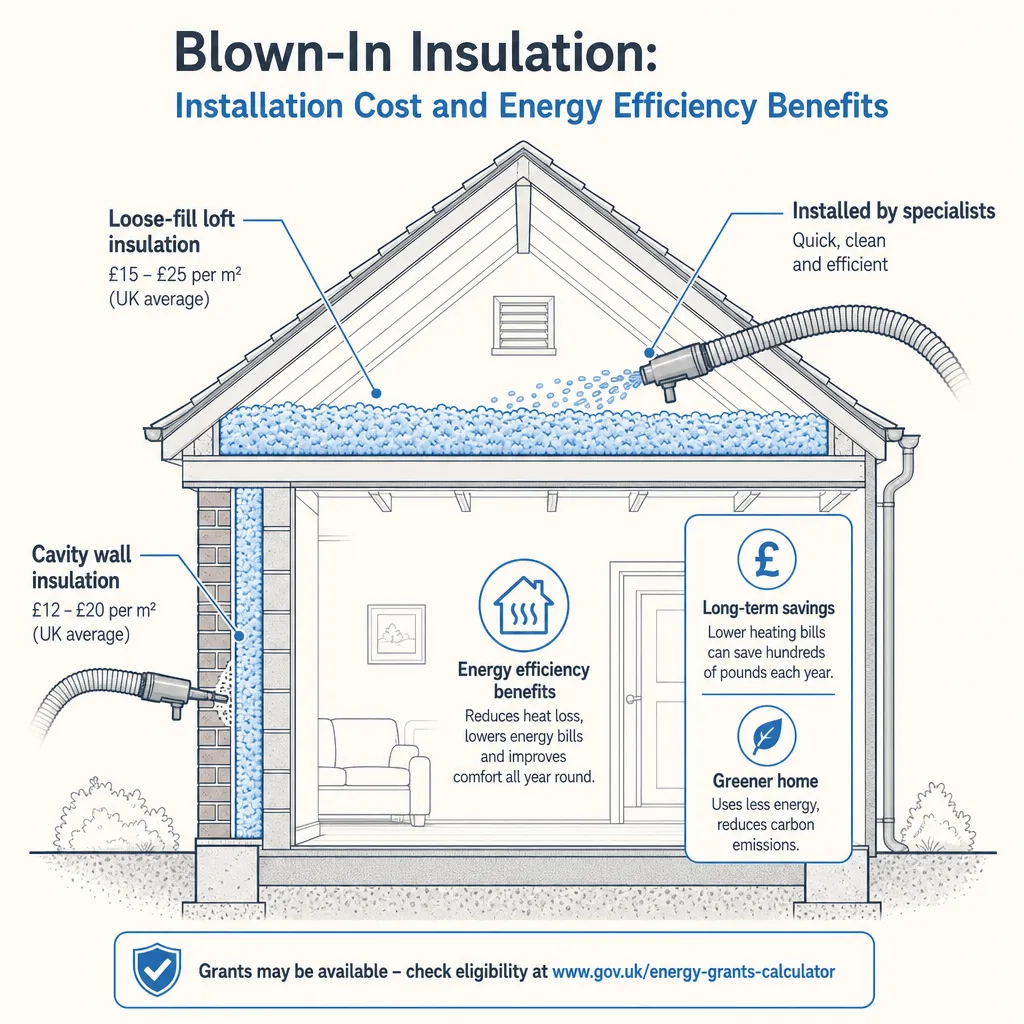
Blown-In Insulation: Installation Cost and Energy Efficiency Benefits
Blown-in insulation is one of the more practical routes to cutting heat loss in a UK home, particularly where standard roll or batt insulation is impractical — such as lofts with irregular joist spacing, obstacles like water tanks or pipework, or cavity walls in properties built from the 1920s through to the 1990s. With energy costs remaining high and Government-backed grant schemes still accepting applications, homeowners are increasingly looking at blown insulation as both a comfort improvement and a way to reduce heating bills without significant disruption.
Key points
- Blown loft insulation typically costs £300–£700 for an average three-bedroom semi-detached home; cavity wall blown insulation costs approximately £400–£1,200 depending on property size (indicative UK costs, last reviewed 2026-06-01).
- ECO4, the Government's main energy efficiency obligation scheme, may fund blown insulation at no cost to eligible households — check eligibility via the Simple Energy Advice service on GOV.UK.
- The Energy Saving Trust recommends a minimum loft insulation depth of 270 mm; blown mineral wool can reach this in a single installation visit.
- Cavity wall blown insulation must be installed by a BBA-certified or BSI Kitemark-accredited installer using a system approved for the specific wall type — incorrect installation can cause moisture ingress.
- Work funded through ECO4 or the Great British Insulation Scheme (GBIS) must be carried out by a TrustMark-registered, PAS 2030-certified installer under the PAS 2035 retrofit framework.
What is blown-in insulation?
Blown-in insulation (also called loose-fill insulation) uses a machine to pump or blow insulating material — mineral wool fibres, cellulose granules, or expanded polystyrene (EPS) beads — into a space rather than fitting pre-formed rolls or rigid boards by hand. The method is particularly effective where other approaches struggle:
- Lofts with irregular joist spacing or obstructions — loose fill flows around pipes, tanks, and stored items more easily than cut batts.
- Top-up installations — blown insulation can be added over thin existing insulation to reach the recommended 270 mm depth.
- Cavity walls — material is injected through small-diameter holes drilled into the external masonry, then re-mortared flush.
- Timber-framed structures — where rigid boards would leave gaps at edges and around joists.
Which blown insulation material is right for your home?
Material | Typical application | Thermal performance (λ value) | Key advantage | Key limitation |
|---|---|---|---|---|
Mineral wool (glasswool/rockwool) | Loft, cavity wall | 0.033–0.044 W/mK | Non-combustible, widely available | May settle slightly over very long periods |
Cellulose (recycled paper fibre) | Loft primarily | 0.035–0.040 W/mK | High recycled content; good for irregular lofts | Must be kept dry; check BBA certification |
EPS (expanded polystyrene) beads | Cavity wall specifically | 0.035–0.040 W/mK | Hydrophobic — sheds water in cavity | Not suitable for open-drained or poorly detailed cavities |
Polyurethane foam | Cavity wall (limited applications) | ~0.025 W/mK | Very low λ value | Difficult to remove; not suitable for all cavity types |
A note on cavity wall suitability: Not every cavity wall can be insulated with blown fill. Very narrow cavities (under 50 mm), exposed elevations prone to driven rain, and non-standard constructions — such as partial fill already present, rubble fill, or unusual wall ties — may be unsuitable. A pre-installation survey, typically carried out free by the installer, is required before any work begins.
How much does blown-in insulation cost in the UK?
Indicative UK costs, last reviewed 2026-06-01. Costs vary by property size, material choice, access conditions, and whether grant funding applies.
Blown loft insulation:
- 1–2 bedroom flat or small terraced house: £200–£400
- 3-bedroom semi-detached: £300–£700
- 4+ bedroom detached: £500–£1,000+
- Top-up of existing thin insulation: from approximately £150 for a small loft
Cavity wall blown insulation:
- 3-bedroom semi-detached: £400–£700
- 4-bedroom detached: £600–£1,200
- End-of-terrace (three exposed walls): £700–£1,400
Available grant funding:
- ECO4: Fully funded for households on qualifying benefits and low-income homes with an EPC rating of D, E, F, or G. Apply through your energy supplier or the Simple Energy Advice service on GOV.UK.
- Great British Insulation Scheme (GBIS): Partial funding for a wider income band — check current eligibility on GOV.UK.
- Local authority schemes: Some councils offer additional support for off-gas-grid or fuel-poor households. Contact your local authority directly.
Which blown insulation route is right for you?
- Choose blown loft insulation if your loft has less than 100 mm of existing insulation, joists are irregularly spaced, or the space is partially boarded and hard to access with rolls.
- Choose cavity wall blown insulation if your home was built between approximately 1920 and 1995, has a cavity wall construction, and has not previously been insulated.
- Get an independent assessment first if you have had persistent damp or condensation on internal walls, or the property is in a coastal or highly exposed location — cavity insulation can worsen pre-existing moisture problems if the root cause is not addressed.
- Check grant eligibility before agreeing to pay in full — eligible households may receive the work free under ECO4 or part-funded under GBIS.
- Use a TrustMark-registered, PAS 2030-certified installer if the work is being funded through an official scheme — only accredited installers can certify scheme-funded installations under PAS 2035.
- Ask a specialist about solid walls if you are unsure of your construction — solid masonry walls are sometimes mistaken for cavity walls and require a different retrofit approach entirely.
What energy savings can you expect?
Actual savings depend on how the home was heated before, existing insulation levels, occupant behaviour, and current energy tariffs. Based on Energy Saving Trust estimates (2024) for a typical semi-detached gas-heated home:
- Loft insulation (from uninsulated to 270 mm): approximately £150–£300 per year
- Cavity wall insulation (from uninsulated): approximately £200–£350 per year
These are indicative estimates for average households. Your Energy Performance Certificate (EPC) rating before and after installation is the most reliable way to measure thermal improvement — a good installer should be able to explain the expected EPC rating uplift before work begins.
U-value context: Adding 270 mm of blown mineral wool to an uninsulated loft can improve the roof's U-value from approximately 2.3 W/m²K (uninsulated) to around 0.15 W/m²K — below the 0.16 W/m²K target in Building Regulations Approved Document L for new work.
Homeowner checklist: before your blown insulation installation
When to get professional help
Blown insulation is generally a low-disruption improvement, but professional assessment is important — particularly for cavity walls.
Seek an independent professional opinion or pre-installation assessment before proceeding if:
- Your home has persistent damp or condensation on internal walls — cavity insulation can worsen underlying moisture problems if the cause is not resolved first.
- The property is in a high-exposure location such as a coastal or elevated site facing prevailing rain — some cavities in these positions are unsuitable for traditional blown fill.
- You have a non-standard wall construction — for example, a solid masonry wall incorrectly assumed to be cavity, a steel frame, or timber frame with unusual detailing.
- The property is listed or in a conservation area — drilling external masonry may require listed building consent.
- A previous cavity wall installation has caused damp — extraction of existing fill is a specialist job and should be assessed independently of the original installer.
How Housey can help
Housey connects UK homeowners with vetted insulation installers who can assess your loft or cavity walls, advise on the right blown insulation system, handle grant applications, and carry out certified installations. If you want an independent view before committing — particularly for cavity wall work in older or unusual properties — Housey can also help you book an insulation assessment to confirm wall type, cavity condition, and the best route forward.
Frequently asked questions
Is blown loft insulation better than rolls?
Blown insulation is particularly effective in lofts with irregular joist spacing, pipework, tanks, or areas that are hard to reach manually. Rolls are often sufficient — and slightly cheaper — for straightforward, accessible lofts. Many installers combine both: rolls for accessible runs and blown material to fill awkward edges and around joists. The right approach depends on your specific loft layout.
How long does blown cavity wall insulation last?
A properly installed system should last for the life of the property. The Cavity Insulation Guarantee Agency (CIGA) provides a 25-year independent guarantee on qualifying installations, covering the performance of the installation rather than the installer's continued trading. Both mineral wool and EPS bead systems are durable in dry, well-detailed cavities.
Can blown insulation cause damp?
Correctly installed cavity wall blown insulation in a suitable property should not cause damp. Problems typically arise when fill is installed in very exposed elevations, properties with pre-existing moisture defects, or non-standard wall details. This is why a pre-installation survey matters. If damp develops after installation, seek an independent assessment rather than relying on the original installer.
Do I need planning permission for blown insulation?
In most cases, no. Cavity wall blown insulation is injected through small holes that are re-mortared afterwards and does not require planning permission for standard residential properties. However, listed buildings may require consent, and conservation area properties should check with the local planning authority before any external masonry drilling takes place.
What is the CIGA guarantee?
The Cavity Insulation Guarantee Agency (CIGA) provides a 25-year independent guarantee on cavity wall insulation installed by registered members. It covers the performance of the installation rather than the specific installer's continued operation. Always request a CIGA guarantee certificate on completion of cavity wall insulation work.
Sources and further reading
- Simple Energy Advice — insulation guidance — Energy Saving Trust / GOV.UK
- Great British Insulation Scheme — GOV.UK
- ECO4 scheme guidance — Ofgem
- Cavity Insulation Guarantee Agency (CIGA) — CIGA
- Energy Saving Trust: loft and roof insulation — Energy Saving Trust
- Building Regulations Approved Document L — GOV.UK
Useful next reads
 Energy & Retrofit
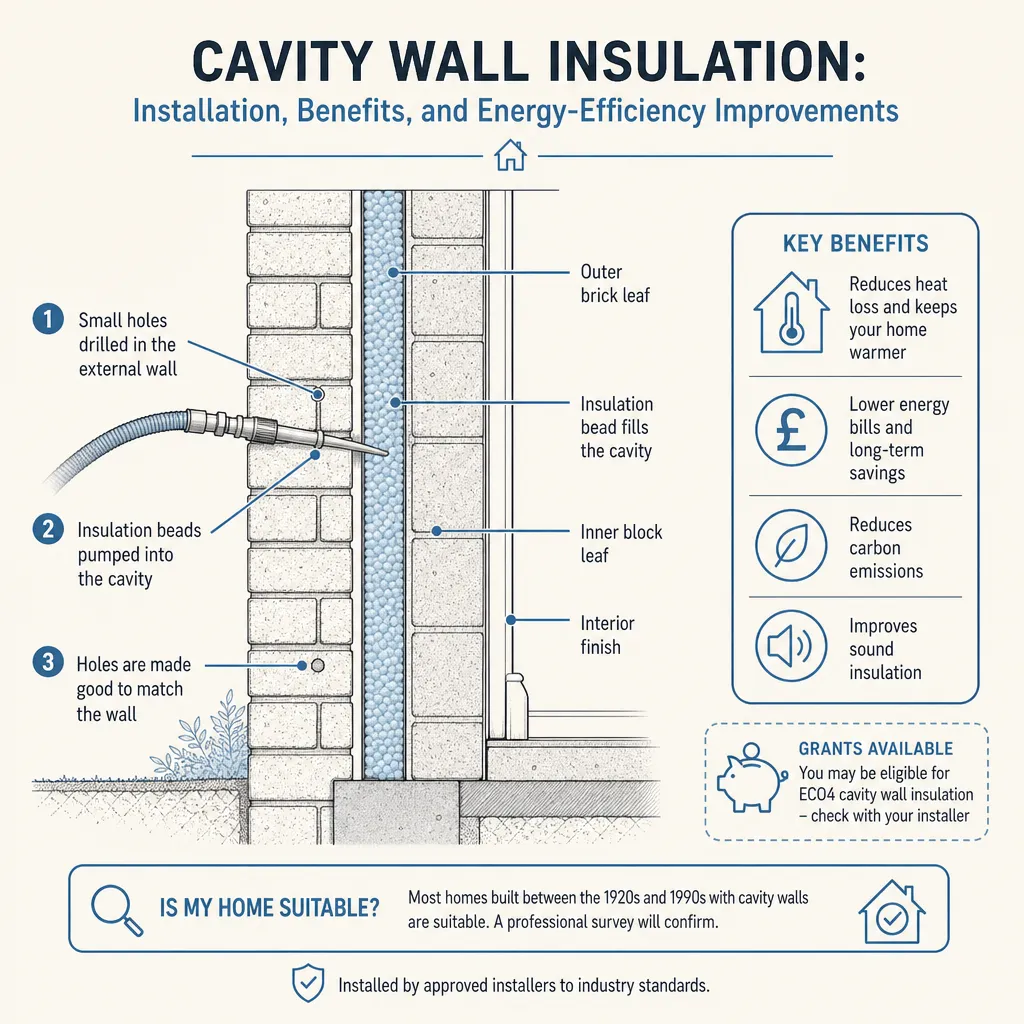
Cavity Wall Insulation: Installation, Benefits, and Energy-Efficiency Improvements
Cavity wall insulation fills the gap between the inner and outer leaves of a cavity wall with mineral wool, EPS beads, or injected foam.
 Energy & Retrofit
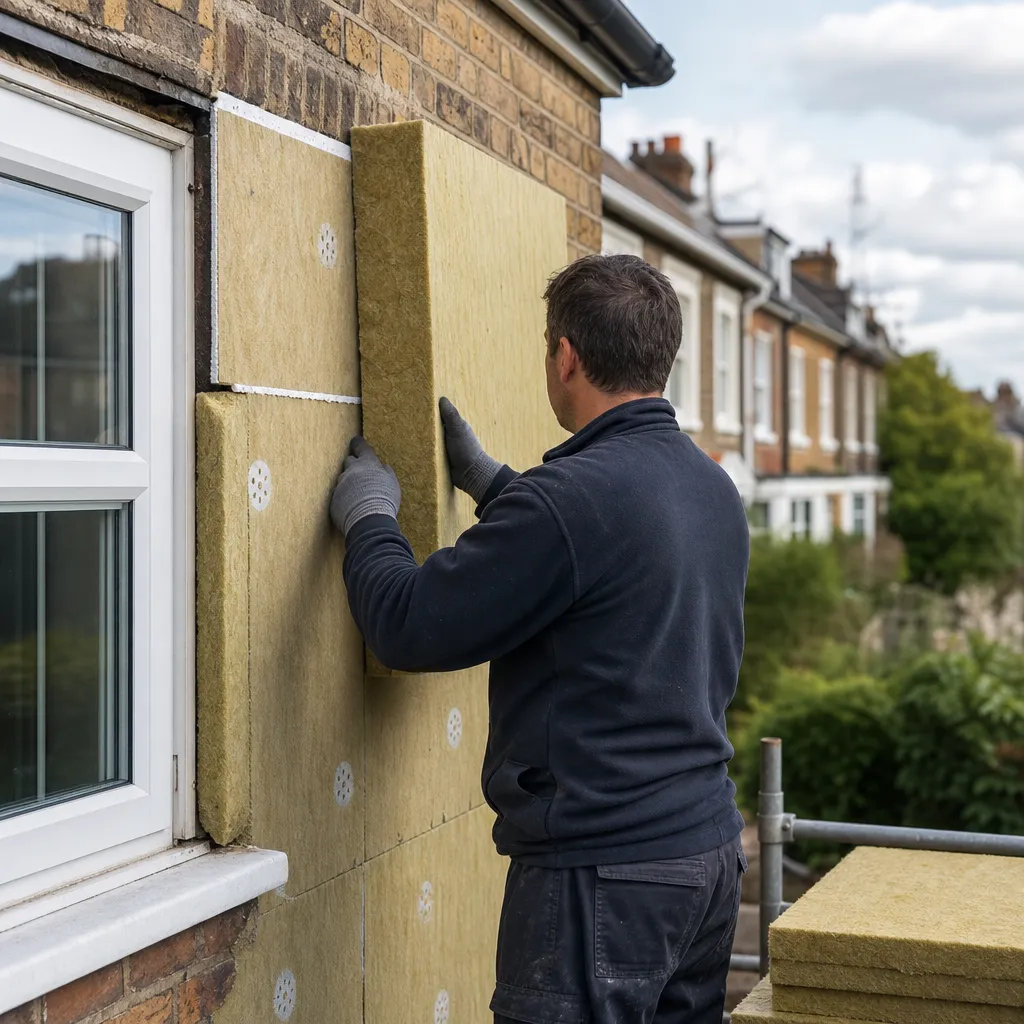
Insulation Types: Understanding Your Options for Home Energy Efficiency
The main insulation types used in UK homes are mineral wool, rigid foam boards, blown loose fill, spray foam, and natural materials such as wood fibre or sheep's wool.
 Energy & Retrofit
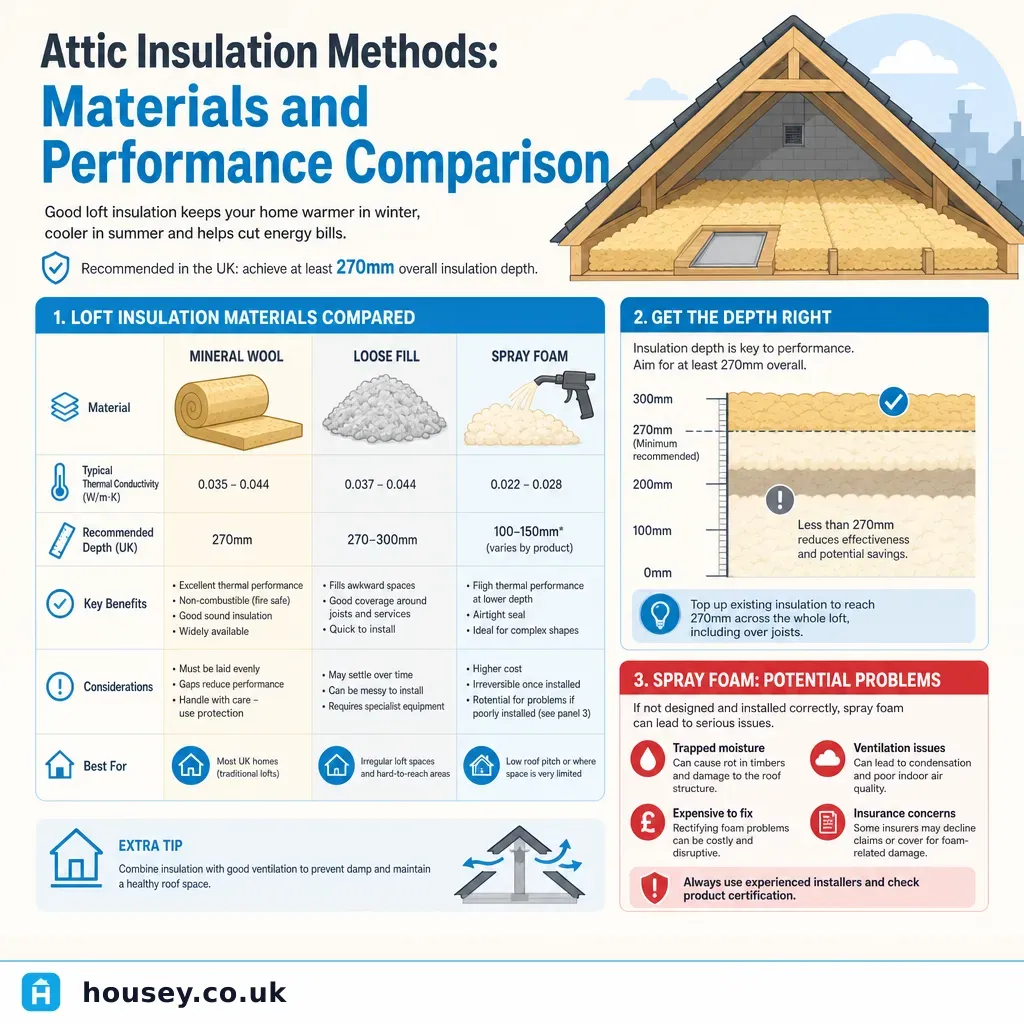
Attic Insulation Methods: Materials and Performance Comparison
UK loft insulation options include mineral wool rolls (most common and grant-funded), blown loose-fill for irregular lofts, and rigid PIR board for warm roof conversions.
 Energy & Retrofit
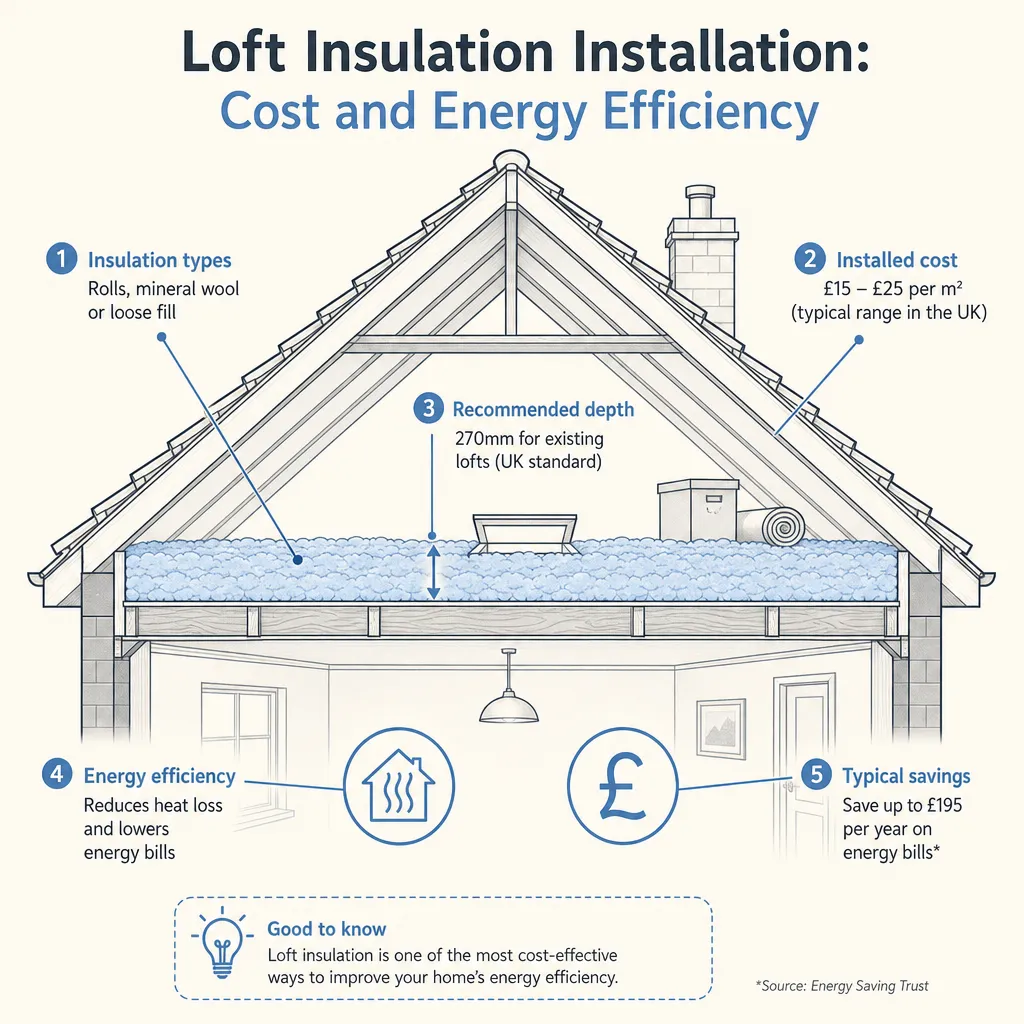
Loft Insulation Installation: Cost and Energy Efficiency
Loft insulation typically costs £300–£700 installed for a standard three-bedroom semi-detached using mineral wool.
 Energy & Retrofit
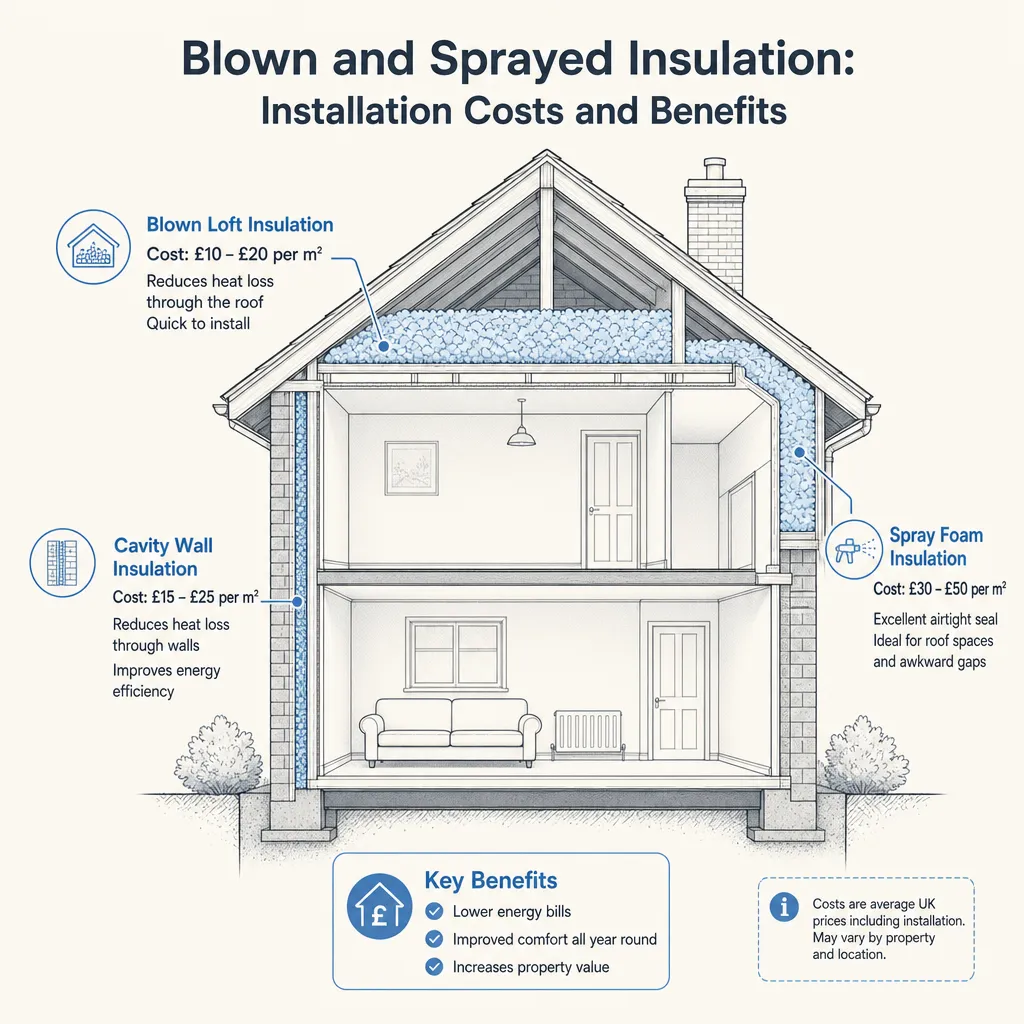
Blown and Sprayed Insulation: Installation Costs and Benefits
Blown cavity wall insulation for a typical semi-detached house costs £400–£1,200; blown loft insulation costs £300–£600.