Loft Insulation Installation: Cost and Energy Efficiency
By Housey · Last reviewed 7th of May 2026
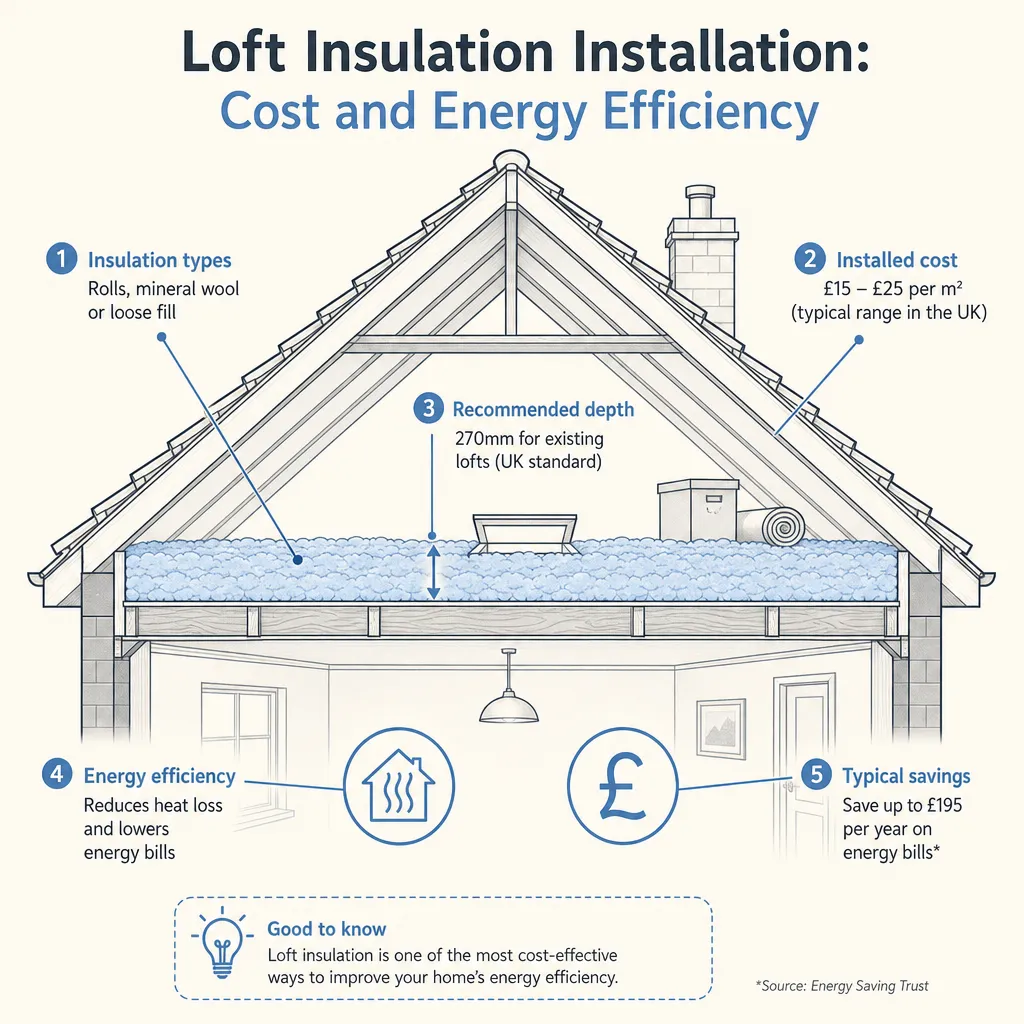
Loft Insulation Installation: Cost and Energy Efficiency
Loft insulation sits near the top of most energy-efficiency improvement lists for UK homes because an uninsulated or under-insulated pitched roof can account for up to 25% of a property's heat loss. The question of type, depth, and cost typically arises when a surveyor flags thin or missing insulation, an EPC assessment returns a low rating, or heating bills remain stubbornly high despite other upgrades. Getting the specification right before requesting quotes avoids costly rework and ensures any grant funding is correctly applied.
Key points
- Building Regulations Approved Document L recommends a minimum 270mm total depth of mineral wool for a cold loft floor, achieving a U-value of approximately 0.16 W/m²K.
- The ECO4 scheme, administered by Ofgem, can fund loft insulation at no cost for eligible low-income and energy-vulnerable households — check current GOV.UK guidance for up-to-date eligibility.
- The Great British Insulation Scheme (GBIS) extends grant eligibility to homes with an EPC rating of D or below in many cases; check GOV.UK for current scheme status.
- Cold loft insulation (laid between and over the joists) suits unoccupied lofts; warm loft insulation (fitted between and over the rafters) is required when the loft is a habitable or converted space.
- Spray foam insulation applied directly to roof timbers can complicate mortgage lending and should only be considered after independent professional advice.
What types of loft insulation are available?
The right insulation type depends on how the loft is used and the roof's construction.
Insulation type | How it is installed | Best for | Key considerations |
|---|---|---|---|
Mineral wool blanket (glass or rock wool) | Laid in two layers between and over joists | Cold, unoccupied lofts in most property types | Most common and cost-effective; eave ventilation must be maintained |
Loose-fill (cellulose or mineral fibre) | Machine-blown into the loft space | Irregular joist spacings or hard-to-reach areas | Fast installation; netting may be needed near eaves |
Rigid insulation boards | Fixed between or over rafters | Warm lofts and loft conversions | Higher thermal performance per millimetre; higher material cost |
Spray polyurethane foam (SPF) | Sprayed directly onto the roof underside | Rarely recommended for standard refurbishment | Can cause condensation in roof timbers, void warranties, and complicate mortgage lending |
Sheep's wool or natural fibre | Laid between joists | Eco-conscious homeowners | Good thermal and moisture-regulating properties; higher material cost than mineral wool |
For most UK homes with a conventional pitched roof and an unoccupied loft, mineral wool blanket insulation is the standard recommendation: 100mm between the joists and a further 170mm cross-laid on top, reaching the recommended 270mm total.
How much does loft insulation cost in the UK?
Costs depend on loft floor area, access quality, existing insulation depth, and whether boarding or hatch work is required.
Indicative UK costs, last reviewed 2026-05-07.
Property type | Approximate loft floor area | Typical installed cost (mineral wool, cold loft) |
|---|---|---|
One-bedroom flat with accessible loft | 15–25 m² | £200–£400 |
Three-bedroom semi-detached | 40–55 m² | £300–£700 |
Four-bedroom detached | 60–80 m² | £500–£900 |
Warm loft / rafter insulation | Per m² rate | £20–£45 per m² supply and install |
Key cost drivers to discuss with installers:
- Access: A small or awkwardly positioned hatch adds time and cost.
- Existing depth: Topping up from 100mm to 270mm is faster than starting from nothing.
- Loft boarding: Boards sitting directly on joists must be raised on proprietary legs to sit above the insulation — typically adding £150–£400.
- Grant funding: ECO4 or GBIS may reduce or eliminate cost for eligible households.
Always request at least three written quotes specifying material, installed depth, total area, and any preparatory work.
Grants and funding for loft insulation
Eligibility and availability change, so verify current status on GOV.UK before instructing any installer on grant grounds.
ECO4: Administered by Ofgem via energy suppliers, targeting low-income and fuel-poor households. Eligible properties have typically received insulation fully funded. Check via GOV.UK or contact your energy supplier.
Great British Insulation Scheme (GBIS): Open to homes with an EPC rating of D or below in many circumstances, delivered by TrustMark-registered installers.
Local Authority Flex (LA Flex): Some councils extend ECO4 eligibility to households in fuel poverty who do not meet standard criteria. Contact your local council's energy-efficiency team.
Government-funded installations must use a TrustMark-registered installer. Verify registration independently at the TrustMark website before agreeing to any work.
What depth of insulation do you need?
For a cold loft, Approved Document L and the Energy Saving Trust recommend a minimum of 270mm of mineral wool, achieving roughly 0.16 W/m²K. Many homes built before 1990 — including 1930s semis and post-war estates — have 100mm or less. A top-up to 270mm is often the single most cost-effective thermal upgrade available.
For warm loft or rafter insulation in a habitable loft room, Part L targets a U-value of 0.18 W/m²K or better when this forms part of regulated building work.
Red flags and what not to assume
Do not assume existing boarding is compatible with deeper insulation. Boards laid directly on joists typically sit at 47–75mm, well below 270mm. Retaining them requires raising on legs — a step that must be explicitly quoted.
Do not accept spray foam without independent advice. SPF is difficult and expensive to remove, can cause condensation in roof timbers, and has led some lenders to decline mortgage applications on affected properties. RICS has published guidance flagging these concerns.
Do not assume the loft is safe to work in. If asbestos-containing materials (ACMs) are suspected — common in homes built before 2000 — do not disturb them. Arrange an asbestos survey before any insulation work proceeds.
Do not assume a grant offer means the installer is qualified. Always verify TrustMark status independently.
What to ask before accepting a quote
Use this checklist when comparing insulation installers:
- What material and product are you specifying, and what is its thermal conductivity (λ value)?
- What total installed depth will be achieved, and does this meet the 270mm recommendation?
- Is the quote based on a loft survey or estimated from property type alone?
- What happens if existing insulation is damp or ACMs are suspected?
- Is existing loft boarding included? Will it need raising on legs?
- Is VAT included? (Domestic insulation is currently zero-rated.)
- Are you TrustMark-registered? Can I verify this independently?
- What documentation will you provide on completion?
When to get professional help
Get professional input when:
- You suspect asbestos-containing materials — arrange an asbestos survey before any insulation work.
- The loft has active damp, condensation, or timber decay — insulating over moisture problems makes them worse.
- You are considering spray foam and have a mortgage or plan to sell.
- The loft will become habitable space — warm loft design needs a detailed thermal and ventilation specification.
- The property is listed or in a conservation area and alterations may require consent.
How Housey can help
Housey connects you with vetted insulation installers across the UK. If you want site-specific guidance before committing to a product or grant application, you can also request a professional insulation assessment to confirm the right specification for your home.
Frequently asked questions
How much does loft insulation cost for a three-bedroom house?
For a typical three-bedroom semi-detached with an accessible cold loft, mineral wool insulation to 270mm depth usually costs £300–£700 installed. Costs vary with loft area, access conditions, existing insulation depth, and whether loft boarding needs lifting or re-raising on legs. Indicative UK costs, last reviewed 2026-05-07.
Can I install loft insulation myself?
Laying mineral wool blanket insulation in an accessible cold loft is DIY-feasible for a physically capable person who can safely reach the space. However, ECO4 and GBIS funding requires a TrustMark-registered installer. Before starting, check for damp, confirm there are no asbestos-containing materials, and ensure the eaves have adequate ventilation to prevent condensation.
Will spray foam loft insulation cause problems when I sell?
It may. Some mortgage lenders have declined to lend on properties where spray foam has been applied to roof timbers, citing concerns about moisture, structural integrity, and difficulty of removal. RICS has flagged this issue in guidance to surveyors. Seek independent advice and check with your mortgage lender before proceeding.
What is the recommended depth for loft insulation in the UK?
Building Regulations Approved Document L and Energy Saving Trust guidance recommend a minimum total depth of 270mm for mineral wool on a cold loft floor, achieving a U-value of around 0.16 W/m²K. Many homes built before 1990 have only 100mm and benefit significantly from a straightforward top-up layer.
Is loft insulation VAT-free in the UK?
Yes. Under current HMRC rules, the installation of energy-saving materials — including loft insulation — in residential properties is zero-rated for VAT, covering both materials and labour. Always confirm this with your installer and check the latest HMRC guidance, as VAT treatment can change.
Sources and further reading
- Loft insulation guidance — Energy Saving Trust
- Energy Company Obligation (ECO4) — GOV.UK
- Great British Insulation Scheme — GOV.UK
- Approved Document L: Conservation of fuel and power — GOV.UK / DLUHC
- TrustMark installer register — TrustMark
- RICS news and insights — RICS
Useful next reads
 Energy & Retrofit
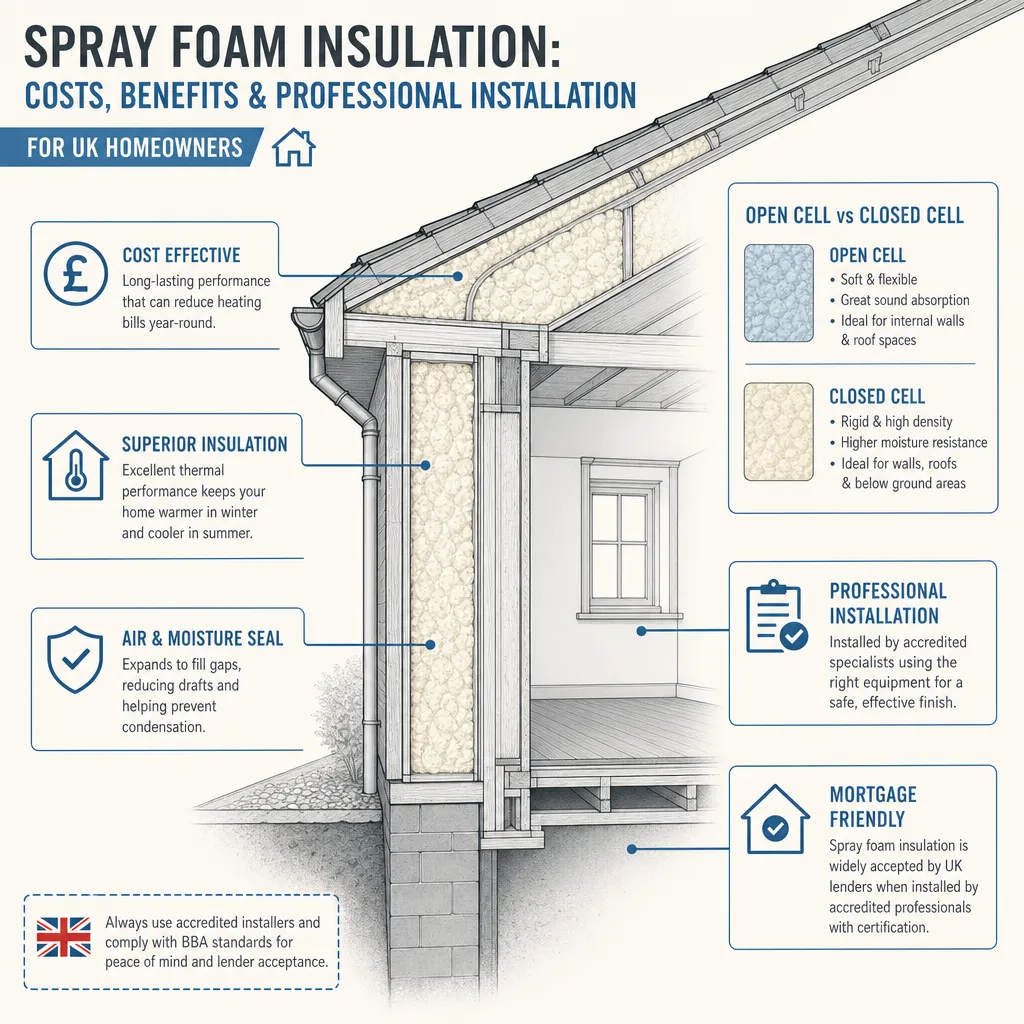
Spray foam insulation: costs, benefits and professional installation
Spray foam insulation costs between £15 and £60 per square metre installed in the UK, depending on whether open-cell or closed-cell foam is used.
 Energy & Retrofit
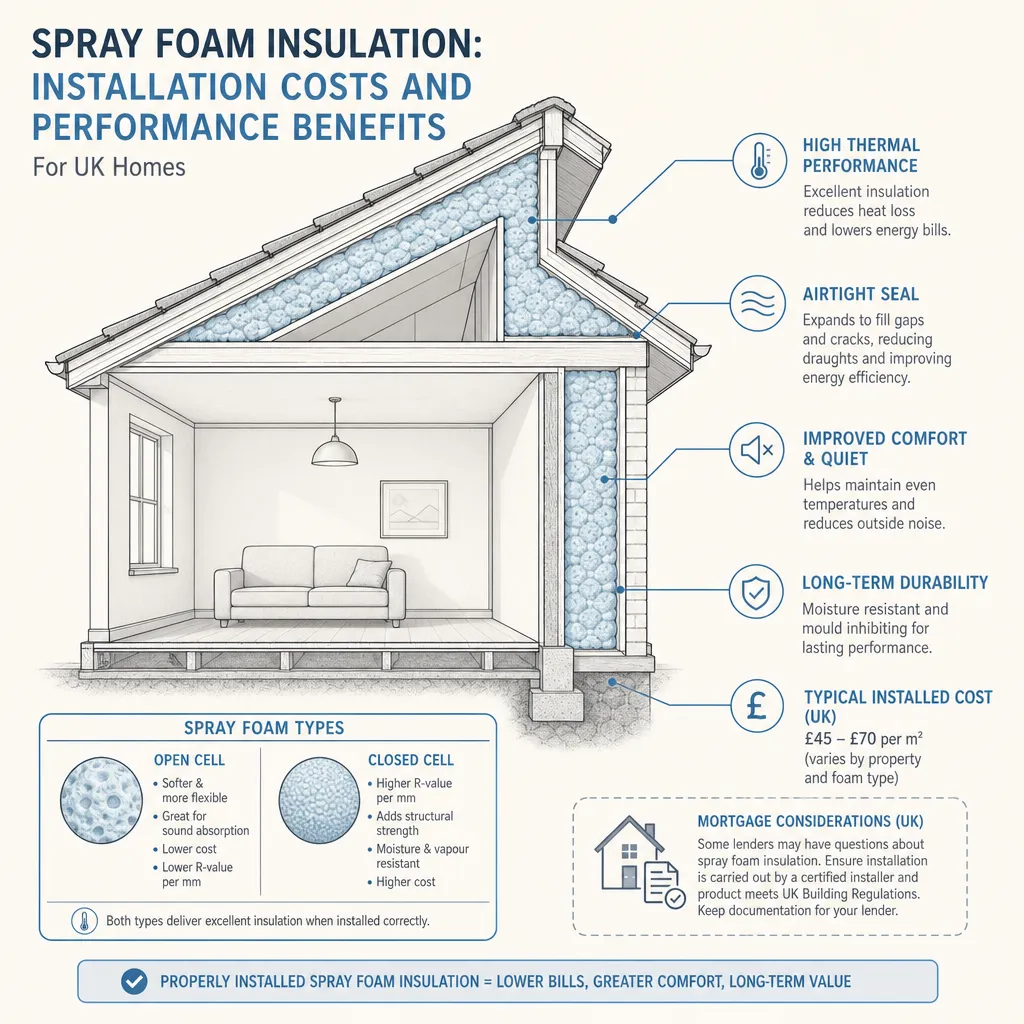
Spray Foam Insulation: Installation Costs and Performance Benefits
Spray foam insulation costs £1,500–£5,000 installed for an average UK home depending on type and area covered.
 Energy & Retrofit
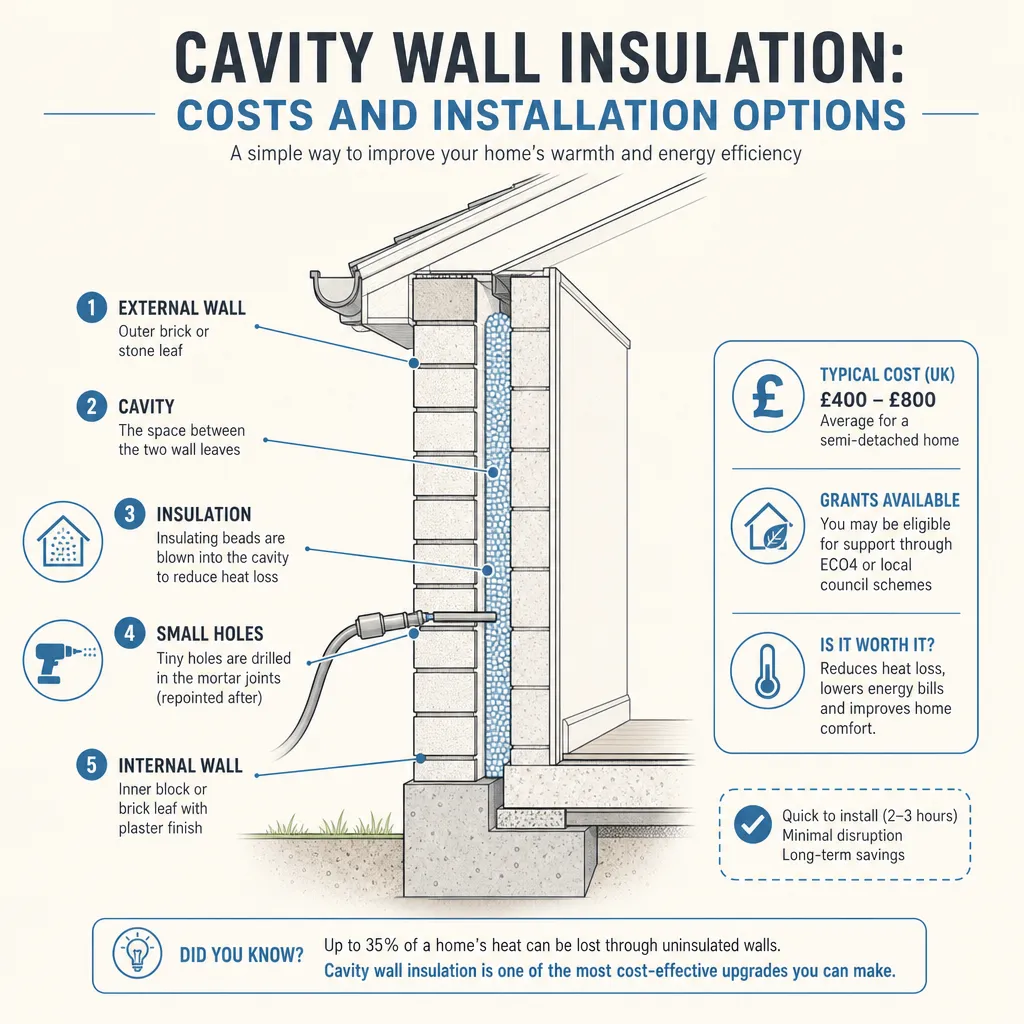
Cavity Wall Insulation: Costs and Installation Options
Cavity wall insulation typically costs £400–£1,200 for a standard UK semi-detached home, though eligible households may pay nothing under ECO4.
 Energy & Retrofit
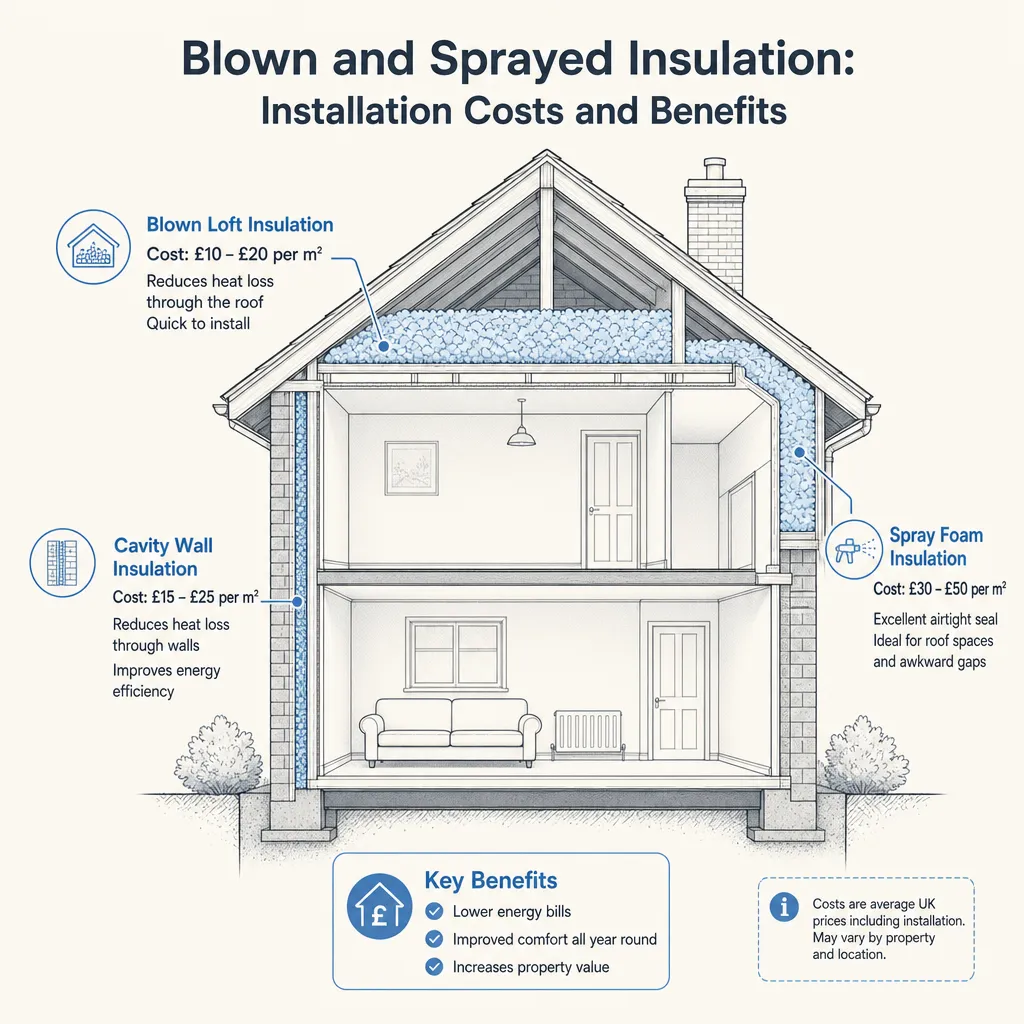
Blown and Sprayed Insulation: Installation Costs and Benefits
Blown cavity wall insulation for a typical semi-detached house costs £400–£1,200; blown loft insulation costs £300–£600.
 Energy & Retrofit
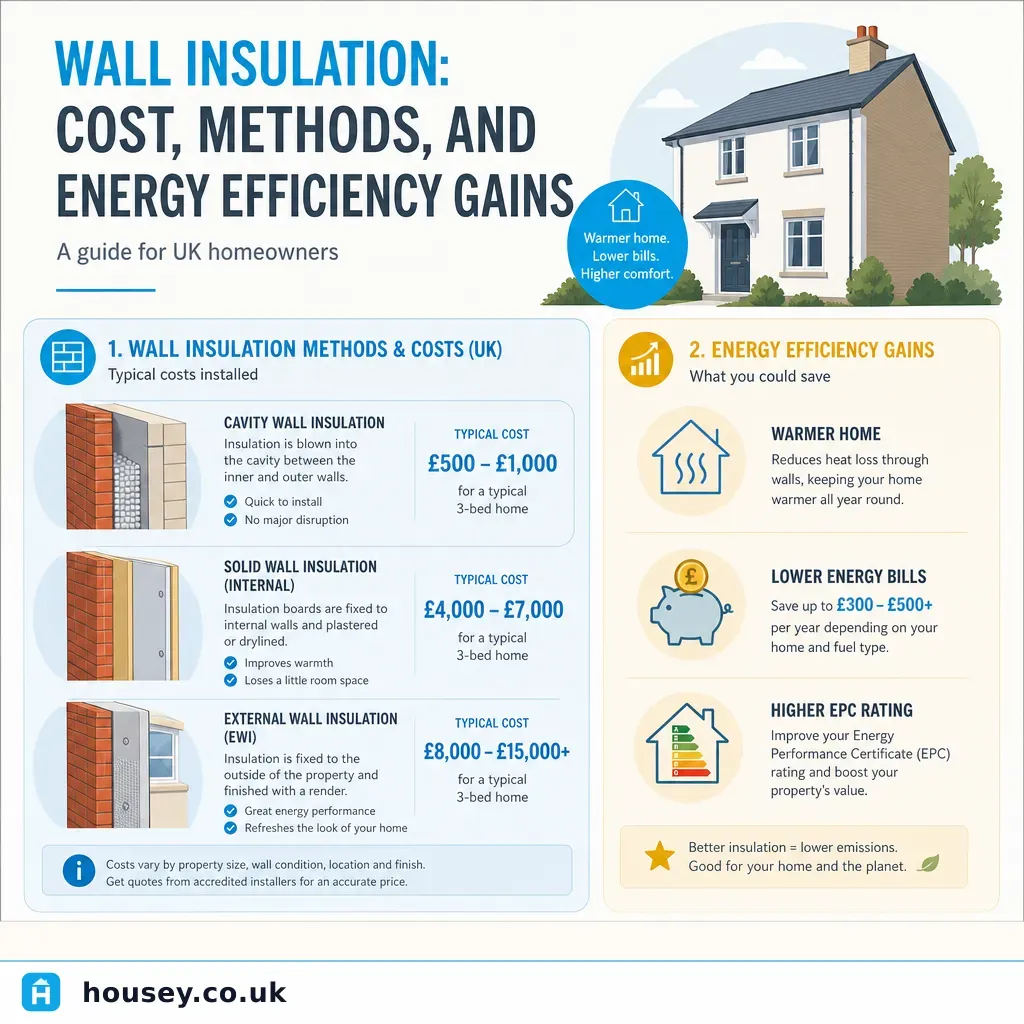
Wall Insulation: Cost, Methods, and Energy Efficiency Gains
Wall insulation in UK homes uses one of three main methods: cavity wall insulation for post-1920 homes with an unfilled cavity, external wall insulation for solid-walled properties, and internal wall insulation where external changes are not permitted.