Blown and Sprayed Insulation: Installation Costs and Benefits
By Housey · Last reviewed 30th of May 2026
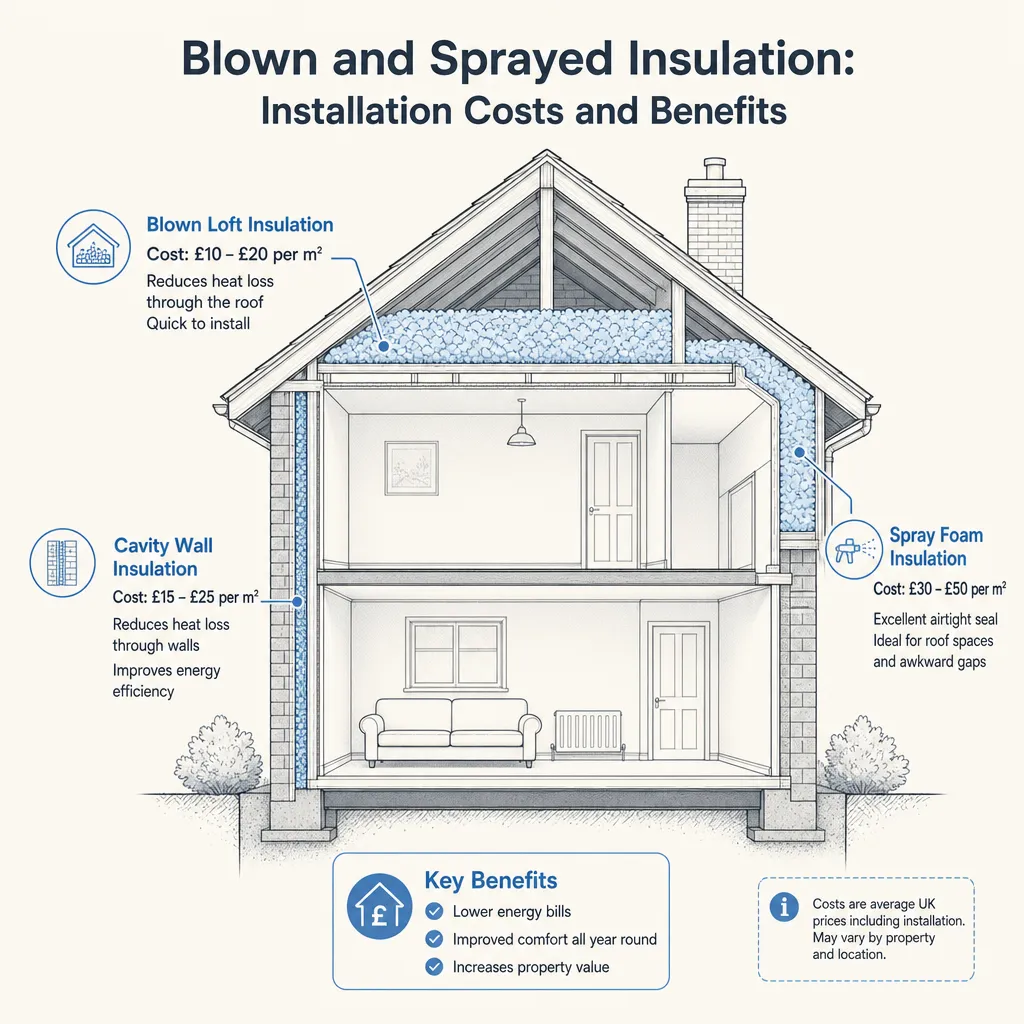
Blown and Sprayed Insulation: Installation Costs and Benefits
Cavity wall and loft insulation installed through blown or sprayed techniques are among the most widely used measures in UK homes for reducing heat loss and cutting energy bills. But installation quality, material suitability, and moisture management vary considerably — and the consequences of poorly specified or incorrectly installed insulation, from interstitial condensation to mortgage complications from sprayed foam, can be significant and expensive to reverse. Understanding costs, grant options, and risks before commissioning work helps you avoid those pitfalls.
Key points
- Blown mineral wool or cellulose cavity wall insulation for a typical semi-detached house typically costs £400–£1,200 installed; blown loft insulation typically costs £300–£600 (Indicative UK costs, last reviewed 2026-05-30).
- PAS 2035 is the UK quality standard for domestic retrofit; work funded through public schemes such as ECO4 or the Great British Insulation Scheme must comply with PAS 2035 and be overseen by a TrustMark-registered Retrofit Coordinator.
- Sprayed polyurethane foam (SPF) in roof spaces is not recommended by RICS and is viewed with caution by many mortgage lenders — it can make a property difficult to mortgage or sell, and should only be considered after written confirmation from your lender and conveyancing solicitor.
- ECO4 (Energy Company Obligation 4) and the Great British Insulation Scheme may fund cavity wall or loft insulation at no cost for eligible households, assessed on income, qualifying benefits, or EPC rating.
- Installers should carry TrustMark registration and provide a CIGA (Cavity Insulation Guarantee Agency) guarantee for cavity wall work — these give homeowners a recognised route to recourse if problems emerge after installation.
Types of blown and sprayed insulation compared
Type | Application | Typical installed cost | Approx. U-value achieved | Main risk if wrong |
|---|---|---|---|---|
Blown mineral wool (cavity wall) | Injected into existing cavity via drilled holes in outer leaf | £400–£1,200 (semi-detached) | ~0.5 W/m²K | Moisture bridging if cavity already has defects; not suitable for all wall constructions |
Blown cellulose (loft) | Pumped as loose-fill to required depth in loft space | £300–£600 (semi-detached loft) | ~0.16 W/m²K at 270 mm depth | Moisture sensitivity if loft ventilation is inadequate; settles slightly over time |
Blown EPS beads (cavity wall) | Adhesive-bonded expanded polystyrene beads injected into cavity | £600–£1,400 (semi-detached) | ~0.5 W/m²K | Bead migration if cavity is poorly sealed; specialist pre-survey essential |
Sprayed open-cell polyurethane foam (roof / loft) | Sprayed directly onto underside of roof tiles or rafters | £1,500–£3,000 (semi-detached) | ~0.2–0.3 W/m²K | Mortgage lendability issues; bonds tiles together, complicating future repairs |
Sprayed closed-cell polyurethane foam (walls / floors) | Applied to subfloor or internal wall surfaces | £2,000–£5,000+ depending on area | ~0.2 W/m²K | Strong vapour barrier effect; interstitial condensation risk in inappropriate applications |
Indicative UK costs, last reviewed 2026-05-30. Costs depend on property size, access conditions, material specification, and regional market rates.
Blown cavity wall insulation: what to expect
Cavity wall insulation suits homes with an unfilled cavity between inner and outer wall leaves — typically most UK homes built roughly between 1920 and 1995, before factory-fitted insulation became standard in new construction.
An installer drills small holes at regular intervals in the outer leaf (usually into mortar joints), injects mineral wool fibre or EPS beads using a blower hose, then fills and points the holes with mortar matched to the existing masonry. For a standard semi-detached house the process typically takes half a day.
A thorough pre-installation survey should check:
- Cavity width — a minimum of approximately 50 mm is typically required for most materials
- Cavity condition — existing debris, mortar droppings, or previous partial fill
- Site exposure to driving rain — highly exposed sites may need different materials or may be unsuitable
- Whether the outer leaf has cracks, failed pointing, or saturated areas that could be worsened by installation
Blown loft insulation: what to expect
Blown loft insulation — typically mineral wool or cellulose — is used where access constraints, existing obstructions, or irregular joist layouts make rolling manually impractical, or where a consistent depth across a large loft is the priority. A blower machine achieves the Approved Document L recommended depth of 270 mm or above.
Worked example — 1970s semi-detached in the East Midlands: A three-bedroom 1970s cavity-wall semi-detached had 100 mm of existing glass wool in the loft, well below the Approved Document L recommendation of 270 mm. The homeowner commissioned a cellulose top-up blow to achieve 270 mm total depth. The work took approximately three hours, cost £380, and was funded in full through the Great British Insulation Scheme as the property had an EPC rating of E and met the household income criteria. Annual heating bill savings were estimated at £150–£200 based on Energy Saving Trust indicative figures for East Midlands stock of that era.
Sprayed foam insulation: key considerations
Sprayed polyurethane foam applied to the underside of roof tiles or structural timbers is a distinct product category with a materially different risk profile from blown insulation.
Why sprayed foam in roof spaces warrants particular caution:
- RICS has issued guidance noting that sprayed foam in roof spaces can render a property difficult to value and mortgage, because lenders and valuers cannot adequately inspect the timber condition beneath the foam coating.
- Several major UK mortgage lenders will decline to lend on properties with spray foam in the roof space unless a specialist assessment confirms the timbers are sound and the foam is removable.
- Removal is expensive — often £3,000–£7,000 or more — and may cause damage to structural timbers.
- Foam bonds roof tiles together, complicating individual tile replacement and potentially voiding roofing warranties.
Before instructing any sprayed foam installation in a roof or loft space, obtain written confirmation from your mortgage lender and conveyancing solicitor that it will not affect your current or future mortgage or your ability to sell.
Grants and funding available (as of 2026)
- ECO4 (Energy Company Obligation 4) — funded by energy suppliers, ECO4 provides insulation at no cost to eligible households in England, Scotland, and Wales. Eligibility is assessed against income, qualifying benefits received, and EPC rating (typically D to G). Apply via a registered ECO4 installer or through GOV.UK.
- Great British Insulation Scheme — a separate government scheme targeting homes with an EPC rating of D or below, with some income means-testing. Both schemes require PAS 2035-compliant installation overseen by a TrustMark-registered Retrofit Coordinator.
- Local authority flexible eligibility (LA Flex) — councils can extend ECO4 eligibility to households outside the standard income criteria who are in fuel poverty. Contact your local council's energy or housing team.
- Warmer Homes Scotland — the equivalent programme for Scottish homeowners, administered by Home Energy Scotland.
Important limitations
This article provides general information about blown and sprayed insulation costs and installation considerations. It is not a technical specification or a professional assessment of your specific property. Suitability depends on your property's construction type, age, cavity width, condition, exposure rating, existing insulation, ventilation arrangements, and moisture levels — all of which require on-site assessment by a qualified installer or independent assessor.
Grant eligibility criteria, scheme rules, and Building Regulations requirements can change. Confirm current eligibility and compliance obligations with a TrustMark-registered installer or the relevant scheme administrator before commissioning any work. If your property is listed or in a conservation area, consult your local planning authority before any wall or roof insulation work, as listed building consent may be required.
What to ask a qualified professional
Before instructing an insulation installer, ask:
- Is a pre-installation survey included, and will it be carried out by an independent assessor or by the same firm doing the installation?
- Does the installation need to comply with PAS 2035, and will a TrustMark-registered Retrofit Coordinator be overseeing the work?
- What warranty or guarantee is provided, and through which body — CIGA, KIWA, or another recognised scheme?
- Is the installer registered under ECO4 or the Great British Insulation Scheme, if you are applying for grant funding?
- For cavity wall work: has the cavity been assessed for suitability, exposure rating, and the presence of existing debris or partial fill?
- For sprayed foam: do you have written confirmation from my mortgage lender that this installation will not affect my ability to mortgage or sell the property?
- What ventilation measures will accompany the insulation to prevent condensation risk?
- How will drilled holes in the masonry be finished and colour-matched to the existing brickwork or render?
When to get professional help
Do not proceed with blown or sprayed insulation without a pre-installation survey from a suitably qualified assessor if any of the following applies:
- The property has a history of damp, condensation, or mould — insulation can trap moisture and worsen existing conditions.
- External walls show cracking, failed pointing, or signs of saturated masonry — installing insulation into a compromised envelope can accelerate deterioration.
- You are planning to sell or remortgage — check with your solicitor or lender first, particularly if sprayed foam is under consideration.
- The property was built before approximately 1920 and has solid (single-leaf) walls — cavity wall insulation does not apply; external or internal wall insulation carries a different and more complex moisture risk profile.
- You have been approached by a cold caller offering free insulation — verify independently that any offer is part of a legitimate government-backed scheme before allowing work to begin.
How Housey can help
Housey connects homeowners with TrustMark-registered insulation installers across the UK. Request quotes from accredited specialists, check their scheme registrations, and compare their pre-installation survey processes before you commit.
Frequently asked questions
How long does cavity wall insulation last?
Mineral wool and EPS bead cavity wall insulation, when correctly installed in a suitable property, typically lasts 25 years or more. The Cavity Insulation Guarantee Agency (CIGA) issues 25-year guarantees for qualifying installations by registered member firms, providing a formal route to recourse if problems emerge within that period.
Is blown loft insulation better than rolled insulation?
Blown insulation achieves consistent depth in lofts with obstructions — pipes, joists, awkward eaves — where manually laying rolls is difficult. Rolled mineral wool gives comparable thermal performance when correctly installed to the right depth. The choice usually depends on the installer's equipment and the specific loft layout rather than any significant performance difference.
Will cavity wall insulation cause damp?
Correctly installed cavity wall insulation in a suitable property should not cause damp. Problems arise when walls are already wet, the cavity contains bridging mortar, or the site is highly exposed to driving rain. A proper pre-installation survey should identify these risks. CIGA maintains a process for investigating and remedying defective installations by registered members.
Can blown cavity wall insulation be removed?
Mineral wool cavity wall insulation can usually be removed by reverse extraction — essentially reverse blowing — though the process is not always completely successful and some residue may remain. Sprayed foam is substantially harder and more costly to remove, and full extraction may not be possible without damaging structural timbers, which is a key reason it warrants particular caution.
Does blown insulation require building regulations approval?
Cavity wall insulation in existing homes is generally covered by a self-certification scheme — the registered installer submits a completion notice — rather than requiring a formal building control application. The work must nonetheless meet Approved Document L (Conservation of Fuel and Power). Always request the certificate of completion and retain it with your property documents.
Sources and further reading
- ECO4 — energy company obligation scheme — GOV.UK
- Great British Insulation Scheme — GOV.UK
- TrustMark — PAS 2035 and retrofit standards — TrustMark
- RICS — guidance on spray foam insulation in residential properties — RICS
- Cavity Insulation Guarantee Agency (CIGA) — CIGA
- Cavity wall insulation — energy saving guidance — Energy Saving Trust
Useful next reads
 Energy & Retrofit
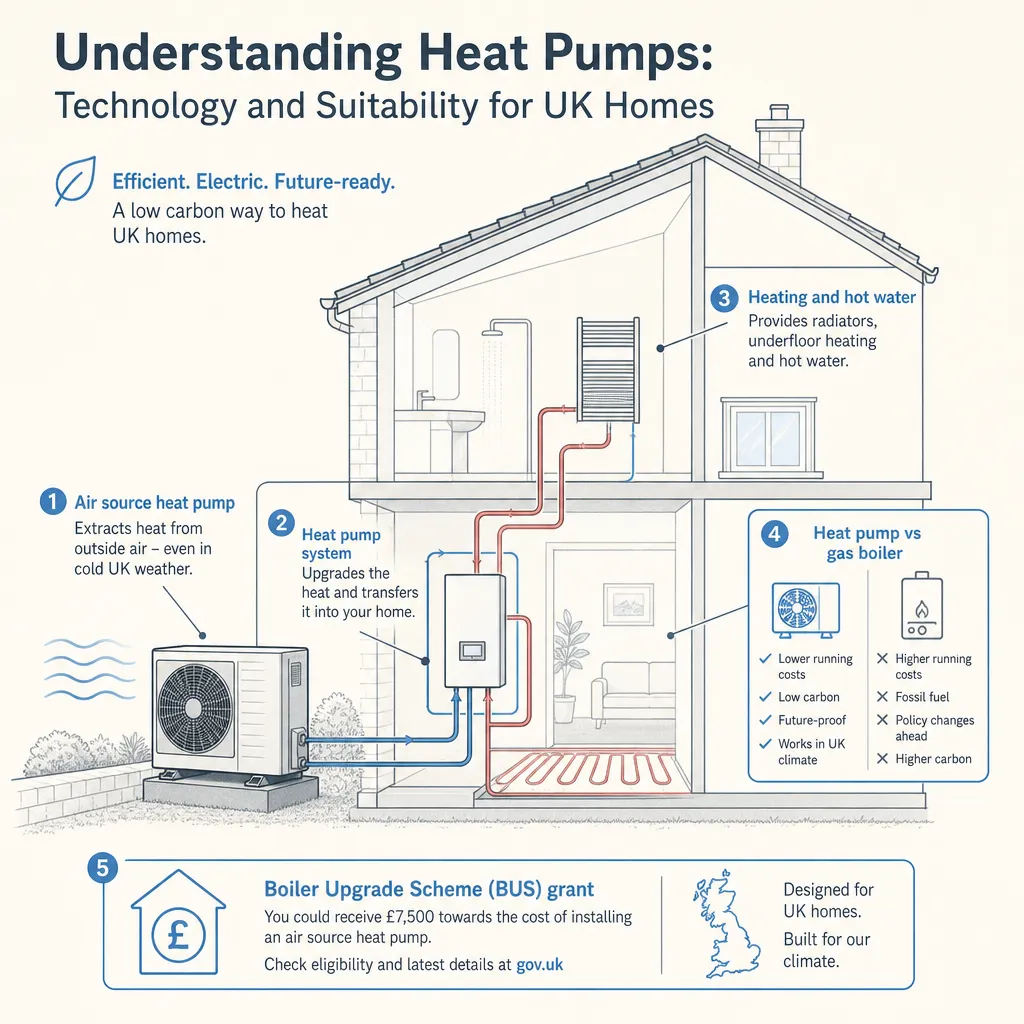
Understanding Heat Pumps: Technology and Suitability for UK Homes
Heat pumps extract heat from the air or ground and transfer it indoors, typically achieving efficiencies of 250–400% compared to a conventional boiler's near 100%.
 Energy & Retrofit
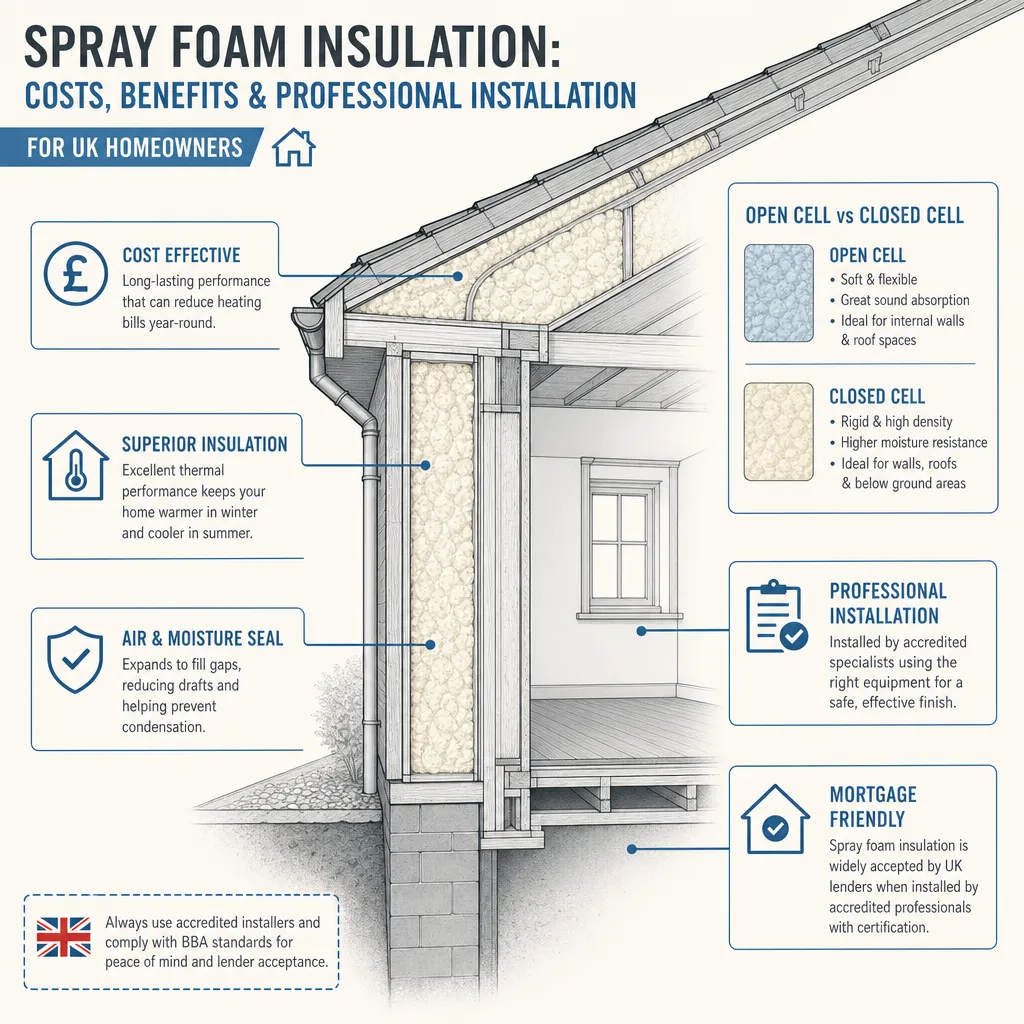
Spray foam insulation: costs, benefits and professional installation
Spray foam insulation costs between £15 and £60 per square metre installed in the UK, depending on whether open-cell or closed-cell foam is used.
 Energy & Retrofit
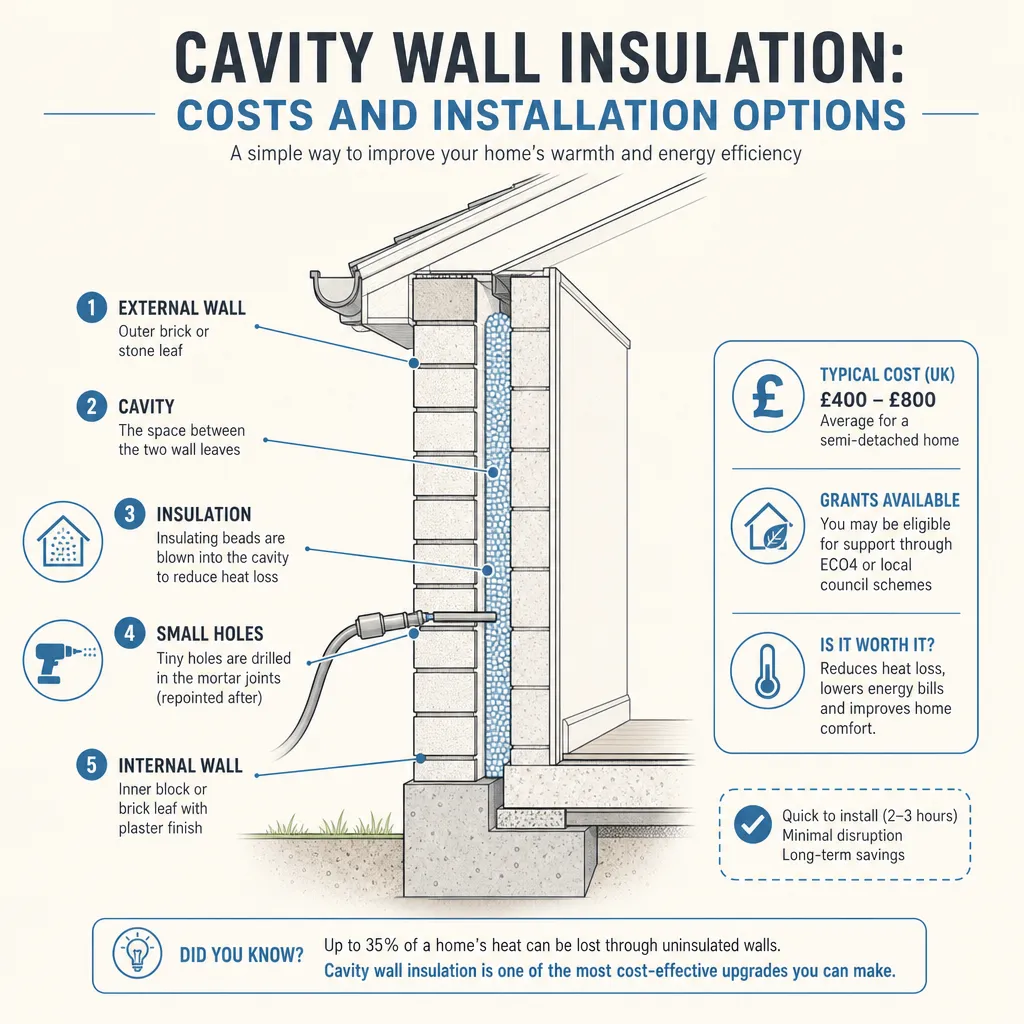
Cavity Wall Insulation: Costs and Installation Options
Cavity wall insulation typically costs £400–£1,200 for a standard UK semi-detached home, though eligible households may pay nothing under ECO4.
 Energy & Retrofit
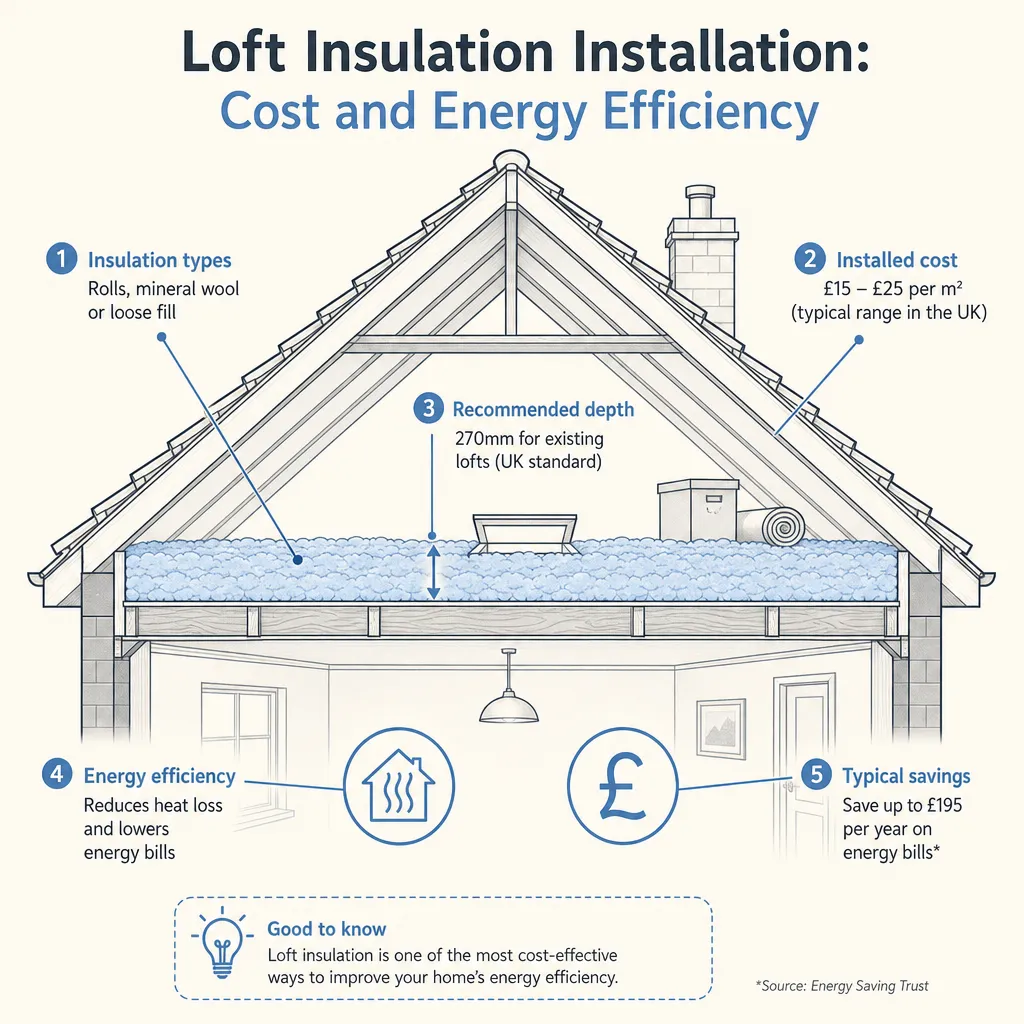
Loft Insulation Installation: Cost and Energy Efficiency
Loft insulation typically costs £300–£700 installed for a standard three-bedroom semi-detached using mineral wool.
 Energy & Retrofit
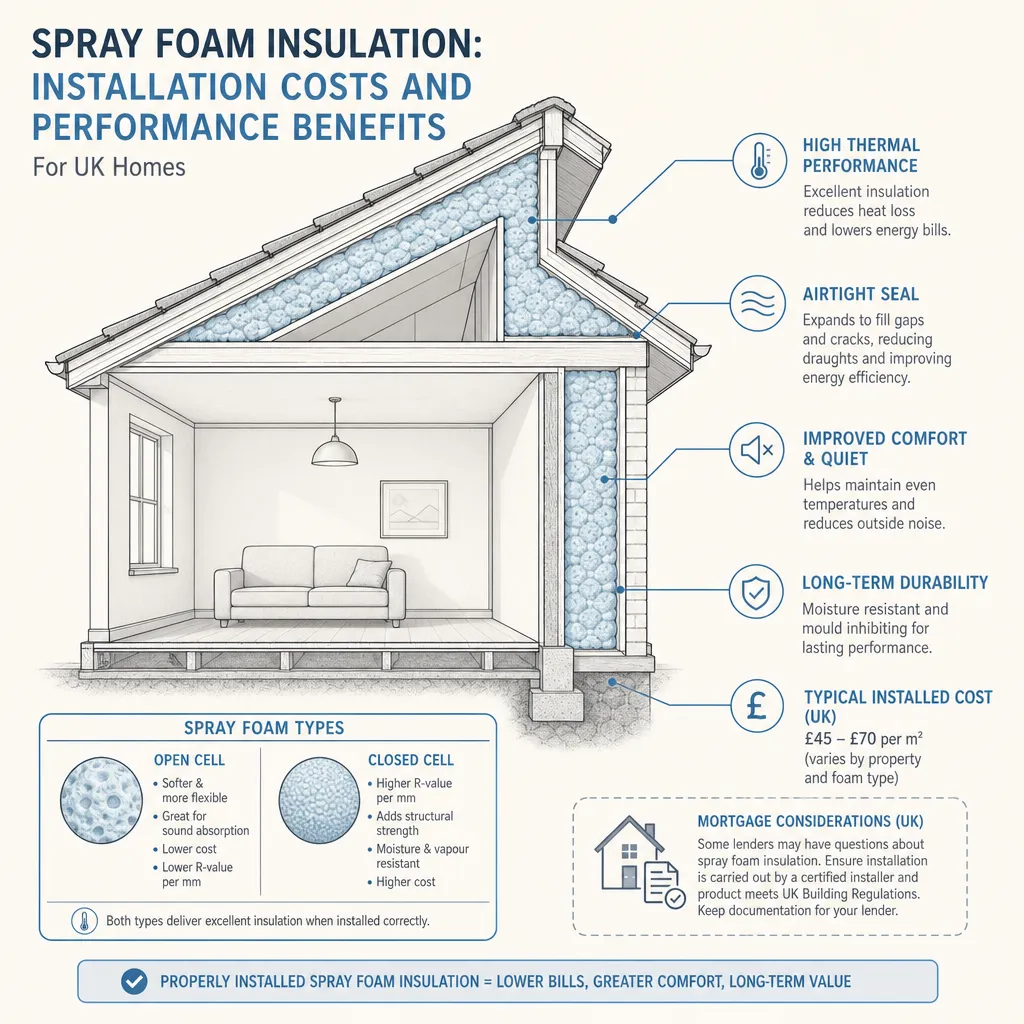
Spray Foam Insulation: Installation Costs and Performance Benefits
Spray foam insulation costs £1,500–£5,000 installed for an average UK home depending on type and area covered.