Spray Foam Insulation: Installation Costs and Performance Benefits
By Housey · Last reviewed 10th of May 2026
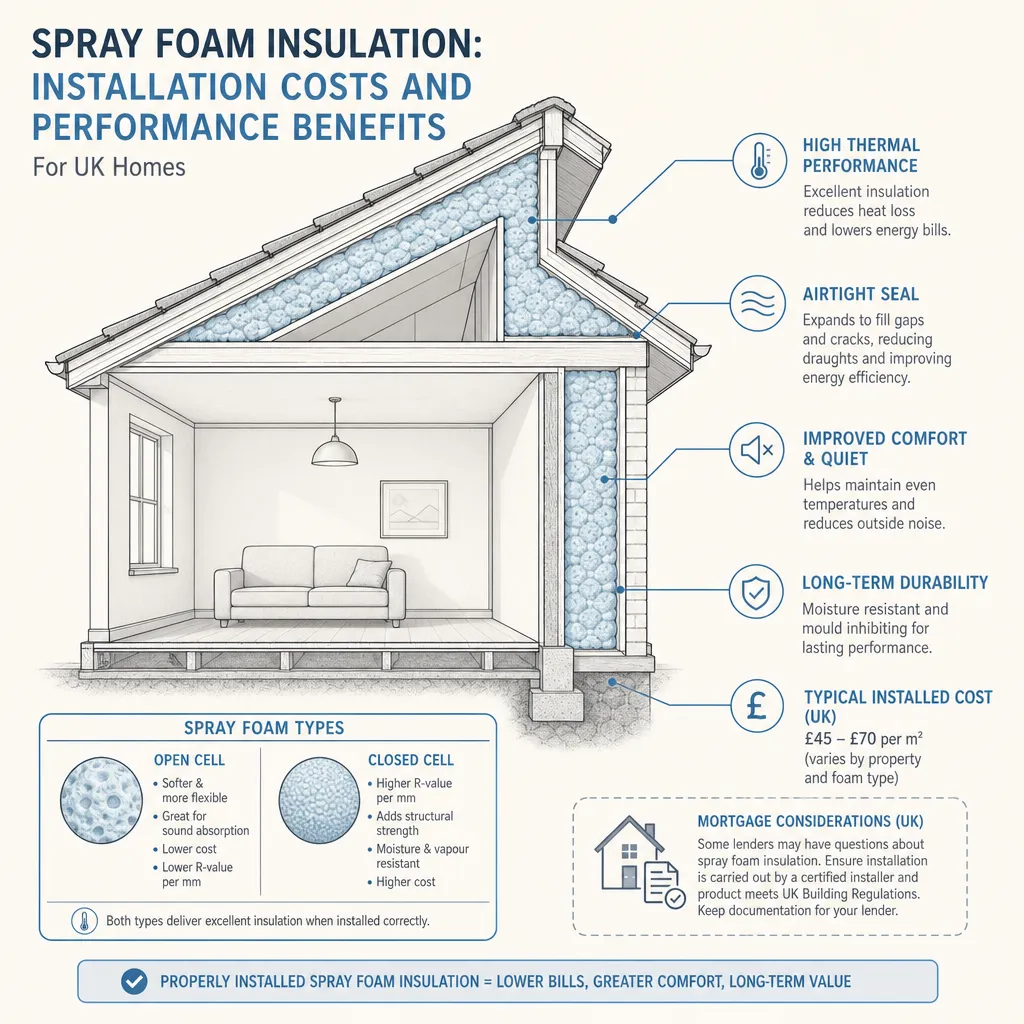
Spray Foam Insulation: Installation Costs and Performance Benefits
Spray foam insulation has grown in use as homeowners seek ways to reduce heat loss in roof spaces with complex rafter geometries — areas where laying mineral wool or rigid boards is impractical. However, spray polyurethane foam sits at the centre of a serious and ongoing controversy in the UK property market, with RICS, mortgage lenders, and retrofit standards bodies all raising concerns about its application in residential buildings.
Key points
- Spray foam applied to roof rafters or joists can make a property difficult or impossible to mortgage — many UK lenders decline applications or require professional removal before lending.
- RICS has issued guidance stating that spray foam in roof spaces can conceal structural defects and impede inspection of roof timbers, making condition assessment unreliable.
- There are two main types: open-cell foam (vapour-permeable, lower thermal resistance) and closed-cell foam (vapour-resistant, thermal conductivity approximately 0.022–0.028 W/mK).
- Under PAS 2035 (the UK retrofit quality standard), spray foam must be assessed within a whole-house retrofit plan by a Retrofit Coordinator before ECO4-funded installation can proceed.
- Removal of incorrectly applied spray foam typically costs £2,000–£10,000+ depending on coverage and access — often exceeding the original installation cost.
Open-cell versus closed-cell spray foam
Property | Open-cell foam | Closed-cell foam |
|---|---|---|
Vapour permeability | Permeable (breathable) | Vapour-resistant |
Thermal conductivity | ~0.035–0.040 W/mK | ~0.022–0.028 W/mK |
Density | Low (~10–11 kg/m³) | High (~30–50 kg/m³) |
Structural benefit | None | Moderate (adds rigidity) |
Moisture risk if incorrectly specified | Lower | Higher |
Typical residential use | Internal rafter or wall applications | Below-ground, external, specialist |
UK mortgage lender concern | High | High |
Both types carry significant mortgage risk when applied to roof timbers in UK residential properties.
What does spray foam insulation cost?
Application | Indicative installed cost |
|---|---|
Loft/roof rafter — open-cell, average 3-bed | £1,500–£3,500 |
Loft/roof rafter — closed-cell, average 3-bed | £2,000–£5,000 |
Underfloor (crawl space), average 3-bed | £1,200–£2,500 |
Internal wall application (per room) | £500–£1,500 |
Professional removal — average 3-bed roof space | £2,000–£10,000+ |
Indicative UK costs, last reviewed 2026-05-10. Spray foam installation in occupied domestic properties attracts VAT at 5%. Removal costs vary considerably by contractor, coverage, and access conditions. Always obtain at least three quotes.
The mortgage and valuation problem — a worked UK scenario
Consider a homeowner in a 1970s semi-detached in the East Midlands who had spray foam applied to the roof rafters in 2021. When they attempted to remortgage in 2024, the lender commissioned a RICS-accredited valuer who flagged the foam. The lender declined the application on the grounds that the foam prevented adequate inspection of the roof structure.
Removal quotes ranged from £4,500 to £7,500. The surveyor noted that the foam appeared to have been applied over timbers showing signs of historic moisture staining — making it impossible to determine whether an active defect had been sealed in.
This scenario is now common across the UK. UK Finance, representing mortgage lenders, has flagged spray foam as a material consideration affecting mortgage eligibility. Understanding the resale and remortgage implications before installation is essential.
Red flags: when spray foam is the wrong choice
- You plan to sell or remortgage within 10 years. Spray foam in a roof space routinely triggers surveyor flags and lender refusals. Mineral wool, rigid board, or blown-fibre alternatives carry no such risk.
- Your roof timbers show signs of moisture, staining, or historic leaks. Spray foam will seal in existing problems and prevent all future inspection.
- Your property is listed or in a conservation area. Foam application may constitute an unauthorised material alteration; check with the local planning authority's conservation officer first.
- The installer cannot provide TrustMark registration and PAS 2030 certification. Non-certified installers may apply foam at incorrect thickness or on unsuitable substrates, creating moisture traps.
- The quote arrived via an unsolicited cold call or doorstep approach. Aggressive spray foam marketing has been the subject of multiple consumer complaints and Trading Standards investigations.
- Your property is pre-1919 with solid walls and traditional breathable construction. Introducing impermeable spray foam can disrupt moisture-management pathways and cause condensation damage to historic fabric.
What not to assume
- Do not assume spray foam is covered under ECO4 without a Retrofit Assessment. PAS 2035 requires a Retrofit Coordinator to design a whole-house plan; spray foam cannot be claimed as a standalone ECO4 measure without one.
- Do not assume an installer's 10-year guarantee protects your mortgage position. Installer warranties do not bind mortgage lenders; lender policies are set independently of product guarantees.
- Do not assume all spray foam products perform equally. Thermal resistance, vapour permeability, and fire performance vary between products, application methods, and achieved thickness.
- Do not assume removal is always straightforward or affordable. In some applications, foam adheres so firmly that removal requires partial dismantling of the roof covering — at costs that may far exceed the original installation.
Important limitations
This article provides general information only. The regulatory position on spray foam insulation, individual mortgage lender policies, and applicable product standards continue to evolve. Risks and outcomes vary significantly depending on property type, construction era, local planning designations, individual lender requirements, and the specific product applied. This article does not constitute professional advice. A qualified retrofit assessor, RICS-registered surveyor, and your mortgage lender should all be consulted before proceeding with spray foam installation or removal.
When this becomes urgent
Seek professional input immediately if:
- You are under offer to buy or sell a property and a surveyor has flagged spray foam — contact the surveyor, your conveyancer, and any instructed mortgage lender straight away.
- You have received a mortgage decline citing spray foam in the roof space — obtain an independent RICS survey report on current condition before seeking removal quotes.
- You suspect spray foam has been applied over pre-existing roof leaks or structurally defective timbers — have a RICS-registered surveyor inspect and report before any further insulation work proceeds.
- An ECO4 installer has proposed spray foam without providing evidence of a full PAS 2035 Retrofit Assessment signed off by a certified Retrofit Coordinator.
What to ask a qualified professional
Before instructing any spray foam installer or retrofit assessor, ask:
- Are you TrustMark-registered and certified to PAS 2030 for spray foam insulation?
- What moisture assessment have you carried out on the roof timbers before any application?
- How will this installation affect future access to roof timbers for structural inspection or repair?
- What are the implications for my mortgage, remortgage, and property sale?
- If removal is ever required, what would that involve and what is the indicative cost?
- Is a Retrofit Coordinator required under PAS 2035 for my property and funding route?
- What specific product are you proposing, and what are its independently certified thermal and fire-performance values?
- Will you provide a full written specification and installation warranty?
When to get professional help
Spray foam insulation should not be treated as a standard home improvement. Professional input is required at every stage:
- A Retrofit Coordinator (mandatory under PAS 2035 for ECO4-funded work) to assess whether spray foam is appropriate within a whole-house retrofit strategy.
- A RICS-registered surveyor to report on existing roof timber condition before installation and to advise on mortgage implications.
- A TrustMark- and PAS 2030-certified installer for any installation — reject quotes from uncertified contractors.
- Your mortgage lender or broker to confirm the impact on current or future borrowing before committing to any work.
If spray foam is already present in a property you are buying, selling, or remortgaging, engage a RICS surveyor and your solicitor before proceeding.
How Housey can help
Housey connects homeowners with verified insulation installers who can confirm PAS 2030 and TrustMark accreditation, assess your property's construction, and advise on appropriate insulation measures. Request quotes from accredited installers and compare their recommendations alongside guidance from a qualified Retrofit Assessor.
Frequently asked questions
Will spray foam insulation affect my mortgage?
Spray foam in roof spaces is a significant concern for UK mortgage lenders. Many treat it as a material defect because foam prevents inspection of roof timbers and may conceal structural issues. If you are considering spray foam, or buying or selling a property where foam is present, speak to your mortgage lender or broker first. Both RICS and UK Finance have highlighted this issue.
How much does spray foam insulation cost in the UK?
Indicative UK costs (last reviewed 2026-05-10): open-cell loft rafter insulation for an average 3-bedroom home typically costs £1,500–£3,500 installed; closed-cell applications generally run to £2,000–£5,000. Underfloor crawl-space applications typically cost £1,200–£2,500. VAT at 5% applies to domestic installations. Removal costs, if required, range from approximately £2,000 to over £10,000.
Can spray foam insulation be removed?
Yes, but removal is complex, disruptive, and expensive. Spray foam bonds firmly to roof timbers; professional removal involves specialist contractors using mechanical methods and may risk damage to roof coverings or structural timbers. Indicative costs range from £2,000 to over £10,000 for a typical 3-bedroom roof space. Some mortgage lenders require a post-removal structural survey report before agreeing to lend.
Is spray foam insulation suitable for all property types?
No. Spray foam carries particular risks in pre-1919 breathable-construction properties, listed buildings, and any property where roof timbers show signs of existing moisture damage. It is generally considered unsuitable for roof rafter application in UK residential properties where future mortgageability is a concern — which covers the majority of the UK housing stock.
Sources and further reading
Useful next reads
 Energy & Retrofit
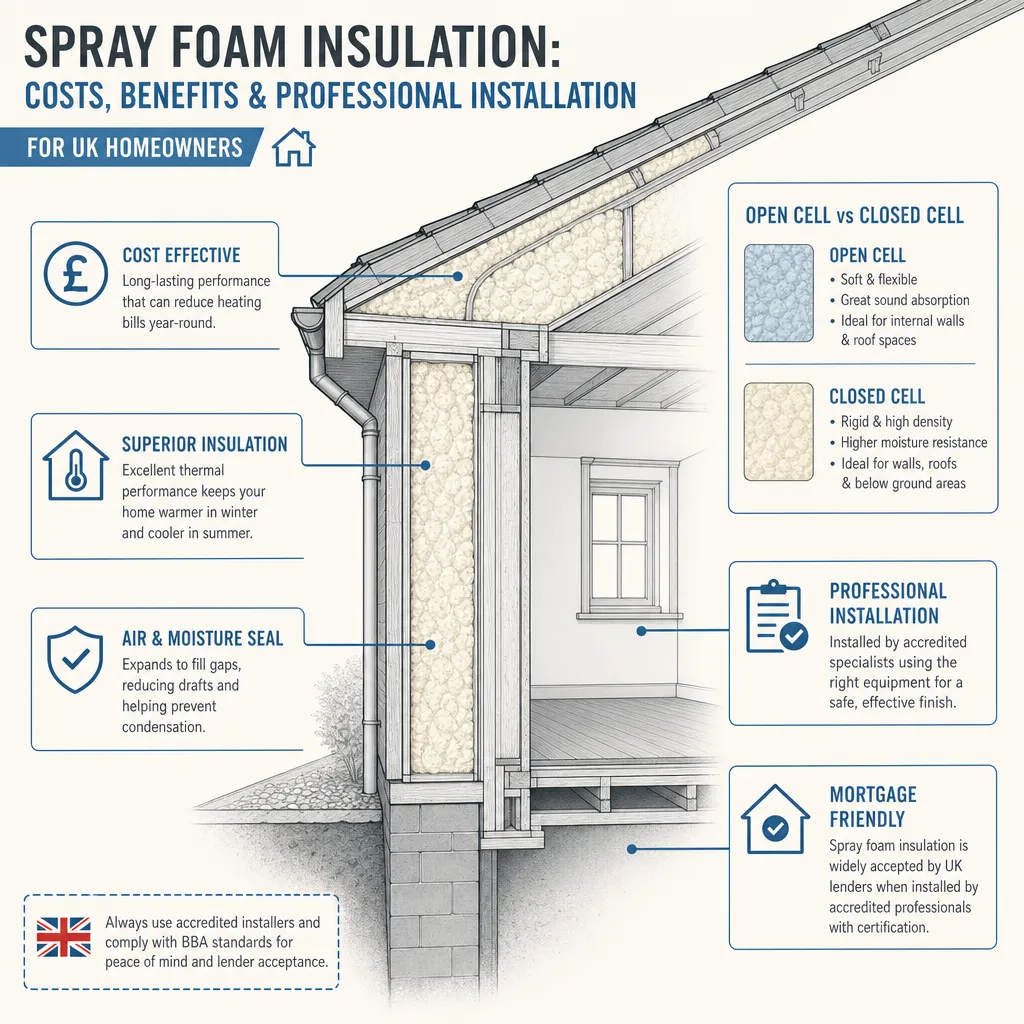
Spray foam insulation: costs, benefits and professional installation
Spray foam insulation costs between £15 and £60 per square metre installed in the UK, depending on whether open-cell or closed-cell foam is used.
 Energy & Retrofit
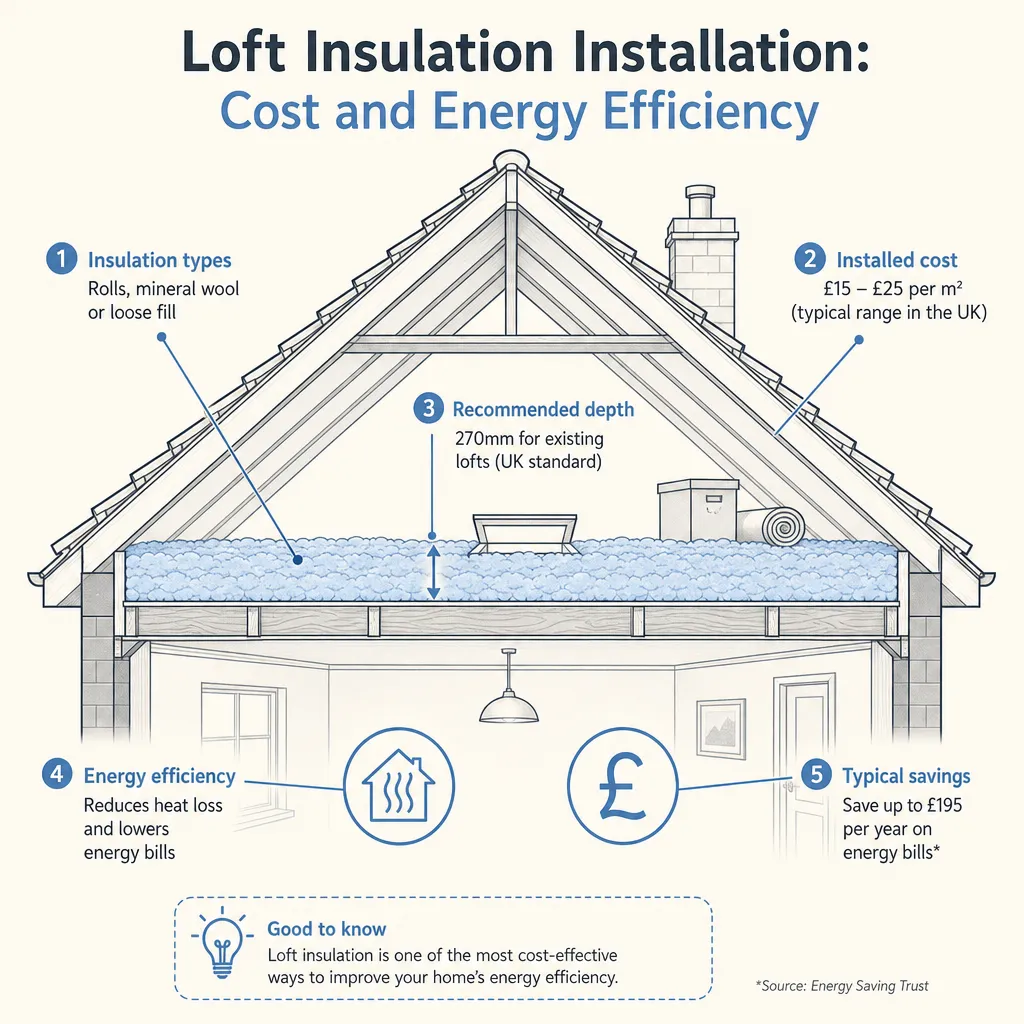
Loft Insulation Installation: Cost and Energy Efficiency
Loft insulation typically costs £300–£700 installed for a standard three-bedroom semi-detached using mineral wool.
 Energy & Retrofit
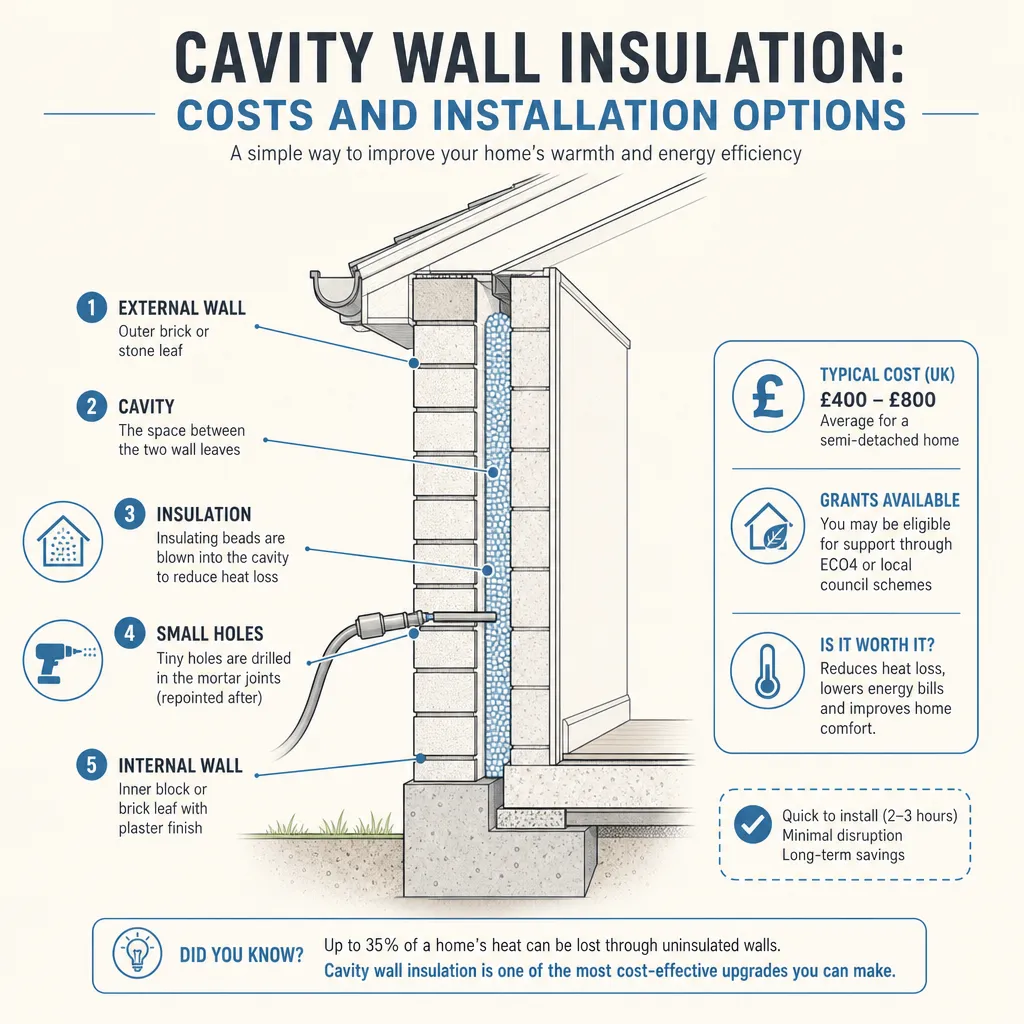
Cavity Wall Insulation: Costs and Installation Options
Cavity wall insulation typically costs £400–£1,200 for a standard UK semi-detached home, though eligible households may pay nothing under ECO4.
 Energy & Retrofit
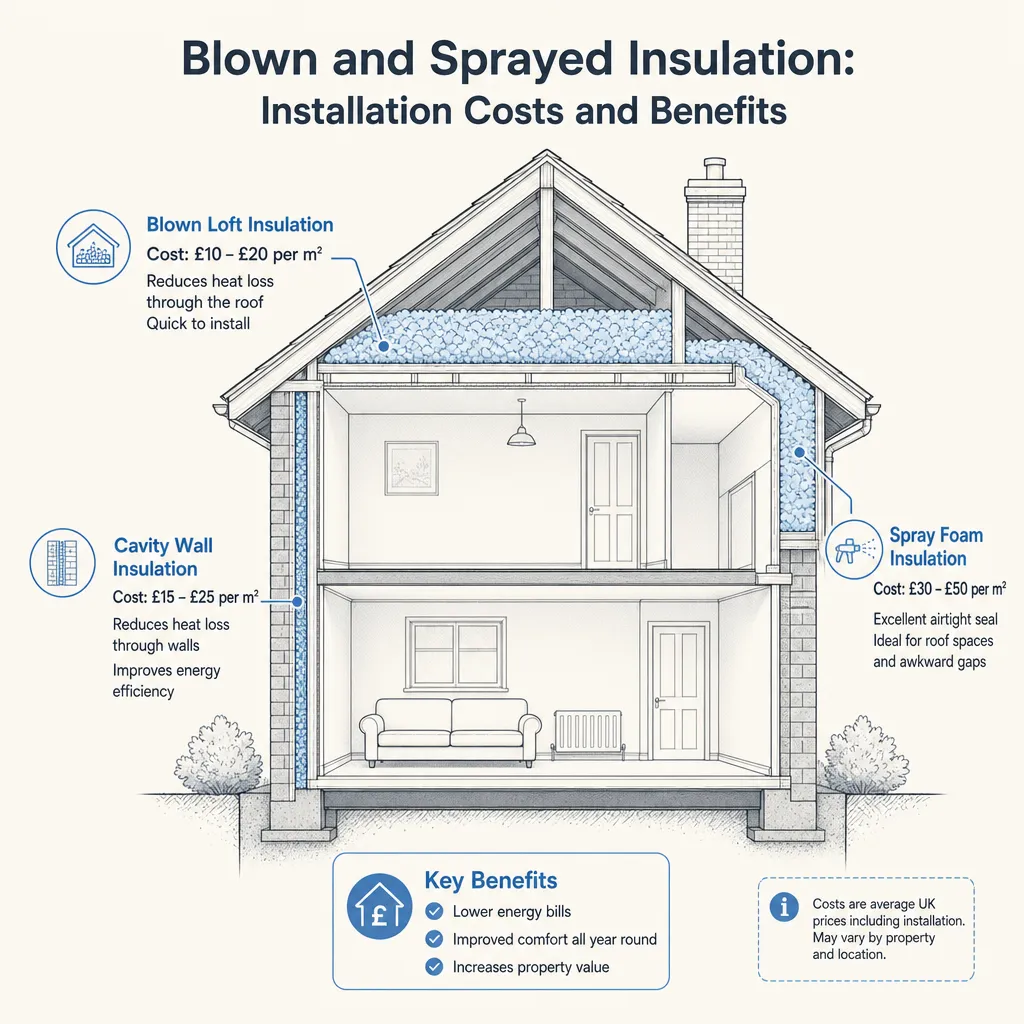
Blown and Sprayed Insulation: Installation Costs and Benefits
Blown cavity wall insulation for a typical semi-detached house costs £400–£1,200; blown loft insulation costs £300–£600.
 Energy & Retrofit
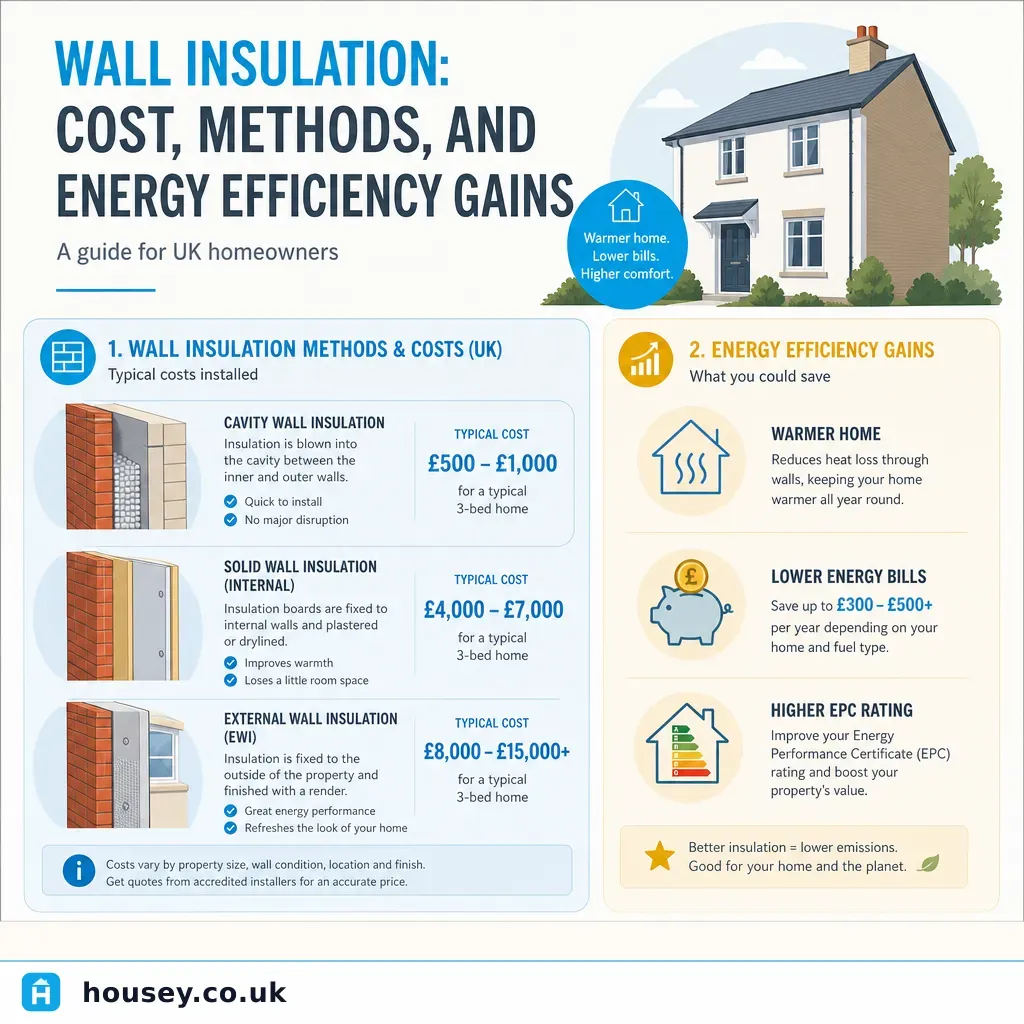
Wall Insulation: Cost, Methods, and Energy Efficiency Gains
Wall insulation in UK homes uses one of three main methods: cavity wall insulation for post-1920 homes with an unfilled cavity, external wall insulation for solid-walled properties, and internal wall insulation where external changes are not permitted.