Spray foam insulation: costs, benefits and professional installation
By Housey · Last reviewed 12th of May 2026
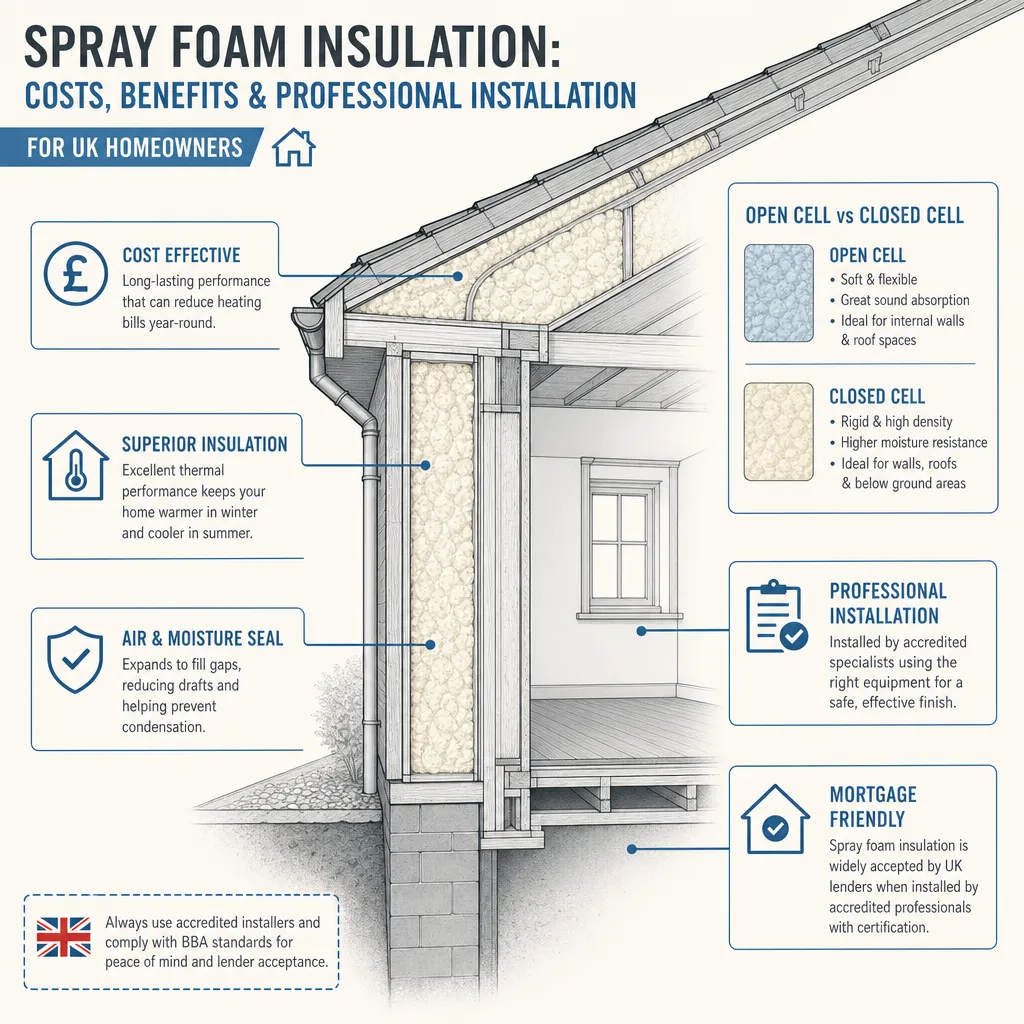
Spray foam insulation: costs, benefits and professional installation
Spray foam insulation is increasingly considered as part of whole-house energy-efficiency upgrades across the UK, particularly for older properties where roof spaces, floor voids, or irregular cavities are difficult to treat using conventional mineral wool or blown-fibre methods. It can deliver strong thermal performance and air-sealing in a single application. However, spray foam carries specific risks around moisture management, mortgage eligibility, and removal difficulty that have grown in prominence under PAS 2035 and recent RICS guidance — making professional assessment essential before any installation decision is made.
Key points
- Spray foam insulation is available in two main types: open-cell (moisture-permeable, lower R-value, approximately £15–£30/m² installed) and closed-cell (vapour-resistant, higher R-value, approximately £30–£60/m² installed); indicative UK costs, last reviewed 2026-05-12.
- Several major UK mortgage lenders will decline applications or require specialist surveys when spray foam is present in a roof space, affecting resale and remortgage options — RICS issued specific valuation guidance on this in 2023.
- PAS 2035:2023 — the UK standard for domestic retrofit — identifies unventilated spray foam in roof voids as a higher-risk measure requiring assessment by a qualified Retrofit Assessor before specification.
- Installers funded under ECO4 or the Great British Insulation Scheme (GBIS) must hold PAS 2030 certification and be registered with TrustMark; for self-funded work, TrustMark registration and a BBA-certified product remain strongly advisable.
- Spray foam applied incorrectly to roof timbers can trap moisture, cause structural timber decay, and void roof or building warranties.
Open-cell vs closed-cell spray foam: which is right for your property?
The two types behave very differently and suit different applications. Choosing the wrong type — or the right type in the wrong location — is one of the most common causes of problems in domestic spray foam installations.
Property | Open-cell foam | Closed-cell foam |
|---|---|---|
Thermal performance | Lower (~R-3.5 per 25 mm) | Higher (~R-6.5 per 25 mm) |
Moisture permeability | Permeable (breathes) | Vapour barrier (does not breathe) |
Typical UK application | Internal floors, walls, irregular surfaces | Roof voids, external walls, damp-prone areas |
Installed cost (approx.) | £15–£30/m² | £30–£60/m² |
Mortgage impact risk | Lower if correctly applied | Higher if incorrectly applied to roof timbers |
Removal difficulty | Moderate | High |
Structural strength added | Minimal | Moderate (adds some rigidity) |
Indicative UK installed costs, last reviewed 2026-05-12. Costs vary by region, access difficulty, and required thickness.
How much does spray foam insulation cost in the UK?
Cost depends on foam type, application area, and site accessibility.
Open-cell foam in a floor void: typically £15–£25/m² installed. A floor treatment for an average two- or three-bedroom semi-detached house commonly costs £600–£2,000 in total, depending on floor area and access conditions.
Closed-cell foam on the underside of roof rafters: typically £30–£50/m² installed. A 60 m² loft space may cost £1,800–£3,000.
Whole-house programmes via ECO4 or GBIS may be fully or partially funded for eligible households in properties rated EPC band D or below. Check current eligibility via the Energy Saving Trust's insulation advice pages or your energy supplier.
Additional costs to budget for:
- Roof condition inspection before installation: £150–£350
- Any necessary ventilation improvements: variable — confirm with your installer before committing
- Future removal if needed: £500–£3,000 or more, depending on extent and whether timber is affected
Always request an itemised written quote specifying the product name, BBA certificate number, applied thickness, expected U-value outcome, and whether VAT is included.
Where is spray foam insulation used in UK homes?
- Pitched roof undersides (warm roof): closed-cell foam applied between or below rafters, eliminating the cold loft void — but requires careful prior assessment of existing ventilation and timber condition.
- Suspended timber floor voids: open-cell foam between joists reduces heat loss and draughts; generally the lower-risk domestic application.
- Flat roof hybrid systems: spray foam occasionally used alongside a waterproofing layer; usually a specialist light-commercial application.
- Air-sealing at junctions: open-cell or closed-cell foam applied around pipework penetrations, eaves, and ceiling-to-wall connections to reduce infiltration.
- Cavity walls: rarely specified in UK residential cavities, where mineral wool, EPS bead, or blown fibre are generally preferred and less problematic for mortgageability.
The mortgage and resale risk
This is the issue most likely to have a significant financial impact on UK homeowners. Since approximately 2020, a number of major mortgage lenders — including several high-street banks and building societies — have either refused applications or required specialist surveys where spray foam has been applied to a roof structure. The concerns are threefold:
- Spray foam can conceal existing roof defects that a surveyor would otherwise identify during a standard inspection.
- It can restrict or prevent inspection and maintenance of the roof deck and underlying timbers.
- Incorrect application can cause moisture accumulation and progressive structural timber decay.
In 2023, RICS confirmed in published guidance that valuers must flag spray foam in roof voids and assess its impact on both value and mortgageability. If you are considering spray foam for a roof space and may wish to sell or remortgage within the next 10–15 years, discuss the implications with your conveyancer or mortgage broker before proceeding.
PAS 2035 and funded scheme requirements
Any spray foam installation funded under ECO4 or the Great British Insulation Scheme (GBIS) must comply with PAS 2035:2023, the UK standard for domestic retrofit. This requires:
- A Retrofit Assessment by a qualified Retrofit Assessor before any measure is specified.
- Specification by a Retrofit Coordinator — a separately qualified professional responsible for the overall retrofit plan.
- Installation only by a PAS 2030-certified installer registered with TrustMark.
PAS 2035 specifically identifies unventilated spray foam in roof spaces as a higher-risk measure. A compliant Retrofit Coordinator must assess the existing roof condition and ventilation strategy before spray foam can be included in a funded programme.
For self-funded installations, PAS 2035 compliance is not a legal requirement, but choosing a TrustMark-registered installer using a BBA-certified product is strongly advisable for warranty, insurance, and resale protection.
Important limitations
This article provides general information only. The risks associated with spray foam insulation — including moisture trapping, timber decay, mortgage impacts, and removal complexity — vary considerably depending on your property's age, construction type, roof condition, existing ventilation, and tenure. Nothing in this article should be treated as technical, structural, or financial advice. Your property should be assessed by a qualified Retrofit Assessor or specialist insulation surveyor before any installation decision is made.
When this becomes urgent
Seek professional advice promptly if any of the following apply:
- A RICS Level 2 or Level 3 survey has flagged existing roof or structural issues — spray foam applied over defects may mask them and complicate later remediation.
- You are about to list your property for sale or begin remortgaging — spray foam in a roof space must be disclosed and may affect the transaction.
- A previous occupant has installed spray foam and you are uncertain whether it was done correctly or with appropriate products.
- You notice condensation, mould growth, or a musty smell in the loft after installation — these may indicate moisture is being trapped within the roof structure.
What to ask a qualified professional
Before instructing any spray foam insulation installer, ask:
- What type of foam are you recommending, and can you provide the BBA certificate number for the specific product?
- Are you TrustMark-registered and PAS 2030-certified?
- Have you assessed the existing roof condition, ventilation, and timber health for this property and this application?
- Will this installation affect the existing roof warranty or building warranty?
- How will it affect the ability to inspect or maintain roof timbers in future?
- What U-value will be achieved after installation, and how does this compare to current Part L targets for existing dwellings?
- If removal is needed in future, what does that typically involve and what is the likely cost?
- Is this installation eligible for funding under ECO4 or GBIS, and if so what documentation will be provided on completion?
When to get professional help
Spray foam insulation should not be self-installed in a roof space or structural cavity — incorrect application creates moisture risks that may not become apparent for years. Professional assessment is essential in all cases. Particular caution is warranted when:
- The property was built before 1950 with original or unassessed roof timbers.
- The property has a mortgage, or is likely to be sold or remortgaged in future.
- A loft conversion is planned and existing ventilation has not been formally assessed.
- The property is listed or in a conservation area, where changes to the building envelope may require consent.
- The project qualifies for ECO4 or GBIS funding — a PAS 2035-compliant Retrofit Coordinator must specify the measure before any work begins.
How Housey can help
If you are exploring spray foam as part of a broader energy-efficiency programme, insulation installers on Housey hold relevant credentials and can survey your property before recommending a product and application method. For a whole-house view of cost-effective retrofit measures, energy-efficiency consultants can help you prioritise interventions that improve thermal performance without introducing new moisture or structural risks.
Frequently asked questions
Will spray foam insulation affect my mortgage?
It may. Several major UK mortgage lenders have declined applications or required specialist surveys on properties where spray foam has been installed in a roof space. RICS has issued guidance requiring valuers to flag such installations and report on their impact on value and mortgageability. Always check with your mortgage broker or lender before installation if you plan to sell or remortgage.
Does spray foam insulation need planning permission?
Internal insulation work generally does not require planning permission under permitted development rights in England. Exceptions include listed buildings, where changes to the building envelope may need listed building consent. Building Regulations compliance — particularly Approved Document L (thermal performance) and Approved Document C (moisture resistance) — is required for all installations. Your local planning authority can confirm whether any restrictions apply to your property.
What is the difference between open-cell and closed-cell spray foam?
Open-cell foam is softer, moisture-permeable, and provides a lower R-value per millimetre; it is generally used for internal floors and walls. Closed-cell foam is denser, forms a vapour barrier, provides a higher R-value, and adds modest structural rigidity. Closed-cell is typically used for roof and external applications but carries a higher risk of trapping moisture if applied to roof timbers without a proper ventilation assessment beforehand.
Can spray foam insulation be removed?
Removal is possible but often difficult, particularly for closed-cell foam bonded directly to roof timbers. In some cases the foam can be cut or ground away; in others it adheres so thoroughly that affected timber must be replaced. Removal costs typically range from £500 to £3,000 or more depending on extent. Always obtain a specialist survey and removal estimate before purchasing a property with existing spray foam.
Sources and further reading
- PAS 2035:2023 — Retrofitting dwellings for improved energy efficiency — BSI / TrustMark
- RICS: valuation of properties with spray polyurethane foam roof insulation — RICS
- Great British Insulation Scheme — GOV.UK
- TrustMark: find a registered installer — TrustMark
- Energy Saving Trust: roof and loft insulation — Energy Saving Trust
- Approved Document L: Conservation of fuel and power — GOV.UK
Useful next reads
 Energy & Retrofit
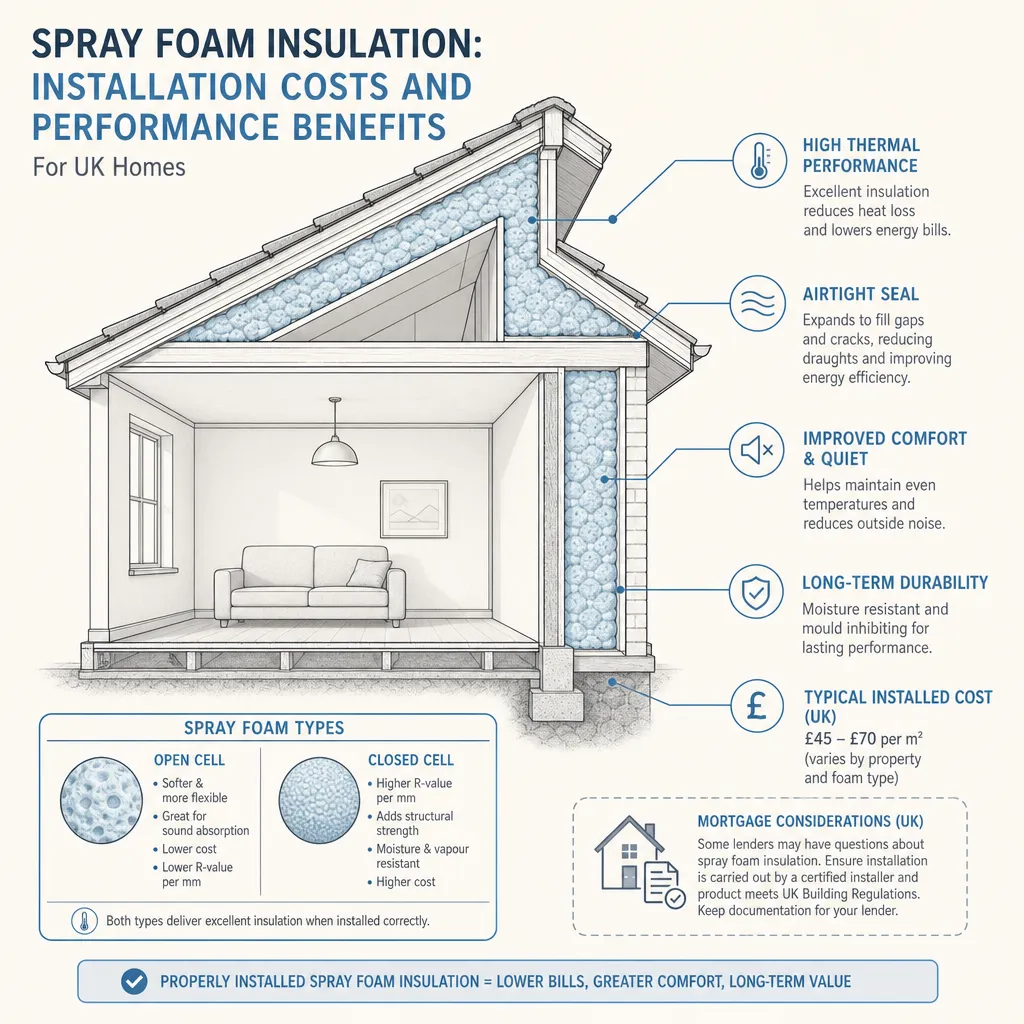
Spray Foam Insulation: Installation Costs and Performance Benefits
Spray foam insulation costs £1,500–£5,000 installed for an average UK home depending on type and area covered.
 Energy & Retrofit
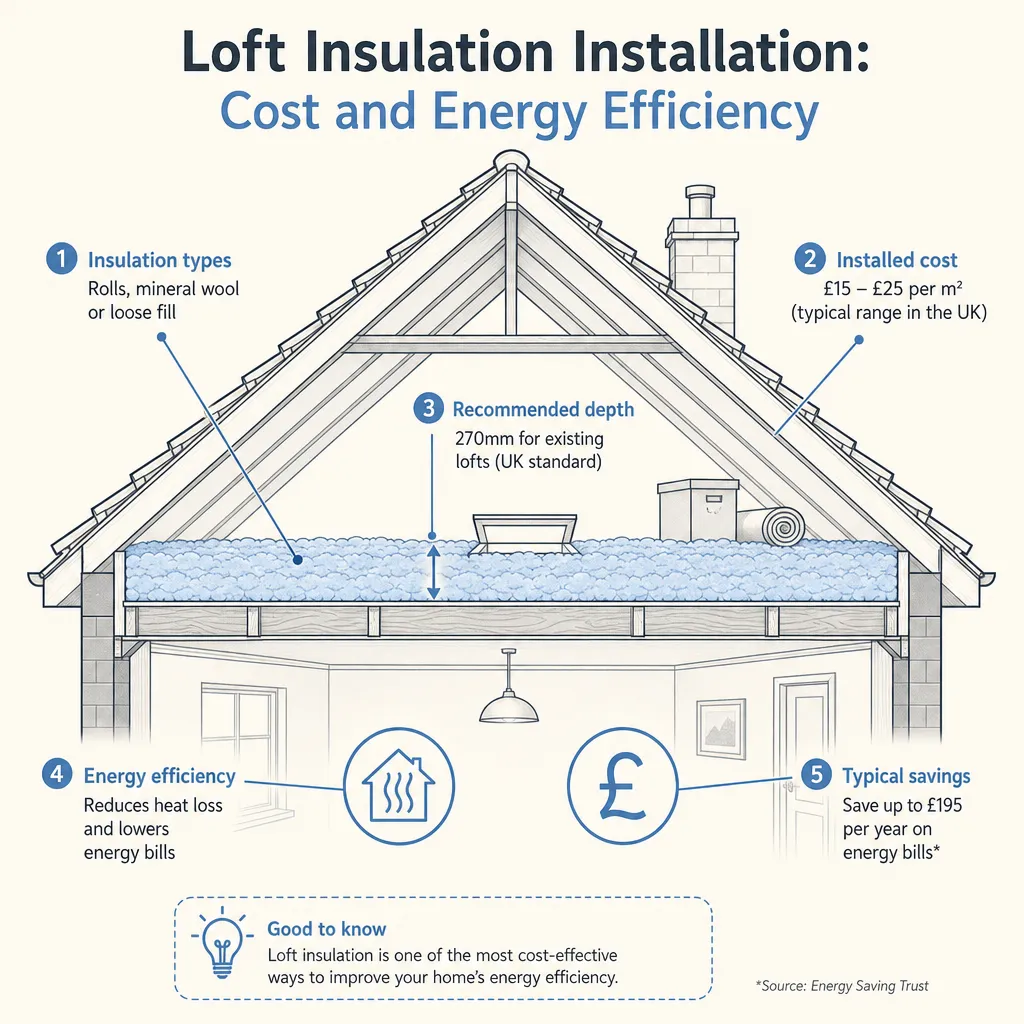
Loft Insulation Installation: Cost and Energy Efficiency
Loft insulation typically costs £300–£700 installed for a standard three-bedroom semi-detached using mineral wool.
 Energy & Retrofit
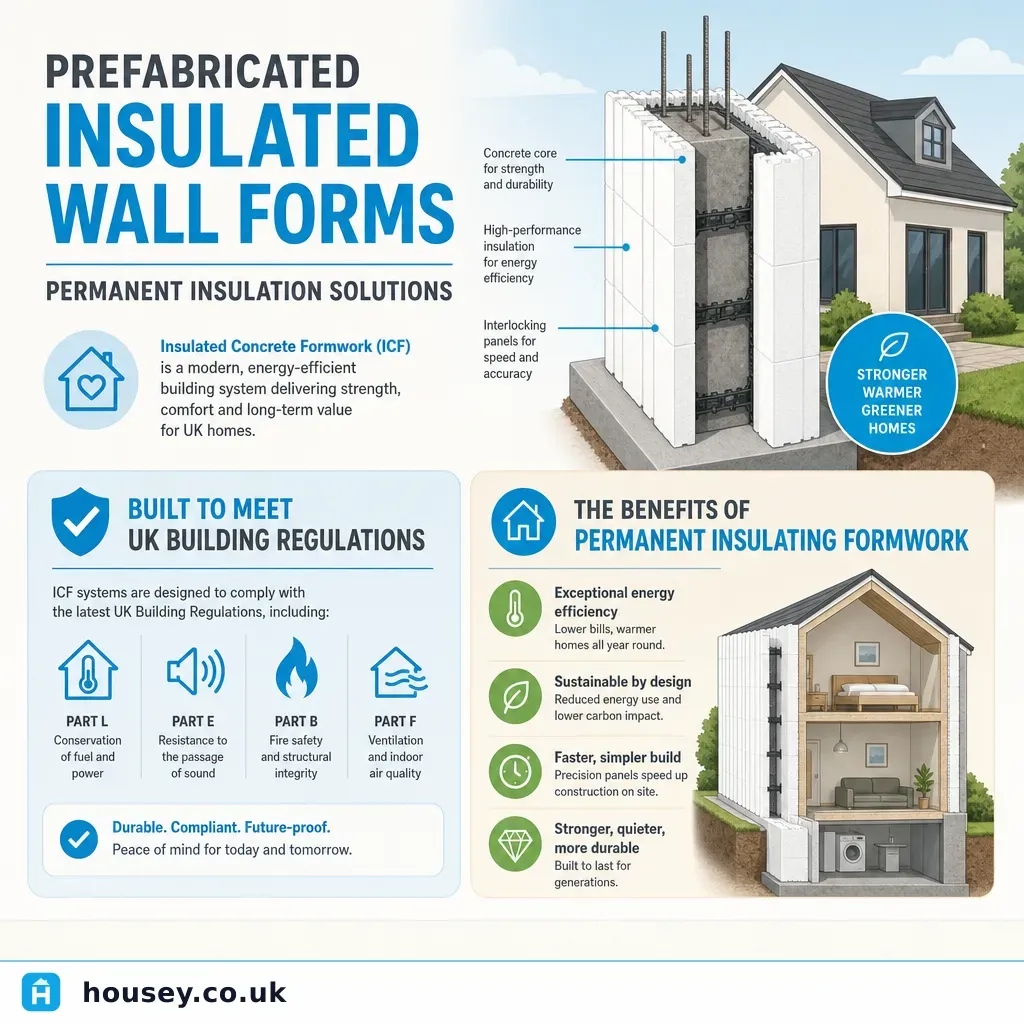
Prefabricated Insulated Wall Forms: Permanent Insulation Solutions
Prefabricated insulated wall forms — including ICF and SIPs systems — deliver high thermal performance by combining permanent insulation with structural concrete or timber in a single wall assembly.
 Energy & Retrofit
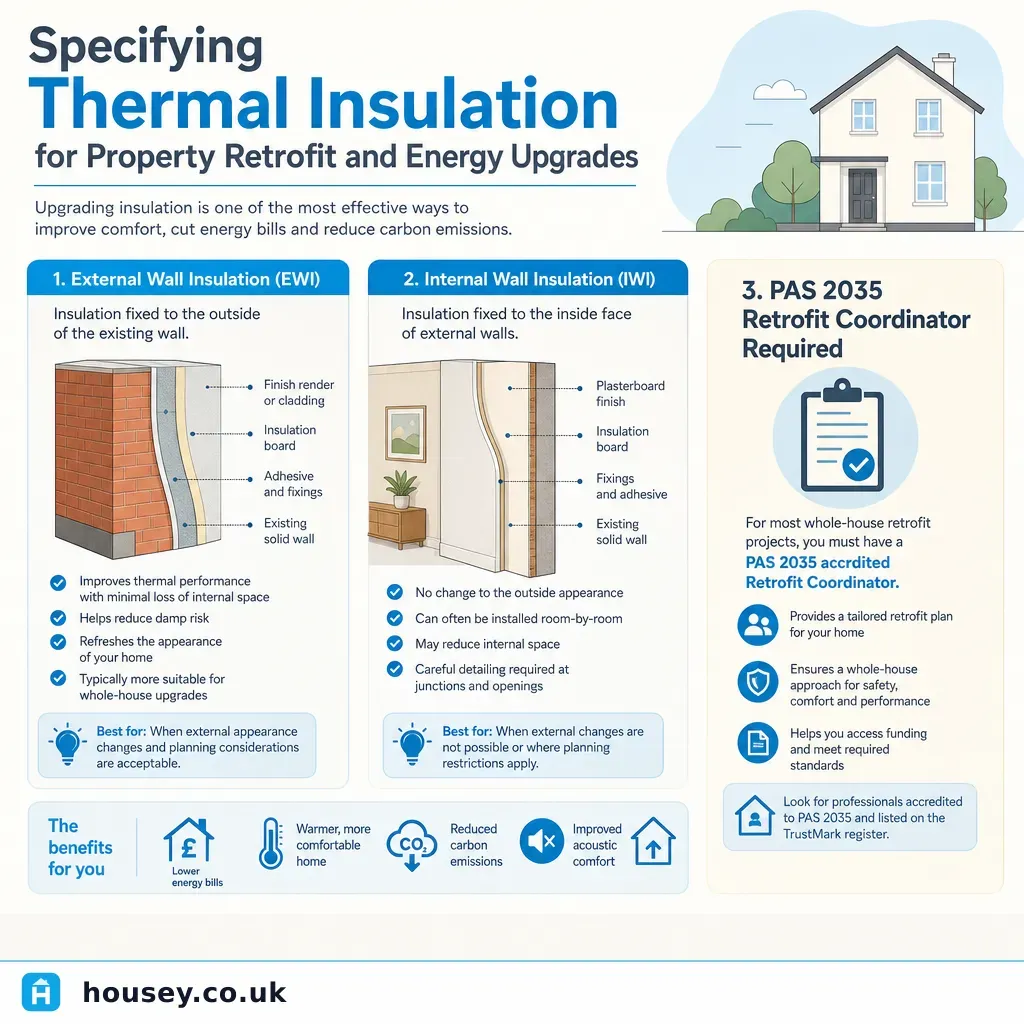
Specifying Thermal Insulation for Property Retrofit and Energy Upgrades
Specifying thermal insulation for UK retrofit requires matching the product to your property's construction, moisture conditions, and heating system.
 Energy & Retrofit
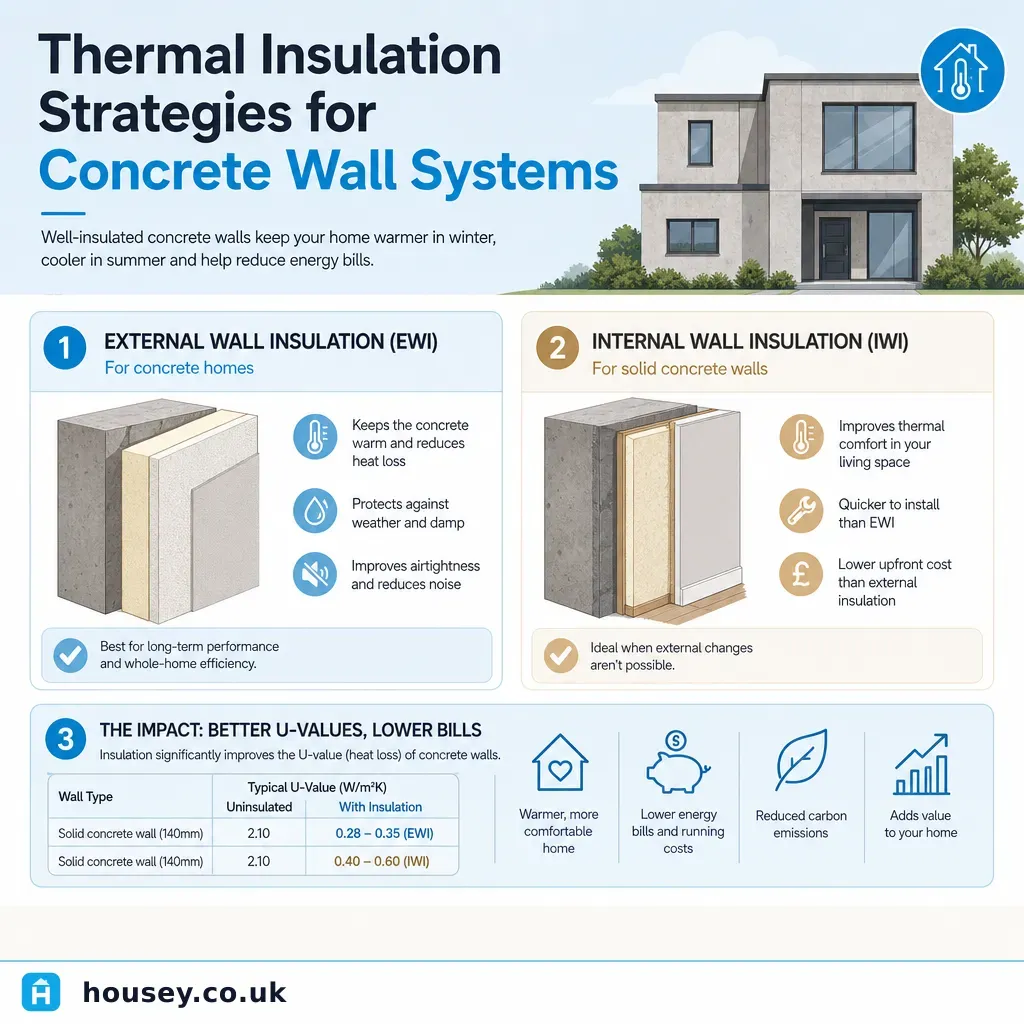
Thermal Insulation Strategies for Concrete Wall Systems
Concrete walls can be insulated using three main approaches: external wall insulation (EWI), internal wall insulation (IWI), or — where a cavity exists — cavity fill.