Boundary Disputes and Tree Responsibility: Professional Advice
By Housey · Last reviewed 31st of May 2026
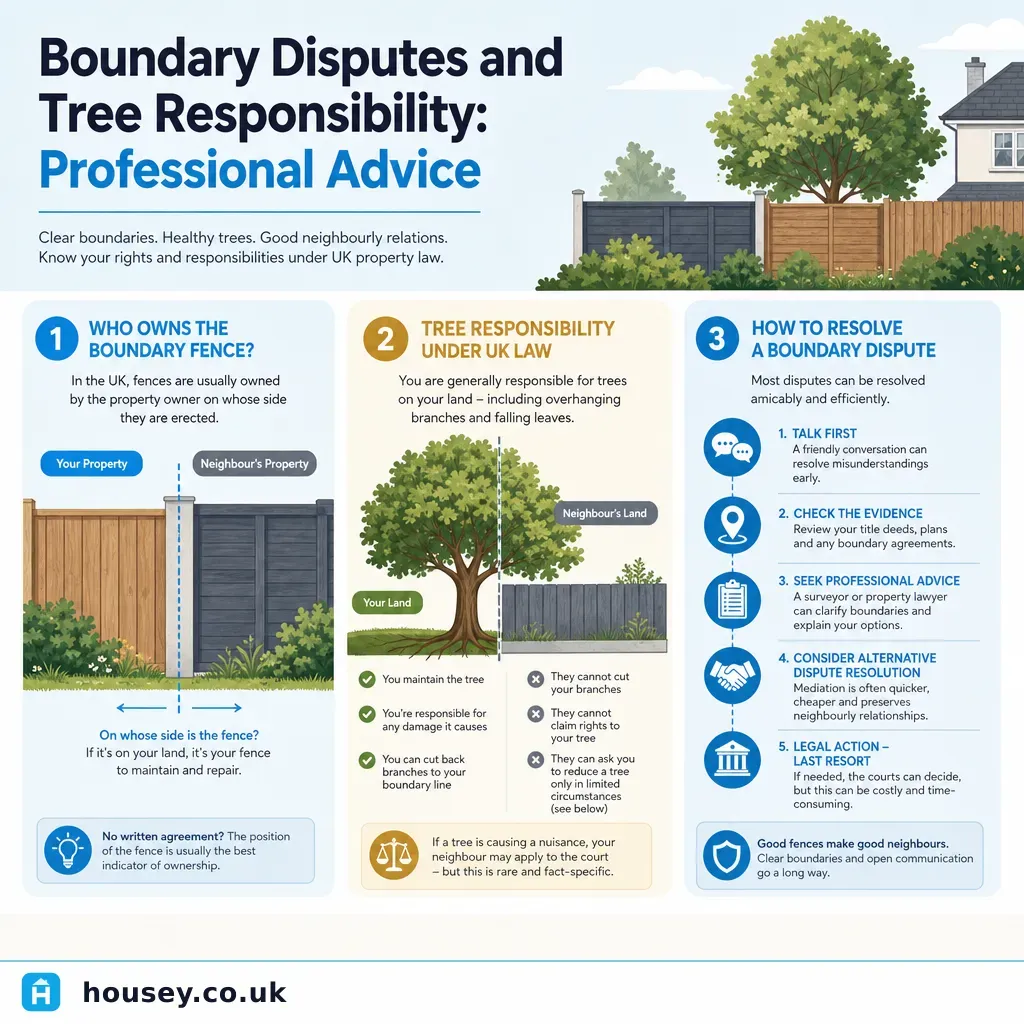
Boundary Disputes and Tree Responsibility: Professional Advice
Disagreements over where one property ends and another begins are among the most common — and most stressful — neighbour disputes in England and Wales. They can arise when fencing is replaced, extensions are planned, or land is sold, and they often intersect with questions about who owns a tree and who is liable when roots or branches cause damage. The legal and practical position is rarely straightforward, and early professional advice usually prevents costly escalation.
Key points
- HM Land Registry title plans are drawn to a scale of 1:1250 and are not intended to fix the precise legal boundary line — they show general position only and are not definitive legal boundary documents.
- The T-mark on a title plan indicates maintenance responsibility for a boundary feature, not necessarily ownership of the land beneath or alongside it, and not all older deeds use it.
- Under the Party Wall etc. Act 1996, certain works near a boundary — including excavation within 3 or 6 metres of a neighbouring building depending on depth — require a formal party wall notice before work starts.
- Tree ownership follows land ownership: a tree is owned by the person on whose land the trunk stands, even if roots or branches extend across the boundary onto a neighbour's land.
- You have the legal right to cut back overhanging branches or encroaching roots to the boundary line, but must offer the cuttings to the tree owner and must not cause serious harm to the tree.
Why boundary disputes are hard to resolve without professional help
Title deeds, Land Registry plans, and historical conveyances often conflict with physical features on the ground. Boundaries that were accurately described in a 1930s conveyance may no longer match current fence lines, which may themselves have shifted over decades of replacements. A RICS-accredited boundary surveyor can:
- Prepare a measured survey of the physical features currently on site.
- Research historical title documents, old Ordnance Survey maps, and the full conveyancing history of both properties.
- Produce an expert report giving a professional opinion on the most likely legal boundary position.
- Act as a Single Joint Expert if proceedings reach the First-tier Tribunal (Property Chamber).
Without this professional input, parties often rely on their own interpretation of Land Registry plans — which, as HM Land Registry Practice Guide 40 makes clear, are general position plans only and carry no guarantee of exact boundary position.
Which professional do you need?
Situation | Professional to instruct | Why |
|---|---|---|
Disputed fence, wall, or hedge position | RICS boundary surveyor | Expert report on the most likely legal boundary position |
Works near a shared wall or close to the boundary | Party wall surveyor (RICS or FPWS member) | Statutory award under the Party Wall etc. Act 1996 |
Overhanging tree or root damage, clear land ownership | Arboricultural consultant | Tree health, risk assessment, and causation evidence |
Tree damage where land ownership is also disputed | Arboricultural consultant and RICS boundary surveyor | Both disciplines needed |
Tree Preservation Order on a disputed or boundary tree | Local planning authority and arboricultural consultant | TPO consent required regardless of ownership |
Dispute escalating to legal proceedings | Property solicitor and RICS boundary surveyor | Tribunal or County Court process |
Decision tree: what should you do first?
- Instruct a RICS boundary surveyor if the dispute concerns the position of a fence, wall, or boundary feature — gather your title deeds and Land Registry title register first, and do not move or erect any boundary feature until you have a professional opinion.
- Instruct an arboricultural consultant if the issue involves a tree causing damage, posing a safety risk, or where the tree's condition or ownership is in question.
- Check Party Wall etc. Act 1996 obligations if you or a neighbour plan excavation or construction close to a shared wall or boundary — serve the appropriate notice before work starts.
- Check with your local planning authority before carrying out any work to a tree in a conservation area or one subject to a Tree Preservation Order — consent is required regardless of which side of the boundary the tree stands on.
- Consider mediation before escalating to the First-tier Tribunal or court; a jointly appointed expert determination or recognised mediation service is usually faster and cheaper.
- Seek legal advice from a property solicitor if you have received a formal letter from a solicitor, if exchange of contracts is imminent on a property with an unresolved boundary matter, or if a court claim has been issued.
Tree responsibility: what the law says
Ownership
A tree is owned by whoever owns the land on which the trunk grows. If the trunk straddles the boundary, the tree is jointly owned by both landowners. Tree ownership is entirely separate from the ownership of any boundary fence or wall nearby.
Your right to cut back
Under common law, you are entitled to cut back branches and roots that cross your boundary, but only to the boundary line. You must offer the cut material back to the tree owner and should not cut in a way likely to kill or seriously damage the tree — doing so may expose you to a civil claim, particularly where the tree has significant amenity or financial value.
If the tree carries a Tree Preservation Order (TPO) or stands in a conservation area, you must apply to your local planning authority for consent before carrying out any works, including minor cutting on your own side of the boundary. GOV.UK guidance on Tree Preservation Orders sets out the application process and exemptions.
Liability for damage caused by a tree
If a neighbour's tree causes damage to your property — subsidence from roots, roof damage from fallen limbs — liability depends on whether the tree owner knew or ought reasonably to have known about the risk and failed to take reasonable action. This is a question of nuisance and negligence in civil law. An arboricultural survey can document the tree's condition and provide causation evidence, which is important for any insurance or legal claim.
Resolving disputes without going to court
Escalating a boundary or tree dispute to the courts is expensive and slow. Consider these routes first:
- Written communication — put your position in writing clearly and keep copies of all correspondence.
- Mediation — a neutral mediator helps both parties reach a negotiated agreement. RICS and the Civil Mediation Council both list qualified mediators for property disputes.
- Expert determination — both parties jointly instruct a boundary surveyor whose written determination is binding on both sides, avoiding the cost of Tribunal proceedings.
- First-tier Tribunal (Property Chamber) — handles boundary disputes under the Land Registration Act 2002 for registered land. Less formal than the County Court but still requires clear preparation and usually professional support.
Important limitations
This article provides general information about boundary disputes and tree responsibility in England and Wales. Property law in Scotland and Northern Ireland differs significantly. Rules vary depending on the specific conveyancing documents, local authority designations (such as conservation areas, Article 4 directions, or Tree Preservation Orders), and the full history of the land in question. Nothing in this article constitutes legal advice. If you face a boundary or tree dispute, obtain advice from a qualified professional — a RICS-accredited boundary surveyor or a property solicitor — based on your specific title documents and circumstances.
What to ask a qualified professional
Before instructing a boundary surveyor or arboricultural consultant, ask:
- Are you a RICS member with specific experience in boundary disputes? Can you provide references or examples of similar cases you have handled?
- For an arboricultural consultant: are you a member of the Arboricultural Association and do you hold a relevant professional qualification?
- What documents will you need from me before starting, and how long will the process take?
- Will you produce a written expert report suitable for use in mediation, expert determination, or First-tier Tribunal proceedings?
- What is your fee, what does it include, and under what circumstances might it increase?
- Can you act as a Single Joint Expert if the dispute escalates to the Tribunal or court?
- If the dispute is not resolved at expert level, can you recommend appropriate legal professionals to work alongside?
When to get professional help
Seek professional advice promptly if:
- You have received a formal letter from a solicitor about a boundary or tree matter.
- You plan to erect a fence, wall, or extension close to a boundary and the exact legal line is unclear.
- A tree on or near the boundary is visibly damaged, leaning, or has already caused structural damage to your property.
- You are about to exchange contracts on a property where a boundary or tree issue is noted in title documents or solicitor enquiries.
- You have been served a notice under the Party Wall etc. Act 1996 and are unsure whether to agree or dissent.
How Housey can help
Housey connects you with qualified professionals for boundary surveying and arboricultural assessments. Getting an independent expert opinion early — before positions harden or physical changes are made to any boundary feature or tree — is almost always the most cost-effective route to resolution.
Frequently asked questions
Who owns the fence or wall on a boundary?
Ownership is determined by the title deeds, not the Land Registry plan alone. Older conveyances may describe boundary features explicitly. The T-mark on a Land Registry plan indicates maintenance responsibility for that boundary feature, but it is not universal — some older deeds do not use it, and its absence does not mean the boundary is unowned or shared between neighbours.
Can I cut branches from my neighbour's tree?
Under common law, you can cut back branches and roots that overhang or encroach across your boundary to the boundary line. You must offer the cuttings back to the tree owner and must not damage the tree's health. If the tree has a Tree Preservation Order or is in a conservation area, you need prior consent from your local planning authority before carrying out any works.
What is a boundary determination survey?
A boundary determination survey is carried out by a RICS-accredited surveyor who researches historical title documents and physical features on the ground to give a professional opinion on where the legal boundary most likely lies. The output is a written expert report and scaled plan suitable for use in mediation, expert determination, or First-tier Tribunal (Property Chamber) proceedings.
What if my neighbour refuses to engage with a boundary dispute?
If informal approaches fail, you can pursue mediation through a recognised service, instruct a jointly appointed expert for a binding determination, or apply to the First-tier Tribunal (Property Chamber) for registered land boundary disputes. A property solicitor can advise on the most appropriate route given your specific title documents and the nature of the disagreement.
Sources and further reading
- Solve a neighbour dispute — GOV.UK — GOV.UK
- Practice Guide 40: Land Registry plans — HM Land Registry — HM Land Registry
- Tree Preservation Orders and trees in conservation areas — GOV.UK — GOV.UK
- Boundaries — RICS professional standards — RICS
- Find an arboricultural consultant — Arboricultural Association — Arboricultural Association
Useful next reads
 Surveys & Inspections
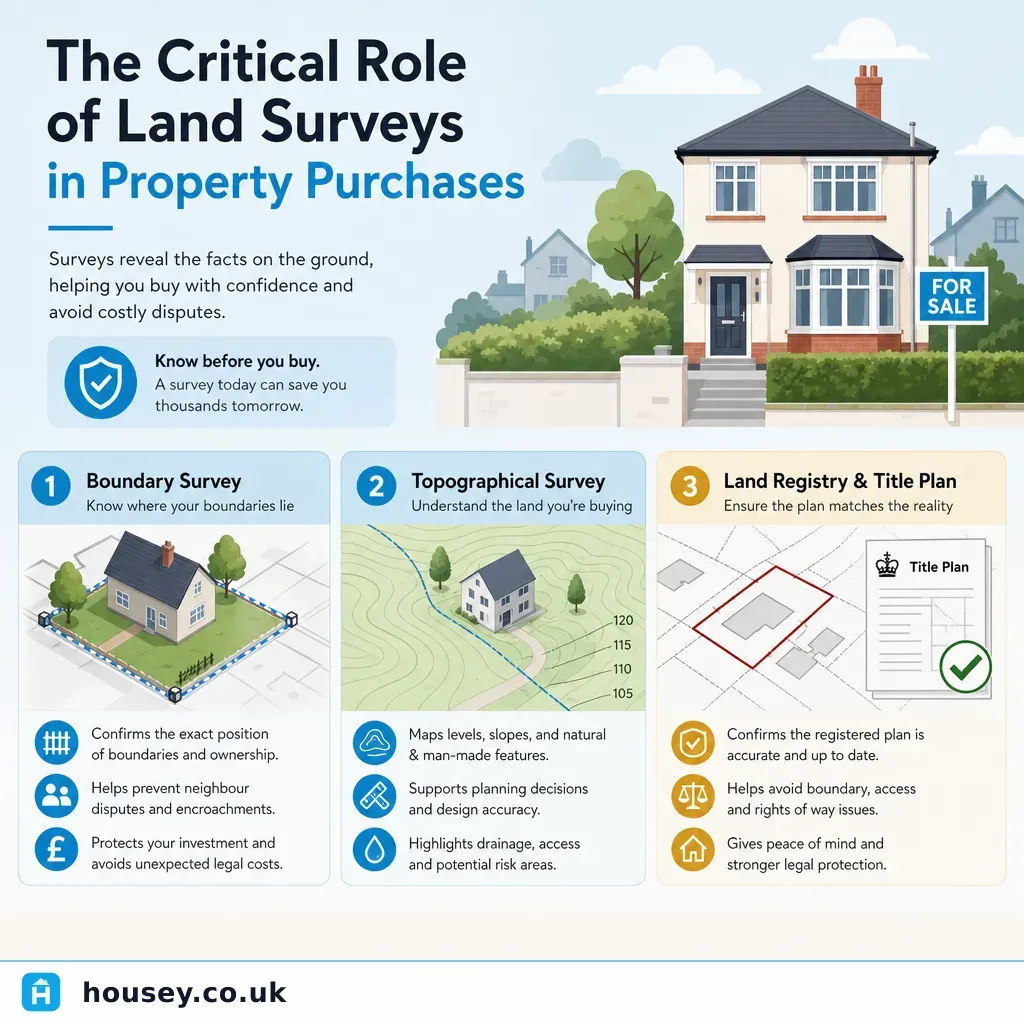
The Critical Role of Land Surveys in Property Purchases
A land survey can identify boundary discrepancies, missing access rights, encroachments, and topographical issues that a RICS home survey or conveyancing search will not cover.
 Surveys & Inspections
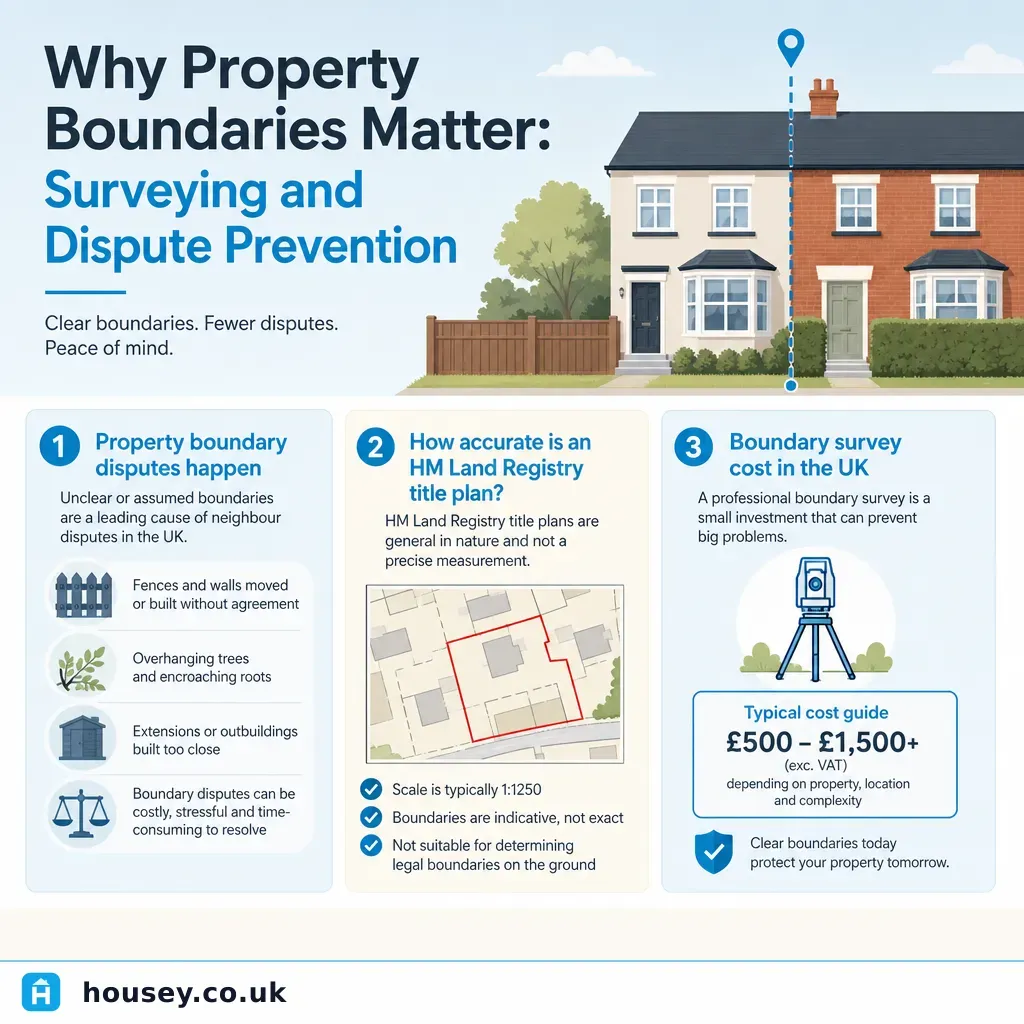
Why Property Boundaries Matter: Surveying and Dispute Prevention
Property boundaries in England and Wales are recorded as general boundaries by HM Land Registry — not precise measurements.
 Surveys & Inspections
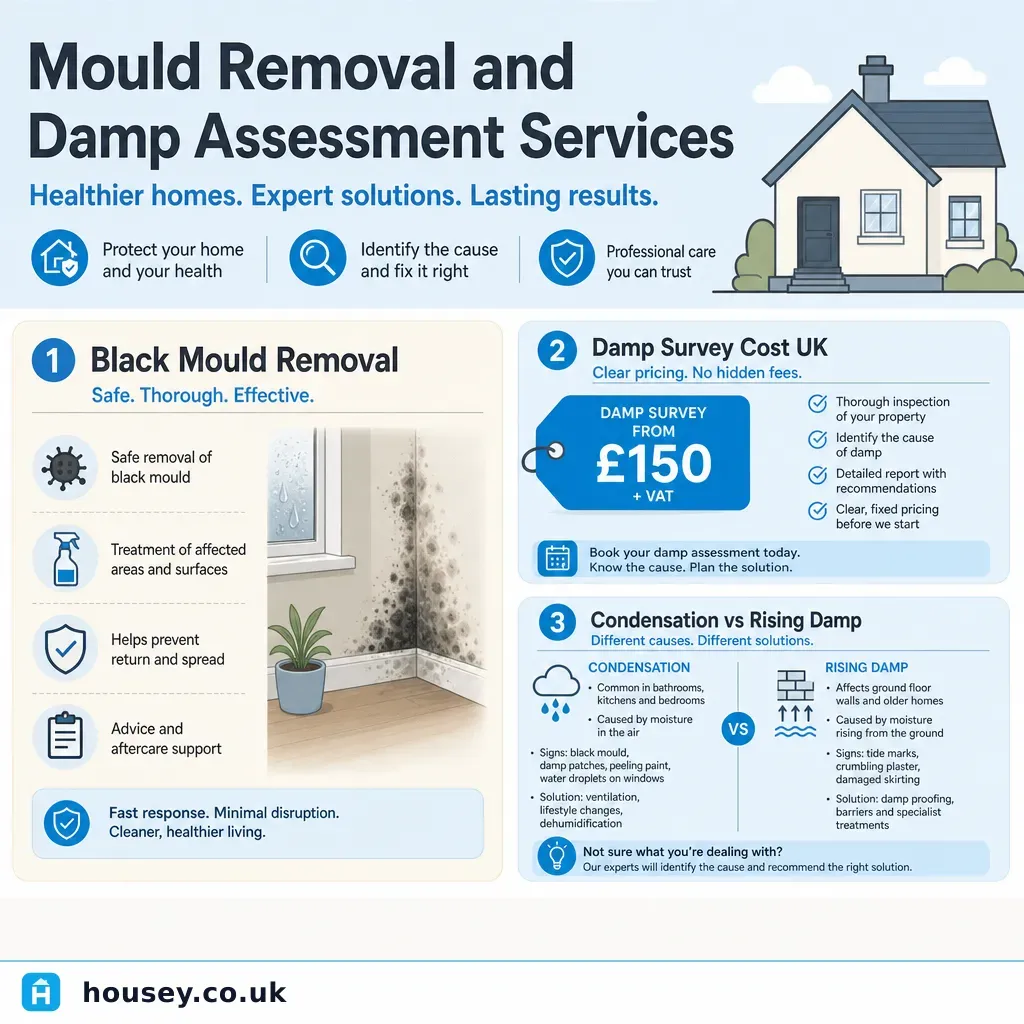
Mould Removal and Damp Assessment Services
Professional mould removal and damp assessment starts with identifying the moisture source—condensation, rising damp, or penetrating damp—before any treatment begins.
 Surveys & Inspections
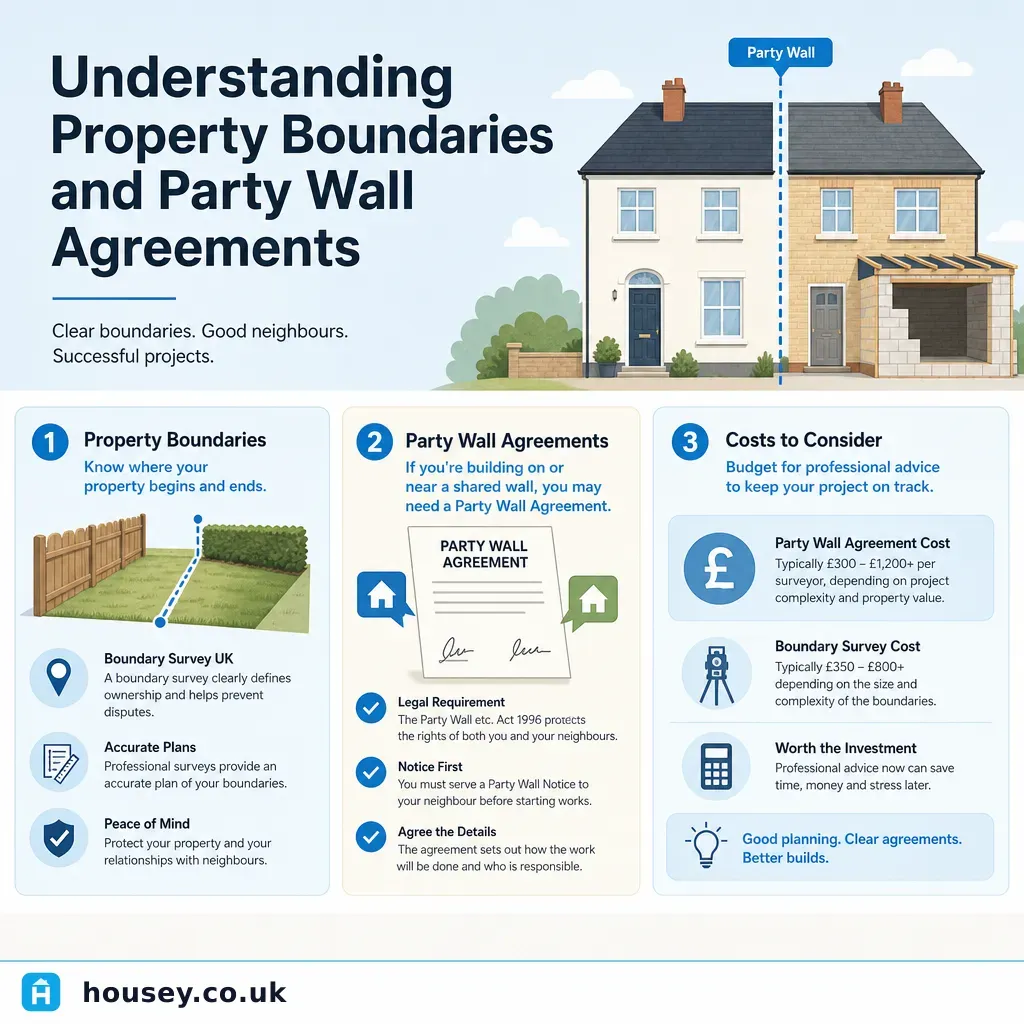
Understanding Property Boundaries and Party Wall Agreements
Property boundaries define the legal extent of your land; the Party Wall etc.
 Surveys & Inspections
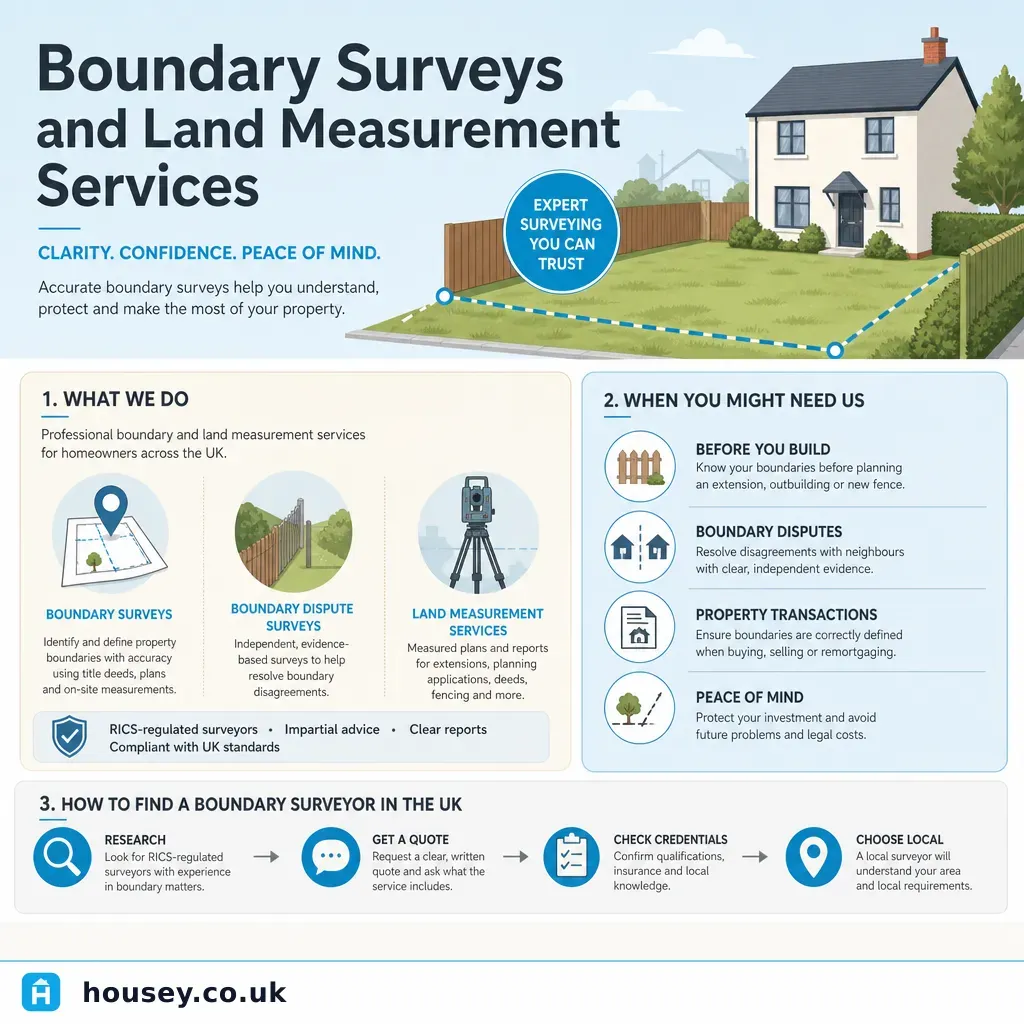
Boundary Surveys and Land Measurement Services
A boundary survey establishes where the legal boundary of a property sits, using title deeds, historic maps, and on-site measurement.