Understanding Property Boundaries and Party Wall Agreements
By Housey · Last reviewed 31st of May 2026
Understanding Property Boundaries and Party Wall Agreements
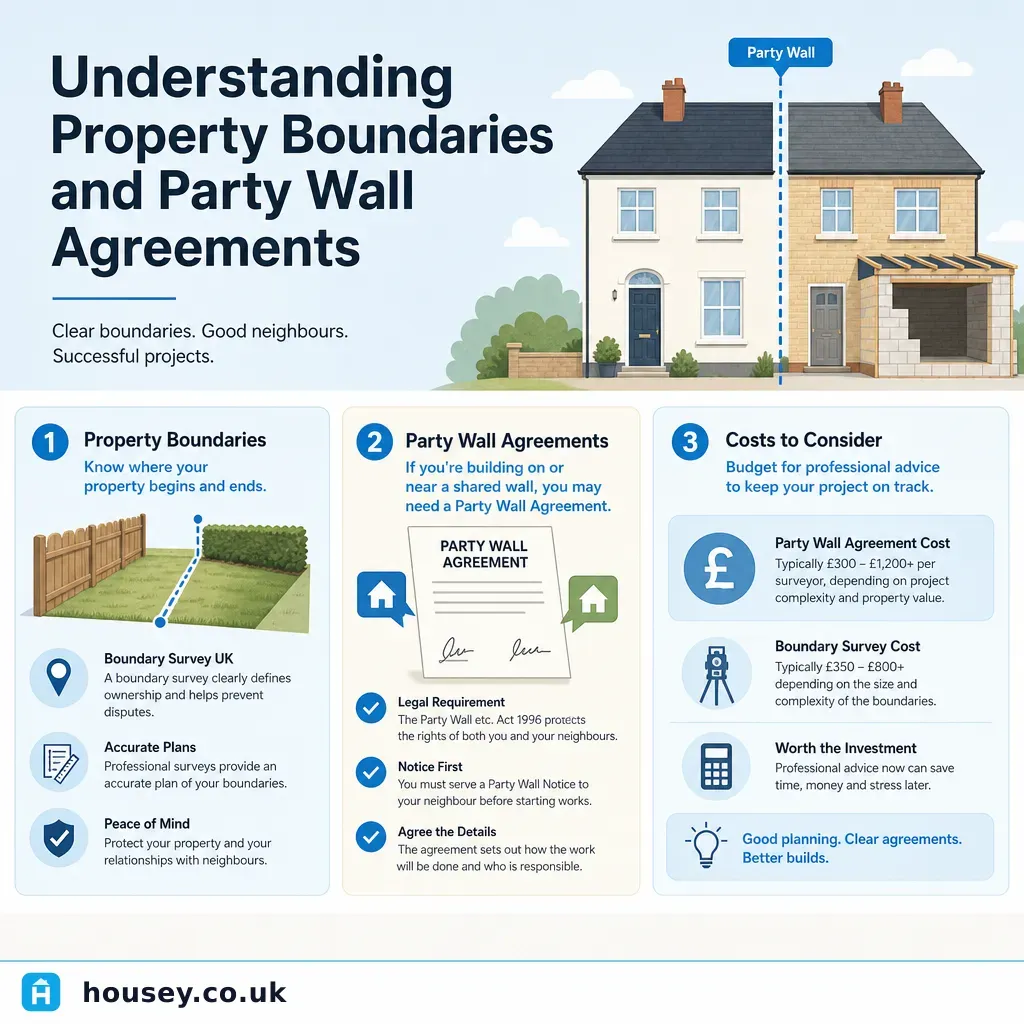
Whether you are planning a home extension, buying a property with an uncertain fence line, or receiving notice from a neighbour about planned works, questions about property boundaries and party walls arise at some of the most pressured moments in UK homeownership. The two topics are closely related — both concern the edges of your property — but they are governed by entirely different legal frameworks and call for different professional expertise.
Key points
- The Party Wall etc. Act 1996 is a statutory regime in England and Wales requiring written notice to be served on adjoining owners before most works to a shared wall, boundary structure, or excavations within 3–6 metres of a neighbour's foundations.
- HM Land Registry title plans use Ordnance Survey mapping and show the general boundary only — the precision is approximately ±500 mm at 1:1250 scale, which is not sufficient to resolve sub-metre boundary disputes.
- A party wall award produced by an appointed surveyor is a legally binding document; it governs how works are carried out and protects both parties if damage occurs.
- T-marks on a title plan indicate maintenance responsibility for a boundary feature, not necessarily ownership; their absence is common in older deeds.
- Failure to serve a party wall notice before notifiable works can result in an injunction to stop the works even after they have started, and the building owner may be liable for the adjoining owner's legal costs.
What is a property boundary?
A property boundary is the legal division between your land and your neighbour's (or a public highway). In England and Wales, the general boundary rule applies: HM Land Registry registers the general position of a boundary, not its precise location. Title plans are drawn on Ordnance Survey base maps at scales unsuited to sub-metre precision.
This matters because many boundary disputes involve disagreements measured in centimetres — a fence post, a wall face, a hedge centre-line — that the title plan alone cannot resolve. Determining the legal boundary requires analysis of the original conveyancing documents, any boundary agreements registered at Land Registry using Form DB, historic deeds, aerial photographs, physical features, and in some cases expert evidence from a RICS-accredited boundary surveyor.
Who owns the fence, wall, or hedge?
Ownership of a boundary feature is not determined by which side of the boundary it sits on. T-marks on a title plan indicate maintenance responsibility, but they are absent or ambiguous in many older deeds. Your title register and title plan — available from HM Land Registry — are the correct starting point.
What is a party wall?
A party wall is a wall that stands astride the boundary of two owners' land, or a wall that forms part of a building and stands on the boundary. The Party Wall etc. Act 1996 covers three categories:
- Party walls — walls shared between two buildings, such as the internal dividing wall of a semi-detached pair or mid-terrace property.
- Party fence walls — walls at the boundary not forming part of a building, such as a garden wall straddling the boundary line.
- Excavations near neighbouring structures — works within 3 metres of a neighbour's building or structure to a depth lower than their foundations, or within 6 metres if the proposed works undercut a 45-degree line drawn from the base of the neighbour's foundations.
The Act applies in England and Wales only. Scotland operates under separate common law provisions.
What works require a party wall notice?
Type of work | Notice required | Minimum notice period |
|---|---|---|
Works to or on a party wall (cutting in, raising, repairing, underpinning) | Party Structure Notice | 2 months before works begin |
Building a new wall at or astride the boundary | Line of Junction Notice | 1 month before works begin |
Excavations within 3 m or 6 m of a neighbour's foundations | Notice of Adjacent Excavation | 1 month before works begin |
Loft conversion cutting into a party wall or raising a shared gable | Party Structure Notice | 2 months before works begin |
Rear extension involving a shared flank wall or close excavation | Party Structure Notice or Adjacent Excavation Notice | As above |
Notice must be served in writing. If the adjoining owner consents in writing within 14 days, works may proceed. If there is no response, or if the owner dissents, a dispute is deemed to have arisen and surveyors must be appointed under the Act.
Boundary disputes vs party wall matters: key differences
| Boundary dispute | Party wall matter |
|---|---|---|
Legal framework | General property law, Land Registration Act 2002, case law | Party Wall etc. Act 1996 (statutory) |
Trigger | Disagreement over the location or ownership of a boundary feature | Planned works affecting a party structure or requiring close excavation |
Professionals involved | Boundary surveyor, solicitor, RICS expert witness | Party wall surveyor(s) — RICS or FPWS-qualified |
Process | Negotiation, mediation, First-tier Tribunal or County Court | Notice, consent or deemed dispute, party wall award |
Typical timescales | Months to years in contested cases | Statutory notice period (1–2 months); award usually within weeks of appointment |
Cost exposure | Variable; solicitor costs can escalate significantly | Party wall surveyor fees; building owner typically meets costs |
Risk of inaction | Escalation; adverse possession possible in extreme long-term cases | Injunction to stop works; liability for damage and neighbour's costs |
Which professional do I need?
Situation | Professional to instruct | Qualification to look for |
|---|---|---|
Planning an extension or loft conversion affecting a shared wall | Party wall surveyor | RICS, Faculty of Party Wall Surveyors (FPWS) |
Received a party wall notice from a neighbour | Party wall surveyor (to advise or act as your appointed surveyor) | RICS, FPWS |
Dispute over fence or boundary location | Boundary surveyor | RICS accredited, expert witness experience |
Buying a property with an unclear or disputed boundary | Solicitor, plus a boundary surveyor if complexity warrants it | Solicitor (SRA regulated), RICS surveyor |
Boundary dispute reaching tribunal or court | Property litigation solicitor and RICS expert witness | SRA regulated, RICS accredited |
Important limitations
This article provides general information about the Party Wall etc. Act 1996 and property boundary law in England and Wales. Legal and procedural rules vary depending on the specific works planned, the property's history, the title documents, and local circumstances. Nothing in this article constitutes legal advice. Always consult a qualified party wall surveyor and, where legal proceedings are a possibility, a solicitor regulated by the Solicitors Regulation Authority (SRA) before taking action.
What to ask a qualified professional
Before instructing a party wall surveyor or boundary surveyor, ask:
- Are you a member of RICS and/or the Faculty of Party Wall Surveyors?
- What is your fee structure — fixed fee per award, or hourly rate?
- Will you serve the notice on my behalf, or do I need to do that myself?
- How long is the process likely to take given my construction programme?
- What does a party wall award cover, and what does it not protect against?
- If the boundary is disputed, what evidence should I gather before instructing you?
- Is mediation a realistic option in my situation before considering litigation?
When to get professional help
Instruct a party wall surveyor as soon as you know works will affect a shared wall or require excavation near a neighbour — do not wait until planning permission is granted. Red flags that require immediate professional attention:
- You have already started notifiable works without serving the required notice.
- Your neighbour has served a counter-notice or appointed their own surveyor.
- Physical works have cracked, damaged, or destabilised a shared wall.
- A boundary dispute is preventing a property sale from exchanging or completing.
- You have received a letter from a solicitor concerning a boundary or party wall matter.
How Housey can help
Housey connects homeowners with experienced party wall surveyors and boundary surveyors who can advise on your legal obligations, serve notices on your behalf, prepare party wall awards, and represent your interests if a dispute requires escalation.
Frequently asked questions
Do I need a party wall agreement for a rear extension?
Often yes — if the extension involves building on or near a shared wall, raising a party fence wall, or excavating within 3–6 metres of a neighbour's foundations, the Party Wall etc. Act 1996 applies. The exact requirement depends on the design. A party wall surveyor can confirm your obligations before you commit to a programme and serve notice on your behalf.
What happens if my neighbour ignores a party wall notice?
If an adjoining owner does not respond within 14 days of receiving a party wall notice, a dispute is deemed to have arisen under the Act. Both parties must appoint surveyors. Works cannot begin until a party wall award is in place. The award sets out how works will be carried out and provides legal protection for both parties throughout the project.
Can I use HM Land Registry to settle a boundary dispute?
HM Land Registry records general boundaries, not exact line determinations. If both parties agree, a determined boundary can be applied for jointly under the Land Registration Rules 2003. Where there is a dispute, Land Registry will not adjudicate — you would need the First-tier Tribunal (Property Chamber) or court. A boundary surveyor's report is often key evidence in such proceedings.
How much does a party wall surveyor cost?
Fees vary by location and complexity. An agreed surveyor for a straightforward loft conversion may charge £700–£1,500 for the award. Where separate surveyors are appointed, total costs can reach £2,000–£4,000 or more, with the building owner typically meeting the costs. Indicative UK costs, last reviewed 2026-05-31. Always request itemised quotes from at least two surveyors.
Sources and further reading
- Party Wall etc. Act 1996 — legislation.gov.uk
- Party walls and building work — GOV.UK
- Land Registry plans guidance — HM Land Registry
- RICS professional standards and guidance — RICS
- Faculty of Party Wall Surveyors — FPWS
Useful next reads
 Surveys & Inspections
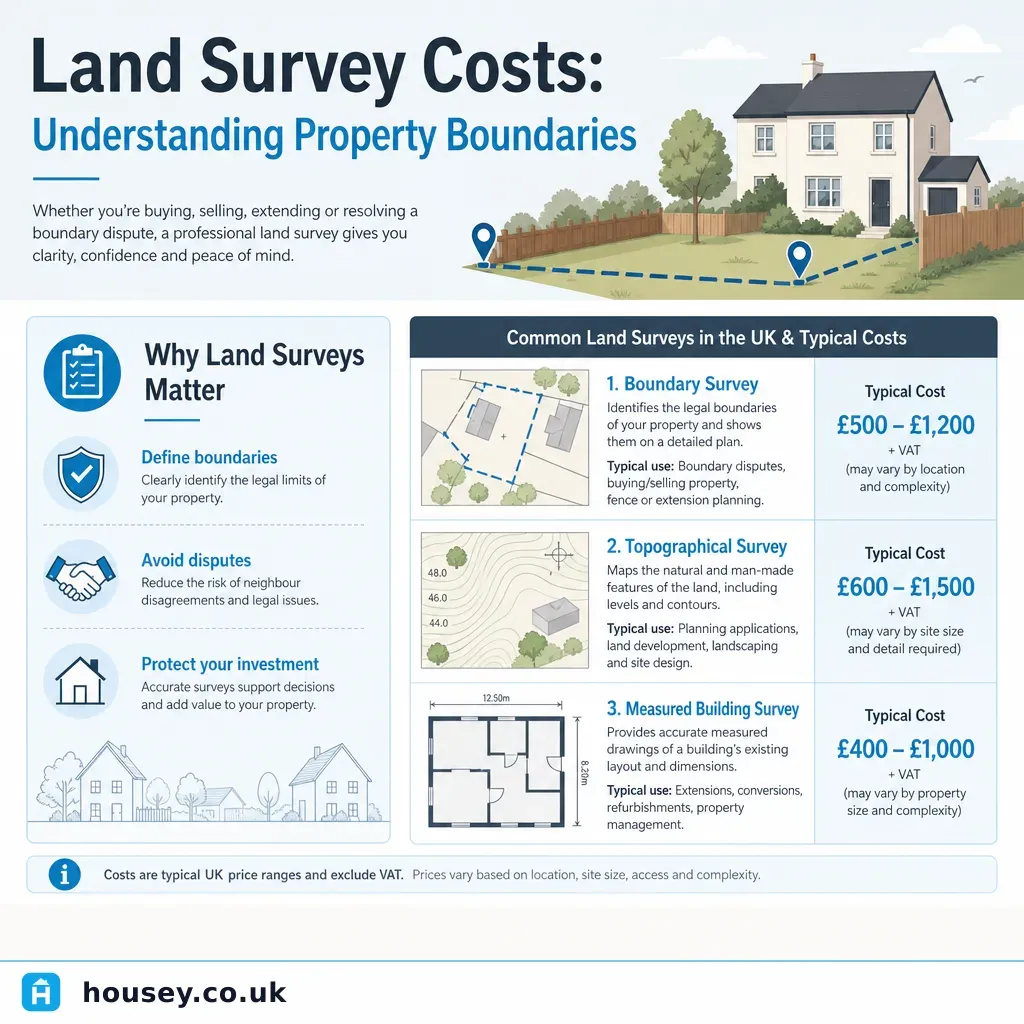
Land Survey Costs: Understanding Property Boundaries
Land survey costs in the UK depend on the type of survey needed: boundary surveys typically cost £500–£2,000, topographical surveys £600–£2,500, and measured building surveys £800–£3,000 for a standard house.
 Surveys & Inspections
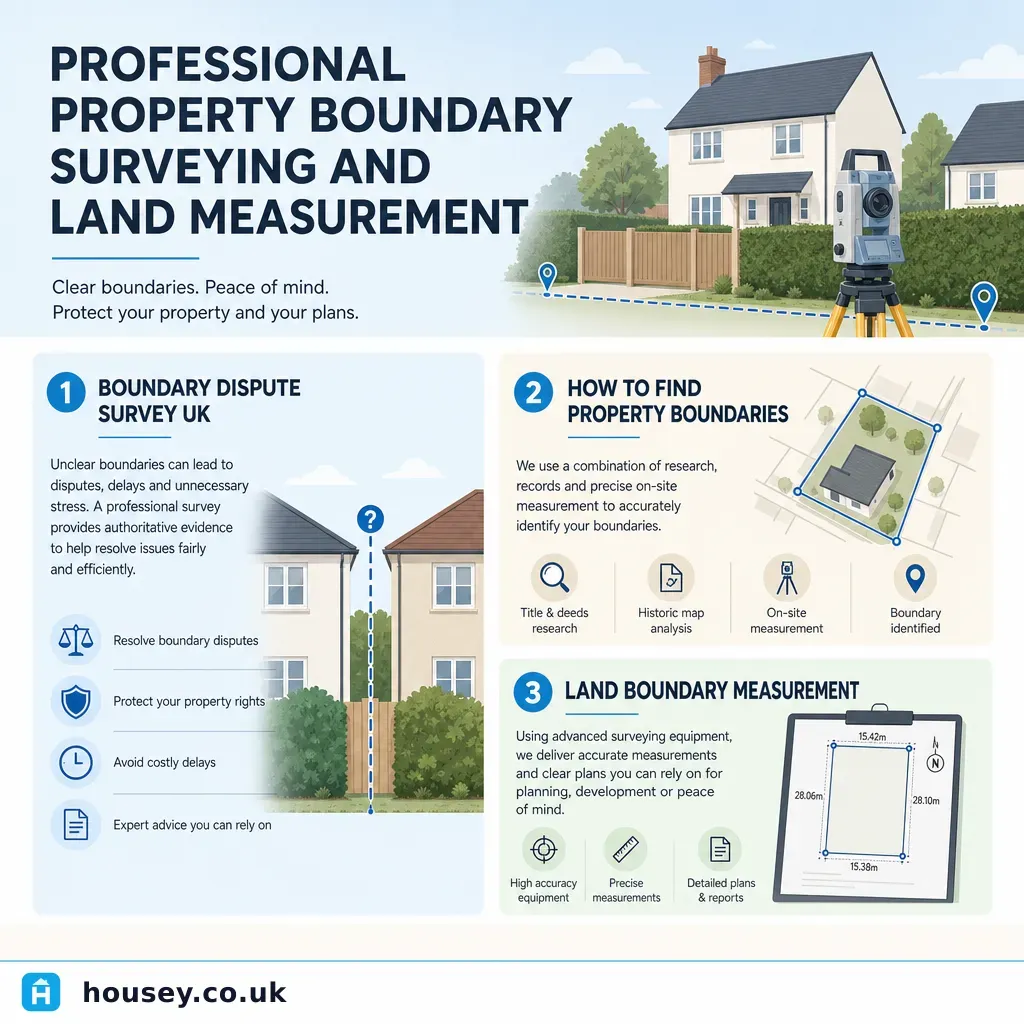
Professional Property Boundary Surveying and Land Measurement
A property boundary survey precisely establishes the legal extent of your land using title deeds, Ordnance Survey data, and physical evidence.
 Surveys & Inspections
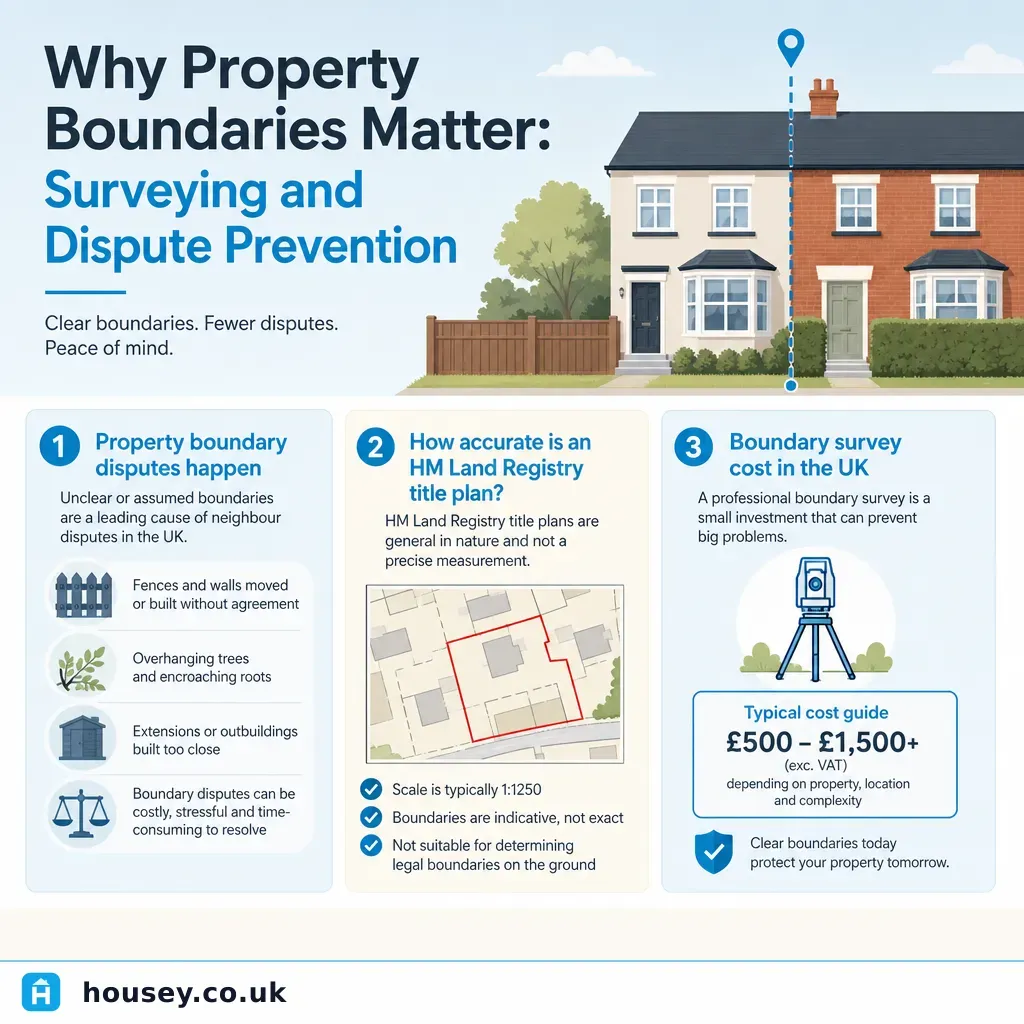
Why Property Boundaries Matter: Surveying and Dispute Prevention
Property boundaries in England and Wales are recorded as general boundaries by HM Land Registry — not precise measurements.
 Surveys & Inspections
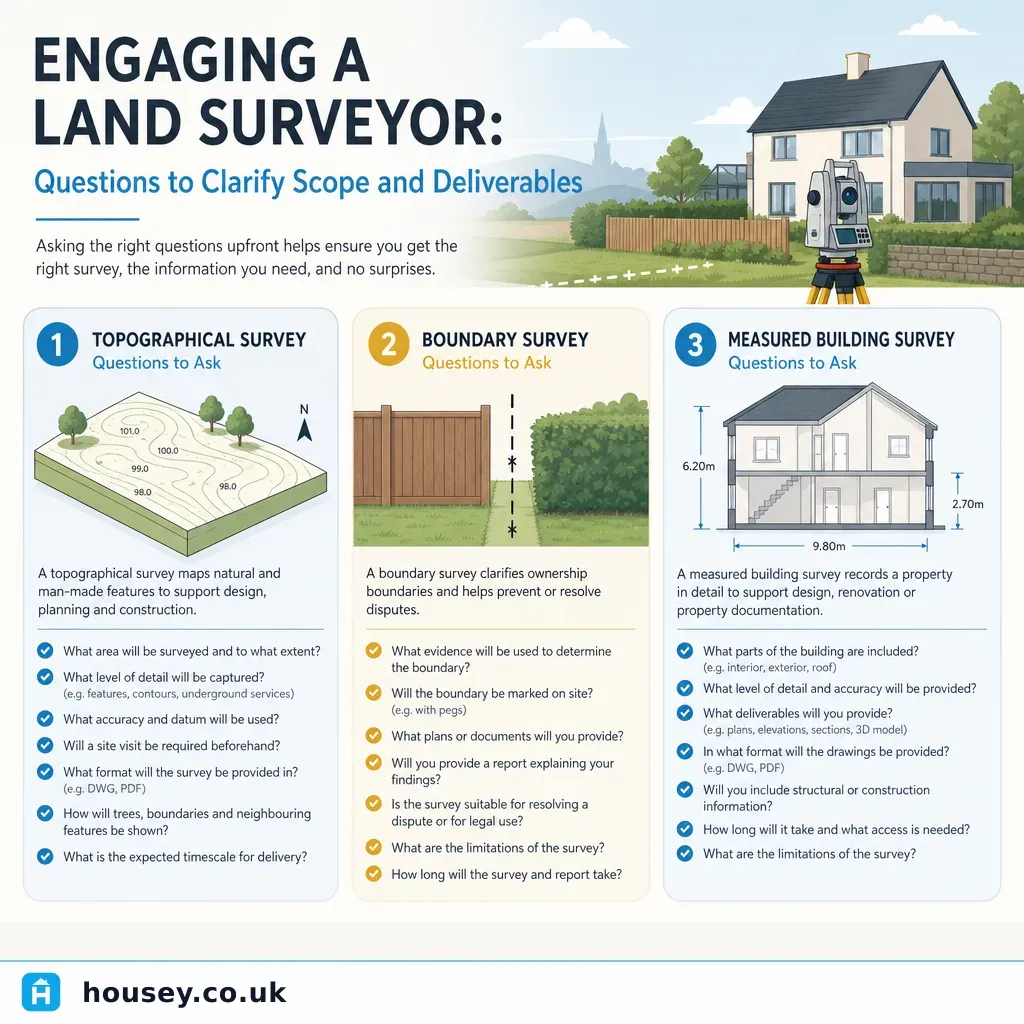
Engaging a Land Surveyor: Questions to Clarify Scope and Deliverables
When engaging a land surveyor, clarify exactly which type of survey you need — topographical, boundary, or measured building — before agreeing a fee.
 Surveys & Inspections
Land and Property Surveying Costs
Land survey costs in the UK typically range from around £400 for a simple boundary check to £3,000 or more for a detailed topographical or measured building survey of a large site.