Breeze Block Wall Construction and Costs
By Housey · Last reviewed 5th of May 2026
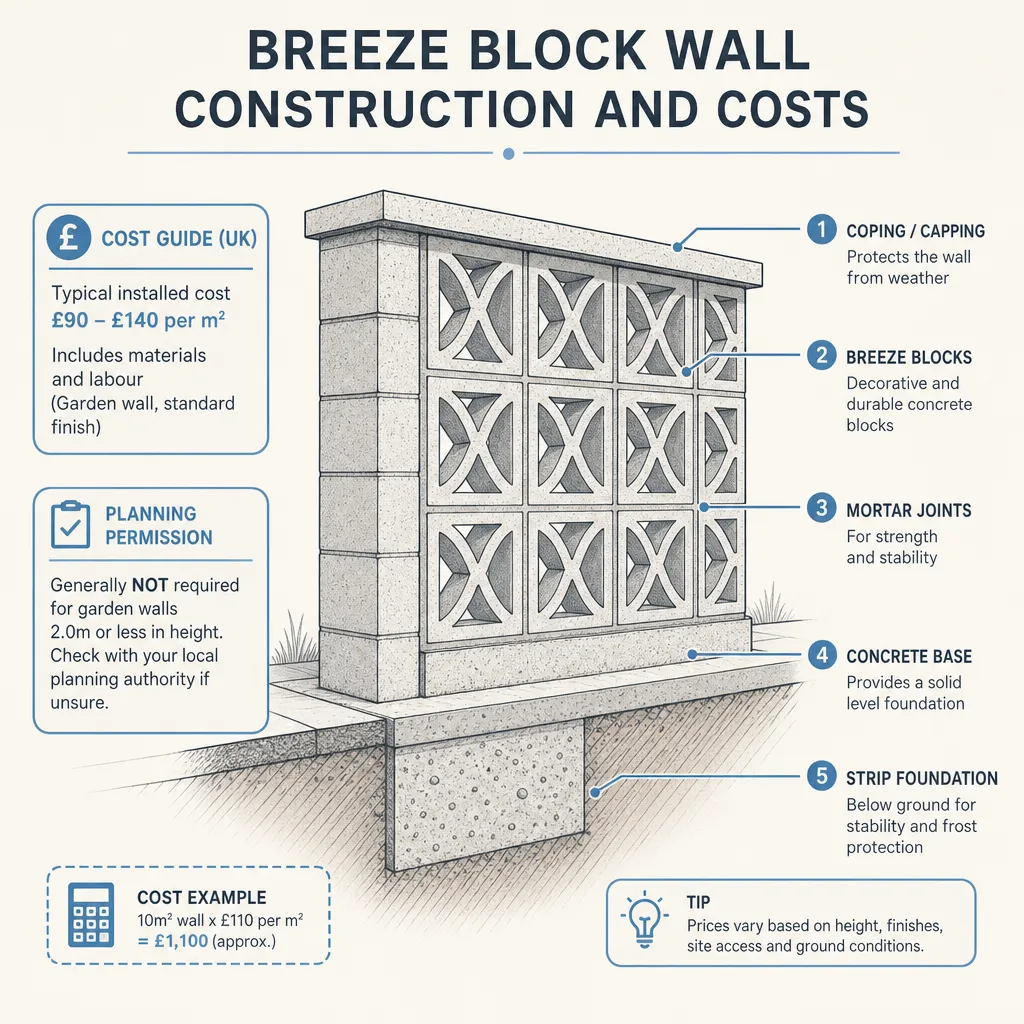
Breeze Block Wall Construction and Costs
Breeze blocks — the informal UK name for concrete masonry units — are among the most widely used materials in British domestic and commercial construction. Whether the project is a garden boundary wall, a house extension, an outbuilding, or a retaining structure, choosing the right block specification, understanding the regulatory requirements, and knowing when professional input is needed all affect both structural performance and legal compliance.
Key points
- Breeze block is the informal UK term for concrete masonry units; formal categories include dense aggregate blocks (compressive strength 7.3–35 N/mm²), lightweight aircrete blocks such as Thermalite and Celcon, and medium-density blocks
- Structural blockwork walls forming part of a building must comply with Building Regulations Part A (structural safety) and Part L (thermal performance), and require building control sign-off
- Garden and boundary walls over 2 metres in height may require planning permission in England under the Town and Country Planning Act 1990; walls over 1 metre adjacent to a highway or public footpath require permission regardless of height
- Indicative costs for a simple single-skin garden wall (dense concrete block, supply and build) run from approximately £80–£150 per square metre — Indicative UK costs, last reviewed 2026-05-05
- A structural engineer should specify block grade, wall thickness, reinforcement, and foundation requirements for any load-bearing or retaining wall
Types of concrete block used in UK construction
Not all concrete blocks are interchangeable. Block type significantly affects structural capacity, thermal performance, weight, and workability on site.
Block type | Common examples | Typical use | Compressive strength | Key characteristic |
|---|---|---|---|---|
Dense aggregate block | Tarmac, Hanson, Plasmor | Foundations, below-DPC work, retaining walls | 7.3–35 N/mm² | High strength, heavy, poor insulator |
Medium-density block | Various manufacturers | Inner and outer leaf in cavity walls | 3.6–10.4 N/mm² | Balance of strength and workability |
Lightweight aircrete block | Thermalite, Celcon, H+H | Inner leaf of cavity walls, internal partitions | 2.9–8.7 N/mm² | Good thermal performance, easy to cut, lightweight |
Facing concrete block | Forticrete, Marshalls | Garden and boundary walls, architectural finishes | Varies | Weather-resistant aesthetic finish |
Planning permission: when is it required?
In England, the rules under the Town and Country Planning Act 1990 and the Town and Country Planning (General Permitted Development) Order 2015 are as follows — rules differ in Scotland, Wales, and Northern Ireland:
- Walls adjacent to a highway or public footpath: planning permission is required for walls over 1 metre in height
- Walls in other locations: walls up to 2 metres are generally permitted development and do not require a planning application
- Retaining walls that significantly change ground levels: may require planning permission depending on height and location
- Listed buildings and conservation areas: permitted development rights are restricted or removed — consult your local planning authority before any boundary or garden wall work
- Extensions and outbuildings: blockwork structures used as extensions or outbuildings follow the Permitted Development rules for householder extensions
Always check with your local planning authority if you are unsure, particularly if your property has had previous extensions, sits within an Article 4 direction area, or is in any form of restricted zone.
When do Building Regulations apply?
Building Regulations apply to blockwork in the following situations:
- Any new structural wall forming part of a building — including extensions, attached garages over 15 m² floor area, and habitable outbuildings
- Any wall forming part of the thermal envelope, subject to Part L minimum U-value requirements
- Structural alterations to an existing load-bearing wall
- Retaining walls within 3 metres of a building or boundary where retained height is significant
Simple freestanding garden walls below planning thresholds generally do not require a building regulations application, but structural best practice — adequate foundation depth, correct mortar specification, and appropriate block grade — still applies and affects long-term performance.
How a breeze block wall is built
- Foundation: a concrete strip foundation is required for most walls; at least 300 mm deep in stable soil, deeper in clay or made-up ground, and at least twice the width of the wall
- Damp-proof course (DPC): a DPC membrane is laid at ground level and above any finished external ground level to prevent rising damp
- Blockwork courses: blocks are laid in a running bond (staggered joints) in cement-sand mortar, typically a 1:5 mix for above-ground work
- Reinforcement: retaining walls and tall freestanding walls may require vertical steel reinforcing bar and in-fill concrete, as specified by a structural engineer
- Capping or coping: the top course must be protected with a weathered coping stone, capping block, or similar to shed rainwater and slow mortar joint erosion
- Finishing: render, fair-faced pointing, or a surface coating applied as the specification requires
Indicative costs
Indicative UK costs, last reviewed 2026-05-05. Costs vary with block specification, site access, ground conditions, finish, and region.
Wall type | Approximate cost per m² (supply and build) |
|---|---|
Single-skin garden wall — 100 mm dense concrete block | £80–£150 |
Single-skin garden wall — facing block, fair finish | £110–£200 |
Double-skin or reinforced retaining wall | £150–£300+ |
Extension inner leaf — lightweight aircrete block | £100–£180 (inner leaf only) |
Foundation costs are additional. A strip foundation for a standard garden wall typically adds £50–£100 per linear metre, depending on depth and soil conditions. Always obtain at least two written quotes before committing to a contractor.
Worked UK property scenario
A homeowner in Bristol wants to replace a collapsed 1.8 m timber fence with a concrete block wall across the rear of a 12 m garden. The plot is a standard residential site with no highway frontage and the property is not listed.
- At 1.8 m height and away from a highway, no planning permission is required under current permitted development rules
- A simple garden wall does not require a building regulations application
- Foundation: 300 mm deep concrete strip, 12 m long — indicative cost £600–£1,200
- Blockwork: 1.8 m × 12 m = approximately 21.6 m² at £80–£150 per m² — indicative blockwork cost £1,700–£3,200
- Coping stones and pointing: approximately £300–£600 additional
- Total indicative project cost: £2,600–£5,000, depending on block specification, access, and contractor rates
- A structural engineer is not required for a straightforward garden wall of this type, but the builder should have demonstrable experience in blockwork construction and provide a written quote specifying materials and foundation depth
Homeowner checklist before starting a breeze block wall
Important limitations
This article provides general guidance on breeze block wall construction for UK homeowners. Structural requirements, foundation depths, block grades, and wall thicknesses vary significantly depending on soil conditions, wall height, loading, proximity to other structures, and local site conditions. Planning permission and building regulations requirements can also vary by location, property history, and local authority policy. Always consult a qualified structural engineer for any load-bearing or retaining wall, and confirm requirements with your local planning authority and building control body before starting work. Nothing in this article constitutes structural, legal, or planning advice.
What to ask a qualified professional
Structural engineer (for load-bearing or retaining walls):
- What block grade and wall thickness do you specify for this loading condition and soil type?
- What foundation depth and specification do you recommend?
- Is reinforcement required, and if so, what type and at what centres?
- Will you provide a written structural specification or drawing for the builder?
- Will I need building control approval, and can you assist with the submission?
Builder or bricklayer:
- What is your experience with blockwork of this type and height?
- Do you hold public liability insurance — can I see the current certificate?
- Will you obtain any required building regulations approval?
- What block grade and mortar specification will you use?
- Does your quote include foundation, blocks, mortar, coping, and VAT?
- What could change the price or timeline once work has started?
When to get professional help
A straightforward garden wall can be built by a competent, experienced bricklayer without engineering input. Consult structural engineering services or a building control body if:
- The wall will retain soil or water at any significant height
- The wall is close to an existing building's foundations
- The site has made-up ground, expansive clay soils, or known ground contamination
- The wall forms part of a building extension requiring Building Regulations approval
- You are in a conservation area, Article 4 area, or the property is listed
- You are unsure whether the Party Wall etc. Act 1996 applies to your situation
How Housey can help
For extensions, retaining walls, or any structural blockwork needing engineering input, Housey can connect you with local structural engineering services and civil engineers who can provide specifications, drawings, and professional oversight of your project.
Frequently asked questions
What is the difference between a breeze block and an aircrete block?
Breeze block is an informal UK term now used loosely for any concrete masonry unit. Aircrete blocks — such as Thermalite or Celcon — are a specific lightweight type valued for thermal performance and ease of cutting, commonly used for the inner leaf of cavity walls in UK house construction. Dense concrete aggregate blocks are heavier, stronger, and better suited to structural, below-ground, and exposed applications.
Do I need a structural engineer for a garden wall?
For a simple freestanding garden wall below 2 m in stable soil, a structural engineer is not usually required. For retaining walls, walls over approximately 1 m retained height, walls in made-up or clay ground, or any wall close to a building's foundations, a structural engineer's specification is strongly recommended to avoid foundation failure or collapse.
How deep should foundations be for a breeze block wall?
As a general guide, freestanding garden wall foundations should be at least 300 mm deep in stable soil, and 450–600 mm or deeper in clay or made-up ground. Foundations are typically at least twice the width of the wall. For structural walls in buildings, foundation depth is specified by a structural engineer following a site investigation. These are general guidelines; conditions vary by site.
Can I build a breeze block wall on a boundary?
You can build up to your land boundary but not on your neighbour's land without permission. Check your title deeds and HM Land Registry title plan to confirm the boundary position. The Party Wall etc. Act 1996 may apply if you are building within 3 metres of a neighbouring structure or directly on the boundary line — a party wall surveyor can advise on the correct process.
How long does a breeze block garden wall last?
A well-built concrete block wall with correct foundations, mortar specification, and a weatherproof coping can last 50–100 years or more. The main failure modes are mortar joint erosion, frost damage in exposed locations, subsidence from shallow foundations, and coping failure allowing water ingress. Using a freeze-thaw rated block and fitting a good coping significantly extends service life.
Sources and further reading
- Building Regulations Approved Document A: Structure — GOV.UK
- Planning Portal: Fences, walls and gates — permitted development rules — Planning Portal
- Town and Country Planning Act 1990 — legislation.gov.uk
- HSE: Excavations in construction — safe working practice — Health and Safety Executive
- RICS guidance on party wall matters — RICS
Useful next reads
 Planning & Pre-Build
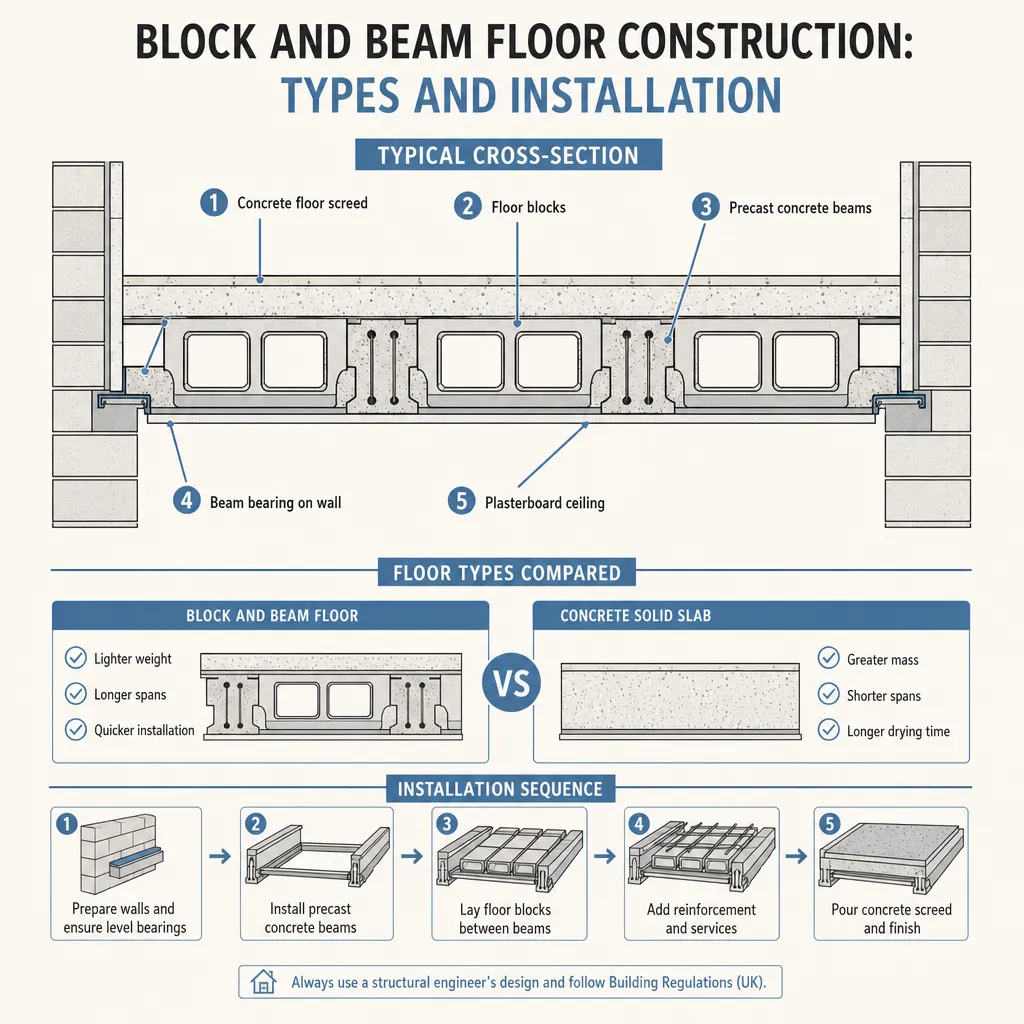
Block and Beam Floor Construction: Types and Installation
Block and beam floors use precast concrete beams with infill blocks to form a suspended ground floor over a ventilated void.
 Planning & Pre-Build
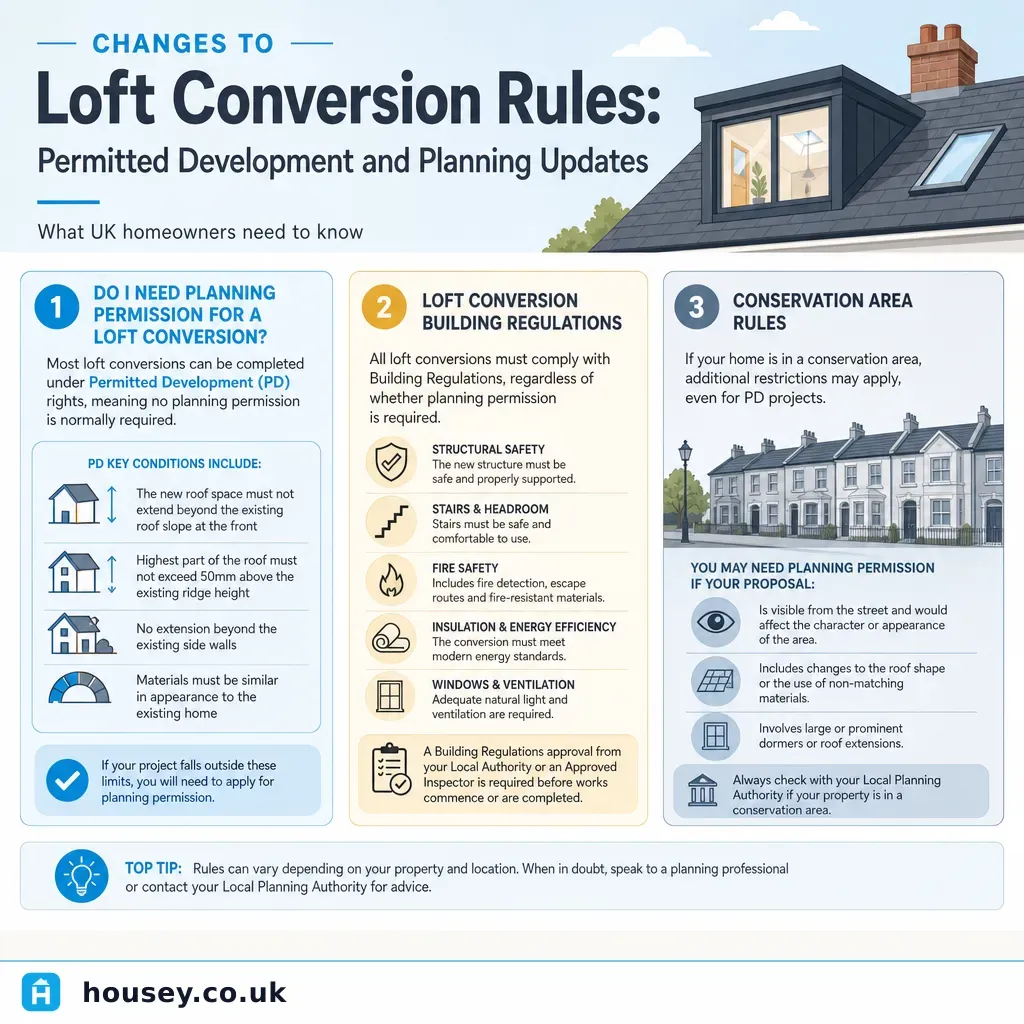
Changes to Loft Conversion Rules: Permitted Development and Planning Updates
In England, most loft conversions on standard houses qualify as Permitted Development under Class B of the GPDO 2015, allowing up to 40 cubic metres (terraced) or 50 cubic metres (detached or semi-detached) without a planning application — if conditions are met.
 Planning & Pre-Build
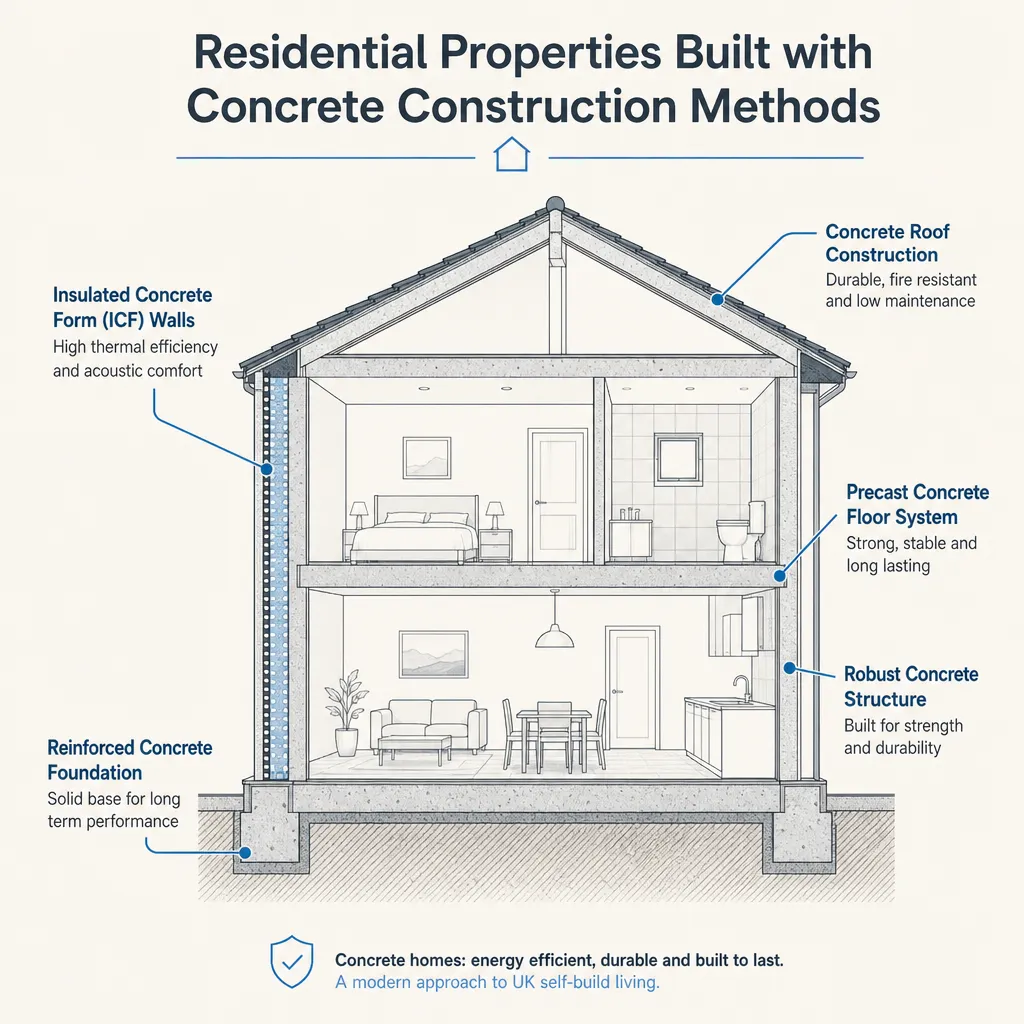
Residential Properties Built with Concrete Construction Methods
UK homes are built using several concrete methods: in-situ cast concrete, precast panel systems, insulating concrete formwork (ICF), and older non-traditional types such as Wimpey No-Fines and Laing Easiform.
 Planning & Pre-Build
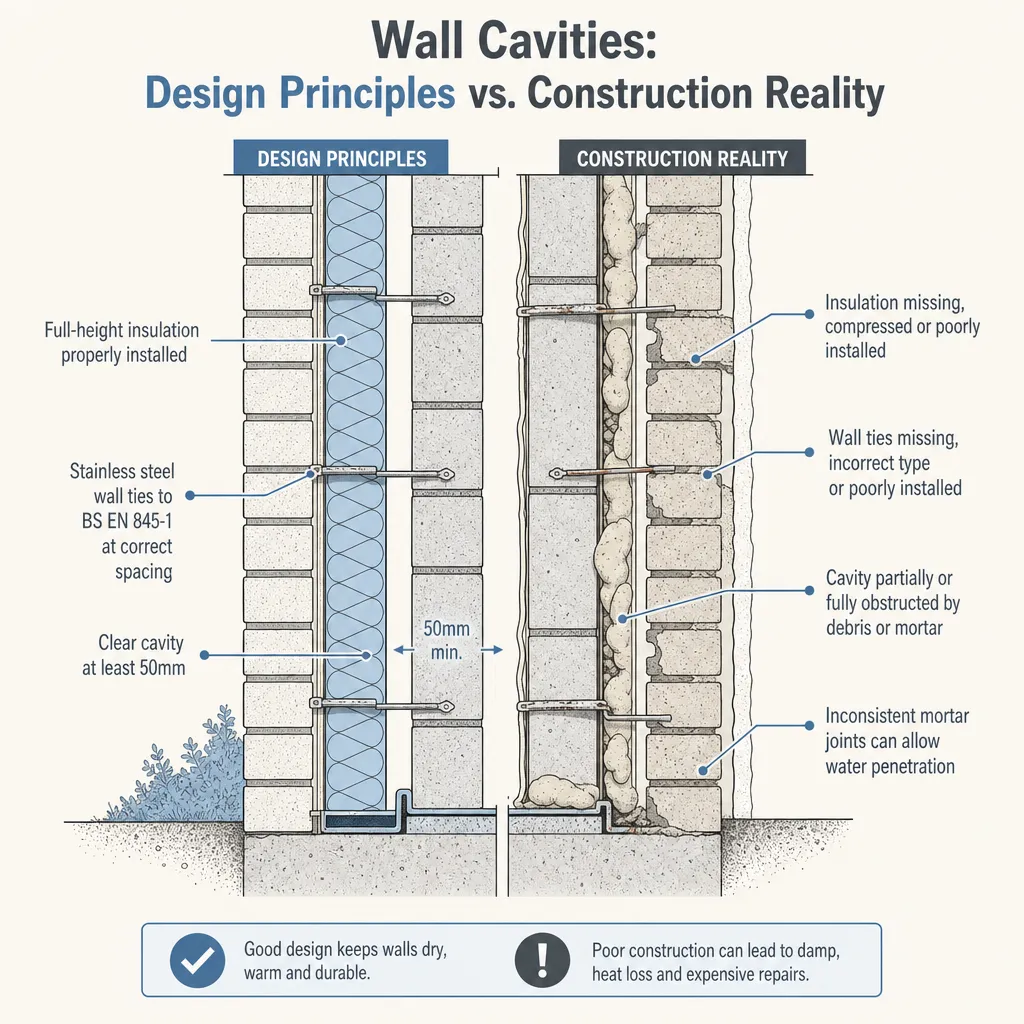
Wall Cavities: Design Principles vs. Construction Reality
A UK cavity wall is designed to resist weather, control heat loss, and structurally link two masonry leaves.
 Planning & Pre-Build
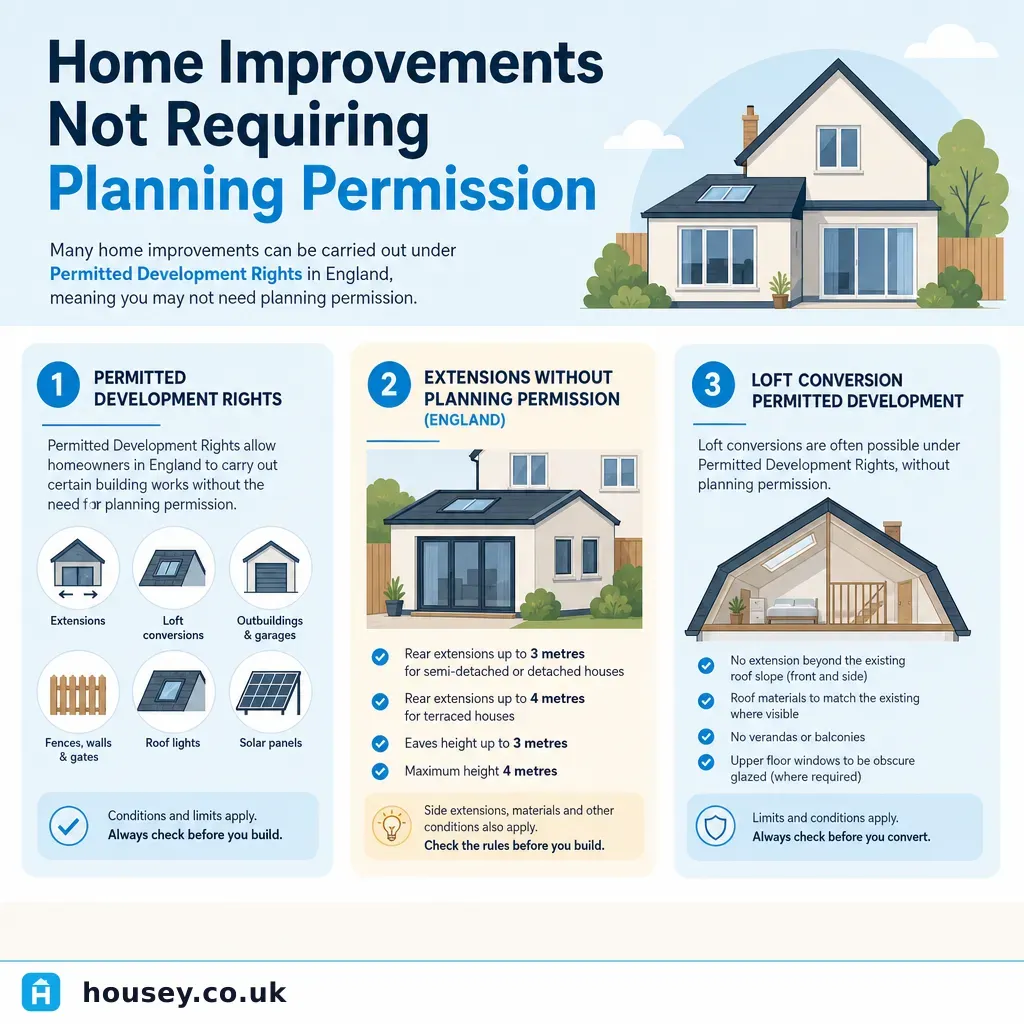
Home Improvements Not Requiring Planning Permission
Many common home improvements in England fall under Permitted Development Rights and do not require a planning application.