Pervious Concrete Surfaces: Modern Sustainable Driveway Solutions
By Housey · Last reviewed 11th of May 2026
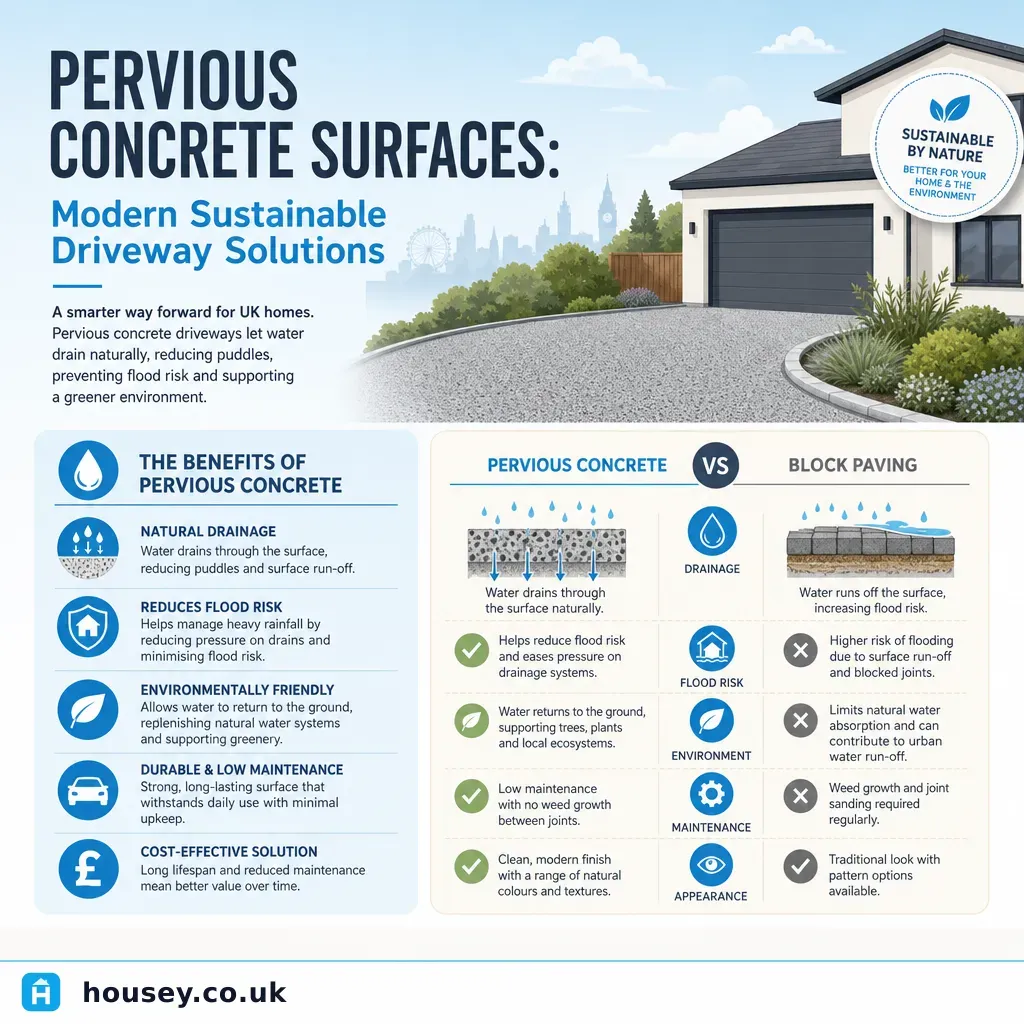
Pervious Concrete Surfaces: Modern Sustainable Driveway Solutions
Pervious concrete has moved from highway engineering into mainstream residential use over the last decade, and UK homeowners replacing tired tarmac aprons or laying new driveways are increasingly asking whether it offers a genuine alternative to block paving or resin-bound aggregate. The material's appeal lies in its ability to handle surface water at source — but correct mix specification and sub-base design are critical to long-term performance, and not every installer has direct experience with the product.
Key points
- Pervious concrete (also called porous or no-fines concrete) typically achieves a void ratio of 15–25%, compared with near-zero for conventional dense concrete, allowing water infiltration rates of 100–1,000 litres per square metre per hour when new.
- As a permeable surface, correctly installed pervious concrete generally satisfies the permitted development rule for front driveways in England (Schedule 2, Part 2, Class F of the Town and Country Planning General Permitted Development Order 2015), avoiding the need for planning permission on most residential drives over 5 m².
- The mix design omits or severely limits fine aggregate (sand), relying on cement paste to bind coarse aggregate particles at contact points — producing compressive strength of approximately 10–20 MPa, adequate for domestic car loading but not heavy goods vehicles.
- Pervious concrete requires a compatible open-graded sub-base (typically MOT Type 3 or clean angular gravel) to function as a complete drainage system; laying it over a dense sub-base eliminates the drainage benefit entirely.
- Maintenance typically involves periodic jet-washing or vacuum sweeping to clear fine sediment from surface voids — neglected pervious concrete can lose up to 80% of its infiltration capacity within five years without cleaning.
How pervious concrete works
Standard concrete relies on a dense matrix of cement, sand, and aggregate with minimal void space — water runs off the surface because there is nowhere for it to go. Pervious concrete replaces most or all of the fine aggregate with a coarser, uniformly sized stone (typically 10–20 mm), held together by a thin cement paste. The result is an open lattice structure visible to the naked eye as a slightly rough, honeycombed surface.
Rainwater enters the surface voids and travels downward through the sub-base, either infiltrating into the ground below (an infiltration system) or draining to a controlled outlet or attenuation feature if the underlying soil has poor permeability, such as clay.
The material is cast in place on site, unlike block paving which uses prefabricated units. Saw-cut control joints every 2–3 metres are essential to manage shrinkage and prevent random cracking across the surface.
Pervious concrete vs other permeable driveway surfaces
Surface type | Permeability | Strength for domestic use | Typical lifespan | Indicative cost per m² | Maintenance demand |
|---|---|---|---|---|---|
Pervious concrete | High | Adequate | 20–30 years | £60–£110 | Low–medium (periodic vacuum sweep) |
Permeable block paving | High | High | 25–40 years | £60–£120 | Low (joints may need topping up) |
Resin-bound aggregate | High | Medium | 15–25 years | £70–£130 | Low |
Gravel (loose) | Very high | Low | Ongoing replenishment | £15–£35 | Medium (raking, replenishment) |
Porous asphalt | High | High | 15–20 years | £40–£80 | Medium (top course more vulnerable) |
Indicative UK costs, last reviewed 2026-05-11. Prices vary significantly by region, site access, and installer. Obtain at least three written quotes.
Which option is right for your driveway?
- Choose pervious concrete if you want a seamless poured finish with lower long-term maintenance than loose gravel, and your installer has direct experience with the mix specification.
- Choose permeable block paving instead if you want the ability to lift and replace individual units easily, or prefer a traditional kerb-and-sett aesthetic.
- Choose resin-bound aggregate if you want a smoother decorative finish with the widest colour choice and equivalent drainage credentials.
- Ask a drainage engineer if the ground beneath the driveway is heavy clay, made ground, or in a flood risk zone — infiltration into these soils is slow and may require an attenuation or soakaway design.
- Check with your local planning authority if the property is in a conservation area, is listed, or has an Article 4 Direction — permitted development rights for driveway surfacing may be restricted regardless of material choice.
Worked example: 1970s detached house with clay sub-soil
A homeowner in the East Midlands replacing a cracked 60 m² concrete driveway on a 1970s detached house found the clay sub-soil drained at roughly 10 mm per hour on a basic percolation test — too slow for full infiltration into the ground.
The specification was adjusted to use pervious concrete over a 200 mm MOT Type 3 sub-base with a perforated drainage pipe at the base, discharging to a 2 m³ attenuation crate installed in the front border. This managed the 1-in-30-year storm event calculated for the catchment area without discharging to the highway drain, satisfying the permitted development drainage requirement.
Indicative total cost for this installation: approximately £7,500–£9,000 including sub-base, attenuation crate, and pervious concrete surface. A comparable permeable block paving scheme with the same sub-base and drainage would have been broadly similar in cost but would have produced a different aesthetic finish.
Indicative UK costs, last reviewed 2026-05-11. Costs vary by region and site conditions.
When to get professional help
- Your soil type is heavy clay or peat — a percolation test and drainage design may be needed before any permeable surface is specified.
- The driveway area exceeds 50 m² — larger areas generate significant run-off loads and benefit from formal drainage calculations.
- The property is near a watercourse or in a flood risk zone — check the Environment Agency flood map and consider consulting a drainage engineer.
- You have seen evidence of ground movement, such as cracking in nearby paths or walls — pervious concrete does not tolerate differential settlement and may crack prematurely.
- Your installer has not previously installed pervious concrete — ask for a reference site you can inspect before committing.
How Housey can help
Pervious concrete installation requires a specialist mix and the right sub-base specification — it is not a standard skill for every general paving contractor. Housey connects homeowners with experienced driveway installers who can advise whether pervious concrete suits your soil type, drainage requirements, and aesthetic preferences, and who can provide written specifications for comparison.
Frequently asked questions
Does pervious concrete qualify as a permeable surface for planning purposes in England?
In most cases, yes. Correctly installed pervious concrete with a permeable sub-base should satisfy the permitted development definition of a permeable surface under the Town and Country Planning (General Permitted Development) (England) Order 2015. Your local planning authority is the definitive check, particularly if the property is in a conservation area or subject to an Article 4 Direction.
How long does pervious concrete last on a domestic driveway?
A well-specified and maintained pervious concrete driveway typically lasts 20–30 years. Key factors are mix strength, joint control via saw-cut joints, sub-base quality, and periodic sediment removal. Surface spalling can occur in areas subject to repeated freeze-thaw cycles if the water-to-cement ratio is not correctly controlled during mixing.
Can pervious concrete be used on sloped driveways?
Yes, but with care. Steeper slopes greater than 1:10 increase the risk of surface run-off before water has time to infiltrate, and fresh concrete placed on a slope requires careful screeding to maintain even thickness. Some installers prefer permeable block paving on steeper runs. Discuss the slope angle with your installer before specifying the surface.
How do I maintain a pervious concrete driveway?
Jet-washing or vacuum sweeping once or twice a year removes fine sediment that progressively blocks surface voids. Avoid sealing the surface with standard concrete sealers, as this eliminates drainage. Minor cracks can be repaired with a compatible porous repair mortar; larger cracks or settlement usually require the affected section to be broken out and repoured.
Sources and further reading
- Driveways and dropped kerbs: planning permission — Planning Portal
- Town and Country Planning (General Permitted Development) (England) Order 2015 — legislation.gov.uk
- The SuDS Manual C753 — CIRIA
- Concrete guidance for pavements — The Concrete Society
- Environment Agency flood map for planning — Environment Agency
Useful next reads
 Improvement & Build
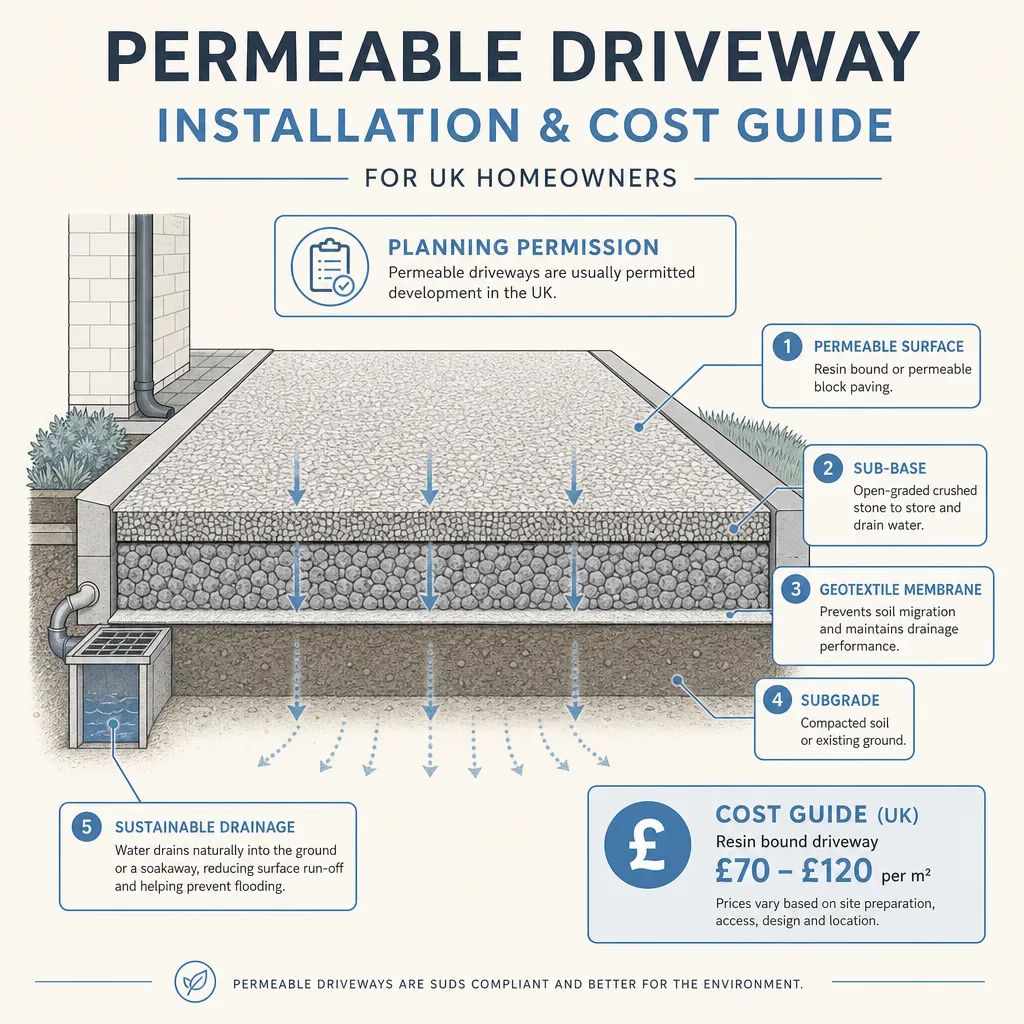
Permeable Driveway Installation and Cost Guide
A permeable driveway lets rainwater drain through or around the surface rather than running off into the road or drainage system.
 Improvement & Build
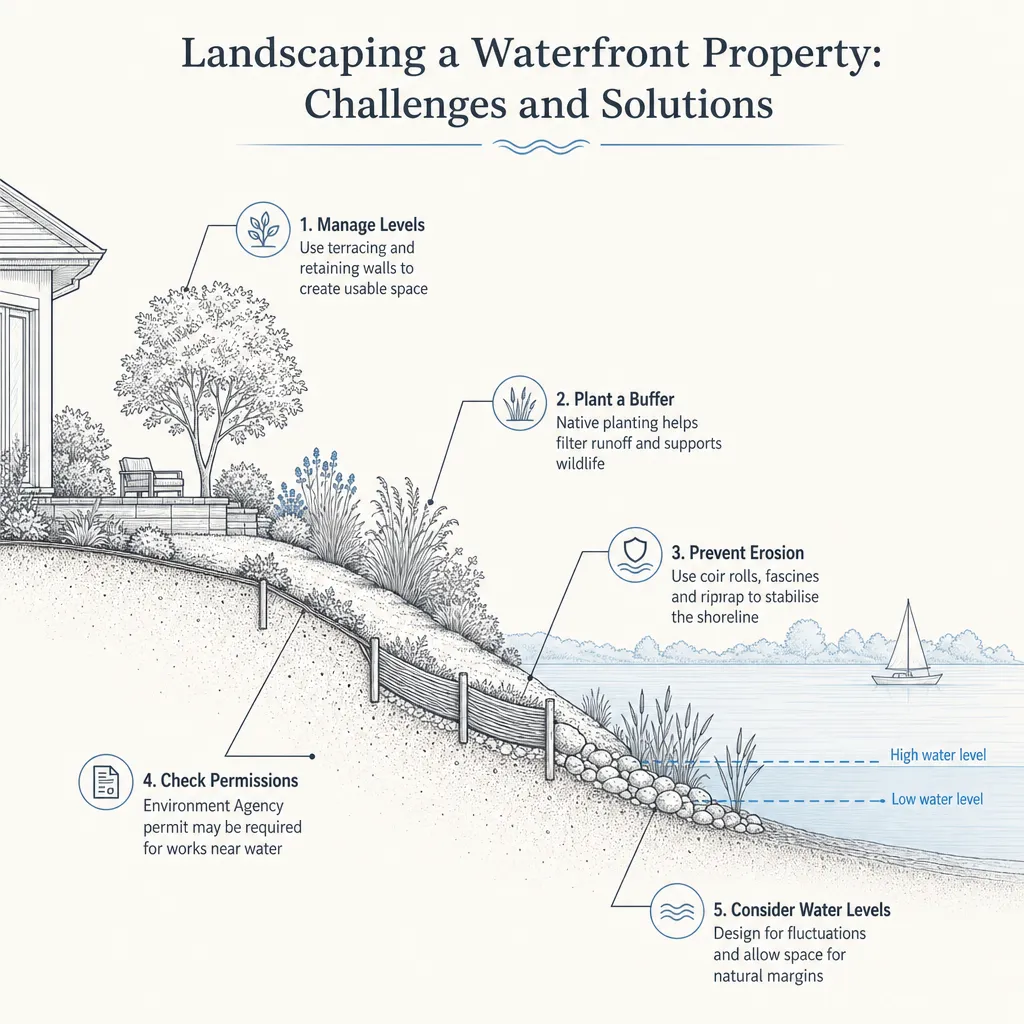
Landscaping a Waterfront Property: Challenges and Solutions
Waterfront landscaping requires specialist planning to manage erosion, flooding, and drainage.
 Improvement & Build
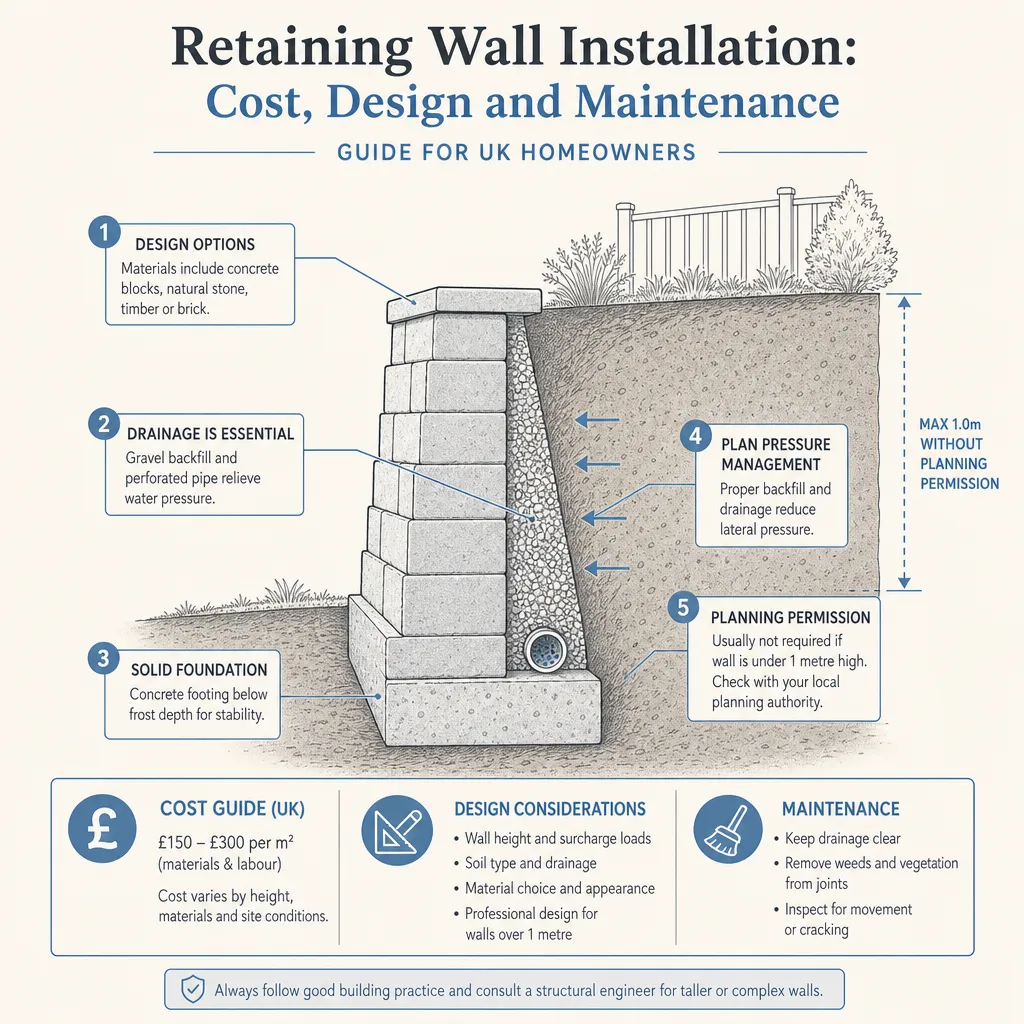
Retaining Wall Installation: Cost, Design and Maintenance
A retaining wall holds back soil on a sloped or banked site.
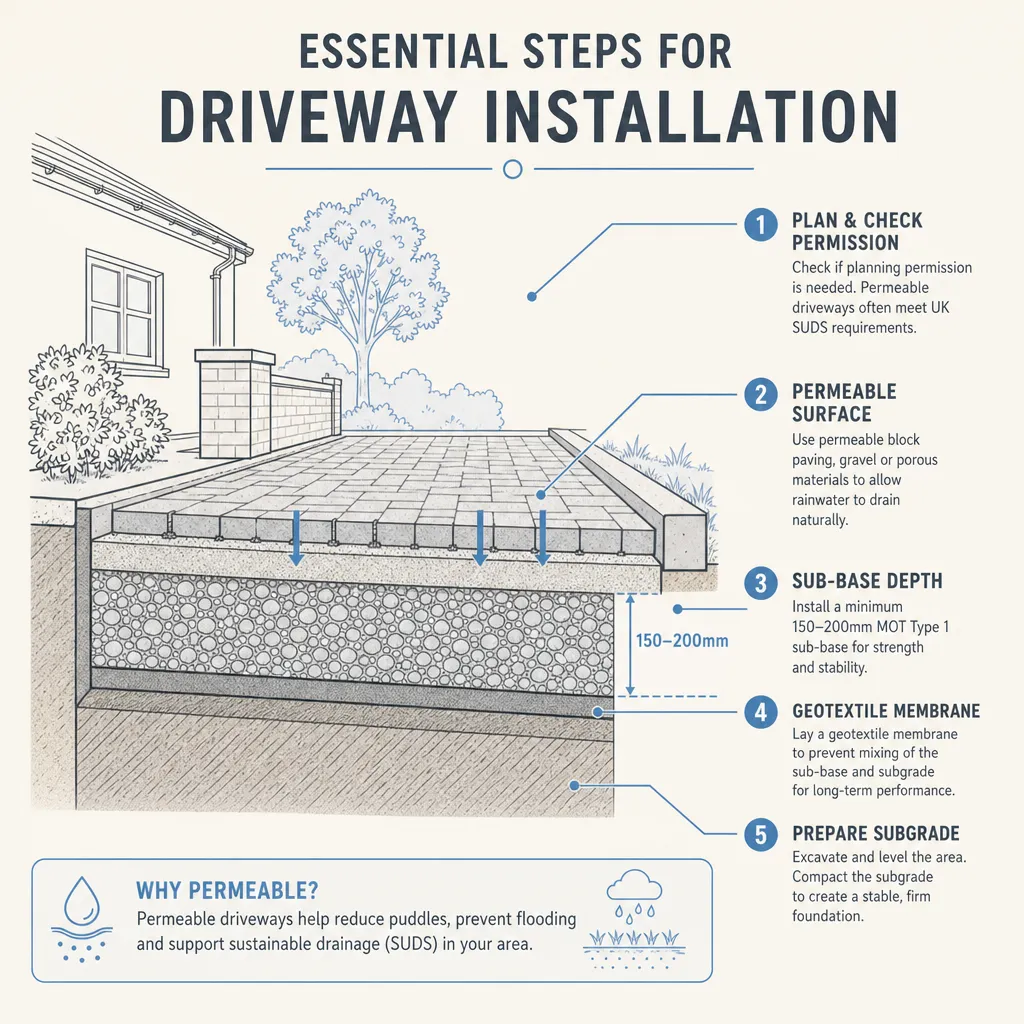 Improvement & Build
Essential Steps for Driveway Installation
Installing a driveway in England requires planning permission only when using an impermeable surface (standard tarmac, concrete, or block paving) on a front garden area over 5 m².
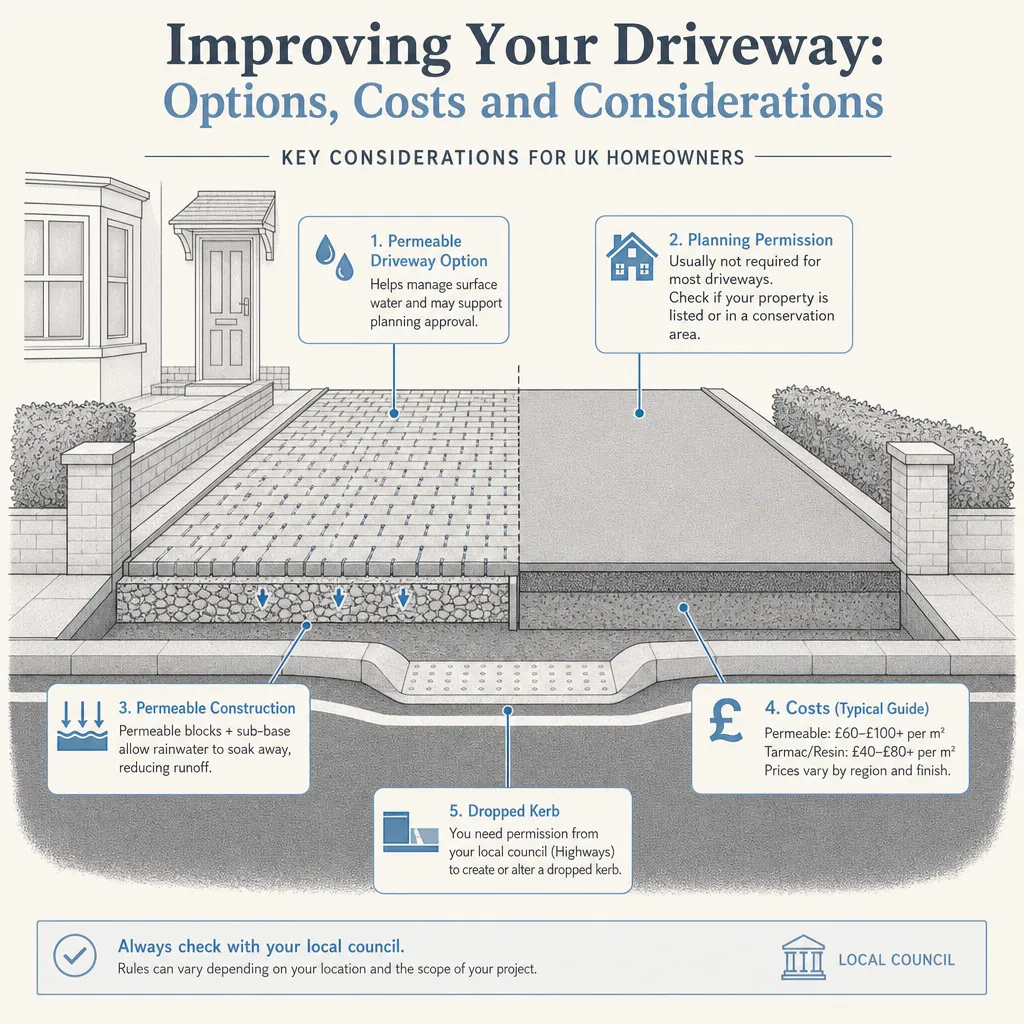 Improvement & Build
Improving Your Driveway: Options, Costs and Considerations
Installing a new driveway with a non-permeable surface larger than 5m² over a front garden in England requires planning permission unless water drains to a permeable area.