Brick Slip Installation for Facade Renovation
By Housey · Last reviewed 5th of May 2026
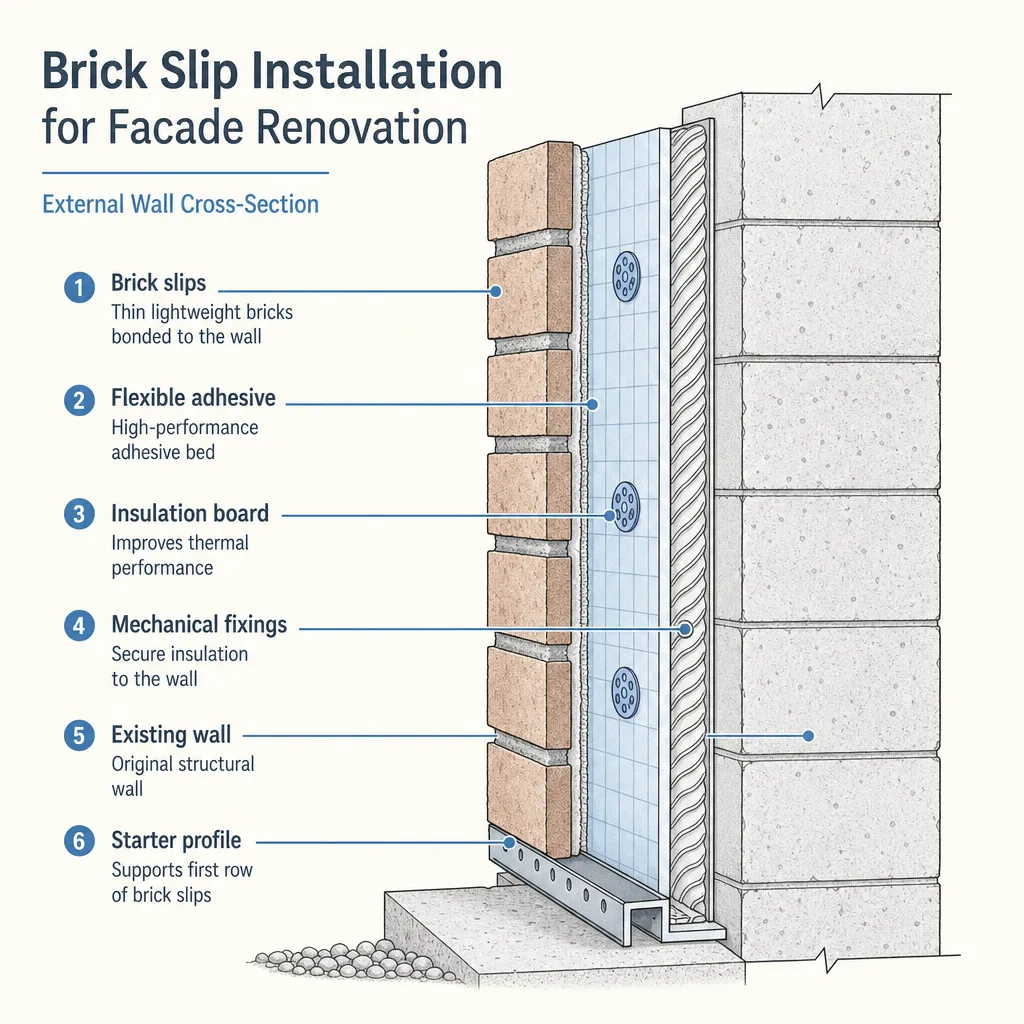
Brick Slip Installation for Facade Renovation
Brick slips have become an increasingly popular choice for UK homeowners renovating older facades, updating a tired extension, or adding a brick-like finish to a modern timber-frame or steel-framed structure. Questions about installation method, substrate suitability, and compliance with building regulations typically arise when planning begins — or when a builder first suggests brick slips as an alternative to full masonry. Getting the specification right from the outset avoids costly failure and ensures the finish is both durable and compliant.
Key points
- Brick slips are thin sections of real or reconstituted clay brick, typically 20–25 mm thick, bonded or mechanically fixed to a prepared substrate.
- Suitable substrates include masonry, concrete, sand-cement render, and framed structures with appropriate carrier sheeting — each requiring specific preparation and fixing systems.
- Approved Document L (Conservation of Fuel and Power) under the Building Regulations 2010 may apply if the renovation changes the thermal performance of the building envelope.
- Planning permission is usually not required for like-for-like facade treatments, but conservation areas and listed buildings carry additional restrictions under the Town and Country Planning (General Permitted Development) (England) Order 2015.
- External-grade adhesive systems must be cement-based or polymer-modified (compliant with EN 12004); standard tile adhesive is not appropriate for brick slips on exterior elevations.
What are brick slips and how do they differ from real brick?
Brick slips — also called brick tiles or brick veneers — are cut or purpose-made sections of clay or concrete, typically 20–25 mm in depth, designed to replicate the appearance of a full brick face. Unlike a traditional brick wall, which is structural, brick slips are a purely decorative or weather-protecting cladding layer applied to an existing structure. The structural integrity of the wall behind remains unchanged.
Feature | Full brick wall | Brick slips |
|---|---|---|
Thickness | 102.5 mm (half-brick) or 215 mm (full) | 20–25 mm |
Structural role | Structural or cavity fill | Decorative / weather cladding only |
Suitable for retrofit? | No — requires rebuilding | Yes — applied to existing walls |
Weight per m² | Approx. 200–250 kg | Approx. 40–60 kg |
Planning implications | Usually requires Building Notice | Usually none for like-for-like |
Typical use | New build, extension walls | Renovation, feature walls, frame cladding |
Reconstituted brick slips (made from cement and aggregate) are generally less expensive than kiln-fired clay slips but may show colour fading over time. For external elevations, kiln-fired clay slips closely matched to existing brickwork give the most durable and authentic result.
Which substrates are suitable for brick slip installation?
The substrate is the most critical factor in determining how brick slips are fixed and how long the installation lasts. Incorrect substrate preparation is the leading cause of slip failure on UK external elevations.
Masonry and concrete — The most straightforward substrate. The surface should be clean, structurally sound, free from loose material, and primed with a bonding agent before adhesive application. Existing render should be checked for hollow spots (a coin tap test is a useful first check) and removed where loose.
Timber-frame panels and OSB — Require a proprietary carrier board (such as fibre cement sheet) fixed to the studs, a waterproof breather membrane behind, and mechanical fixings as well as adhesive. Adhesive alone is not reliable on timber-based substrates in wet UK climates.
Steel-framed structures — Similar to timber frame; a carrier board system is essential. Stainless steel fixings should be used throughout to avoid corrosion staining on the face.
Sand-cement render — Can be bonded to directly if the render is intact and well keyed. A scratch coat is often added to improve adhesion.
What not to assume: Do not assume the substrate is stable because the building looks sound externally. A damp survey, and for older properties a check for sulfate attack in existing lime mortar, should be carried out before committing to a brick slip system.
Which fixing system should be used for external installations?
For external UK applications, two main approaches are used.
Adhesive-only systems use a cement-based or polymer-modified adhesive mortar compliant with EN 12004 for external use. This is suitable for masonry and render substrates in good condition. Joints are pointed with an exterior-grade mortar once slips are set.
Mechanical-fix systems use stainless steel rails or clips in addition to adhesive. These are more robust on framed substrates or for large-format slips, and are increasingly specified on commercial facades. For domestic retrofit, mechanical fixing is usually reserved for specific products or substrates where adhesive alone carries higher risk.
Always check the brick slip manufacturer's installation guidance — many void their product warranty if adhesive or pointing products from a different system are used.
Homeowner checklist: before you start
Do brick slips need planning permission?
For most UK homes, adding or replacing an external finish is classed as permitted development — no planning permission is needed — provided:
- The dwelling is not in a conservation area, National Park, Area of Outstanding Natural Beauty (AONB), or World Heritage Site.
- The building is not listed (any grade).
- The works do not materially alter the appearance of the building in a way that conflicts with local development plan policies.
In conservation areas, the Town and Country Planning (General Permitted Development) (England) Order 2015 removes permitted development rights for cladding on principal elevations. Prior approval or full planning permission may then be required. Always check with your local planning authority before starting.
For listed buildings, brick slip cladding almost always requires listed building consent. Even cosmetic changes to listed buildings may need consent — speak to your local planning authority's conservation officer at the earliest stage.
Do Building Regulations apply?
Building Regulations are unlikely to apply for a purely decorative brick slip finish added to an already-insulated wall. However:
- If you are adding insulation to the wall as part of the same project — a common approach in solid-wall retrofit — Approved Document L applies and building control notification may be required.
- If the building is a House in Multiple Occupation (HMO) or has commercial elements, fire performance requirements under Approved Document B are relevant.
- Any work affecting drainage, structural elements, or means of escape may require a Building Notice or Full Plans application.
If in doubt, a brief conversation with your local authority building control (LABC) or an approved inspector will clarify whether notification is needed before work starts.
When to get professional help
A competent builder or specialist cladding contractor can install brick slips on a straightforward masonry substrate. However, seek professional input if:
- The wall shows signs of damp, cracking, or structural movement
- The substrate is a framed system (timber or steel) — a carrier board system and possibly structural engineer input may be needed
- You are in a conservation area or have a listed building — a planning consultant or heritage professional should advise before works begin
- The elevation is above two storeys — scaffold or a mobile elevated work platform (MEWP) will be required, and working at height regulations apply
- You want a long-term warranty — many warranty providers (NHBC, Premier Guarantee, LABC Warranty) require materials and installers to be specified and accredited accordingly
How Housey can help
Housey connects UK homeowners with experienced local builders and cladding specialists. Whether you need a specialist for a full facade renovation or a quote for a single feature elevation, you can use Housey to request and compare detailed quotes from vetted local contractors — all in one place.
Frequently asked questions
How long do brick slips last on an external wall?
Quality kiln-fired clay brick slips installed with the correct external-grade adhesive and pointing mortar can last 30–50 years on a well-prepared substrate. Reconstituted (concrete) slips may show surface degradation earlier, particularly in exposed UK locations subject to freeze-thaw cycling. Longevity depends heavily on substrate preparation, adhesive specification, and quality of pointing.
Can brick slips update the look of a 1970s concrete-panel house?
Yes, brick slips are commonly used to improve the appearance of concrete-panel and no-fines concrete homes from the 1960s and 1970s. However, the substrate must be carefully assessed — these homes often have thermal bridging and moisture issues that should be addressed before cladding is applied. A thermal survey and damp assessment are advisable before specifying a brick slip system.
Are brick slips suitable for a garage or outbuilding?
Brick slips can be applied to a garage or outbuilding using the same substrate preparation and adhesive specification as for a main dwelling. Planning permission is rarely needed for outbuilding facades, but if the outbuilding is within a conservation area or forms part of a listed building, the usual restrictions apply. Check with your local planning authority if unsure.
What is the difference between brick slips and render finishes like K-rend?
Brick slips provide a textured, brick-jointed appearance intended to replicate traditional masonry. Render finishes such as K-rend or Monocouche give a smooth or lightly textured uniform face. Both are applied to a prepared substrate, but brick slips are significantly heavier, require more labour, and take longer to install. The choice usually depends on aesthetics, budget, and the character of the surrounding area.
How much do brick slips cost to install on an external wall?
Indicative UK costs, last reviewed 2026-05-05. Brick slip supply typically costs £30–£80 per m² depending on clay type and finish. Installation labour for external elevations adds approximately £40–£80 per m², giving an indicative all-in range of £70–£160 per m² before scaffolding and VAT. Costs vary significantly by location, substrate condition, and access requirements. Always obtain at least two detailed written quotes.
Sources and further reading
- Planning Portal — Do I need permission? (House) — Planning Portal / MHCLG
- Approved Document L: Conservation of fuel and power — MHCLG
- Historic England — Advice for homeowners — Historic England
- HSE — Working at height — Health and Safety Executive
- GOV.UK — Building regulations technical guidance — GOV.UK
Useful next reads
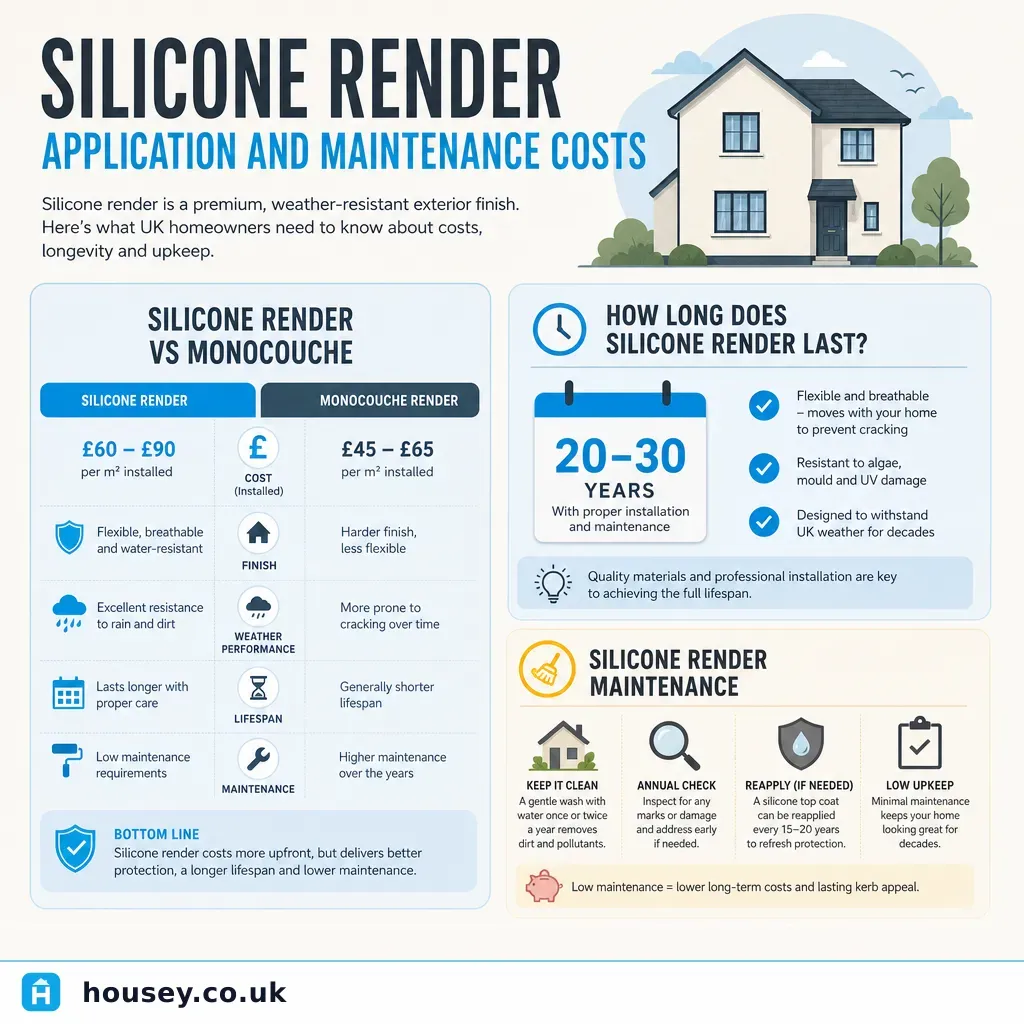 Improvement & Build
Silicone Render Application and Maintenance Costs
Silicone render typically costs £30–£70 per square metre installed across the UK, making a standard semi-detached house treatment around £3,000–£8,000.
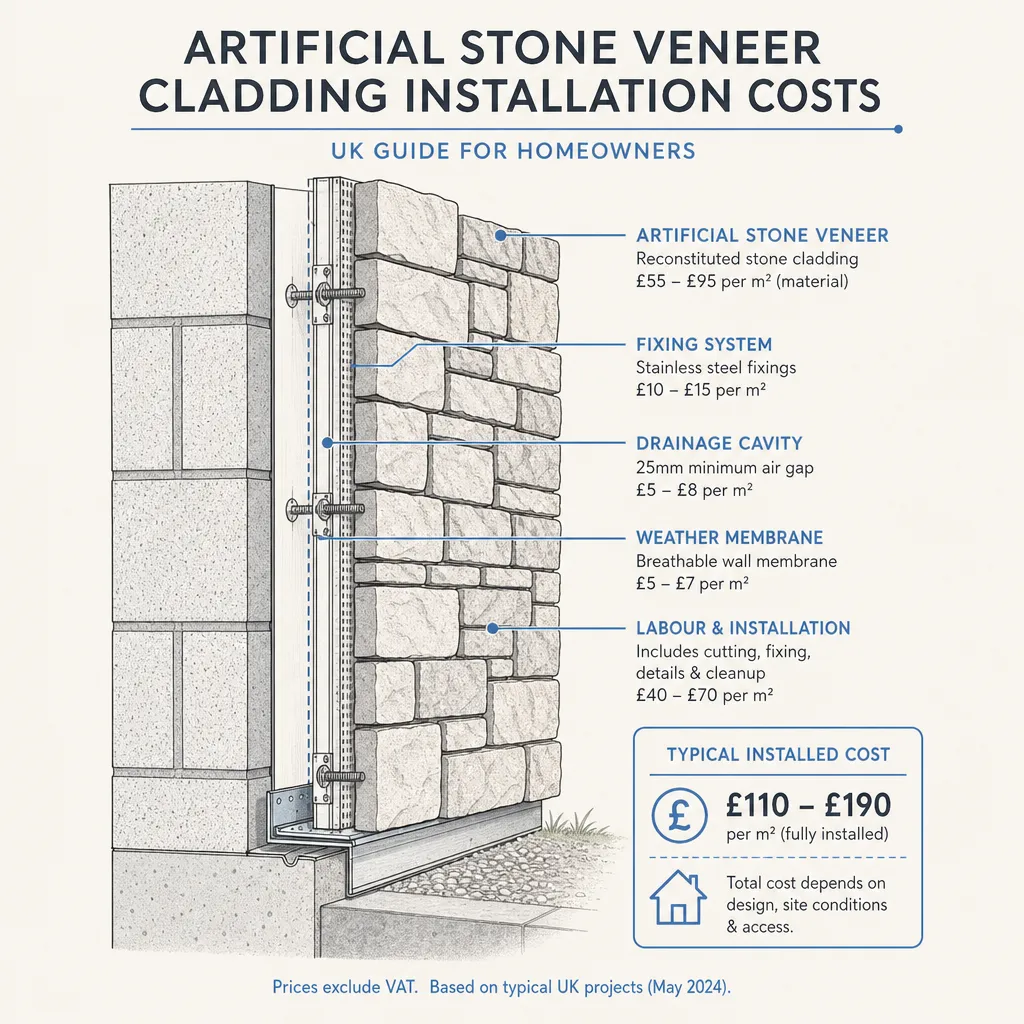 Improvement & Build
Artificial Stone Veneer Cladding Installation Costs
Artificial stone veneer cladding in the UK typically costs £60–£150 per m² installed, depending on panel brand, substrate condition, and access requirements.
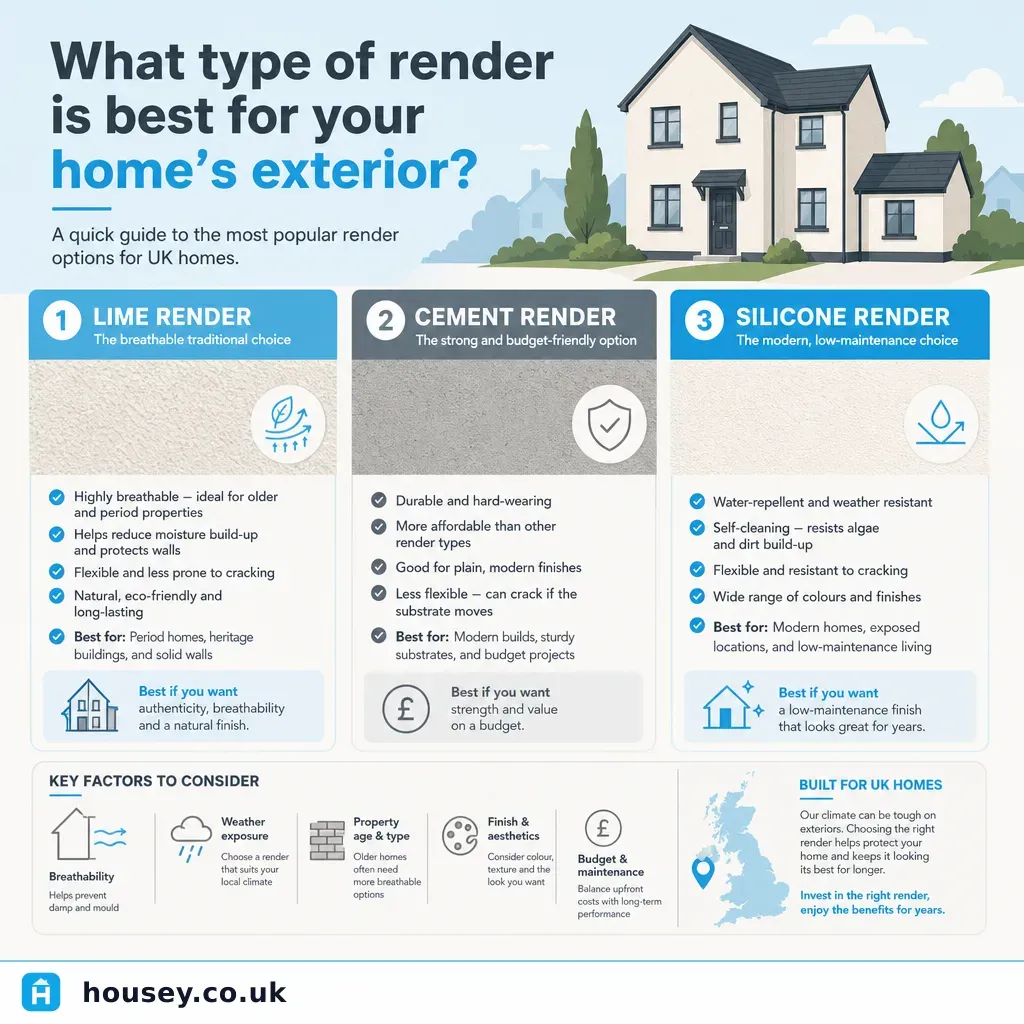 Improvement & Build
What type of render is best for your home's exterior?
The right render depends on your wall type and property age.
 Improvement & Build
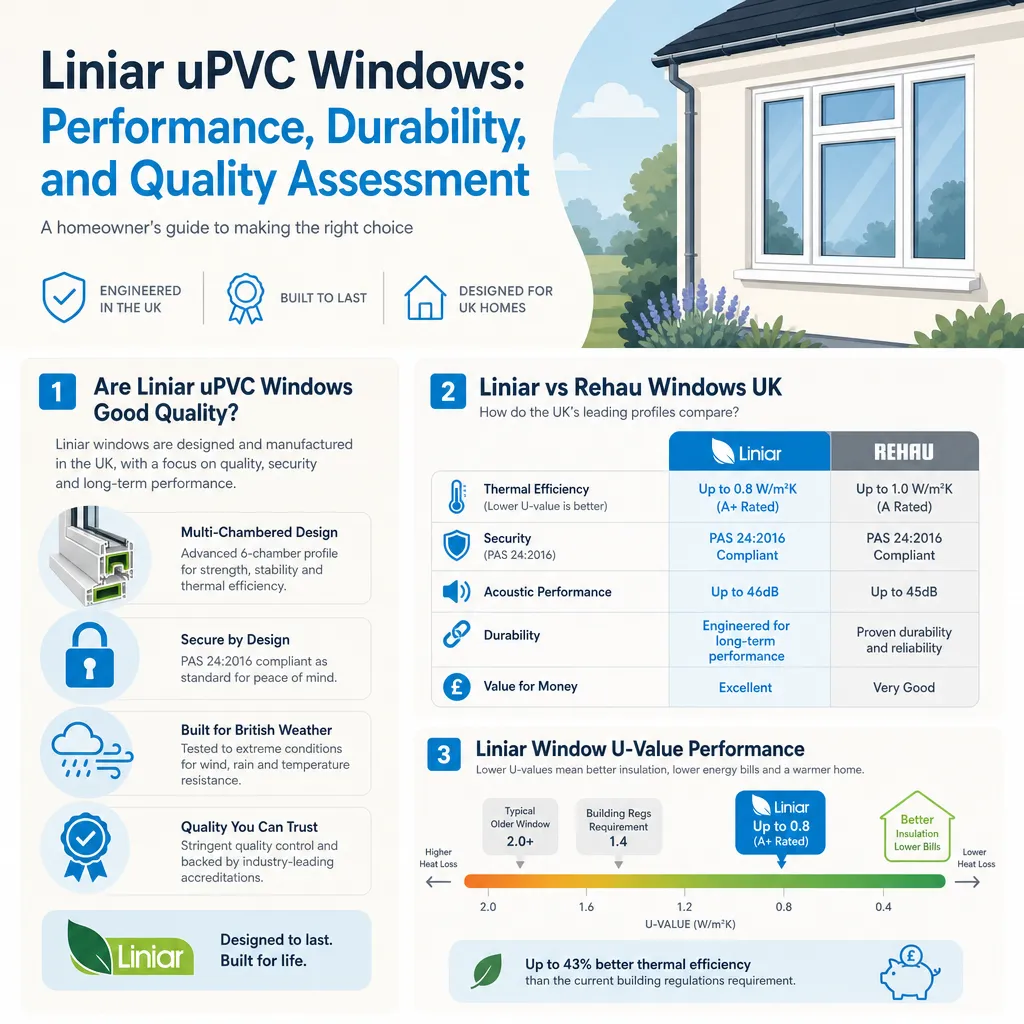
Liniar uPVC Windows: Performance, Durability, and Quality Assessment
Liniar uPVC window profiles are manufactured in the UK using multi-chambered, foamed frames.
 Improvement & Build
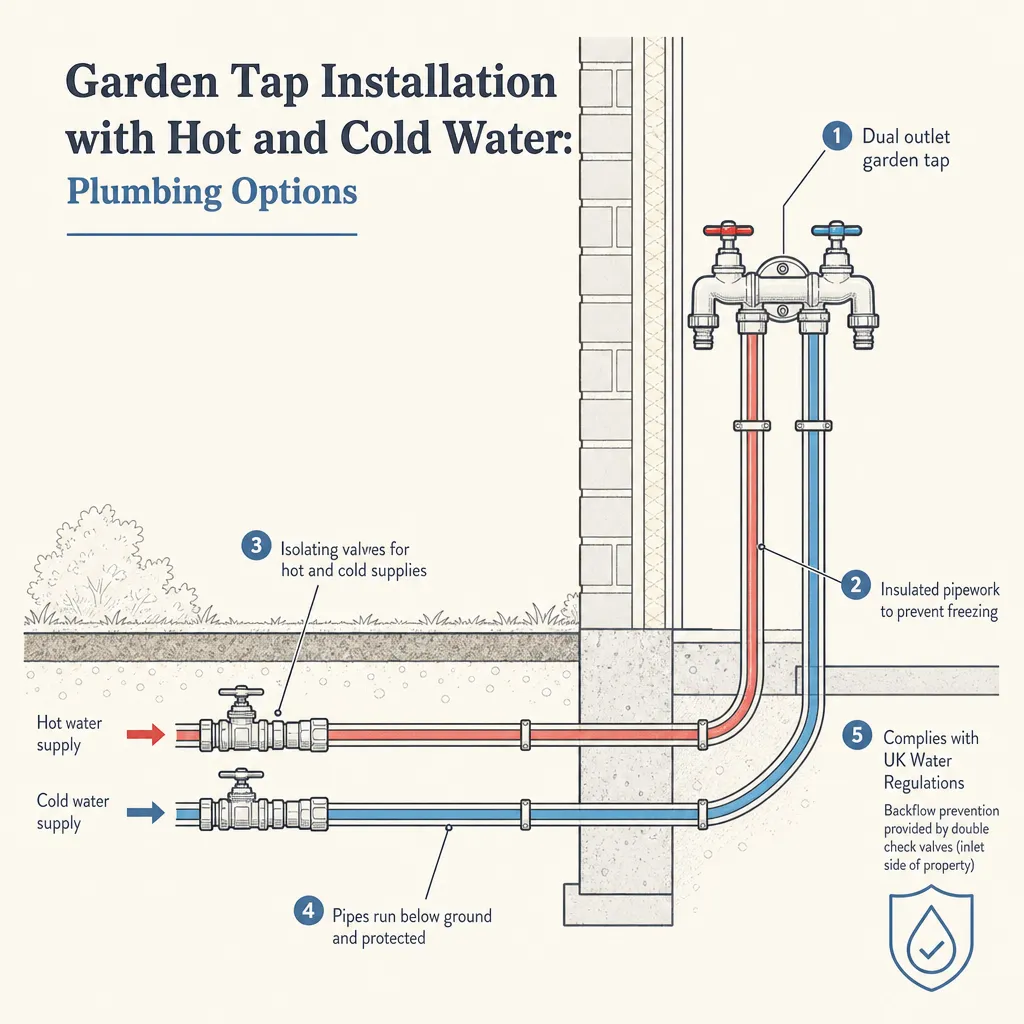
Garden Tap Installation with Hot and Cold Water: Plumbing Options
Adding a cold garden tap is a common DIY project, but routing hot water outdoors requires a plumber to connect to your domestic hot water system and comply with the Water Supply (Water Fittings) Regulations 1999.