What type of render is best for your home's exterior?
By Housey · Last reviewed 11th of May 2026
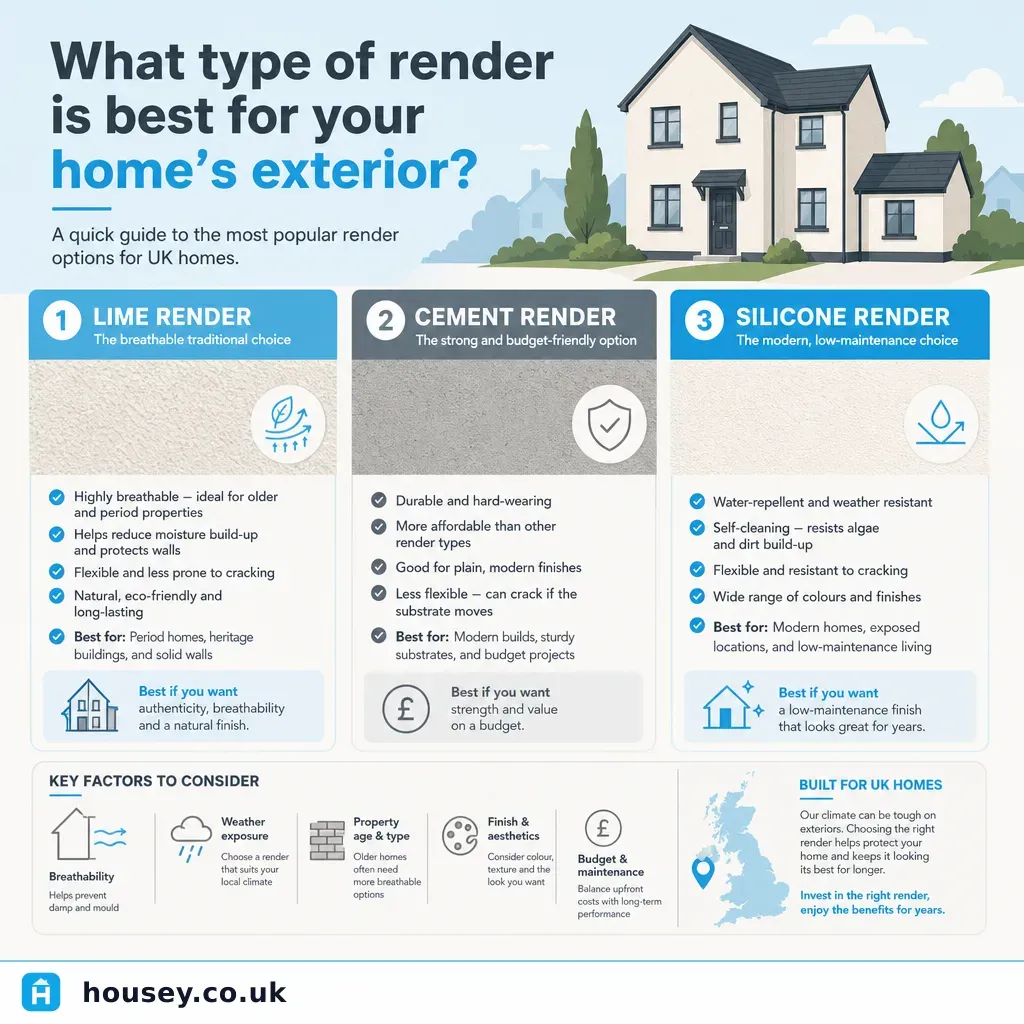
What type of render is best for your home's exterior?
Choosing the right exterior render matters far more than most homeowners expect when they first start planning a project. The wrong material on an older solid-wall property can trap moisture, trigger cracking, and lead to costly remedial work; the right choice protects the structure, refreshes the appearance, and can contribute to thermal performance. Whether you are re-rendering a 1930s semi, finishing a new extension, or cladding a Victorian terrace with insulation, the properties of the render system need to match the wall beneath it.
Key points
- Lime render must be used on pre-1919 solid-wall and stone buildings; cement-based renders trap moisture in these properties and can cause long-term structural deterioration.
- Silicone thin-coat renders typically carry a 15–25-year manufacturer warranty and offer hydrophobic protection suited to most UK climates.
- Monocouche (through-coloured single-coat) render avoids a separate paint finish but requires experienced application to prevent patchy colouration.
- Building Regulations Approved Document L (2021 edition) requires new EWI systems on existing homes to achieve a U-value of 0.30 W/m²K or better; the render finish is a component of that certified system.
- Conservation area consent or listed building consent may be required before applying any new render to a protected property — check with your local planning authority first.
Render types compared
Different render systems are designed for different wall constructions, budgets, and performance requirements. The table below summarises the main options available in the UK.
Render type | Best for | Not ideal for | Typical finish life | Main risk if wrong choice |
|---|---|---|---|---|
Lime (traditional or hydraulic) | Pre-1919 solid-wall, stone, timber-frame | Modern cavity walls where a harder finish performs better | 20–40+ years with maintenance | Cement render traps moisture in older walls, causing decay and spalling |
Sand and cement | Post-1945 brick or block cavity walls, extensions | Older solid-wall buildings; prone to cracking without movement joints | 10–20 years | Cracking and moisture ingress if applied to flexible or historic masonry |
Monocouche (through-coloured) | New-build, extensions, cavity-wall re-render | High-movement walls without adequate preparation | 15–25 years | Uneven colour if applied incorrectly; difficult to patch invisibly |
Acrylic / polymer thin-coat | Over EWI boards, smooth substrate | Directly onto solid-wall masonry without a base coat | 10–15 years | Cracking if substrate not prepared; less breathable than silicone |
Silicone thin-coat | EWI systems, re-render over existing sound base coat | Budget projects (higher material cost) | 15–25+ years | Minor incompatibility issues if mismatched with the base coat system |
Mineral (dry-dash or wet-dash) | Scottish and northern English vernacular properties | Areas where smooth render is expected by planners or conservation officers | 20–30 years | Appearance mismatch; may not be acceptable in conservation areas |
Lime render: the rule for older properties
If your home was built before around 1919 and has solid walls — common in Victorian terraces, Georgian townhouses, and many rural stone buildings — lime render is almost always the correct choice. Traditional solid-wall construction relies on vapour permeability: moisture that enters the wall needs to evaporate back through the surface. Cement render seals this pathway, causing moisture to migrate through the structure and attack the masonry from within.
Both the Society for the Protection of Ancient Buildings (SPAB) and Historic England recommend lime-based mortars and renders for pre-1919 buildings. The choice between non-hydraulic lime (the most flexible and breathable) and hydraulic lime (stronger and faster-curing) depends on wall composition and exposure level. A building conservation specialist or an experienced lime plasterer can advise on the appropriate binder strength for your property.
Sand and cement render: where it works well
Standard sand and cement render — typically a 3:1 or 4:1 mix of sharp sand to cement — is the familiar choice for post-war cavity-wall construction. It is robust, relatively inexpensive, and widely available. It is, however, rigid. Without adequate movement joints cut to allow the render to expand and contract, sand and cement is prone to cracking; once water enters a crack, it can freeze and widen the gap through a British winter.
For modern brick or block extensions and 1950s–1990s cavity-wall houses, a properly applied two- or three-coat sand and cement system remains a sound option when budget is a priority. Movement joints should be planned into the specification from the outset.
Monocouche: the clean, low-maintenance option
Monocouche (French for "single-coat") is a factory-blended, through-coloured render applied in one thick coat, usually 15–20 mm. Because the colour runs all the way through the material, superficial scuffs and minor surface weathering do not expose a different substrate colour. There is no need for a separate paint or masonry coating after application.
It is particularly popular on new-build housing estates and extensions where a consistent, factory-controlled finish is important. The material is more costly than sand and cement, and application requires skill — inconsistent thickness during application causes colour variation that is difficult to correct once the render has dried.
Silicone and acrylic thin-coat systems
Silicone render is widely used as the decorative finish coat on External Wall Insulation (EWI) systems, applied over a reinforced render carrier board. The silicone polymer gives it hydrophobic properties — water beads off rather than soaking in — and it remains more flexible than traditional renders, reducing cracking risk during thermal movement.
Acrylic thin-coat renders are similar in application but less breathable. On EWI systems where vapour management is important — particularly on solid-wall properties being upgraded under PAS 2030 or PAS 2035 retrofit standards — silicone is generally preferred. Both systems are available in a wide palette of colours and textures and are almost always used as a final coat over a prepared base, not as a standalone render onto bare masonry.
EWI render systems and Building Regulations
If you are installing External Wall Insulation rather than simply re-rendering over existing masonry, the render system becomes part of a designed thermal upgrade. Under Approved Document L (Conservation of Fuel and Power, 2021 edition), when you insulate an existing external wall the completed system must achieve a U-value of 0.30 W/m²K or better.
The insulation board thickness, adhesive, reinforcing mesh, base coat, and final render coat are all components of a certified system. Changing one element — for example, substituting a different finish coat — can void the system certification. Always ask your installer which certified system they are using and confirm the U-value calculation in writing.
EWI work on solid-wall properties may also qualify for government funding under the ECO4 scheme or the Great British Insulation Scheme, depending on your household income and your home's Energy Performance Certificate rating. Check the Energy Saving Trust or your energy supplier for current eligibility criteria.
Which render should you choose?
- Choose lime render if your property has solid brick, rubble stone, or earth walls and predates roughly 1919.
- Choose sand and cement if you have a post-war cavity-wall house, are on a tighter budget, and want a durable base or finish coat.
- Choose monocouche if you want a through-coloured, low-maintenance finish on a cavity-wall or new-build property.
- Choose silicone thin-coat if you are installing EWI, want long-term hydrophobic protection, or are finishing over an existing EWI base coat.
- Ask a conservation officer or specialist if the property is listed or in a conservation area, or if you are uncertain whether planning consent is needed.
- Commission a wall survey before specifying any system if existing render looks blown, cracked, or damp.
Red flags to look out for
- Existing render that sounds hollow when tapped — blown render must be stripped before re-rendering
- Persistent damp patches on internal walls coinciding with cracks in the external render
- Any history of rising damp combined with solid-wall construction (investigate the cause before re-rendering)
- Cement render on an older solid-wall property showing spalling, dark staining, or bubbling
- Render that has been applied over original lime pointing in historic stonework
When to get professional help
Re-rendering is skilled work, and an incorrectly specified system can cause problems that take years to appear. Seek professional advice if your property is pre-1919, listed, or in a conservation area; if you can see signs of structural cracking or significant dampness; if you are planning EWI as part of a wider retrofit (which requires a Retrofit Assessor and Retrofit Coordinator under PAS 2035); or if you are unsure whether planning consent is needed before starting work.
How Housey can help
Housey connects homeowners with experienced rendering contractors and retrofit specialists across the UK. Whether you need a specification for lime render on a period property, a quote for monocouche on a modern extension, or guidance on an EWI system, Housey makes it straightforward to request quotes from accredited professionals in your area.
Frequently asked questions
Can I render over existing render?
In some cases yes — if the existing render is sound and well-bonded, a thin-coat silicone or acrylic finish can be applied over it. Blown, cracked, or contaminated render must be stripped back to the masonry first. A specialist can test adhesion with a tap test and advise on correct preparation before a new system is specified.
Does re-rendering need planning permission?
Re-rendering in the same colour and material is generally permitted development. Changing the external appearance significantly — particularly in a conservation area or on a listed building — may require consent. Always check with your local planning authority before specifying a different colour, texture, or render system, as rules vary by location and property history.
How long does exterior render last?
Lime render on well-maintained older properties can last 30–40 years or more. Sand and cement typically needs attention after 10–20 years. Silicone thin-coat systems carry manufacturer warranties of 15–25 years. Longevity depends heavily on application quality, surface preparation, and the property's exposure to driving rain and frost.
How much does exterior rendering cost?
Indicative UK costs, last reviewed 2026-05-11. Prices vary by property size, render type, and preparation required. Sand and cement on a typical three-bedroom semi might range from £4,000–£8,000; silicone EWI systems including insulation boards are typically £8,000–£20,000+. Always request at least three written quotes and confirm the specification suits your wall type.
Sources and further reading
- Mortars, Renders and Plasters — Historic England
- SPAB Advice on Lime — Society for the Protection of Ancient Buildings
- Approved Document L: Conservation of Fuel and Power — GOV.UK
- Great British Insulation Scheme — GOV.UK
- Solid Wall Insulation — Energy Saving Trust
Useful next reads
 Improvement & Build
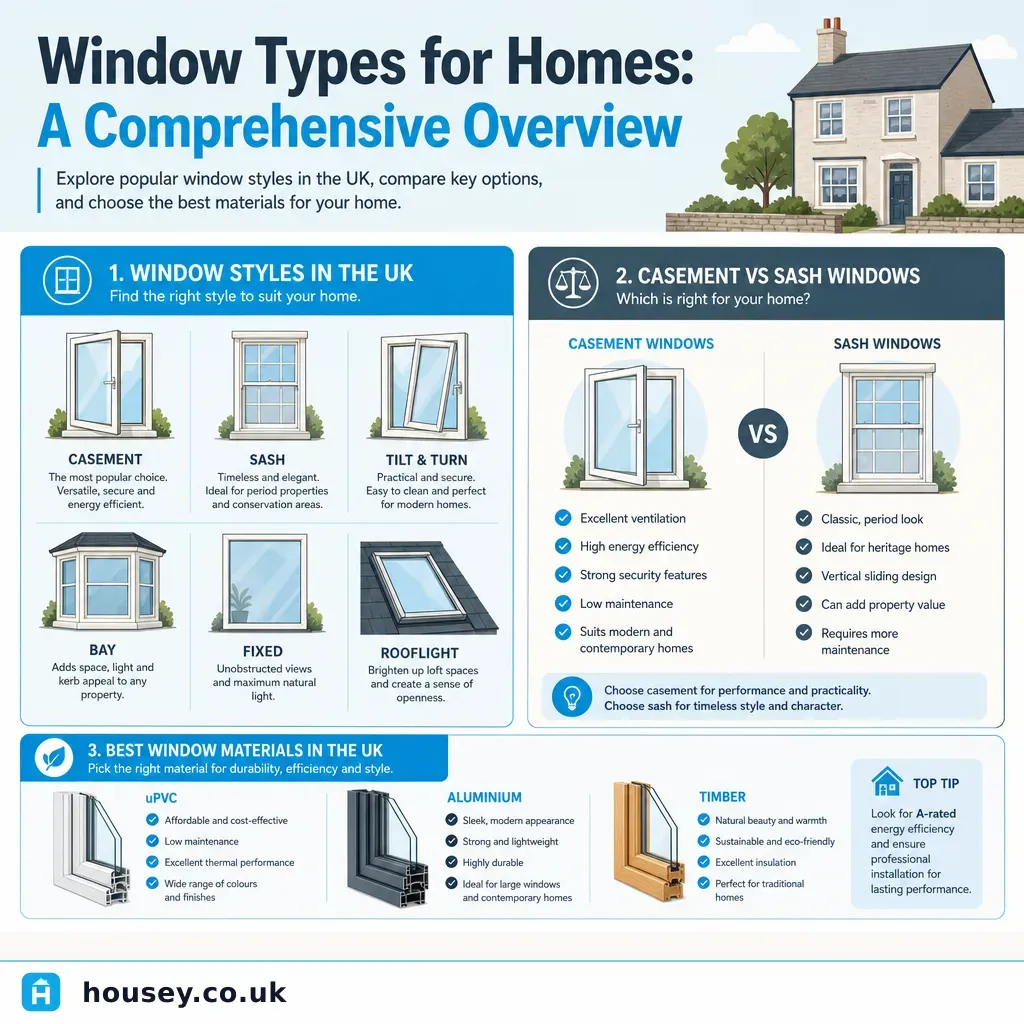
Window Types for Homes: A Comprehensive Overview
UK homes use several main window styles: casement (outward-swinging), sash (vertically sliding), tilt-and-turn, fixed light, and bay or bow.
 Improvement & Build
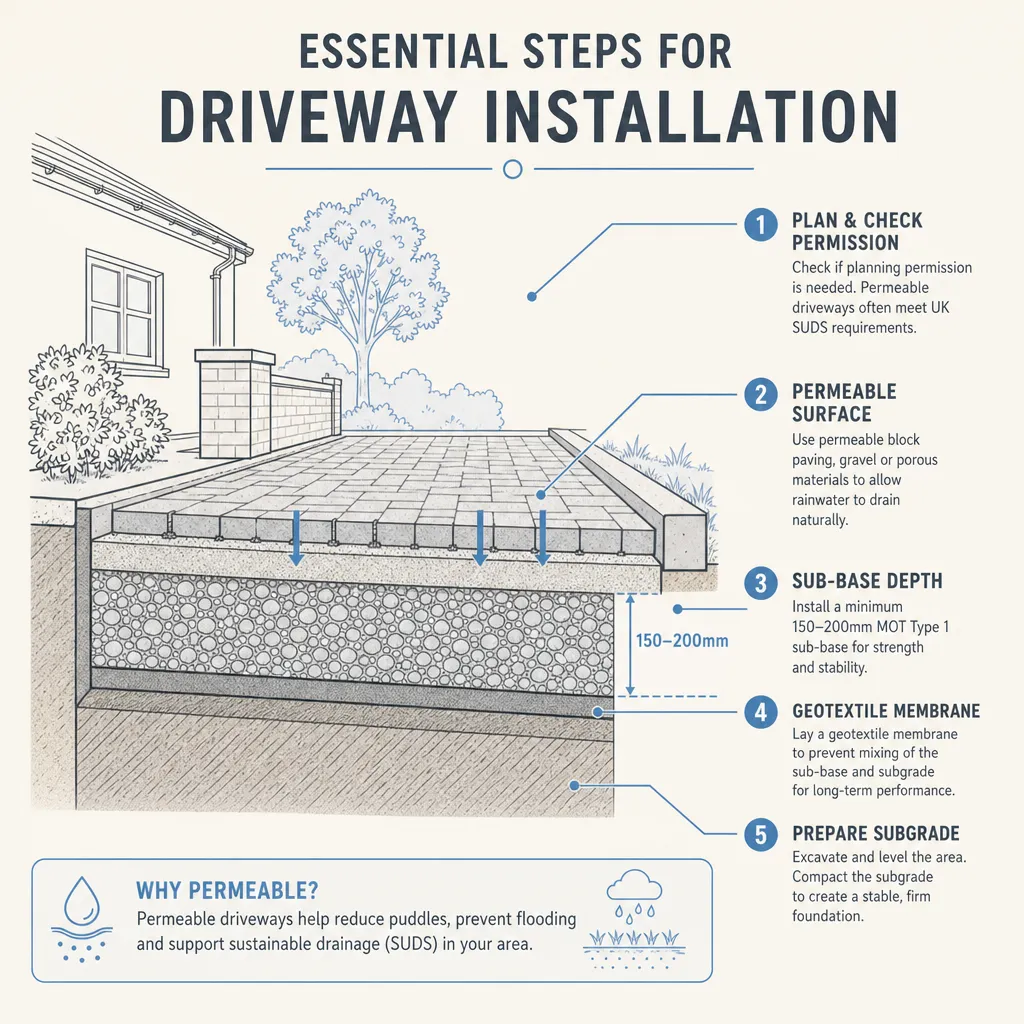
Essential Steps for Driveway Installation
Installing a driveway in England requires planning permission only when using an impermeable surface (standard tarmac, concrete, or block paving) on a front garden area over 5 m².
 Improvement & Build
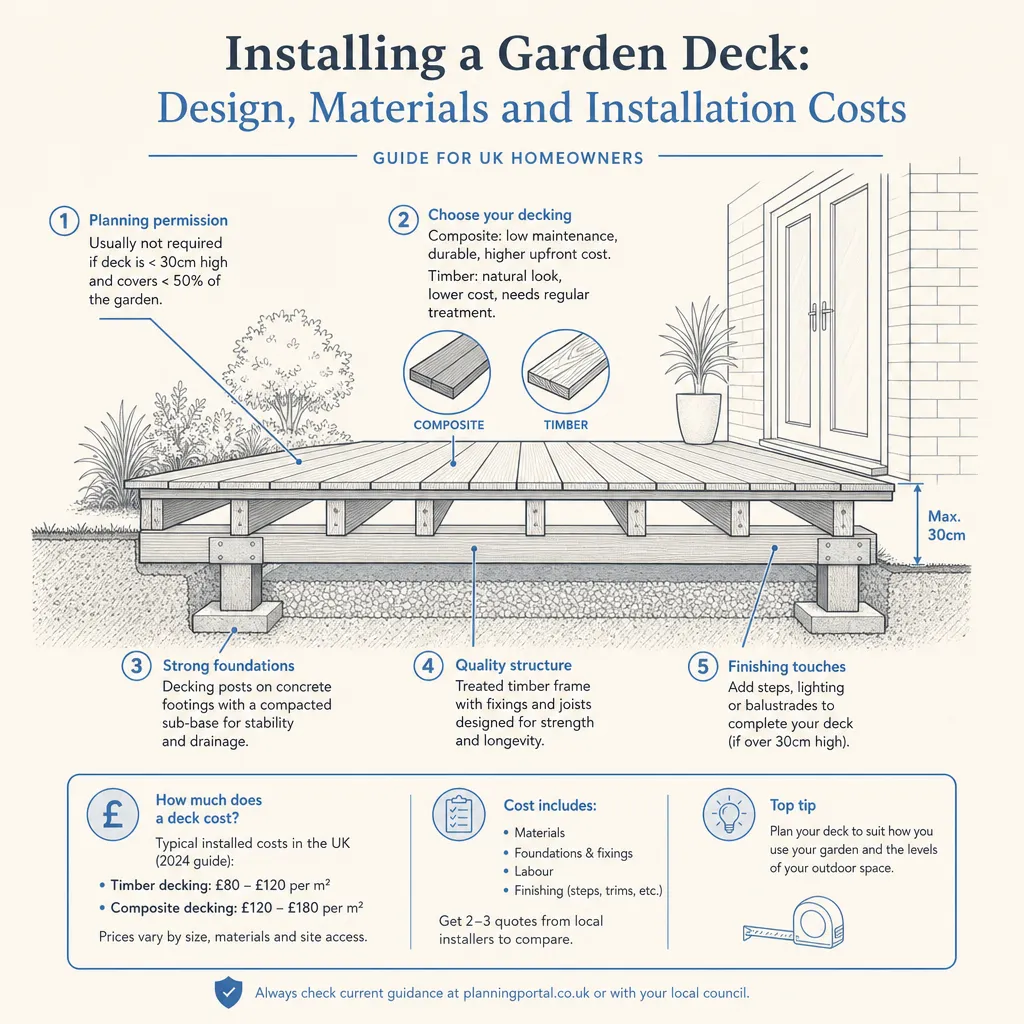
Installing a Garden Deck: Design, Materials and Installation Costs
Garden decking costs £80–250 per m² installed in the UK depending on material — softwood is cheapest, composite the most durable.
 Improvement & Build
Why UK Builders Are Specifying Engineered Building Products
UK builders increasingly specify engineered building products — I-joists, LVL beams, metal web joists, and aircrete blocks — because they offer consistent dimensions, predictable structural performance, and compliance documentation that supports Building Regulations sign-off.
 Improvement & Build
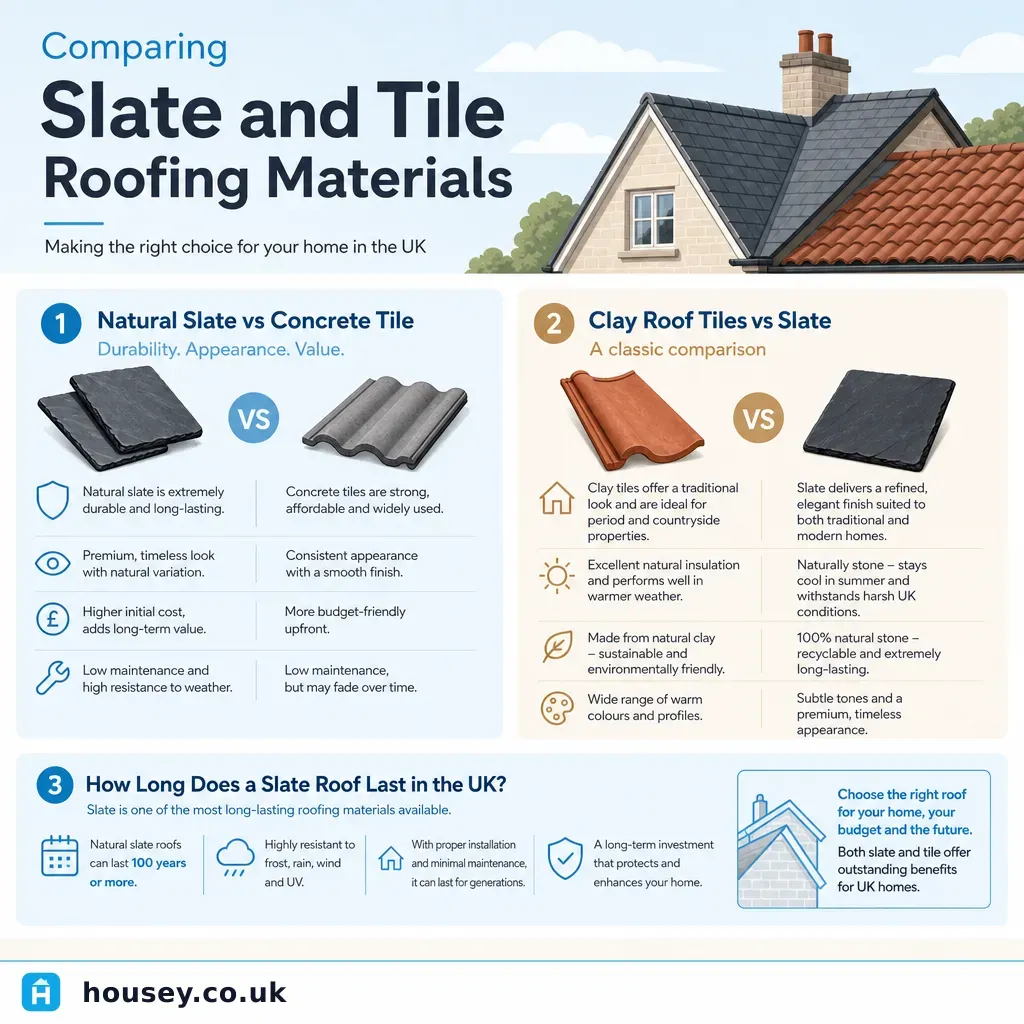
Comparing Slate and Tile Roofing Materials
Natural slate typically lasts 80–150 years and suits period and listed UK properties, while clay tiles offer 60–100 years and remain historically appropriate for Victorian and Edwardian stock.