Bricking Up a Doorway: Planning Permission and Building Regulations Requirements
By Housey · Last reviewed 3rd of May 2026
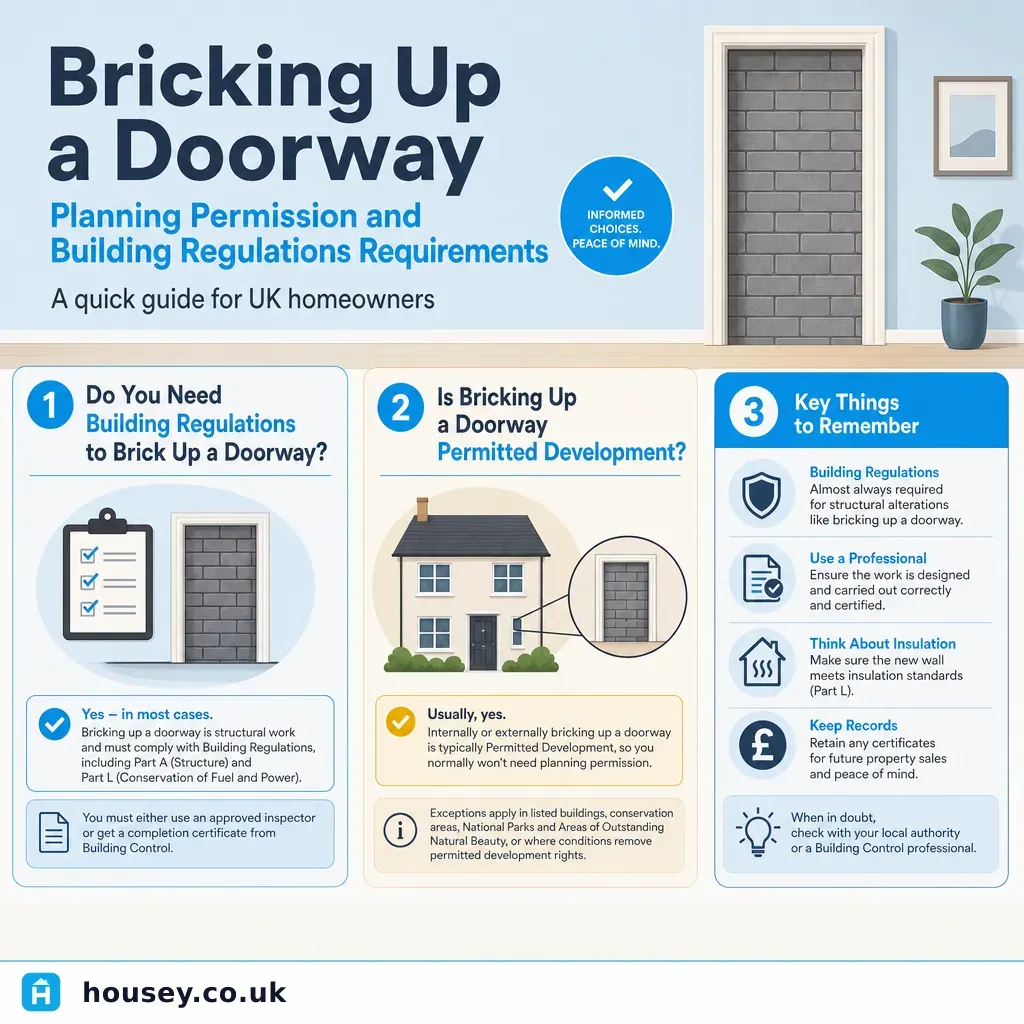
Bricking Up a Doorway: Planning Permission and Building Regulations Requirements
Blocking up an existing doorway is one of the most common alterations in UK homes — carried out to reconfigure living space, improve insulation, or remove redundant openings during a renovation or extension project. Whether you need formal consent depends on where the doorway sits, what the wall above it carries, and whether your property is subject to any planning designation. Getting this wrong can create problems at resale, invalidate buildings insurance, or leave you exposed to enforcement action.
Key points
- Bricking up an internal doorway in a non-load-bearing wall generally requires no planning permission and no Building Regulations approval.
- Where the wall is load-bearing, Building Regulations apply and a structural engineer's assessment is usually needed to determine whether the lintel can be removed or must remain.
- External doorway closures must meet the weatherproofing requirements of Approved Document C and the thermal performance requirements of Approved Document L — the infill will need to meet the applicable U-value target (currently 0.30 W/m²K for a replacement element in an existing external wall in England).
- Properties in conservation areas, Article 4 Direction zones, or listed buildings require additional consents before any external alterations are carried out.
- A building control completion certificate is the legal evidence of compliance and is routinely requested by solicitors during conveyancing — keep all documents safely.
Does bricking up a doorway need planning permission?
In most cases, no. Internal alterations are not classed as development under the Town and Country Planning Act 1990 and fall entirely outside the planning system. External alterations to a standard residential property — including closing an external doorway — are generally permitted development under the Town and Country Planning (General Permitted Development) (England) Order 2015.
If your property sits within a conservation area, the local planning authority (LPA) may have removed permitted development rights via an Article 4 Direction. In this case, planning permission may be required before any external alteration visible from a public highway. Always check with your LPA before proceeding.
Listed buildings are a separate matter. Any works affecting the character of a listed building — internal or external — require Listed Building Consent from the LPA. This includes blocking up doorways that form part of the historic layout or fabric of the building. Contact your LPA's conservation officer at an early stage; a planning consultancy can help you prepare an appropriate application.
Which scenario applies to you?
Use this decision tree to identify whether consent is needed before work begins:
- Internal doorway, non-load-bearing wall → No planning permission; no Building Regulations approval needed in most cases.
- Internal doorway, load-bearing wall → No planning permission; Building Regulations approval required; commission a structural engineer to assess the lintel and wall.
- External doorway, standard residential property, not designated → No planning permission (permitted development); Building Regulations approval required for thermal and weatherproofing compliance.
- External doorway, conservation area or Article 4 zone → Check with LPA; planning permission may be required; Building Regulations approval required regardless.
- Any doorway in a listed building → Listed Building Consent required; Building Regulations approval required; engage a heritage consultant or conservation officer early.
- Shared or party wall affected → Check whether the Party Wall etc. Act 1996 is engaged before work starts; a Party Structure Notice may need to be served.
When do Building Regulations apply?
Scenario | Planning permission | Building Regulations | Structural engineer needed |
|---|---|---|---|
Internal doorway, non-load-bearing | No | No | No |
Internal doorway, load-bearing wall | No | Yes | Yes |
External doorway, standard property | No (permitted development) | Yes | Possibly |
External doorway, conservation area | Possibly | Yes | Possibly |
Listed building — any doorway | Yes (LBC) | Yes | Possibly |
Where Building Regulations apply, you have two procedural routes. A Full Plans application means submitting drawings before work starts and receiving formal approval — recommended for structural work. A Building Notice means informing building control before work proceeds, with inspections carried out during the build. For a doorway closure involving a load-bearing wall, Full Plans provides a clearer paper trail and identifies structural issues before the wall is opened.
For external doorway infills, Approved Document C requires the new construction to be properly tied into the existing masonry and finished with a weatherproof external surface. Approved Document L requires the infill to achieve the applicable U-value; if the construction falls significantly short, building control may require additional insulation within the infill wall thickness.
Is the wall load-bearing?
This is the most critical question before any work begins. A load-bearing wall carries the weight of floor joists, roof timbers, or upper-storey walls above it. Signs a wall may be load-bearing include: it runs perpendicular to floor joists; it sits directly above or below another wall on a different storey; it has a substantial lintel above the existing door opening; or it forms a gable end or external wall.
A structural engineering assessment confirms this definitively. A structural engineer will inspect the construction, check whether the lintel can be removed safely, and where necessary produce calculations and specification for any propping, temporary support, or retention works. Do not assume a wall is non-load-bearing based on appearance alone.
Documents you will need
Depending on the scope of the work, prepare the following:
- Building Regulations drawings detailing the infill construction, insulation specification, cavity closure, and ties into the existing masonry.
- Structural calculations if a load-bearing wall is involved.
- Building control completion certificate issued after the work is inspected and approved.
- Listed Building Consent application with supporting heritage statement, if applicable.
- Party Wall Agreement or Award if the wall is shared with an adjoining owner.
A building regulations drawings service can produce the technical drawings needed for your Full Plans submission. A building control consultant can manage the application and inspection process on your behalf.
Important limitations
This article provides general information about the planning and Building Regulations framework in England. Rules vary between England, Scotland, Wales, and Northern Ireland. Permitted development thresholds, conservation area designations, and Article 4 Directions differ by local authority. The structural implications of bricking up any doorway depend entirely on the specific construction of your property. Nothing in this article constitutes professional structural, planning, or legal advice. Always confirm requirements with your local planning authority and engage qualified professionals before starting work.
What to ask a qualified professional
Before instructing a structural engineer, building control consultant, or planning consultant, ask:
- Is this wall load-bearing, and does the existing lintel need to remain in place or can it be removed?
- Do I need a Full Plans application or can I proceed via Building Notice?
- What U-value must the infill achieve under the current Approved Document L?
- Will I receive a completion certificate on sign-off, and in what form?
- Is Listed Building Consent or conservation area permission needed for my property?
- Does the Party Wall etc. Act 1996 apply, and do I need to serve notice on a neighbour?
- What drawings or calculations will you produce, and will these be sufficient for future conveyancing?
When to get professional help
Always engage a structural engineer if there is any uncertainty about whether the wall is load-bearing — even a superficially straightforward doorway can sit in a wall that carries structural loads. Contact a planning consultant if the property is in a conservation area, is listed, or if you have received any pre-application advice suggesting consent is required. Use a building control consultant to manage the Full Plans submission and inspection process if you are not familiar with the procedural requirements.
How Housey can help
Housey connects you with qualified professionals across the UK. If you need building regulations drawings for your doorway closure, a structural engineering assessment of the wall construction, or building control consultant support to manage your application and inspections, Housey can help you request and compare quotes from relevant providers. For properties in sensitive locations, our planning consultancy network can advise on conservation area rules and Listed Building Consent requirements.
Frequently asked questions
Do I need planning permission to brick up an internal doorway?
No. Internal alterations — including blocking up doorways — are not classed as development under the Town and Country Planning Act 1990 and do not require planning permission, regardless of property type. Listed buildings are an exception: Listed Building Consent is required for any works affecting the character of a listed building, which can include internal alterations that alter the historic layout or fabric.
Will bricking up a doorway affect my buildings insurance?
It should not, provided the work is carried out competently and complies with Building Regulations where required. Notify your insurer before making structural changes. If building control approval is required, obtaining a completion certificate demonstrates compliance and protects your position should a claim arise later.
What happens if I brick up a doorway without building control approval when it was required?
You may be unable to sell the property until a regularisation certificate is obtained from building control. Regularisation involves a retrospective inspection and, if the work does not comply, may require remedial works before a certificate is issued. Regularisation certificates are not always available for older unapproved work, which can complicate or delay a sale.
How long does a Building Regulations Full Plans application take?
The local authority has a statutory five-week period — or up to two months by agreement — to approve a Full Plans application. Inspection and completion sign-off after the work is done depends on scheduling with the building control officer; most straightforward doorway closures can be signed off in a single site visit after the work is complete.
Can I use a private building control inspector instead of the council?
Yes. You can appoint a Registered Building Control Approver (previously called an Approved Inspector, under the Building Safety Act 2022) as an alternative to the local authority building control service. Both routes result in a formal completion certificate that is accepted by solicitors for conveyancing purposes.
Sources and further reading
- Planning Portal: Internal changes and permitted development — Planning Portal
- Approved Document C: Resistance to moisture — GOV.UK
- Approved Document L: Conservation of fuel and power — GOV.UK
- The Party Wall etc. Act 1996: explanatory booklet — GOV.UK
- Listed buildings: GOV.UK guidance — Historic England / GOV.UK
Useful next reads
 Planning & Pre-Build
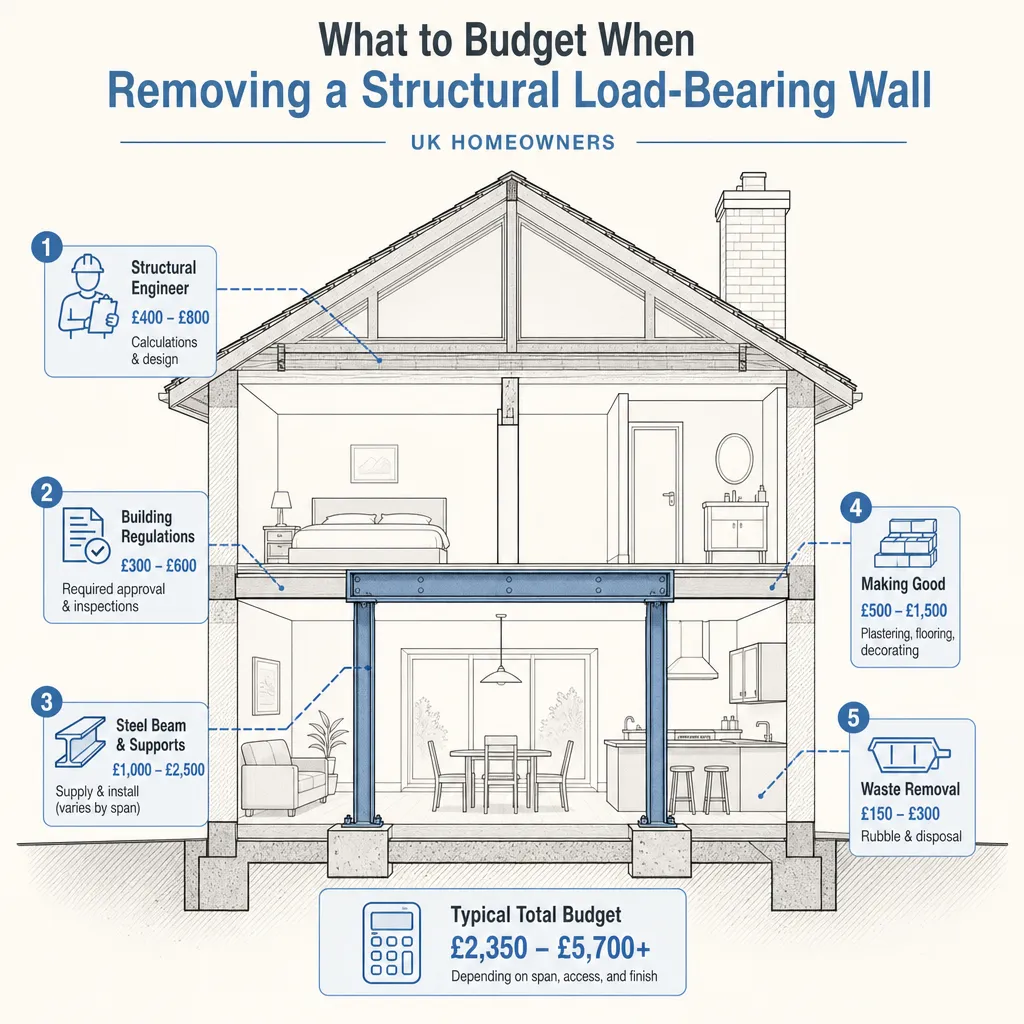
What to Budget When Removing a Structural Load-Bearing Wall
Removing a load-bearing wall in a typical UK home costs £2,500–£8,000 or more in total, covering a structural engineer's calculations, Building Regulations approval, the steel beam, builder's labour, and replastering.
 Planning & Pre-Build
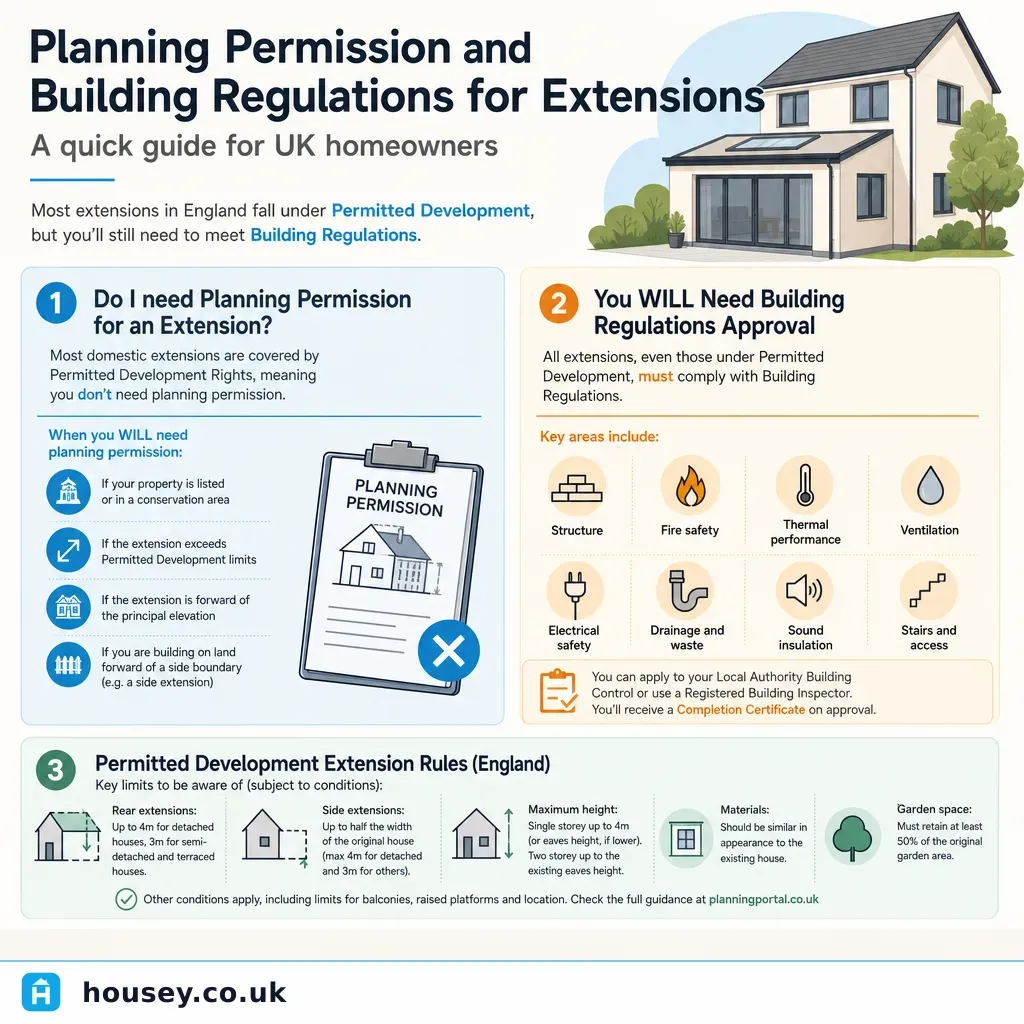
Planning Permission and Building Regulations for Extensions
UK home extensions usually require both planning permission and Building Regulations approval, though most smaller rear extensions qualify as Permitted Development under the GPDO 2015 and need no planning application.
 Planning & Pre-Build
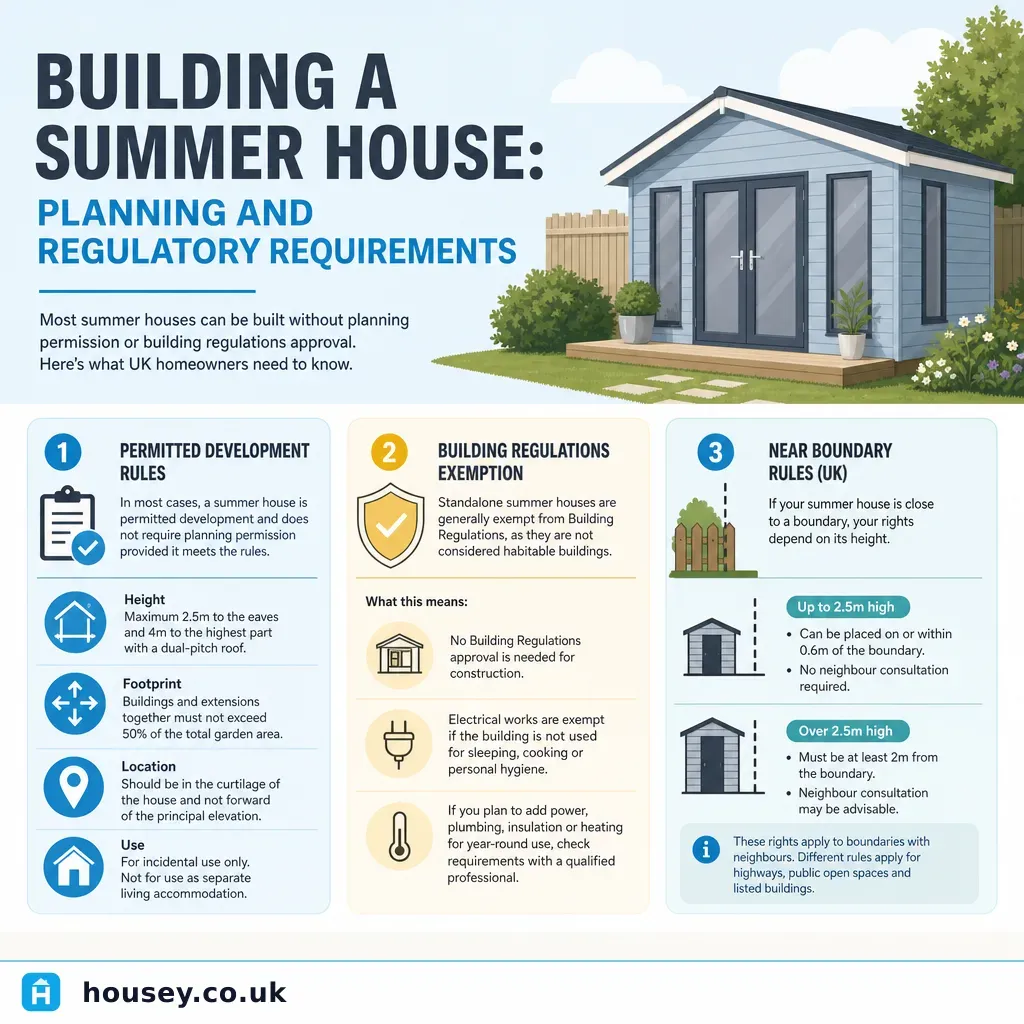
Building a Summer House: Planning and Regulatory Requirements
Most garden summer houses in England fall under Class E permitted development and need no planning permission, provided they are single-storey, within height limits, and not used for sleeping.
 Planning & Pre-Build
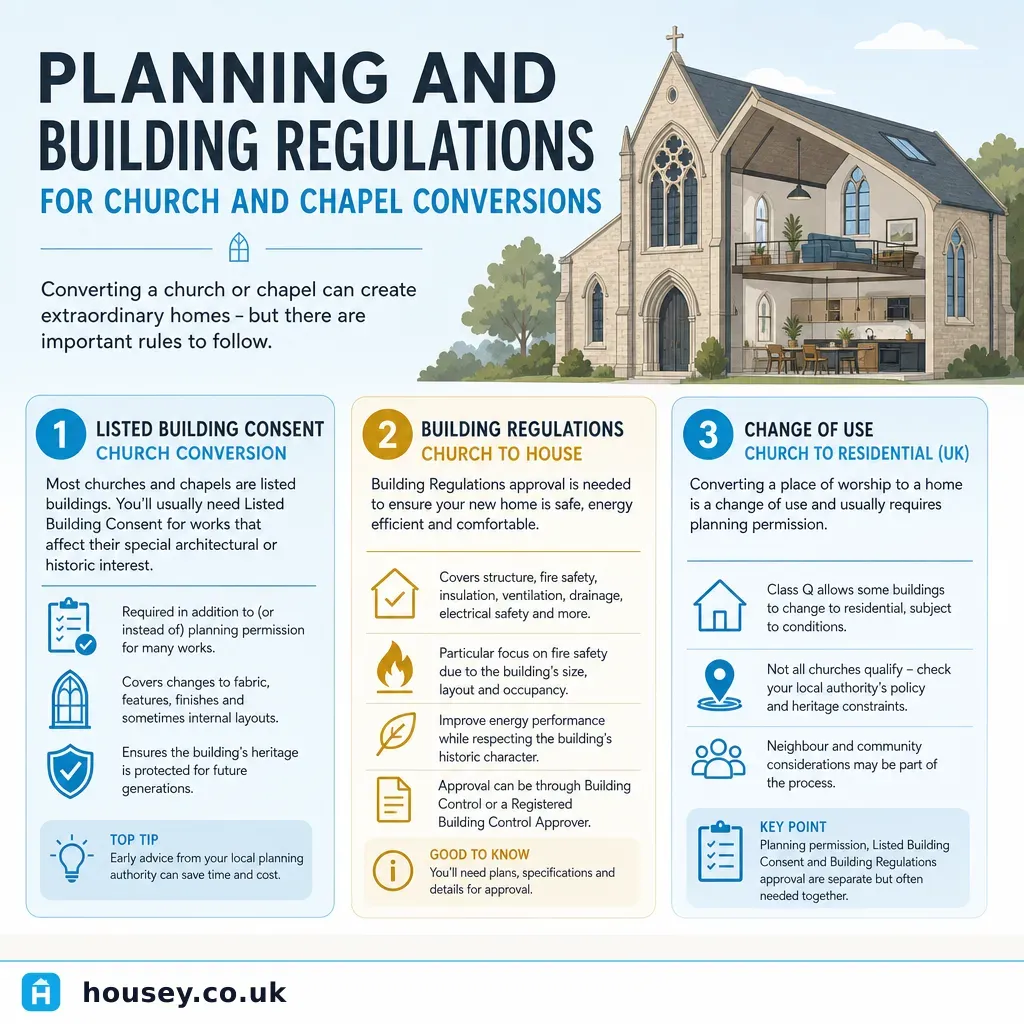
Planning and Building Regulations for Church and Chapel Conversions
Converting a church or chapel to residential use requires planning permission for change of use from Class F1 to Class C3, and listed building consent if the building is listed.
 Planning & Pre-Build
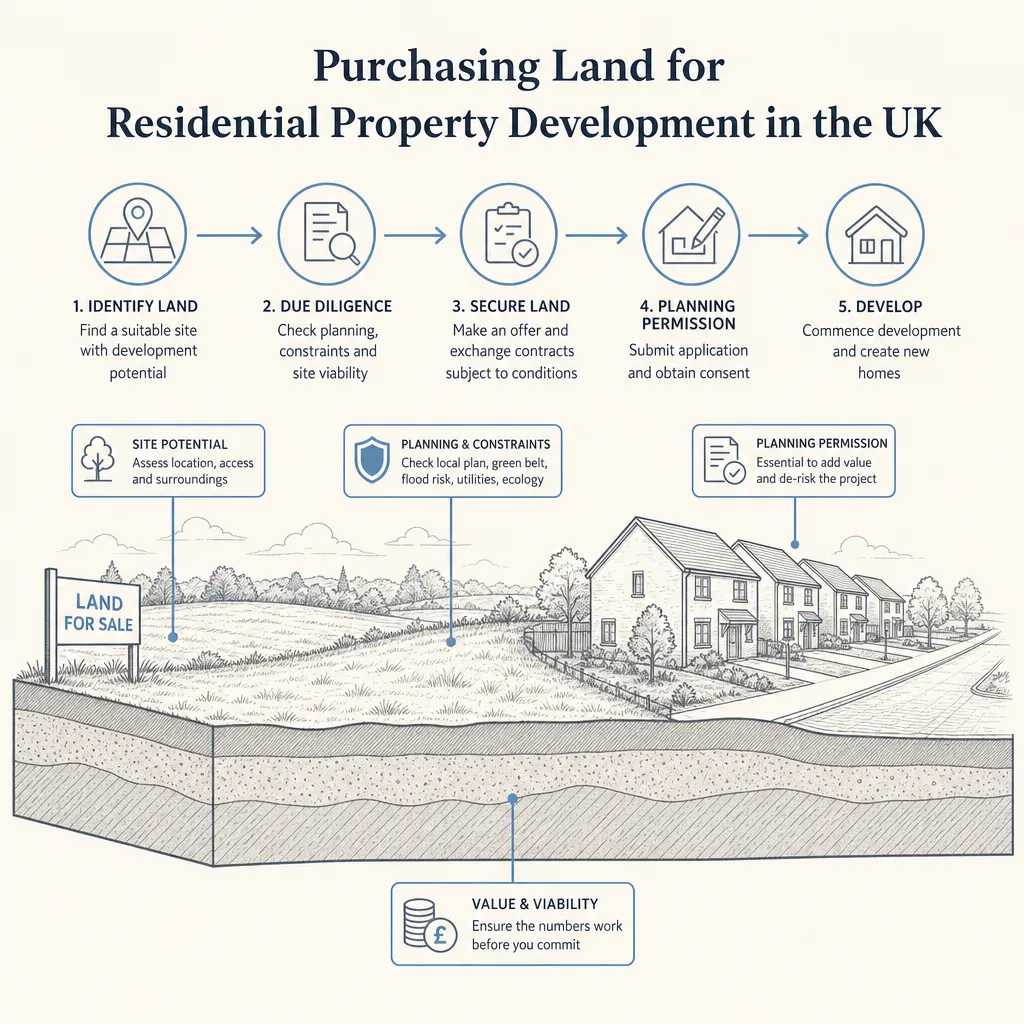
Purchasing Land for Residential Property Development in the UK
Buying development land in the UK involves due diligence on planning status, ground conditions, legal title, and utilities access before exchange.