What to Budget When Removing a Structural Load-Bearing Wall
By Housey · Last reviewed 7th of May 2026
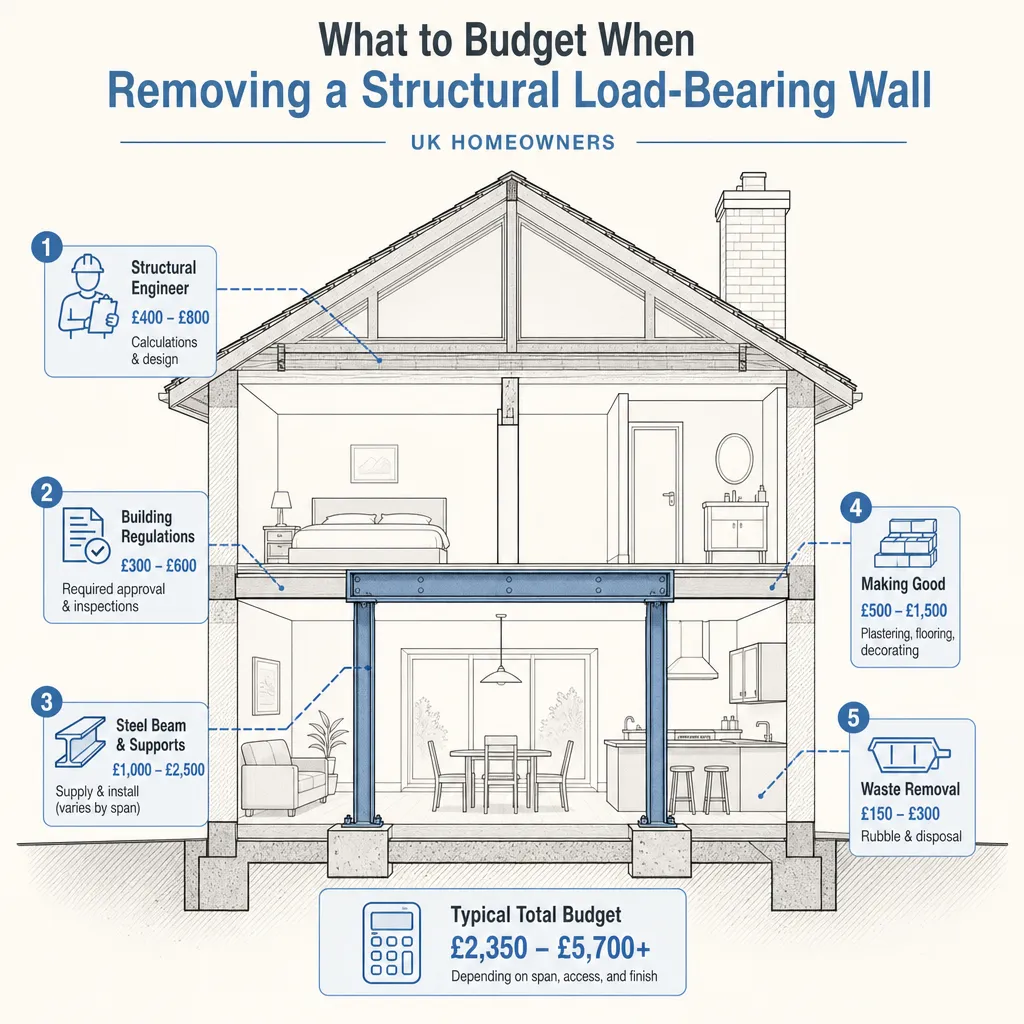
What to Budget When Removing a Structural Load-Bearing Wall
Opening up ground-floor rooms is one of the most popular ways to transform the living space in a UK home, and removing a load-bearing wall is how most homeowners achieve it. But unlike cosmetic work, structural alterations require a chain of professional inputs — structural engineer, builder, and building control — and getting any one of them wrong can create safety risks, legal difficulties at resale, and costs that far exceed the original budget. This guide sets out the realistic cost picture before you request your first quote.
Key points
- Structural engineer fees for a domestic load-bearing wall project typically range from £300 to £900, covering a site visit, structural calculations, and a written beam specification for the builder (Indicative UK costs, last reviewed 2026-05-07).
- Building Regulations approval under Part A (Structure) of the Building Regulations 2010 is required in England and Wales for load-bearing wall removal — proceeding without it can make a property difficult or impossible to sell or remortgage.
- A steel RSJ, Universal Beam, or flitch beam — specified by the structural engineer — typically costs £200–£1,500 or more in materials alone, depending on the span and the load it must carry.
- Total indicative costs for a typical domestic knock-through range from £2,500 to £8,000 or more, depending on beam span, wall length, location, and whether plastering and decoration are included (Indicative UK costs, last reviewed 2026-05-07).
- Listed buildings and some properties in conservation areas may require Listed Building Consent in addition to Building Regulations approval — this is a separate process and can add several months to the programme.
Why the costs are higher than they look
Many homeowners budget only for the builder and are surprised when the final invoice includes a structural engineer fee, a building control fee, temporary propping hire, beam materials, and replastering to finish. The realistic budget has five distinct layers:
- Structural engineer — to determine load paths, design the replacement beam, and produce calculations for building control.
- Building Regulations application — submitted to the local authority building control (LABC) or an approved inspector (private building control body).
- Builder or structural contractor — to carry out the physical work, including temporary propping, wall removal, padstone installation, beam fitting, and making good.
- Materials — the steel beam, padstones, temporary acrow props, plaster, and fixings.
- Finishing — plastering, floor repair, skirting boards, and decoration.
Omitting any of these from the initial budget is the most common reason load-bearing wall projects run over cost.
Which professional do you need — and when?
Professional | When you need them | What they provide | Indicative fee range |
|---|---|---|---|
Structural engineer | Before any work starts | Site assessment, beam calculations, written specification | £300–£900 |
Architect or architectural technologist | If the project involves planning permission or significant layout design | Drawings, planning application, design coordination | £500–£2,000+ |
Building control (LABC or approved inspector) | When submitting the application | Approval, inspections, completion certificate | £200–£600 |
Builder or structural contractor | After the design stage is complete | Propping, wall removal, beam installation, making good | £1,500–£5,000+ |
Indicative UK fees, last reviewed 2026-05-07. Fees vary by property, location, and project complexity.
Typical cost breakdown: a worked UK scenario
Scenario: A homeowner in a 1960s semi-detached in the East Midlands wants to knock through the wall between the kitchen and dining room to create an open-plan kitchen-diner. The proposed opening is approximately 3 metres wide. The wall runs perpendicular to the rear elevation and parallel to the floor joists above — a strong indicator it is a load-bearing spine wall.
Cost element | Indicative cost |
|---|---|
Structural engineer (site visit, calculations, beam specification) | £550 |
Building Regulations — full plans application (LABC) | £300 |
Builder: temporary propping (2 days) | £400 |
Builder: wall removal, padstone installation, beam fitting | £1,800 |
Steel RSJ (3 m span, supplied and delivered) | £600 |
Plastering and making good | £600 |
Decoration (homeowner undertaking DIY finish) | £0 |
Approximate total | £4,250 |
Indicative costs only, last reviewed 2026-05-07. Actual costs vary by contractor, location, and structural complexity. Always obtain itemised written quotes.
In London and the South East, the same project commonly costs £5,500–£9,000 or more, primarily reflecting higher builder day rates and steeper building control fees.
What drives costs up
- Beam span: Every additional metre increases the required steel section size and weight, raising both material and installation costs.
- Upper floors or roof above: A wall carrying upper-floor joists or a roof ridge line requires more rigorous engineering and a larger beam section than one carrying only a ceiling.
- Chimney breast involvement: If the wall contains or abuts a chimney breast or hearth, the structural picture becomes significantly more complex and costly.
- Temporary propping duration: If access is restricted or the programme extends, acrow prop hire and additional labour time increase costs.
- Hidden complications: Opening a wall can reveal damaged timbers, unexpected structural steel from previous works, or out-of-level floors — each adding cost.
- Listed building or conservation area constraints: Additional consent processes and potentially specialist contractors, lime plasters, or heritage materials.
Beam options: a comparison
Beam type | Typical domestic use | Pros | Cons |
|---|---|---|---|
Steel Universal Beam (UB / RSJ) | Most domestic openings | Strong, economical, widely available | Requires fireproofing or boxing in; heavy to manoeuvre on site |
Universal Column (UC) | Shorter spans where section depth is limited | Compact section depth | More expensive than UB for equivalent load capacity |
Flitch beam (steel plate sandwiched between timber) | Narrower openings with restricted headroom | Can sit within existing floor depth; less visible | Limited to shorter spans; specialist fabrication |
Engineered timber (LVL or glulam) | Design-led schemes where an exposed beam is desired | Natural aesthetic; lighter than steel | Often more expensive; always requires structural engineer approval |
The structural engineer specifies the beam type and section size based on structural calculations — this is not a decision for the homeowner or builder to make independently.
Important limitations
This article provides general information about the process and indicative costs involved in removing a load-bearing wall. It is not structural, legal, or regulatory advice. Every property is different: the age, construction method, load path, condition of materials, and local planning designations of your specific building will all determine what is needed and what it costs. A qualified structural engineer must assess your property before any work begins. Building Regulations requirements are administered differently by different local authorities and approved inspectors, and rules may vary. All cost figures are indicative estimates based on publicly available information as of 2026-05-07; always obtain itemised written quotes from qualified professionals before committing to a budget.
When this becomes urgent
Seek immediate professional advice — and do not continue with the project or attempt remedial work yourself — if any of the following arise:
- Work has already begun on removing or cutting into the wall without a structural engineer's specification and temporary propping in place.
- New cracks appear in adjoining walls, ceilings, or floors during or immediately after any demolition nearby.
- Doors or windows in the vicinity begin sticking or dropping from level unexpectedly following any structural disturbance.
- A surveyor, mortgage lender, or solicitor has flagged existing structural alterations during a sale or remortgage as lacking building control documentation.
- Building control visits the property and issues a notice requiring immediate remedial action.
What to ask a qualified professional
Before instructing a structural engineer or builder, use the following questions to establish scope and confirm credentials:
- Are you a Chartered Structural Engineer (CEng MIStructE) or Chartered Civil Engineer (CEng MICE), and are you registered with a recognised professional body?
- Will you visit the site to assess the wall in person, or are calculations produced remotely from drawings only?
- Does your fee include a written specification and structural calculations for the builder and building control to work from?
- Are you able to liaise directly with building control during inspections if needed?
- What information do you need from me before you can quote — floor plans, property age, details of what is above the wall?
- Does the builder's quote include temporary propping for the full duration of the beam installation, not just the day of fitting?
- Who is responsible for booking building control inspections — the engineer, the builder, or the homeowner?
- Will I receive a completion certificate from building control at the end of the project, and does your fee include supporting that sign-off process?
When to get professional help
You should involve a structural engineer before any breaking-out work begins — not after. Contact a professional immediately if:
- You are uncertain whether the wall is load-bearing; a structural engineer must confirm this, not a builder alone.
- The wall is on the ground floor of a two-storey or taller building and you have no existing structural drawings.
- The wall contains or is adjacent to a chimney breast, hearth, or party wall.
- Your property is listed or sits within a conservation area and you are unsure what consents are needed before work starts.
- A RICS survey report has flagged the absence of building regulations documentation for previous structural work during a sale or remortgage.
How Housey can help
Housey can connect you with qualified professionals for every stage of a load-bearing wall removal. You can request quotes from structural engineering specialists, building control consultants, and architectural technologists who are familiar with domestic structural work across the UK.
Frequently asked questions
Do I need planning permission to remove a load-bearing wall?
Planning permission is not usually required for internal structural alterations inside a house where the external appearance is unchanged. However, Building Regulations approval under Part A of the Building Regulations 2010 is almost always required for load-bearing wall removal. Listed buildings are an exception — they require Listed Building Consent for most structural or material changes, which is a separate process from Building Regulations and may also require planning permission.
Can a builder assess whether a wall is load-bearing without a structural engineer?
Experienced builders can often make a reasonable judgement based on wall position, the direction of floor joists above, and what the wall supports. However, only a structural engineer can confirm load paths with certainty and produce the calculations building control requires. Do not rely solely on a builder's assessment for a structural decision — an incorrect assumption can have serious safety and legal consequences at resale or remortgage.
What is the difference between a building notice and full plans approval for this type of work?
A building notice is a simplified route — you notify building control before work starts and they inspect during the project. Full plans approval involves submitting structural drawings and calculations in advance for formal approval before work begins. Full plans approval is generally preferred for load-bearing wall removal, as it confirms the design is compliant before the builder starts, reducing the risk of costly remedial work being required.
Does the work need to be signed off by building control?
Yes — building control will typically inspect the temporary propping, padstones, beam installation, and the finished state. On satisfactory completion they issue a completion certificate. Keep this document permanently, as it will be required when you sell or remortgage. An absence of completion documentation for structural work is a common cause of delays and legal complications during property transactions.
How long does load-bearing wall removal take?
The physical work usually takes 3–7 working days for an experienced builder, including propping, wall removal, beam installation, and initial making good. Allow additional time for plastering to dry before decoration. The full process — from instructing a structural engineer through to receiving the building control completion certificate — typically takes 4–10 weeks, depending on engineer availability and the building control route chosen.
Sources and further reading
- Building regulations approval — GOV.UK
- Approved Document A: Structure — GOV.UK / Ministry of Housing, Communities and Local Government
- Find a structural engineer — Institution of Structural Engineers
- Listed buildings and conservation areas — Planning Portal
Useful next reads
 Planning & Pre-Build
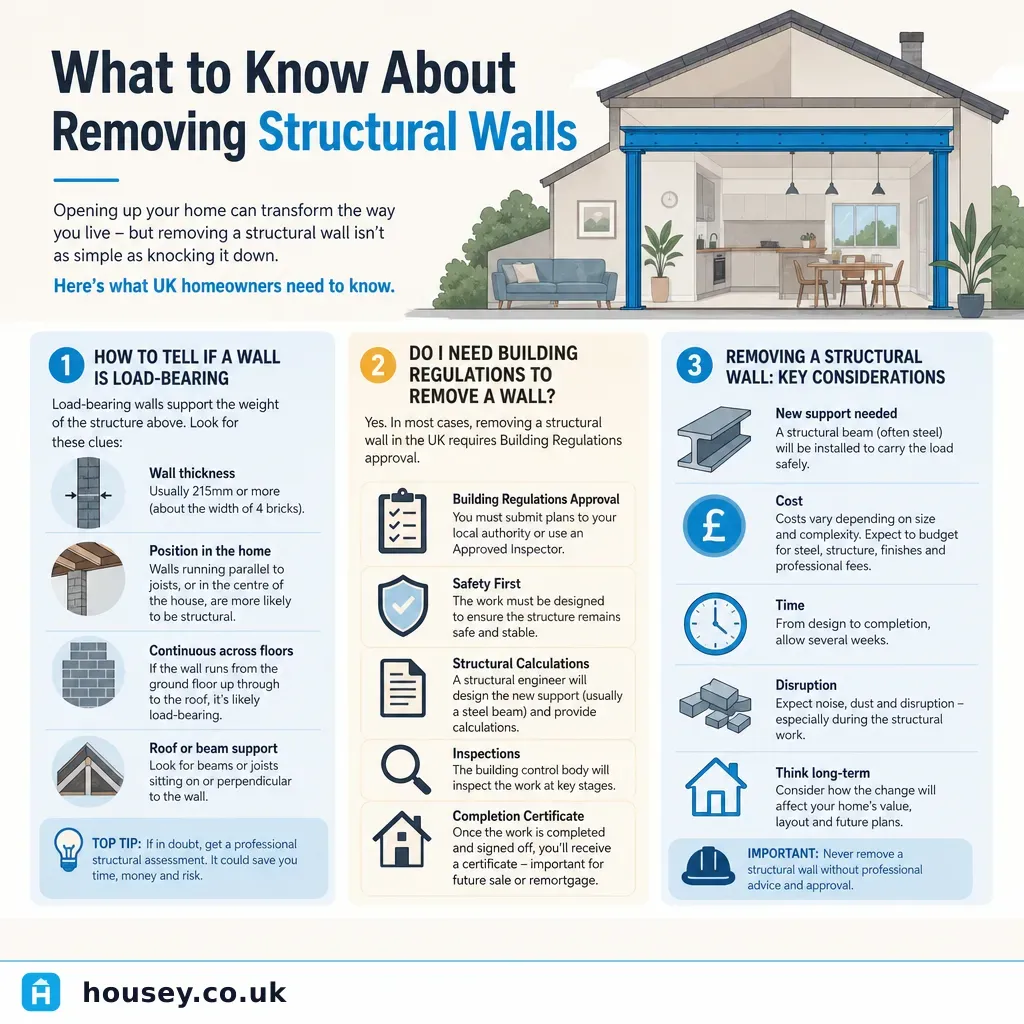
What to Know About Removing Structural Walls
Removing a structural or load-bearing wall in a UK home requires a structural engineer's assessment, a correctly specified steel beam (RSJ), and Building Regulations approval.
 Planning & Pre-Build
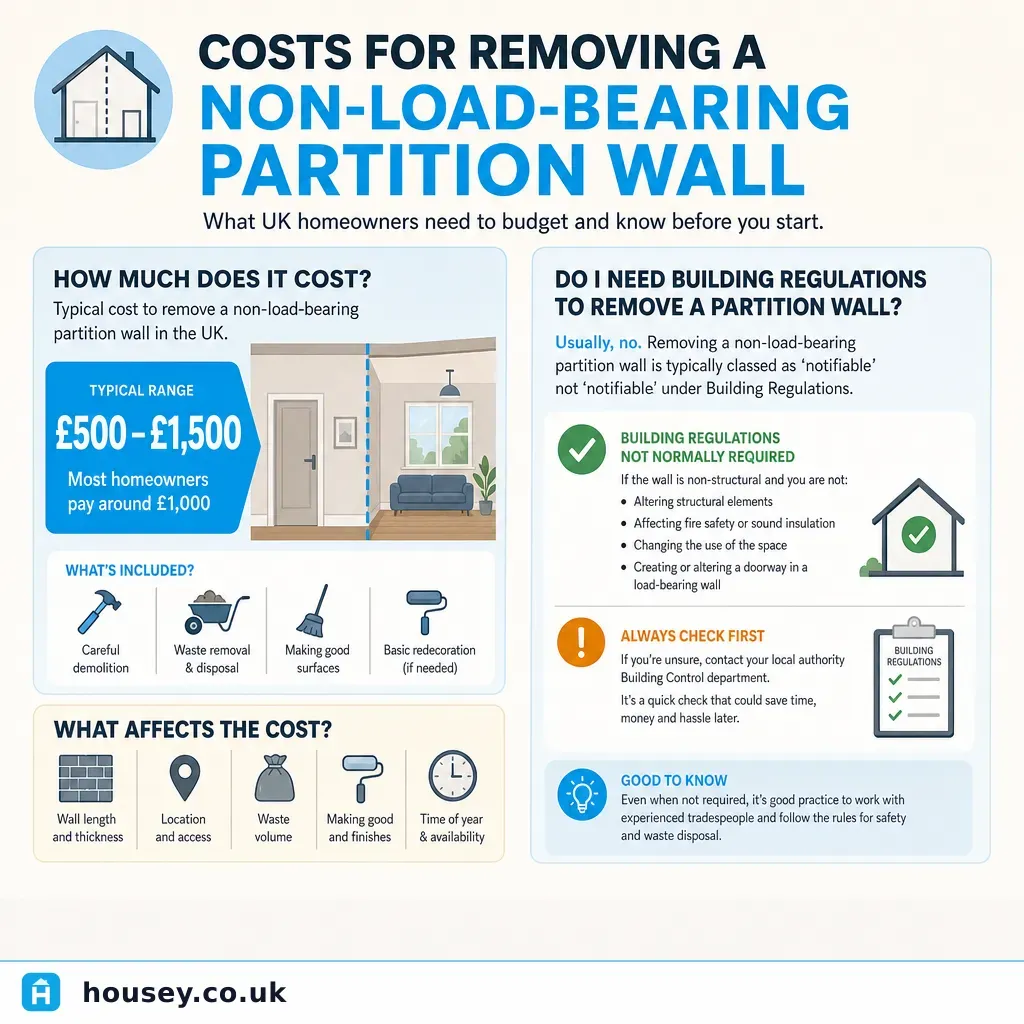
Costs for removing a non-load-bearing partition wall
Removing a non-load-bearing partition wall in a UK home typically costs £300–£1,500 in labour, plus £200–£600 or more for replastering and making good.
 Planning & Pre-Build
Planning Permission and Building Regulations for Extensions
UK home extensions usually require both planning permission and Building Regulations approval, though most smaller rear extensions qualify as Permitted Development under the GPDO 2015 and need no planning application.
 Planning & Pre-Build
Building a Summer House: Planning and Regulatory Requirements
Most garden summer houses in England fall under Class E permitted development and need no planning permission, provided they are single-storey, within height limits, and not used for sleeping.
 Planning & Pre-Build
Planning and Building Regulations for Church and Chapel Conversions
Converting a church or chapel to residential use requires planning permission for change of use from Class F1 to Class C3, and listed building consent if the building is listed.