Building a Summer House: Planning and Regulatory Requirements
By Housey · Last reviewed 11th of May 2026
Building a Summer House: Planning and Regulatory Requirements
Adding a summer house to your garden can feel like one of the simpler home projects — until you realise that permitted development thresholds, building control exemptions, and boundary rules combine in ways that catch many homeowners out. Questions about height limits, garden coverage, and whether electricity requires separate notification often arise after materials have been ordered, making early research far more cost-effective than correcting mistakes on site.
Key points
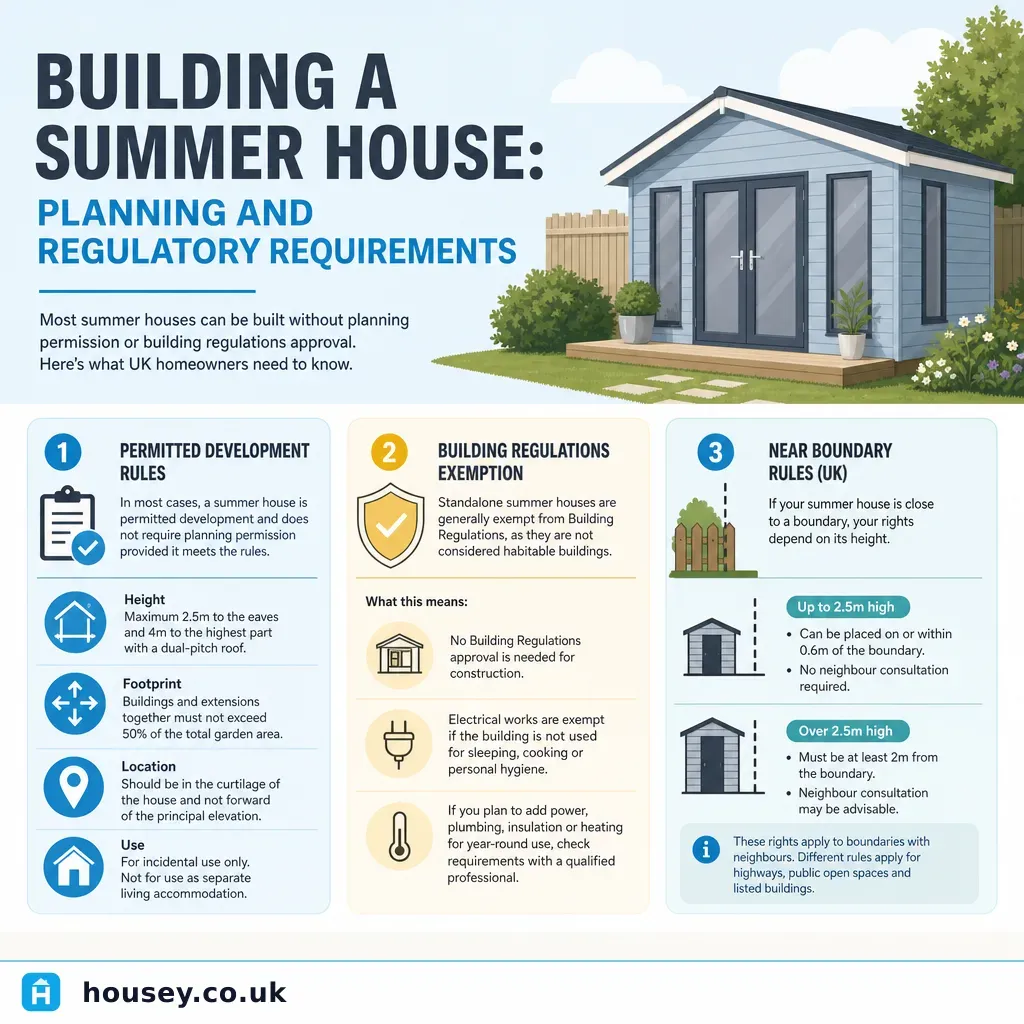
- Under Class E permitted development (Schedule 2, Part 1 of the Town and Country Planning (General Permitted Development) (England) Order 2015), most single-storey summer houses in residential gardens need no planning application.
- A summer house within 2 m of any boundary must not exceed 2.5 m in overall height; further away, the limit is 4 m for a dual-pitched roof or 3 m for any other roof type.
- All outbuildings combined must not cover more than 50% of the total garden area around the original house.
- Permitted development rights do not apply in conservation areas, national parks, Areas of Outstanding Natural Beauty, or for listed buildings — full planning permission is required in these locations.
- Building regulations do not usually apply to a summer house under 15 m²; those between 15 m² and 30 m² are also generally exempt if they are at least 1 m from a boundary and not used for sleeping.
Do you need planning permission for a summer house?
For most homeowners in England, a summer house falls within Class E permitted development rights under the Town and Country Planning (General Permitted Development) (England) Order 2015 (as amended). This means no planning application is needed, provided all of the following conditions are met:
Condition | Requirement |
|---|---|
Use | Incidental to the enjoyment of the dwelling — not a separate dwelling or business premises |
Storeys | Single storey only |
Height within 2 m of any boundary | Maximum 2.5 m to any part of the structure |
Height beyond 2 m from boundary | Maximum 4 m (dual-pitched roof) or 3 m (any other roof type) |
Garden coverage | All outbuildings must not cover more than 50% of the curtilage of the original house |
Location | Must not be forward of the principal elevation that faces a highway |
Sleeping accommodation | Not permitted if the building is used for sleeping |
If any of these conditions cannot be met, a planning application will be needed before work begins.
When permitted development rights do not apply
Permitted development rights are removed or restricted in several circumstances:
- Conservation areas, national parks, Areas of Outstanding Natural Beauty, and the Broads: Class E permitted development applies in principle, but Article 4 Directions issued by the local planning authority (LPA) may remove or limit rights. Check with your LPA before proceeding.
- Listed buildings: Any structure within the curtilage of a listed building requires listed building consent in addition to any planning permission. There are no permitted development exemptions for curtilage structures of listed buildings.
- New-build estates: Some developments have permitted development rights removed by a condition on the original planning consent. Check the planning history of your property on your local authority's planning portal.
- Flats and maisonettes: Class E only applies to houses. Permitted development rights for outbuildings do not extend to flats.
Decision tree: do I need planning permission?
- Is your property a house (not a flat or maisonette)? Permitted development may apply — continue.
- Is the property listed, in a conservation area, national park, or AONB? Planning permission is required. Contact your LPA.
- Has permitted development been removed by an Article 4 Direction or planning condition? Check your LPA's planning portal. If rights have been removed, planning permission is required.
- Will the summer house be within 2 m of a boundary and taller than 2.5 m? Planning permission is required.
- Will all outbuildings combined cover more than 50% of the garden? Planning permission is required.
- Will the building be used for sleeping accommodation? Planning permission is required.
- All conditions above satisfied? Permitted development likely applies. Consider applying for a Lawful Development Certificate for documentary proof.
Do you need building regulations approval?
Building regulations do not automatically apply to garden buildings. The exemptions under Schedule 2 of the Building Regulations 2010 are as follows:
Floor area | Distance from any boundary | Building regulations required? |
|---|---|---|
Under 15 m² | Any distance | No (unless used for sleeping) |
15 m² to 30 m² | 1 m or more | No (unless used for sleeping) |
15 m² to 30 m² | Less than 1 m | Yes — fire risk from proximity to boundary |
Over 30 m² | Any distance | Yes |
Any size | Used for sleeping accommodation | Yes |
A typical garden summer house measuring around 4 m × 4 m (16 m²) positioned at least 1 m from all boundaries and not used for sleeping would therefore be exempt from building regulations under Schedule 2.
If your summer house does require building regulations, the aspects most likely to be assessed include structural stability (Part A), fire safety if it will contain sleeping accommodation (Part B), and thermal performance if it will be permanently heated (Part L).
Worked example: a 5 m × 4 m summer house in a suburban garden
A homeowner in a 1970s semi-detached house in a non-designated area of England plans a timber-framed summer house measuring 5 m × 4 m (20 m²), with a dual-pitched apex roof rising to 3.2 m at the ridge. The building will be sited 1.5 m from the rear boundary and 2 m from the side boundary, and will not be used for sleeping.
Planning: The house is not listed and not in a conservation area or AONB. No Article 4 Direction applies. The summer house is single-storey, the ridge height is under 4 m, it sits more than 2 m from any boundary, and the total outbuilding coverage remains below 50% of the curtilage. No planning permission is required under Class E permitted development.
Building regulations: At 20 m², the floor area falls between 15 m² and 30 m². The structure is more than 1 m from all boundaries and will not be used for sleeping. No building regulations approval is required under Schedule 2 of the Building Regulations 2010.
Recommended action: The homeowner obtains a Lawful Development Certificate from the LPA (costing approximately half the equivalent planning application fee) and retains the dimensional drawings. Both documents are provided to solicitors at the point of sale to answer conveyancing enquiries clearly.
Red flags to watch for
Several associated decisions can inadvertently trigger regulatory requirements even when the summer house itself is exempt:
- Running a mains electricity supply to the building is notifiable electrical work under Part P of the Building Regulations, regardless of whether the building itself needs building regulations approval. This work must be carried out by a registered electrician (NICEIC, NAPIT, or ELECSA) or notified to building control.
- Attached decking or a raised platform can count towards the 50% garden coverage limit and may have separate height restrictions under permitted development.
- Mezzanine levels or sleeping lofts can constitute a second storey, which removes Class E permitted development for the whole structure.
- Commercial use — running the summer house as a treatment room, client-facing studio, or business office — can constitute a change of use requiring planning permission, regardless of its physical form.
- Installing toilet or bathroom facilities typically requires building regulations approval under Part H (drainage) and Part G (sanitation), even if the building itself is otherwise exempt.
When to get professional help
Seek qualified advice if:
- Your property is listed or situated in a conservation area, national park, or AONB.
- You are not certain whether permitted development rights have been removed on your property by a planning condition or Article 4 Direction.
- The summer house is over 30 m² in floor area or will be used for sleeping accommodation.
- You plan to connect mains electricity, water, or drainage to the building.
- The site has specific ground conditions that may affect the type of foundation required.
- You want a Lawful Development Certificate as documentary proof of permitted development compliance for a future sale.
Important limitations
Planning and building regulations rules are subject to change, and permitted development thresholds and conditions vary with the location and history of the property. This article reflects the position in England under the Town and Country Planning (General Permitted Development) (England) Order 2015 and the Building Regulations 2010 as of May 2026. Scotland, Wales, and Northern Ireland each have their own planning and building standards frameworks with different rules. Always verify requirements with your local planning authority or a qualified planning consultant before starting work.
What to ask a qualified professional
Before instructing a designer, builder, or planning consultant:
- Does my property have any restrictions on permitted development rights — Article 4 Direction, planning condition, or designation?
- Should I apply for a Lawful Development Certificate to confirm no planning permission is needed?
- Do my proposed dimensions bring the building within or outside the building regulations exemptions?
- What type of foundation is appropriate for this structure on this ground?
- Who is responsible for the Part P electrical notification if I connect a mains supply?
- If I do need a planning application, what is the likely fee and timescale with my local authority?
How Housey can help
If you want certainty about whether your summer house requires planning permission, planning consultancy specialists on Housey can review your proposal and advise whether a Lawful Development Certificate or a full planning application is needed. For design and construction, design-and-build firms can manage the project from concept to completion, while building control consultants can confirm whether any building regulations notification is required for your specific build.
Frequently asked questions
Can I get a Lawful Development Certificate for a summer house built under permitted development?
Yes. A Lawful Development Certificate is not mandatory, but it provides formal confirmation from the local planning authority that the development is lawful. It costs approximately half the equivalent planning application fee and is particularly useful when selling — it gives solicitors acting for buyers documentary evidence of permitted development compliance, reducing the risk of enquiries or requests for indemnity insurance.
Does a summer house need to be insulated?
If the building falls within the building regulations exemptions — typically under 30 m², not used for sleeping, and at the appropriate distance from boundaries — there is no statutory insulation requirement. However, if the space will be heated year-round, practical insulation significantly reduces running costs. Any combustion appliance such as a wood-burning stove will require building regulations compliance under Approved Document J.
Can I live in or rent out my summer house as a separate unit?
No — using a garden outbuilding as a separate dwelling requires planning permission for a change of use to a dwellinghouse and full building regulations approval. A summer house built under Class E permitted development must remain incidental to the enjoyment of the main house. Renting it as a separate residential unit without consent is likely to constitute a breach of planning control.
How close to the boundary can I build a summer house?
There is no absolute minimum distance in planning terms, but a summer house within 2 m of any boundary must not exceed 2.5 m in overall height. For building regulations exemptions, a structure between 15 m² and 30 m² must be at least 1 m from any boundary. Solid-fuel appliances also require specific clearance distances from combustible materials under Approved Document J.
Sources and further reading
- Town and Country Planning (General Permitted Development) (England) Order 2015 — Schedule 2, Part 1, Class E — legislation.gov.uk
- Building Regulations 2010 — Schedule 2: Exempt buildings and work — legislation.gov.uk
- Planning permission: outbuildings — GOV.UK
- Outbuildings — interactive guidance — Planning Portal
Useful next reads
 Planning & Pre-Build
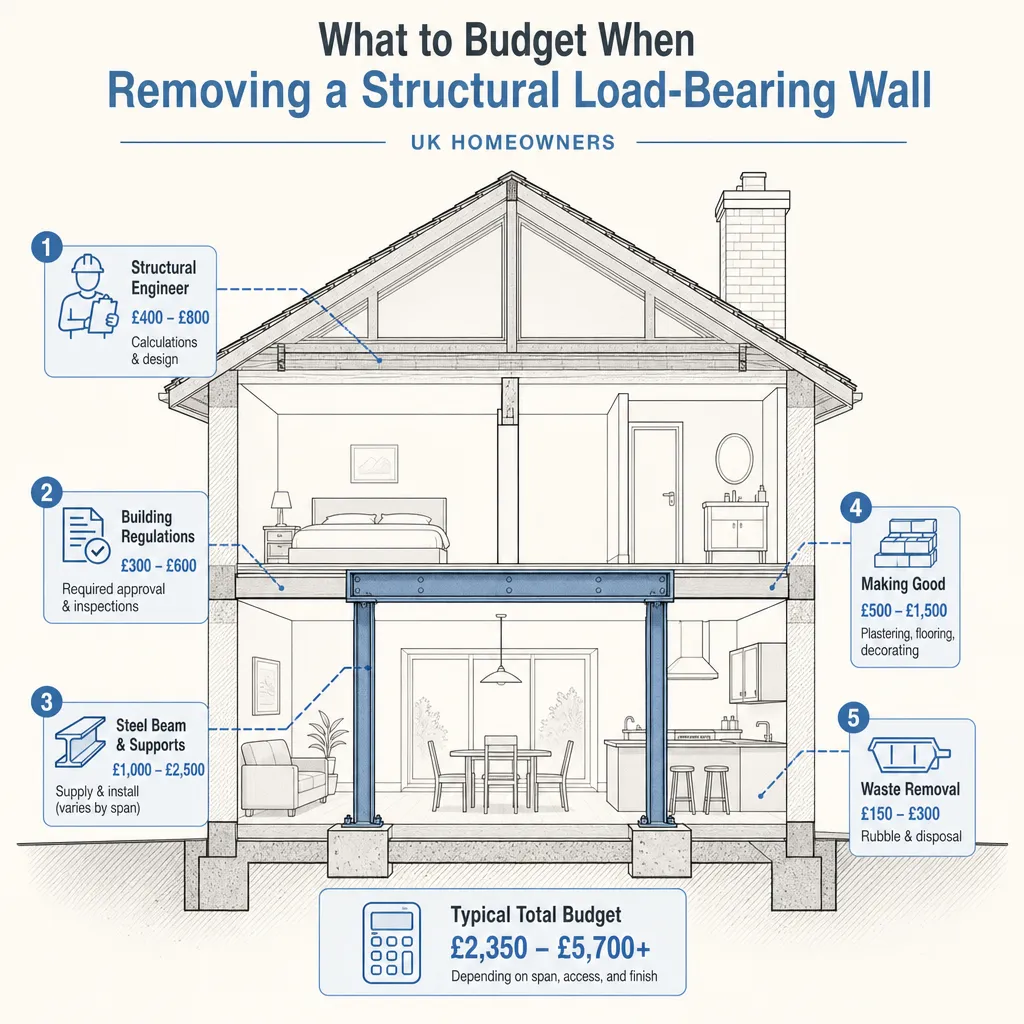
What to Budget When Removing a Structural Load-Bearing Wall
Removing a load-bearing wall in a typical UK home costs £2,500–£8,000 or more in total, covering a structural engineer's calculations, Building Regulations approval, the steel beam, builder's labour, and replastering.
 Planning & Pre-Build
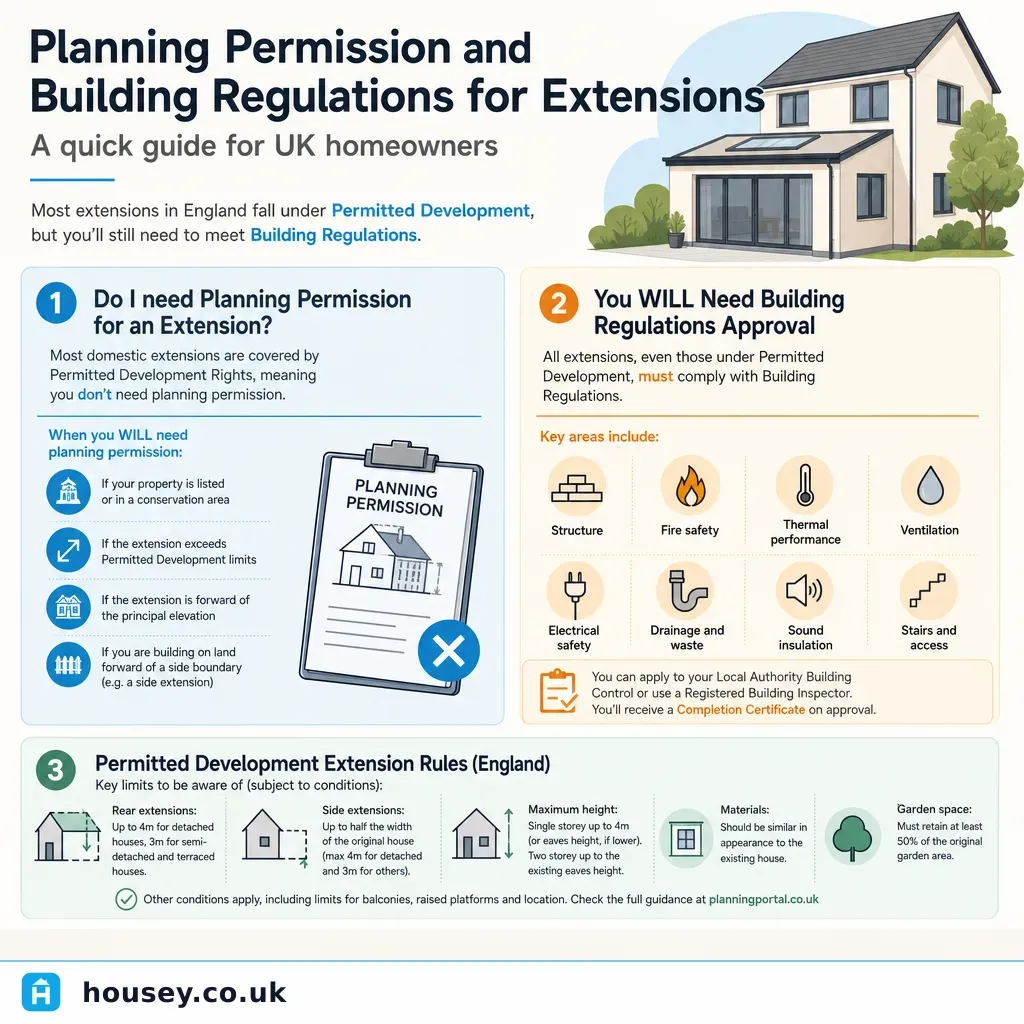
Planning Permission and Building Regulations for Extensions
UK home extensions usually require both planning permission and Building Regulations approval, though most smaller rear extensions qualify as Permitted Development under the GPDO 2015 and need no planning application.
 Planning & Pre-Build
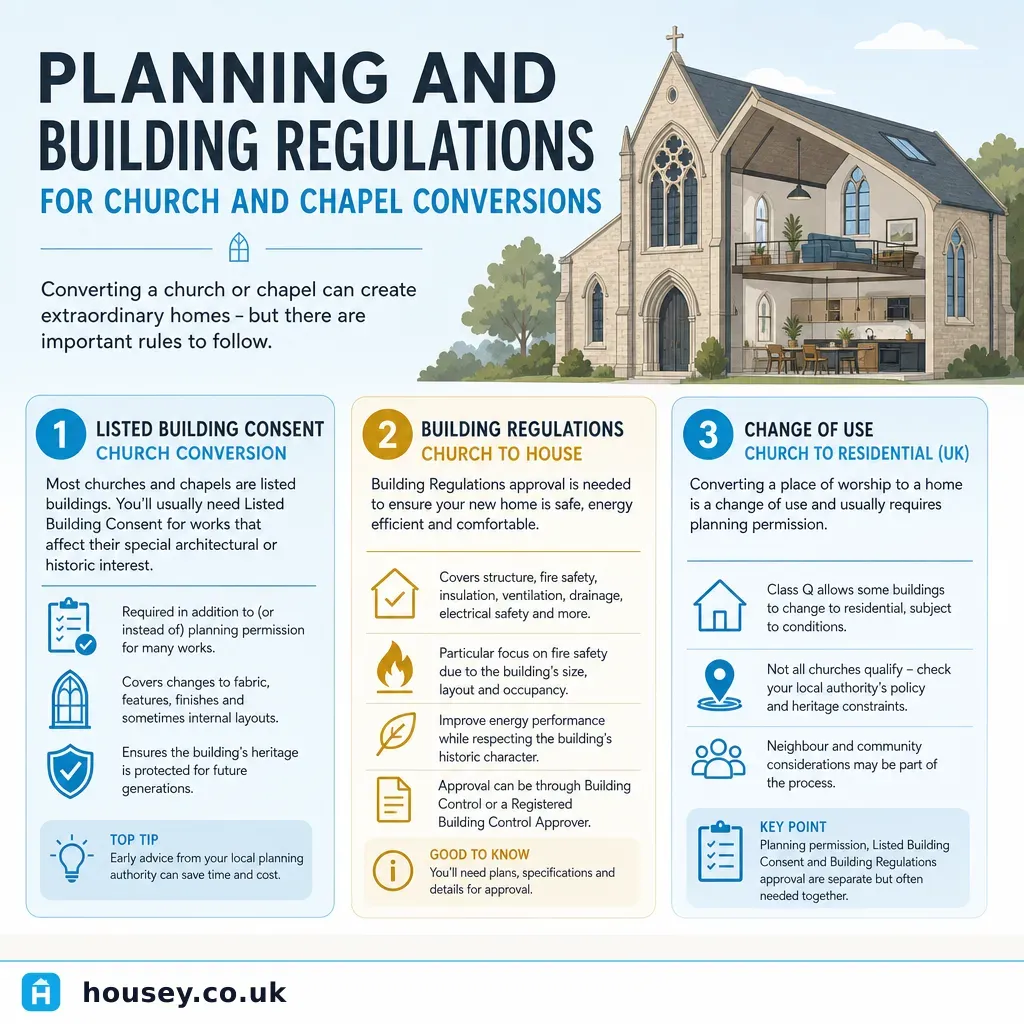
Planning and Building Regulations for Church and Chapel Conversions
Converting a church or chapel to residential use requires planning permission for change of use from Class F1 to Class C3, and listed building consent if the building is listed.
 Planning & Pre-Build
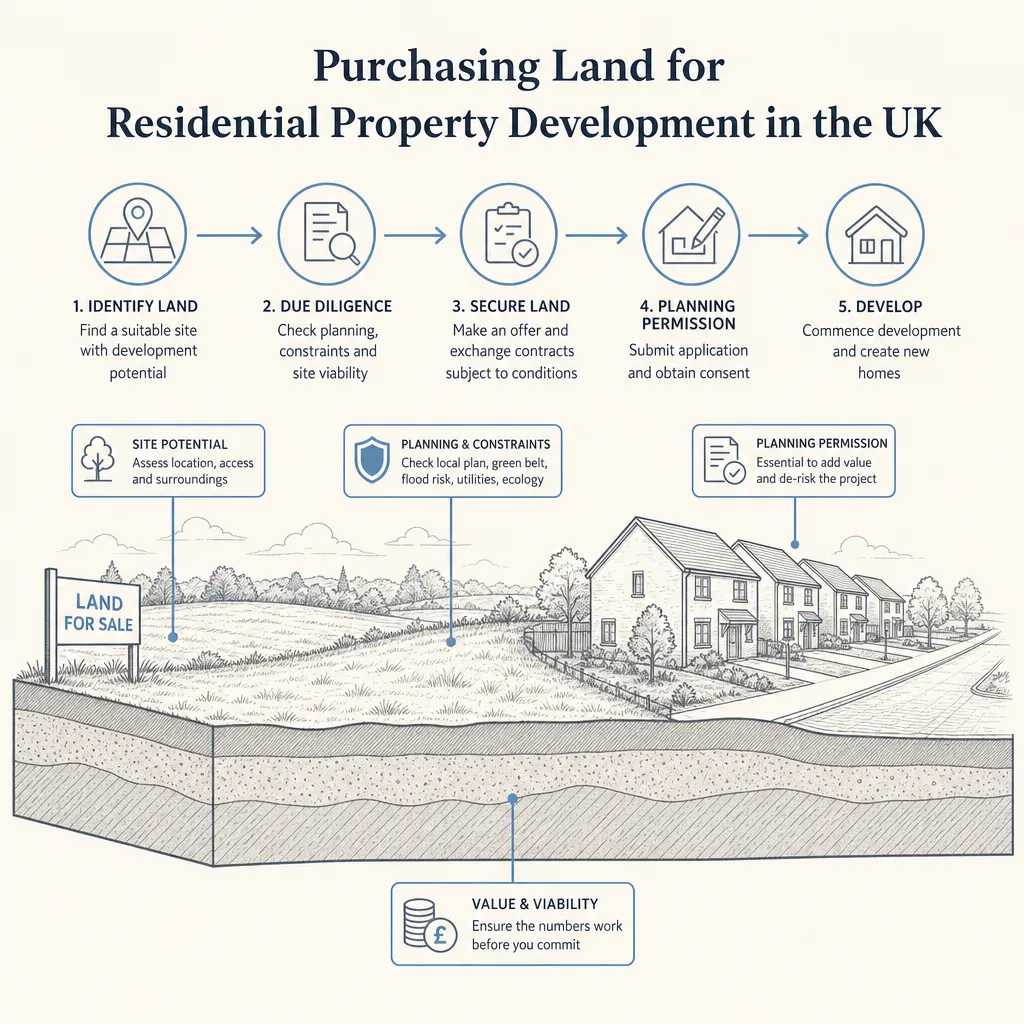
Purchasing Land for Residential Property Development in the UK
Buying development land in the UK involves due diligence on planning status, ground conditions, legal title, and utilities access before exchange.
 Planning & Pre-Build
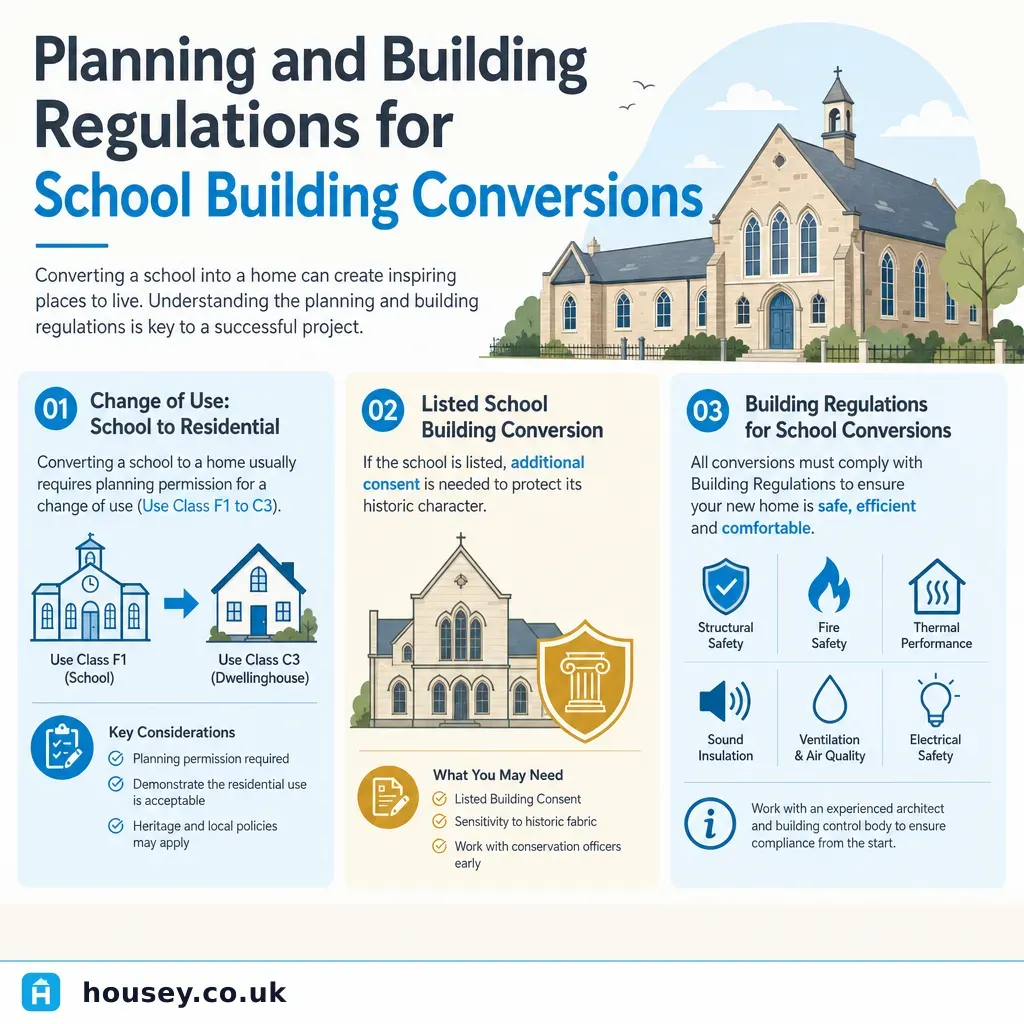
Planning and Building Regulations for School Building Conversions
Converting a school to residential use in England requires full planning permission — there is no permitted development right for this change of use.