Planning Permission and Building Regulations for Extensions
By Housey · Last reviewed 31st of May 2026
Planning Permission and Building Regulations for Extensions
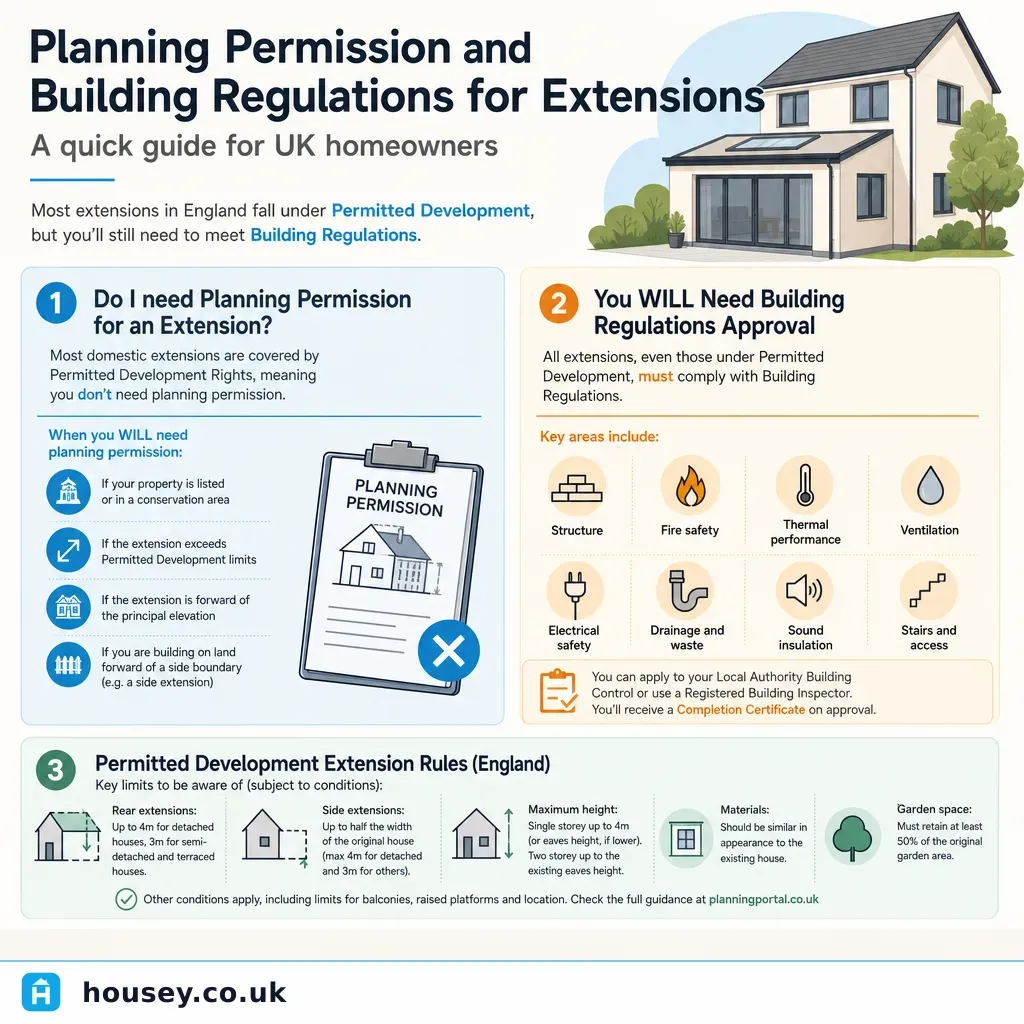
Few decisions prompt more uncertainty for UK homeowners than working out which approvals are needed before extending a property. The rules draw on two separate legislative frameworks — planning law and building regulations — and both typically apply even for a modest single-storey rear extension. Confusion between the two is common, and starting work without the correct approvals can create serious problems at the point of sale, remortgage, or when obtaining buildings insurance.
Key points
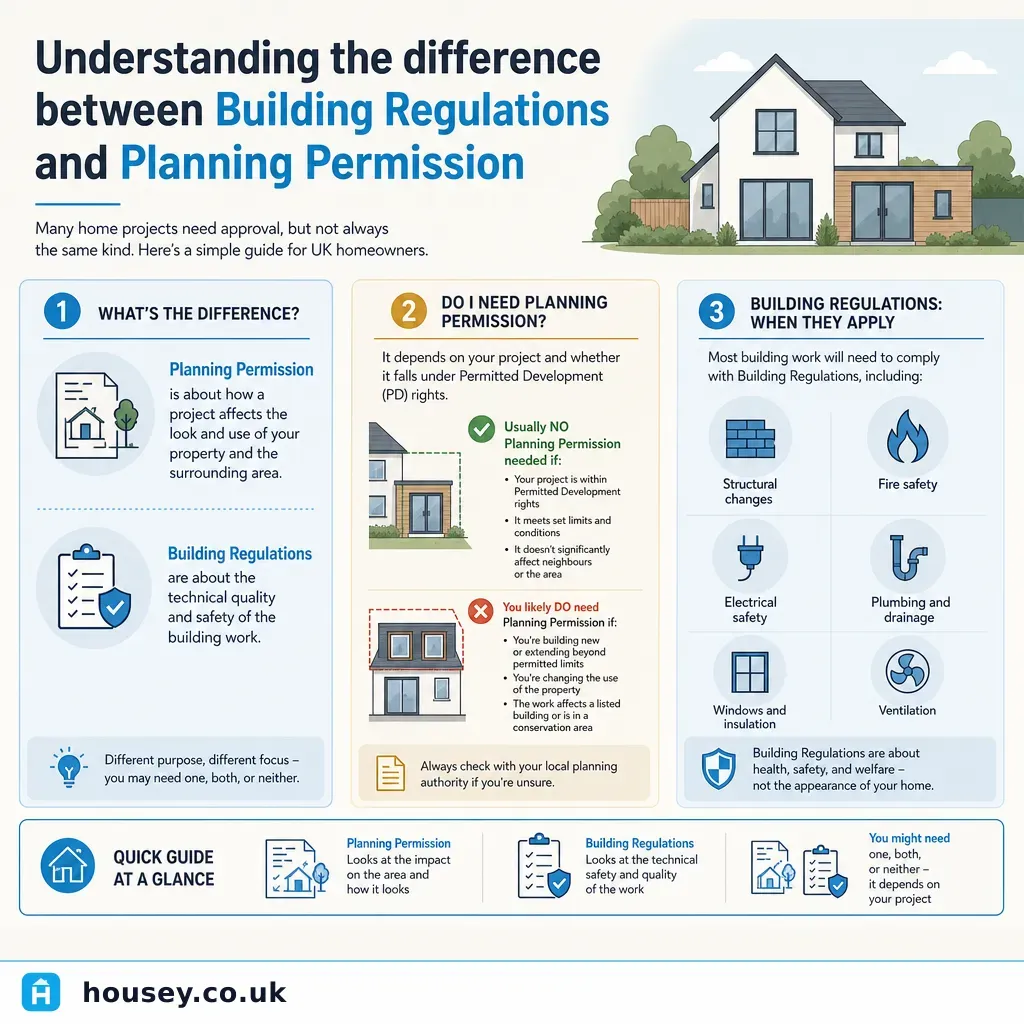
- Planning permission and Building Regulations approval are separate requirements: planning law controls whether you can build; building regulations control how safely and efficiently it must be built.
- Most single-storey rear extensions in England qualify as Permitted Development (PD) under the Town and Country Planning (General Permitted Development) (England) Order 2015, within defined size and height limits — but all extensions still require Building Regulations approval under the Building Regulations 2010.
- A Lawful Development Certificate (LDC) provides formal written confirmation from the local planning authority that a project is Permitted Development — it is not legally required but is strongly recommended before, or shortly after, works complete.
- Listed buildings require Listed Building Consent for any works affecting their character, in addition to any planning and building regulations requirements.
- Properties in conservation areas, National Parks, and Areas of Outstanding Natural Beauty have reduced or removed Permitted Development rights for side and front extensions.
Planning permission versus building regulations: the key distinction
Homeowners frequently ask which approval they need. For most extensions, the answer is both — but they serve entirely different purposes and involve different bodies.
| Planning permission | Building Regulations approval |
|---|---|---|
What it controls | Land use, appearance, visual impact on neighbours and surroundings | Structural integrity, fire safety, insulation, drainage, energy efficiency |
Who decides | Local planning authority (LPA) | Local authority building control or a Registered Building Control Approver (RBCA) |
Legislation | Town and Country Planning Act 1990 | Building Regulations 2010 |
When needed for extensions | Only if works fall outside Permitted Development rights | Always — there is no PD equivalent that removes this requirement |
How to apply | Planning Portal (England) — householder application or Prior Approval | Full plans or building notice submission to building control |
Consequence of non-compliance | Enforcement notice; possible demolition order; problem at sale | Unsafe structure; local authority may require remediation; problem at sale |
Decision tree: do I need planning permission for my extension?
Work through these questions in order:
- Is the property listed? → Listed Building Consent is required for any works affecting its character, in addition to any planning and building regulations requirements. Consult a planning consultant or your local conservation officer before proceeding.
- Is the property in a conservation area, National Park, AONB, or World Heritage Site? → Permitted Development rights are significantly reduced. Side extensions and changes to roof materials typically require a planning application. Check with your local planning authority (LPA).
- Has the property already been extended? → PD allowances are cumulative across the original footprint. If a previous owner extended, remaining allowance may be reduced or fully used.
- Is the extension at the front of the property, facing a highway? → Permitted Development rarely covers front extensions; a householder planning application is usually required.
- Is it a single-storey rear extension within the standard PD limits — 4 m depth for detached houses, 3 m for attached; maximum 4 m in height at the eaves; no higher than the existing roof ridge? → Likely Permitted Development in England, subject to conditions. Apply for a Lawful Development Certificate to confirm this formally.
- Does the extension exceed those limits but fall within the Prior Approval thresholds — up to 8 m rear depth for detached, or 6 m for attached? → Prior Approval may apply, subject to a 42-day LPA neighbour-notification process and design conditions.
- None of the above apply clearly? → A full householder planning application is needed. Speak to a planning consultant or your LPA's duty planner before committing to design costs.
Note: These rules apply in England. Wales, Scotland, and Northern Ireland operate under separate planning regimes with different thresholds and procedures.
Building Regulations: what extensions must comply with
All extensions require Building Regulations approval. The relevant Approved Documents depend on the scope of works:
Approved Document | What it covers | Relevant to most extensions? |
|---|---|---|
Part A — Structure | Structural loading, foundations, and stability | Yes — always |
Part B — Fire safety | Means of escape and fire spread to boundaries | Yes |
Part C — Moisture resistance | Damp-proofing and weather resistance | Yes |
Part F — Ventilation | Fresh air supply and extraction | Yes |
Part L — Energy efficiency | U-values, insulation, thermal bridging, limiting heat loss | Yes — always |
Part O — Overheating | Solar gain and ventilation (introduced for new residential, 2022) | Yes for extensions in England |
Part P — Electrical safety | Notifiable electrical installations | If electrical work is included |
Part E — Sound | Airborne and impact sound between dwellings | If party walls or floors are affected |
Since the Building Safety Act 2022, approved inspectors now operate as Registered Building Control Approvers (RBCAs). For most domestic extensions, either local authority building control or an RBCA is an acceptable route — discuss with your architect or designer which suits your project programme.
Documents typically needed for an extension
- Architect or designer's drawings — existing and proposed floor plans, elevations, sections, and roof plan.
- Site location plan — usually a 1:1250 OS-based map; required for all planning applications.
- Structural calculations — required for new foundations, steel beams, load-bearing walls, and any structural alterations.
- Energy calculations — to demonstrate Part L compliance; the method (simplified or full SAP calculation) depends on the scope of works.
- Party Wall Notice — required under the Party Wall etc. Act 1996 if works are on or near the boundary, or within 3–6 metres of an adjoining owner's foundations.
- Design and Access Statement — required for listed building applications and some full planning applications.
- Drainage drawings — if new surface water or foul drainage connections are required.
Important limitations
This article provides general guidance on planning permission and Building Regulations in England and must not be relied on as legal or planning advice. Rules are subject to change, vary between local planning authorities, and depend on your property's specific history, tenure, location, and the design of the proposed works. A qualified planning consultant, architect, or your LPA's duty planning officer should be consulted before you commit to design expenditure or start any works on site.
When this becomes urgent
Seek professional advice without delay if:
- Work has already started and you are unsure whether the correct planning or building regulations approvals were in place before you began.
- You have received a planning enforcement notice or a building control compliance notice.
- A property sale has stalled because a solicitor has raised queries about an extension with no Building Regulations completion certificate or Lawful Development Certificate.
- You are considering purchasing a property with an extension that has no supporting documentation — your conveyancing solicitor can advise on indemnity insurance or regularisation options.
What to ask a qualified professional
Before instructing a planning consultant, architect, or building control body, ask:
- Does this specific extension require planning permission, or does it clearly fall within Permitted Development rights given this property's planning history and location?
- Are there any Article 4 Directions or local plan policies that restrict Permitted Development rights in this street or area?
- Should I apply for a Lawful Development Certificate even if Permitted Development rights appear to apply?
- Which Approved Documents are most likely to require formal supporting evidence — structural calculations, energy calculations, drainage details?
- Who will act as principal designer under the CDM Regulations 2015 if more than one contractor is involved?
- Does the Party Wall etc. Act 1996 apply, and if so, what are the correct notice procedures?
- If I am relying on Prior Approval rather than full planning permission, what design conditions and neighbour notification steps apply in practice?
When to get professional help
Even for apparently straightforward extensions, the interaction between planning rules, building regulations, the Party Wall Act, and any local planning restrictions can be complex. Instructing an architect or designer early reduces the risk of abortive design work and can identify constraints before money is spent on detailed drawings.
Engage planning consultants if your property is listed or in a conservation area, if you are approaching or exceeding Permitted Development limits, if a pre-application enquiry has raised concerns, or if you want a pre-purchase assessment of extension potential before buying a property.
Engage building control consultants early to agree the submission route (full plans versus building notice), understand what calculations and construction details will be required, and avoid programme delays when stage inspections fall due during the build.
How Housey can help
Housey connects homeowners with experienced planning consultants and building control consultants who can advise on approval requirements, prepare submissions, and manage the process with your local planning authority and building control body from initial assessment through to completion certificates.
Frequently asked questions
Do I always need Building Regulations approval for an extension?
Yes, in virtually all cases. Building Regulations approval is required regardless of whether your extension is Permitted Development. It is the process by which building control verifies that structure, insulation, fire safety, drainage, and energy performance meet current standards. There is no Permitted Development equivalent that removes this requirement.
What is a Lawful Development Certificate and do I need one?
A Lawful Development Certificate (LDC) is a formal document from the local planning authority confirming that a proposed or completed development is lawful — that is, it falls within Permitted Development rights. It is not legally required to proceed, but it provides certainty for you, future buyers, and mortgage lenders, and is strongly recommended.
Does a rear extension always count as Permitted Development?
Not automatically. PD rights for rear extensions are subject to size limits, height limits, proximity to boundaries, and material conditions. They are also removed or restricted for listed buildings, properties in conservation areas, and properties subject to Article 4 Directions. Allowances differ between detached and attached houses. Always verify with your LPA before committing to a design.
How long does it take to get planning permission for an extension?
A standard householder planning application in England should be determined within eight weeks of validation. More complex applications or those attracting objections may take longer. Building Regulations approval via full plans submission typically takes three to five weeks for the initial assessment, with stage inspections taking place throughout the build.
Sources and further reading
- Planning permission: England and Wales — GOV.UK
- Permitted development rights for householders: technical guidance — GOV.UK
- The Town and Country Planning (General Permitted Development) (England) Order 2015 — legislation.gov.uk
- Building Regulations 2010 — legislation.gov.uk
- Approved Documents (Building Regulations) — GOV.UK
- Party Wall etc. Act 1996 — legislation.gov.uk
- Building Safety Act 2022 — legislation.gov.uk
Useful next reads
 Planning & Pre-Build
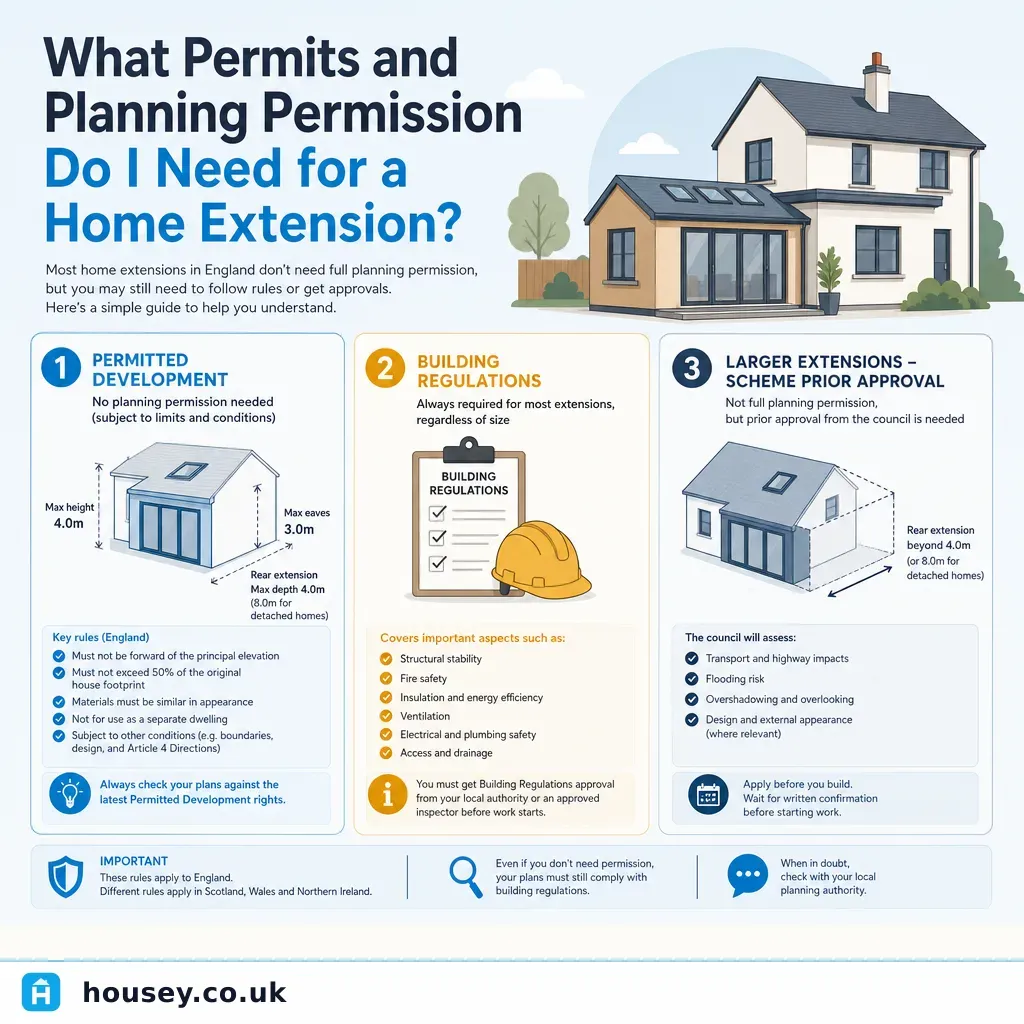
What Permits and Planning Permission Do I Need for a Home Extension?
Most single-storey rear extensions fall under permitted development and do not need a formal planning application, provided they stay within size limits set out in the Town and Country Planning (General Permitted Development) (England) Order 2015.
 Planning & Pre-Build
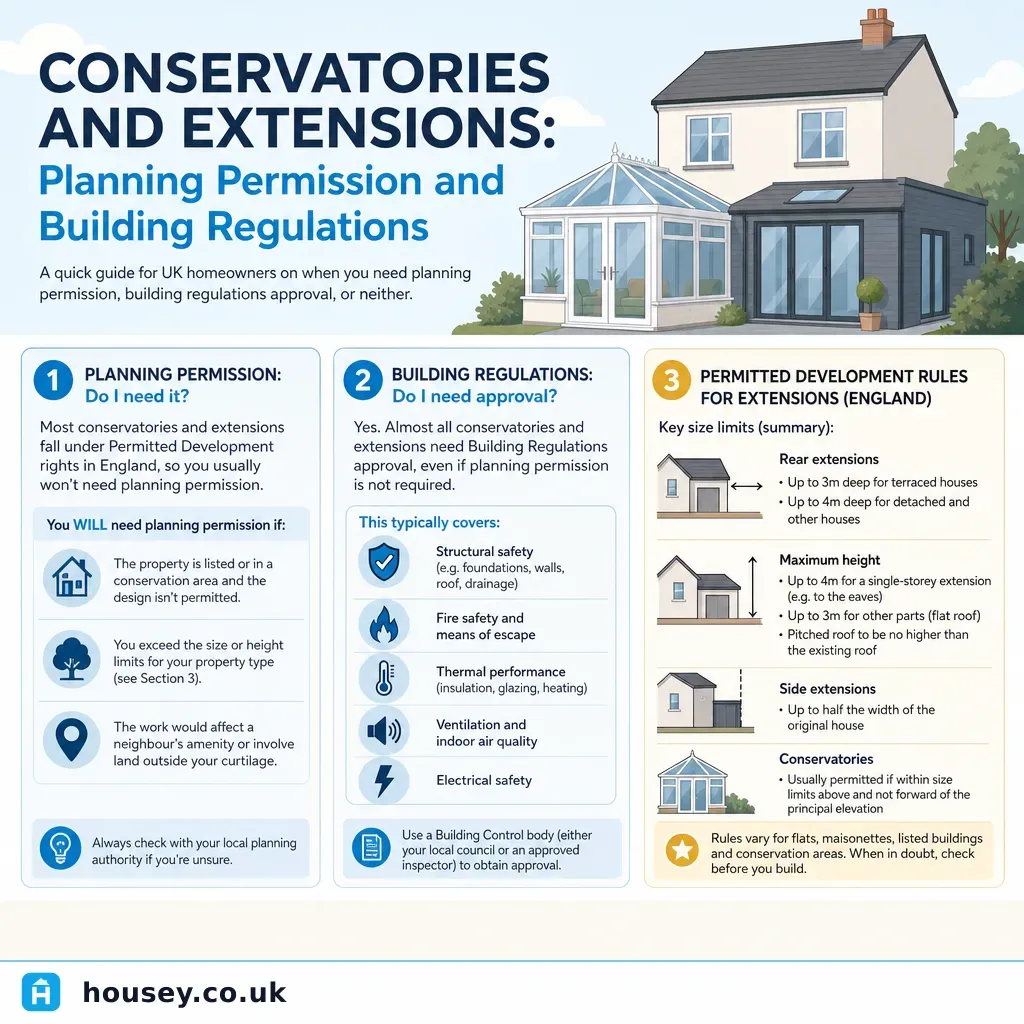
Conservatories and Extensions: Planning Permission and Building Regulations
Whether your conservatory or extension needs planning permission depends on its size, height, position, and property type.
 Planning & Pre-Build
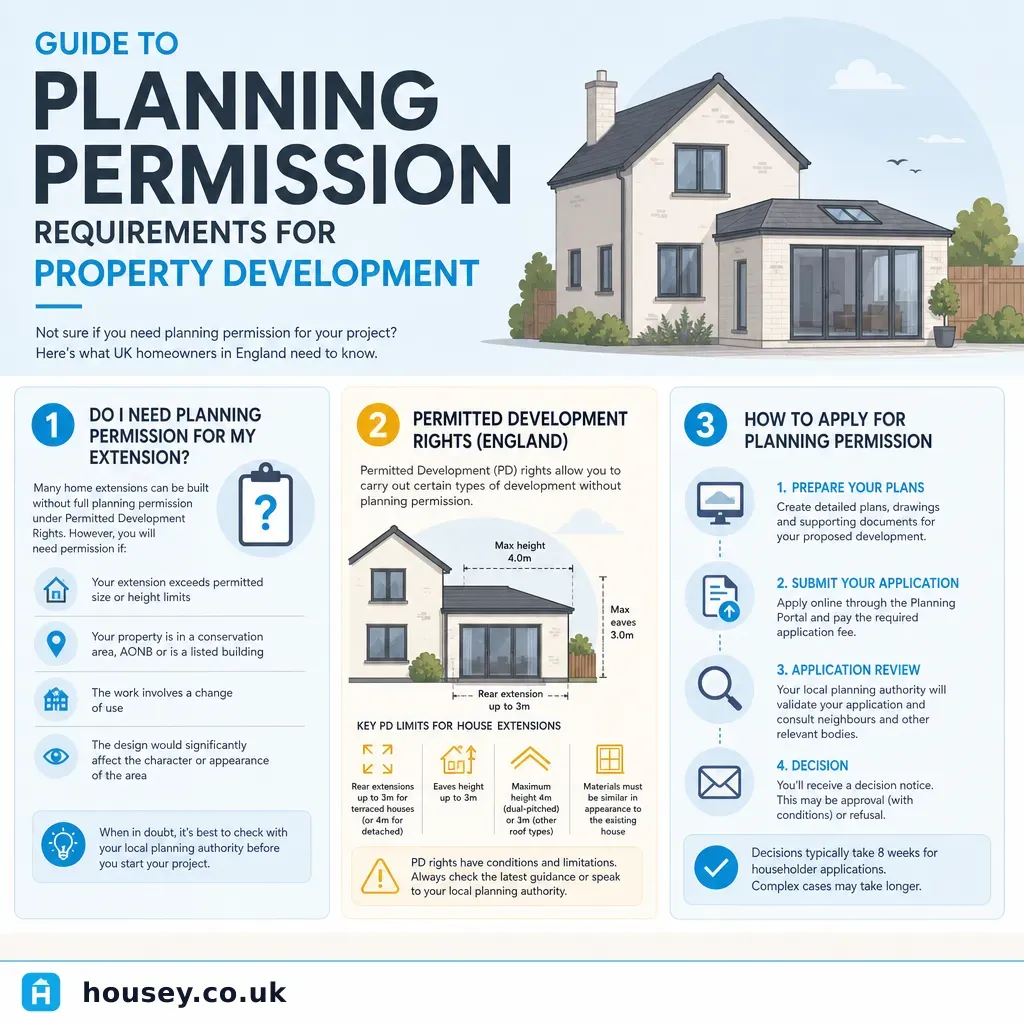
Guide to Planning Permission Requirements for Property Development
Most home improvements in England fall within permitted development rights and do not need a planning application.
 Planning & Pre-Build
Understanding the difference between building regulations and planning permission
Planning permission is granted by your Local Planning Authority and controls whether a development is acceptable in principle — its appearance, use, and impact on the area.
 Planning & Pre-Build
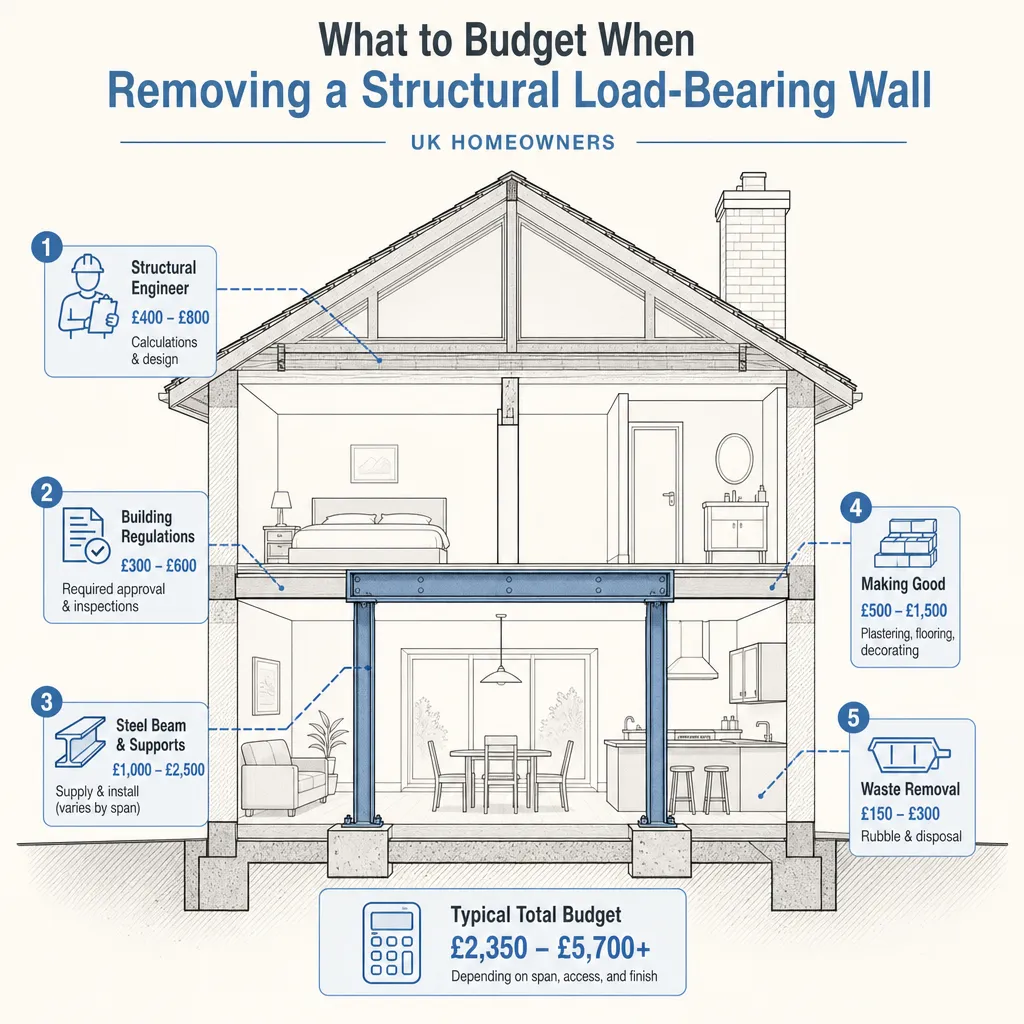
What to Budget When Removing a Structural Load-Bearing Wall
Removing a load-bearing wall in a typical UK home costs £2,500–£8,000 or more in total, covering a structural engineer's calculations, Building Regulations approval, the steel beam, builder's labour, and replastering.