Brownstone and Townhouse Characteristics: Architectural Overview
By Housey · Last reviewed 11th of May 2026
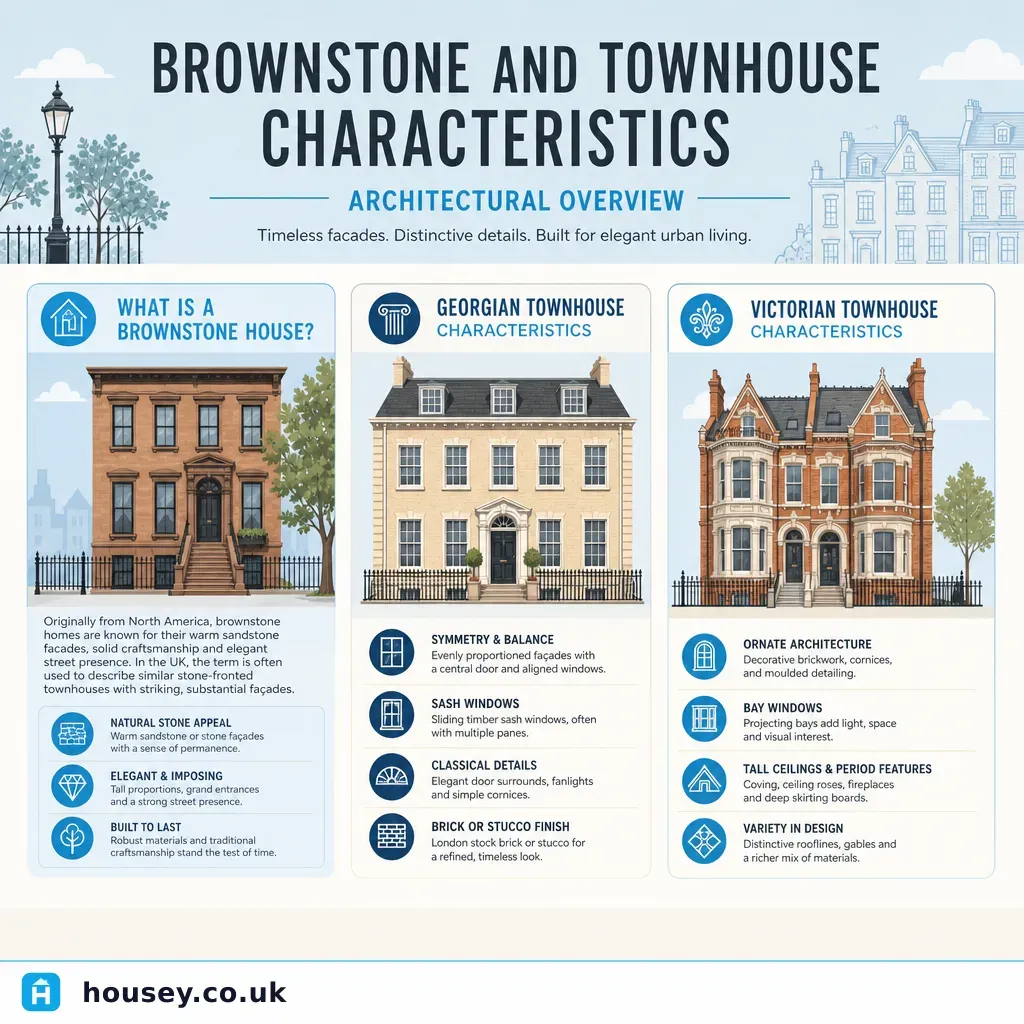
Brownstone and Townhouse Characteristics: Architectural Overview
UK buyers and renovation planners researching urban property sometimes encounter the term 'brownstone' through American property media, design publications, or international listings. Understanding what a brownstone actually is — and how it relates to the UK's Georgian and Victorian townhouse tradition — is useful context before purchasing, planning works on, or extending an older urban property where conservation area or listed building rules may apply.
Key points
- 'Brownstone' is a North American term for a sandstone-fronted terraced urban house; the type does not exist as a recognised category in UK property or planning law, where the nearest equivalent is the Georgian or Victorian townhouse.
- UK townhouses are typically 3–5 storeys, narrow-fronted, and built in terrace form from the late 17th century through to the Edwardian period, using brick, stucco, or stone depending on region and era.
- Many UK townhouses sit within Conservation Areas or carry Statutory Listing (Grade I, II*, or II), which substantially restricts permitted development rights and requires Listed Building Consent for most internal and external alterations.
- Basement and lower-ground-floor extensions are a common aspiration for Georgian and Victorian townhouse owners; these require structural assessment, Building Regulations approval, and often party wall notices under the Party Wall etc. Act 1996.
- The RICS Level 3 Building Survey — formerly the Full Structural Survey — is the recommended survey type for pre-1919 townhouses given the complexity of solid wall construction, lime mortar, original pipework, and potential hidden defects.
What is a brownstone?
A brownstone is a style of urban terraced house associated primarily with 19th-century American cities — New York, Boston, Baltimore, and Philadelphia in particular. The name refers to the reddish-brown sandstone used to clad the facade. Architecturally, brownstones are typically:
- 3–5 storeys in height, built in attached terrace form.
- Accessed via a prominent stoop — a raised external front staircase — with a service basement below street level.
- Decorated in Greek Revival, Italianate, or Romanesque Revival style depending on the decade of construction.
- Popular from roughly 1840–1900, before falling out of fashion and later being extensively converted to apartments.
Brownstones do not exist in the UK. The term is occasionally misapplied in online discussion to dark-brick Victorian terraces or similar-looking urban properties, but it is not a recognised category in British architecture, planning, or property law.
UK townhouses: characteristics by period
In the UK, 'townhouse' describes a tall, narrow, multi-storey terraced or semi-detached house in an urban or suburban setting. The type spans several distinct architectural periods, each with different construction characteristics relevant to surveys, planning applications, and renovation work.
Georgian townhouse (c.1714–1830)
- Characterised by symmetry, sash windows, and restrained classical ornamentation.
- Built from local brick or stone; often with painted stucco facades in London, Bath, and Edinburgh.
- Typically 4–5 storeys, including a basement service area and attic rooms.
- Examples: Bath's Royal Crescent, London's Bloomsbury and Islington, Edinburgh's New Town.
Victorian townhouse (c.1837–1901)
- Wider stylistic range: Gothic Revival, Italianate, and Queen Anne influences.
- Common materials: London stock brick, red brick, sandstone, Yorkshire stone, and terracotta detailing.
- 3–4 storeys typical; bay windows, decorative cornicing, and encaustic-tiled front paths are characteristic features.
- The predominant townhouse type in most UK city centres and inner suburbs.
Edwardian townhouse (c.1901–1914)
- Slightly larger rooms and more decorative timber joinery than late Victorian equivalents.
- Arts and Crafts influence visible in tile work, stained glass, and internal timber detailing.
- Red brick with mock-Tudor half-timbering common in outer suburban areas.
Modern developer townhouse (post-2000)
- The term is also applied to new-build 3-storey terraced houses with cavity wall or timber frame construction.
- These carry full permitted development rights in most cases and should not be compared to heritage townhouses when planning works or commissioning surveys.
Brownstone vs UK townhouse: a comparison
Feature | US brownstone | UK Georgian townhouse | UK Victorian townhouse |
|---|---|---|---|
Facade material | Brown sandstone | Brick, stucco, or Bath stone | Brick, stone, or terracotta |
Typical storeys | 3–5 | 4–5 (including basement) | 3–4 |
Entry arrangement | Raised stoop (external staircase) | Street-level or shallow steps | Street-level or small front garden |
Planning controls | US city zoning and landmarks law | UK Conservation Area or Listed Building Consent | UK Conservation Area or permitted development |
Structural complexity | High: brownstone weathering, stoop maintenance | High: lime mortar, solid walls, basement vaulting | High: solid walls, original timbers, damp risk |
Recommended survey type | Full structural survey | RICS Level 3 Building Survey | RICS Level 3 Building Survey |
Planning and permitted development considerations
UK heritage townhouses — particularly pre-1919 examples — frequently sit within Conservation Areas or carry Statutory Listing. This has significant implications for buyers, owners, and anyone planning renovation or extension works:
- Conservation Area: Permitted development rights for extensions, roof alterations, and changes to external materials are restricted. Your local planning authority must be consulted before most external works. Demolishing unlisted buildings within a conservation area also requires consent in most cases.
- Listed Building: Listed Building Consent (LBC) is required for any works affecting the character of a Listed Building — including internal changes such as replacing original windows, fireplaces, floorboards, or historic plasterwork. Carrying out such works without LBC is a criminal offence.
- Basement extensions: A common aspiration for London and urban townhouse owners. These require full planning permission, structural engineering assessment, and party wall notices under the Party Wall etc. Act 1996 where works affect a shared wall, boundary, or involve excavation near a neighbour's foundations.
- Roof terraces: Almost always require planning permission on a historic townhouse and can be contentious in conservation areas due to impact on rooflines and overlooking concerns.
Check a property's listed status using the National Heritage List for England (Historic England), or the equivalent registers for Scotland (Historic Environment Scotland), Wales (Cadw), and Northern Ireland (NIEA). Consult your local authority's online planning map for Conservation Area boundaries before making an offer or committing to a design.
Structural and survey considerations for pre-1919 townhouses
Pre-1919 townhouses present a specific set of potential defects that a RICS Level 2 Home Survey may not fully document. A RICS Level 3 Building Survey is strongly recommended, with particular attention to:
- Solid wall construction: No cavity; damp penetration behaves differently from cavity-wall failure and requires experienced assessment.
- Lime mortar: Flexible by design. Repointing with hard Portland cement damages original brickwork or stonework. Any repointing should use a lime mortar matched to the original specification.
- Timber floors and joists: Susceptible to wet rot, dry rot, wood-boring beetle infestation, and settlement. The subfloor void should be inspected where accessible.
- Lead, iron, and early copper pipework: Often requires full replacement. Factor this into purchase budgets and refurbishment planning.
- Chimney stacks: Multiple stacks are common; check pointing, pot condition, and lead or mortar flashing at roof level.
Which professional do I need?
Need | Professional |
|---|---|
Understanding the building's architectural history | Architect or architectural historian with heritage experience |
Planning application in a conservation area | Architect or architectural technologist with local planning authority experience |
Listed Building Consent application | RIBA Conservation Accredited Architect |
Pre-purchase condition survey | RICS Level 3 Building Surveyor (MRICS or FRICS) |
Basement or structural extension design | Structural engineer (MIStructE or CEng) |
Party wall matters | Party wall surveyor (RICS accredited) |
When to get professional help
Always consult a qualified professional before undertaking any works on a pre-1919 UK townhouse, and particularly if:
- You suspect structural movement — stepped cracks in brickwork, sloping floors, sticking doors and windows, or gaps appearing at window frames.
- You are planning to alter, extend, divide, or convert the property.
- The property is Listed or located in a Conservation Area and you are unsure which works require formal consent.
- You are buying — always commission a RICS Level 3 survey before exchange of contracts on a heritage townhouse.
How Housey can help
Housey connects homeowners and buyers with vetted local professionals experienced in UK townhouse renovation and heritage work. Whether you need an architect with conservation experience for a Listed Building application, or an architectural technologist to prepare drawings for a planning submission, Housey can provide multiple quotes so you can compare and choose with confidence.
Frequently asked questions
Are there brownstone houses in the UK?
No. Brownstone is a North American architectural term for sandstone-fronted urban terraced houses associated with 19th-century US cities such as New York and Boston. The UK equivalent in character and era is the Georgian or Victorian townhouse, though the construction materials, planning controls, and design conventions differ significantly from the American type.
Do I need planning permission to renovate a Victorian townhouse in the UK?
It depends on the work and the property's status. Internal works generally do not require planning permission, but if the property is Listed, Listed Building Consent is required for most alterations. External works in Conservation Areas usually require prior approval. Always check with your local planning authority before starting work.
What survey should I get for a pre-1919 townhouse?
A RICS Level 3 Building Survey, carried out by a chartered surveyor (MRICS or FRICS), is generally recommended for pre-1919 townhouses. These properties involve solid wall construction, lime mortar, and original materials that a Level 2 survey may not fully assess. For suspected structural movement, an additional structural engineer's report may be needed alongside the survey.
What is the difference between a townhouse and a terraced house in the UK?
In UK usage, a townhouse typically implies a taller, narrower multi-storey urban property — usually three or more floors — while a terraced house is a broader category covering any property in a continuous row. All terraced townhouses are terraced houses, but not all terraced houses are townhouses. The distinction is informal and varies by region and period of construction.
Sources and further reading
- National Heritage List for England — Historic England
- Conservation areas: designation, appraisals and management — GOV.UK
- Listed buildings and obtaining listed building consent — GOV.UK
- Party Wall etc. Act 1996 — legislation.gov.uk
- RICS Home Survey Standard — RICS
Useful next reads
 Planning & Pre-Build
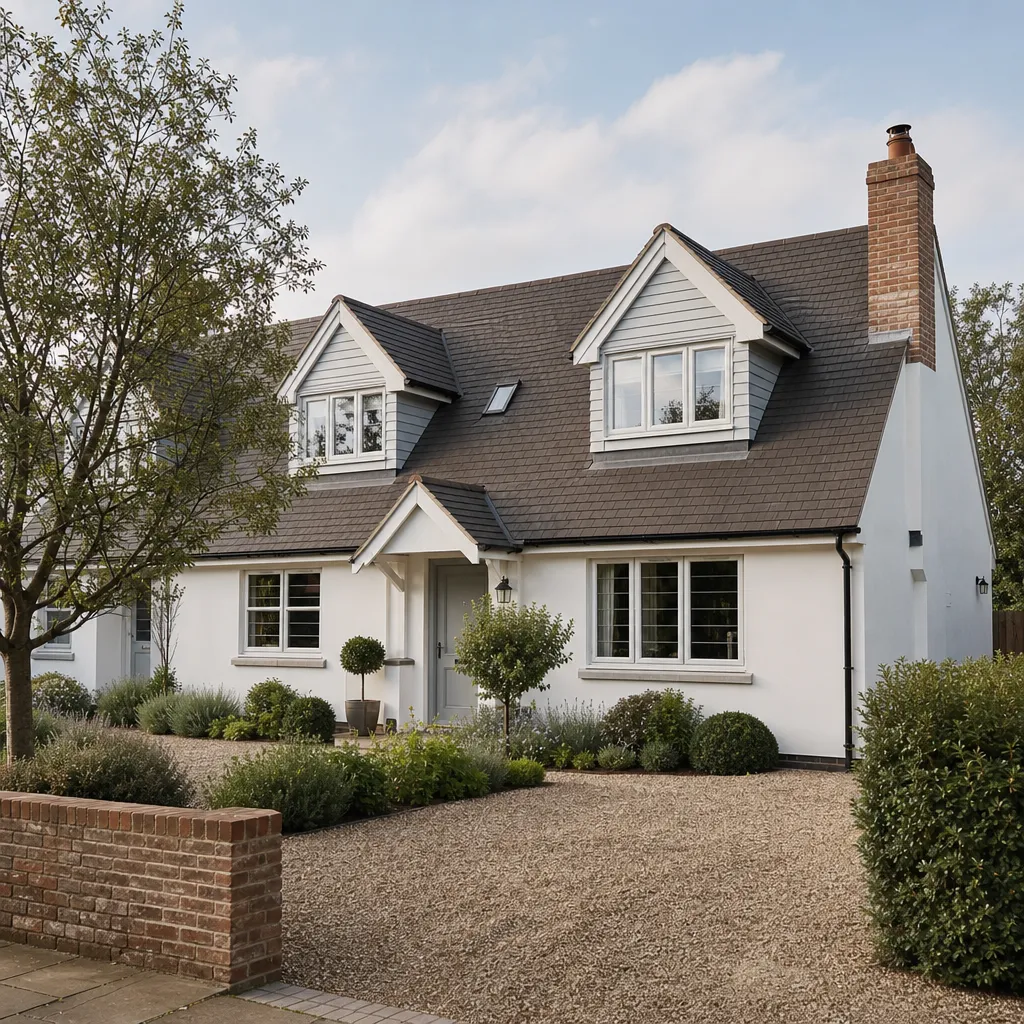
Cape Cod Style Homes: Design Elements and Characteristics
A Cape Cod home is defined by its steep symmetrical gabled roof, compact 1.
 Planning & Pre-Build
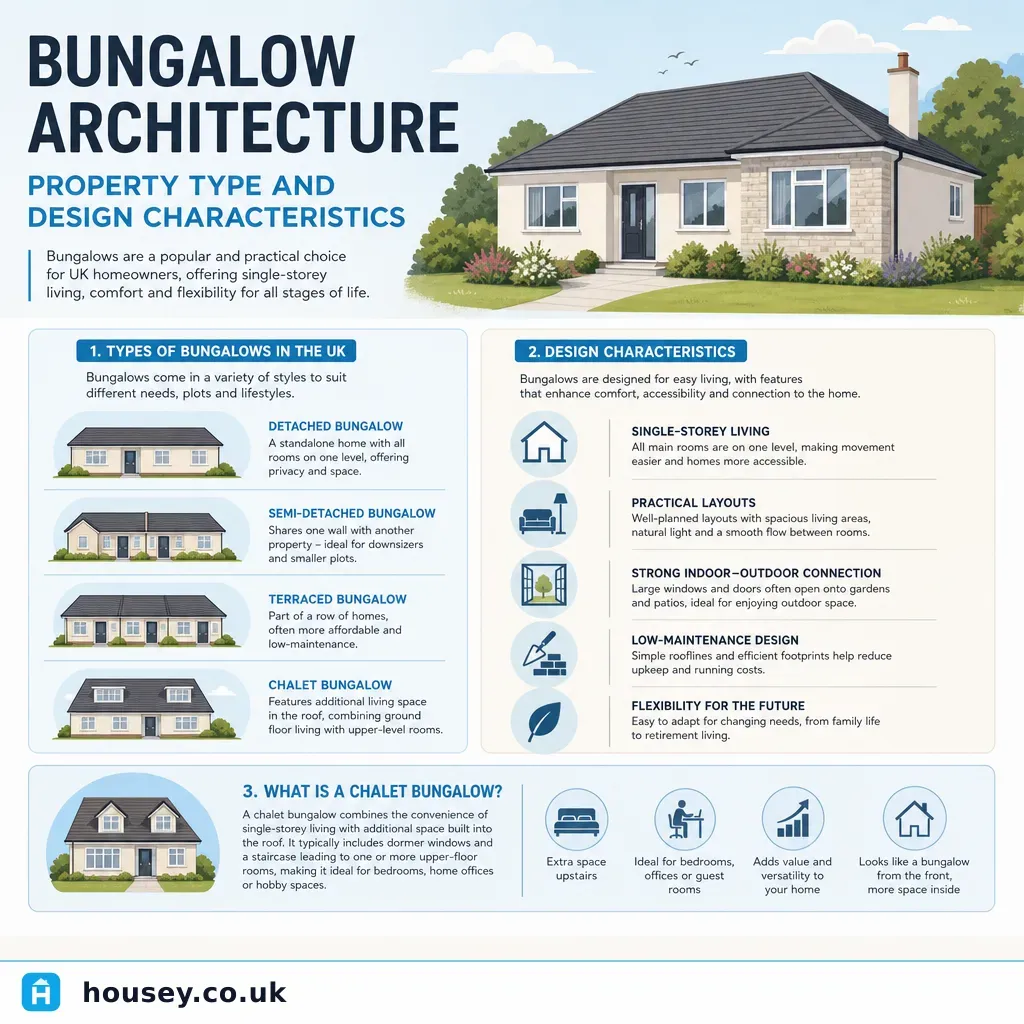
Bungalow Architecture: Property Type and Design Characteristics
A bungalow is a single-storey residential property, though some variants incorporate usable roof space.
 Planning & Pre-Build
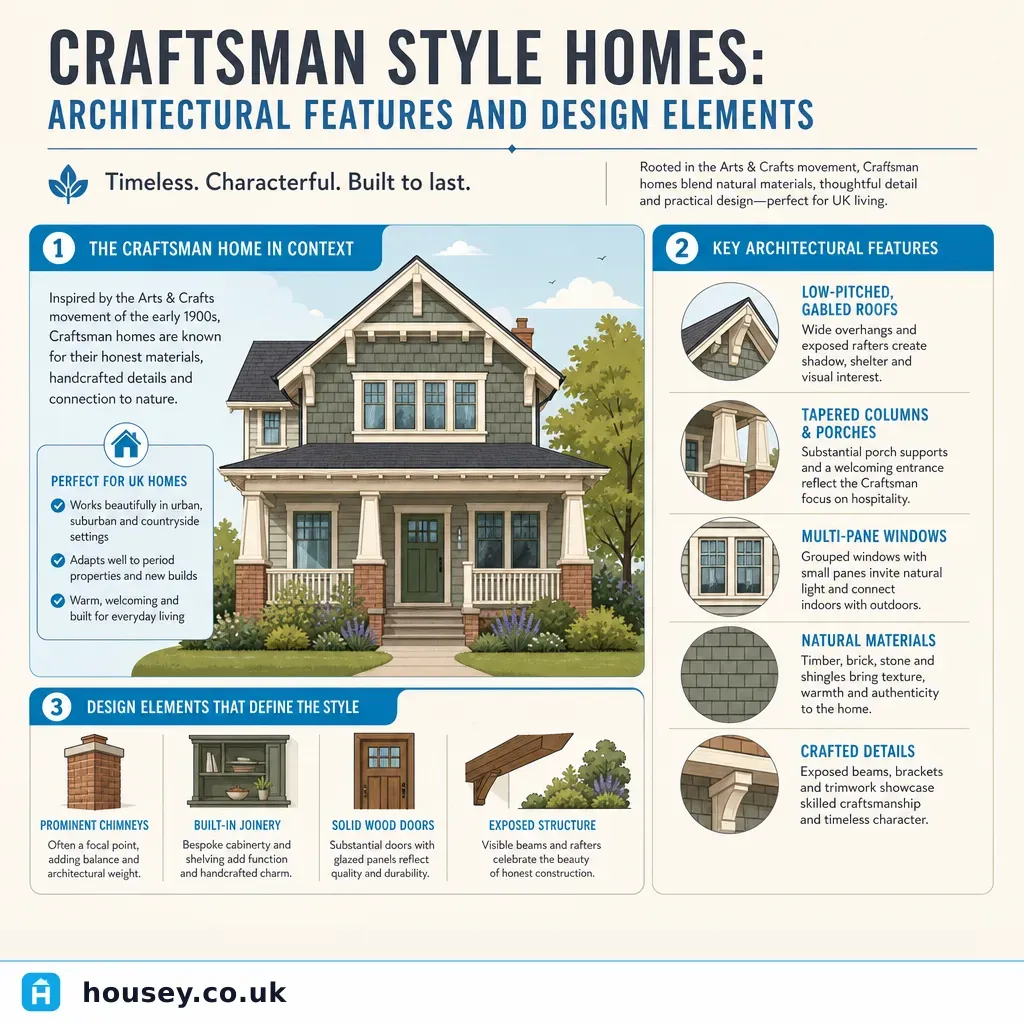
Craftsman Style Homes: Architectural Features and Design Elements
Craftsman style homes are defined by natural materials, low-pitched gabled roofs with wide eaves, covered porches, exposed timber details, and grouped casement windows.
 Planning & Pre-Build
What Is a Patio Home? Understanding This Property Type in the UK
A patio home is a compact, low-maintenance property designed around a private patio or courtyard rather than a traditional lawn garden.
 Planning & Pre-Build
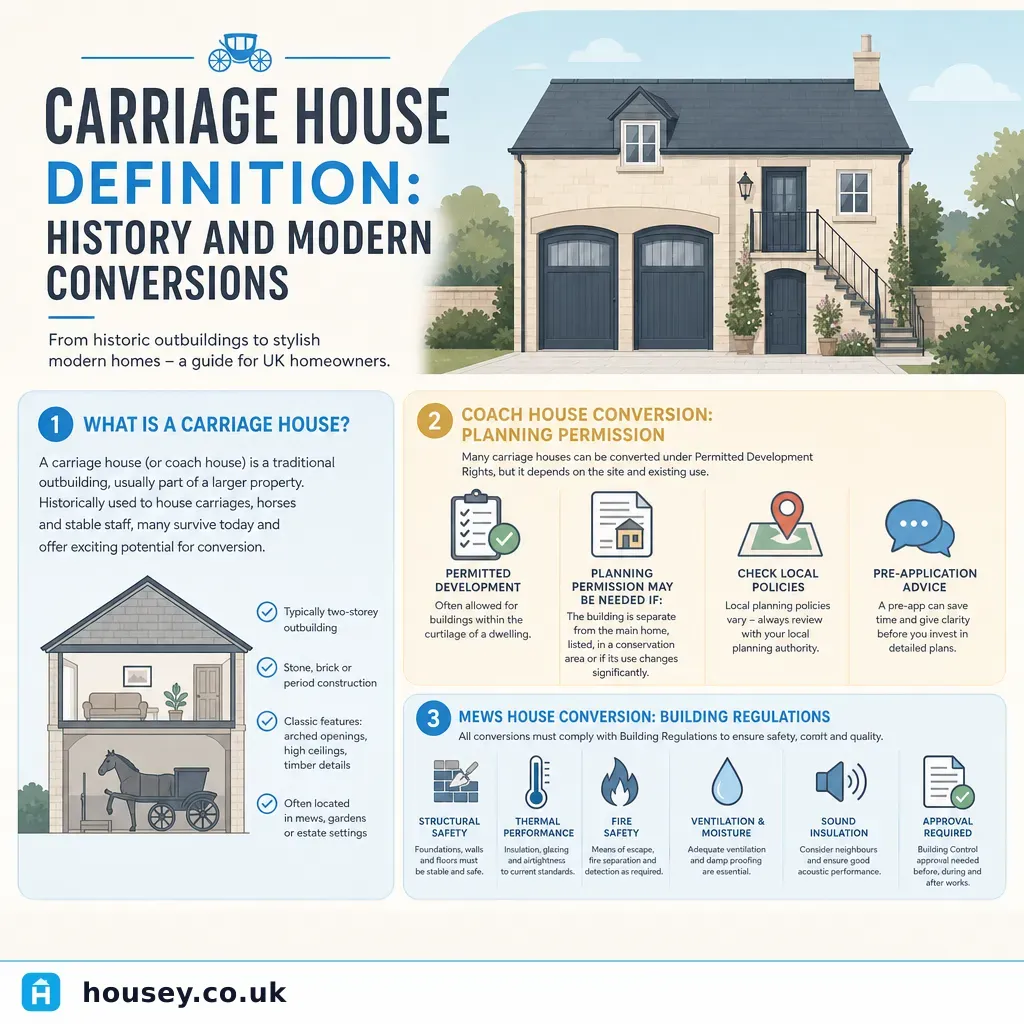
Carriage House Definition: History and Modern Conversions
A carriage house is a Victorian or Edwardian outbuilding originally used to shelter horse-drawn vehicles, often with groom's accommodation above.