Bungalow Architecture: Property Type and Design Characteristics
By Housey · Last reviewed 1st of June 2026
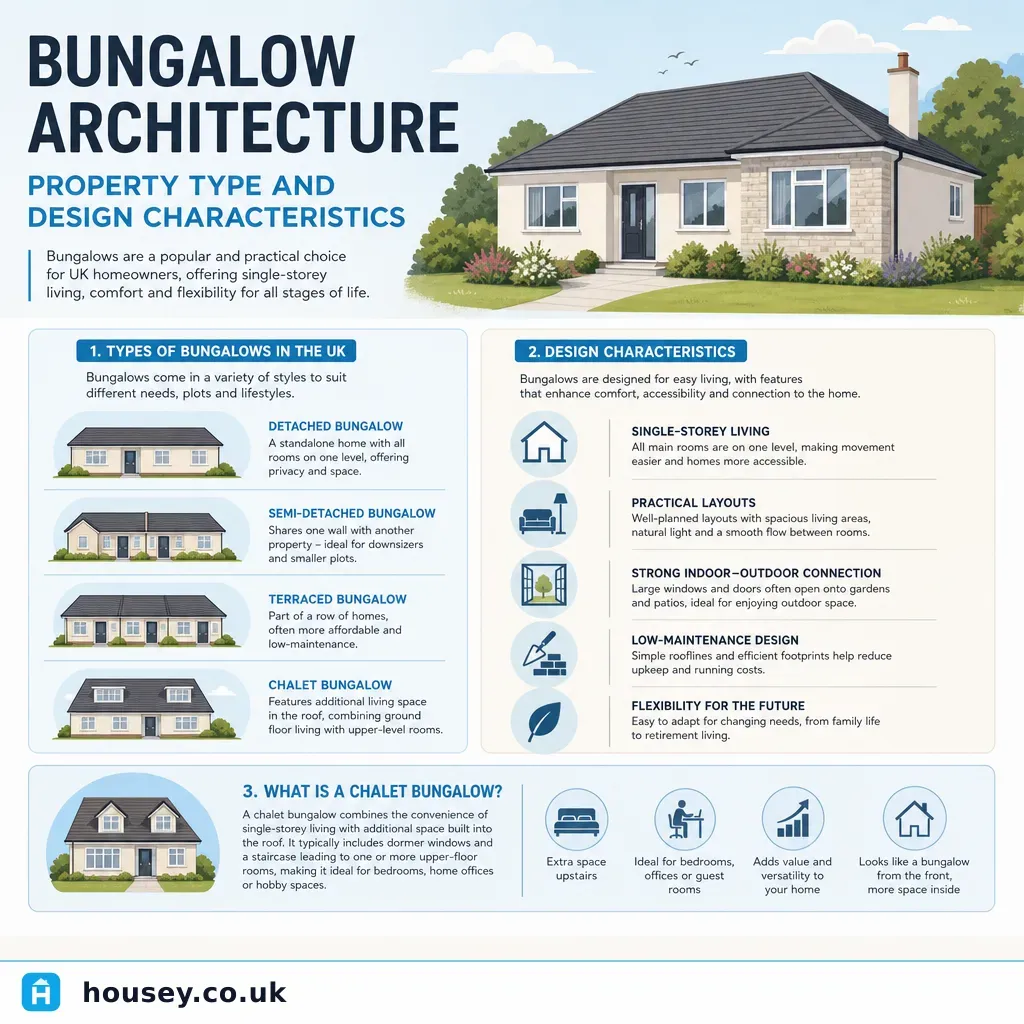
Bungalow Architecture: Property Type and Design Characteristics
Single-storey homes occupy a distinctive place in the UK housing stock, shaped by post-war suburban expansion, shifts in planning policy, and growing demand for accessible, level living. Whether you are buying a bungalow, planning an extension, or considering a loft conversion, understanding how the property type is defined architecturally — and how different variants affect your planning and building options — matters before you instruct a designer or submit an application.
Key points
- A bungalow is defined by its single-storey living space; a property with more than one storey of habitable accommodation is classified differently for planning purposes.
- Chalet bungalows include partially habitable roof space — typically with dormer windows or rooflights — and are treated as intermediate between a single and two-storey dwelling in some planning calculations.
- Permitted development rights allow a single-storey rear extension of up to 4 metres for a detached bungalow and 3 metres for a semi-detached or terraced bungalow, subject to conditions.
- Extensions between these limits and 8 metres (detached) or 6 metres (semi-detached/terraced) may be possible under the Neighbour Consultation Scheme, rather than a full planning application.
- Converting roof space into habitable rooms almost always requires Building Regulations approval and may require planning permission depending on the volume added and local restrictions.
What defines a bungalow architecturally
A bungalow is a residential dwelling in which all principal rooms — living, sleeping, and bathing — occupy a single floor at or close to ground level. The term entered British usage in the late 19th century and became widespread during the inter-war suburban expansion of the 1920s and 1930s.
The classification matters in practice because:
- Planners assess ridge height, eaves height, and volume against the original dwelling footprint differently for single-storey and two-storey homes.
- Mortgage lenders and valuers may apply different approaches to properties classified as bungalows versus houses with similar floor areas.
- Insurance reinstatement costs are calculated differently given a bungalow's typically larger footprint relative to its internal floor area.
Bungalows are not defined by name in primary planning legislation, but planning policy and case law generally treat a dwelling as a bungalow when all habitable accommodation sits at a single storey, even if unconverted loft space exists above.
Types of bungalow in the UK
Type | Description | Planning and design notes |
|---|---|---|
Detached bungalow | Freestanding, single storey, no shared walls | Widest permitted development envelope; most flexible for extensions and loft conversions |
Semi-detached bungalow | One shared wall with a neighbouring property | Extensions must respect the party wall; smaller PD rear extension allowance (3 m without prior approval) |
Terraced bungalow | Two shared walls; found on some post-war estates | Most constrained PD rights; front and rear extensions often require full planning permission |
Chalet bungalow | Single storey with usable roof space, often with dormers; designed into the original structure | May be treated as 1.5 storeys in some planning calculations; roof space headroom and floor area affect classification |
Dormer bungalow | Bungalow with one or more dormer windows in the roof slope | Existing dormers affect further conversion permitted development rights; headroom varies |
Link-detached bungalow | Joined to a neighbour only via a garage or outbuilding | Usually treated as detached for most planning purposes; shared structure may raise party wall considerations |
Chalet and dormer variants: what the distinction means in practice
A chalet bungalow typically has a steeply pitched roof enclosing rooms — often bedrooms — accessed by a staircase and sitting partly within the roof structure. The key distinction from a dormer bungalow is that the chalet's upper floor is designed into the original build, rather than added later.
For planning purposes, whether the upper floor counts as a full storey depends on:
- The proportion of roof volume used as habitable accommodation.
- Whether the floor area at upper level exceeds a threshold the local planning authority (LPA) considers significant.
- Local planning policy and precedent in your area.
If you are buying a chalet bungalow and intend to extend or alter it, check with your LPA whether they classify it as a single-storey or two-storey dwelling before commissioning drawings — this directly affects your permitted development envelope.
Which bungalow type suits your plans?
- Choose a detached bungalow if you want the widest possible extension and conversion options with minimum neighbour impact.
- Choose a semi-detached or terraced bungalow if location, price, or community matters more than maximum extension flexibility — but budget for party wall agreements if works affect the shared wall.
- Consider a chalet or dormer bungalow if you need more floor area than a single storey provides, but want to avoid building a full two-storey extension from scratch.
- Consult an architect before purchase if you have specific conversion or extension ambitions — particularly for roof conversions, which hinge on structural feasibility and existing roof pitch.
- Check your LPA's website and the Planning Portal if the property is in a conservation area, Area of Outstanding Natural Beauty (AONB), or subject to an Article 4 Direction removing permitted development rights.
Bungalow construction and fabric
Most UK bungalows were built between the 1920s and 1980s, with peak output in the 1950s–1970s. Common construction characteristics by era:
- 1920s–1940s: Solid brick walls, tile or slate roofs, suspended timber ground floors, single-glazed timber windows. Retrofitting insulation requires careful attention to moisture and airtightness.
- 1950s–1970s: Cavity brick walls (often unfilled), concrete or block-and-beam floors, early UPVC window replacement common. Cavity wall insulation is usually feasible but requires a pre-installation survey.
- 1980s onward: Cavity walls with partial insulation, gas central heating standard, double glazing from new. Generally easier to bring to current Building Regulations Part L thermal performance standards.
Bungalows have a high surface-area-to-floor-area ratio — ground floors lose heat to the sub-floor void or slab, and the roof spans the entire footprint. Heat loss per square metre of floor area is typically higher than in a multi-storey house of equivalent total floor area, making roof and floor insulation a worthwhile investment.
Extending and converting: what to check first
Homeowner checklist before instructing a designer:
When to get professional help
Bungalow extension, conversion, and retrofit projects involve overlapping regulatory regimes. Get professional input early if:
- You are considering converting the roof space into habitable accommodation — this typically requires a structural engineer for new floor beams, plus Building Regulations sign-off covering fire, insulation, and means of escape.
- The property is listed or in a conservation area — permitted development rights are restricted or removed, and a heritage or conservation specialist should advise before any works begin.
- Extensions are proposed close to the boundary — permitted development conditions restrict proximity and require neighbour notification for larger extensions.
- The bungalow has a flat roof — structural and waterproofing implications need professional assessment before any additional loading is considered.
How Housey can help
If you are planning an extension, loft conversion, or new-build bungalow project, connecting with an experienced architect early can save time and cost. Housey links you with architectural design services suited to single-storey residential projects — from feasibility assessments through to planning applications and Building Regulations coordination.
Frequently asked questions
Does a bungalow with a loft conversion still count as a bungalow?
Once a loft conversion creates fully habitable rooms — with fixed staircase access, compliant ceiling heights, and Building Regulations approval — the property is generally reclassified by planners as a house with two or more storeys, affecting future permitted development rights. Some local planning authorities may retain the bungalow designation depending on local policy, so check with your LPA before assuming your PD envelope.
Do bungalows need planning permission for extensions?
Not always. Single-storey rear extensions up to 4 metres (detached) or 3 metres (semi-detached and terraced) are often permitted development, subject to conditions. Extensions over these limits up to 8 metres (detached) or 6 metres (semi-detached/terraced) may use the Neighbour Consultation Scheme rather than a full application. Conservation areas, listed buildings, and Article 4 Directions restrict or remove these rights. Always check with your local planning authority.
What is the difference between a chalet bungalow and a dormer bungalow?
A chalet bungalow is designed from the outset with habitable accommodation within the roof structure — an integral part of the original build. A dormer bungalow has dormer windows added to bring light and headroom to what might otherwise be unconverted roof space. The distinction affects how planners calculate existing floor area and what further permitted development is allowed.
Are bungalows harder to extend than two-storey houses?
In some respects, yes — the roof spans the entire footprint, so rear extensions must stay single storey or require complex structural work at the roof junction. Loft conversions also depend on roof pitch and ridge height. However, bungalows often sit on generous plots with simpler structural forms, which can make wraparound single-storey additions relatively straightforward to plan and build.
Sources and further reading
- Permitted development rights for householders: technical guidance — GOV.UK / DLUHC
- Householder application guidance: extensions — Planning Portal
- Approved Documents: Building Regulations — GOV.UK
- Advice for homeowners: your home — Historic England
Useful next reads
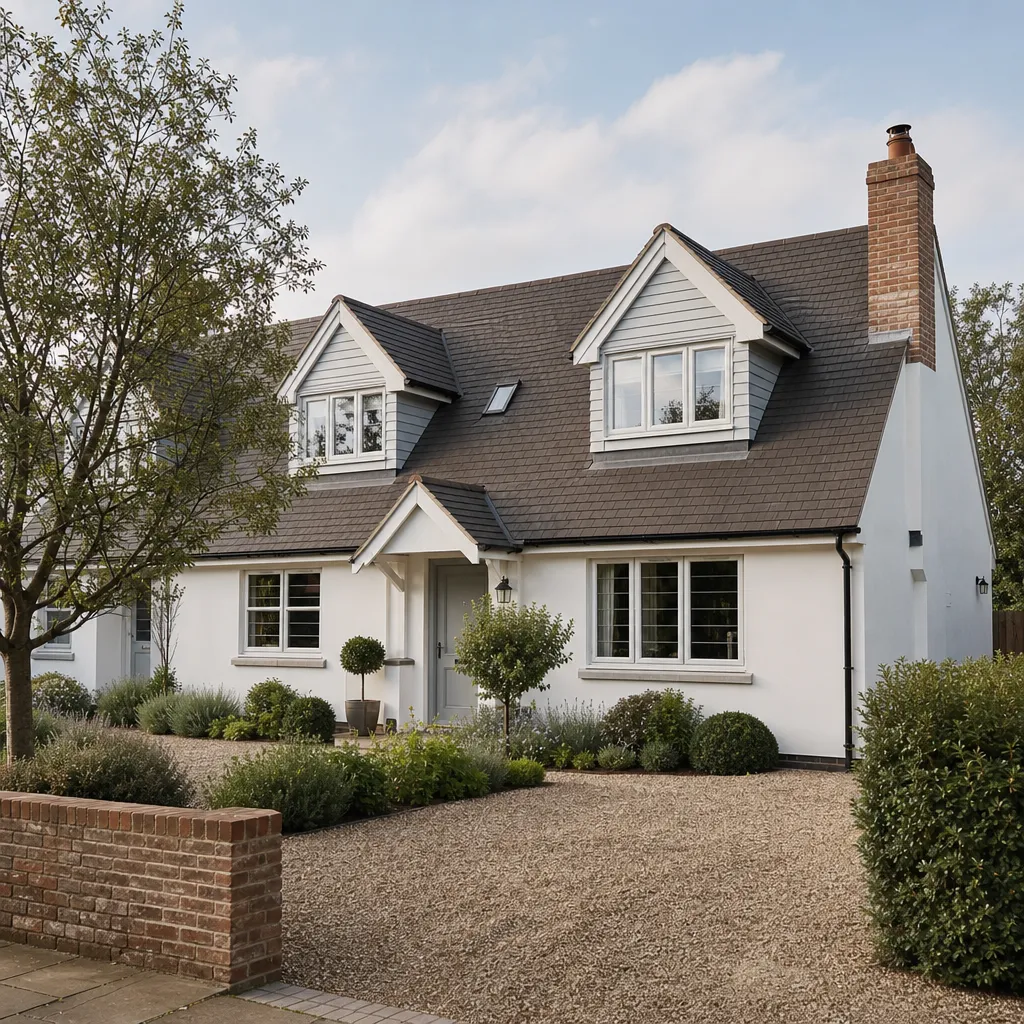 Planning & Pre-Build
Cape Cod Style Homes: Design Elements and Characteristics
A Cape Cod home is defined by its steep symmetrical gabled roof, compact 1.
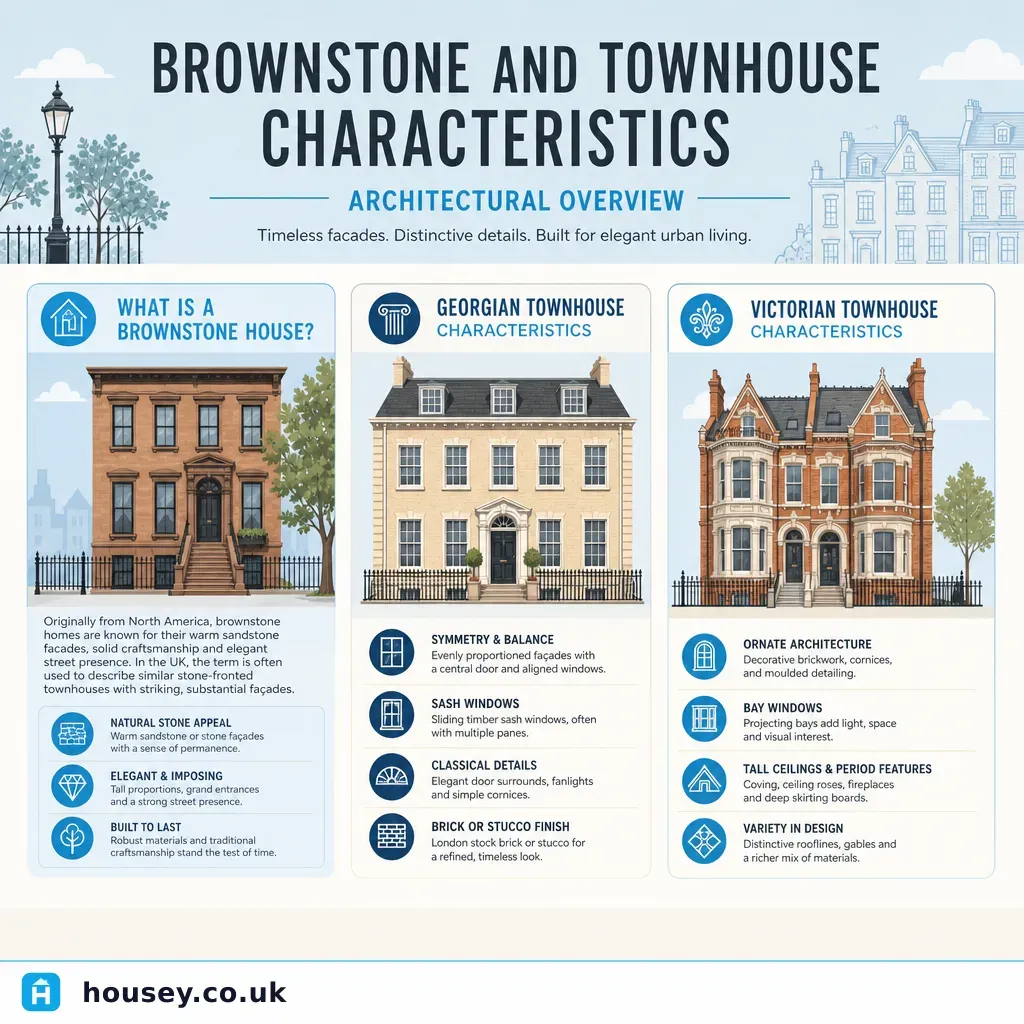 Planning & Pre-Build
Brownstone and Townhouse Characteristics: Architectural Overview
Brownstones are a North American building type — sandstone-fronted urban terraced houses associated with 19th-century US cities.
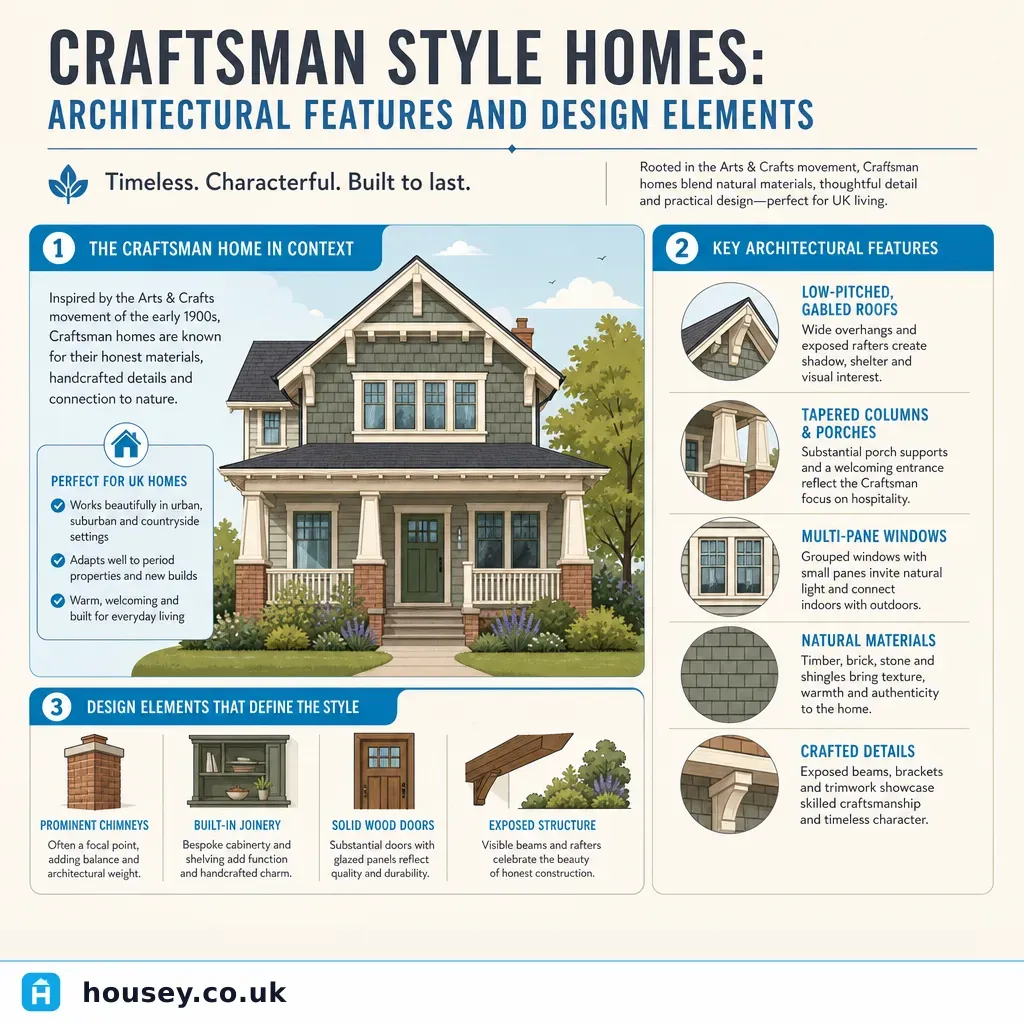 Planning & Pre-Build
Craftsman Style Homes: Architectural Features and Design Elements
Craftsman style homes are defined by natural materials, low-pitched gabled roofs with wide eaves, covered porches, exposed timber details, and grouped casement windows.
 Planning & Pre-Build
What Is a Patio Home? Understanding This Property Type in the UK
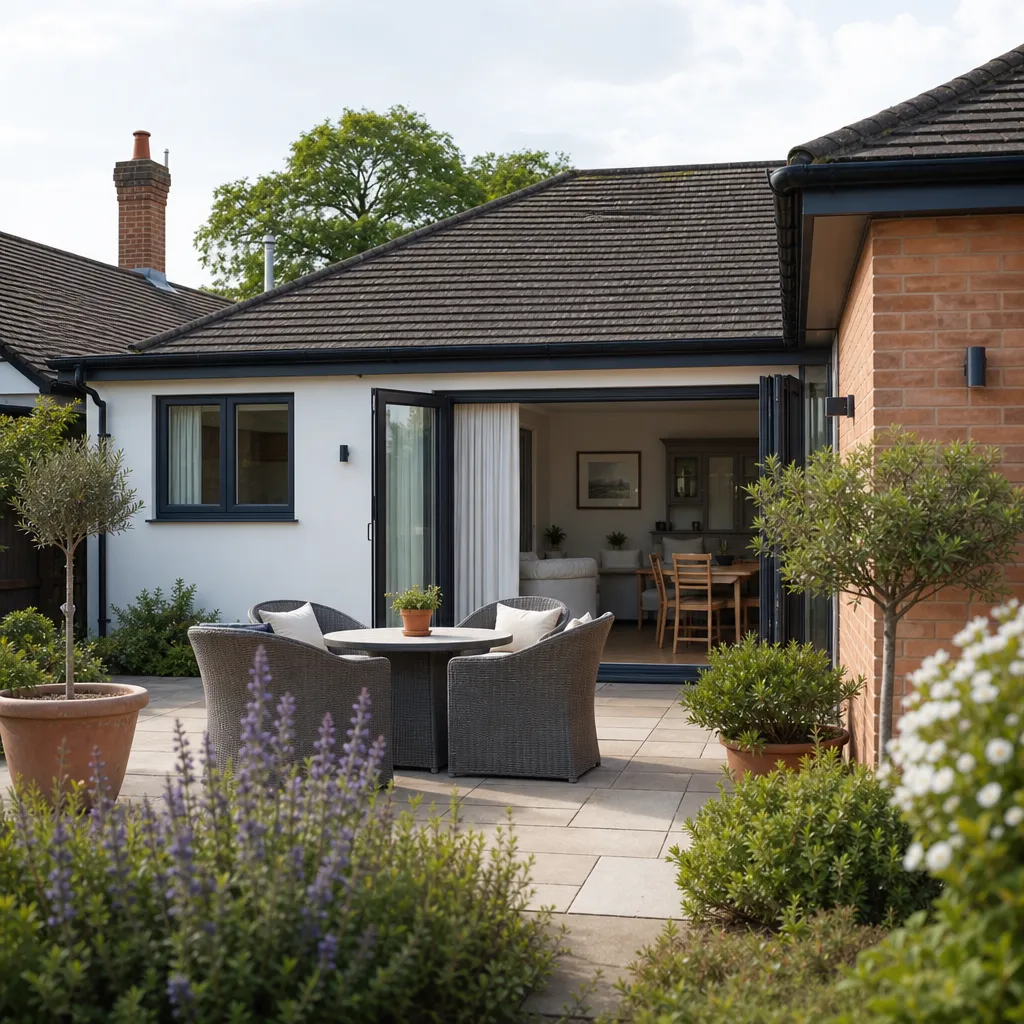
A patio home is a compact, low-maintenance property designed around a private patio or courtyard rather than a traditional lawn garden.
 Planning & Pre-Build
Building a Bungalow in the UK: Design, Planning, and Costs
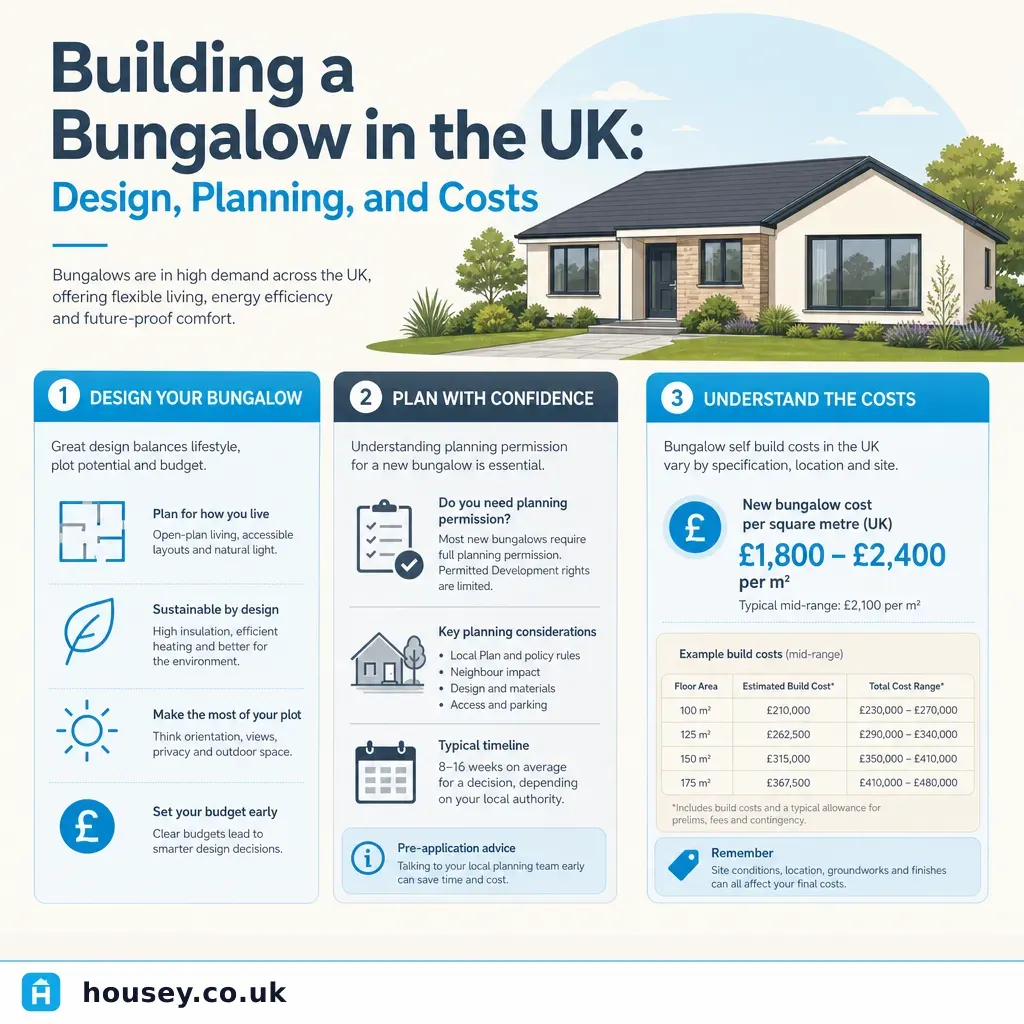
Building a bungalow in the UK typically costs £1,500–£3,000 per square metre, putting a 100m² bungalow at roughly £150,000–£300,000 in build costs before land, professional fees, and VAT.