Carriage House Definition: History and Modern Conversions
By Housey · Last reviewed 11th of May 2026
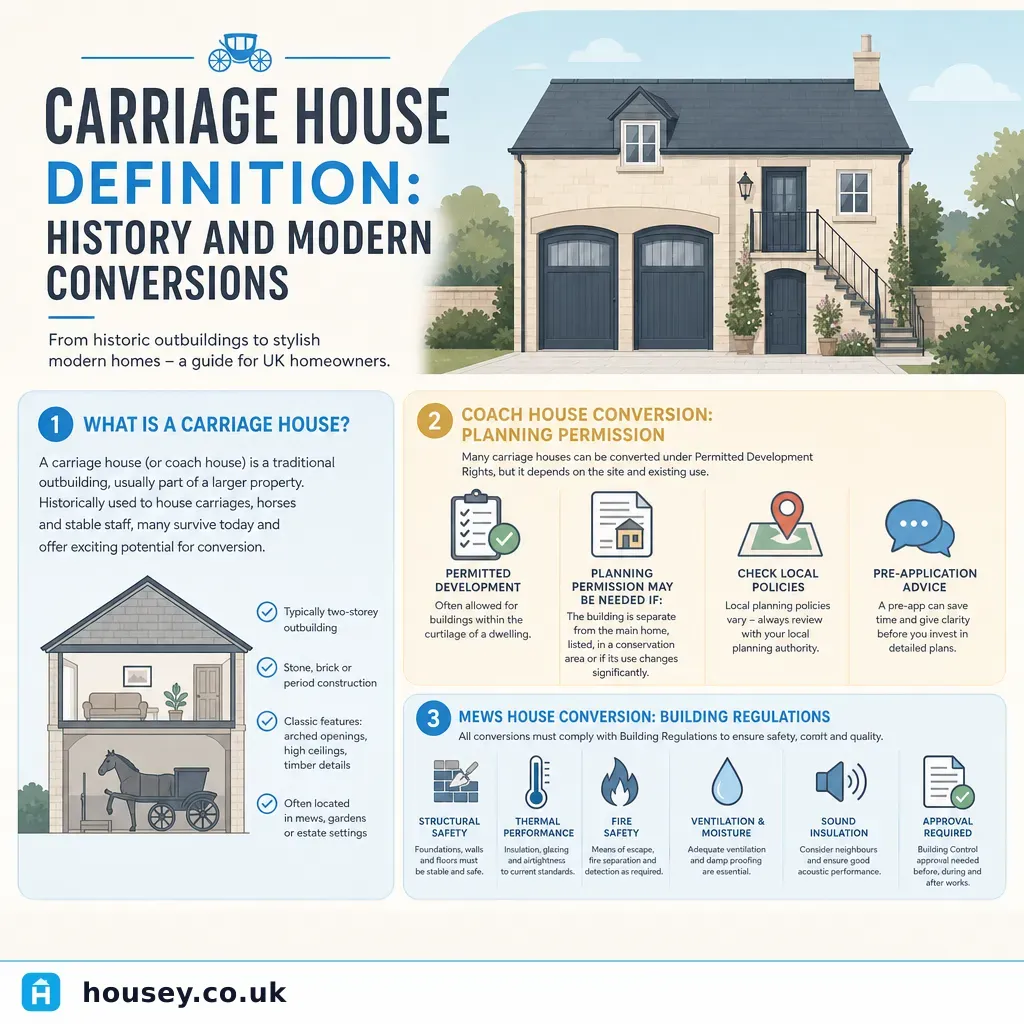
Carriage House Definition: History and Modern Conversions
Thousands of UK properties — particularly those built before the First World War — originally included a dedicated outbuilding for housing horse-drawn carriages and the grooms who maintained them. Many of these structures survive today: some converted to residential use decades ago, others still serving as garages, stores, or untouched outbuildings. Understanding what a carriage house is, why it matters legally and architecturally, and what a conversion actually involves helps owners make the right decisions before spending money on plans or applications.
Key points
- Carriage houses in the UK are typically Victorian or Edwardian outbuildings constructed between approximately 1840 and 1914, associated with larger town houses, country estates, and urban terraces with rear mews access.
- Conversion to residential use almost always requires planning permission for change of use; permitted development does not extend to creating new dwellings from outbuildings.
- Many surviving carriage houses are subject to listed building consent requirements where they sit within the curtilage of a listed property, even if the outbuilding is not separately listed.
- Building Regulations approval — including compliance with Part L thermal performance standards — is required for any conversion to habitable use, regardless of listed status.
- Converted carriage houses, marketed as mews houses or coach houses, are treated by RICS valuers as a distinct residential sub-type and can command a significant price premium in urban UK markets.
What is a carriage house?
A carriage house (also known in the UK as a coach house, mews building, or stable block, depending on the arrangement) is an outbuilding designed to shelter horse-drawn vehicles and related equipment. They were typically built to the rear or side of the main dwelling, accessed by a rear lane or mews.
Typical features of a historic UK carriage house:
- A wide carriage doorway — often 2.5 to 3.5 metres wide — to allow vehicles to enter and turn
- A loft or hayloft above the vehicle storage area, sometimes reached by external or internal stairs
- Stable bays for horses, with brick stall divisions, iron fittings, and drainage channels
- Living accommodation for grooms or coachmen, either over the stables or in an attached cottage
- Brick or stone construction with pitched or hipped roofs finished in slate or plain clay tile
- Cast-iron lamp brackets, pulley systems for hay bales, and stone or cast-iron water troughs
In London and other large UK cities, groups of carriage houses arranged along a rear service lane form what we now call a mews — a term that originally referred specifically to stabling. Mews arrangements are found in most Victorian-era towns across England, Scotland, and Wales, not only in the well-known Belgravia and Kensington examples.
A brief history of UK carriage houses
Period | Development |
|---|---|
Pre-1830 | Carriage houses associated mainly with large country estates and wealthy urban households |
1840–1880 | Rapid expansion with railway-era prosperity; mews blocks built behind terraced town houses |
1880–1914 | Peak of carriage house construction; early motor garages begin to replace horse bays |
1920s–1950s | Motor vehicles replace horses; carriage houses repurposed as garages and stores |
1960s–1980s | Piecemeal conversions; many subdivided informally without formal planning consent |
1990s–present | Formal conversion and renovation market established; mews and coach house properties valued as premium residential |
Planning permission for carriage house conversions
Converting a carriage house to a residential dwelling is a change of use — typically from an ancillary or storage use to Class C3 (dwellinghouse). This almost always requires full planning permission.
Permitted development under the Town and Country Planning (General Permitted Development) (England) Order 2015, and equivalent Welsh, Scottish, and Northern Irish regulations, does not include the right to create a new dwelling from an outbuilding. Class Q permitted development — which allows certain agricultural buildings to be converted to dwellings — applies only to qualifying agricultural buildings and does not extend to historic urban or suburban carriage houses.
Decision tree: do I need planning permission for my carriage house conversion?
- Is the carriage house a separate structure from the main house? If yes, planning permission for change of use is very likely required.
- Is the main house or any adjacent building listed? If yes, listed building consent is also required for all internal and external works affecting the character of the listed structure.
- Is the property in a conservation area? If yes, permitted development rights are already curtailed; demolition of outbuildings may require conservation area consent.
- Was planning permission previously granted for residential use? If yes, check conditions carefully — the established use may already be residential, which simplifies matters.
- Is the carriage house within the curtilage of a listed main dwelling? If yes, it falls within the listed building designation even if not separately listed — full listed building consent applies to all works.
- Unsure about any of the above? Seek pre-application advice from your Local Planning Authority before commissioning any drawings.
Building Regulations for a carriage house conversion
Building Regulations approval is required for any conversion to habitable use, separate from and in addition to planning permission. Key areas to address:
Regulation area | Typical requirements for a carriage house conversion |
|---|---|
Structure — Part A | Assessment of existing walls, floors, and roof; structural engineering input often required |
Fire safety — Part B | Means of escape, fire detection, fire resistance of structure and compartmentation |
Thermal performance — Part L | Insulation to current U-value standards for walls, roof, floor, and glazing |
Ventilation — Part F | Mechanical or natural ventilation to all habitable rooms |
Drainage — Part H | Connection to the foul water drainage system |
Access — Part M | Step-free access where feasible and practicable |
Electrical — Part P | All electrical installation by a registered competent person or subject to Building Control inspection |
For listed buildings, full compliance with Part L energy efficiency standards can sometimes be negotiated where meeting the standard would unacceptably harm historic fabric. Historic England's guidance on energy efficiency in historic buildings provides the framework for that negotiation.
What does a carriage house conversion cost?
Costs vary significantly by location, condition, size, and specification. Indicative UK costs, last reviewed 2026-05-11:
- Basic conversion (structure sound, modest specification): £1,200–£1,800 per m²
- Mid-range conversion (some structural work, good-quality specification): £1,800–£2,500 per m²
- High specification or listed building conversion: £2,500–£4,000 per m² or more
- Planning application fees: vary by application type — check the current schedule on GOV.UK before budgeting
- Architectural drawings and project management: typically 8–15% of construction cost
- Structural engineering: £800–£3,000 depending on scope and the existing structure's condition
These are indicative figures only. Obtain at least three quotes and ask specifically what is included and excluded. Costs vary widely based on site access, drainage requirements, and the condition of the existing fabric.
What to ask before commissioning a carriage house conversion
- Does the building have any existing planning consent for residential use — or has it ever been used as a dwelling?
- Is the main house, or any adjacent structure, listed? If so, at what grade?
- Is the property in a conservation area or subject to an Article 4 direction?
- Has a structural engineer assessed the existing fabric before drawings are prepared?
- What has the Local Planning Authority said in pre-application discussions about the principle of conversion?
- Will the conversion require a new connection to mains drainage, and what is the likely cost?
- Are there any restrictive covenants or rights of way across the site that affect the project?
- What warranty is offered on structural work and materials, and is it in writing?
When to get professional help
You should involve both an architect and a planning consultant before spending money on detailed design if:
- The property or any part of its curtilage is listed, or you suspect it may be.
- Pre-application advice from the LPA has not yet been obtained.
- The structure shows signs of significant movement, damp penetration, or roof deterioration.
- Access is via a shared mews or lane with unresolved ownership or maintenance obligations.
- The conversion is intended to create a separate freehold or leasehold title — in which case legal advice on the title is also needed.
How Housey can help
Housey connects homeowners with experienced professionals for every stage of a carriage house project. Find RIBA-registered architects with conversion experience to develop your brief from feasibility through to detailed design, or speak to a specialist planning consultant for change of use and listed building consent before committing to design costs.
Frequently asked questions
What is the difference between a carriage house, coach house, and mews house?
The terms overlap. A carriage house is the general term for a building designed to house horse-drawn vehicles. Coach house is used interchangeably, though it historically referred to buildings for enclosed coaches. A mews house is a carriage house or stable converted to residential use — the term now applies to the finished dwelling, not the original function of the building.
Can I convert a carriage house under permitted development?
No. Creating a new dwelling from a carriage house or outbuilding requires full planning permission for change of use. Permitted development rights do not permit the creation of new dwellinghouses from outbuildings. Class Q permitted development, which covers agricultural buildings, applies only to qualifying agricultural structures and does not extend to historic urban or suburban carriage houses.
Does listed building consent apply to my carriage house?
If the carriage house sits within the curtilage of a listed building — even if not separately listed itself — it is covered by the listing. Any works affecting its character require listed building consent in addition to planning permission. Check the entry on Historic England's National Heritage List for England, or Cadw, HES, or NIEA for Wales, Scotland, and Northern Ireland respectively.
How long does planning permission for a carriage house conversion take?
Standard applications are determined within eight weeks of validation. Applications involving listed buildings, conservation areas, or requiring an Environmental Statement may take 13 weeks or more. Pre-application discussions with the Local Planning Authority can significantly reduce uncertainty before the formal application is submitted and are strongly recommended before commissioning detailed architectural drawings.
Sources and further reading
- Planning Practice Guidance — Change of use — GOV.UK
- Town and Country Planning (General Permitted Development) (England) Order 2015 — legislation.gov.uk
- Energy Efficiency and Historic Buildings — Historic England
- National Heritage List for England — Historic England
- Fees for Planning Applications — GOV.UK
Useful next reads
 Planning & Pre-Build
What Is a Patio Home? Understanding This Property Type in the UK
A patio home is a compact, low-maintenance property designed around a private patio or courtyard rather than a traditional lawn garden.
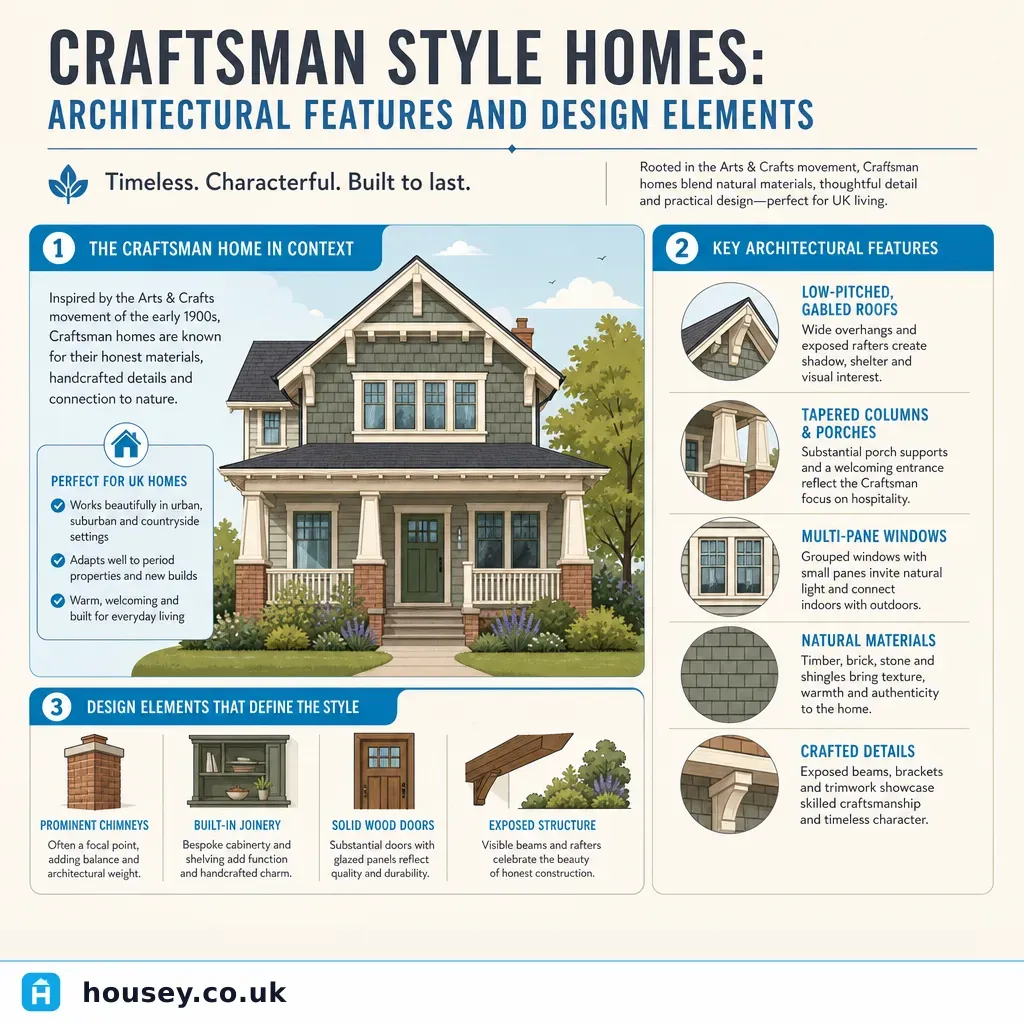 Planning & Pre-Build
Craftsman Style Homes: Architectural Features and Design Elements
Craftsman style homes are defined by natural materials, low-pitched gabled roofs with wide eaves, covered porches, exposed timber details, and grouped casement windows.
 Planning & Pre-Build
Cape Cod Style Homes: Design Elements and Characteristics
A Cape Cod home is defined by its steep symmetrical gabled roof, compact 1.
 Planning & Pre-Build
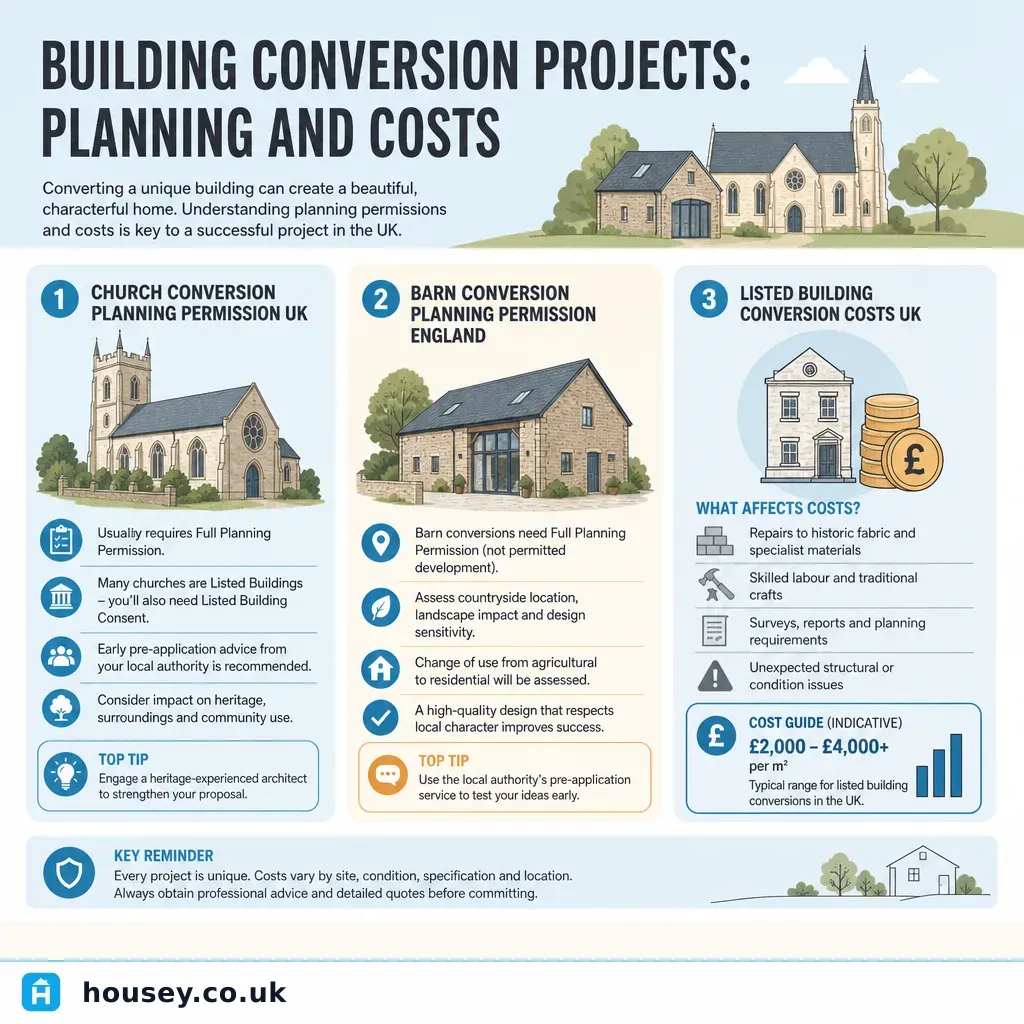
Building Conversion Projects: Planning and Costs
Converting a non-residential building in the UK — such as a barn, church, or commercial property — typically requires full planning permission and often Listed Building Consent.
 Planning & Pre-Build
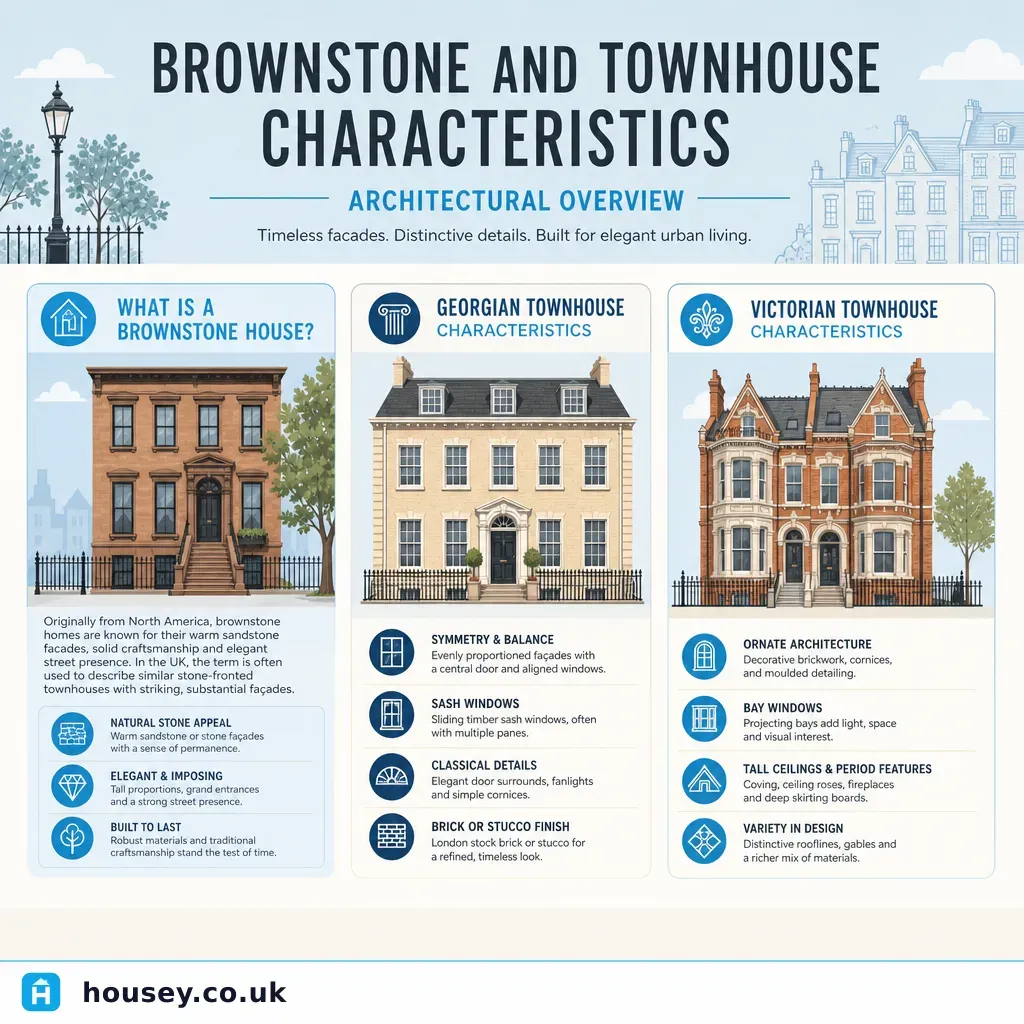
Brownstone and Townhouse Characteristics: Architectural Overview
Brownstones are a North American building type — sandstone-fronted urban terraced houses associated with 19th-century US cities.