Budget for Epoxy or Specialist Coating of Concrete Floors
By Housey · Last reviewed 6th of May 2026
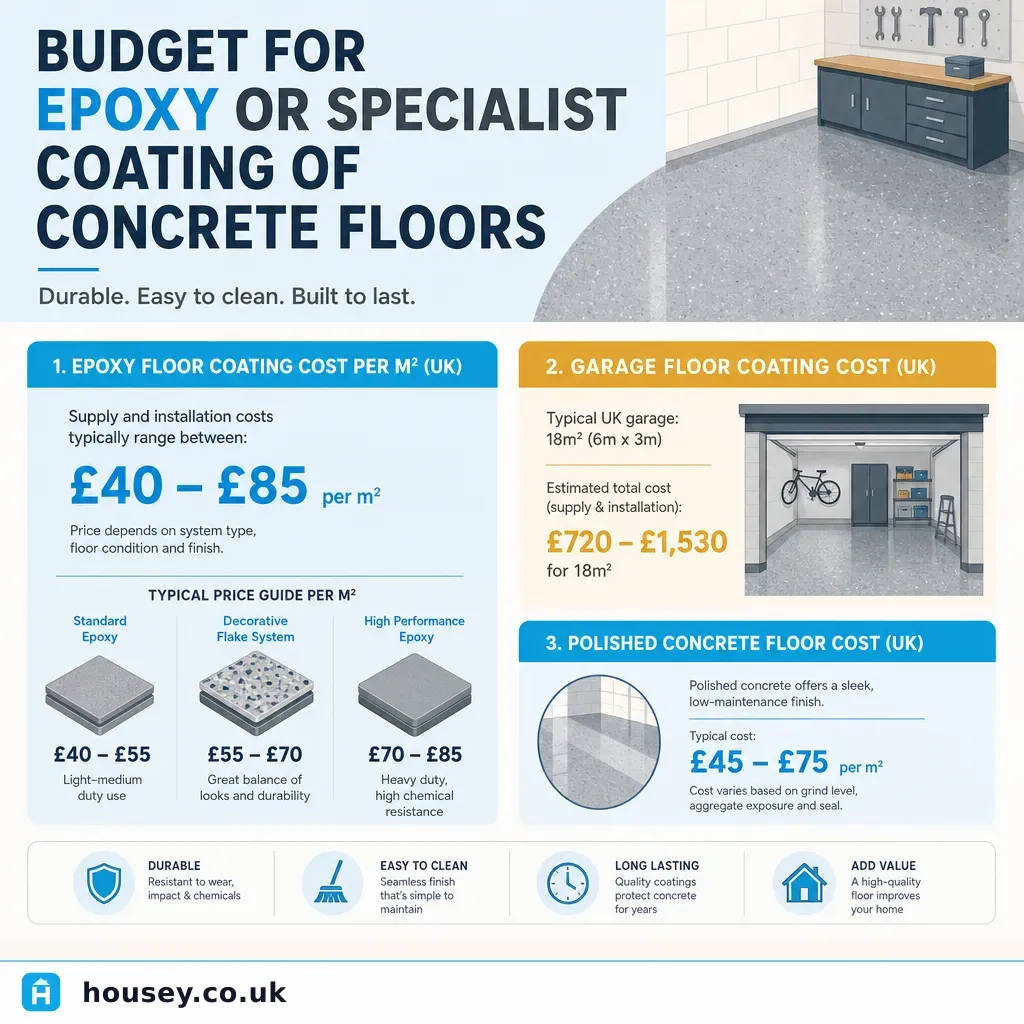
Budget for Epoxy or Specialist Coating of Concrete Floors
Concrete floors appear in UK homes more often than buyers expect — in period terraces with original stone flags, post-war semi-detached garages, or new-build extensions designed with polished concrete in mind. A renovation is frequently the moment when coating that surface moves from a vague ambition to a real budgeting decision, with options ranging from a straightforward garage epoxy paint to a bespoke microcement finish that runs continuously from floor to wall.
Key points
- Professional epoxy floor coating typically costs £20–£60 per square metre in the UK, depending on the system specification and number of coats; decorative flake and multi-layer builds sit at the upper end of that range.
- Surface preparation — diamond grinding, shot blasting, or acid etching — adds £5–£15 per square metre and is the single most important factor in long-term coating adhesion; skipping or cutting it back is the most common cause of premature delamination.
- Polished concrete and microcement are specialist finishes requiring professional application and typically cost £40–£120 per square metre; they are not suitable for DIY.
- A moisture vapour emission rate (MVER) test — usually £50–£150 per test point — is recommended before any coating system is applied; most professional applicators will insist on one.
- DIY two-part epoxy kits cost roughly £8–£20 per square metre in materials but require curing conditions above 10 °C and below 75% relative humidity to bond correctly.
What types of specialist concrete floor coating are available?
Concrete floor coatings range from single-coat paint products to elaborate multi-layer resin systems. The right choice depends on the intended use, traffic level, moisture conditions, and the finish required.
Coating type | Typical professional cost (per m²) | Best for | Not suitable for | Approximate durability |
|---|---|---|---|---|
Single-coat epoxy paint | £15–£30 | Garages, sheds, light storage | Heavy traffic, damp substrates | 3–5 years |
Two-part epoxy system | £25–£50 | Domestic garages, workshops | Very damp slabs without DPM | 5–10 years |
Decorative broadcast/flake epoxy | £30–£65 | Garages, utility rooms, showrooms | Tight budgets | 7–15 years |
Polyurethane (PU) topcoat system | £25–£55 | Commercial kitchens, wet rooms, high-traffic areas | Budget-only projects | 10–15 years |
Polished/ground concrete | £40–£100 | Living spaces, retail, open-plan kitchens | Badly cracked or structurally damaged slabs | 20+ years with maintenance |
Microcement | £50–£120 | Bespoke interiors, continuous floor-to-wall finishes | DIY application | 10–20 years |
Indicative UK costs, last reviewed 2026-05-06. Costs vary by location, contractor, substrate condition, and system specification. Always request itemised quotes.
What drives the cost of concrete floor coating?
Substrate condition and preparation
Surface preparation is typically the largest variable in the final price. A clean, structurally sound, dry slab with no previous coating can be prepared relatively quickly. Old paint, adhesive residues, oil contamination, crack repairs, or a damp substrate all add time and cost. Shot blasting or diamond grinding to achieve the correct surface profile (known as the concrete surface profile, or CSP) is priced per square metre; acid etching is cheaper but less reliable for adhesion on older or contaminated slabs.
Room size and layout
Larger areas cost less per square metre once the contractor's mobilisation, equipment, and set-up costs are spread more thinly. Small rooms, layouts with multiple columns or drainage channels, or areas with restricted access typically cost more per square metre than open, uncomplicated floors.
System specification and number of coats
A basic two-coat system — primer plus topcoat — costs less than a three- or four-coat build incorporating a scratch coat, broadcast aggregate layer, and UV-stable polyurethane finish. Dry-film thickness, measured in microns or millimetres, affects both material usage and labour time significantly.
Moisture and damp-proofing
Concrete transmits moisture vapour upward from the ground. If an MVER test reveals high emission rates, the applicator may need to apply a specialist moisture-tolerant epoxy primer or a DPM-grade barrier coat before the decorative layers. This remediation step can add £8–£20 per square metre to the project cost before the chosen finish coat is even applied.
Location and contractor accreditation
Labour costs in London and the South East typically run 20–40% higher than in the Midlands, North, and Wales. Specialist contractors registered with the Resin Flooring Association (FeRFA) or holding TrustMark registration may charge a premium but should offer warranted, specifiable systems with documented product data sheets.
How much does a typical concrete floor coating project cost?
The figures below are illustrative, based on common project sizes and a standard two- or three-coat epoxy system professionally installed on a prepared substrate.
- Single-car garage (approximately 16–20 m²): £350–£900
- Double garage or workshop (approximately 36–44 m²): £750–£1,800
- Large basement or utility area (approximately 50–70 m²): £1,200–£4,000+
- Open-plan ground floor with polished concrete (approximately 40–60 m²): £2,000–£6,000+
Indicative UK costs, last reviewed 2026-05-06. Prices exclude VAT unless stated. Obtain at least three like-for-like quotes before committing.
Is DIY concrete floor coating worth it?
DIY epoxy kits — available from flooring specialists and builders' merchants — can reduce material costs significantly. A single-car garage might cost £120–£300 in materials as a DIY project. However, a durable result requires:
- Mechanical preparation (hired floor grinder or proper acid etch), not just sweeping and cleaning.
- Relative humidity below 75% and temperature above 10 °C during both application and the full curing period.
- Moisture vapour emission within the kit manufacturer's stated tolerance — damp slabs or those below rooms with limited subfloor ventilation are high-risk candidates for failure.
Failed DIY coatings — peeling, bubbling, or flaking — often require professional removal before a new system can be applied, which adds cost and time to the project. DIY is a reasonable choice for dry, sound, modest-use slabs such as a garden outbuilding floor. It carries higher risk for a main garage, a kitchen extension, or any floor where long-term appearance and cleanability matter.
Homeowner checklist: before requesting quotes
Use this list when approaching contractors to ensure you can provide accurate information and receive comparable quotes:
What to ask when comparing quotes
- What system and specification is being quoted — including primer, build coat, topcoat, sealer, and named product references?
- What surface preparation is included in the price, and what substrate condition does the quote assume?
- Is the moisture vapour emission rate (MVER) test included, or is it an additional cost?
- Is VAT included in the total quoted price?
- What are the minimum floor temperature and humidity requirements for application, and who bears responsibility if site conditions are not met on the day of installation?
- What does the warranty cover, for how long, and is it backed by the product manufacturer or by the contractor alone?
- Is the contractor registered with FeRFA or another recognised industry body?
- Will a test patch or sample board be provided before full application begins?
When to get professional help
Concrete floor coating is not a licensed trade in the same way as gas or electrical work, but professional application is strongly advisable for:
- Any floor in a food-preparation or commercial environment, where hygiene compliance standards or Environmental Health requirements may apply.
- Heavily contaminated slabs (fuel, oil, or chemical residues) that require specialist decontamination preparation.
- Floors with significant cracking or suspected structural movement — consult a structural engineer before applying any cosmetic treatment to a potentially compromised slab.
- Polished concrete and microcement systems, which require specialist grinding equipment and hands-on training to achieve a consistent, durable result.
- Any floor where a written product warranty is needed as part of a property sale, tenancy agreement, or building warranty.
Red flags to watch for when choosing a contractor:
- A contractor who quotes without a site visit or any mention of moisture testing.
- Quotes that do not specify the product system, number of coats, or expected dry-film thickness.
- No written warranty or only a verbal guarantee with no product data sheet.
- Proposed application in cold or very humid conditions with no documented precautions or planned programme adjustments.
How Housey can help
Housey connects UK homeowners with tradespeople and specialist flooring contractors. If you are planning a concrete floor coating project, use Housey to describe your requirements and receive quotes from relevant local professionals.
Frequently asked questions
How long does epoxy floor coating last?
A professionally applied two-part epoxy system typically lasts 5–10 years in a domestic garage with moderate use. Decorative flake systems with a polyurethane topcoat can last 10–15 years. Polished concrete, properly maintained, can last 20 years or more. Durability depends heavily on surface preparation quality and the slab's moisture condition at the time of application.
Does epoxy floor coating work on damp concrete?
Standard epoxy coatings are not suitable for slabs with high moisture vapour emission rates. If moisture is present, the applicator should use a specialist moisture-tolerant epoxy primer or a DPM-grade barrier coat before the decorative layers. Always insist on a moisture vapour emission rate (MVER) test before any coating is applied to confirm the slab is within tolerance.
Do I need planning permission to coat a concrete floor?
No planning permission is required to coat or resurface an internal concrete floor. However, if you are converting a garage into habitable living space and coating the floor as part of that conversion, the broader conversion works will likely require Building Regulations approval. Check with your local building control body before beginning any conversion project.
What is the difference between epoxy and polyurethane floor coatings?
Epoxy coatings offer excellent adhesion and chemical resistance but can yellow under UV exposure over time. Polyurethane topcoats are more flexible, UV-stable, and scratch-resistant, making them better suited as a finishing layer in areas exposed to natural light or heavy foot traffic. Many professional systems combine both: epoxy as the build coat and polyurethane as the protective topcoat.
Can epoxy floor coating be applied over existing floor tiles?
In some circumstances, yes. The existing tiles must be fully adhered, level, clean, and free of grease or adhesive contamination. Loose, cracked, or poorly bonded tiles must be removed and the substrate levelled first. A specialist contractor should assess the substrate condition before quoting on this basis to avoid premature delamination or coating failure.
Sources and further reading
- FeRFA — guidance on resin floor systems and specification — Resin Flooring Association
- HSE — COSHH guidance for construction products — Health and Safety Executive
- TrustMark — government-endorsed quality scheme for home improvement — TrustMark
- GOV.UK — Building Regulations and when approval is needed — GOV.UK
Useful next reads
 General property advice
What to do when your boiler stops working
When your boiler stops working, check the pressure gauge (should read 1–1.
 General property advice
Property Market Trends: Activity Growth and Price Movements
UK property market activity is measured through completed sale registrations (HM Land Registry), lender mortgage data, and transaction volumes from HMRC.
 General property advice
Installing a water main shut-off valve for your property
A water main shut-off valve — commonly called a stopcock — controls all water entering your home from the mains.
 General property advice
Monthly House Price Index: August Market Report and Analysis
The UK House Price Index is published monthly using completed Land Registry transaction data, meaning August figures typically reflect sales agreed months earlier.
 General property advice
Scottish Property Market: Activity and Regional Trends
Scotland's property market operates under distinct legal rules: sellers must provide a Home Report before marketing, transactions become legally binding at conclusion of missives rather than exchange of contracts, and Land and Buildings Transaction Tax replaces Stamp Duty.