Budget for Relocating a Boiler or Heating System
By Housey · Last reviewed 6th of May 2026
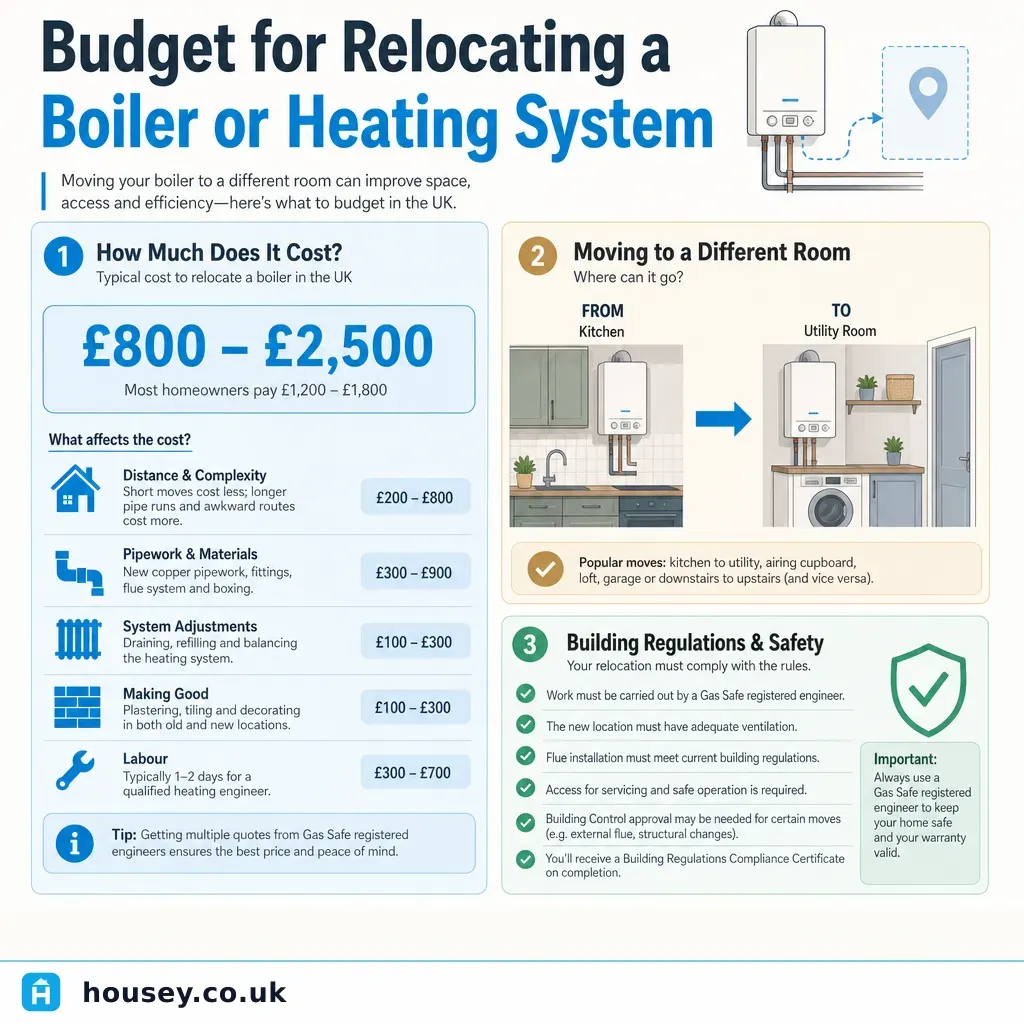
Budget for Relocating a Boiler or Heating System
Moving a boiler or central heating system is often prompted by a kitchen renovation, loft conversion, or home extension that changes room layouts and access. The cost depends on factors that are not always apparent at the quoting stage, and the work sits within a regulated framework that determines who can carry it out, what approvals are needed, and what documentation you should receive on completion.
Key points
- All gas boiler work in the UK must be carried out by a Gas Safe registered engineer — a legal requirement under the Gas Safety (Installation and Use) Regulations 1998.
- Building Regulations notification is required for boiler relocations in England and Wales; most Gas Safe engineers self-certify through the Competent Person Scheme under Approved Document J (combustion appliances) and Approved Document L (energy efficiency).
- Moving a boiler to a different floor adds material cost because the flue, condensate pipe, and gas pipework routes all change.
- Manufacturer warranties commonly require installation to comply with the manufacturer's manual; a relocation that alters the flue configuration may void coverage if not approved in writing first.
- Indicative UK costs for a straightforward boiler relocation range from approximately £500 to £2,000+, depending on distance, floor level, and pipework complexity (Indicative UK costs, last reviewed 2026-05-06).
What affects the cost of relocating a boiler?
The largest cost driver is how far the boiler moves and what must change as a result. A move of one or two metres within the same room is primarily a pipework task. Moving to another room — or another floor — brings in flue extension, condensate re-routing, and potentially a new pump location.
Key factors that influence the price:
- Distance of the move — longer pipework runs cost more in materials and labour.
- Floor change — moving from ground to first floor, or into a loft, typically adds £300–£700 to the job.
- Flue route — a new external wall penetration requires core drilling and a new flue kit, often adding £150–£400.
- Condensate pipe — modern condensing boilers require a condensate discharge point; re-routing may add cost where no drain is nearby.
- Gas pipe extension — extending the incoming gas supply pipe is chargeable and must meet strict standards.
- Existing pipework condition — corroded, incorrectly sized, or substandard pipework may need upgrading before the move proceeds.
- System flush and balance — the system usually requires a power flush or chemical flush plus radiator rebalancing after a move.
Typical cost scenarios
The table below gives indicative cost ranges for common UK boiler relocation scenarios. Prices are approximate and exclude VAT unless otherwise stated. Always obtain at least three quotes from Gas Safe registered engineers.
Scenario | Indicative cost range | Notes |
|---|---|---|
Short move within same room (up to 1 m) | £300–£600 | Minimal pipework; flue position unlikely to change |
Move to adjacent room, same floor | £600–£1,000 | Flue extension or new wall penetration likely |
Move to a different floor (e.g. airing cupboard to loft) | £1,000–£2,000+ | Flue, condensate, and gas pipe extension all affected |
Relocation coordinated with a kitchen refit | £500–£1,500 | Costs may reduce when timed with other structural work |
Heating system reconfiguration (e.g. back boiler to combi) | £1,500–£3,000+ | Includes new unit, pipework redesign, and radiator changes |
Indicative UK costs, last reviewed 2026-05-06. Quotes vary significantly by region and property type.
Building regulations and compliance
In England and Wales, installing or relocating a gas boiler is notifiable work under the Building Regulations. A Gas Safe registered engineer self-certifies the work under the Competent Person Scheme, notifying your local building control body on your behalf. You should receive a Building Regulations compliance certificate after completion — retain this document, as you will need it on any future sale or remortgage.
The relevant Approved Documents are:
- Approved Document J — covers flue design, air supply for combustion, and carbon monoxide detector requirements.
- Approved Document L — covers energy efficiency standards; if the existing boiler is also being replaced, the new unit must meet current minimum efficiency requirements.
In Scotland, work is covered by the Building (Scotland) Regulations 2004. In Northern Ireland, the Building Regulations (Northern Ireland) 2012 apply. Seek local guidance if your property is in those nations.
What a boiler relocation involves
Understanding the typical workflow helps you plan timing and access:
- Initial survey — the engineer assesses the proposed location, checks the flue route, condensate disposal, gas supply, and future servicing access.
- Quotation — a detailed quote should itemise labour, materials (pipework, flue kit, fittings), system flush, and Building Regulations notification fees.
- Isolation — the system is drained and the gas supply isolated.
- New pipework and flue — gas and water pipes are extended or re-routed; a new external wall penetration is made if required.
- Boiler installation — the unit is moved to the new position and recommissioned.
- System flush and balance — the heating system is chemically flushed, inhibitor is dosed, and radiators are rebalanced.
- Compliance notification — the engineer notifies building control through the Competent Person Scheme and provides your certificate.
Which option makes sense?
Use this decision guide before committing to a relocation:
- Choose relocation if the current position prevents practical room use, blocks a kitchen refit, or no longer allows adequate access for annual servicing.
- Consider a new boiler instead if the existing unit is more than 10–12 years old — combining replacement with relocation can be more cost-effective than moving an ageing appliance.
- Ask an energy-efficiency consultant if you are planning wider energy upgrades — the optimal position for a heat pump or hybrid system differs from a gas boiler, and early advice avoids costly rework later.
- Check your warranty terms first if the boiler is under manufacturer or installer warranty — some policies require written approval before relocation.
- Ask your building insurer if the property has had structural movement or flood history, as these can affect the approved location for a flue penetration.
Important limitations
This article provides general cost guidance for informational purposes only. Boiler and gas heating work is regulated under the Gas Safety (Installation and Use) Regulations 1998. The costs given are indicative ranges based on typical UK market conditions as of May 2026; actual quotes will vary by region, property type, system complexity, and individual contractor pricing. This article is not a substitute for a site survey by a qualified Gas Safe registered engineer. Building Regulations requirements can vary; consult your local building control body or installer for definitive guidance on your specific circumstances.
When this becomes urgent
Seek immediate professional help — do not attempt any DIY intervention — if:
- You smell gas near the boiler or any pipework.
- The boiler shows a fault code indicating a heat exchanger, flue, or gas valve failure.
- A CO alarm activates or you suspect carbon monoxide exposure — leave the property immediately and call the Gas Emergency Service on 0800 111 999.
- The boiler is in a structurally compromised location following flood, fire, or significant structural movement.
What to ask a qualified professional
Before accepting a quote for boiler relocation, ask your Gas Safe registered engineer:
- Are you Gas Safe registered, and can I verify your registration number on the Gas Safe Register website?
- What does the quote include — pipework, flue kit, system flush, inhibitor dose, and Building Regulations notification fees?
- Will the new location comply with the manufacturer's installation manual and keep the warranty valid?
- What is the condensate disposal route, and is there a suitable drain nearby?
- Will the flue terminal position meet Approved Document J clearance requirements in the new location?
- What happens if additional issues are found once the system is isolated, such as corroded pipework or undersized gas pipes?
- When will I receive my Building Regulations compliance certificate?
When to get professional help
Any work on a gas boiler or gas pipework must be carried out by a Gas Safe registered engineer — this is a legal requirement, not a recommendation. There is no homeowner exemption for gas work.
Red flags that warrant prompt professional assessment:
- A carbon monoxide alarm activating near the boiler or flue.
- Visible corrosion, weeping joints, or black marks around the flue outlet.
- Persistent loss of heating system pressure that cannot be resolved by re-pressurising.
- A boiler in a space that no longer meets flue clearance or ventilation requirements following building work.
How Housey can help
If you are planning a boiler relocation as part of a wider energy upgrade, an energy-efficiency consultant can help you assess whether a heat pump, improved insulation, or a redesigned heating layout would deliver better long-term value before you commit to moving gas infrastructure.
Frequently asked questions
Does moving a boiler need building regulations approval?
Yes. In England and Wales, installing or relocating a gas boiler is notifiable under the Building Regulations. Most Gas Safe registered engineers self-certify the work through the Competent Person Scheme, notifying your local building control body on your behalf. You should receive a completion certificate, which you will need to provide on any future sale or remortgage.
Can I move a boiler to a different room?
Yes, provided the new location has an accessible external wall for the flue, a suitable route for the condensate pipe, adequate gas supply pipework, and meets clearance requirements under Approved Document J. A Gas Safe registered engineer will assess feasibility during a site survey before any work begins.
Will relocating my boiler void the warranty?
It may do. Many manufacturers require strict compliance with their installation manual. If your boiler is under warranty, check the manufacturer's terms and seek written confirmation before work begins. Using a Gas Safe engineer who notifies the work through the Competent Person Scheme satisfies the regulatory requirement, but manufacturer-specific conditions vary.
How long does boiler relocation take?
A straightforward same-floor relocation typically takes one to two days. Moving to a different floor or re-routing the flue and gas pipe may take two to three days. Allow additional time for the system to be chemically flushed and balanced before you commission the heating.
Can I move a boiler during a kitchen renovation?
Yes, and this is often the best time to do it. Coordinating the boiler move with other trades reduces the number of separate access visits and can lower overall cost. Plan the boiler relocation early in the project, before kitchen units or flooring are fitted, to avoid costly rework.
Sources and further reading
- Gas Safe Register: Find a registered engineer — Gas Safe Register
- Approved Document J: Combustion Appliances and Fuel Storage Systems — GOV.UK
- Approved Document L: Conservation of Fuel and Power — GOV.UK
- Gas Safety (Installation and Use) Regulations 1998 — Health and Safety Executive
Useful next reads
 Energy & Retrofit
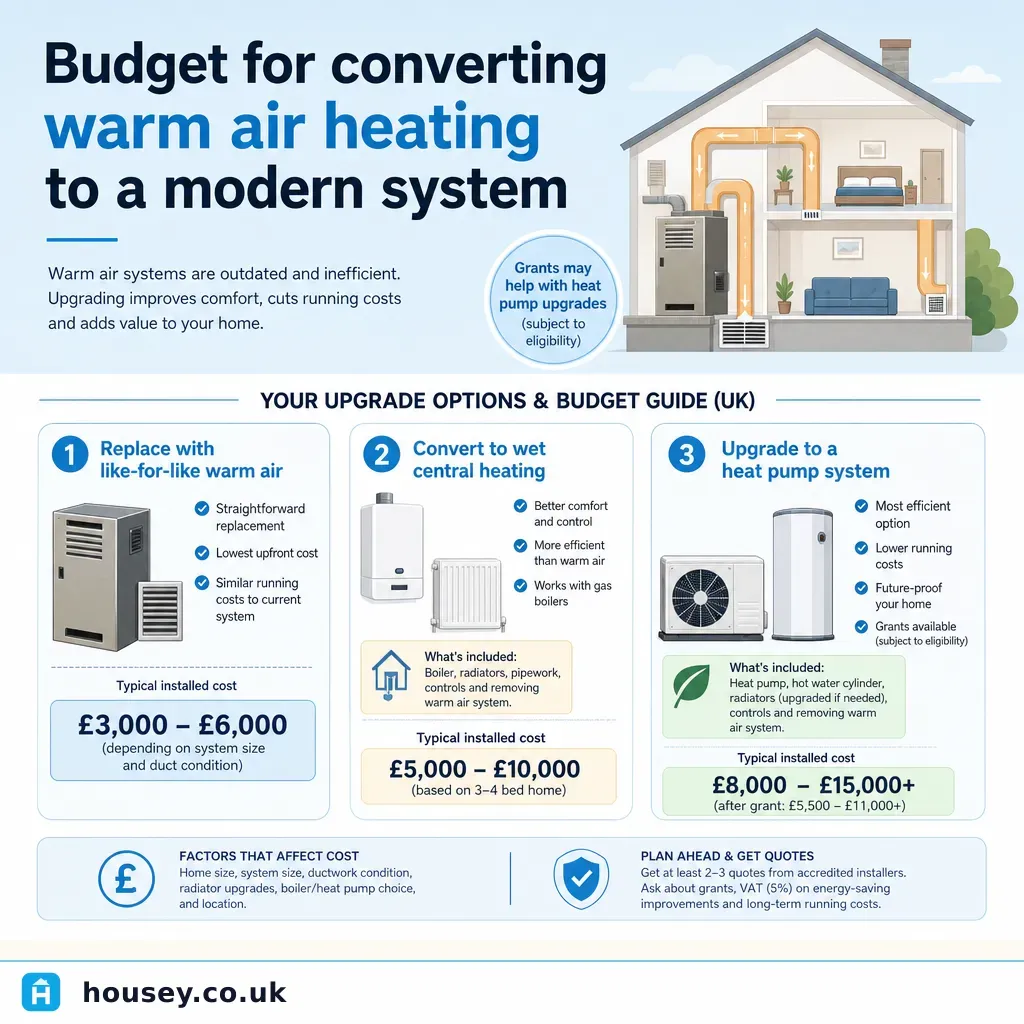
Budget for converting warm air heating to a modern system
Converting a warm air heating system to wet central heating typically costs £5,000–£15,000 in the UK, depending on property size, system choice, and pipework complexity.
 Energy & Retrofit
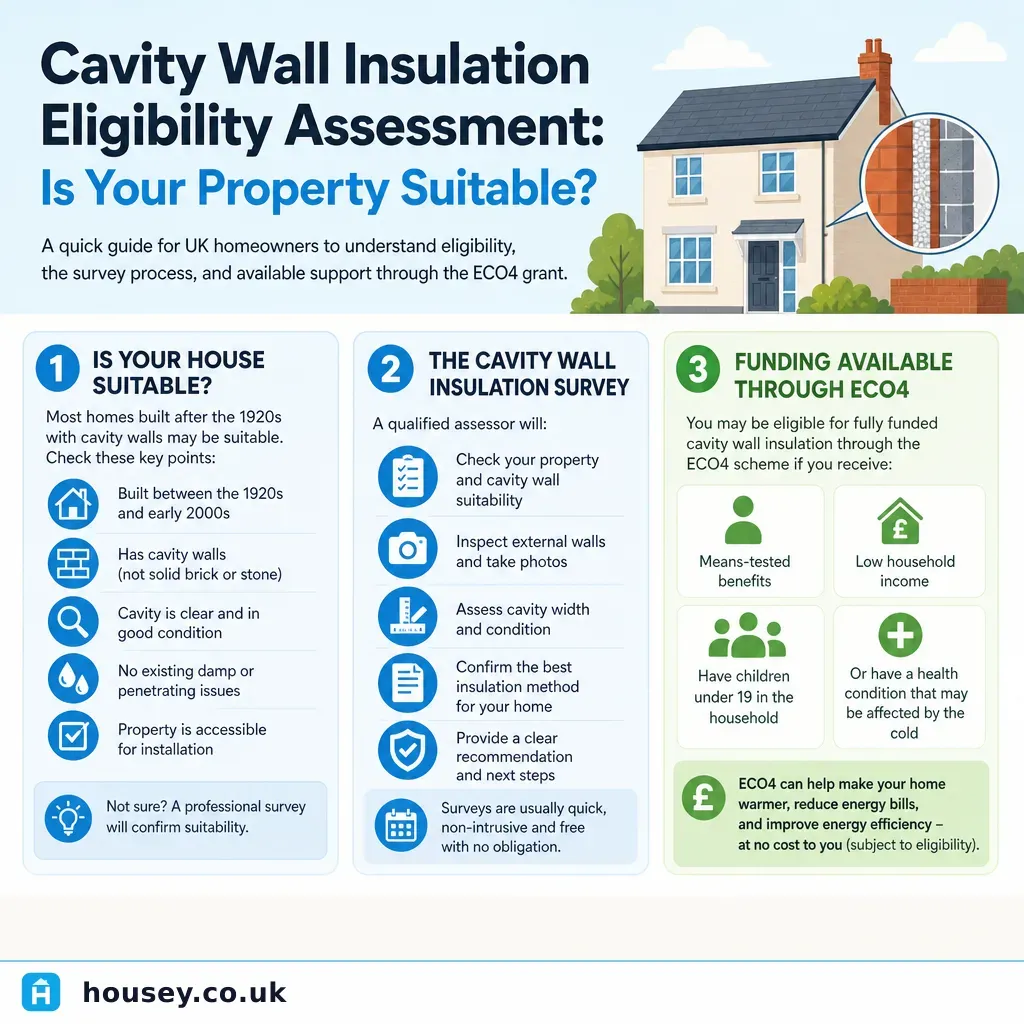
Cavity Wall Insulation Eligibility Assessment: Is Your Property Suitable?
Cavity wall insulation suits most UK homes built from around 1920 onwards with unfilled cavities at least 50mm wide in sheltered or moderately exposed locations.
 Energy & Retrofit
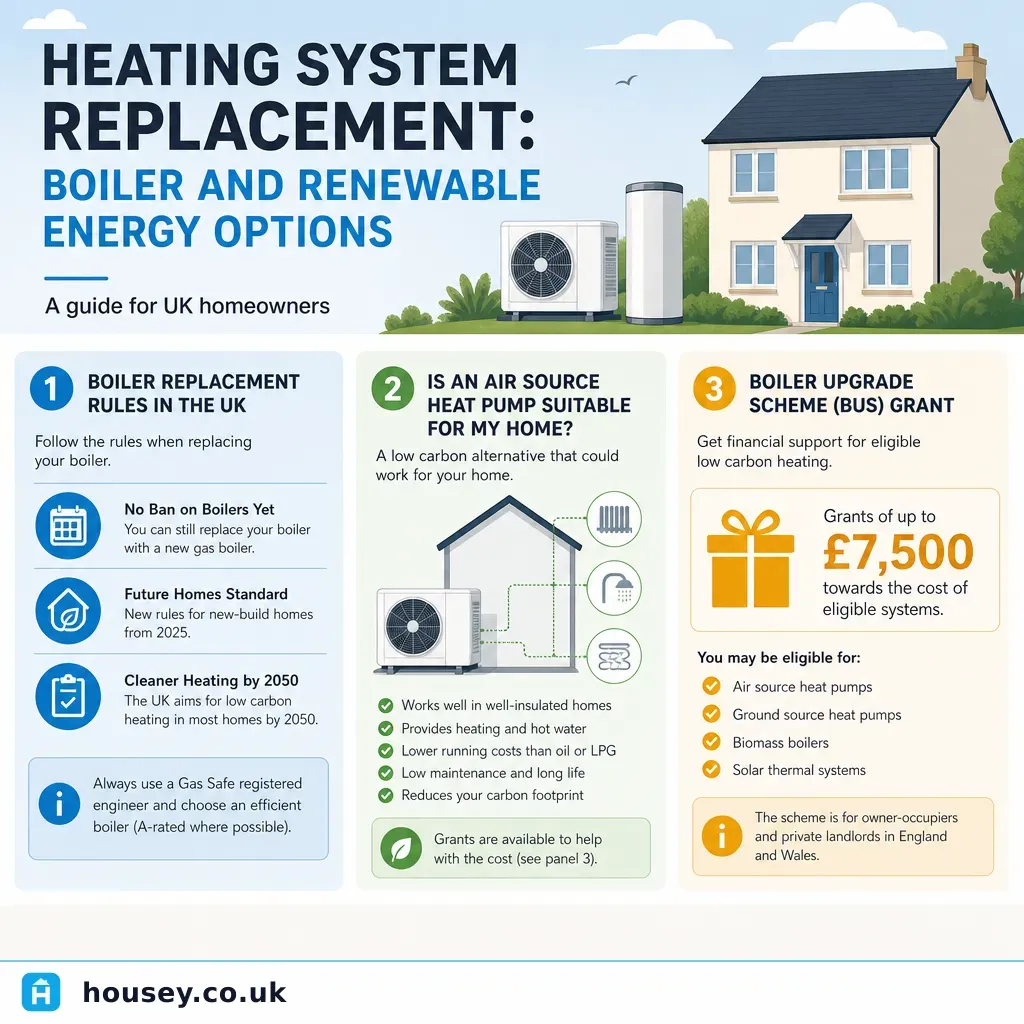
Heating System Replacement: Boiler and Renewable Energy Options
When replacing a heating system in the UK, a new gas boiler must comply with Boiler Plus (Part L) and be fitted by a Gas Safe registered engineer.
 Energy & Retrofit
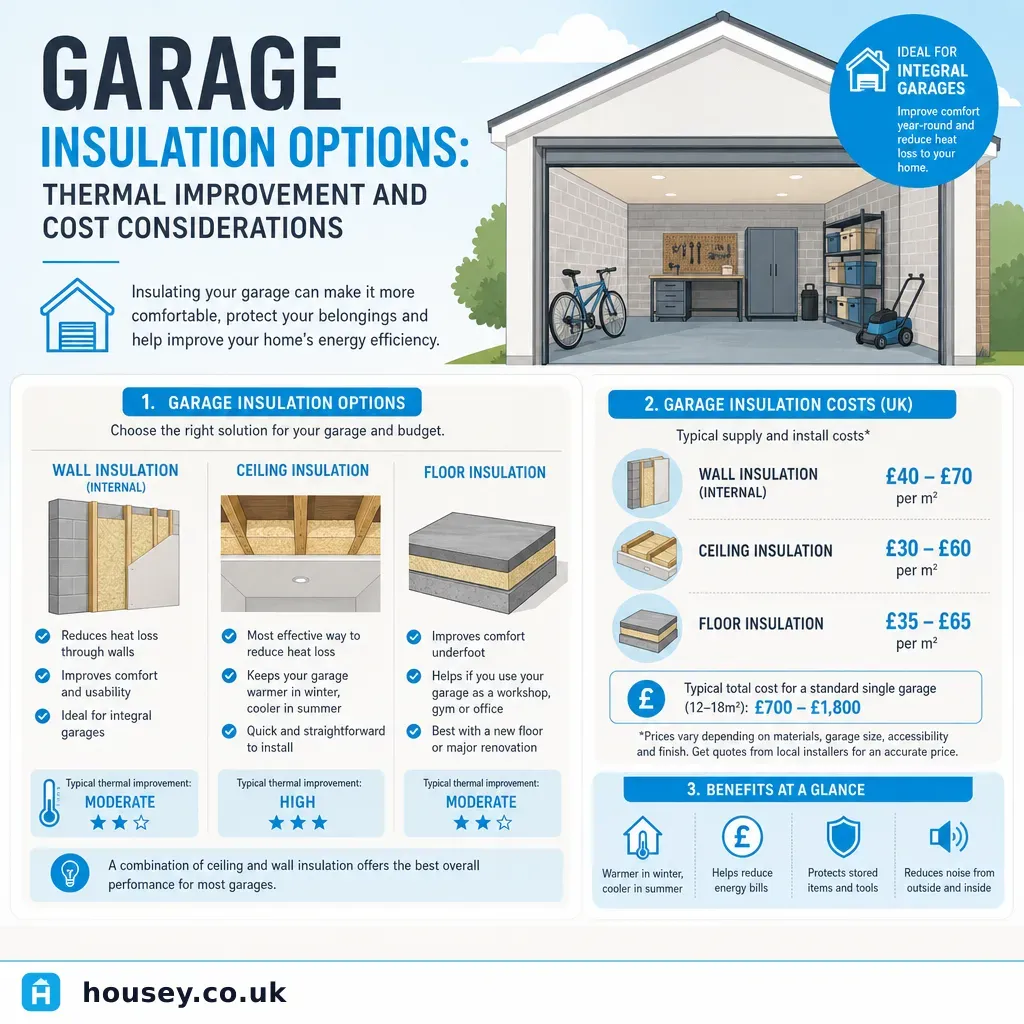
Garage Insulation Options: Thermal Improvement and Cost Considerations
Garage insulation options in the UK include mineral wool batts, rigid foam boards (PIR or EPS), and insulated garage doors.
 Energy & Retrofit
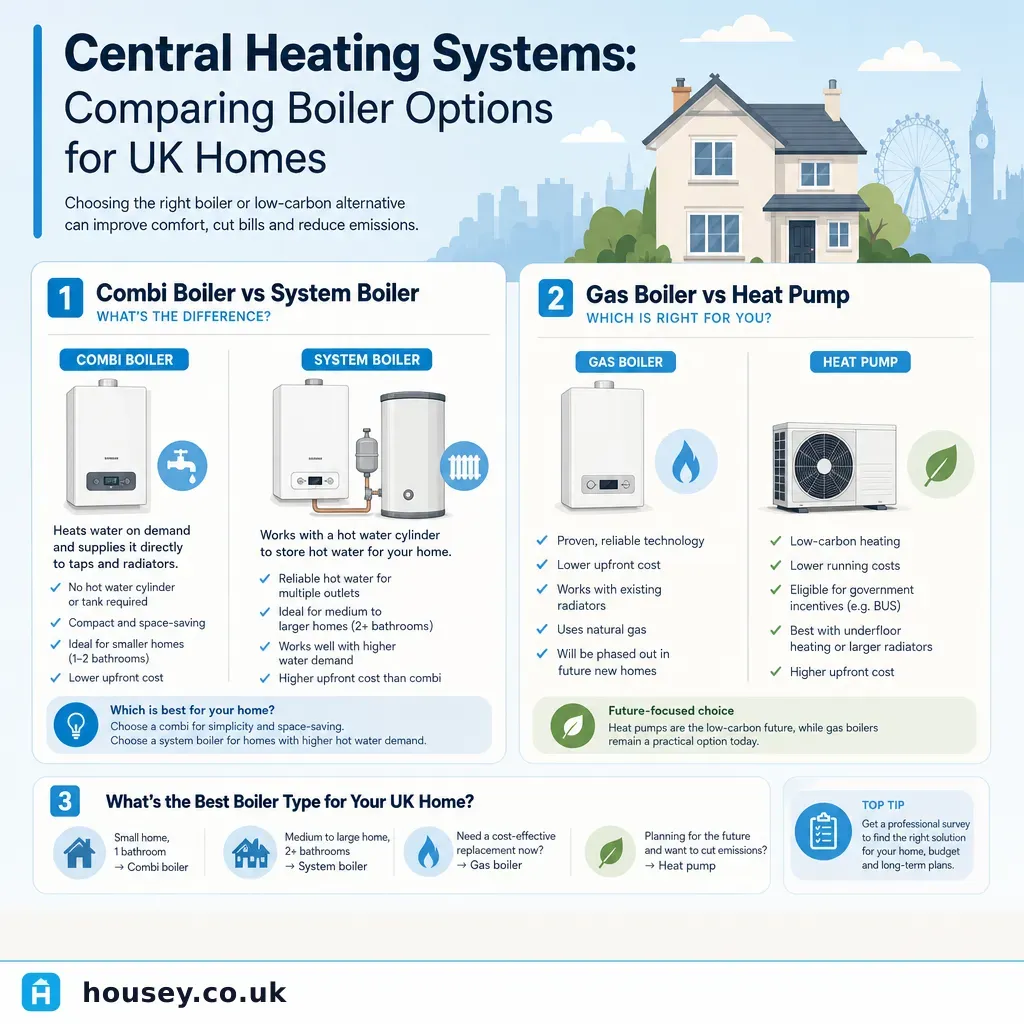
Central Heating Systems: Comparing Boiler Options for UK Homes
UK homes are generally heated by a combi boiler (no cylinder needed), system boiler (needs a hot water cylinder), or regular boiler (needs both a cylinder and cold-water tank).