Heating System Replacement: Boiler and Renewable Energy Options
By Housey · Last reviewed 1st of June 2026
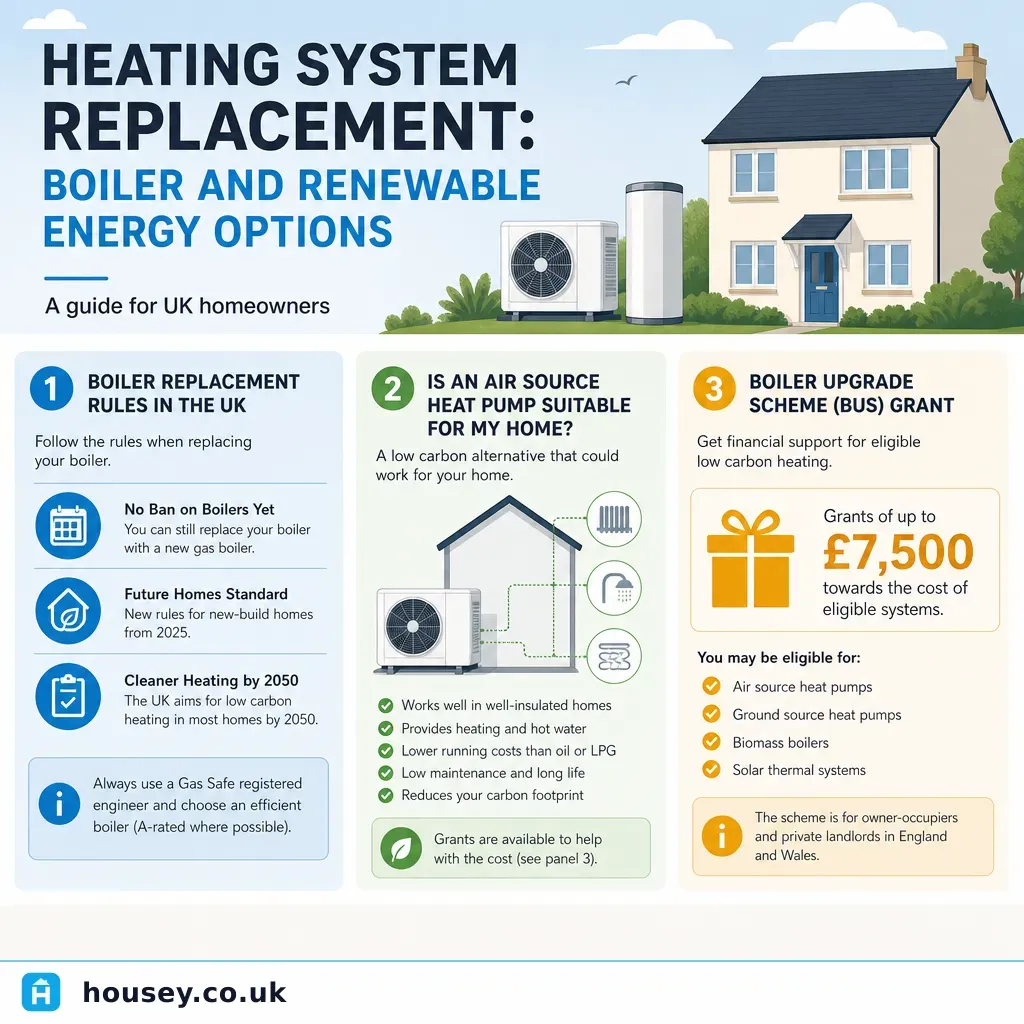
Heating System Replacement: Boiler and Renewable Energy Options
Homeowners face a heating system decision at two distinct moments: when a boiler fails unexpectedly and a rapid replacement is needed, or during a planned retrofit when low-carbon alternatives become worth evaluating seriously. The decision has grown more complex since the Boiler Upgrade Scheme introduced capital grants for heat pumps and the Future Homes Standard moved gas boilers toward obsolescence in new-build construction. For the millions of UK homes on existing gas networks, the right technology depends on property fabric, budget, and long-term energy goals.
Key points
- The Boiler Upgrade Scheme (BUS), administered by Ofgem, currently offers a £7,500 grant for eligible air source and ground source heat pump installations; the system must be installed by an MCS-certified contractor.
- Under Building Regulations Part L (Boiler Plus), all new gas boiler installations must meet ErP A-rated efficiency, and combination boilers must include weather compensation controls or a flue-gas heat recovery device.
- PAS 2035 is the UK standard governing domestic energy retrofit; it requires a qualified Retrofit Coordinator to oversee whole-house retrofit projects and mandates a Retrofit Assessment before recommending heating measures.
- Heat pump efficiency depends heavily on building fabric — properties with a space heating demand above approximately 120 kWh/m²/year typically need insulation improvements before a heat pump will operate cost-effectively.
- The Future Homes Standard is expected to prohibit gas boilers in new-build homes in England; existing homes are not yet subject to a ban, but the policy direction is firmly toward electrification.
Gas boiler replacement: what the regulations require
When a gas boiler is replaced in England, Wales, or Scotland, the new installation must comply with Building Regulations in force at the time. In England and Wales, Boiler Plus (introduced under Part L, 2018) requires:
- A minimum ErP (Energy-related Products) seasonal efficiency of 92% for gas boilers.
- For combination boilers: a flue-gas heat recovery device or time and temperature zone controls.
- Weather compensation controls (adjusting flow temperature based on outdoor conditions) or load compensation controls.
All gas work must be carried out by a Gas Safe registered engineer — this is a legal requirement under the Gas Safety (Installation and Use) Regulations 1998. Always verify registration at the Gas Safe Register before work begins.
Renewable heating options: comparing the main technologies
Technology | Best for | Not ideal for | Indicative installed cost | BUS grant available |
|---|---|---|---|---|
Air source heat pump (ASHP) | Well-insulated homes, off-grid properties, new builds | Poorly insulated solid-wall homes without prior fabric improvement | £8,000–£15,000 | Yes — £7,500 |
Ground source heat pump (GSHP) | Properties with sufficient land, high heat demand | Small urban plots, limited budgets | £15,000–£30,000 | Yes — £7,500 |
Biomass boiler | Rural properties, access to affordable wood fuel | Urban areas with air quality restrictions, no fuel storage | £10,000–£22,000 | Check Ofgem guidance |
Hybrid heat pump (ASHP + gas boiler) | Homes where full electrification is not yet viable | Homes targeting net-zero heating | £6,000–£12,000 | Check Ofgem guidance |
Infrared electric panels | Highly insulated homes with very low residual heat demand | Older, draughty, or solid-wall properties | £2,000–£6,000 | No |
Indicative UK costs, last reviewed 2026-06-01. Costs vary by property size, location, and specification. Obtain at least three quotes.
Heat pumps: what your home needs to be ready
A heat pump operates at lower flow temperatures than a gas boiler — typically 35–55°C versus 60–80°C. This means radiators must be adequately sized to deliver the required heat output at those lower temperatures, and the building fabric must limit heat loss sufficiently for the system to run efficiently.
Heat pump readiness decision guide:
- Proceed with heat pump installation if: EPC rating is C or above, radiators are generously sized or underfloor heating is already installed, and suitable outdoor space is available for the unit.
- Improve fabric first if: EPC is D or below, loft insulation is absent, or walls are uninsulated solid construction — a retrofit assessment will identify the correct sequence of measures.
- Consider a hybrid system if: full insulation improvement is not practical in the medium term (for example, a solid-wall listed building) but you want to begin reducing gas consumption.
- Consult an MCS-certified heat pump designer before committing if: you are unsure about radiator sizing, hot water cylinder compatibility, or whether your electrical supply capacity is sufficient.
A heat pump survey will assess property suitability, model expected running costs, and confirm whether your home meets the Boiler Upgrade Scheme eligibility criteria.
Funding and support
Boiler Upgrade Scheme (BUS): A one-off capital grant of £7,500 for eligible air source and ground source heat pump installations. Administered by Ofgem; the MCS-certified installer applies on the homeowner's behalf. The property must have a valid EPC with no outstanding recommendations for loft or cavity wall insulation.
ECO4: The Energy Company Obligation funds insulation and heating upgrades for eligible low-income households. Eligibility is means-tested; contact your energy supplier or local authority to establish whether you qualify.
Great British Insulation Scheme: Funds single insulation measures for eligible households — relevant as a preparatory step before heat pump installation in properties with poor fabric performance.
Check current eligibility criteria and funding levels directly with Ofgem, as scheme parameters can change with little notice.
Important limitations
This article provides general information about heating system options for UK homeowners. Heating system sizing, heat pump performance modelling, and retrofit sequencing are technical assessments that depend on individual property characteristics — construction type, fabric U-values, airtightness, existing heat distribution, hot water demand, and local climate data. Nothing in this guide constitutes engineering or regulatory advice for your specific property. A Gas Safe registered engineer, MCS-certified heat pump designer, or PAS 2035 qualified Retrofit Assessor should evaluate your property before you proceed with any replacement or upgrade.
When this becomes urgent
Seek qualified professional help promptly if:
- A boiler has failed completely in winter and a vulnerable occupant — elderly, young children, or a person with a health condition — is present in the home.
- A carbon monoxide (CO) alarm activates — leave the property immediately, call 999, and contact the National Gas Emergency Service on 0800 111 999.
- You notice unusual smells, sooting around appliances, or yellow or orange boiler flames — stop using the appliance and call a Gas Safe engineer immediately.
- Radiators have widespread cold spots suggesting sludge accumulation — a powerflush may be required before any heat pump installation, and an engineer should assess the system first.
What to ask a qualified professional
Before instructing a heating installer or retrofit coordinator, ask:
- Are you Gas Safe registered for gas work, or MCS certified for heat pump installation — and can I verify your registration number?
- Will you carry out a full heat loss calculation to BS EN 12831 before sizing the system?
- Will radiators need upsizing, and is that work included in the quoted price?
- What flow temperature will the heat pump operate at, and what seasonal COP does that imply for my property's heat loss?
- Will the installation qualify for the Boiler Upgrade Scheme, and will you manage the application on my behalf?
- Does my existing hot water cylinder need replacing, and is that within the project scope?
- What Building Regulations compliance route will you use, and what certificate will I receive at completion?
- Is the quote inclusive of commissioning, system balancing, and a handover demonstration?
When to get professional help
Beyond the urgent situations above, obtain specialist input before proceeding if:
- The property is a listed building or in a conservation area — an external heat pump unit may require planning permission.
- The property has solid walls — a Retrofit Coordinator under PAS 2035 should advise on the sequencing of insulation and heating work to manage moisture risk.
- You are considering ground source heating — ground investigations and MCS heat pump design are mandatory and not a DIY exercise.
- Your EPC shows an F or G rating — fabric-first improvements should precede any heating system change to avoid an undersized or inefficient system.
How Housey can help
Housey connects UK homeowners with qualified professionals at every stage of the heating retrofit journey — from an initial energy-efficiency consultation and retrofit assessment through to a specialist heat pump survey that models performance, confirms sizing, and establishes grant eligibility for your specific property.
Frequently asked questions
Can I replace a gas boiler like-for-like without additional work?
Yes — a like-for-like gas boiler replacement is permitted provided the new boiler meets Boiler Plus requirements, including ErP A-rated efficiency and appropriate controls such as weather compensation. The installer must be Gas Safe registered and should certify the installation via a competent-person scheme. If the existing system has ageing pipework or undersized radiators, the engineer should flag these before proceeding.
Is a heat pump suitable for a Victorian terrace?
Potentially, but usually only after fabric improvements. Victorian terraces typically have solid brick walls and high heat loss, making heat pump efficiency poor without prior insulation work. Solid wall insulation, improved loft insulation, and draught-proofing are usually required first. A PAS 2035 Retrofit Assessment will establish the correct sequence and confirm whether a heat pump is the right long-term solution.
How long does a heat pump installation take?
A straightforward air source heat pump installation on a prepared property typically takes two to four days. If radiator upgrades, a replacement hot water cylinder, or electrical work to the consumer unit are also required, allow one to two weeks for the complete project. The installer should provide a programme as part of the formal quote.
Will my energy bills change after installing a heat pump?
This depends on the electricity-to-gas price ratio, the heat pump's seasonal COP, and how well the property is insulated. A well-performing heat pump with a COP of 3.0 or above can match or undercut a condensing boiler on running costs. The calculation is property-specific — ask your installer to model projected annual running costs before you commit.
Sources and further reading
- Boiler Upgrade Scheme — Ofgem
- Approved Document L: Conservation of fuel and power (Boiler Plus) — HM Government
- Gas Safe Register — Gas Safe Register
- MCS — Microgeneration Certification Scheme — MCS
- PAS 2035: Retrofitting dwellings for improved energy efficiency — BSI
- Future Homes and Buildings Standards consultation — DESNZ / HM Government
Useful next reads
 Energy & Retrofit
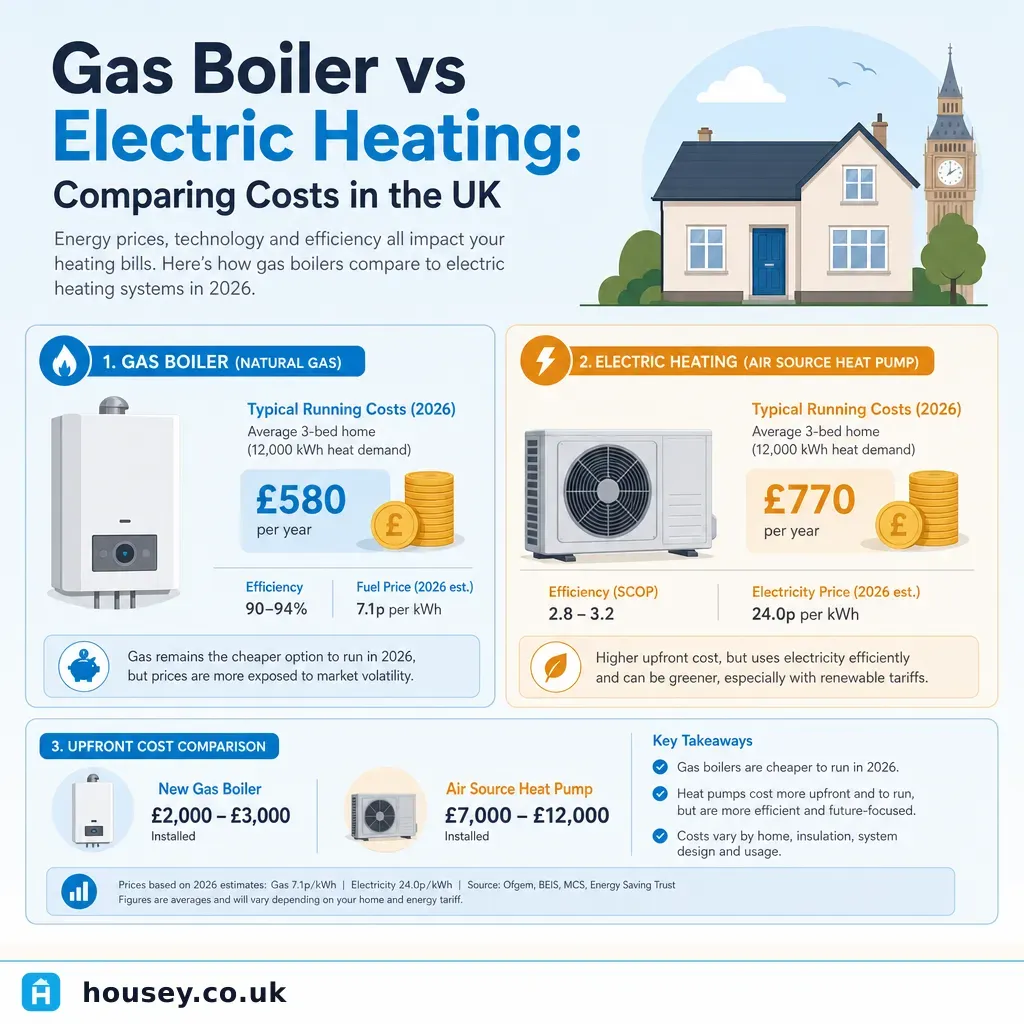
Gas Boiler vs Electric Heating: Comparing Costs in the UK
Gas boilers currently cost around 6.
 Energy & Retrofit
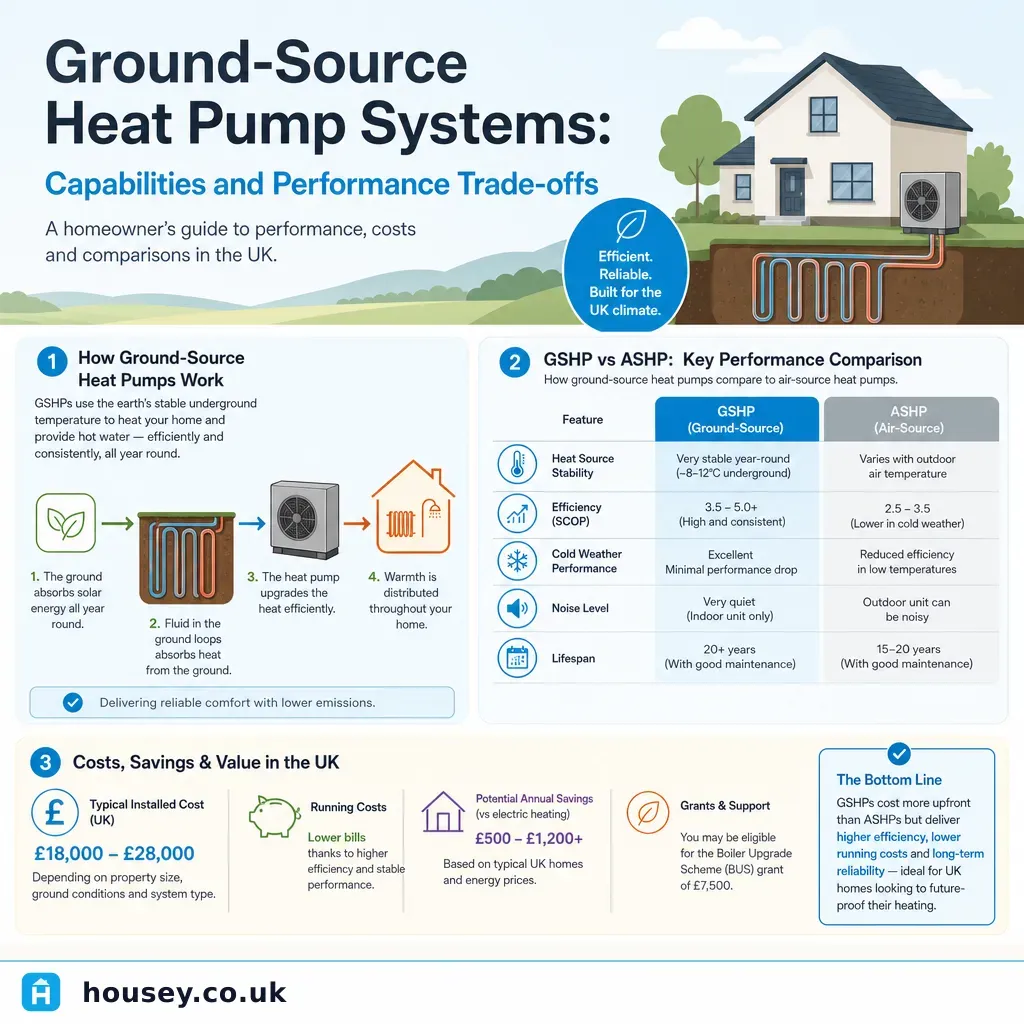
Ground-Source Heat Pump Systems: Capabilities and Performance Trade-offs
A ground-source heat pump extracts heat from the ground via buried loops, typically achieving a COP of 3.
 Energy & Retrofit
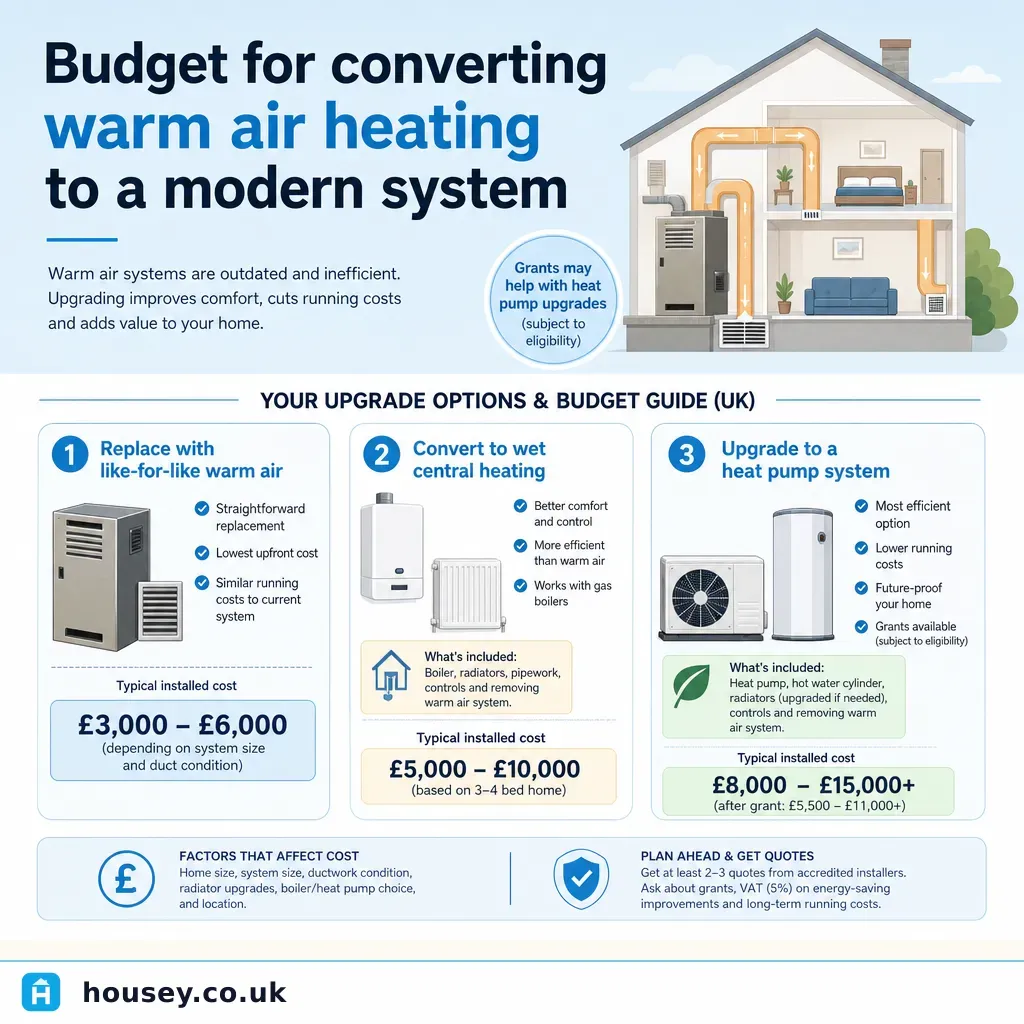
Budget for converting warm air heating to a modern system
Converting a warm air heating system to wet central heating typically costs £5,000–£15,000 in the UK, depending on property size, system choice, and pipework complexity.
 Energy & Retrofit
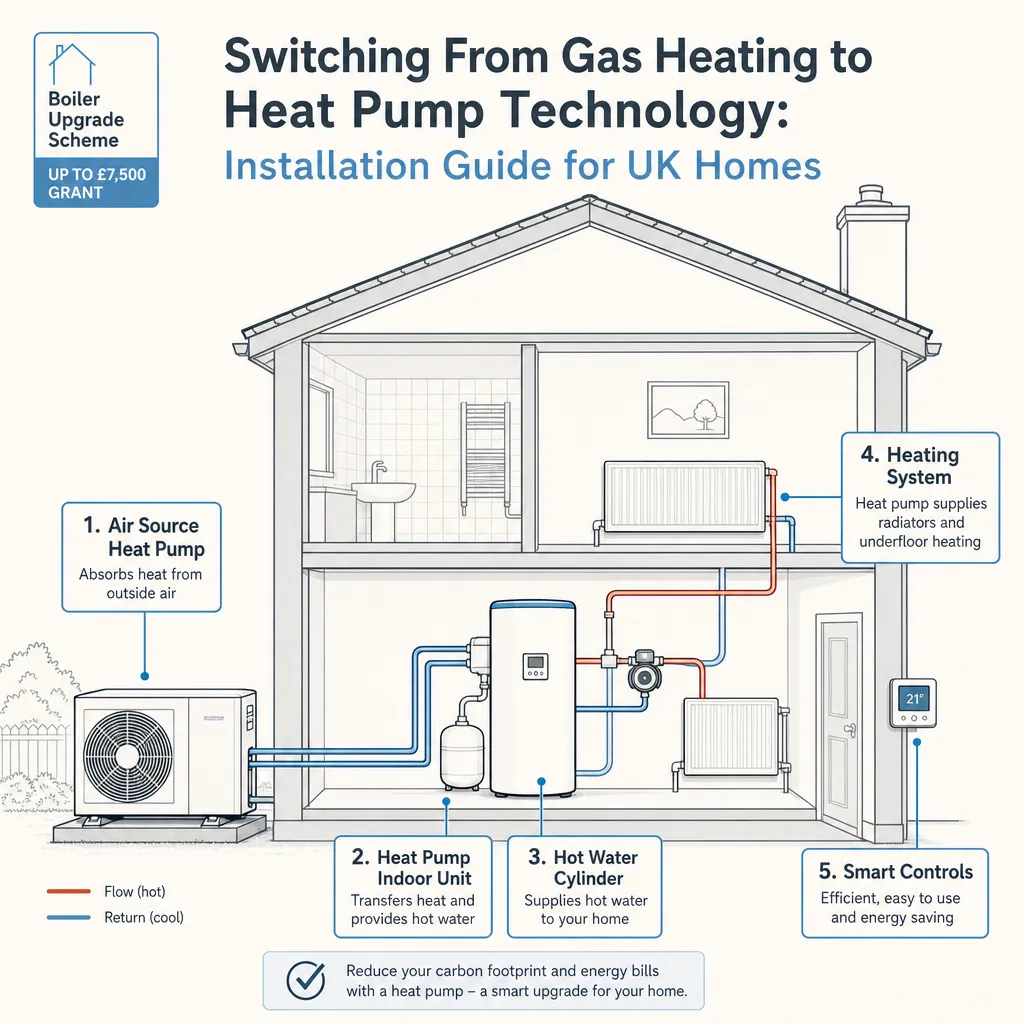
Switching From Gas Heating to Heat Pump Technology: Installation Guide
Switching from gas to a heat pump requires a heat loss calculation, correctly sized equipment, and often radiator upgrades before installation.
 Energy & Retrofit
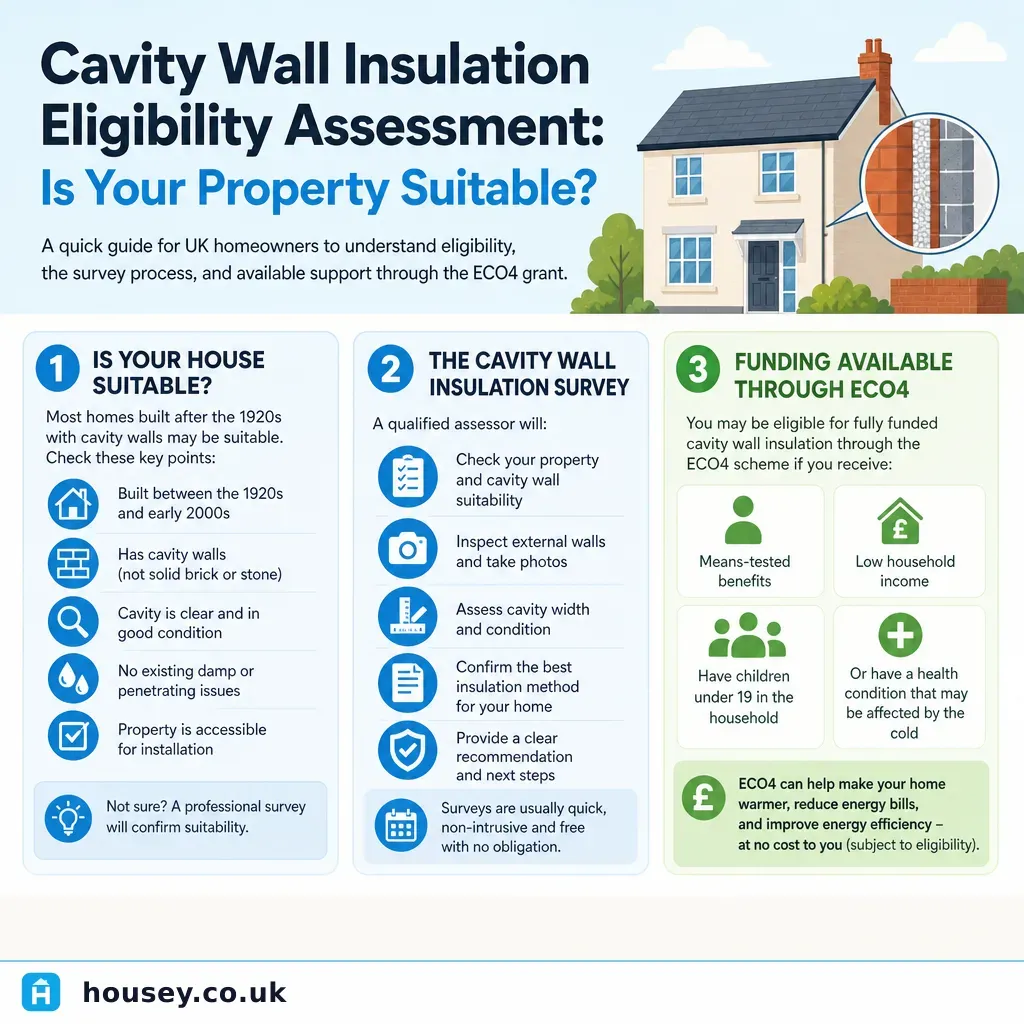
Cavity Wall Insulation Eligibility Assessment: Is Your Property Suitable?
Cavity wall insulation suits most UK homes built from around 1920 onwards with unfilled cavities at least 50mm wide in sheltered or moderately exposed locations.