Garage Insulation Options: Thermal Improvement and Cost Considerations
By Housey · Last reviewed 26th of May 2026
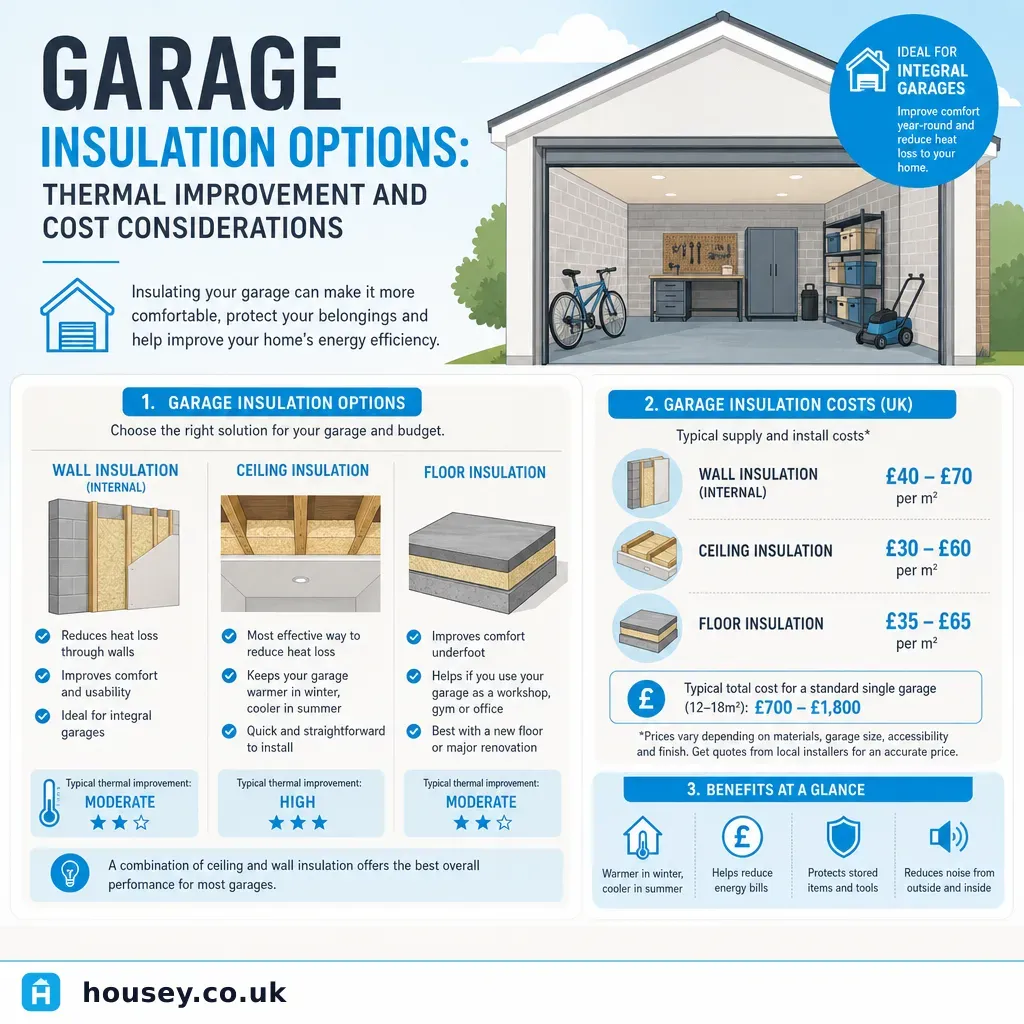
Garage Insulation Options: Thermal Improvement and Cost Considerations
Garages are among the most thermally inefficient spaces in or attached to UK homes. An uninsulated integral garage — one built into the house footprint — can act as a cold bridge into adjacent rooms, increasing heating demand and, in some cases, contributing to condensation along shared walls and ceilings. Whether the aim is to make the space usable year-round, reduce heat loss to the rooms alongside it, or prepare for a full habitable conversion, the range of insulation approaches available in the UK suits different budgets, garage configurations, and regulatory situations.
Key points
- Integral garages (part of the house footprint) benefit most from insulating the shared wall with the house, the garage ceiling, and the garage door — all three elements form part of the thermal envelope of the adjacent living space.
- Building Regulations Part L (Conservation of Fuel and Power, 2021 edition for England) applies in full if you convert a garage to habitable use; minimum U-values for walls (0.30 W/m²K), roofs (0.16 W/m²K), and floors (0.25 W/m²K) apply.
- Rigid foam board insulation (PIR or PUR products) achieves U-values as low as 0.022–0.028 W/m²K, offering the highest thermal performance per millimetre — useful where internal floor area is limited.
- Spray foam insulation applied to structural roof elements in garages has raised concerns with some mortgage lenders and insurers; check your lender's position before specifying.
- Cavity fill insulation for garage masonry walls must be installed by a CIGA-registered contractor under the Cavity Insulation Guarantee Agency standards.
Integral vs detached: different thermal priorities
The justification for insulating a garage depends on its relationship to the rest of the house.
Integral or directly attached garage: Shares at least one wall or ceiling with the main dwelling. Heat loss through those shared elements directly increases the heating demand in adjacent rooms. Insulating the party wall, the garage ceiling (which is often the floor of a room above), and the garage door has a measurable effect on the whole-house thermal envelope.
Detached garage: No shared elements with the house. The case for insulation here is about making the space usable — protecting vehicles, tools, or workshop equipment from temperature extremes — rather than reducing household energy consumption. Building Regulations do not require insulation in a detached garage unless it is being converted to habitable use.
Insulation options by element
Garage door
The door is often the single largest heat loss surface in a garage. Options include:
- Insulated sectional or roller doors: Factory-insulated doors with PIR foam cores can achieve U-values of 1.0–1.5 W/m²K, significantly better than an uninsulated steel or timber door. Professional installation is recommended.
- Retrofit insulation panels: Rigid foam boards cut to fit existing door panels offer some thermal improvement at lower cost, though performance is constrained by the original door's construction and fit.
Walls
- Rigid foam board (PIR or EPS): Fixed to the internal face of masonry walls and finished with dry-lining board or plasterboard. PIR boards at 50 mm typically achieve around 0.45 W/m²K depending on substrate and fixing method. Suitable for both solid-wall and cavity-wall garages where internal space permits.
- Mineral wool in stud framing: A practical option for garages with existing or newly formed stud walls. Mineral wool is more breathable than closed-cell foam, which may be beneficial in garages prone to moisture from vehicles.
- Cavity fill: If the garage walls include a masonry cavity, injected or blown insulation (EPS beads, mineral wool, or polyurethane foam) can improve performance without reducing internal floor area. A pre-installation cavity survey is always required.
Ceiling and roof
- Between-joist mineral wool: Where the garage has a boarded ceiling with a void above, rolled or loose-fill mineral wool between ceiling joists is a cost-effective option requiring no specialist labour.
- Rigid foam to underside of roof structure: For open-pitched or flat-roofed garages, PIR boards can be fixed to the underside of rafters or the roof deck. Vapour control layer placement must be considered to avoid interstitial condensation.
Floor
Floor insulation is rarely installed in garages that remain in use as garages — vehicle loads, drainage requirements, and practical durability make a finished insulated floor impractical. For a habitable conversion, Part L requires a floor U-value of 0.25 W/m²K or better, typically achieved with rigid foam boards beneath a concrete screed.
Garage insulation options compared
Option | Best for | Thermal performance | Indicative cost range* | Key consideration |
|---|---|---|---|---|
Insulated sectional or roller door | New door installation | Good (U-value ~1.0–1.5 W/m²K) | £700–£2,500 installed | Professional installation recommended |
Rigid foam board — walls | Limited space, high performance | Excellent (0.022–0.040 W/m²K) | £300–£800 DIY; £600–£1,500+ installed | Requires dry-lining finish |
Mineral wool in stud walls | Framed walls, cost-sensitive | Good (0.032–0.044 W/m²K) | £150–£500 DIY; £400–£900 installed | Include vapour control layer |
Cavity fill | Existing cavity masonry walls | Moderate–good | £300–£600 | CIGA-registered installer required |
Spray foam | Irregular surfaces, roof underside | Variable | £500–£1,500+ | Check lender and insurer position first |
*Indicative UK costs, last reviewed 2026-05-26. Figures vary by garage size, location, and contractor. Always obtain at least two quotes.
Homeowner checklist before starting
Work through this before commissioning or undertaking any garage insulation work:
Building regulations for garage conversions
If you are converting the garage into a habitable room, full Building Regulations compliance is required. Under Part L (2021 edition, England), minimum U-values for existing dwelling extensions and conversions include:
- Walls: 0.30 W/m²K
- Roofs: 0.16 W/m²K
- Floors: 0.25 W/m²K
- Windows and glazed doors: 1.6 W/m²K
Part F (ventilation), Part B (fire safety — including the required fire separation between the garage and the dwelling), and any structural requirements must also be addressed. A building control application must be submitted before work begins. Local authority building control or an approved inspector can advise on your specific project's compliance requirements.
When to get professional help
Consider instructing a professional for:
- Any garage conversion requiring building control sign-off — particularly where fire separation, structural alterations, drainage, or electrical work are involved.
- Cavity fill insulation — always requires a pre-installation survey and installation by a CIGA-registered contractor.
- Suspected damp in walls before insulating — a moisture assessment should precede any insulation installation.
- Roof structure concerns — address any movement, rot, or structural weakness before adding insulation weight or fixing loads.
How Housey can help
Housey helps UK homeowners find qualified insulation installers for garage insulation projects — from rigid foam wall boards and ceiling insulation to insulated door installations. If you are unsure which approach is right for your garage, an insulation assessment from a qualified assessor can identify the most cost-effective route before you commit to a product or contractor.
Frequently asked questions
Does garage insulation add value to my home?
Insulating an integral garage — particularly the shared wall and ceiling — can contribute to a higher EPC rating, which increasingly affects mortgage conditions, saleability, and rental compliance. A full garage-to-room conversion with building control sign-off typically adds more measurable value. Standalone garage insulation without conversion is less likely to appear directly on a surveyor's valuation.
Can I insulate my garage myself?
Fitting rigid foam boards or mineral wool to walls and ceilings is generally DIY-accessible where no structural or regulated building services work is involved. Cavity fill must be installed by a CIGA-registered operative. For any work forming part of a building regulations application — such as a habitable conversion — professionally installed and inspected work is strongly advisable to ensure sign-off.
What U-value should I aim for in a non-converted integral garage?
There is no regulatory minimum for a non-converted garage. As a practical target, insulating the shared wall to 0.30 W/m²K or better and the garage ceiling to 0.25 W/m²K or better achieves a meaningful reduction in heat loss to adjacent habitable rooms without excessive material or installation cost.
Will insulating my garage cause condensation problems?
Insulation itself does not cause condensation, but incorrectly installed insulation without an appropriate vapour control layer can create cold spots where moisture accumulates. Garages where vehicles are regularly parked introduce road moisture, so deliberate background ventilation should be maintained even after insulation is installed.
Sources and further reading
- Approved Document L: Conservation of fuel and power — GOV.UK
- Cavity Insulation Guarantee Agency — CIGA
- Home insulation guidance — Energy Saving Trust
- Garage conversions: planning and permitted development — Planning Portal
- Approved Document F: Ventilation — GOV.UK
Useful next reads
 Energy & Retrofit
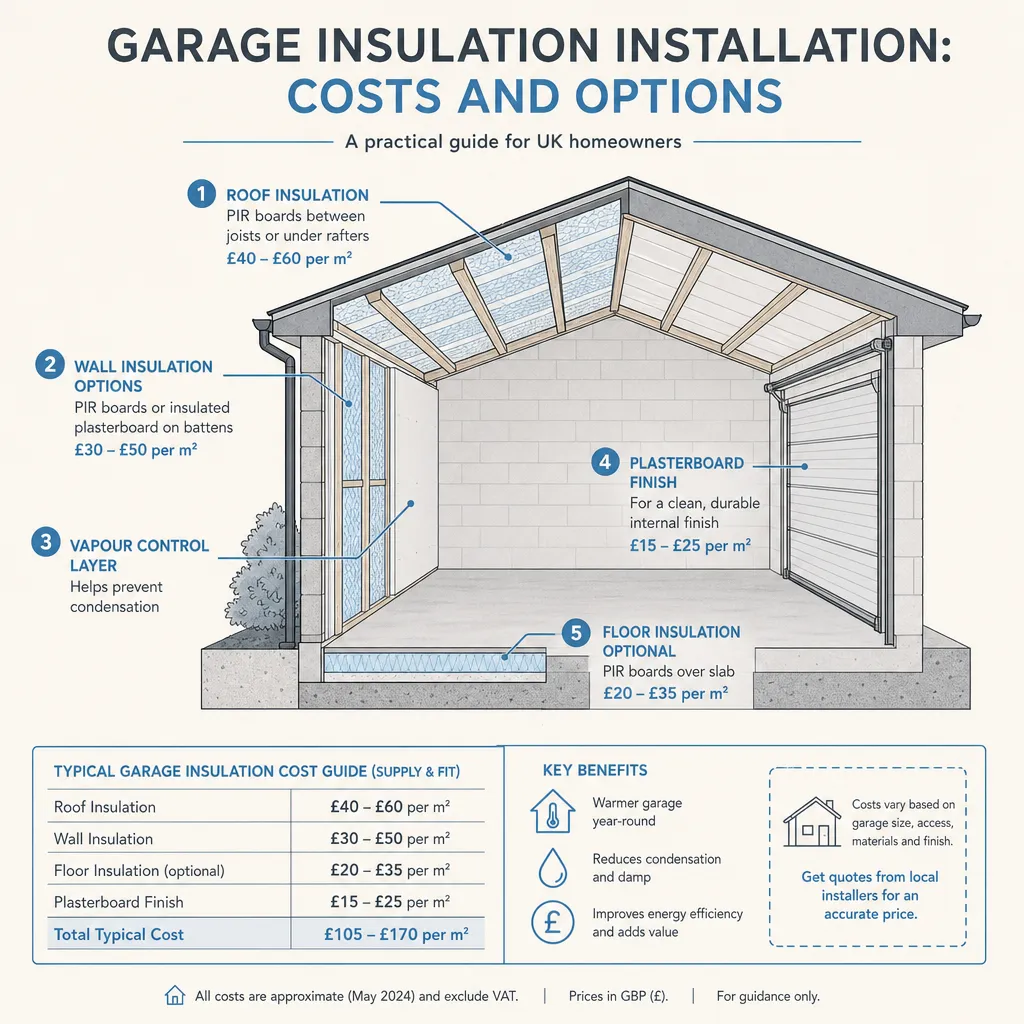
Garage Insulation Installation: Costs And Options
Garage insulation costs and methods depend on whether you are converting to habitable space or improving a working garage.
 Energy & Retrofit
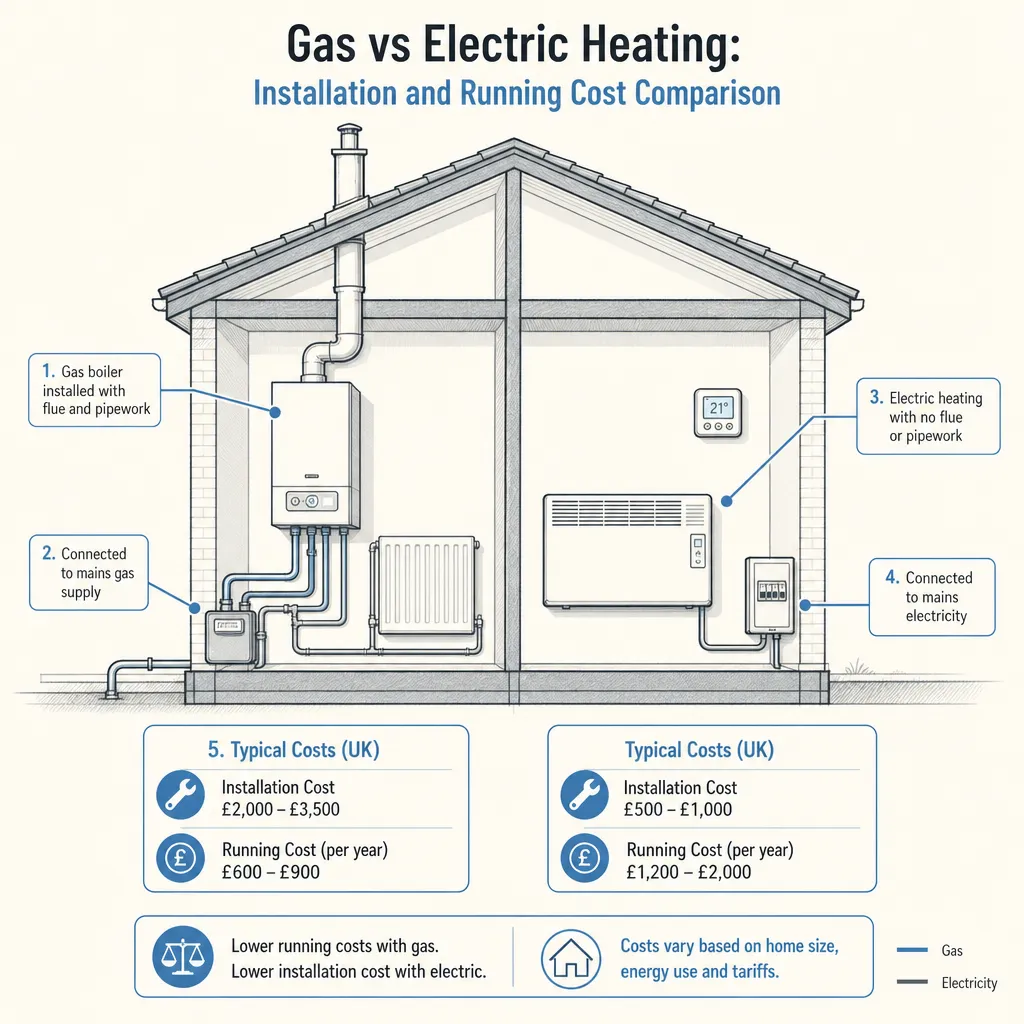
Gas vs Electric Heating: Installation and Running Cost Comparison
Gas central heating usually has lower running costs per kWh than direct electric heating in the UK, though heat pumps can change that equation.
 Energy & Retrofit
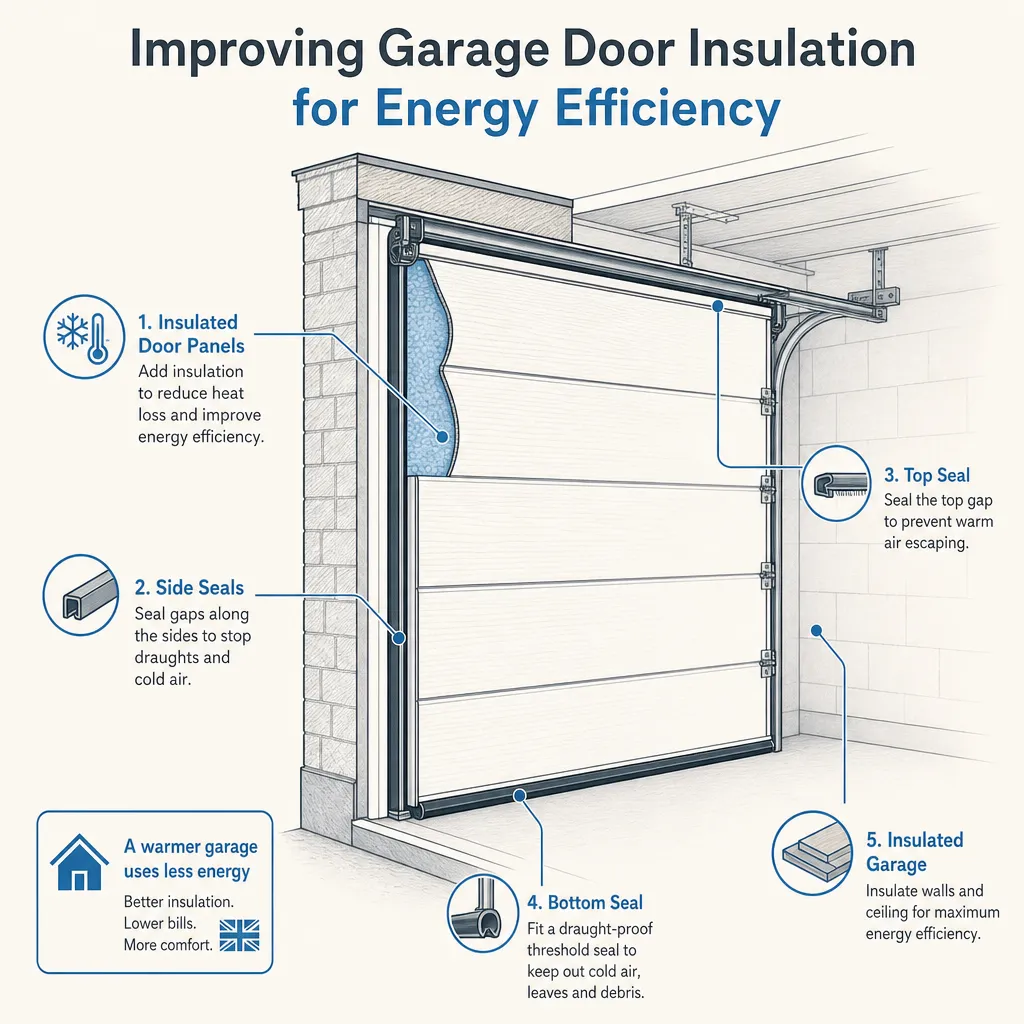
Improving Garage Door Insulation for Energy Efficiency
Improving garage door insulation typically involves fitting a retro-fit panel kit to an existing door, replacing a single-skin door with an insulated sectional model, or adding draught seals around the frame.
 Energy & Retrofit
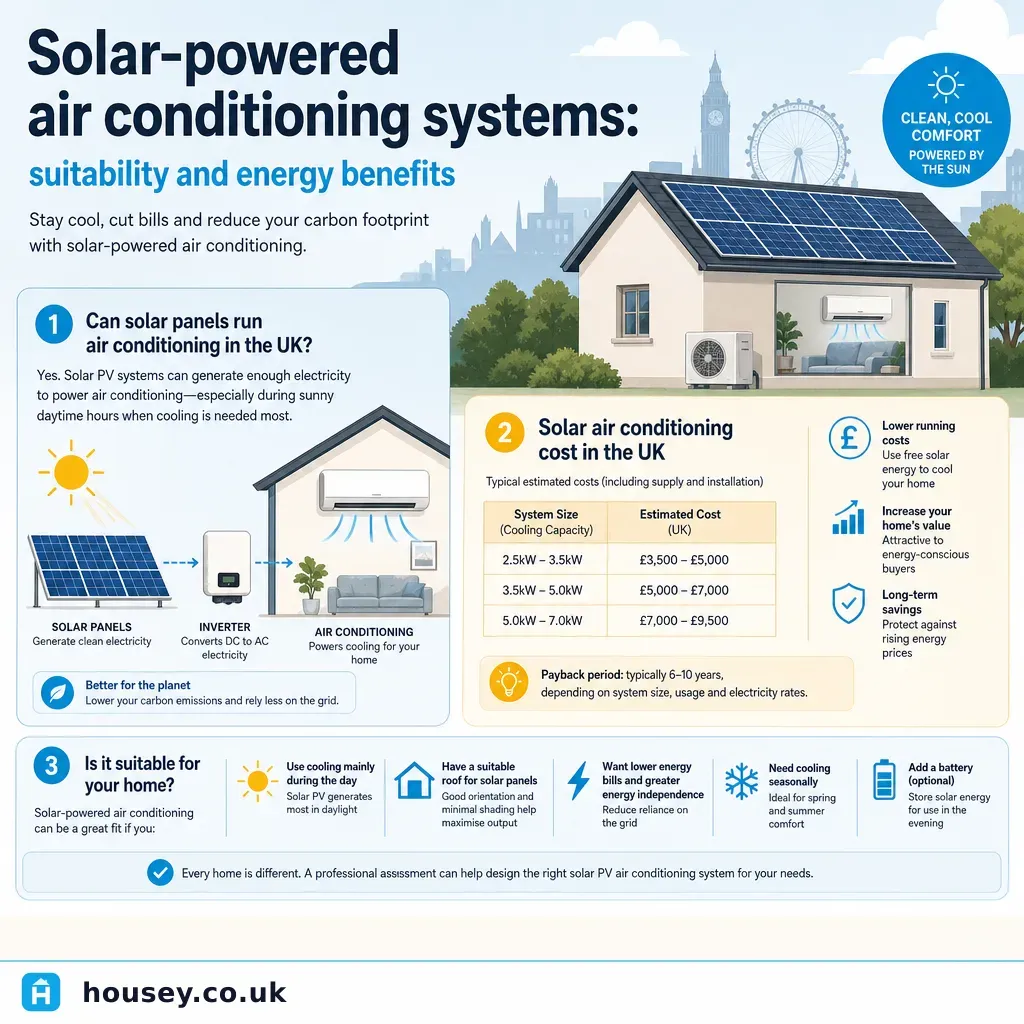
Solar-powered air conditioning systems: suitability and energy benefits
Solar-powered air conditioning pairs photovoltaic panels with an inverter-driven air conditioning unit to cool a home using renewable electricity.
 Energy & Retrofit
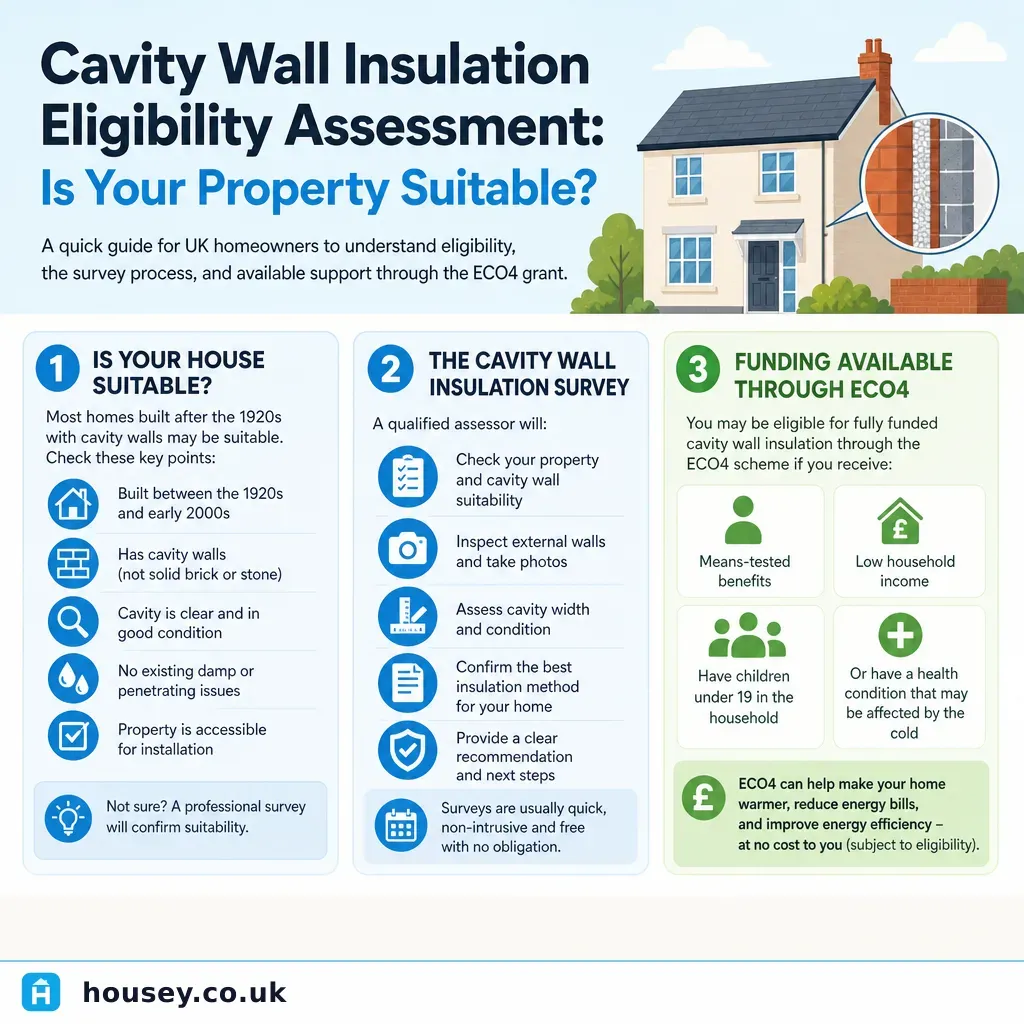
Cavity Wall Insulation Eligibility Assessment: Is Your Property Suitable?
Cavity wall insulation suits most UK homes built from around 1920 onwards with unfilled cavities at least 50mm wide in sheltered or moderately exposed locations.