Central Heating Systems: Comparing Boiler Options for UK Homes
By Housey · Last reviewed 19th of May 2026
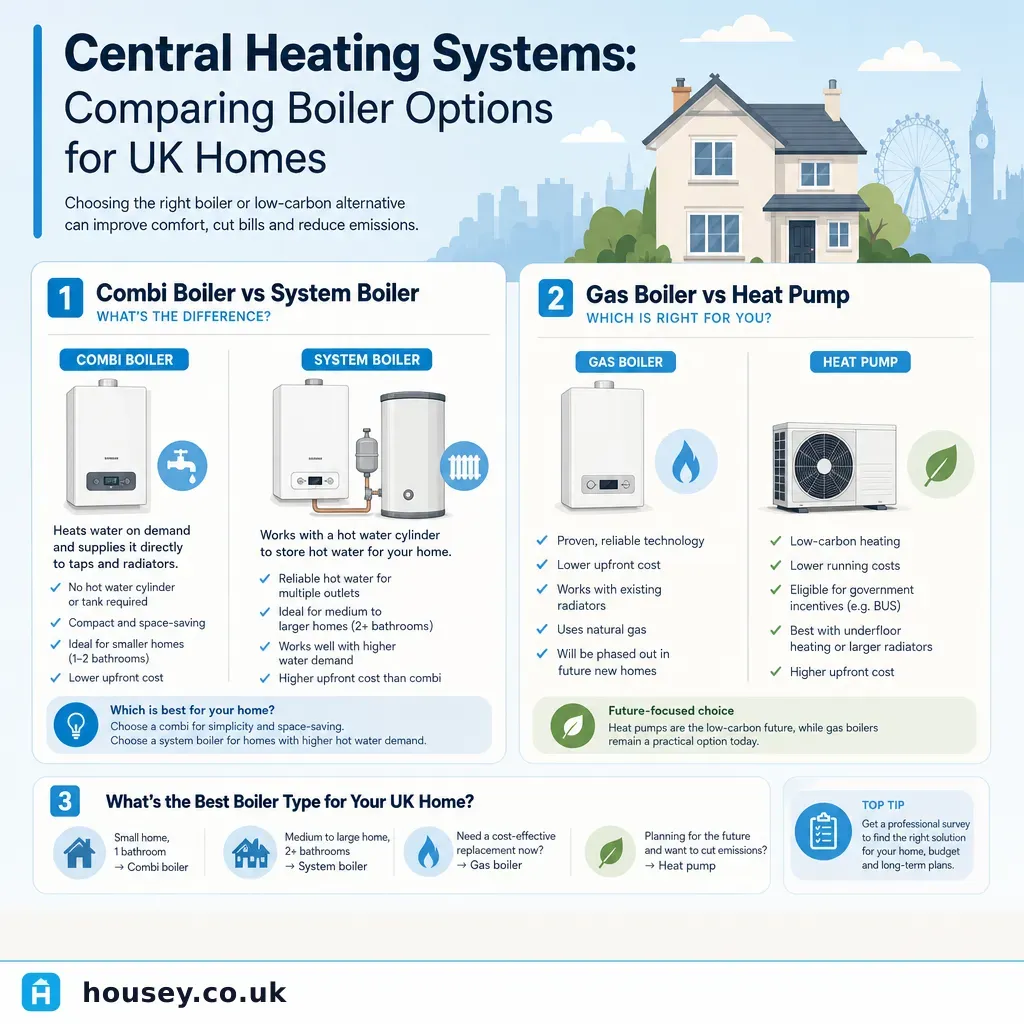
Central Heating Systems: Comparing Boiler Options for UK Homes
Choosing or replacing a central heating system is one of the most significant home improvement decisions UK homeowners face, affecting energy bills, comfort, and property value for a decade or more. The choice is more nuanced than it once was: gas boiler technology has evolved, heat pump uptake is growing under the Boiler Upgrade Scheme, and government policy is actively shifting the economics of switching to low-carbon heat. Getting the decision right for your property type, household size, and existing infrastructure requires understanding the key options before instructing an installer.
Key points
- Combi boilers provide instant hot water and space heating from a single unit with no separate cylinder or cold-water tank; they account for the majority of new gas boiler installations in the UK.
- System boilers require a hot water cylinder but no cold-water tank; they suit homes with two or more bathrooms and higher simultaneous hot water demand.
- Regular (heat-only) boilers need both a hot water cylinder and a cold-water tank (typically in the loft); they remain common in pre-1970s UK properties with existing traditional heating systems.
- All gas boiler installation, replacement, and servicing must be carried out by a Gas Safe registered engineer — a legal requirement under the Gas Safety (Installation and Use) Regulations 1998.
- The Boiler Upgrade Scheme (BUS) offers grants of £7,500 for eligible air source heat pump installations and £7,500 for ground source heat pumps (GOV.UK, as of May 2026).
The three main boiler types: how they work and what they suit
Combi (combination) boiler
A combi boiler heats water on demand directly from the mains supply, eliminating the need for a hot water storage cylinder or cold-water header tank. This makes it compact and generally the least expensive option for a straightforward boiler replacement.
Best for: smaller homes and flats with one bathroom, properties without space for a cylinder, and households with low-to-moderate simultaneous hot water demand.
Less suitable for: homes with multiple bathrooms in simultaneous use, properties with low mains water pressure, or where high-volume hot water demand peaks sharply.
System boiler
A system boiler heats a separate hot water cylinder but draws cold water directly from the mains, so no cold-water header tank is needed. It can supply multiple bathrooms simultaneously and is compatible with solar thermal panels.
Best for: homes with two or more bathrooms, medium-to-large households, and properties where solar thermal pre-heating of the cylinder is installed or planned.
Less suitable for: small flats or one-bathroom homes with good mains pressure, where a combi usually offers a simpler and cheaper installation.
Regular (heat-only or conventional) boiler
A regular boiler feeds both a hot water cylinder and a cold-water header tank (in the loft). It operates at low pressure, making it well-suited to older UK properties — particularly those built before the 1980s — where a conventional system is already in place.
Best for: replacing an existing regular boiler system without major pipework modifications; properties with multiple bathrooms; older radiators originally sized for lower-temperature systems.
Less suitable for: new heating installations in most modern homes, or where loft space is unavailable for a cold-water tank.
Boiler comparison table
Boiler type | Cylinder needed | Cold-water tank needed | Hot water supply | Best household fit | Installation complexity |
|---|---|---|---|---|---|
Combi | No | No | On-demand, mains-fed | 1–2 bathrooms, flat or smaller home | Low |
System | Yes | No | Stored (hot water cylinder) | 2–4 bathrooms, medium-to-large home | Medium |
Regular/heat-only | Yes | Yes | Stored (hot water cylinder) | Pre-1970s homes with existing system | Medium to higher |
Air source heat pump | Yes | No | Stored (hot water cylinder) | Well-insulated homes of any size | High — full assessment required |
Indicative guide only. Suitability depends on existing system, property type, water pressure, and insulation level.
Heat pumps: when are they worth considering?
Air source heat pumps (ASHPs) extract heat from outside air and deliver it at efficiencies significantly above combustion-based heating, typically achieving a Coefficient of Performance (COP) of 2.5–4 in well-designed installations. However, they are not a like-for-like replacement for a gas boiler and require careful assessment before specification.
Key considerations before committing:
- Insulation level — heat pumps perform best in well-insulated properties; draughty solid-wall homes usually need insulation improvements alongside, or prior to, installation.
- Radiator sizing — heat pumps typically operate at lower flow temperatures (around 45–55°C) than gas boilers (around 70–80°C); many existing radiators need to be assessed and potentially upsized.
- Hot water cylinder — a heat pump always requires a hot water cylinder, typically 200–300 litres for a family home.
- Electricity tariff — running costs depend significantly on the electricity-to-gas price ratio, which has shifted considerably since 2021.
- MCS certification — the installer must hold MCS certification for the installation to qualify for the Boiler Upgrade Scheme grant.
A heat pump survey carried out by a qualified assessor will evaluate your property's heat loss, insulation, and radiator adequacy before any commitment to installation.
Running costs and energy efficiency
Running costs depend on boiler model, age, fuel tariff, and household behaviour. Key efficiency markers:
- Modern A-rated condensing gas boilers achieve seasonal efficiencies of approximately 90% or above.
- Older G-rated boilers (common before 2005) may be only 60–70% efficient; replacing one can reduce gas consumption in comparable usage conditions.
- Gas boiler efficiency is now rated under the Energy-related Products (ErP) framework, retained in UK law.
- Heat pumps are measured by Seasonal Coefficient of Performance (SCOP), typically 2.5–4 for well-designed UK installations — though electricity unit prices affect the real-world cost comparison with gas significantly.
For current tariff data and running-cost comparisons, the Energy Saving Trust provides regularly updated guidance.
Which professional do you need?
Job | Required professional | Key accreditation |
|---|---|---|
Gas boiler installation or replacement | Gas engineer | Gas Safe Register (legally required) |
Gas boiler annual service | Gas engineer | Gas Safe Register |
Heat pump installation | Heating or heat pump engineer | MCS certification (required for BUS grant eligibility) |
New electrical circuit for heat pump | Electrician | NICEIC or NAPIT registered |
Full heating system design (complex or new-build) | Mechanical engineer | CIBSE or equivalent |
Heating assessment for whole-house retrofit | Retrofit coordinator or assessor | PAS 2035 / TrustMark registered |
Important limitations
This article provides general information about UK central heating options. Suitability of any heating system depends on your specific property — its construction, insulation, existing pipework, water pressure, and fuel availability. Nothing in this article constitutes advice on a specific installation. Regulations, grant amounts, and energy tariffs change; always confirm current rules with GOV.UK and the Gas Safe Register before instructing any gas or heating work.
What to ask a qualified professional
Before accepting a quote for boiler replacement or heat pump installation, ask:
- Is this system suited to my current pipework and radiators, or will upgrades be needed — and at what additional cost?
- What is your Gas Safe registration number or MCS certification number?
- What ErP efficiency rating does the proposed boiler carry?
- For heat pumps: what is the design flow temperature, the anticipated SCOP, and what radiator changes are included in the quote?
- Is an MCS design certificate included, which I will need for Boiler Upgrade Scheme grant eligibility?
- What is the expected change in running costs based on current published tariffs?
- Is VAT included in the quoted price?
- What warranty is provided on the unit and on the installation labour?
When to get professional help
Do not attempt any gas work yourself. If you smell gas, leave the property immediately without operating any switches or flames, and call the National Gas Emergency Service on 0800 111 999.
Contact a Gas Safe registered engineer promptly if your boiler:
- Makes unusual banging, kettling, or whistling noises.
- Loses pressure frequently without explanation.
- Produces a yellow or orange flame rather than a steady blue one.
- Triggers your carbon monoxide detector — carbon monoxide is odourless, so test your detector regularly and replace it as the manufacturer recommends.
- Emits a smell of fumes or combustion products indoors.
How Housey can help
If you are considering switching to a low-carbon heating system, a heat pump survey is the recommended first step. Housey connects homeowners with qualified assessors who can evaluate your property's suitability, expected costs, and potential grant eligibility before any commitment to installation.
Frequently asked questions
What is the most common boiler type in UK homes?
Combi boilers are the most commonly installed type in the UK. Their compact size, straightforward installation, and on-demand hot water supply make them a practical choice for most two- to three-bedroom homes with a single bathroom. They are generally less suited to larger households with high simultaneous hot water demand across multiple bathrooms.
Can I switch from a gas boiler to a heat pump?
Yes, but it requires careful assessment rather than a direct swap. A heat pump operates at lower flow temperatures than a gas boiler, always requires a hot water cylinder, and existing radiators may need evaluation and possible upsizing. A professional heat loss calculation is essential before specifying a system. MCS-certified installers are required for Boiler Upgrade Scheme grant eligibility.
How long does a gas boiler typically last?
A modern condensing gas boiler, serviced annually by a Gas Safe registered engineer, typically lasts between 10 and 15 years. Older boilers can last longer but become progressively less efficient and harder to source parts for. Annual servicing is required by most manufacturers to keep warranties valid and is strongly recommended regardless of warranty status.
What is the Boiler Upgrade Scheme?
The Boiler Upgrade Scheme (BUS) is a UK Government grant offering upfront financial support for replacing fossil fuel heating with a low-carbon alternative. As of May 2026, grants stand at £7,500 for air source heat pumps and £7,500 for ground source heat pumps. Ofgem administers the scheme; the installing contractor must hold MCS certification. See the GOV.UK Boiler Upgrade Scheme page for current eligibility rules.
Sources and further reading
- Boiler Upgrade Scheme — GOV.UK
- Gas Safe Register — find a registered engineer — Gas Safe Register
- Heating and hot water guidance — Energy Saving Trust
- MCS — find a certified installer — Microgeneration Certification Scheme
- Approved Document L — conservation of fuel and power — GOV.UK
Useful next reads
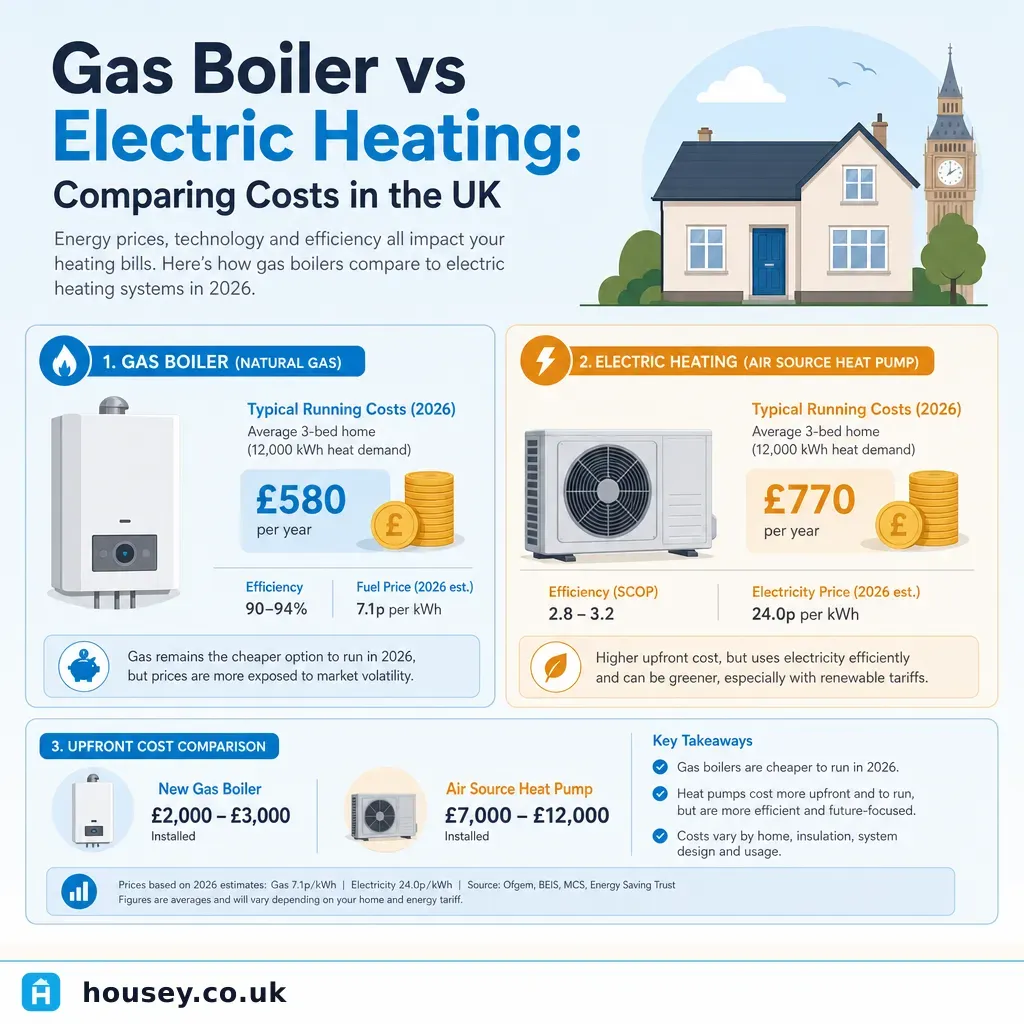 Energy & Retrofit
Gas Boiler vs Electric Heating: Comparing Costs in the UK
Gas boilers currently cost around 6.
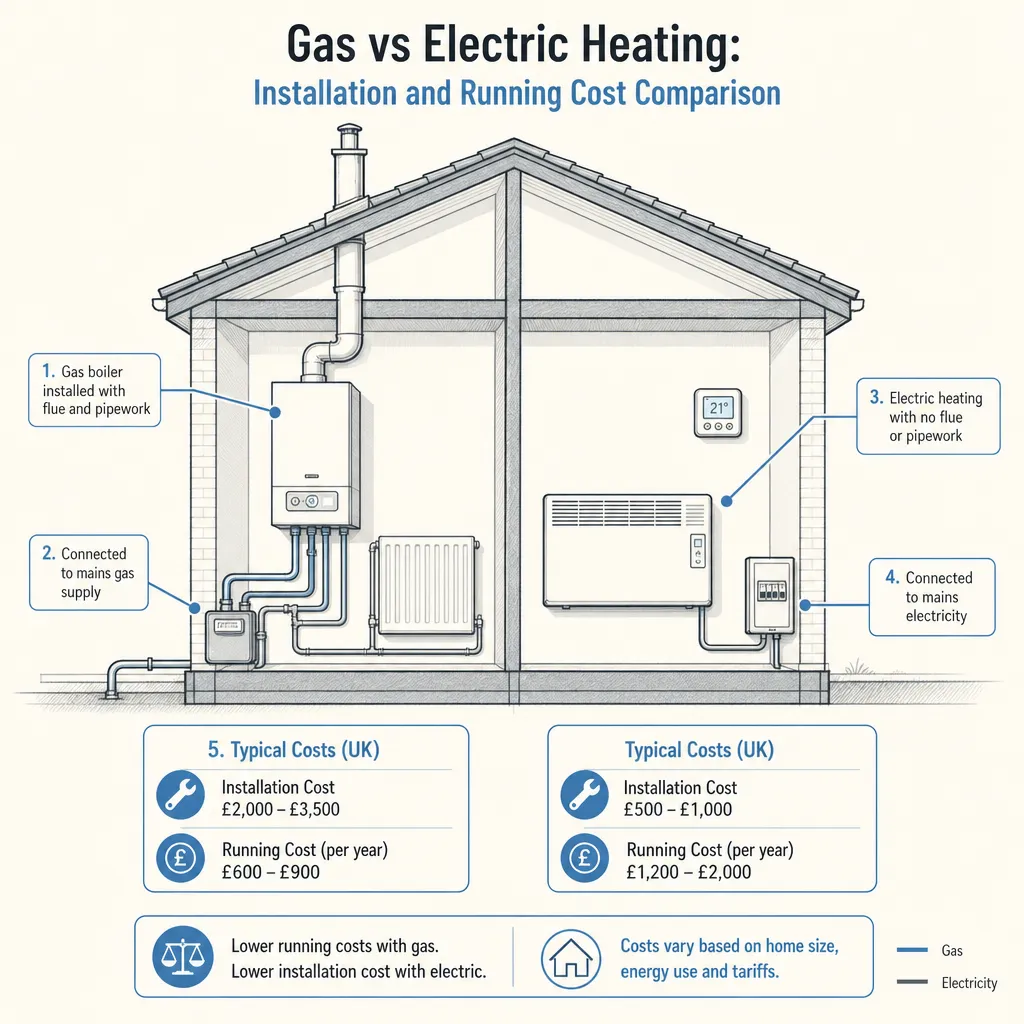 Energy & Retrofit
Gas vs Electric Heating: Installation and Running Cost Comparison
Gas central heating usually has lower running costs per kWh than direct electric heating in the UK, though heat pumps can change that equation.
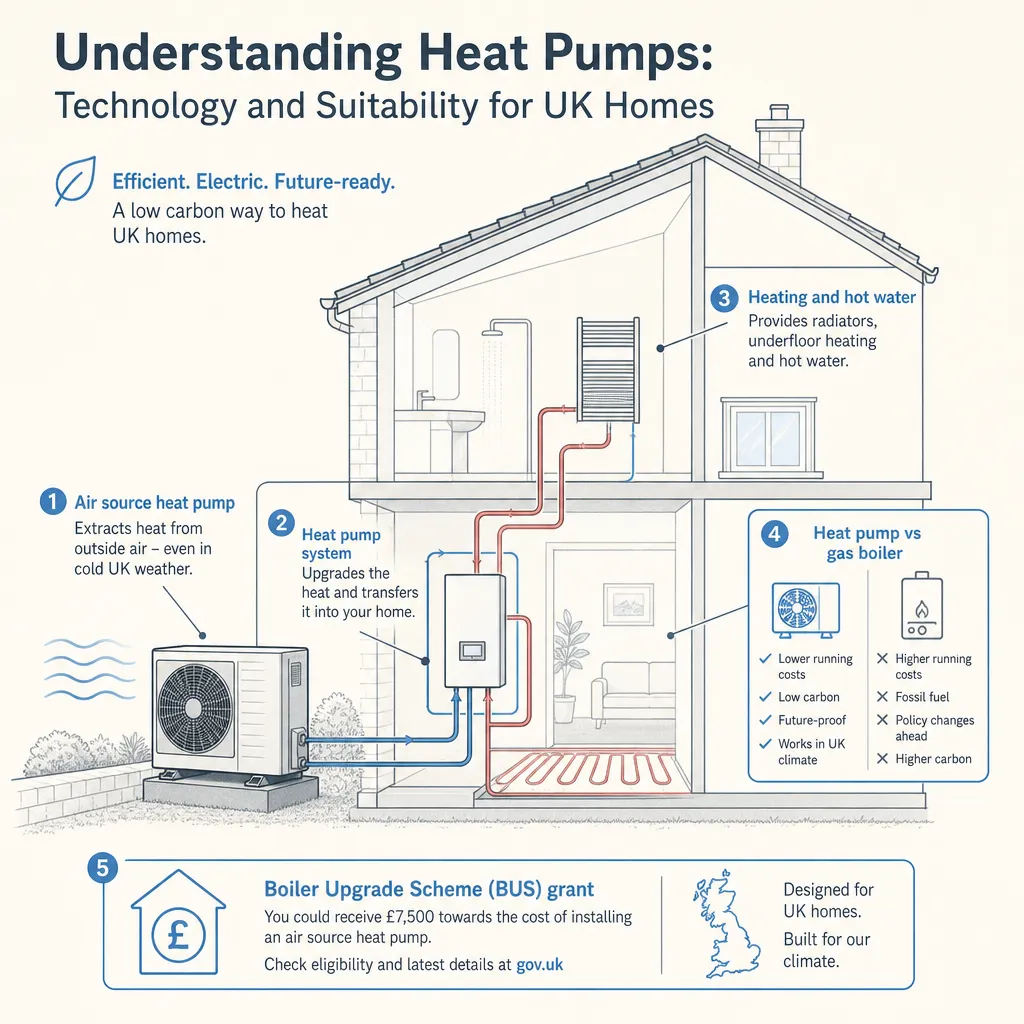 Energy & Retrofit
Understanding Heat Pumps: Technology and Suitability for UK Homes
Heat pumps extract heat from the air or ground and transfer it indoors, typically achieving efficiencies of 250–400% compared to a conventional boiler's near 100%.
 Energy & Retrofit
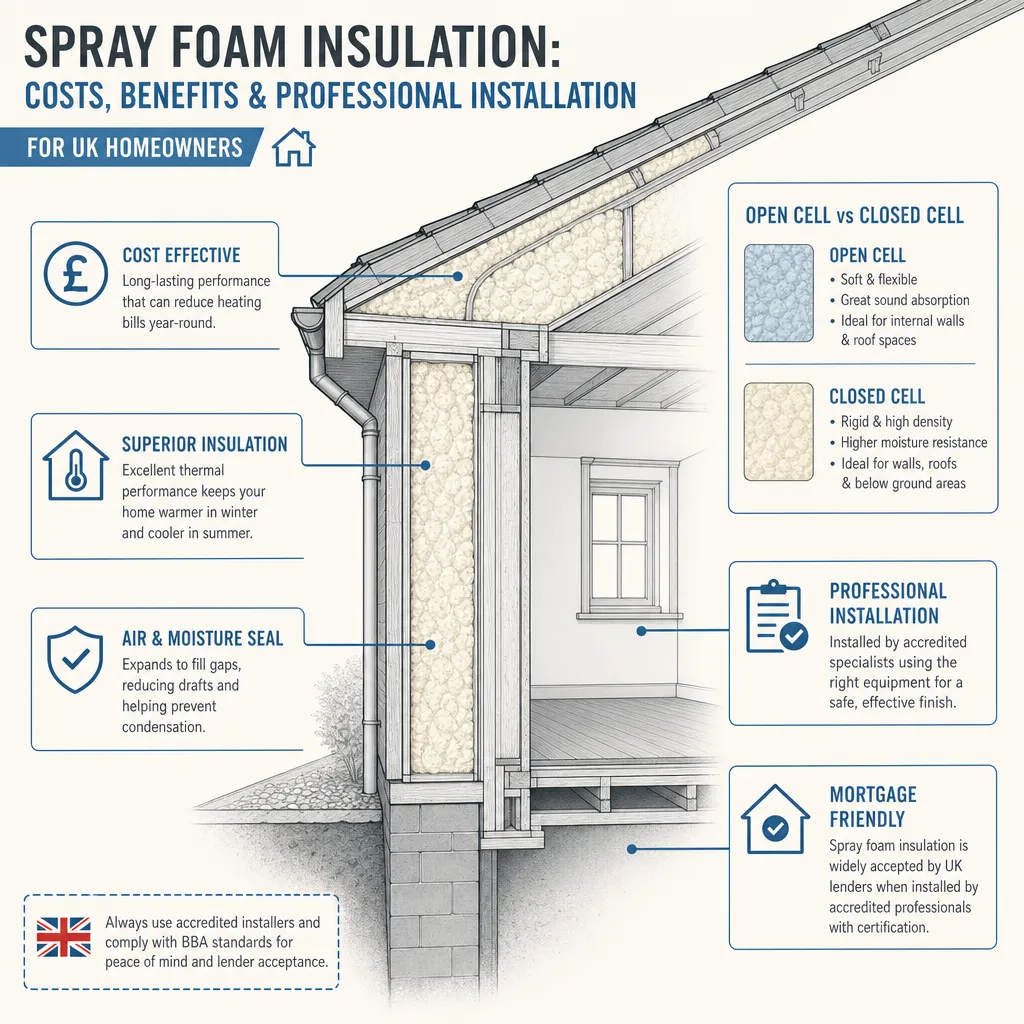
Spray foam insulation: costs, benefits and professional installation
Spray foam insulation costs between £15 and £60 per square metre installed in the UK, depending on whether open-cell or closed-cell foam is used.
 Energy & Retrofit
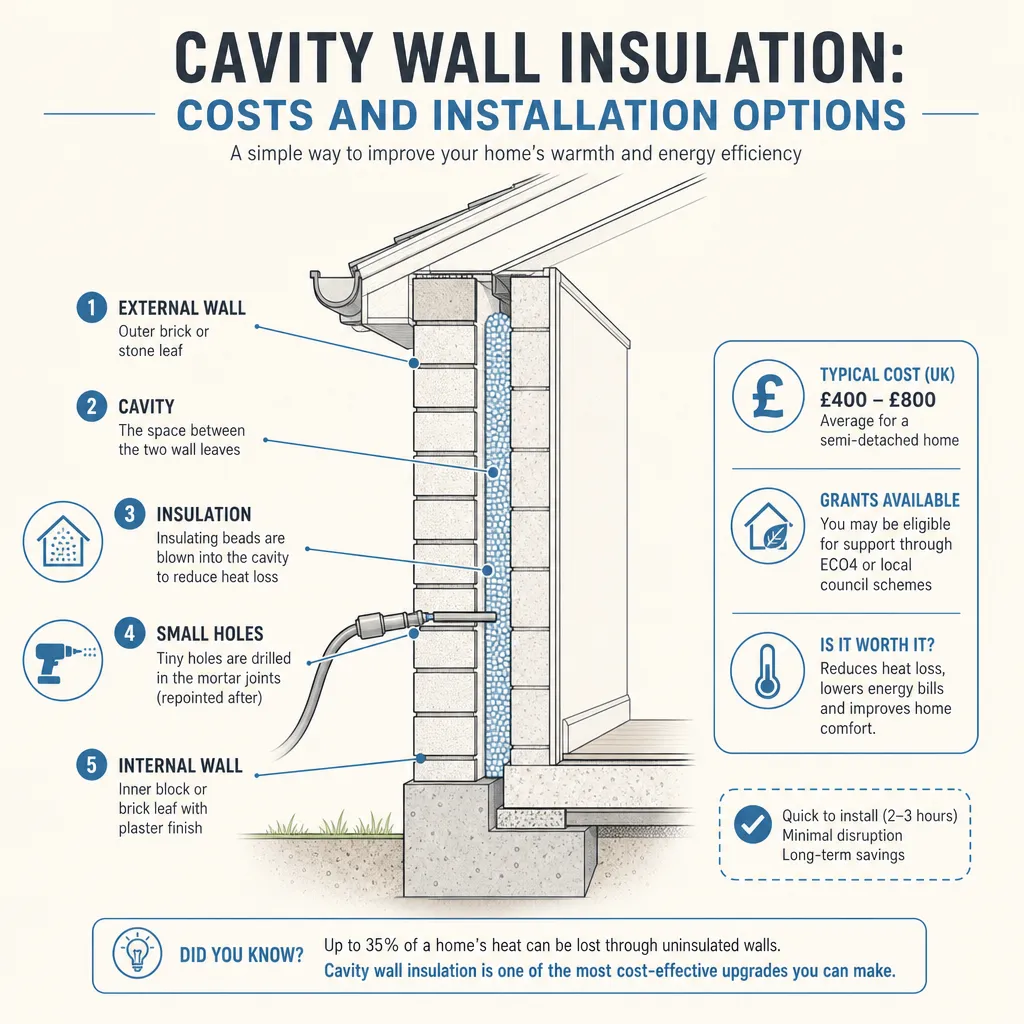
Cavity Wall Insulation: Costs and Installation Options
Cavity wall insulation typically costs £400–£1,200 for a standard UK semi-detached home, though eligible households may pay nothing under ECO4.